Email: [email protected]
Email: [email protected]

Blog
 2026.11.23
 Blog
The KC-B series battery charger and jump starter is designed for vehicle owners, repair workshops, service fleets, agricultural operators, and professional technicians who need dependable battery charging and immediate engine-start assistance. Combining intelligent charging control, 12 V and 24 V compatibility, high starting output, protective functions, and convenient transport features, the series provides a practical solution for maintaining and restarting lead-acid batteries.
The range includes four principal models: KC-320B, KC-420B, KC-520B, and KC-620B. Depending on the selected model, charging current ranges from 5 A to 60 A, while maximum starting current reaches 200 A, 250 A, 300 A, or 350 A at 12 V. The KC-620B provides the highest starting output, delivering up to 350 A at 12 V and 300 A at 24 V.
Unlike a basic battery charger that may require a long charging period before a vehicle can be started, this equipment combines automatic battery charging with a direct engine-start function. When a battery is weak but still suitable for recovery, the operator can use the start-assistance function to help restart the engine without waiting for a complete charge cycle.
A battery charger and jump starter must perform two different tasks. Charging requires controlled current and voltage over an extended period, while engine starting requires a high current output over a short period. The KC-B series is developed to handle both operating conditions in one machine.
The charging system uses microcomputer-controlled operation to manage battery diagnosis, preparation, bulk charging, absorption charging, full-charge confirmation, and maintenance charging. This multi-stage approach is more controlled than a simple constant-current charger and is intended to reduce the risk of unsuitable charging conditions.
The equipment supports 12 V and 24 V battery systems, making it suitable for a broad range of passenger vehicles, light commercial vehicles, trucks, buses, agricultural machinery, construction equipment, and other applications using compatible lead-acid batteries.
The product is supplied with charging cables, clamps, and a color box. A trolley handle improves portability, particularly when the unit is used in garages, workshops, fleet depots, or outdoor service locations.
The most important advantage of the series is the combination of charging and starting assistance. Many conventional chargers are intended only to replenish battery energy. They may not be able to provide the high current needed for an immediate engine restart. Conversely, some compact jump starters are designed mainly for emergency starting and offer limited battery-recharging capability.
The KC-B series combines these functions in a single corded machine. It can be used for routine battery maintenance, recovery of a weak battery, and direct engine starting when the battery does not have enough power to crank the engine independently.
This integrated design can reduce the need for separate equipment. A workshop may use one machine for battery servicing and emergency starting instead of purchasing a standard charger and a separate starting unit. Fleet operators can also benefit from having a machine that supports both scheduled maintenance and urgent roadside or depot assistance.
Switchable 12 V and 24 V operation is valuable for users who service different types of vehicles. Passenger cars and many light commercial vehicles commonly use 12 V systems, while trucks, buses, agricultural machinery, and some industrial vehicles may use 24 V systems.
A single 12/24 V machine gives technicians greater flexibility than a charger limited to one voltage. It also helps reduce equipment duplication in workshops that maintain mixed vehicle fleets.
The operator must always verify the vehicle voltage before connection. Selecting the correct voltage is essential for safe and effective operation. The six charging modes are designed around standard and AGM battery applications, with dedicated options for normal and winter conditions.
The maximum starting output varies by model. The KC-320B provides up to 200 A at both 12 V and 24 V. The KC-420B provides up to 250 A at both voltages. The KC-520B provides up to 300 A at both voltages. The KC-620B provides up to 350 A at 12 V and 300 A at 24 V.
This graduated model structure allows customers to select equipment according to vehicle size, battery capacity, working frequency, and starting requirements. A smaller workshop that mainly services passenger cars may choose a lower-rated model, while a fleet depot or professional repair center may prefer the higher output of the KC-620B.
Starting current is not the same as continuous charging current. Starting assistance is intended for short-duration engine cranking, while charging current is regulated during the longer battery-recovery process. Users should follow the operating instructions and avoid using the starting function continuously or repeatedly without allowing the equipment to cool.
The use of advanced microcomputer control technology allows the charger to follow a structured charging sequence. Intelligent control helps the equipment adapt the charging process to battery condition and selected operating mode.
A controlled charging process offers several practical benefits. It can reduce unnecessary overcharging, provide a more systematic recovery process, and support maintenance charging after the battery reaches full capacity. It also makes the product more suitable for users who may not have advanced battery-testing knowledge.
The charger uses six described stages:
Step 1: Battery condition diagnosis and recovery with pulse charging.
Step 2: Battery preparation with soft start.
Step 3: Automatic current selection and bulk charging.
Step 4: Constant-voltage absorption charging.
Step 5: Full-charge confirmation, with the display showing “FULL.”
Step 6: Maintenance float charging.
These stages are designed to make the charging process progressive rather than abrupt. Initial diagnosis and pulse charging help assess whether the battery can accept charge. Soft start prepares the battery before higher charging current is applied. Bulk charging restores most of the available capacity, while absorption charging supports the final stage of charging at a controlled voltage.
Once the battery reaches the full-charge stage, the maintenance mode helps keep the battery ready for future use. Float charging is especially useful for vehicles that are stored for extended periods, seasonal equipment, backup vehicles, and workshop batteries awaiting installation.
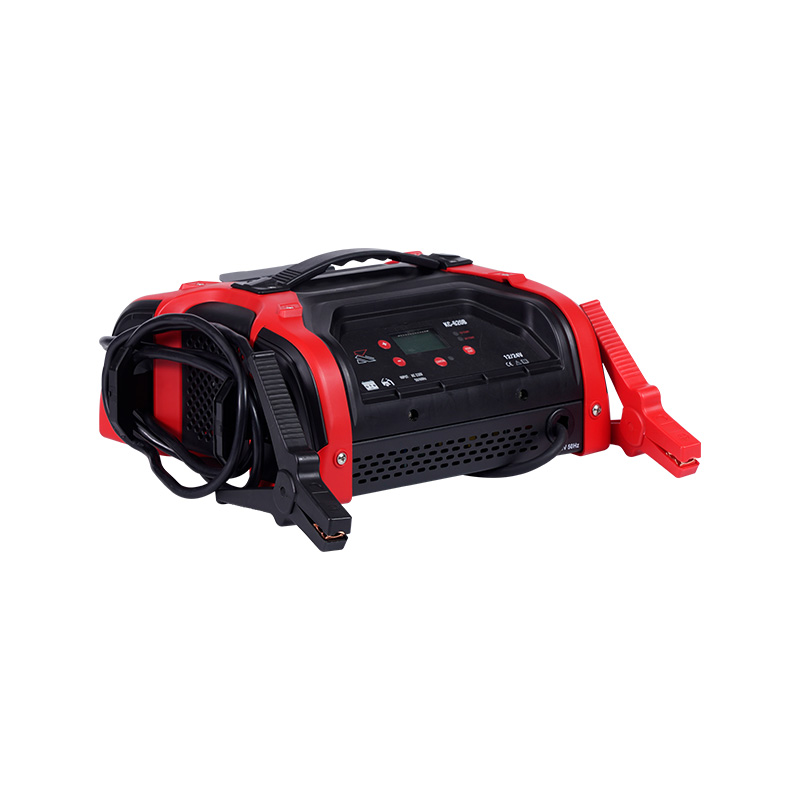
KC-B series battery charger with jump start function 12/24V LCD display, max charging current 60A, start current 12V 350A, 24V 300A,WITH 110V or 220V/230V INPUT
The product documentation identifies support for lead-acid batteries, gel batteries, AGM batteries, and related maintenance-free battery types. The listed charging modes include:
12 V standard mode.
12 V standard winter mode.
12 V AGM mode.
12 V AGM winter mode.
24 V standard mode.
24 V standard winter mode.
The correct mode should be selected according to battery construction, voltage, and ambient conditions. Standard mode is intended for compatible conventional batteries, while AGM mode is intended for compatible absorbed glass mat batteries. Winter mode is designed for charging conditions in lower temperatures, where battery behavior and charging acceptance can differ from normal ambient conditions.
Users should confirm the battery manufacturer’s recommendations before selecting a charging mode. A charger should not be used with battery types outside the approved operating range, and damaged, frozen, leaking, or visibly deformed batteries should be removed from service rather than connected for charging.
The following table summarizes the principal specifications supplied for the KC-B series. The listed supply voltage is 230 V, with a supply frequency of 50/60 Hz. Product descriptions also refer to 110 V or 220 V/230 V input availability. Input-voltage configuration should therefore be confirmed for the intended market and purchase order before shipment.
| Model | Rated Supply Voltage | Supply Frequency | Charging Voltage | Rated Capacity | Rated Current | Maximum Starting Current | Protection Grade | Reference Battery Capacity | Weight | Machine Size |
|---|---|---|---|---|---|---|---|---|---|---|
| KC-320B | 230 V | 50/60 Hz | 12/24 V | 900 W | 5–30 A | 12 V 200 A; 24 V 200 A | IP21S | 20–450 Ah | 4.5 kg | 310 × 310 × 170 mm |
| KC-420B | 230 V | 50/60 Hz | 12/24 V | 1200 W | 5–40 A | 12 V 250 A; 24 V 250 A | IP21S | 20–600 Ah | 4.5 kg | 310 × 310 × 170 mm |
| KC-520B | 230 V | 50/60 Hz | 12/24 V | 1500 W | 5–50 A | 12 V 300 A; 24 V 300 A | IP21S | 20–750 Ah | 4.7 kg | 310 × 310 × 170 mm |
| KC-620B | 230 V | 50/60 Hz | 12/24 V | 1800 W | 5–60 A | 12 V 350 A; 24 V 300 A | IP21S | 20–900 Ah | 4.7 kg | 310 × 310 × 170 mm |
The KC-320B is the entry model of the range. Its 5–30 A charging adjustment and 20–450 Ah reference capacity make it appropriate for many passenger vehicles, motorcycles with suitable battery requirements, light vans, and general household or workshop use.
The KC-420B increases the charging range to 5–40 A and supports a reference capacity of 20–600 Ah. It may be a suitable choice for small repair businesses and users who service both passenger vehicles and larger light commercial vehicles.
The KC-520B provides up to 50 A of charging current and a reference capacity of 20–750 Ah. It is designed for heavier workshop use and larger battery systems where a higher charging output can improve service productivity.
The KC-620B is the top model in the listed range. With charging adjustment up to 60 A, an 1800 W rated capacity, and starting current up to 350 A at 12 V, it is intended for demanding applications involving larger batteries and frequent service work.
Reference capacity is a guide rather than a guarantee of performance for every battery condition. Actual charging time depends on battery capacity, state of discharge, age, temperature, internal resistance, and battery chemistry. Starting performance also depends on engine size, oil viscosity, cable condition, battery condition, and environmental temperature.
Incorrect connection of positive and negative clamps can damage a battery charger and create a dangerous condition. The series includes reverse polarity protection and an indicator. This feature helps alert the operator when the clamps are connected to the wrong terminals.
Protection does not eliminate the need for careful connection. Before switching on the charger, the operator should identify the positive and negative battery terminals, connect the clamps correctly, and verify that the clamps are secure. The battery and vehicle manufacturer’s instructions should also be followed.
Charging and starting can produce heat in electronic components, transformers, cables, clamps, and internal connections. Overheating protection helps safeguard the machine when operating temperature rises beyond an acceptable level.
For reliable operation, the charger should be placed on a stable, dry, and ventilated surface. Air vents should remain unobstructed. The machine should not be covered during use, placed close to combustible materials, or operated in an environment where heat cannot dissipate.
Short-circuit protection is provided for the listed lead-acid, gel, AGM, and related compatible battery applications. This feature is valuable in workshop environments, where clamps may be moved frequently and accidental contact can occur.
Operators should still avoid deliberately shorting the clamps. The protection system is a safety function, not a normal operating method. Damaged cables, loose terminals, melted insulation, or burned clamps should be inspected and replaced before continued use.
The listed protection grade is IP21S. This indicates a basic level of protection against contact with hazardous internal parts and vertically falling water under specified test conditions. It does not mean that the machine is waterproof or suitable for operation in rain, flooding, heavy spray, or wash-down areas.
The equipment should be used indoors or in a protected service area unless the operating instructions specify otherwise. If the machine becomes wet, it should be disconnected from the power supply and inspected by a qualified technician before reuse.
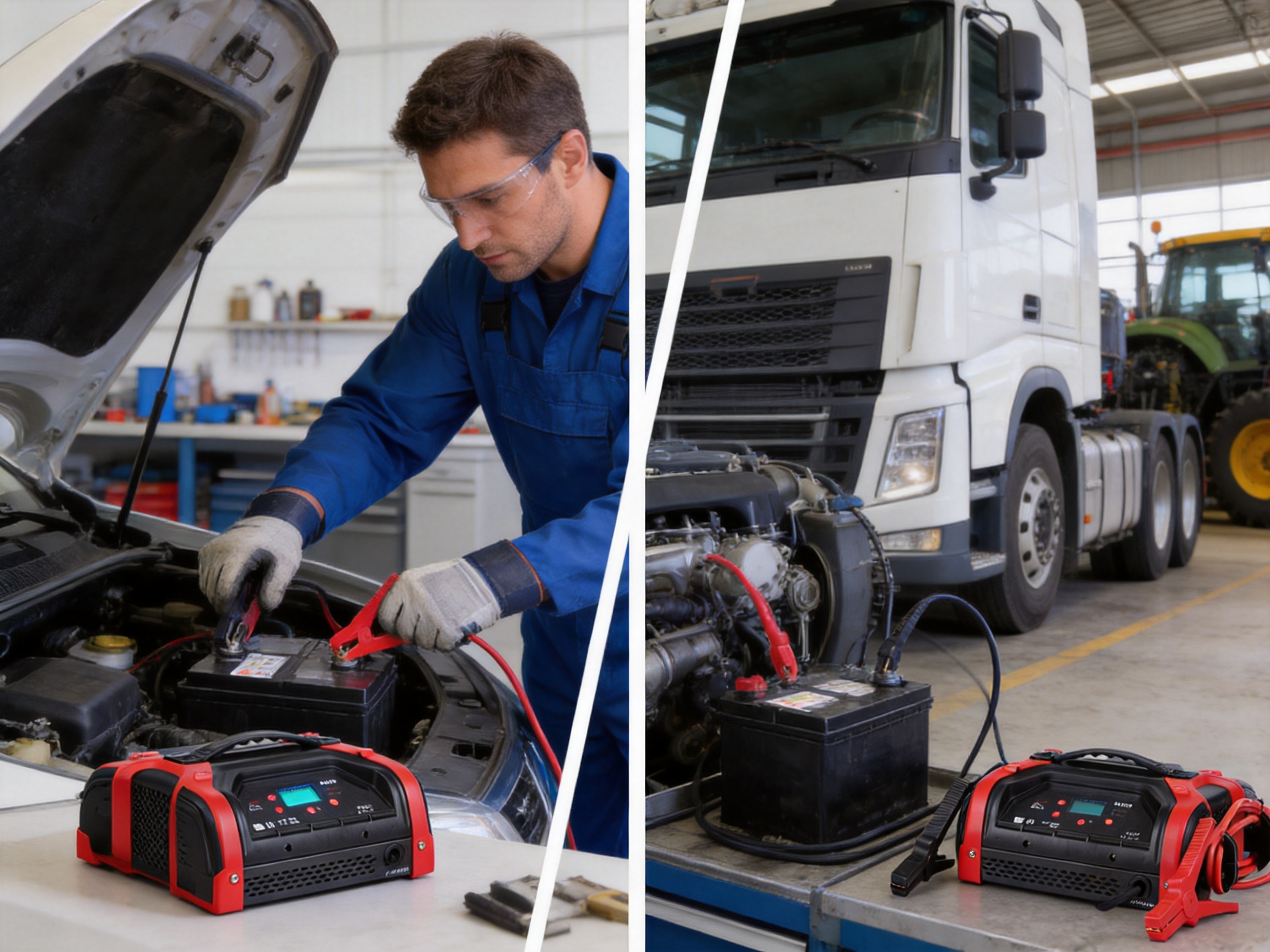
Repair workshops frequently receive vehicles with partially discharged batteries. A vehicle may have remained unused for several weeks, suffered from lights being left on, or developed a charging-system problem. The KC-B series can be used to test, recover, charge, and support starting operations during service.
The automatic charging stages help technicians maintain a more consistent procedure. Instead of connecting a simple charger and manually monitoring the battery for long periods, the operator can select the appropriate voltage and battery mode, begin the process, and monitor the display.
Fleet operators often maintain vehicles with different battery capacities and electrical systems. The 12/24 V design allows one product family to serve cars, vans, trucks, buses, and utility vehicles, subject to the model’s reference capacity and the battery manufacturer’s requirements.
Fleet depots can use the maintenance float function for vehicles that are parked for extended periods. Scheduled charging can help keep batteries ready for dispatch and reduce delays caused by preventable battery discharge.
Tractors, harvesters, loaders, excavators, and other machinery may be stored seasonally or operated in demanding environments. Long periods of inactivity can reduce battery charge, while cold weather can make engine starting more difficult.
The 24 V setting is particularly relevant to equipment using two-battery or 24 V electrical systems. Operators should confirm the system arrangement and ensure that the batteries are connected in a manner compatible with the charger before beginning service.
Roadside assistance providers and mobile technicians require equipment that can be transported between vehicles. The trolley handle and relatively low product weight support movement around a workshop, service bay, or depot.
The direct starting function can be useful when a vehicle must be moved quickly and the battery is too weak for normal cranking. After the vehicle is restarted, the battery can be assessed and charged properly rather than relying on repeated jump starts.
Classic cars, recreational vehicles, boats with compatible battery systems, motorcycles, and seasonal agricultural machines may remain unused for months. A maintenance charging function can help keep a compatible battery at an appropriate charge level during storage.
Long-term storage still requires periodic inspection. The user should check electrolyte condition where applicable, inspect terminals for corrosion, and follow the battery manufacturer’s storage recommendations. Float charging should not be used to conceal a battery that is unable to hold charge.
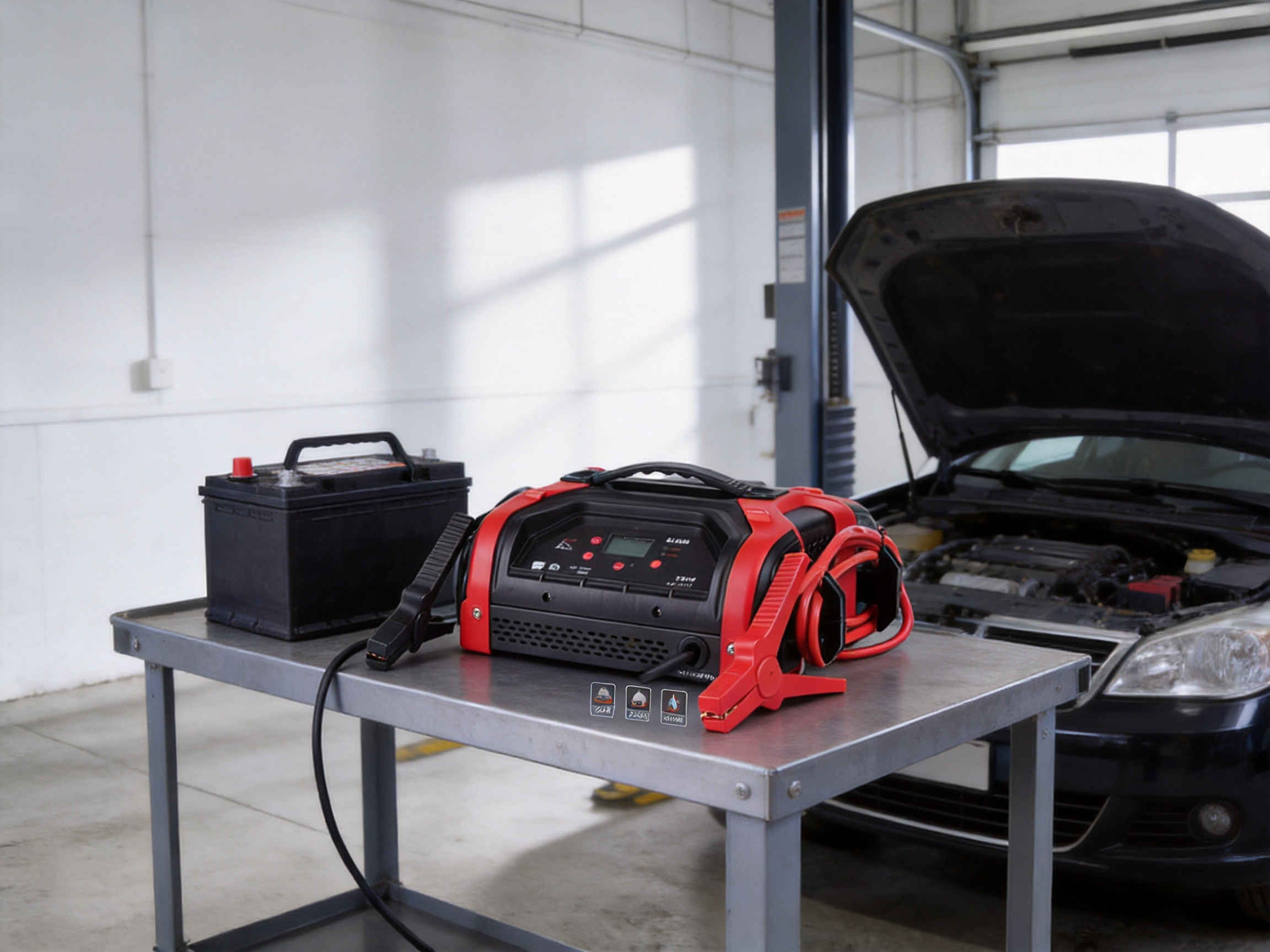
The product is described as light to carry and includes a trolley handle for easier handling. Its dimensions are listed as 310 mm long, 310 mm wide, and 170 mm high across the four models. Weight ranges from approximately 4.5 kg to 4.7 kg.
Portability is important because battery service is not always performed next to a fixed workbench. A charger may need to be moved between service bays, positioned beside a commercial vehicle, or carried into a storage area. A compact form factor helps conserve workshop space when the machine is not in use.
The supplied 1.5 m plus 1.5 m charging cable arrangement provides working reach between the charger and the battery, while the clamps allow connection to the battery terminals. Cable routing should be arranged so that the leads are not exposed to moving belts, fans, hot exhaust components, sharp edges, or vehicle doors.
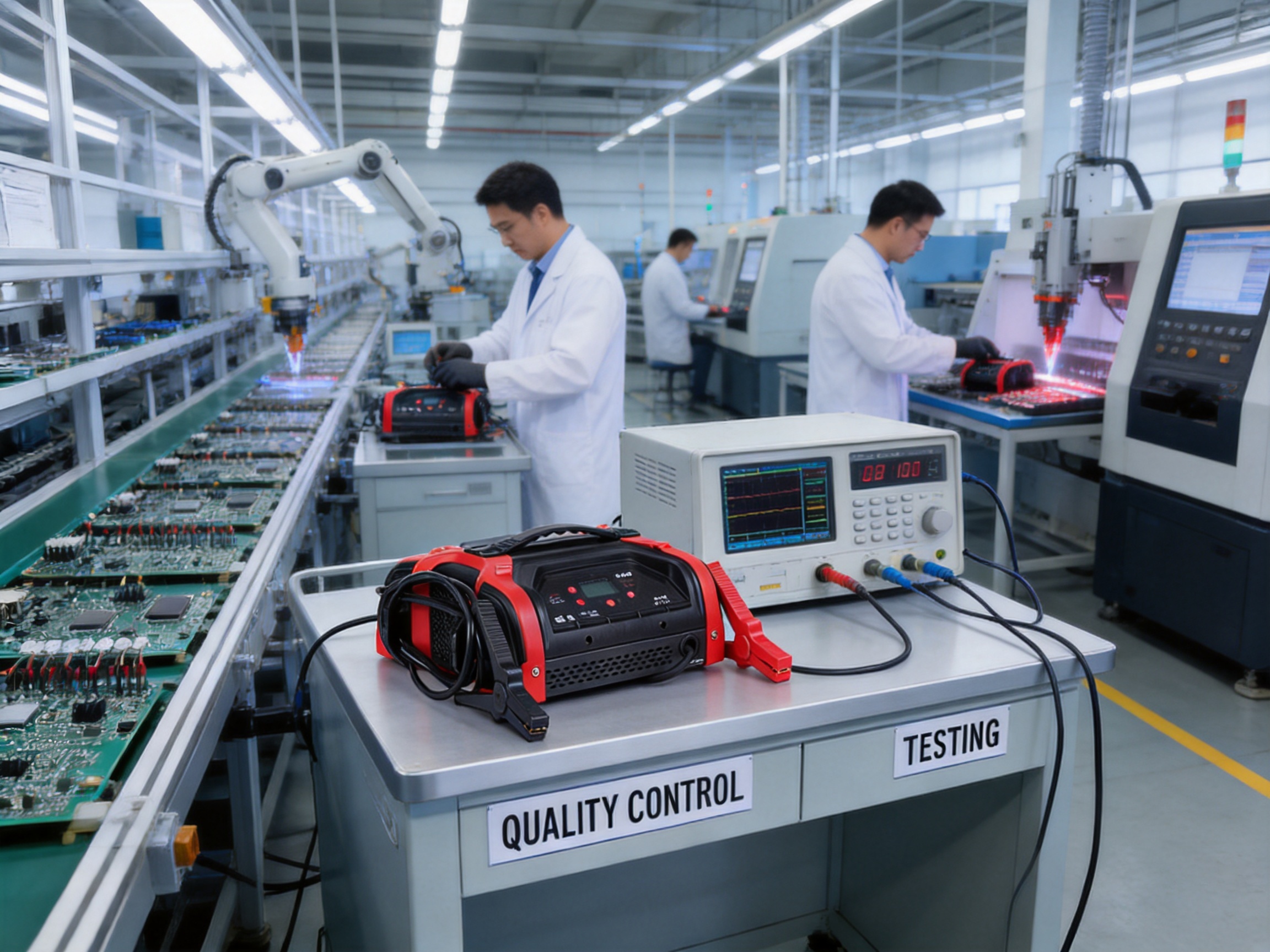
The manufacturer behind the product operates as an established producer of electric welding machines, battery chargers, heaters, and related equipment. Its manufacturing activities cover product development, component processing, assembly, testing, certification support, and international export.
The company reports a site area of approximately 120,000 square meters and a workforce of about 600 employees. It also reports annual exports of nearly 1.5 million units and an annual production capacity of approximately 2 million units. These figures indicate a production organization capable of serving both standard-volume orders and international distribution requirements.
The company maintains a Zhejiang Provincial Research and Development Center, an Enterprise Technology Center, and an Intelligent Welding Technology Research Institute. Although welding equipment is a central part of its product portfolio, the engineering capabilities developed for power electronics, control systems, thermal management, and industrial production are also relevant to battery charging equipment.
The company reports a research and development team of 98 personnel. Its intellectual-property portfolio includes invention patents, utility model patents, appearance patents, and software copyrights. Such development resources can support improvements in charger control algorithms, user interfaces, protection circuits, enclosure design, and production efficiency.
The manufacturer uses several management and production systems, including office automation, Toyota-inspired production management, ERP, and manufacturing execution systems. These systems can help connect purchasing, production scheduling, inventory control, quality records, and shipment preparation.
A manufacturing execution system is particularly useful for products that contain electronic control boards and power components. It can help record process data, identify production batches, track work orders, and improve traceability from component preparation through final assembly.
The company also uses automated surface-mount placement, plug-in assembly, welding systems, robot processing, laser cutting, and other production technologies. Automated surface-mount equipment improves the repeatability of printed circuit board assembly. Automated plug-in and soldering processes can help maintain consistent connection quality for through-hole components. Robot processing and laser cutting support accurate mechanical production for enclosures and structural parts.
Battery chargers and jump starters must be checked for more than appearance. Important quality areas include insulation, grounding, output voltage, charging current, starting current, thermal behavior, cable connection strength, polarity detection, short-circuit response, and display operation.
A professional manufacturing process should include incoming inspection of electronic and mechanical components, process inspection during board and enclosure assembly, and final testing of the completed product. Functional testing can verify that the charger operates in 12 V and 24 V modes, responds correctly to selected battery modes, and enters the appropriate protection states.
Load testing is especially important for the jump-start function. The equipment must be evaluated under appropriate electrical loads to confirm output stability and thermal performance. Cable and clamp assemblies should also be inspected because poor connections can reduce starting performance and create excessive heat.
The company reports experience with multiple international product certifications and compliance marks, including GS, CE, EMC, ERP, United States ETL, United Kingdom UKCA, and China CCC. Certification requirements vary according to product category, market, voltage configuration, and applicable standards.
Buyers should request the specific certificates, test reports, declarations, and input-voltage details applicable to the exact model and destination market. A certification associated with one model or configuration should not automatically be assumed to apply to every model or regional version.
International certification experience can nevertheless be an important supplier advantage. It suggests familiarity with electrical safety, electromagnetic compatibility, energy-related requirements, labeling, documentation, and market-entry procedures.
A simple charger may offer only one voltage, one charging profile, and manual current control. The KC-B series adds 12/24 V compatibility, multiple charging modes, automatic multi-stage charging, diagnostic functions, maintenance charging, and engine-start assistance.
This broader functionality can make the equipment more valuable to professional users. Instead of purchasing separate tools for normal charging, battery maintenance, and emergency starting, a customer can select one model that covers several common requirements.
The four-model structure allows distributors to serve different market segments. Entry-level customers can choose the KC-320B, while professional workshops and fleet operators can select higher-current models. The consistent physical dimensions across the range can simplify storage, display planning, and staff familiarity.
A distributor can also offer a clear product ladder based on charging current, maximum starting current, rated capacity, and intended application. This is often easier for customers to understand than a product family with widely different designs and unclear performance categories.
The charger provides automatic current selection within a controlled charging program, while still allowing the operator to select the battery voltage and charging mode. This balance is useful because customers need both convenience and control.
Automatic operation reduces the need for constant supervision during ordinary charging. Manual selection remains important because the operator must identify whether the battery is a 12 V or 24 V unit, and whether a standard or AGM mode is appropriate.
The manufacturer’s experience in welding machines, chargers, heaters, and other electrical products provides a broader technical foundation than a supplier focused only on product trading. Its reported production capacity, engineering team, automated manufacturing equipment, and export experience can support stable supply and product development.
For original equipment manufacturers, importers, and distributors, supplier capability is as important as product specifications. Consistent production, packaging support, technical documentation, spare-parts availability, and compliance assistance can influence the total cost of ownership and the success of a product in the market.
Before use, inspect the charger, power cord, output cables, clamps, housing, and display. Do not operate the equipment if there are signs of damaged insulation, loose components, cracked housing, burnt connectors, or exposed conductors.
Confirm that the battery is a compatible lead-acid, gel, AGM, or other approved battery type. Do not charge a frozen, leaking, severely swollen, or visibly damaged battery.
Identify the battery system voltage. Select 12 V for a 12 V battery system and 24 V for a 24 V battery system. Selecting the wrong voltage can damage the battery or vehicle electrical system.
Choose the appropriate standard, winter, or AGM mode according to battery construction and ambient conditions. If the battery type is unknown, consult the battery label, vehicle documentation, or battery manufacturer.
Connect the positive clamp to the positive battery terminal and the negative clamp to the negative terminal, unless the vehicle or battery manufacturer provides a different approved connection procedure.
Place the charger in a dry, ventilated position away from fuel, sparks, open flames, and excessive heat. Ensure that the cables cannot contact moving engine parts.
Connect the charger to the correct supply voltage. Confirm that the display and indicators show normal conditions before starting the charging process.
For ordinary charging, allow the multi-stage program to proceed. Monitor the equipment periodically, particularly during the first use or when charging an unfamiliar battery.
For engine starting, follow the product instructions regarding connection, charging preparation, start mode, and maximum starting duration. If the engine does not start after the recommended attempt, stop and investigate the vehicle, battery, cables, or engine rather than repeatedly activating the start function.
After charging or starting assistance is complete, disconnect the power supply before removing the clamps, unless the operating instructions specify another sequence. Store the cables neatly and keep the machine in a dry location.
Keep the enclosure and ventilation openings clean. Dust accumulation can reduce cooling efficiency and may contribute to overheating. Use a dry or slightly damp cloth as appropriate for the housing, and do not spray liquid directly onto the machine.
Inspect the clamps regularly for corrosion, mechanical damage, weak springs, or loose cable connections. Clean battery terminals before charging when necessary, using suitable safety procedures.
Check the power cord and output cables for cuts, abrasions, hardening, or exposed conductors. Damaged cables should be replaced with approved components rather than repaired with temporary tape or unsuitable connectors.
If the overheating protection activates repeatedly during normal operation, stop using the machine and investigate ventilation, ambient temperature, battery condition, load, and internal faults. Repeated protective shutdowns should not be ignored.
Maintenance float charging is useful for batteries that are otherwise healthy. It cannot restore a battery with severe sulfation, a shorted cell, physical damage, or a greatly reduced ability to retain charge. A battery that repeatedly loses charge should be tested or replaced.
Buyers should specify the target market, input voltage, frequency, plug type, labeling language, packaging requirements, and certification needs when requesting a quotation. The product description refers to 110 V or 220 V/230 V input options, while the listed technical table specifies 230 V. This distinction should be clarified before ordering.
Model selection should be based on actual customer applications rather than maximum current alone. A distributor serving passenger-car repair shops may prioritize compactness, ease of use, and 12 V starting capability. A commercial fleet distributor may require 24 V operation, higher charging current, and a larger reference battery capacity.
Packaging should protect the charger, control panel, cables, and clamps from impact during storage and transportation. The supplied color box can support retail presentation, while outer cartons and palletization should be selected according to shipping conditions.
Technical documents should include operating instructions, safety warnings, charging-mode explanations, input requirements, output ratings, maintenance guidance, and troubleshooting information. Clear documentation helps reduce misuse and supports after-sales service.
Importers should also confirm warranty terms, replacement-part availability, service procedures, production lead time, minimum order quantity, and inspection arrangements. These factors can be as important as the published electrical specifications when building a long-term supply relationship.
It is a combined battery charger and engine-start assistance machine for compatible 12 V and 24 V lead-acid, gel, AGM, and related batteries. It can charge a weak battery and provide high current for direct engine starting when the battery is not sufficiently charged.
The KC-620B is the highest-rated model in the supplied range. It provides charging adjustment from 5 A to 60 A, an 1800 W rated capacity, and maximum starting current of 350 A at 12 V and 300 A at 24 V.
Yes, the 12/24 V design is intended for compatible passenger-vehicle, commercial-vehicle, truck, bus, agricultural, and industrial battery systems. The selected model must match the battery capacity and starting requirements.
The listed functions include 12 V AGM and 12 V AGM winter modes. Users should verify that the specific battery is compatible and select the correct charging mode according to the battery manufacturer’s instructions.
It diagnoses and prepares the battery, performs controlled bulk and absorption charging, confirms full charge, and then maintains the battery with float charging. The stages are intended to provide a more controlled process than a basic single-stage charger.
No. The listed IP21S protection grade does not mean the machine is waterproof. It should be used in a dry, protected, and ventilated location away from rain, heavy spray, and flooding.
The listed functions include reverse polarity protection and indication, overheating protection, and short-circuit protection. These functions improve safety but do not replace correct connection, supervision, and proper maintenance.
Consider battery voltage, battery capacity, vehicle type, required charging speed, starting-current requirements, frequency of use, and available supply voltage. The KC-320B is the lowest-output model, while the KC-620B provides the highest charging and 12 V starting output.
The product is supplied with a 1.5 m plus 1.5 m charging cable arrangement, two clamps, and a color box. Exact packaging and accessory details should be confirmed for the selected model and order.
The product description refers to 110 V or 220 V/230 V input, while the model table lists 230 V. Buyers should confirm the required input version, frequency, plug, and certification before placing an order.
No. Float charging can help maintain a healthy compatible battery, but it cannot reliably repair a battery with a shorted cell, physical damage, severe capacity loss, leakage, or an inability to retain charge.
The handle makes it easier to move the charger around a workshop, service bay, fleet depot, or storage area. It is particularly useful when the machine must be positioned near larger vehicles or batteries located away from a fixed workbench.
The KC-B series provides a practical combination of battery charging, battery maintenance, and engine-start assistance. Its 12/24 V compatibility, six charging stages, six listed charging modes, reverse polarity protection, overheating protection, short-circuit protection, LCD display, trolley handle, and supplied accessories make it suitable for both professional and general vehicle service.
The four-model range gives customers a clear choice from 30 A charging and 200 A starting output to 60 A charging and 350 A 12 V starting output. This makes it possible to match equipment to different vehicle types and battery capacities without abandoning the convenience of a common product design.
Its competitive value is strengthened by the manufacturer’s broader capabilities in electrical equipment development, automated production, research and development, international certification, and large-scale export manufacturing. For workshops, fleet operators, distributors, and equipment importers, these strengths can support dependable product supply as well as practical day-to-day performance.
Before purchase and operation, users should confirm the exact voltage configuration, battery compatibility, certification requirements, and model rating. When correctly selected and safely operated, the series can serve as a versatile tool for battery servicing, vehicle maintenance, seasonal storage, and emergency starting support.
1. Product technical information for the KC-B series battery charger and jump starter, including model ratings, charging modes, dimensions, weight, and protection functions.
2. Manufacturer-provided product descriptions for 12 V and 24 V battery charging and engine-start assistance equipment.
3. Manufacturer-provided company information concerning production capacity, research and development facilities, manufacturing systems, certifications, and product categories.
4. General technical principles for lead-acid, AGM, gel battery charging, absorption charging, float charging, and vehicle battery maintenance.
5. General electrical equipment safety practices concerning polarity, overcurrent, short circuits, ventilation, moisture protection, and battery charging environments.
Recommended Products

Contact Us
No.2299, Luqiao Section, Shugang Avenue, Luqiao District, Taizhou, 318057 Zhejiang, PR China.
+86-576-82431568
 Privacy
China Welding Machine Factory
 English
 中文简体
 русский
 Español
 عربى
 Français
 Português
 Deutsch
 Український