Email: [email protected]
Email: [email protected]

Industry News
 2026.06.19
 Industry News
Greasing heavy equipment by hand is a grind. Pump a lever 50 times. Move to the next fitting. Your arm gets tired. Your shoulder aches. An air grease pump changes that. Pull the trigger. Grease flows. No pumping. No fatigue. Here is why shops are switching.
Compressed air does the work
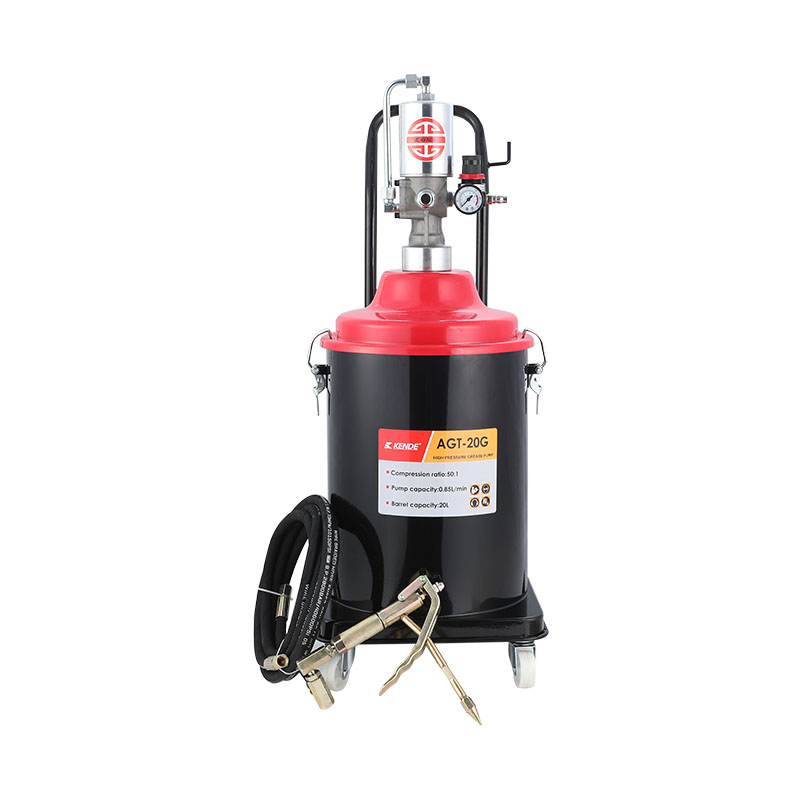
The pump uses compressed air to move grease. The air drives a piston. The piston pushes grease from the drum to the gun. Attaches to a 35-pound or 120-pound drum. The drum sits on a dolly. You roll it to the equipment.
It delivers high pressure
Up to 6,000 PSI. Grease reaches bearings and pins under pressure. The flow is steady. No spurts. No air pockets. Every fitting gets the right amount.
It is faster
Hand pumps are slow. Pump the lever dozens of times for one fitting. An air pump is faster. Pull the trigger. Grease flows. No effort. A job that takes 15 minutes by hand takes 2 minutes with air.
It does not lose prime
Hand pumps lose prime. Air gets in the line. You pump air. No grease. You bleed the line. Waste of time. An air pump self-primes. The air motor pushes the grease. No priming issues.
It is less messy
Hand pumps drip. Grease gets everywhere. Air pumps have a control valve. The flow stops when you release the trigger. Less waste. Less cleanup.
Construction equipment
Excavators have dozens of grease points. Pins and bushings need grease daily. An air pump speeds up the job. One person greases a machine in minutes instead of half an hour.
Truck and fleet maintenance
Trucks have grease fittings on suspension, steering, and driveshafts. An air pump saves time. Saves labor. Fleet shops use them daily.
Industrial manufacturing
Conveyors have bearings. Presses have slide ways. Production equipment needs regular lubrication. An air pump reduces downtime. Keeps machines running.
Here is where an air grease pump makes the most sense:
Pressure ratio
The pressure ratio determines output pressure. 50:1 ratio means 50 PSI air gives 2,500 PSI grease. Higher ratio delivers more pressure for tight fittings.
Flow rate
Flow rate is measured in ounces per minute. Higher flow rate means faster greasing. A pump with high flow rate saves time on big jobs.
Drum size compatibility
35-pound drums are standard. 120-pound drums are for high-volume use. The pump must fit the drum. Check compatibility before buying.
Hose length
Longer hose reaches more points. A 20-foot hose is standard. A 40-foot hose reaches across equipment. Less moving of the drum.
The air motor sticks
Cheap pumps have rough air motors. They stick. The piston stops. No grease flow. You take it apart. Clean it. It works for a while. Then sticks again.
The seals leak
Grease leaks past the seals. It gets everywhere. The pump loses pressure. The flow slows down. Quality pumps have durable seals.
The pump loses prime
Some cheap pumps have poor priming. Air gets in the line. You waste time bleeding it. A quality pump self-primes every time.
An air grease pump is a simple tool. It saves time. It saves effort. It delivers consistent grease flow. Choose the right pressure ratio. Choose the right flow rate. Choose the right drum size. A quality pump lasts for years. It keeps equipment running. It keeps operators from getting tired. That is why shops switch to air grease pumps. Not for the technology. For the time it saves. And for the arms it saves.
Recommended Products

Contact Us
No.2299, Luqiao Section, Shugang Avenue, Luqiao District, Taizhou, 318057 Zhejiang, PR China.
+86-576-82431568
 Privacy
China Welding Machine Factory
 English
 中文简体
中文简体
 русский
 Español
 عربى
عربى
 Français
 Português
 Deutsch
 Український