Email: [email protected]
Email: [email protected]

Blog
 2026.10.18
 Blog
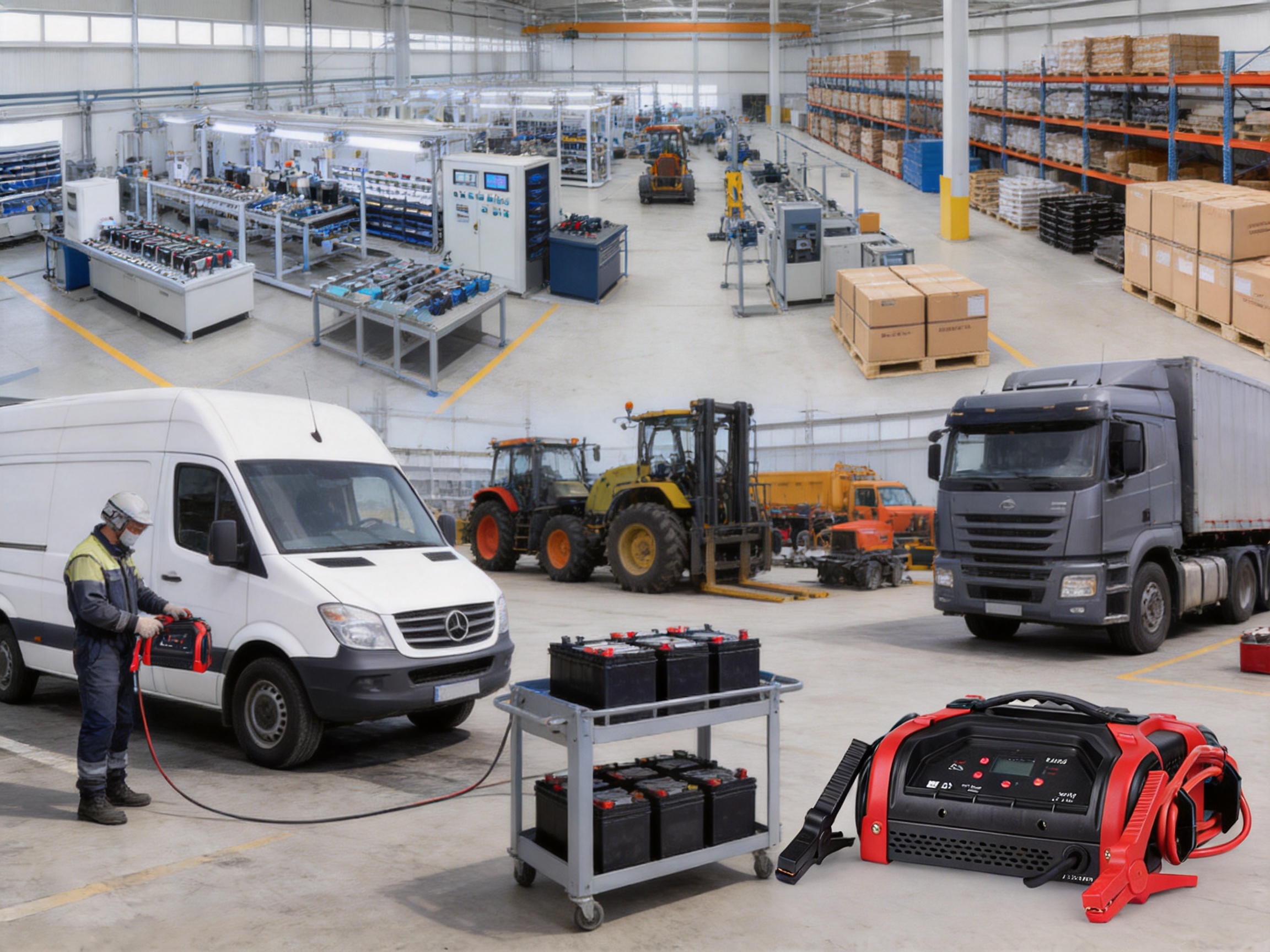
Modern vehicles depend on reliable batteries for starting, control electronics, lighting, safety systems, and auxiliary equipment. When a battery becomes deeply discharged, a conventional charger may require many hours before the vehicle can be used again. A weak battery can also leave a workshop, fleet operator, roadside service provider, or private driver facing an avoidable delay. A combined battery charger and jump starter addresses both requirements by providing controlled battery charging as well as immediate engine-start assistance.
The KC-B series is designed for this dual-purpose application. It supports 12V and 24V battery systems, combines automatic multi-stage charging with a direct engine-start function, and provides up to 60A of charging current and up to 350A of 12V starting current in the KC-620B model. A digital LCD display, trolley handle, protection systems, and selectable charging modes make the series suitable for passenger vehicles, commercial vehicles, agricultural equipment, workshops, maintenance departments, and professional service operations.
Unlike a basic charger that performs only one task, this equipment is intended to cover the complete service cycle: assessing battery condition, recovering a weak battery, charging it safely, maintaining its charge, and helping start the engine when immediate operation is necessary. The result is a versatile power-support tool that can reduce downtime and simplify equipment selection.
The KC-B series battery charger with jump-start function is a 12/24V workshop and service machine based on microcomputer control technology. Its electronic control system manages the charging sequence, helps select a suitable charging current, monitors operating conditions, and supports protective functions. The charger is available in several output classes, from the KC-320B through the KC-620B.
The largest model, KC-620B, offers a rated charging range of 5–60A, a maximum 12V starting current of 350A, and a maximum 24V starting current of 300A. The product information identifies 230V, 50/60Hz supply operation for the listed technical configuration, while the product description also refers to 110V or 220/230V input versions. Input voltage should therefore be confirmed for the specific order, destination market, and factory configuration before purchase.
The machine is built around several practical priorities:
• Support for both 12V and 24V battery systems.
• Automatic six-step charging control.
• Direct engine starting when a battery is too weak for normal starting.
• LCD display and operating status indication.
• Reverse-polarity, overheating, and short-circuit protection.
• Compatibility with lead-acid, AGM, and gel-type batteries, subject to correct mode selection.
• Portable construction with a trolley handle.
• A complete basic accessory package with charging cables and clamps.
These features position the product between a small consumer charger and a permanently installed commercial battery service system. It is sufficiently portable for mobile use but provides the output capacity expected in workshops and maintenance environments.
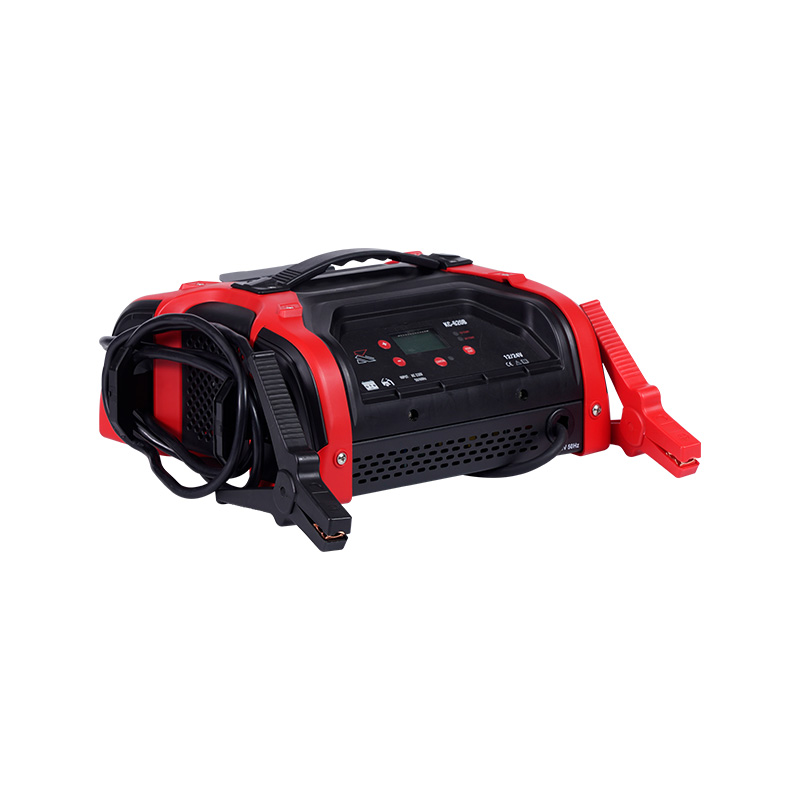
KC-B series battery charger with jump start function 12/24V LCD display, max charging current 60A, start current 12V 350A, 24V 300A,WITH 110V or 220V/230V INPUT
A charger and a jump starter solve different battery problems. Charging restores energy gradually and is the preferred method when time is available. Jump starting supplies a high current for a short period so that an engine can crank when the battery voltage or stored energy is insufficient. A machine that combines both functions gives the operator more options than either device alone.
In a workshop or fleet environment, waiting for a deeply discharged battery to charge can delay inspections, repairs, deliveries, and vehicle dispatch. The direct engine-start function allows an operator to attempt an immediate start when the battery is weak but still suitable for temporary assistance. After the vehicle is running, the battery can be tested and charged using the appropriate automatic program.
This is especially useful for service vehicles, commercial vans, agricultural machinery, construction equipment, and storage vehicles that may remain unused for extended periods. The machine can also support maintenance departments where a single charger must serve many types of equipment.
Many passenger cars use 12V electrical systems, while trucks, buses, heavy equipment, and some industrial vehicles use 24V systems. A workshop that handles both categories may otherwise need separate chargers and starting units. The KC-B series provides a selectable 12/24V platform, allowing one product family to cover a broader range of applications.
Using the correct voltage setting remains essential. The operator should identify the vehicle and battery system before connecting the charger. A 24V system should not be treated as a 12V system, and the correct charging mode must be selected according to battery type and operating conditions.
Traditional manual chargers commonly require the operator to estimate charging time and monitor the battery throughout the process. That approach can be inconvenient and may increase the risk of overcharging if the charger is left connected too long. The KC-B series uses microcomputer control and a staged charging program to make the process more consistent.
Automatic control does not eliminate the need for correct connection and supervision, but it reduces the amount of manual adjustment required. The operator can select the voltage and battery program, connect the clamps with the correct polarity, and allow the charger to manage the principal charging stages.
The six-step charging sequence is one of the main technical advantages of the product. Instead of applying a fixed current continuously, the charger adapts the process to the condition of the battery. The sequence is intended to support recovery, bulk charging, absorption, completion, and maintenance.
The first stage evaluates the battery condition and can apply pulse charging for recovery. A battery that has remained discharged may have reduced acceptance or surface sulfation. Controlled pulses can help prepare the battery for the following stages, although the process cannot restore a battery that has suffered irreversible internal damage.
This diagnostic and recovery stage is valuable because it avoids treating every battery as though it were in the same condition. A battery that needs gentle preparation receives a different beginning from one that is ready to accept normal bulk current.
During the second stage, the charger uses a soft-start process to prepare the battery. The output is introduced progressively rather than immediately applying the maximum available current. This can be beneficial for weak batteries because it reduces abrupt electrical stress and allows the control system to observe the battery’s response.
Soft start is particularly useful when servicing older batteries, batteries that have been stored for long periods, or batteries that have fallen below their normal operating voltage. The operator should still inspect the battery for swelling, leakage, cracks, damaged terminals, or other signs that make charging unsafe.
The third stage is the principal energy-recovery phase. The charger selects an appropriate current within the model’s available range and supplies the majority of the required charge. Bulk charging is generally the fastest part of the process and is where the charger’s rated output has the greatest practical effect.
The KC-620B, for example, provides a charging range of 5–60A. Lower-current operation can be appropriate for smaller batteries or more conservative charging, while higher output can reduce charging time for larger batteries when the battery manufacturer’s specifications permit it.
Once the battery approaches its target voltage, the charger transitions to constant-voltage absorption charging. The current gradually reduces as the battery becomes fuller. This stage helps complete the charging process without continuing to force high current into a battery that is already near its voltage limit.
Absorption charging is important because reaching a target voltage is not always the same as achieving a useful state of charge. The battery needs time at a controlled voltage so that its internal electrochemical process can accept the remaining energy.
When the charging process reaches the full-charge condition, the display indicates FULL. This gives the operator a clear status reference and reduces uncertainty about whether the battery is ready for service. The indication is especially convenient in workshops where multiple chargers may be operating at the same time.
The final stage is maintenance float charging. Instead of stopping permanently after reaching full charge, the charger can maintain the battery at a suitable level with a lower sustaining output. This is useful for batteries in vehicles that are stored, seasonal equipment, emergency units, and workshop stock.
Float maintenance helps compensate for normal self-discharge and small standby losses. It should not be viewed as a substitute for battery inspection, and the battery should not remain connected indefinitely if its condition is uncertain. However, for healthy compatible batteries, the function can support readiness between uses.
The product provides six listed charging modes: 12V STD, 12V STD with winter mode, 12V AGM, 12V AGM with winter mode, 24V STD, and 24V STD with winter mode. These selections allow the charger to be matched more closely to battery construction and ambient conditions.
The 12V STD and 24V STD settings are intended for compatible standard lead-acid batteries. The correct selection depends on the battery system voltage. Selecting the wrong voltage can cause improper charging and should be avoided.
AGM batteries use an absorbent glass mat design and have charging characteristics that differ from conventional flooded batteries. The 12V AGM mode is intended for compatible 12V AGM batteries. Users should always check the battery label or manufacturer documentation before selecting the program.
Cold temperatures affect battery chemistry, cranking performance, and charge acceptance. Winter modes are designed for cold-weather conditions and can be useful when the battery and charger are operating in a low-temperature environment. The actual suitability of a winter mode depends on the battery type, temperature, and manufacturer recommendations.
Although the listed programs include standard, AGM, and winter settings, the product content also refers broadly to lead-gel, lead-acid, AGM, and gel batteries. Operators should confirm the battery technology and use the closest approved program. Not every battery chemistry is suitable for every charger, and lithium batteries should not be connected unless a dedicated compatible program is explicitly provided.
The jump-start function is designed for situations where the battery is weak and the engine requires immediate assistance. The KC-620B provides up to 350A at 12V and up to 300A at 24V. These values are substantial for a portable workshop charger and make the highest-capacity model suitable for a broad range of vehicle service applications.
The lower models also provide useful starting capability. The KC-320B is rated at up to 200A for both 12V and 24V systems. The KC-420B provides up to 250A for both voltage settings, while the KC-520B provides up to 300A for both. These variations allow buyers to select a model according to expected vehicle size and workload rather than paying for the largest unit in every application.
| Model | Supply Voltage | Supply Frequency | Charging Voltage | Rated Capacity | Charging Current | Starting Current | Reference Capacity | Weight | Machine Size |
|---|---|---|---|---|---|---|---|---|---|
| KC-320B | 230V | 50/60Hz | 12/24V | 900W | 5–30A | 12V 200A max; 24V 200A max | 20–450Ah | 4.5kg | 310 × 310 × 170mm |
| KC-420B | 230V | 50/60Hz | 12/24V | 1200W | 5–40A | 12V 250A max; 24V 250A max | 20–600Ah | 4.5kg | 310 × 310 × 170mm |
| KC-520B | 230V | 50/60Hz | 12/24V | 1500W | 5–50A | 12V 300A max; 24V 300A max | 20–750Ah | 4.7kg | 310 × 310 × 170mm |
| KC-620B | 230V | 50/60Hz | 12/24V | 1800W | 5–60A | 12V 350A max; 24V 300A max | 20–900Ah | 4.7kg | 310 × 310 × 170mm |
The starting-current rating should not be interpreted as a guarantee that every engine will start under every condition. Engine size, oil viscosity, temperature, cable contact, starter condition, battery damage, and the required cranking current all affect the result. The unit is intended to assist a weak but serviceable battery; it is not designed to replace a failed starter motor or compensate for a mechanically seized engine.
Compared with a small household charger, the higher-output models offer faster charging and stronger starting assistance. Compared with a dedicated industrial starting cart, the KC-B series offers a more compact and portable format. This combination is a practical competitive advantage for users who need capability without installing a large fixed system.
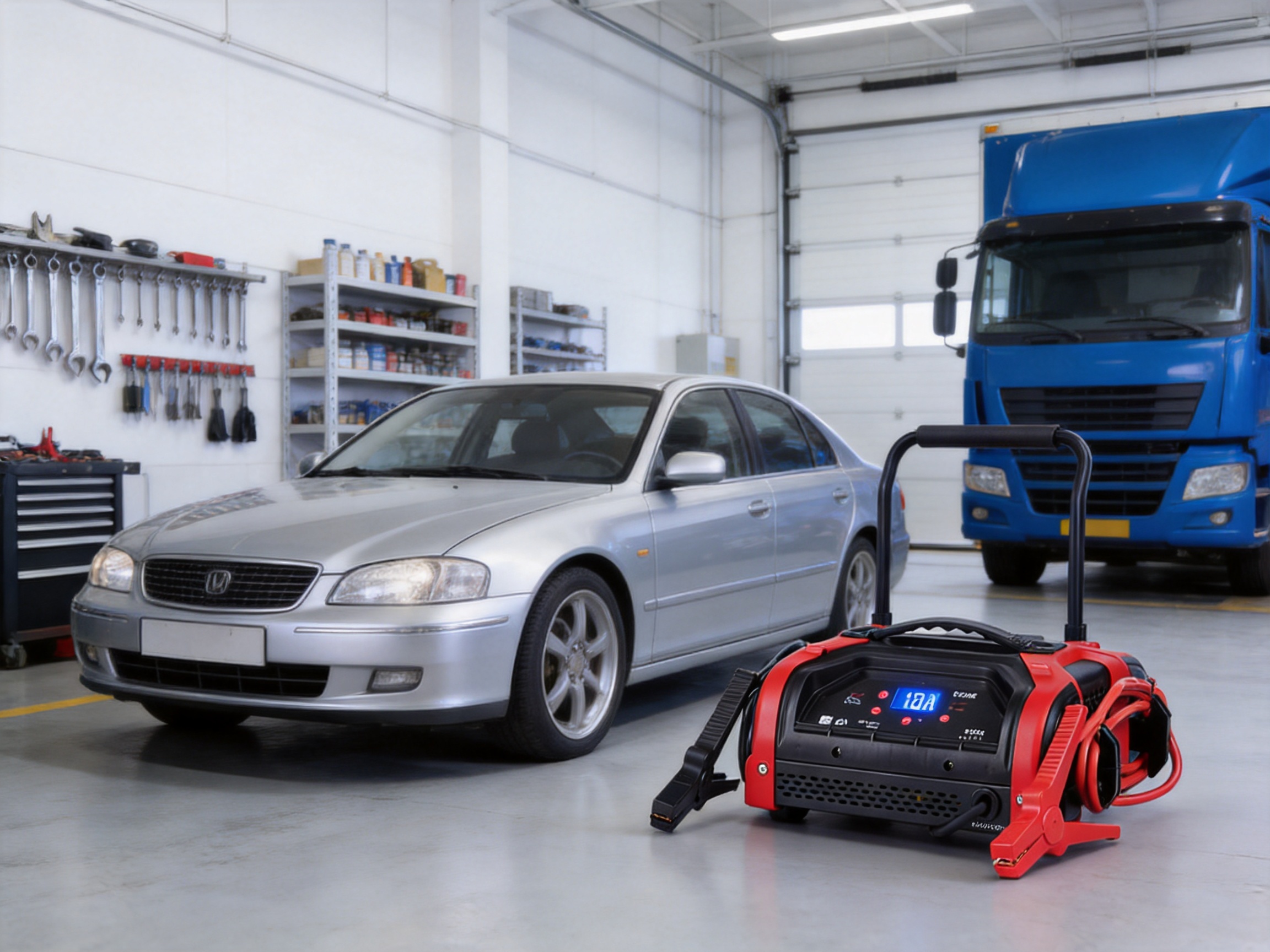
Electrical protection is a central consideration for any charger that can deliver high current. The KC-B series includes reverse-polarity protection and an indicator, overheating protection, and short-circuit protection. These functions help reduce the consequences of common operating mistakes and abnormal conditions.
Connecting the positive clamp to the negative terminal or the negative clamp to the positive terminal can damage equipment and batteries. Reverse-polarity protection and indication alert the operator and help prevent incorrect connection from becoming a serious failure. Nevertheless, the clamps should always be identified before connection, and the operator should follow the correct connection sequence.
High-current charging and starting place thermal demands on the charger, cables, and internal components. Overheating protection helps control operation when the unit becomes too hot. Adequate ventilation is still necessary. The charger should not be covered, operated in a confined space without airflow, or placed near combustible materials.
A short circuit can occur because of damaged cables, incorrect clamp contact, conductive debris, or accidental contact between the clamps. Short-circuit protection helps safeguard the machine and wiring. The operator should disconnect the mains supply before investigating a cable or clamp problem.
The listed degree of protection is IP21S. This indicates a product designed for indoor or protected working environments rather than exposure to rain, wash water, dust-heavy outdoor conditions, or direct moisture. The equipment should be kept dry and used in a clean, ventilated area.
Battery charging can produce hydrogen gas, particularly with some lead-acid batteries. Charging should take place in a well-ventilated area away from sparks, open flames, cigarettes, and ignition sources. Operators should wear suitable eye and hand protection and inspect the battery before use.
Portability is one of the product’s practical strengths. The machine weighs approximately 4.5–4.7kg depending on the model and has a compact size of approximately 310 × 310 × 170mm. A trolley handle makes movement easier, especially when the unit is carried between vehicles or placed beside a workbench.
A charger may have excellent electrical specifications but still be inconvenient if it is difficult to move, store, or position. The trolley handle improves handling and reduces the need to lift the machine repeatedly. The compact footprint also helps workshops conserve bench and floor space.
The supplied accessory package includes a 1.5m charging cable, a 1.5m cable, two clamps, and a color box. Cable length provides useful flexibility when the charger is positioned beside a vehicle. The clamps must maintain firm, clean contact with the battery terminals or approved connection points. Corroded terminals should be cleaned according to safe workshop procedures.
Repair shops can use the charger for battery recovery, vehicle preparation, post-repair starting, and maintaining batteries in stock. The combination of 12V and 24V operation allows the same product family to serve cars, vans, light commercial vehicles, and selected heavy vehicles.
Fleets often experience battery discharge when vehicles remain parked, operate in cold weather, or have accessories that consume power during loading and unloading. A high-current charger and jump starter can help maintenance teams restore vehicle availability without sending every affected unit to an external service provider.
Tractors, loaders, generators, and construction machines may use large batteries and may be stored outdoors or used intermittently. The higher-capacity models provide a useful charging range for larger lead-acid batteries, although the battery manufacturer’s rated capacity and charging instructions should always be checked.
Dealerships and storage facilities need to maintain batteries in vehicles that may not be driven daily. Float charging can help keep suitable batteries ready for demonstration, delivery, inspection, or seasonal use. The LCD display and full-charge indication make routine status checks easier.
The portable format and starting function are useful for mobile technicians. A service vehicle can carry the charger to a disabled vehicle, provide starting assistance, and then charge the battery after the immediate problem has been addressed. The machine does require access to the appropriate AC supply, so the operating environment must be considered before deployment.
The product is manufactured by Zhejiang Kende Mechanical & Electrical Co., Ltd., a Chinese manufacturer with a broad portfolio covering welding machines, battery chargers, heaters, and related equipment. The company’s stated production capability includes annual output of nearly 1.5 million units and an annual production capacity of approximately 2 million units. These figures indicate an established manufacturing structure rather than a small single-product operation.
The company operates on a site covering approximately 120,000 square meters and employs around 600 people. Such scale supports dedicated functions for engineering, procurement, production, quality management, testing, warehousing, and export service. For buyers, this can be important because product consistency, spare-part support, documentation, and repeat-order capacity are often as important as the first unit’s specification.
The company reports a Zhejiang Provincial R&D Center, an Enterprise Technology Center, and an Intelligent Welding Technology Research Institute. It also states that approximately 98 R&D personnel work on product development and innovation. Although the featured product is a battery charger rather than a welding machine, the same engineering environment can support power electronics, thermal management, control systems, enclosure design, and production validation.
The company also reports invention patents, utility model patents, appearance patents, and software copyrights. Intellectual property does not by itself prove field performance, but it indicates ongoing investment in design and product development. A buyer evaluating private-label or long-term supply should combine these claims with sample testing, factory audits, inspection records, and market feedback.
The company describes the use of automatic patching, plug-in, and welding systems, together with robot processing and laser cutting. These processes can improve repeatability in electronic assembly and metal fabrication when properly controlled. Automated placement helps maintain component positioning, while controlled soldering and insertion processes can reduce variation between production batches.
Laser cutting can support accurate enclosure and bracket production, while robot processing can improve repeatability in repetitive operations. These capabilities are relevant to charger manufacturing because reliable electrical equipment depends on consistent circuit-board assembly, secure wiring, accurate mechanical fit, and effective heat dissipation.
The company reports the use of OA office automation, Toyota Production System methods, ERP K3, and MES management systems. These systems can connect production planning, material control, work orders, process tracking, inventory, and quality records. A mature manufacturing execution system can also improve traceability by associating production information with batches, workstations, inspection points, and finished products.
For international buyers, organized production management supports more predictable lead times and repeatability. It can also make it easier to discuss packaging requirements, language-specific labels, input-voltage configurations, certification needs, and customized product specifications.
The company reports international certifications and approvals including GS, CE, EMC, ERP, US ETL, UKCA, and China CCC across its product portfolio. The applicable certification depends on the exact model, electrical configuration, market, and current certification scope. Buyers should request the relevant certificate and test report for the specific KC-B version being purchased rather than relying only on a general company statement.
Electrical safety, electromagnetic compatibility, energy performance, labeling, and documentation requirements vary by market. A product intended for Europe may require different markings and declarations from a product intended for North America or another region. The input-voltage issue is particularly important: the listed technical table specifies 230V, while the commercial description mentions 110V or 220/230V input options. The purchaser should confirm the rated supply voltage, plug type, frequency, fuse arrangement, and certification package before shipment.
The company also states that it participates in the drafting, formulation, and revision of national standards and has contributed to 20 national standards while leading the drafting of one group standard. This experience suggests familiarity with technical compliance and industry requirements, although each supplied product must still be verified against the regulations of its destination country.
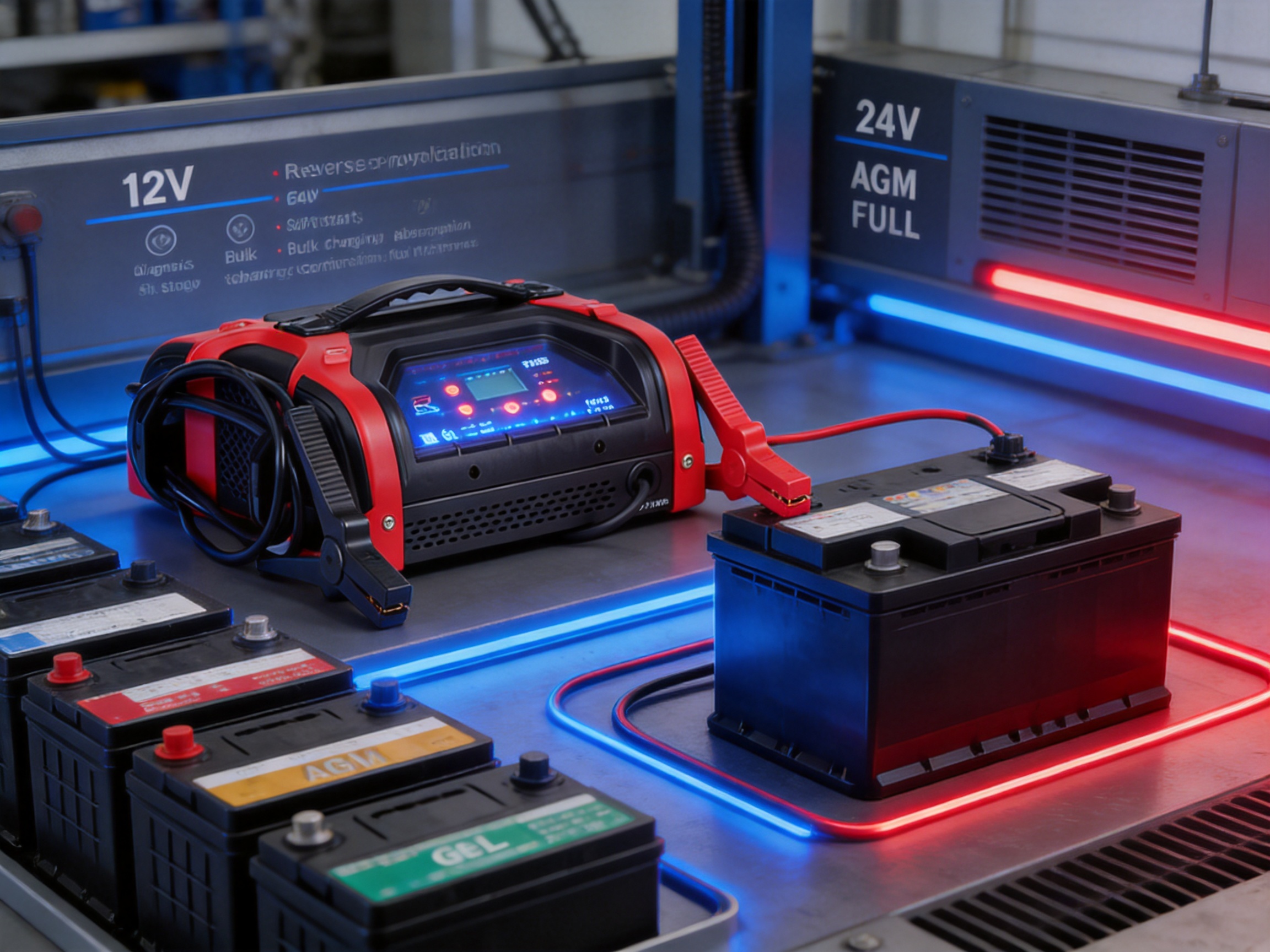
The most obvious advantage is the combination of charging and jump starting. A standard maintenance charger may be excellent for slow charging but cannot necessarily provide the current required for an immediate engine start. A separate jump starter may provide starting assistance but lack a controlled six-stage charging and float-maintenance program. The KC-B series brings both functions into one machine.
12/24V selection makes the product useful across passenger, commercial, agricultural, and industrial vehicle categories. This can reduce equipment duplication for mixed fleets and workshops. The four output levels also allow a buyer to match the model to battery capacity and starting requirements.
Microcomputer control, automatic current selection, pulse recovery, soft start, absorption charging, full-charge detection, and float maintenance provide a more complete charging strategy than a simple fixed-current device. This can improve convenience and help protect compatible batteries when the correct program is selected.
The trolley handle, compact dimensions, moderate weight, and included cables support mobile operation. The unit is not limited to a permanent installation, yet it provides more output than many compact consumer chargers. This balance is attractive for small workshops, vehicle service departments, and mobile maintenance teams.
Reverse-polarity indication, overheating protection, short-circuit protection, and a defined IP21S enclosure rating provide a foundation for safer routine operation. Protection systems are particularly valuable in busy workshops where different operators may connect the unit throughout the day.
Before use, inspect the charger, cables, clamps, plug, battery case, and terminals. Do not use damaged cables or a battery that is leaking, swollen, cracked, or frozen. Confirm that the work area is dry, ventilated, and free from ignition sources.
Identify whether the vehicle uses a 12V or 24V system. Confirm the battery type and select the appropriate standard, AGM, or winter mode. Place the charger on a stable surface with sufficient ventilation around the enclosure.
With the AC supply disconnected, connect the positive clamp to the positive battery terminal or approved positive connection point. Connect the negative clamp to the negative terminal or approved ground point according to the vehicle manufacturer’s service instructions. Check that the clamps are secure and not touching each other.
Connect the charger to the correct AC supply, select the required voltage and charging mode, and observe the display and indicators. If reverse polarity or another fault is indicated, disconnect the AC supply and correct the connection before continuing.
For normal charging, allow the six-step program to progress. The exact charging time depends on battery capacity, state of discharge, temperature, battery age, and selected current. Do not assume that a larger current is always better; use a setting suitable for the battery and follow the battery manufacturer’s recommendations.
For jump starting, ensure that the vehicle is in a safe starting condition, the transmission is in neutral or park, and unnecessary electrical loads are switched off. Use the correct 12V or 24V setting, allow the charger to stabilize as instructed by the operating procedure, and avoid prolonged or repeated cranking attempts. If the engine does not start, investigate the battery, starter, fuel, ignition, and mechanical systems rather than continuously increasing electrical stress.
After charging or starting, disconnect the AC supply before removing the clamps. Remove the negative connection first when appropriate, followed by the positive connection. Store the cables and charger in a dry, clean location.
Routine maintenance is straightforward but important. Keep the enclosure free from dust and oil. Check ventilation openings periodically. Inspect cables for cuts, flattened sections, exposed conductors, heat damage, and loose terminals. Examine clamps for corrosion and verify that their springs maintain firm contact.
The display and indicators should be checked during normal operation. Unusual noise, burning odor, excessive heat, repeated protection trips, or unstable output should be treated as warning signs. Disconnect the equipment and arrange qualified inspection rather than opening the enclosure without authorization.
Battery service also requires maintenance. A charger cannot correct every battery problem. If a battery repeatedly loses charge after a complete charging cycle, it may have sulfation, a damaged cell, internal leakage, or an electrical drain in the vehicle. Battery testing and vehicle-system diagnosis should accompany charger use.
Distributors should identify the target market before ordering. Important questions include the required input voltage, frequency, plug standard, language of labeling, certification documentation, packaging requirements, warranty terms, and expected annual quantity. The 110V, 220V, and 230V descriptions should be clarified in writing for each model.
Professional users should select the model according to the largest battery capacity and vehicle type that will be serviced regularly. The reference capacities range from 20–450Ah for the KC-320B to 20–900Ah for the KC-620B. These ranges are useful selection guidelines, but the exact charging suitability must be checked against battery specifications.
Buyers should also distinguish between maximum starting current and continuous charging current. Starting current is delivered for a short period, while charging current is applied through a longer controlled process. A high starting rating does not mean that the unit should be used as a continuous power supply.
For private-label projects, the manufacturer’s reported engineering, automated production, ERP, MES, and export experience may support customized labels, packaging, manuals, and market-specific configurations. Customization should be validated through approved drawings, samples, inspection standards, and pre-shipment testing.
Battery maintenance can extend battery service life by keeping suitable batteries charged during storage and reducing the frequency of deep discharge. A longer battery service life can reduce replacement costs and the material consumption associated with premature disposal.
The automatic charging process also avoids the need to operate at maximum current continuously. Bulk charging uses higher output when necessary, while absorption and float stages reduce the output as the battery becomes full. This staged approach is more appropriate than applying a fixed maximum current throughout the entire charging period.
Users should still consider the machine’s rated capacity and operating environment. The charger should be used only with compatible batteries, connected to the correct mains supply, and operated in a ventilated location. Responsible use combines electrical efficiency with safe battery handling and proper end-of-life recycling.
It is a combined 12/24V battery charger and jump starter. It can charge compatible lead-acid, AGM, and gel-type batteries and can provide high current for direct engine-start assistance.
The KC-620B provides a maximum charging current of 60A. Other models provide 30A, 40A, and 50A maximum charging current respectively.
The KC-620B is rated at up to 350A for 12V starting and 300A for 24V starting. The actual starting result depends on the vehicle, engine, battery condition, temperature, cable connection, and mechanical condition.
Yes. The series is designed for selectable 12V and 24V battery systems. The operator must verify the battery voltage and select the correct setting before operation.
Yes. The listed charging modes include 12V AGM and 12V AGM winter mode. The battery label and manufacturer instructions should be checked before selecting the AGM program.
The steps are battery diagnosis and pulse recovery, soft-start preparation, automatic current selection and bulk charging, constant-voltage absorption, full-charge confirmation, and maintenance float charging.
It indicates that the charger has reached its full-charge condition in the automatic charging sequence. The battery should still be inspected and tested if it is known to be old, damaged, or repeatedly discharged.
The listed protection rating is IP21S, so the unit should be used indoors or in a dry, protected environment. It should not be exposed to rain, wash water, or excessive moisture.
Yes. The stated accessory package includes 1.5m charging cables, two clamps, and a color box. The exact accessory configuration should be confirmed for the purchase order.
The technical table lists 230V, 50/60Hz. The commercial product description also mentions 110V or 220/230V input versions. The specific input voltage, plug, frequency, and certification must be confirmed with the supplier before ordering.
No lithium compatibility is specified in the supplied product information. It should not be connected to a lithium battery unless the manufacturer confirms a dedicated compatible charging program and operating procedure.
Selection should be based on the required charging current, battery capacity, starting-current requirement, vehicle types, and expected workload. The KC-320B is the smallest model, while the KC-620B provides the highest charging and 12V starting output.
The company reports large-scale production, international product certifications, research and development facilities, automated manufacturing processes, ERP and MES management, and extensive experience producing welding machines, chargers, and heaters. Specific product documents should still be reviewed for every destination market.
The 12/24V charger and jump starter combines several functions that are often purchased separately. Its six-stage microcomputer-controlled charging process supports diagnosis, recovery, bulk charging, absorption, full-charge confirmation, and float maintenance. Its direct starting capability provides immediate assistance when a vehicle battery is too weak for normal engine cranking.
The range of four models, charging currents up to 60A, starting current up to 350A at 12V, selectable battery programs, LCD display, trolley handle, and integrated protection systems make the product suitable for workshops, fleets, dealerships, agricultural operations, construction equipment, and mobile service work.
Its competitive value comes from the balance between power, portability, automation, and application range. It is more versatile than a basic charger, more charging-oriented than a simple jump starter, and more mobile than many fixed workshop systems. The manufacturer’s reported R&D resources, automated production, quality systems, certification experience, and large-scale export capability further support its position as a practical equipment partner.
Before purchasing, users should confirm the exact model, input voltage, battery compatibility, certification requirements, accessories, and intended application. When correctly selected and operated, the product can help reduce vehicle downtime, improve battery maintenance, and provide a dependable power-support solution for professional and domestic users.
1. Product technical information for the KC-B series battery charger and jump starter, including model specifications, charging modes, protection functions, accessories, and operating features.
2. Manufacturer-provided company information concerning production capacity, research and development resources, manufacturing systems, certifications, and product categories.
3. General lead-acid battery charging principles, including bulk charging, absorption charging, float maintenance, battery recovery, and safe charging practices.
4. General automotive service guidance for 12V and 24V vehicle electrical systems, jump starting, battery inspection, and workshop safety.
5. International electrical equipment safety and electromagnetic compatibility practices applicable to battery chargers and automotive service equipment.
Recommended Products

Contact Us
No.2299, Luqiao Section, Shugang Avenue, Luqiao District, Taizhou, 318057 Zhejiang, PR China.
+86-576-82431568
 Privacy
China Welding Machine Factory
 English
 中文简体
 русский
 Español
 عربى
 Français
 Português
 Deutsch
 Український