Email: [email protected]
Email: [email protected]

Blog
 2026.10.16
 Blog
The WSME-200X AC/DC TIG 200 Puls Pro is a digitally controlled inverter welding machine designed for fabricators, maintenance professionals, workshops, contractors, and demanding home users who require flexible arc performance in a compact package. Combining AC TIG, DC TIG, pulsed TIG, and MMA welding functions, the machine supports a broad range of metals and applications while maintaining a straightforward operating interface.
With a maximum welding current of 200 amps, high-frequency arc ignition, adjustable pulse operation, 2T and 4T torch control, VRD functionality, hot start, and arc force adjustment, this model is intended to provide the control normally associated with larger and more complex welding systems. Its inverter architecture also helps reduce weight, improve electrical efficiency, and deliver stable output under changing working conditions.
The machine is particularly suitable for aluminum and aluminum alloys because of its AC TIG capability. At the same time, its DC TIG function supports carbon steel, stainless steel, alloy steel, copper, and other conductive metals. The MMA mode adds practical versatility for electrode welding when portability, outdoor work, or less controlled conditions make a gas-shielded process less convenient.
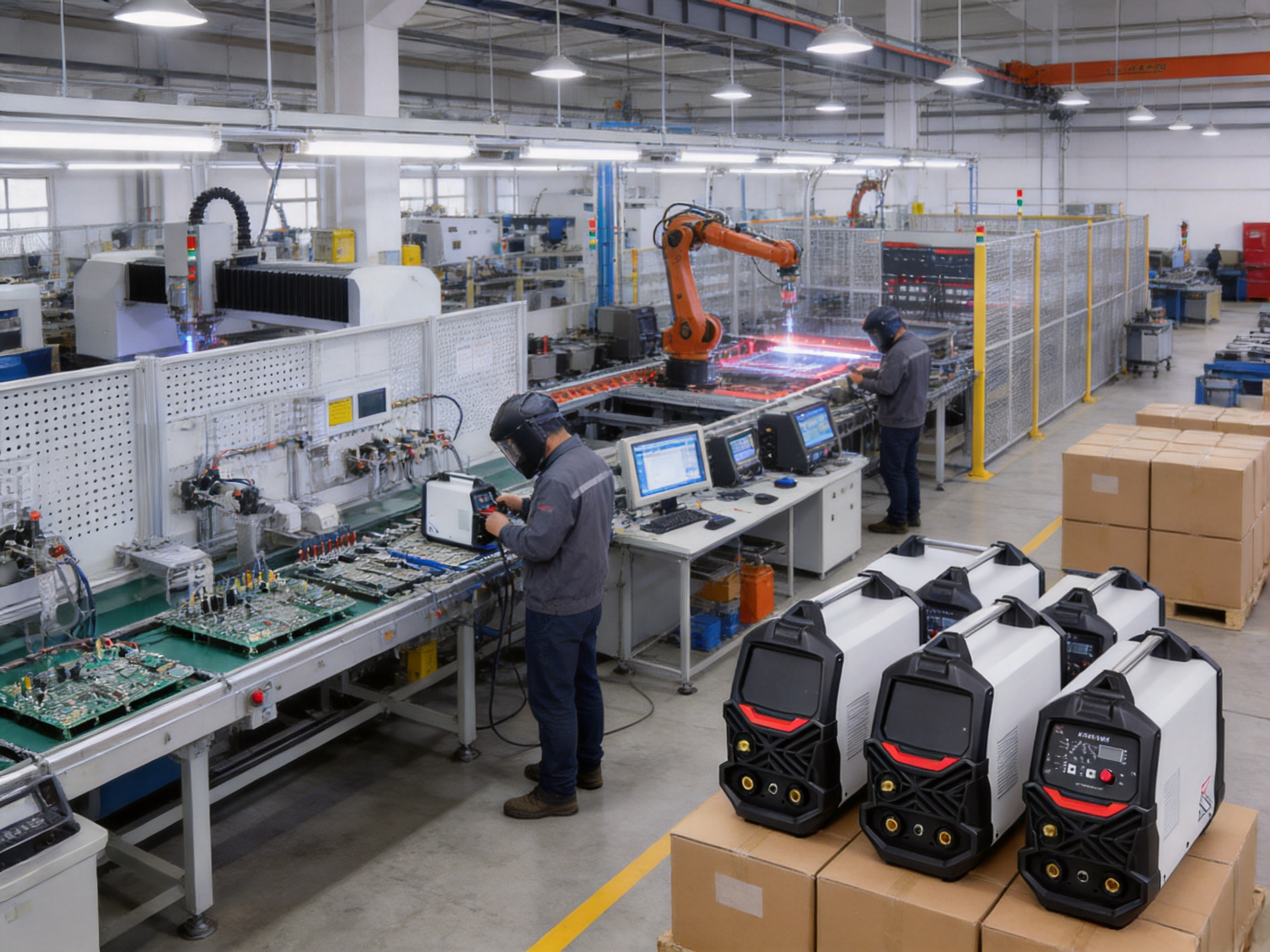
Behind the product is Zhejiang Kende Mechanical & Electrical Co., Ltd., an experienced manufacturer of welding equipment, battery chargers, heaters, and related products. The company combines large-scale manufacturing, in-house research and development, automated production systems, international certification experience, and a broad export network. These capabilities are important when evaluating a welding machine not only by its front-panel features, but also by its consistency, maintainability, production quality, and long-term supply potential.
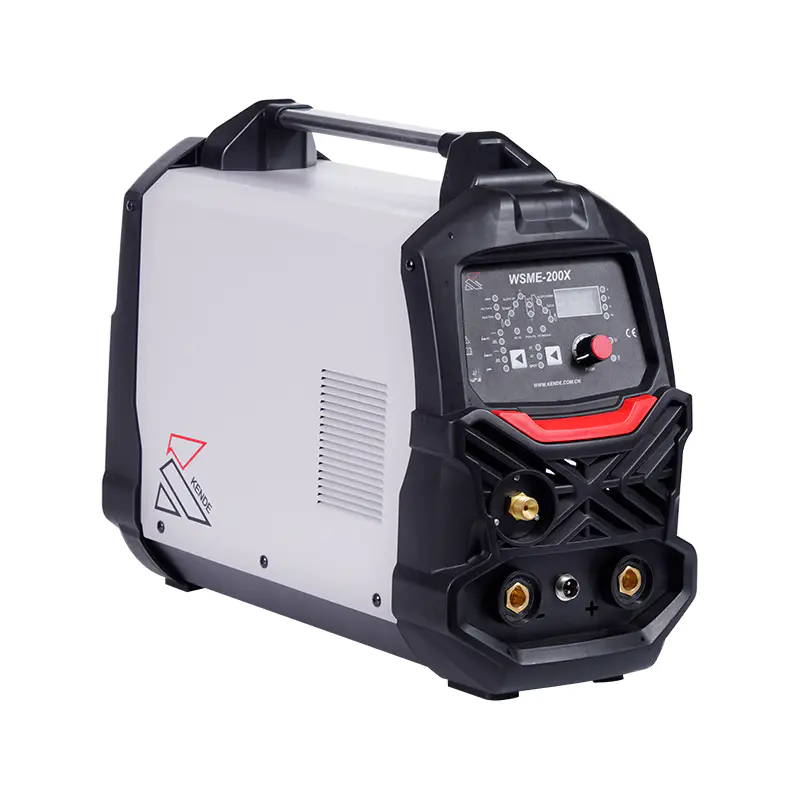
WSME-200X AC/DC TIG 200 Puls Pro - Digital welder | inverter with 200 amps, (TIG DC-HF, TIG AC-HF, PULSE MMA ) , Digital Display, With an automatic high-frequency ignition, 2T/4T VRD
The WSME-200X is a single-phase, 230-volt AC/DC TIG inverter with a rated supply frequency of 50 Hz. It provides a welding current range of 10 to 200 amps in both DC TIG and AC TIG modes. In MMA mode, the current range is 20 to 160 amps. This range allows the machine to cover delicate thin-sheet work as well as medium-duty fabrication tasks.
The unit uses powerful insulated-gate bipolar transistor, or IGBT, switches and advanced two-stage inverter control technology. IGBT-based power conversion is widely used in modern welding equipment because it enables fast electronic control, compact construction, and efficient conversion of input power into a controlled welding output.
Digital and pulse-width modulation control technologies are used to regulate the constant-current output. Constant-current operation is important in TIG welding because it helps maintain a stable welding arc when torch distance, electrode position, or material conditions change slightly. More predictable current control can help the operator achieve consistent penetration and bead appearance.
The front-panel interface uses touch buttons and an encoder to select and adjust welding parameters. This arrangement is intended to make the machine easier to configure than a system that requires complex external controls. Operators can select the welding method, torch trigger mode, spot operation, and relevant parameters according to the chosen process.
The product title identifies the unit as a 200-amp pulse machine, but its usefulness extends beyond the headline amperage. AC operation, DC operation, pulse control, high-frequency ignition, MMA support, and digital parameter adjustment together create a multiprocess platform for workshops that would otherwise need separate equipment.
AC TIG welding is the principal feature that distinguishes this equipment from a basic DC TIG inverter. Alternating current is commonly used when welding aluminum and aluminum alloys because the changing polarity supports oxide-film management on the workpiece surface. Aluminum oxide has a higher melting point than the base aluminum, so effective control of the arc and polarity is essential for producing a clean and stable weld.
The WSME-200X can operate from 10 to 200 amps in AC TIG mode. This makes it suitable for smaller aluminum components, sheet metal, brackets, enclosures, repair work, and medium-sized fabricated parts. The ability to use AC TIG from a compact inverter also offers a practical alternative to purchasing a separate aluminum-capable welding power source.
AC TIG is also useful for magnesium and magnesium alloys when the correct procedure, shielding gas, joint preparation, and safety controls are applied. The machine’s AC capability therefore broadens the range of materials that a workshop can process.
DC TIG welding is appropriate for carbon steel, stainless steel, alloy steel, copper, and many other metals. The 10-to-200-amp DC range gives the operator a broad adjustment window for thin and medium plate applications. Lower current settings can be used for heat-sensitive components and thin sheet, while higher settings can support deeper penetration on heavier workpieces within the machine’s duty-cycle limits.
DC TIG is valued for its precise arc, low spatter, and clean weld appearance. The process is especially useful where weld quality, visual finish, and control of heat input are important. Typical applications may include stainless-steel fabrication, equipment repair, light structural components, pipe-related work, artistic metalwork, and general workshop production.
Pulse TIG alternates between a higher peak current and a lower background current. This allows the operator to manage average heat input while retaining enough peak energy to establish fusion. Pulsed operation can be helpful when welding thin materials, controlling distortion, improving bead consistency, or working on components that are sensitive to excessive heat.
The product information identifies DC pulse TIG as one of the machine’s available functions. In practical terms, pulse operation can help the welder control the weld pool more deliberately, particularly during thin-sheet work or when a controlled bead pattern is desired. The exact pulse settings should be selected according to material thickness, joint design, tungsten size, shielding gas flow, and the welding procedure being used.
The MMA function gives the WSME-200X an additional operating mode for covered electrodes. Stick welding is useful when working outdoors, on dirty or less accessible surfaces, or in circumstances where a TIG torch, shielding-gas cylinder, and high level of surface preparation are not practical.
The MMA current range is 20 to 160 amps. Hot start and arc force adjustments are available in stick mode. Hot start provides a temporary increase in current during arc initiation, which can help reduce electrode sticking. Arc force adjustment influences the behavior of the arc when the electrode approaches the workpiece, helping the operator adapt the machine to different electrode types and welding preferences.
By combining TIG and MMA capability, the machine can be used for precision welding and general repair without requiring two separate power sources. This multiprocess flexibility is a significant advantage for mobile technicians, small fabrication shops, training facilities, and maintenance departments.
The WSME-200X includes automatic high-frequency ignition. High-frequency starting allows the TIG arc to begin without the tungsten electrode touching the workpiece. This reduces the risk of tungsten contamination, unwanted starting marks, and inconsistent arc initiation.
Contactless ignition is especially helpful when welding stainless steel, aluminum, visible surfaces, or small precision components. A clean start contributes to better weld appearance and can reduce the need for post-weld grinding or repair. It also protects the tungsten from accidental transfer of base-metal contaminants.
The machine supports 2T and 4T torch switch operation. In 2T mode, the operator generally holds the torch switch to maintain welding and releases it to stop. This arrangement is convenient for short welds and frequent starts and stops. In 4T mode, the operator can begin and end the welding sequence with separate switch actions, reducing the need to continuously hold the trigger during longer welds.
Four-step operation can improve comfort during extended fabrication work and may help maintain a steadier torch position. It is particularly useful for longer seams, repeated production welds, and situations where the operator needs both hands positioned carefully around the joint.
The product also provides a spot mode. Spot welding settings can support repeated welds of controlled duration, depending on the selected configuration and workpiece requirements. This can be useful for thin sheet, tack-style operations, repetitive components, and applications where consistent weld timing is important.
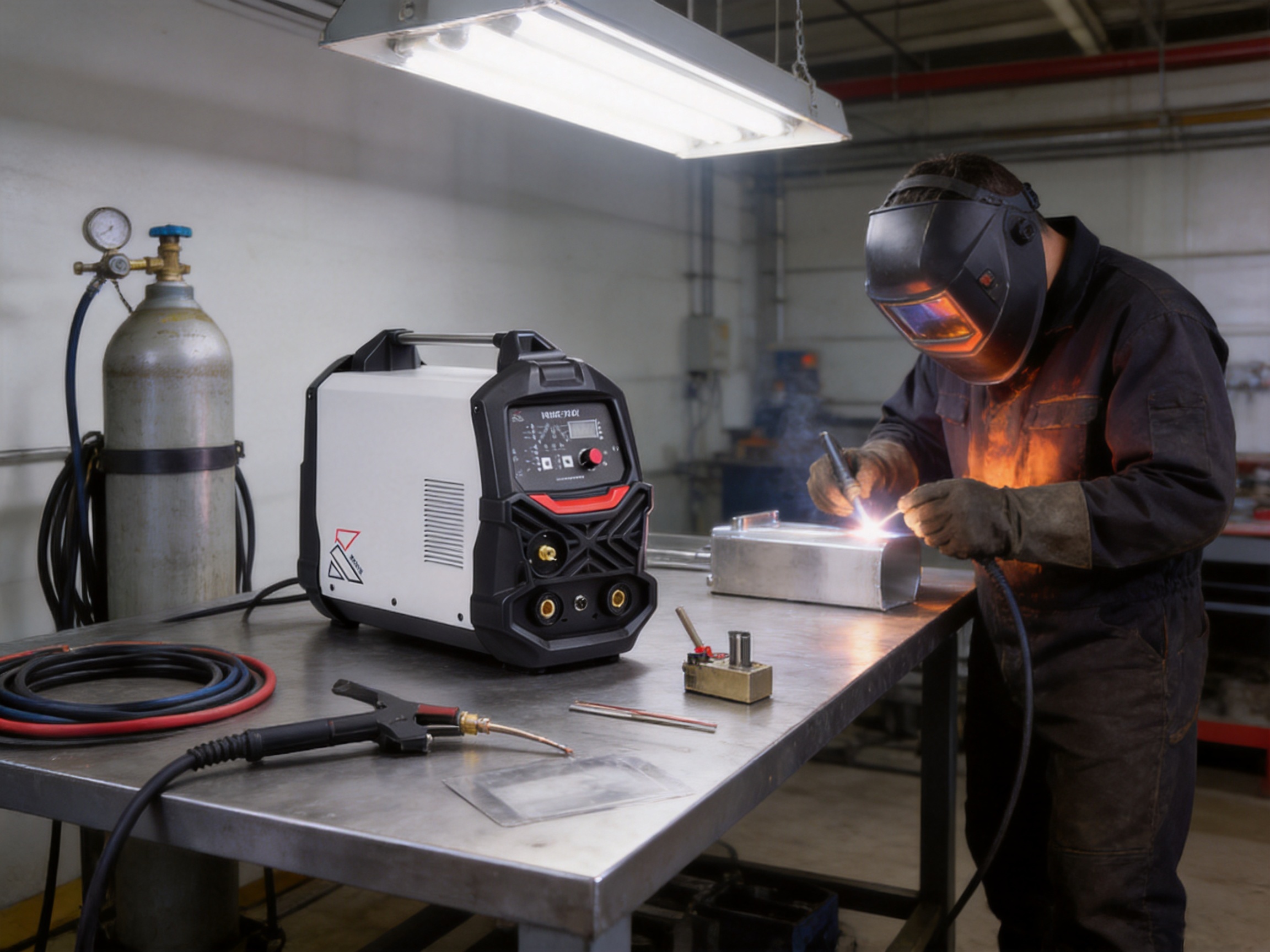
A welding machine’s performance depends not only on its maximum output, but also on how easily the operator can select, understand, and repeat settings. The WSME-200X uses digital control technology, touch buttons, and an encoder to adjust welding parameters. This approach provides a more precise alternative to relying only on a simple analog dial.
Digital parameter control can improve repeatability between jobs. When a suitable setting has been identified for a particular material and joint, the operator can more easily reproduce the same configuration for future work. This is valuable in workshops that handle batches of similar components or require a consistent procedure across multiple operators.
The interface is designed around a simple operating concept: select the welding process, choose the desired operating mode, and set the appropriate current or other available parameters. The product description emphasizes advanced features with a simple interface, which is important because excessive menu complexity can slow production and make training more difficult.
The digital display allows welding information to be viewed directly at the machine. A clear display helps the operator verify that the selected current and process are appropriate before beginning work. It can also support troubleshooting by making it easier to identify an incorrect setting.
Digital and PWM control contribute to stable constant-current output. In TIG welding, stable current helps limit unwanted variation in bead width and penetration. Although operator technique, joint preparation, filler-metal selection, shielding-gas control, and torch movement remain essential, consistent power-source behavior provides a stronger foundation for good results.
The following table summarizes the principal technical data supplied for the WSME-200X. Operators should consult the product documentation and applicable local electrical requirements before installation and use.
| Specification | Value |
|---|---|
| Model | WSME-200X |
| Rated supply voltage | 230 V |
| Supply frequency | 50 Hz |
| Rated input capacity | 7.2 kVA |
| Rated supply current | 31.5 A |
| No-load voltage | 64 V |
| DC TIG welding current range | 10–200 A |
| AC TIG welding current range | 10–200 A |
| MMA welding current range | 20–160 A |
| Rated welding voltage, DC TIG | 10.4–18 V |
| Rated welding voltage, AC TIG | 10.4–18 V |
| Rated welding voltage, MMA | 20.8–26.4 V |
| Rated duty cycle, DC TIG | 15% |
| Rated duty cycle, AC TIG | 20% |
| Rated duty cycle, MMA | 25% |
| Usable electrode diameter | 1.6–4.0 mm |
| Efficiency | 85% |
| Power factor | 0.9 |
| Protection rating | IP21S |
| Insulation class | H |
| Net weight | 10 kg |
| Machine dimensions | 500 L × 220 W × 380 H mm |
The specifications show that the product is intended for single-phase workshop and service environments with a 230-volt supply. Its 0.9 power factor is favorable for an inverter welder because it indicates comparatively effective use of input current. The stated 85 percent efficiency also supports reduced energy loss compared with less efficient power-conversion designs.
The 10-kilogram net weight makes the unit relatively portable for an AC/DC TIG machine with a 200-amp output rating. Portability can reduce setup time, simplify movement between workstations, and make the machine more practical for field service or repair work.
The IP21S protection rating indicates that the machine should be operated in suitable indoor or protected environments and should not be treated as weatherproof equipment. Welding machines must be kept away from rain, standing water, excessive dust, and conditions that could allow conductive contamination to enter the enclosure.
The Class H insulation designation reflects the thermal class of the insulation system used in the machine. Appropriate ventilation, correct duty-cycle management, and routine inspection remain necessary to preserve reliability.
Duty cycle is an important specification that should be understood before selecting a welding power source. The listed duty cycle is 15 percent for DC TIG, 20 percent for AC TIG, and 25 percent for MMA. These values define the proportion of a standard test period during which the machine can weld at the rated output before a cooling period is required.
For example, a 20 percent duty cycle over a ten-minute test period represents approximately two minutes of welding followed by approximately eight minutes of cooling at the specified conditions. Actual operating performance can vary with ambient temperature, input voltage, ventilation, welding current, cable length, and maintenance condition.
The duty-cycle figures do not mean that the machine is unsuitable for professional work. Rather, they help users plan jobs realistically. Many TIG operations involve short welds, controlled starts, repositioning, inspection, filler-metal handling, and workpiece preparation. These natural pauses can provide useful cooling time.
For continuous high-amperage production, a larger power source with a higher duty cycle may be more appropriate. However, for repair work, small and medium components, thin and medium plate, fabrication, maintenance, and general workshop use, the WSME-200X offers a practical balance between capability, size, and mobility.
Operators should avoid covering ventilation openings, placing the machine against hot surfaces, or using it in a confined space without adequate airflow. Correct cable sizing and secure electrical connections are also important for limiting heat buildup and ensuring stable output.
AC TIG capability makes the machine suitable for aluminum and aluminum-alloy components. Potential applications include brackets, frames, tanks, covers, furniture, vehicle parts, heat-related components, and general repair work. Successful aluminum welding requires clean material, suitable tungsten preparation, correct shielding-gas flow, and careful control of heat input.
Aluminum conducts heat rapidly, so the operator must balance current, travel speed, joint design, and preheating requirements where applicable. The machine’s pulse and AC functions provide useful tools for controlling the weld pool, but proper technique remains essential.
DC TIG welding is well suited to stainless steel because it can produce a clean, concentrated arc with limited spatter. The process is useful for visible welds, hygienic equipment, architectural components, thin sheet, pipes, and fabrication where corrosion resistance and appearance are important.
Stainless steel can be sensitive to excessive heat input and contamination. Pulse operation may help reduce distortion and control the size of the heat-affected area. Operators should use appropriate shielding practices on both sides of the weld when the joint design requires internal protection.
Carbon steel and alloy steel can be welded using DC TIG or MMA, depending on the application. TIG is advantageous where clean, controlled welds are needed, while MMA may be preferable for outdoor repairs, heavier sections, or work where surface conditions are less ideal.
The choice of process should account for material thickness, joint accessibility, required appearance, production speed, electrode type, and available shielding gas. The WSME-200X provides flexibility by allowing the operator to select the most appropriate process without changing to another power source.
The product information identifies copper and copper alloys among the materials that can be welded. Copper’s high thermal conductivity can require careful control of current and workpiece temperature. Joint preparation, suitable filler metal, shielding gas, and welding procedure qualification should be considered before production work.
AC TIG can also support work on magnesium and magnesium alloys. These materials require specialized preparation and strict attention to fire prevention, cleanliness, shielding, and procedure control. Users should follow the recommendations of the material supplier and relevant welding standards.
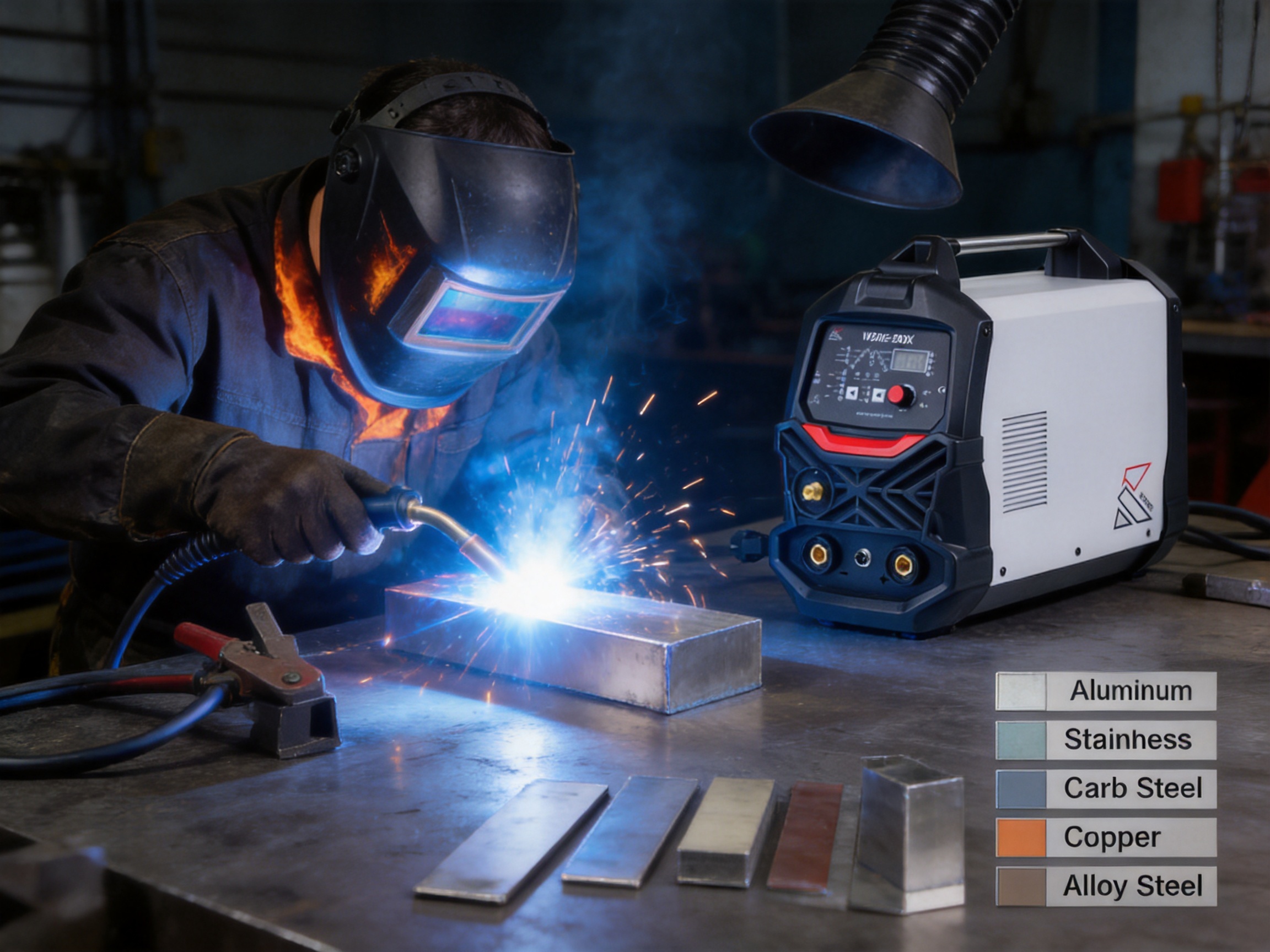
One of the main advantages of the WSME-200X over a basic MMA-only inverter is its process versatility. A conventional stick machine may be effective for general repairs but cannot provide the same level of control for aluminum, stainless steel, thin sheet, or appearance-critical welds. The WSME-200X adds AC TIG, DC TIG, pulse TIG, and high-frequency starting in one platform.
Compared with a basic DC TIG machine, the AC function significantly broadens the material range. A DC-only TIG system is not the preferred choice for many aluminum welding tasks, whereas an AC/DC unit can serve both nonferrous and ferrous-metal applications.
Compared with older transformer-based equipment, the inverter design offers lower weight and more compact dimensions. A 10-kilogram machine with a 500-by-220-by-380-millimeter envelope is easier to move and store than many traditional power sources with comparable general-purpose functionality.
Digital control is another advantage over simple analog equipment. Digital selection and encoder adjustment can improve repeatability, make process changes more structured, and help users return to previously established settings. The high-frequency ignition system also provides a cleaner and more controlled start than scratch-start TIG.
The inclusion of hot start and arc force in MMA mode further improves flexibility. These functions allow the operator to adapt stick performance to electrode type and personal technique rather than accepting a single fixed arc behavior.
The product should not be evaluated only by maximum amperage. Its real value comes from the combination of current range, AC and DC operation, pulse control, digital regulation, high-frequency ignition, torch-trigger modes, MMA support, portability, and electrical efficiency.
The WSME-200X includes automatic overheat protection. If internal temperature rises beyond a safe operating level, protective control can interrupt or limit operation until the machine has cooled. This feature helps reduce the risk of damage caused by excessive thermal loading, although it should not replace proper duty-cycle management.
The machine is also designed to tolerate fluctuations in supply voltage more effectively than less sophisticated systems. Strong resistance to power-supply fluctuation can be useful in workshops or service locations where the electrical supply is not perfectly stable. Nevertheless, the machine should always be connected to a correctly rated circuit with appropriate grounding and protective devices.
Welding generates intense ultraviolet radiation, heat, fumes, sparks, and electrical hazards. Operators must use a suitable welding helmet, flame-resistant clothing, gloves, safety footwear, and appropriate eye and face protection. Adequate ventilation or fume extraction is necessary, particularly when welding coated, painted, galvanized, or contaminated materials.
Gas cylinders must be secured upright, protected from impact, and fitted with suitable regulators and hoses. Argon and other shielding gases can displace oxygen in confined areas, so enclosed-space welding requires strict atmospheric controls and trained supervision.
Before maintenance, the machine should be disconnected from the power supply and allowed to discharge according to the manufacturer’s instructions. Internal repairs should be performed only by qualified personnel because inverter welding machines contain high-voltage components that may remain hazardous after disconnection.
The product is manufactured by Zhejiang Kende Mechanical & Electrical Co., Ltd., a large Chinese producer of welding machines, chargers, heaters, and related electrical equipment. The company operates from a facility covering approximately 120,000 square meters and has around 600 employees.
Large-scale manufacturing provides several potential benefits for product customers. It can support dedicated production lines, organized component sourcing, controlled assembly procedures, structured quality inspection, and greater capacity for repeat orders. These factors are especially important for distributors, importers, project suppliers, and customers who require dependable product availability.
The company reports annual exports of approximately 1.5 million units and annual production capacity of approximately 2 million units. Such volume indicates experience with international packaging, logistics, documentation, market requirements, and production planning. It also provides a foundation for supplying multiple regional markets with different electrical standards and compliance expectations.
Kende’s product portfolio covers MMA or stick welding machines, MIG/MAG equipment, flux-cored welding machines, TIG welding machines, plasma cutters, stud welders, submerged arc welding machines, battery chargers, and electric, gas, and oil heaters. This broad product range supports cross-category engineering knowledge and allows the company to serve customers seeking multiple types of workshop equipment.
The company also states that it can develop new products according to the needs of different regions, countries, and customers. This capability is relevant to original-equipment manufacturing, private-label programs, market-specific configurations, and applications requiring special electrical or packaging arrangements.
Advanced welding equipment depends on more than mechanical assembly. Power semiconductors, control software, thermal management, electromagnetic compatibility, user interfaces, and protection circuits must work together. Kende reports having a Zhejiang Provincial Research and Development Center, an Enterprise Technology Center, and an Intelligent Welding Technology Research Institute.
The company reports approximately 98 research and development personnel. A dedicated engineering team can support product improvement in areas such as inverter topology, control algorithms, arc behavior, energy efficiency, thermal protection, manufacturing automation, and compliance testing.
Kende has obtained invention patents, utility model patents, appearance patents, and software copyrights. Intellectual-property activity in these areas suggests that the company works across both hardware and control-system development. For a digital TIG machine, software and electronic-control expertise are particularly important because many operating characteristics are determined by programmed control behavior as well as physical components.
The company has also participated in the drafting, formulation, and revision of national standards and is identified as one of the national standard drafting units of the National Welding Machine Standardization Committee. Participation in standards work can provide engineers with deeper awareness of safety, performance, testing, and terminology requirements.
The company applies several modern management and production systems, including office automation, Toyota production-system methods, enterprise-resource-planning software, and manufacturing-execution systems. These systems can improve production visibility by connecting planning, material control, assembly, quality records, and delivery information.
Automated surface-mount placement and plug-in production systems are used for electronic assemblies. Automated component placement can improve repeatability and placement accuracy on circuit boards. Consistent board assembly is important in inverter welders because power-control boards, sensing circuits, display controls, and protection systems must operate reliably under demanding electrical conditions.
Automated welding and soldering processes can help control connection quality and reduce variation between units. Where appropriate, automation also improves production efficiency and reduces the risk of inconsistent manual assembly. Inspection remains necessary because automated equipment must be monitored, calibrated, and supported by suitable process controls.
The company also uses robot processing, laser cutting, and other advanced manufacturing technologies. Laser cutting can provide precise sheet-metal components with repeatable dimensions, while robotic processing can support consistent fabrication of suitable parts. These technologies can contribute to cleaner enclosure fit, improved structural consistency, and more efficient material utilization.
Manufacturing quality is not determined by one machine or one process. It results from coordinated design, supplier management, incoming inspection, electronic assembly, mechanical assembly, calibration, safety testing, functional testing, packaging, and after-sales support. The combination of engineering resources and structured manufacturing systems gives the product a stronger industrial foundation than an unverified, low-volume assembly.
Kende reports holding or supporting products with certifications and compliance marks including GS, CE, EMC, ERP, US ETL, UKCA, and China CCC. The applicable certification depends on the specific product, configuration, destination market, and current regulatory requirements, so buyers should request the relevant documentation for the exact model and version being purchased.
Experience with international certifications requires attention to electrical safety, electromagnetic compatibility, energy performance where applicable, labeling, technical files, user documentation, and testing procedures. This experience can help a manufacturer prepare products for distributors and users in multiple regions.
The company’s export activity also suggests familiarity with differing supply voltages, plug standards, packaging requirements, customs documentation, and regional customer expectations. For international buyers, these operational capabilities may be as important as the welding specifications.
Product quality should still be verified through appropriate inspection and testing. Buyers may request inspection reports, sample testing, production photographs, certification copies, warranty terms, spare-parts information, and details of the quality-control process before placing large orders.
The WSME-200X can serve general metal fabrication workshops that work with both ferrous and nonferrous materials. A shop may use AC TIG for aluminum, DC TIG for stainless steel, and MMA for repair work, all without changing the main power source.
Maintenance departments can benefit from its combination of portability and process range. Equipment repair often involves different materials and access conditions. A technician may need the precision of TIG for a small stainless component and the practicality of stick welding for an outdoor steel repair.
Automotive and motorcycle workshops may use the machine for brackets, exhaust-related components, body panels, aluminum parts, and restoration work, subject to correct procedures and material compatibility. The pulse function can be helpful when controlling heat on thin sheet.
Light industrial fabricators can use the machine for frames, enclosures, machine parts, fixtures, stainless components, and small production batches. For continuous high-volume production, duty-cycle requirements should be reviewed carefully, but the machine can be well suited to flexible, varied work.
Educational and training environments may also benefit from a multiprocess platform. Students can learn AC TIG, DC TIG, pulse TIG, and MMA principles using one compact machine. Instructors should ensure that training is supported by proper ventilation, electrical safety, personal protective equipment, and qualified supervision.
Before use, inspect the power cable, grounding connection, torch, electrode holder, work clamp, gas hose, regulator, and connectors. Damaged cables or loose terminals can cause unstable arc behavior, overheating, or electrical hazards.
Place the machine on a dry, stable surface with sufficient clearance around ventilation openings. Keep combustible materials away from the welding area. The workpiece should be clean and correctly positioned, and the return clamp should be attached to a suitable electrically conductive location.
For TIG welding, use a suitable tungsten electrode and prepare its geometry according to the current type and welding procedure. Select an appropriate shielding gas, generally argon for many common TIG operations, and adjust flow to the torch, nozzle, joint, and environmental conditions.
Begin with a conservative current and make test welds on similar material. Adjust current, pulse settings, torch movement, gas flow, and filler-metal technique according to the actual joint. A machine’s rated output does not automatically define the correct setting for every material thickness.
When using MMA, choose the electrode type and diameter for the base material and welding position. Use hot start and arc force adjustments carefully. Excessive settings can create an aggressive arc or increase spatter, while insufficient settings may make starting and arc maintenance more difficult.
After welding, allow the machine to cool as needed. Keep the enclosure and ventilation passages clean, and follow the manufacturer’s maintenance schedule. Periodic inspection can identify dust accumulation, loose connections, damaged insulation, or abnormal fan operation before these problems lead to downtime.
The WSME-200X is designed to bridge the gap between a basic portable inverter and a more specialized industrial TIG system. It provides professional-oriented functions without requiring a large floor-standing power source. High-frequency ignition, digital control, pulse operation, AC capability, 2T and 4T modes, spot operation, and MMA support give users a substantial range of tools in one machine.
For professional users, the machine offers flexibility for varied jobs and reduces the need to keep separate equipment for aluminum, steel, stainless steel, and general repair work. For advanced hobbyists and small workshops, it provides access to controlled TIG welding without the size and complexity of many larger systems.
Its main limitation is the stated duty cycle, which should be considered when planning continuous high-current production. The product is best matched to applications involving varied workpieces, intermittent welds, thin and medium plate, repair, maintenance, fabrication, and controlled workshop production.
The combination of compact construction, 10-kilogram weight, 230-volt operation, and multiprocess functionality makes it a practical choice where workspace and transportability matter. Its value is further supported by the manufacturer’s development resources, production capacity, automation, certification experience, and international supply capabilities.
The machine supports AC TIG, DC TIG, DC pulse TIG, and MMA or stick welding. This combination allows it to work with aluminum, aluminum alloys, magnesium alloys, carbon steel, stainless steel, alloy steel, copper, and other suitable metals.
Yes. Its AC TIG function is intended to support aluminum and aluminum-alloy welding. Operators must still use correct cleaning, tungsten preparation, shielding gas, joint preparation, and heat-control procedures.
The maximum stated current is 200 amps for both AC TIG and DC TIG. The MMA range is 20 to 160 amps.
Yes. The machine includes automatic high-frequency arc ignition, allowing the TIG arc to start without deliberately touching the tungsten to the workpiece.
2T is generally convenient for short welds because the torch switch is held during welding. 4T can be more comfortable for longer welds because separate switch actions can start and stop the welding sequence.
Yes. The product supports DC pulse TIG. Pulse welding can help control average heat input, reduce distortion, and improve control when welding thin or heat-sensitive material.
Yes. The MMA function supports covered electrodes from approximately 1.6 to 4.0 millimeters, subject to the selected electrode type, current, and operating conditions. Hot start and arc force adjustments are available in MMA mode.
With a stated net weight of 10 kilograms and dimensions of 500 by 220 by 380 millimeters, it is relatively portable for an AC/DC TIG machine with a 200-amp rating. It should still be transported and positioned carefully to protect the enclosure and connections.
The suitability depends on the required current, weld length, production rhythm, and cooling time. The stated duty cycle is 15 percent for DC TIG, 20 percent for AC TIG, and 25 percent for MMA. High-volume users should compare these figures with their actual process requirements.
The listed rated supply is 230 volts at 50 Hz, with a rated input capacity of 7.2 kVA and rated supply current of 31.5 amps. Installation should be performed according to local electrical regulations and the manufacturer’s instructions.
The machine includes automatic overheat protection and is designed with resistance to supply-voltage fluctuation. Users must still provide correct grounding, ventilation, protective equipment, safe gas-cylinder handling, and proper duty-cycle management.
The product is manufactured by Zhejiang Kende Mechanical & Electrical Co., Ltd., a Chinese producer of welding machines, battery chargers, heaters, and related equipment.
The company reports a 120,000-square-meter facility, approximately 600 employees, annual production capacity of about 2 million units, research and development centers, automated electronic assembly, robotic processing, laser cutting, ERP and MES systems, and experience with international product certifications.
The WSME-200X AC/DC TIG 200 Puls Pro is a versatile inverter welding machine for users who need more than a basic stick or DC TIG power source. Its AC TIG capability supports aluminum and other nonferrous materials, while DC TIG serves steel, stainless steel, alloy steel, copper, and related applications. Pulse TIG helps manage heat input, high-frequency ignition improves arc starts, and MMA operation adds practical flexibility for repair and outdoor work.
Digital control, encoder adjustment, 2T and 4T torch modes, spot operation, hot start, arc force, overheat protection, an 85 percent efficiency rating, and a 0.9 power factor contribute to a well-rounded product specification. Its compact dimensions and 10-kilogram weight make it easier to transport than many conventional welding systems.
The machine is best suited to intermittent professional work, general fabrication, maintenance, repair, training, and advanced workshop applications. Users requiring prolonged welding at maximum current should evaluate the stated duty cycle carefully. With correct installation, appropriate shielding, proper material preparation, and sound welding technique, the product can provide a flexible and efficient platform for a wide range of metalworking tasks.
Its overall proposition is strengthened by the manufacturer’s large-scale production capability, engineering resources, automated manufacturing processes, standards participation, export experience, and broad product portfolio. These factors provide a foundation for consistent supply and ongoing product development, making the WSME-200X a capable option for distributors, workshops, service technicians, and fabricators seeking a compact AC/DC TIG system with multiprocess functionality.
1. Product technical information for the WSME-200X AC/DC TIG 200 Puls Pro, including operating functions, electrical specifications, dimensions, and rated performance data.
2. Manufacturer-provided information concerning inverter welding technology, IGBT power conversion, digital control, pulse-width modulation, and constant-current output regulation.
3. Manufacturer-provided corporate information concerning production capacity, research and development resources, manufacturing systems, product certifications, and export experience.
4. General welding engineering principles concerning AC TIG welding of aluminum and magnesium alloys, DC TIG welding of ferrous metals, pulse welding, and MMA process operation.
5. General occupational safety guidance concerning arc radiation, welding fumes, electrical hazards, shielding-gas handling, personal protective equipment, and workshop ventilation.
Recommended Products

Contact Us
No.2299, Luqiao Section, Shugang Avenue, Luqiao District, Taizhou, 318057 Zhejiang, PR China.
+86-576-82431568
 Privacy
China Welding Machine Factory
 English
 中文简体
 русский
 Español
 عربى
 Français
 Português
 Deutsch
 Український