Email: [email protected]
Email: [email protected]

Blog
 2026.10.20
 Blog
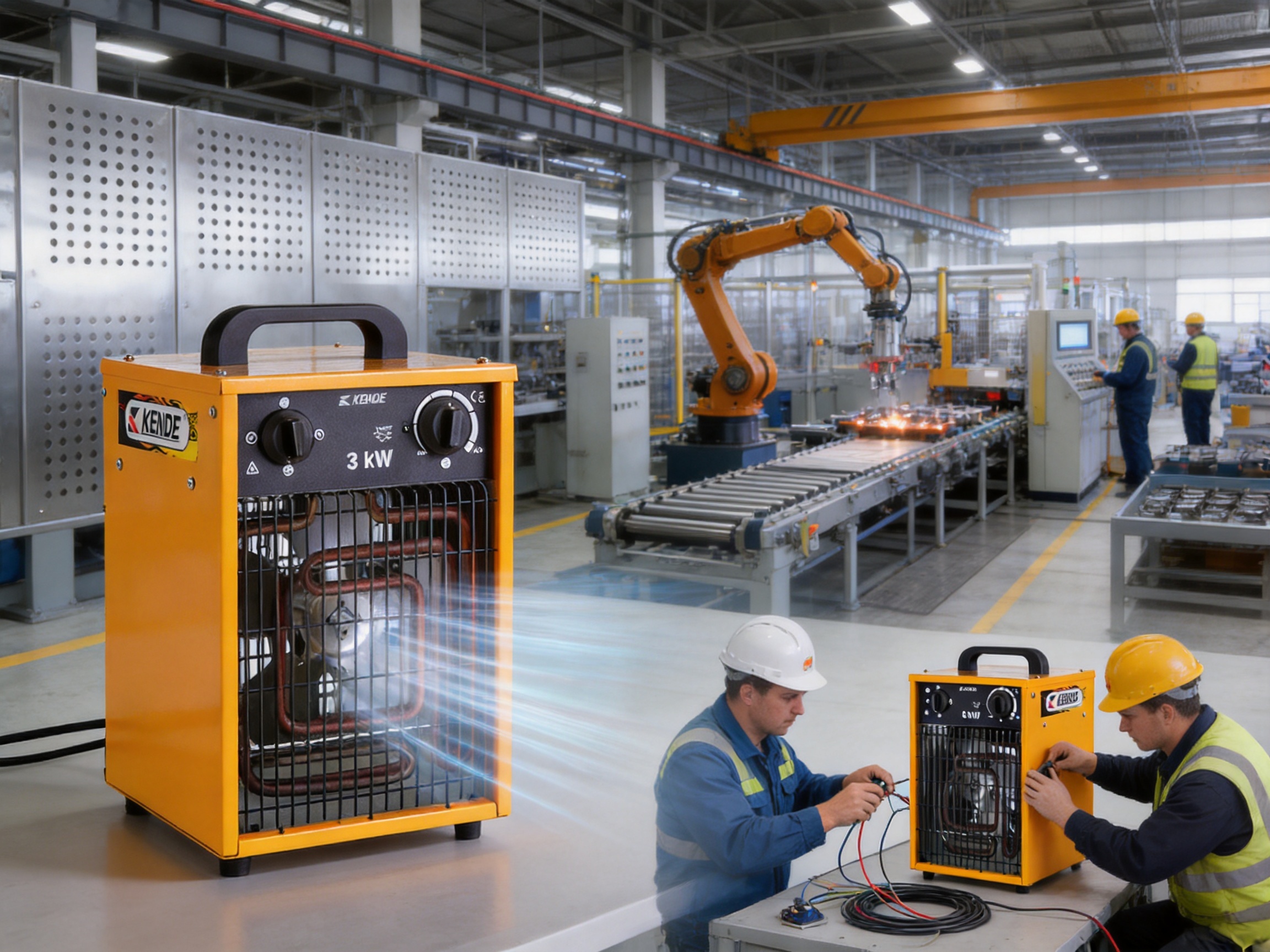
Portable electric fan heaters provide a practical way to deliver rapid, controllable heat wherever a temporary or supplementary heating solution is required. The HOT-100M/S, HOT-120M/S, HOT-130M/S, and PLanet-50 models are designed for warehouses, workshops, offices, family spaces, service areas, and other environments that need dependable warm air without combustion. Their combination of electrical resistance heating, forced-air circulation, adjustable temperature control, and portable construction makes them suitable for users who want immediate heating without installing a permanent heating system.
These heaters are engineered around a straightforward principle: an electric resistance element produces heat while a motor-driven fan distributes that heat throughout the room. Unlike fuel-fired heating equipment, they do not consume oxygen, produce combustion fumes, release fuel odors, or create additional humidity. This makes them especially useful in enclosed areas where air quality, cleanliness, and ease of operation are important.
The product range covers heating outputs from 2 kW to 5 kW, with rated heat air outputs from 180 m³/h to 400 m³/h. The smaller models are suitable for offices, home areas, workshops, and compact service rooms, while the larger PLanet-50 model provides increased heating capacity for larger spaces and more demanding applications. Each model is built with a steel housing, an insulated handle, automatic reset protection, a built-in room thermostat, and an overheat thermostat.
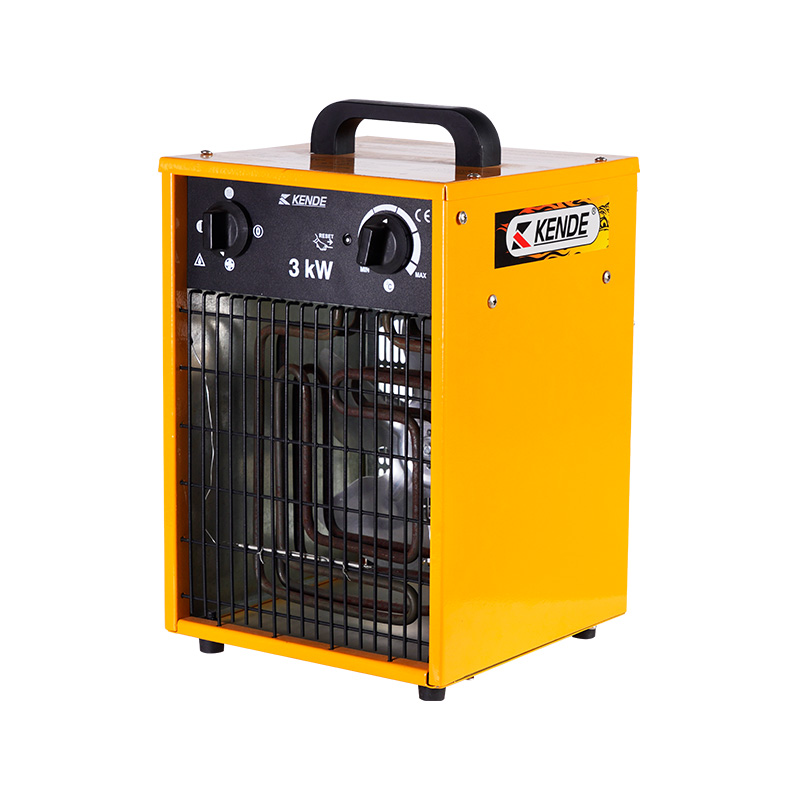
HOT-100M/S HOT-120M/S HOT-130M/S PLanet-50 Electric fan heaters
The four models serve different heating requirements while maintaining the same general operating concept. The HOT-100M/S has a rated output of 2 kW and a heat air output of 180 m³/h. With a recommended heating area of approximately 20 square meters, it is a compact choice for a small office, guard room, workshop corner, home utility room, or temporary work area.
The HOT-120M/S increases the rated output to 3 kW and the air delivery to 300 m³/h. It is intended for spaces of approximately 30 square meters, depending on insulation, ceiling height, outdoor temperature, door opening frequency, and the desired indoor temperature. This model offers a useful balance between portability and heating performance.
The HOT-130M/S delivers 3.3 kW of output and is rated for an approximate heating area of 33 square meters. Its airflow is also 300 m³/h. This additional electrical and thermal capacity makes it suitable for users who need a little more heating power than the HOT-120M/S while retaining a similarly compact footprint.
The PLanet-50 is the largest model in the range. It provides 5 kW of output, a 400 m³/h heat air output, and an approximate heating area of 48 square meters. Unlike the other listed models, it uses a three-phase AC380V–400V, 50 Hz supply. This makes it particularly appropriate for industrial workshops, larger service areas, warehouses, production rooms, and commercial locations where three-phase electrical power is available.
The stated heating areas are practical reference values rather than absolute guarantees. Actual performance depends on building construction, insulation, air leakage, local climate, desired temperature, and whether the heater is being used for maintaining temperature or raising the temperature from a cold starting point. Correct sizing is therefore important. A heater that is too small may operate continuously without achieving the desired comfort level, while an oversized heater may increase initial equipment cost and electrical demand.
| Model | Heat Output | Electrical Supply | Rated Power | Air Output | Approximate Heating Area | Weight | Dimensions |
|---|---|---|---|---|---|---|---|
| HOT-100M/S | 1,720 kcal/h | AC220V–240V, 50 Hz | 2 kW | 180 m³/h | 20 m² | 4.5 kg | 255 × 225 × 350 mm |
| HOT-120M/S | 2,580 kcal/h | AC220V–240V, 50 Hz | 3 kW | 300 m³/h | 30 m² | 5.5 kg | 278 × 255 × 425 mm |
| HOT-130M/S | 2,838 kcal/h | AC220V–240V, 50 Hz | 3.3 kW | 300 m³/h | 33 m² | 6.6 kg | 278 × 255 × 425 mm |
| PLanet-50 | 4,300 kcal/h | AC380V–400V, 50 Hz | 5 kW | 400 m³/h | 48 m² | 7.5 kg | 310 × 270 × 425 mm |
The main operating advantage of these heaters is the combination of resistance heating and fan-assisted air movement. The heating element raises the temperature of the air, and the fan pushes the warmed air into the room. This process helps distribute heat more quickly than a passive electric radiator, which depends primarily on natural convection and surface radiation.
Forced-air heating is especially useful in work environments where personnel need to feel warmth soon after entering a cold room. It can also help reduce temperature differences between areas of a room when the heater is positioned correctly. The fan continuously moves air through the heater, improving the transfer of heat from the resistance tube into the surrounding space.
The HOT-100M/S supplies up to 180 m³/h of heated air, while the HOT-120M/S and HOT-130M/S provide up to 300 m³/h. The PLanet-50 reaches 400 m³/h. These airflow levels are designed to support quick heating while maintaining a compact and portable form. The fan is also described as low-noise, which helps the heaters remain suitable for offices, service counters, indoor workspaces, and family environments where excessive mechanical noise would be undesirable.
Fan-assisted heating can also be more flexible than permanently installed systems. A portable unit can be moved to a different area as operating conditions change. For example, a workshop may need heat near a loading door in the morning, near a maintenance station during the day, and in a staff area later. A portable heater can be repositioned without modifying ductwork, walls, or electrical infrastructure beyond the required power connection.
The heating element is an electric resistance heating tube. When electrical current passes through the resistance material, electrical energy is converted into heat. Because the process does not rely on burning fuel, the heater does not consume oxygen and does not release combustion gases into the room.
This characteristic offers important advantages over LPG, diesel, kerosene, and fuel-oil heaters in enclosed or semi-enclosed areas. Fuel-fired equipment may require ventilation to manage combustion by-products, fuel odors, and oxygen depletion. Electric heating eliminates those combustion-related concerns during normal operation. It is therefore well suited to clean indoor applications, storage areas, offices, and workspaces where fumes could affect people, materials, or equipment.
The product information identifies the heaters as producing no fumes, no odors, and no humidity. This is valuable in environments where moisture or airborne contamination must be minimized. Dry electric heat can help avoid the additional moisture associated with certain combustion heaters, reducing the risk of condensation on tools, metal parts, packaging, and stored goods.
Electric heating also simplifies fuel management. There is no fuel tank to fill, no fuel line to inspect, and no need to store combustible liquid or gas near the workplace. Users can concentrate on electrical safety, airflow, cleaning, and thermostat settings rather than on fuel handling and combustion maintenance.
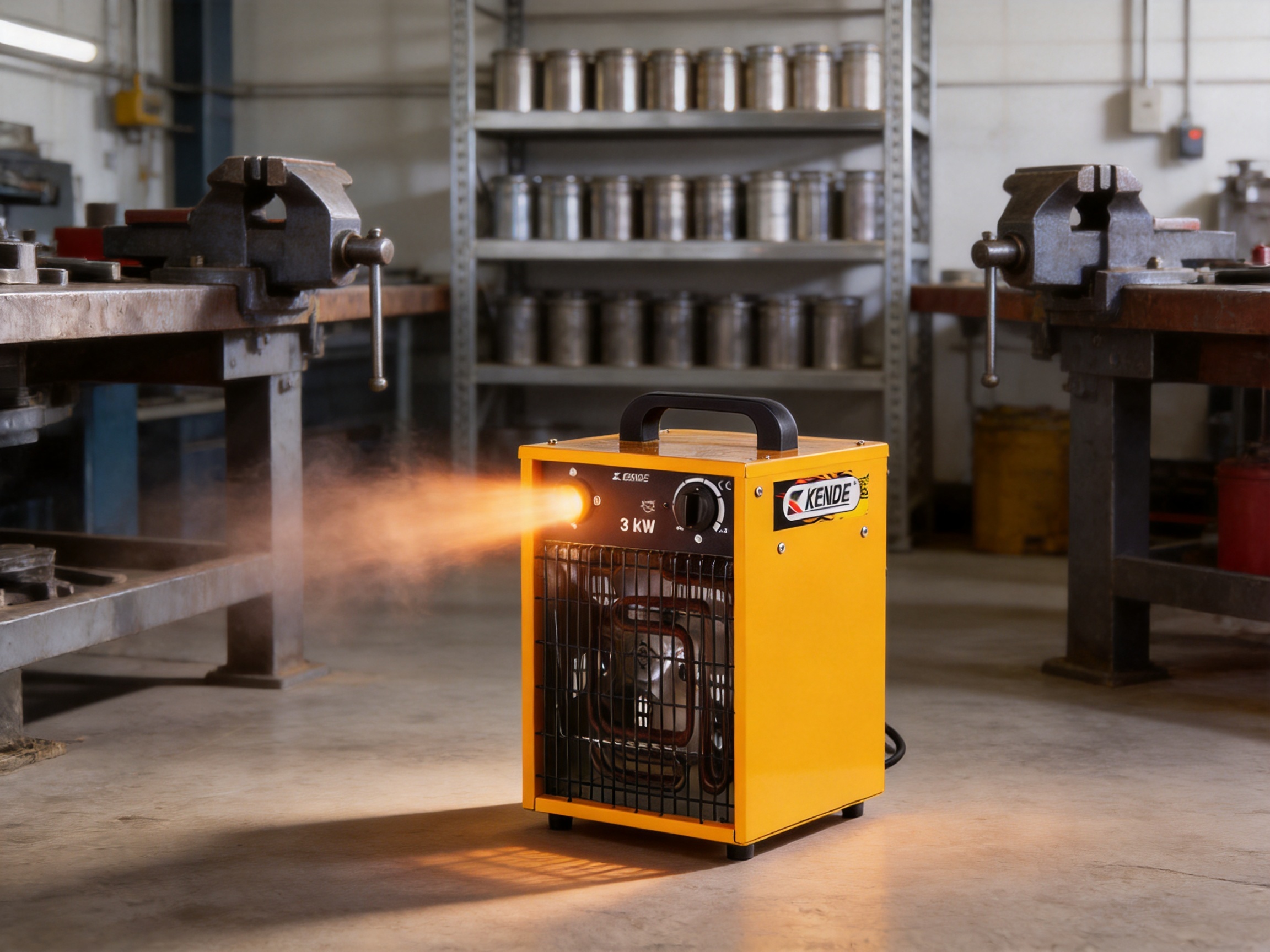
Portability is a central feature of this heater series. The units are relatively light, ranging from 4.5 kg for the HOT-100M/S to 7.5 kg for the PLanet-50. An insulated handle allows the operator to move the heater with reduced contact risk after normal use, provided the unit has been switched off and allowed to cool as required.
The steel housing provides a solid enclosure for the motor, heating element, fan, and control components. Steel construction is well suited to workshops and service environments because it offers mechanical rigidity and durability. The housing is finished with anti-high-temperature paint, helping the external enclosure withstand the heat generated during operation and contributing to a more durable appearance under regular use.
The compact dimensions also support easy storage. The HOT-100M/S measures 255 × 225 × 350 mm, while the HOT-120M/S and HOT-130M/S measure 278 × 255 × 425 mm. The PLanet-50 measures 310 × 270 × 425 mm. These dimensions allow the units to be placed on suitable floors or work areas without occupying excessive space.
Although the heaters are portable, they should always be positioned on a stable, level surface with sufficient clearance around the air inlet and outlet. Airflow must not be blocked by boxes, curtains, furniture, tools, or other equipment. Proper positioning helps the fan operate efficiently, reduces the likelihood of overheating, and improves the distribution of warm air.
Each model includes a built-in room thermostat and a temperature control function. The operator can adjust the desired temperature according to the requirements of the space. Once the room reaches the selected level, the control system can reduce or stop the heating function, depending on the operating design and control setting, and restart heating when the temperature falls.
Thermostatic control is more practical than operating a heater continuously at full output. It helps maintain a more stable indoor temperature and can reduce unnecessary energy consumption when the room has already reached a comfortable level. It also allows the same heater to serve different conditions. A user may select a lower setting for frost protection, a moderate setting for office comfort, or a higher setting for warming a cold workshop.
The thermostat should be located where it can sense representative room temperature. If the heater is placed directly beside a doorway, in a narrow corner, or next to another heat source, the thermostat may detect a temperature that does not reflect the rest of the room. Good placement improves control accuracy and helps prevent short cycling or prolonged operation.
Temperature control is especially important in warehouses and storage rooms. Excessive heat may be unnecessary for stored goods, while insufficient heat may allow condensation or uncomfortable working conditions. Adjustable control gives operators greater flexibility than fixed-output heating products.
Safety and reliability are supported by several integrated protective features. The heaters include an automatic reset function and an overheat thermostat. These features are intended to help protect the equipment if the internal temperature rises beyond the normal operating range.
An overheat thermostat can interrupt or limit heating when excessive temperature is detected. This may occur if airflow is restricted, the air inlet is covered, the outlet is obstructed, or the heater is operated in unsuitable conditions. After the unit cools and the cause of the problem is corrected, the automatic reset function can support a return to normal operation, according to the design of the control system.
Protective controls are not a substitute for correct operation. The user should still keep the heater away from flammable materials, avoid covering the housing, inspect the power cable and plug, and use an electrical supply that matches the model rating. Extension cables, if permitted by local requirements, must be correctly rated for the heater’s current and operating environment.
The listed protection class is IP42 for all four models. This rating indicates a defined level of protection against solid objects and vertically or diagonally falling water under specified test conditions. It does not mean that the heater is waterproof or suitable for outdoor exposure, rain, washdown areas, or wet locations. The heater should be kept dry and used only in environments appropriate for its electrical protection rating.
Fuel-fired heaters can provide high heat output, but they generally require fuel storage, refueling, ventilation, and more attention to combustion-related maintenance. They may also produce odors, fumes, carbon dioxide, water vapor, or other combustion by-products depending on the fuel and heater design. The electric fan heater avoids these issues during operation because it creates heat through electrical resistance rather than combustion.
This makes the electric design a strong option for offices, enclosed workshops, retail back rooms, family spaces, and areas containing sensitive materials. It also simplifies start-up. Users do not need to check a fuel level, connect a gas cylinder, or manage a liquid-fuel tank before heating begins. Once connected to the correct electrical supply, the heater can be controlled through its switches and thermostat.
Passive electric radiators can provide quiet, comfortable heat, but they normally rely on natural convection and may warm a room more gradually. The fan-assisted design moves warm air actively, making it more appropriate when rapid temperature change is important. It can also direct heat toward a specific work area, although the outlet should never be aimed at combustible materials or obstructed.
The portable fan format may also be lighter and easier to relocate than large oil-filled or panel-style electric radiators. The trade-off is that the fan produces some operating noise and requires periodic attention to dust accumulation. For workshops and temporary heating applications, the advantages of rapid airflow and mobility can outweigh these considerations.
Central heating, fixed electric heaters, and ducted systems may offer comprehensive building-wide temperature control, but they require greater installation cost and planning. Portable units can be deployed immediately in a new workspace, temporary structure, rented facility, production area, or seasonal location. They are also useful as supplementary heaters when a permanent system cannot provide adequate warmth in a particular zone.
Portable equipment allows heating to follow the work rather than forcing the work to remain in a fixed location. This flexibility is valuable for maintenance teams, construction environments, warehouses with changing layouts, and businesses that need occasional heating in different spaces.
The HOT-100M/S, HOT-120M/S, and HOT-130M/S models are rated for AC220V–240V at 50 Hz. The PLanet-50 is rated for AC380V–400V at 50 Hz. Electrical compatibility must be confirmed before purchase and installation. The voltage, phase arrangement, frequency, plug configuration, circuit capacity, and local regulations should all be considered.
A 2 kW heater generally places a lower demand on a circuit than a 3 kW or 3.3 kW heater, while the 5 kW PLanet-50 requires a suitable three-phase supply. The electrical installation should be able to handle the heater’s rated load continuously, with appropriate overcurrent protection and grounding. Industrial users should have the three-phase model connected and checked by qualified personnel where required by local rules.
Users should avoid sharing an undersized circuit with other high-power appliances. If a heater causes repeated circuit trips, the problem should be investigated rather than bypassed. Repeated tripping may indicate insufficient capacity, a damaged cable, an installation issue, or a fault in another connected appliance.
Because electric resistance heaters convert nearly all consumed electrical energy into heat at the point of use, their operating cost is closely related to the local electricity tariff and the duration of operation. Thermostatic control, proper room insulation, closed doors, and suitable heater sizing can help manage energy use. The heater should not be operated at maximum output when a lower setting is sufficient.
The manufacturer behind this product range operates as a large-scale producer of welding machines, battery chargers, and electric, gas, and oil heaters. Its reported facilities cover approximately 120,000 square meters and employ around 600 people. Annual exports are described as nearly 1.5 million units, with annual production capacity reaching approximately 2 million units.
This scale provides several advantages for heater production. High-volume manufacturing can support dedicated production planning, standardized component control, process repeatability, and stable supply arrangements. It also allows engineering teams to collect feedback from multiple markets and use that information to improve product design, packaging, compliance, and service support.
The company’s product development background extends across electrical heating, welding power electronics, motor-driven equipment, and charging systems. Experience in these areas is relevant to fan heater production because reliable heaters require coordinated control of electrical input, thermal output, motors, insulation, switches, protective devices, and mechanical housing.
The manufacturer reports using advanced production and management systems, including office automation, enterprise resource planning, manufacturing execution systems, and Toyota-style production management methods. These systems can help connect purchasing, production scheduling, inventory, quality inspection, traceability, and shipment preparation.
Reported manufacturing technologies include automatic patching, plug-in and welding systems, robot processing, laser cutting, and other automated operations. Laser cutting can support accurate preparation of steel housing components, while automated processing can improve repeatability across large production batches. Robotic and semi-automated operations may also reduce variation in repetitive tasks and support consistent assembly standards.
For a portable heater, manufacturing consistency matters. The fan must be correctly aligned, the heating element must be securely installed, the housing must maintain proper clearances, and control components must function reliably. A strong production system helps ensure that these details are managed consistently from one unit to the next.
The manufacturer reports holding international product certificates and compliance credentials including GS, CE, EMC, ERP, US ETL, UKCA, and China CCC. The exact certification applicable to a specific model, voltage version, destination market, and production batch should always be confirmed through the relevant technical documentation. Nevertheless, experience with international certification demonstrates an understanding of the testing, documentation, labeling, and production controls required for global distribution.
Electromagnetic compatibility is particularly relevant to electrically controlled heaters. A compliant product should operate without causing unacceptable interference and should maintain normal function in an appropriate electromagnetic environment. Energy-related requirements may also apply depending on the product category and destination market.
The company reports having a provincial research and development center, an enterprise technology center, and an intelligent welding technology research institute. It also reports a team of 98 research and development personnel. Although the company is widely associated with welding equipment, this engineering infrastructure can support the design of related electrical products such as heaters and chargers.
Reported intellectual property includes invention patents, utility model patents, appearance patents, and software copyrights. Patent numbers and technical claims should be reviewed in official documentation when a project requires detailed verification. For buyers, the broader significance is that the manufacturer maintains an ongoing product development program rather than relying solely on static, unchanging designs.
The product information identifies easy maintenance as one of the advantages of the heater range. A simple construction with a steel housing, resistance heating tube, fan motor, thermostat, and protective controls can make routine inspection more straightforward than the maintenance of a combustion heater with fuel, ignition, and exhaust components.
Before maintenance, the heater must be switched off, disconnected from the power supply, and allowed to cool fully. Dust and debris should be removed from the air inlet and outlet using a suitable method. Accumulated dust can restrict airflow, reduce heating performance, increase fan load, and contribute to overheating. The external housing should be kept clean and dry.
The power cable, plug, switches, handle, and housing should be inspected regularly. Signs of melting, discoloration, cracking, loose connections, unusual noise, burning odor, or repeated protective shutdown should be treated as reasons to stop operation and arrange qualified inspection.
The fan should rotate freely and without unusual vibration. A change in motor noise may indicate dust accumulation, bearing wear, a loose component, or an obstruction. Users should not dismantle electrical or thermal safety components unless they are qualified and authorized to do so. Replacement parts should match the original electrical and thermal specifications.
When stored for a long period, the heater should be cleaned, disconnected, protected from moisture, and placed where the housing and handle will not be damaged. The cable should not be tightly bent or crushed. Before the next season, the unit should be inspected again before being returned to service.
The first selection factor is the size and condition of the area to be heated. The stated reference areas are approximately 20 m² for the HOT-100M/S, 30 m² for the HOT-120M/S, 33 m² for the HOT-130M/S, and 48 m² for the PLanet-50. These figures assume conditions suitable for the product’s intended use. A poorly insulated warehouse or a room with frequently opened doors may require more capacity than a well-insulated office of the same floor area.
The second factor is the available electrical supply. The first three models require AC220V–240V, 50 Hz. The PLanet-50 requires AC380V–400V, 50 Hz. A three-phase model should not be connected to an unsuitable single-phase supply. Likewise, a model must not be used on a voltage or frequency outside its rated specifications.
The third factor is portability. If operators need to carry the heater between rooms, the 4.5 kg HOT-100M/S may be the most convenient option. If greater heat output is more important and the heater will be moved less frequently, the heavier models may be preferable.
The fourth factor is airflow. Higher airflow can help distribute heat through a larger room, but airflow should be considered together with room layout. A heater placed in a large open space may distribute heat differently from one used in a narrow room with partitions or machinery.
The fifth factor is the operating environment. These heaters are designed for dry indoor applications and should not be treated as waterproof equipment. If the space contains dust, moisture, chemicals, or flammable vapors, the user must confirm suitability with the manufacturer and applicable safety requirements before installation.
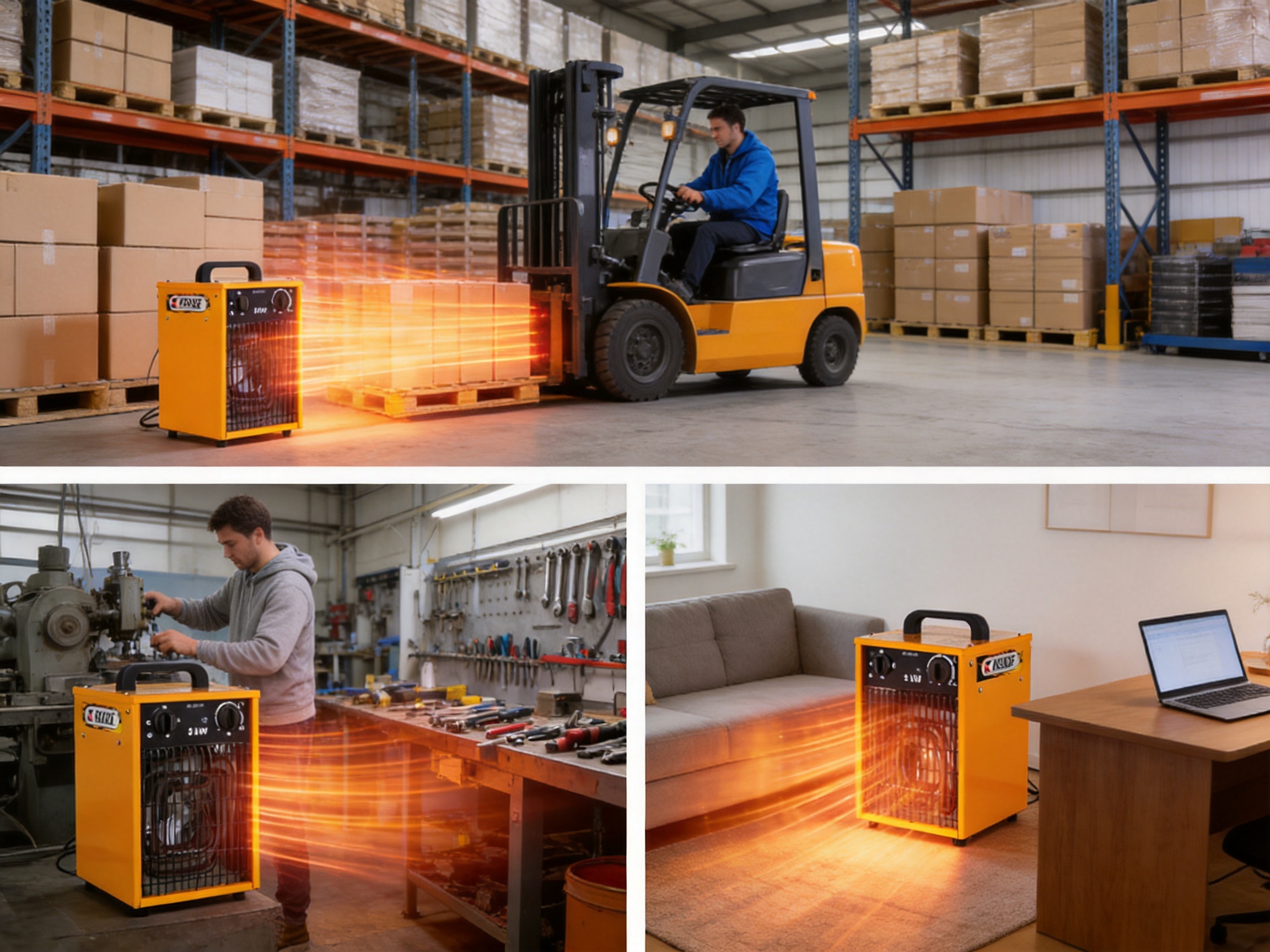
In warehouses, portable electric fan heaters can provide localized warmth near packing stations, dispatch areas, security desks, or maintenance points. They are particularly useful where heating the entire building would be inefficient. Operators should keep the heater clear of cartons, plastic wrapping, pallets, dust, and other combustible materials.
Workshops often have changing work locations and large doors that allow warm air to escape. A portable heater can provide comfort near a bench or assembly station without requiring a permanent installation. The steel housing and insulated handle are practical for this type of environment, but the heater must be protected from metal dust, liquid splashes, welding sparks, and direct contact with tools or materials.
The lower-output models can provide supplementary heat in offices, reception areas, home utility rooms, and family spaces. Low-noise fan operation and the absence of fumes and odors are important benefits in occupied indoor areas. The thermostat can help maintain a comfortable temperature without requiring constant manual adjustment.
Retail back rooms, service counters, garages, temporary work rooms, and small commercial spaces may benefit from the rapid deployment of these heaters. Their compact dimensions make them easier to store outside operating hours. Commercial users should establish procedures for placement, daily inspection, cleaning, and electrical safety.
Place the heater on a firm, level, noncombustible surface. Maintain clear space around the inlet and outlet, and ensure that warm air is not directed at combustible objects, liquids, electrical cables, or people at uncomfortably close range. Do not cover the unit or use it as a shelf, drying rack, or support for other items.
Before operation, check that the supply voltage corresponds to the nameplate. Confirm that the power cable and plug are undamaged and that the socket or connection point is suitable for the rated current. The heater should be grounded where required. Do not use a damaged unit or attempt to defeat a protective device.
Allow the fan and heating system to operate according to the manufacturer’s instructions during start-up and shutdown. If the model includes a fan-only or cooling period, users should not interrupt it unnecessarily. This can help remove residual heat from the heating element and internal housing.
Keep children and untrained persons away from the heater during operation. Operators should understand the thermostat, power controls, reset function, and emergency shutdown procedure. If the unit emits an unusual smell, makes abnormal noise, trips protective equipment repeatedly, or becomes excessively hot externally, disconnect it safely and arrange inspection.
These are portable electric fan heaters that use resistance heating tubes and forced-air circulation. The fan moves air across the heating element and delivers warm air into the surrounding room.
The product information states that they produce no fumes, no odors, and no humidity during normal electric heating operation. They do not use LPG, diesel, kerosene, or other combustion fuels.
The HOT-100M/S is the smallest model, with a 2 kW output, 180 m³/h airflow, and an approximate heating area of 20 m². Actual suitability depends on insulation, climate, ceiling height, and air leakage.
The HOT-120M/S has a 3 kW rated output and is listed for approximately 30 m², while the HOT-130M/S has a 3.3 kW output and is listed for approximately 33 m². Both provide 300 m³/h airflow and use AC220V–240V, 50 Hz power.
The PLanet-50 is the largest model in the listed range. It provides 5 kW of output, 400 m³/h airflow, and an approximate heating area of 48 m². It requires AC380V–400V, 50 Hz three-phase power.
The heater is intended for suitable indoor or protected environments. Its IP42 protection class does not mean that it is waterproof or suitable for rain, washdown, or direct outdoor exposure. Users should confirm environmental suitability before use.
Yes. The products include a built-in room thermostat and a temperature control function that allows the operator to adjust the desired temperature.
The heaters include an automatic reset function and an overheat thermostat. These features help protect the unit if the internal temperature rises above the normal operating range, although correct placement and operation remain essential.
Yes. They can be used for localized or supplementary heating in warehouses, particularly near workstations, loading areas, security desks, or packing stations. The heater must be kept away from combustible packaging and must have adequate airflow clearance.
Disconnect the unit and allow it to cool before cleaning. Keep the air inlet and outlet free from dust and obstructions, inspect the cable and housing, and monitor the fan for unusual noise or vibration. Electrical and thermal components should be serviced only by qualified personnel.
The manufacturer reports broad export experience, high production capacity, international certifications, research and development resources, and automated manufacturing technologies. Buyers should still confirm the exact certification, voltage version, plug type, documentation, and destination-market requirements for the selected model.
For distributors, contractors, and industrial purchasers, product quality is only one part of a successful procurement decision. Consistent supply, repeatable specifications, technical documentation, packaging, certification support, and after-sales communication are equally important. A manufacturer with substantial production capacity and an established export operation may be better positioned to support recurring orders and different regional requirements.
The company’s experience across welding machines, chargers, and heaters indicates a broad electrical manufacturing base. Its reported use of ERP, MES, automated production equipment, laser processing, robotics, and dedicated research facilities supports a more integrated approach to product development and manufacturing. These capabilities can help improve consistency, shorten development cycles, and support customization where market requirements differ.
For buyers considering private-label or regional distribution, important questions include minimum order quantities, available voltage versions, plug standards, packaging options, spare parts, warranty terms, user manuals, certification files, and production lead times. These commercial details should be agreed in writing before an order is placed.
The ability to develop products for different countries and customer requirements is also valuable. Electrical standards, climate conditions, plug systems, language requirements, labeling rules, and energy regulations vary between markets. A manufacturer with international experience can help identify the technical information that must be confirmed before commercialization.
The HOT-100M/S, HOT-120M/S, HOT-130M/S, and PLanet-50 electric fan heaters provide a practical solution for rapid, clean, and controllable indoor heating. Their resistance heating tubes produce heat without combustion, while fan-assisted airflow distributes warmth quickly. The range offers outputs from 2 kW to 5 kW, airflow from 180 m³/h to 400 m³/h, and approximate heating areas from 20 m² to 48 m².
Portable steel housings, insulated handles, low-noise fan operation, built-in thermostats, automatic reset, overheat protection, and easy maintenance make the products suitable for workshops, warehouses, offices, family spaces, and commercial environments. Compared with fuel-fired alternatives, they avoid fuel handling, fumes, odors, oxygen consumption, and combustion humidity. Compared with passive electric heaters, they provide more active air movement and faster perceived heating.
The manufacturer’s reported production scale, international export experience, certification portfolio, research resources, and automated manufacturing systems add value for professional buyers. Laser cutting, robotic processing, automated electronic assembly, enterprise resource planning, and manufacturing execution systems can support repeatable production and consistent product quality.
Correct model selection remains essential. Buyers should match heating output to room size and insulation, confirm the available electrical supply, observe the IP42 environmental limitation, and establish safe placement and maintenance procedures. When selected and operated correctly, these portable electric fan heaters can provide dependable supplementary or localized heating with a simple, flexible, and efficient operating concept.
1. Product specification information for portable electric fan heaters, including rated output, airflow, heating area, dimensions, weight, voltage, and protection class.
2. Manufacturer-provided technical information concerning electric resistance heating elements, fan-assisted heating, thermostatic control, automatic reset, overheat protection, and maintenance.
3. General electrical equipment safety principles for portable heating appliances, including grounding, circuit capacity, clearance, ventilation, inspection, and safe operation.
4. General guidance on electromagnetic compatibility, energy-related product requirements, electrical protection classifications, and international conformity assessment.
5. Manufacturer-provided corporate information concerning production capacity, research and development resources, export activity, automated manufacturing systems, and quality certifications.
Recommended Products

Contact Us
No.2299, Luqiao Section, Shugang Avenue, Luqiao District, Taizhou, 318057 Zhejiang, PR China.
+86-576-82431568
 Privacy
China Welding Machine Factory
 English
 中文简体
 русский
 Español
 عربى
 Français
 Português
 Deutsch
 Український