Email: [email protected]
Email: [email protected]

Blog
 2026.10.22
 Blog
A dependable battery charger is an essential tool for workshops, vehicle owners, roadside-service providers, agricultural operators, fleet managers, and maintenance departments. When a vehicle battery is discharged, a conventional charger may restore its capacity gradually, but many situations also require an immediate starting function. The CD-FP series battery charger with jump-start capability combines both functions in one portable, wheeled machine. It is designed to charge 12V and 24V lead-acid batteries and provide a high-current boost for starting vehicles when the battery does not contain enough energy to crank the engine independently.
The series is built around a practical single-phase design with integrated overload protection, an analog ampere-meter, charging cables, two clamps, and an exchangeable fuse. Its wheeled chassis improves portability, while its selection of charging and starting capacities allows users to choose a model appropriate for passenger cars, vans, light trucks, and larger battery applications. The largest model in the supplied range delivers a maximum charging current of 75A and a starting current of 450A, providing substantial reserve power for demanding service work.
Manufactured by an established electrical-equipment producer with extensive experience in welding machines, battery chargers, heaters, and related products, the series benefits from mature production systems, engineering expertise, quality-control procedures, and large-scale manufacturing capabilities. These strengths help distinguish the product from basic consumer chargers that may lack a dedicated starting function, robust mobility, clear current monitoring, or a full range of professional safety features.
The CD-FP series is a portable battery charger and starter intended for lead-acid batteries with nominal voltages of 12V or 24V. It operates from a single-phase 230V, 50Hz power supply and supports two principal functions: controlled battery charging and high-current engine starting. The charging function is suitable for restoring energy to depleted batteries, while the boost or starting function is intended to assist engine cranking when a vehicle must be returned to service quickly.
Unlike a small maintenance charger, this product is designed as a workshop and service machine. It is mounted on wheels, allowing the operator to position the unit near the vehicle without lifting the complete charger. A built-in ampere-meter gives a direct indication of charging current, helping users observe the charging process and identify abnormal conditions. The front controls provide a straightforward operating experience for technicians who need practical equipment rather than a complicated menu-driven system.
The charger is suitable for various cars, vans, and light trucks. Depending on the model, the recommended battery-capacity range extends from approximately 70Ah to 900Ah. This broad range makes the series appropriate for both everyday automotive service and heavier-duty maintenance environments. The CD-1000 model, for example, provides up to 70/75A of charging current and a 450A starting current, making it the highest-capacity model listed in the supplied specifications.
The product is supplied with essential operating accessories, including charging cables, two battery clamps, and an exchangeable fuse. Providing these components with the machine reduces the need for users to purchase separate connection equipment and helps ensure that the charger is ready for service after installation and inspection.
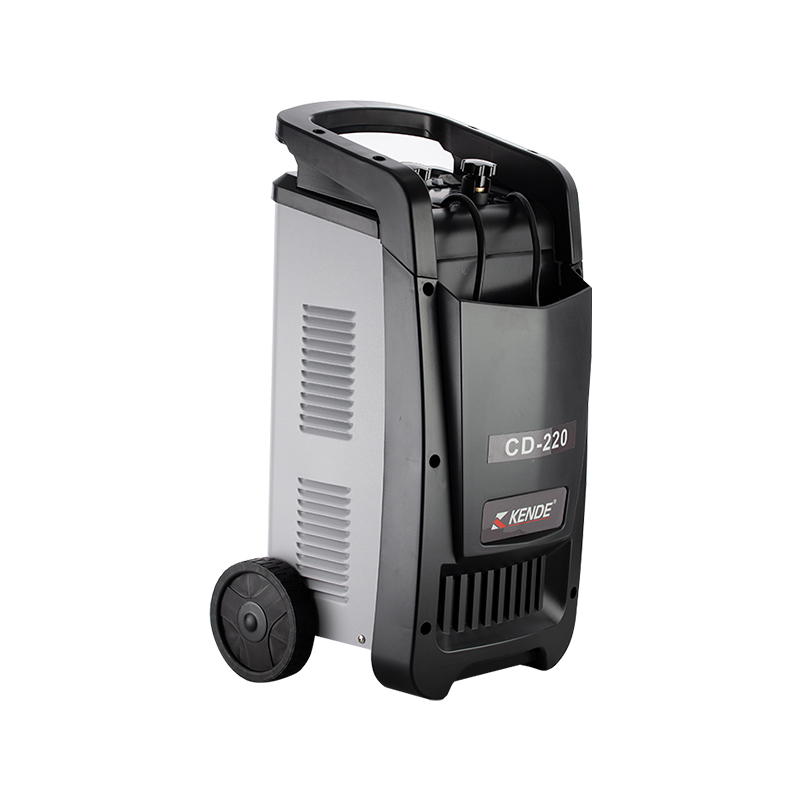
CD-FP series battery charger with jump start function 12/24V max charging current 75A, start current 450A
The ability to work with both 12V and 24V systems is one of the product’s most important advantages. Passenger cars and many light commercial vehicles commonly use 12V electrical systems, while certain trucks, commercial vehicles, agricultural machines, and specialist equipment use 24V systems. A dual-voltage charger eliminates the need to maintain separate machines for these two common battery configurations.
Before connecting the charger, the operator selects the correct charging voltage for the battery system. Correct voltage selection is essential because connecting a 12V battery to an unsuitable setting may damage the battery or vehicle electrical system. The dual-voltage design provides flexibility, but it also requires the user to follow the operating instructions and confirm the vehicle’s system voltage before charging or starting.
The available models provide different charging-current levels. Lower-capacity versions are appropriate for standard automotive batteries and general workshop use, while higher-capacity versions are suitable for large battery banks or vehicles with greater starting requirements. The range allows buyers to match equipment capacity with their typical workload instead of paying for a larger machine when it is not necessary.
A discharged battery may still be physically sound but unable to deliver enough current to operate a starter motor. The boost function supplies a high current for a limited starting operation, assisting the battery during engine cranking. This feature is valuable in repair shops, vehicle depots, emergency maintenance situations, and seasonal operations where equipment may remain unused for extended periods.
The CD-1000 model is specified with a 450A start current. This level is substantially higher than the output of ordinary low-power battery chargers and is intended for demanding automotive starting applications. The product title identifies the range as offering a maximum charging current of 75A and a start current of 450A, making the upper model a practical choice for users who require both regular charging and powerful starting support from one machine.
A jump starter should be used only in accordance with the manufacturer’s instructions. The operator should check battery polarity, select the proper voltage, secure the clamps, and keep the starting period within the recommended operating limits. The starting function is designed to assist a vehicle’s own battery and electrical system; it is not a substitute for repairing a damaged battery, starter motor, alternator, or vehicle wiring.
The integrated ampere-meter is a useful feature for both charging and troubleshooting. By observing current behavior, the operator can gain an immediate indication of how the battery is accepting charge. A heavily discharged battery may initially draw a higher current, while the current may decrease as the battery voltage rises and its state of charge improves.
Current monitoring also helps technicians identify conditions that require attention. Unexpectedly low current may indicate a poor connection, a damaged cable, an incorrect control setting, or a battery that is unable to accept charge. Unusual current behavior may indicate a battery fault or an electrical issue in the vehicle. Although an ampere-meter does not replace professional battery testing equipment, it provides valuable information during routine service.
Overload protection helps protect the charger against excessive electrical demand during operation. Charging and starting batteries involve high currents, particularly when the starter motor is engaged. A protective system is therefore essential for reducing the risk of damage caused by unsuitable operating conditions, excessive load, or abnormal current draw.
The supplied specifications identify exchangeable fuses as part of the accessory and protection arrangement. Fuse protection provides a replaceable safeguard for the electrical circuit. If a fuse operates because of an overload or fault, the operator can inspect the equipment, correct the cause, and install an appropriate replacement. Replacement must always follow the specified rating; using an incorrect fuse can create a serious safety hazard.
The model range includes CD-220, CD-320, CD-420, CD-520, CD-620, and CD-1000. All listed models use a 230V, 50Hz single-phase supply, provide 12/24V charging voltage selection, and have an IP20 degree of protection. They differ primarily in charging current, boost current, starting current, fuse arrangement, recommended battery-capacity range, weight, and chassis size.
| Model | Supply Voltage | Frequency | Charging Voltage | Boost Current | Start Current | Rated Current | Reference Capacity | Weight | Machine Size |
|---|---|---|---|---|---|---|---|---|---|
| CD-220 | 230V | 50Hz | 12/24V | 20A | 130A | 16/18A | 70–300Ah | 17.2kg | 570 × 235 × 285mm |
| CD-320 | 230V | 50Hz | 12/24V | 30A | 170A | 20/22A | 80–450Ah | 17.5kg | 570 × 235 × 285mm |
| CD-420 | 230V | 50Hz | 12/24V | 40A | 250A | 25/27A | 100–600Ah | 18.5kg | 570 × 235 × 285mm |
| CD-520 | 230V | 50Hz | 12/24V | 50A | 300A | 25/30A | 120–750Ah | 28kg | 670 × 385 × 300mm |
| CD-620 | 230V | 50Hz | 12/24V | 60A | 320A | 30/35A | 140–900Ah | 28.4kg | 670 × 385 × 300mm |
| CD-1000 | 230V | 50Hz | 12/24V | 70/75A | 450A | 40/45A | 160Ah and above as listed | 28.4kg | 670 × 385 × 300mm |
The CD-220 is a compact entry model for standard automotive service. Its 130A starting current and 20A boost-current rating are suitable for many passenger cars and smaller batteries. The CD-320 increases output to 30A boost current and 170A starting current, offering additional reserve for vans and larger automotive batteries.
The CD-420 provides 40A boost current and 250A starting current. It is a practical mid-range option for workshops serving mixed vehicle types. Its reference capacity of 100–600Ah allows it to cover a broad range of battery applications without the physical size of the largest units.
The CD-520, CD-620, and CD-1000 use the larger chassis. These models are intended for users who regularly charge larger batteries or require stronger starting performance. The CD-620 combines a 60A boost current with a 320A start current, while the CD-1000 provides the highest stated performance in the range. Buyers should select the model based on battery capacity, expected starting current, daily operating frequency, and available workshop space.
The rated-current figures in the table are listed as paired values for the 12V and 24V operating modes. The mains-fuse information supplied for the range is 2 × 80A for the CD-220, 3 × 80A for the CD-320 and CD-420, 4 × 80A for the CD-520, 5 × 80A for the CD-620, and 6 × 80A for the CD-1000. These values should be interpreted together with the official operating documentation and should not be changed without authorization.
Many small chargers are designed only for slow or moderate battery charging. When a vehicle needs to start immediately, the operator may need a separate jump starter or another vehicle. Combining charging and starting functions in one unit improves equipment efficiency and reduces the number of devices required in a workshop.
This integrated approach is particularly valuable for repair centers and fleet operations. A technician can use the machine to recharge a battery after service and later use the starting function to move the vehicle. In a vehicle depot, the same equipment can support routine battery maintenance and emergency starting. The dual-purpose design reduces storage requirements and simplifies purchasing, training, and equipment management.
Support for both 12V and 24V systems gives the range wider application coverage than a single-voltage charger. Cars, vans, light trucks, commercial vehicles, and some industrial or agricultural equipment can require different electrical configurations. A workshop with mixed customers benefits from one product family that covers several operating needs.
The range of models also allows a buyer to choose output according to actual use. A small repair shop may select the CD-220 or CD-320, while a commercial workshop or fleet maintenance facility may require the CD-620 or CD-1000. This scalable approach is more practical than purchasing a single oversized machine for every application.
The largest model’s 450A starting current is a major performance advantage. High starting output is useful when a vehicle battery is deeply discharged, when cold conditions increase engine resistance, or when the vehicle uses a relatively large engine and starter motor. The machine provides a strong electrical assist without requiring the operator to connect another vehicle as a temporary power source.
Starting performance depends on many factors, including battery condition, engine size, ambient temperature, cable quality, connection quality, and the condition of the vehicle’s starter system. Nevertheless, a charger with a high rated starting current offers greater reserve than a basic household charger and is better suited to professional service conditions.
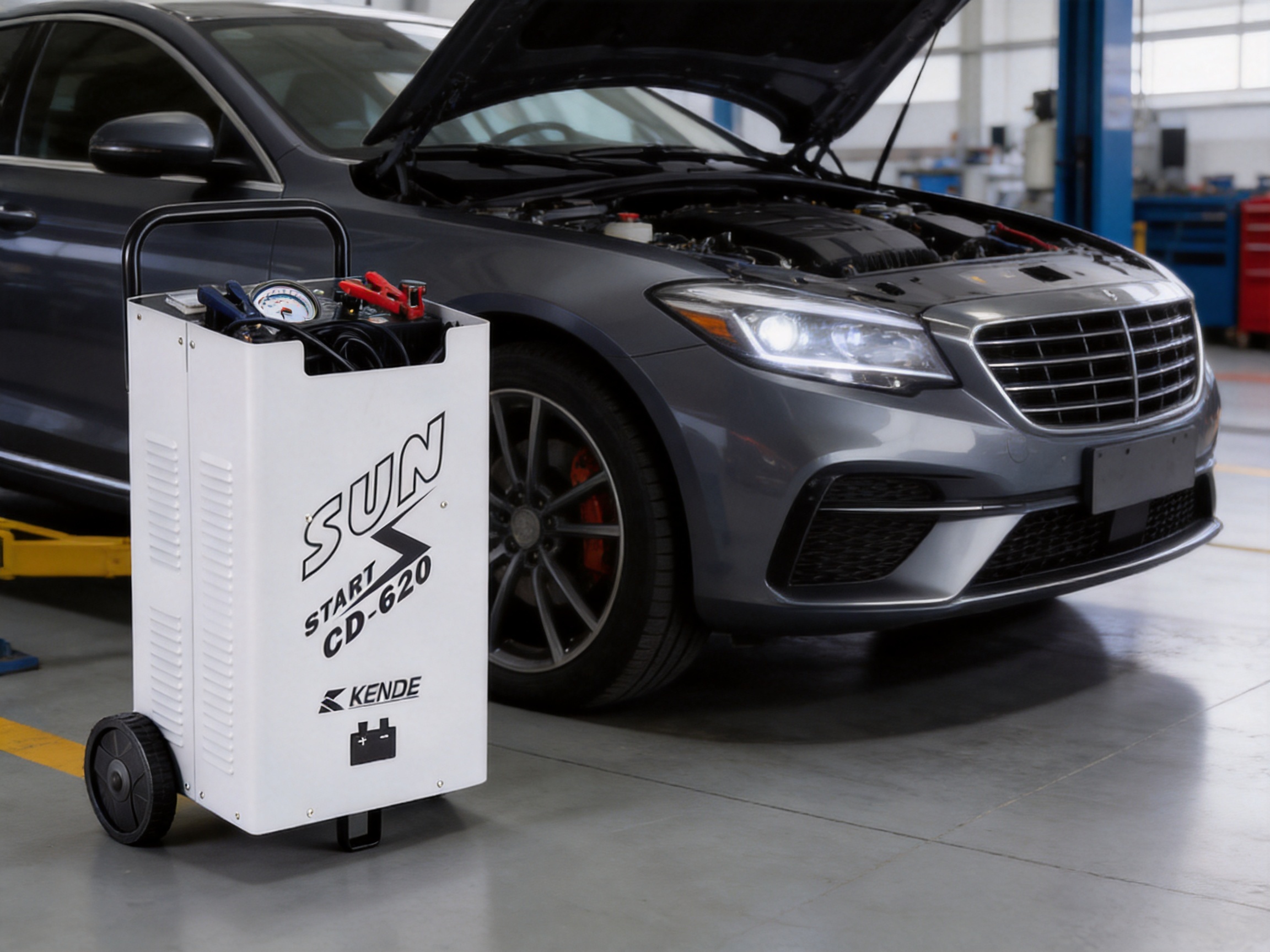
The wheeled construction supports practical movement around the workshop. Battery chargers with high current ratings can be heavy because of their transformer, housing, cables, and protective components. A wheeled frame reduces lifting and allows the unit to be positioned near the front or side of a vehicle.
The larger models measure 670mm long, 385mm wide, and 300mm high, while the smaller models measure 570mm long, 235mm wide, and 285mm high. These dimensions provide a useful balance between electrical capacity and portability. Users should maintain clear access around the unit and store it in a dry, clean area when it is not operating.
Professional equipment is not necessarily improved by excessive complexity. A clear control arrangement, direct current indication, voltage selection, and robust connection hardware can be more useful in daily service than a complicated interface. The product’s integrated ampere-meter allows technicians to see the charging current directly without navigating electronic menus.
Simple controls also make training easier. New operators can learn the basic sequence of identifying battery voltage, connecting the clamps, selecting the operating mode, monitoring current, and disconnecting the equipment. Clear procedures reduce errors and support consistent operation across different shifts.
Battery charging and engine starting involve electrical energy, high current, and potentially explosive gases from lead-acid batteries. Safe operation must therefore be treated as a core requirement rather than an optional practice. The charger includes overload protection and fuse protection, but these features work most effectively when combined with correct operating procedures.
Before use, the operator should inspect the housing, power cable, charging cables, clamps, wheels, control panel, and fuse condition. Damaged insulation, loose terminals, cracked clamps, or exposed conductors should be repaired or replaced before the machine is connected to a battery.
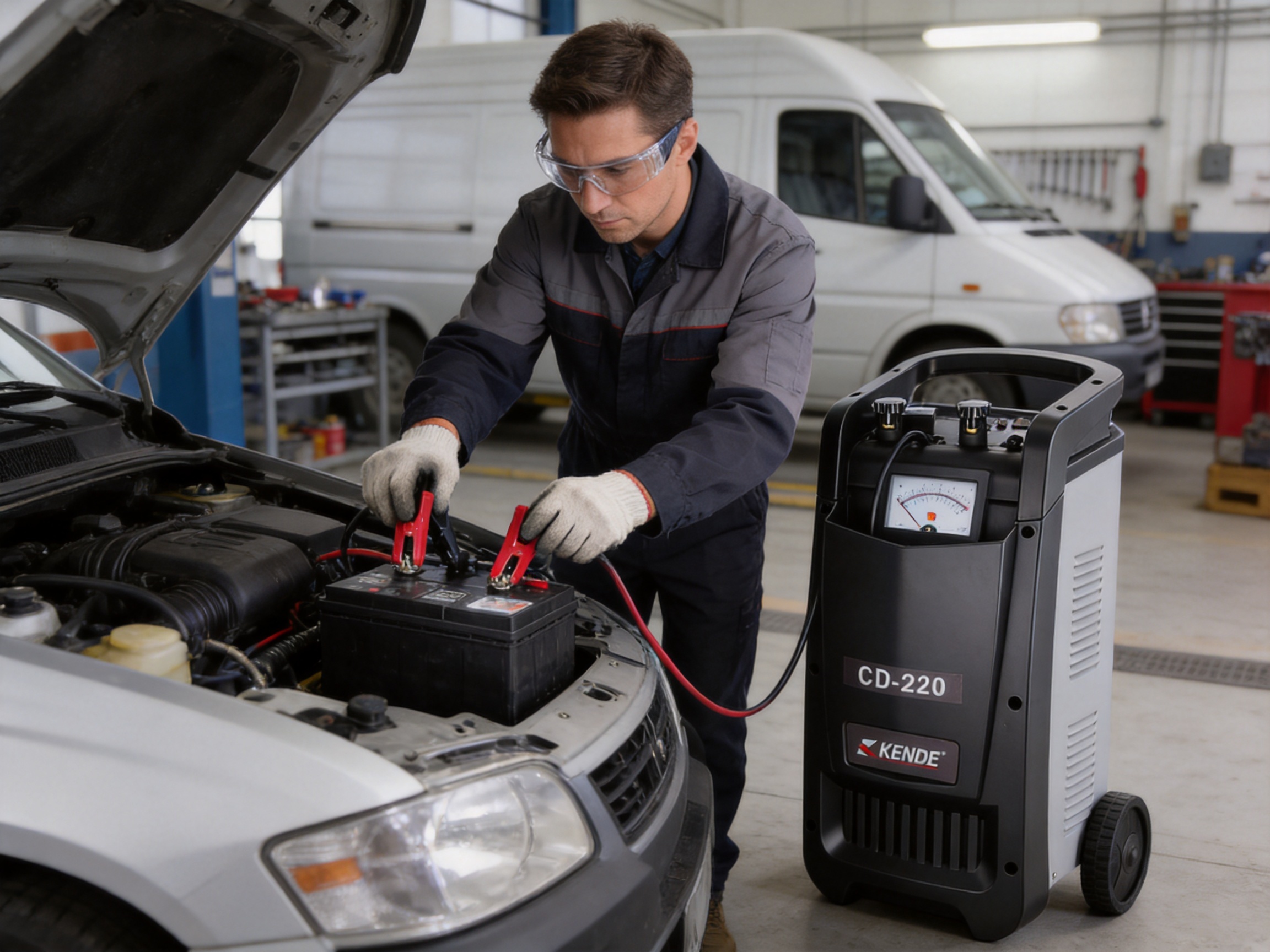
The work area should be dry, well ventilated, and free from open flames, sparks, and combustible materials. Lead-acid batteries can release hydrogen gas during charging. Ventilation reduces the possibility of gas accumulation. Operators should avoid smoking near the battery and should wear suitable eye and hand protection when working with batteries or making electrical connections.
The battery voltage must be identified before the charger is connected. The 12V or 24V setting should match the vehicle system. The positive clamp should be connected to the positive terminal and the negative clamp to the negative terminal, unless the vehicle manufacturer specifies an alternative connection procedure. Clamps should be secure and should not touch each other or unrelated conductive surfaces.
When charging is complete, the charger should be switched off or disconnected according to the operating instructions before the clamps are removed. This helps prevent sparks at the battery terminals. The operator should never attempt to start a vehicle while the charger is connected in an unauthorized or unsuitable mode, and should avoid prolonged repeated cranking that may overheat the equipment or starter system.
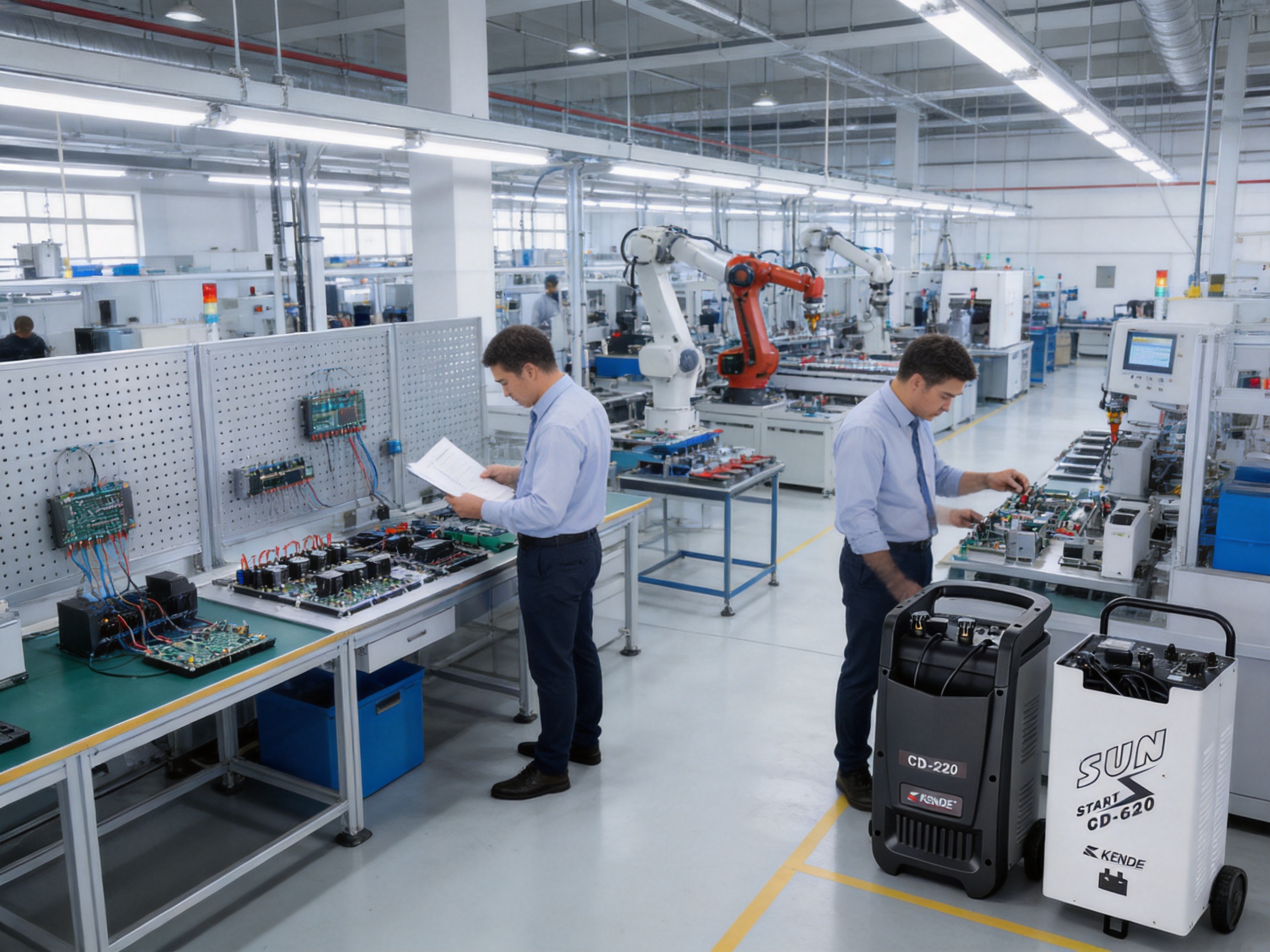
The company behind the product operates as a large manufacturer of electrical equipment, welding machines, battery chargers, and heating products. Its production site covers approximately 120,000 square meters and employs about 600 people. The company reports annual exports of nearly 1.5 million units and annual production capacity of approximately 2 million units. This scale supports stable sourcing, standardized manufacturing, production planning, and consistent quality procedures.
Large-scale production can provide several advantages to buyers. First, established production lines allow recurring models to be manufactured with repeatable processes. Second, engineering teams can improve components and assembly methods based on field experience. Third, higher production volume can support investment in automated equipment, testing systems, tooling, and supply-chain controls.
The manufacturer produces multiple categories of welding equipment, including manual arc welding machines, MIG/MAG machines, flux-cored welding machines, TIG machines, plasma cutters, stud welders, and submerged arc welding systems. It also develops battery chargers and electric, gas, and oil heaters. This broad product portfolio demonstrates experience with power conversion, electrical safety, thermal management, transformer and inverter technologies, control systems, metal fabrication, and equipment housings.
Although a battery charger is different from an arc-welding machine, the underlying manufacturing disciplines overlap in important areas. Both product categories require reliable electrical connections, current control, insulation, protective devices, durable enclosures, effective heat management, and repeatable assembly. Experience in high-current equipment can therefore support the design and manufacture of robust charging and starting products.
The company maintains a provincial research and development center, an enterprise technology center, and an intelligent welding technology research institute. It employs approximately 98 research and development personnel and has obtained invention patents, utility model patents, appearance patents, and software copyrights.
These resources support product development from concept through production. Engineering teams can evaluate circuit design, mechanical structure, user controls, thermal behavior, safety protection, manufacturability, and product certification requirements. A dedicated research structure also allows the manufacturer to respond to regional market needs and develop products with different specifications for different countries and vehicle applications.
Product development is especially important for equipment used in demanding working environments. A charger must balance output capability with physical size, heat generation, protection, portability, component life, and operating convenience. A mature engineering team can address these factors as part of a complete system rather than treating the charger as a collection of individual components.
The company applies several management and manufacturing systems, including office automation, Toyota Production System methods, ERP management, and MES manufacturing execution systems. These systems help coordinate purchasing, production scheduling, inventory, traceability, assembly, testing, and delivery.
Automated patching, plug-in, and welding systems are used in production, alongside robot processing and laser cutting. Automation can improve consistency in repetitive operations and reduce variation between units. Laser cutting can produce precise metal parts for housings, brackets, panels, and structural components. Robot processing can support repeatable fabrication while improving production efficiency and operator safety.
For a wheeled battery charger, accurate metal fabrication is important because the frame must support the weight of the electrical assembly, cables, and accessories. Correctly formed panels and brackets help maintain alignment, protect internal components, and provide a stable base. Consistent welding and finishing also contribute to long-term durability in workshop conditions.
The company holds or has worked with a range of international and domestic product certifications, including GS, CE, EMC, ERP, US ETL, UKCA, and China CCC certifications for applicable products. Certification requirements vary according to product type and destination market, so buyers should confirm the exact approvals applicable to the model and region being purchased.
Electrical equipment intended for international distribution must address more than basic operation. It may need to meet requirements relating to electrical safety, electromagnetic compatibility, energy performance, materials, labeling, documentation, and manufacturing controls. Familiarity with these requirements helps a manufacturer prepare products for export and reduces barriers for distributors serving multiple markets.
Electromagnetic compatibility is relevant to chargers because switching, rectification, transformers, and high-current circuits can produce electrical disturbances. Proper design and testing help limit unwanted emissions and improve immunity to external interference. Electrical safety evaluation addresses insulation, grounding, protective devices, accessible parts, temperature, and abnormal operating conditions.
The manufacturer also participates in national welding-machine standardization activities and has contributed to the drafting, formulation, and revision of numerous national standards. This involvement indicates familiarity with technical requirements and industry practices. While standardization participation does not replace product-specific certification, it reflects broader engagement with engineering and compliance work.
Manufacturing begins with defining the intended application. The product range is designed for lead-acid batteries, 12V and 24V systems, automotive and light commercial vehicles, and users who need charging and starting capability. Product planning includes selecting model capacities, current ratings, chassis dimensions, control layout, protection devices, and accessory requirements.
Offering several models enables the manufacturer to optimize each unit for a specific performance level. The smaller models use a more compact chassis, while the larger models provide increased current capacity and heavier-duty construction. This approach avoids making every customer purchase the largest product and allows distributors to build a complete range around different market segments.
The electrical assembly must be designed to manage both continuous charging and short-duration starting current. Components are selected for their ability to withstand the expected electrical and thermal stresses. Internal wiring, terminals, protective devices, switching elements, meters, and connection points must be assembled consistently and inspected carefully.
High-current cables and clamps are particularly important. They must provide a reliable connection with low resistance while remaining flexible enough for practical use. Poor connections can reduce starting performance, generate heat, and create safety risks. Proper crimping, fastening, routing, and insulation are therefore essential production steps.
The enclosure protects electrical components from accidental contact and provides the physical structure for controls and ventilation. The wheeled chassis supports portability and must remain stable while the unit is moved or positioned beside a vehicle. Sheet-metal processing, laser cutting, forming, welding, coating, and final assembly all contribute to the finished product.
Consistent fabrication improves appearance as well as function. Correctly aligned panels support accurate control installation. Smooth edges reduce the risk of cable damage or operator injury. A durable surface finish helps the charger withstand the normal wear associated with workshops, garages, and service vehicles.
Testing should confirm the correct operation of charging voltage selection, current output, starting function, meter indication, overload protection, fuse arrangement, insulation, grounding, and mechanical stability. Production testing helps identify wiring mistakes, loose connections, defective components, and abnormal electrical behavior before the product is packaged.
Quality control also involves inspection of accessories. Charging cables should be checked for correct length, insulation, termination, and polarity. Clamps should open and close correctly and maintain a firm grip on battery terminals. Wheels and handles should be secure, and the product should be packaged to protect the housing and controls during transport.
Automotive workshops frequently receive vehicles with discharged batteries. The charger can restore batteries during inspection, maintenance, and repair, while the starting function helps technicians move vehicles in and out of service bays. The integrated meter provides an immediate view of current behavior during charging.
A workshop can select a compact model for passenger cars or a higher-capacity model for vans and light trucks. If the shop handles a wide mixture of vehicles, a 12/24V model with a higher starting rating can reduce the need for multiple chargers.
Fleet vehicles may remain parked for long periods, especially seasonal vehicles, delivery units awaiting dispatch, or equipment undergoing maintenance. Battery charging can help prepare vehicles for service, while jump-start capability can reduce delays caused by discharged batteries.
Rental companies can use the equipment during vehicle intake and preparation. Because one machine supports both charging and starting, staff can address routine battery problems without arranging an external power source for every vehicle.
Commercial vehicles often use larger batteries or 24V systems. The higher-capacity models in the range are suitable for users who need additional charging current and stronger starting assistance. Before selecting a model, the operator should compare the vehicle’s battery capacity and starting requirements with the charger’s reference capacity and rated output.
Tractors, utility vehicles, generators, and seasonal machinery may remain unused during particular parts of the year. Batteries can lose charge during storage, and cold weather can make starting more difficult. A portable charger and starter can support maintenance programs and reduce downtime when equipment is returned to service.
The wheeled design supports service operations where equipment must be moved between vehicles in a workshop yard or depot. The charger is not a lightweight handheld jump pack, but its high-current capacity and full charging function make it useful where mains electricity is available and professional equipment is preferred.
Model selection should begin with the vehicle battery’s nominal voltage. A 12V vehicle requires the 12V setting, while a 24V vehicle requires the 24V setting. The next consideration is battery capacity. The listed reference-capacity ranges provide general guidance, but the battery manufacturer’s specifications and the charger’s operating manual should always take priority.
Starting current is another major factor. Users who mainly charge passenger-car batteries may not need the highest model. Users who support vans, light trucks, larger engines, or multiple vehicles may benefit from a higher starting rating. The expected frequency of starting operations should also be considered because repeated high-current use places greater demands on the machine and requires appropriate rest periods.
Physical working conditions matter as well. Smaller models are easier to store in limited spaces, while larger models offer increased output but require more room. Buyers should consider doorway width, workshop layout, storage location, cable reach, floor condition, and the distance between the charger and typical service vehicles.
Electrical supply should be verified before purchase. The supplied specifications identify a 230V, 50Hz single-phase input. Users in regions with different voltage or frequency requirements should consult the manufacturer or distributor to confirm availability of a suitable version. Connecting equipment to an unsuitable supply can damage the charger and create a safety hazard.
Place the charger on a stable surface near the vehicle, ensuring that the wheels are secure and the cables can reach the battery without strain. Inspect the charger and accessories before connection. Confirm that the battery is a lead-acid type compatible with the product and identify whether the vehicle uses a 12V or 24V system.
With the charger disconnected or switched to the appropriate inactive condition, connect the positive clamp to the positive battery terminal and the negative clamp to the negative terminal, following the manufacturer’s instructions. Confirm that the clamps are secure and cannot move during charging or starting.
Select the correct voltage and charging or starting mode. Connect the charger to the appropriate single-phase power supply. Monitor the ampere-meter and observe the battery and charger for unusual noise, smell, heat, smoke, or abnormal current behavior. If any unsafe condition occurs, stop operation and disconnect the power according to the prescribed procedure.
For starting assistance, operate the starting function only for the recommended duration. If the engine does not start, allow the charger and vehicle system to rest before attempting another start. Repeated unsuccessful attempts may indicate a defective battery, starter motor, fuel system, ignition system, or another vehicle fault.
After charging or starting, switch off or disconnect the charger as directed. Remove the clamps carefully, avoiding contact between them. Coil the cables without sharp bends, inspect the unit for damage, and store it in a dry, ventilated location.
Routine maintenance helps preserve performance and safety. Keep the housing free of dust, oil, moisture, and metal particles. Check ventilation openings and keep them unobstructed. Inspect cables and clamps regularly for cuts, exposed conductors, loose connections, corrosion, or heat damage.
The ampere-meter should remain readable and securely mounted. Controls should operate smoothly without excessive force. Wheels, handles, and frame components should be checked for looseness or damage, particularly if the charger is moved frequently across uneven floors.
Fuses should be replaced only with the correct type and rating. If a fuse repeatedly operates, the cause should be investigated rather than bypassed. Never bridge a fuse, install an oversized fuse, or operate the charger with damaged protective components.
Battery terminals should be clean enough to provide a reliable connection. However, operators should follow battery-service procedures and use suitable personal protective equipment when cleaning terminals. Maintenance work on the charger itself should be carried out by qualified personnel with the power disconnected.
A basic household charger may be economical for occasional slow charging, but it often lacks the output required for professional starting assistance. A separate portable jump starter may provide emergency starting power but may not offer the same charging range, continuous workshop use, current monitoring, or selectable 12/24V operation.
The CD-FP approach combines both functions in a wheeled machine. This can reduce the total equipment count and make the charger more useful throughout the working day. Instead of storing one device for charging and another for starting, a workshop can use a single product family with several capacity levels.
Compared with an improvised connection to another vehicle, a dedicated charger provides a more controlled and repeatable service method. It avoids tying up a second vehicle and may reduce the inconvenience of arranging an external power source. The built-in protection and current indication also provide more information than a simple set of jumper cables.
The product is not intended to replace every type of battery technology or every vehicle diagnostic system. Users should confirm compatibility with the battery type and follow vehicle-manufacturer instructions, especially for vehicles containing sensitive electronic control modules or specialized battery-management systems.
The manufacturer’s product portfolio covers welding machines, plasma cutting equipment, battery chargers, and heaters, including electric, gas, and oil-fired products. This breadth demonstrates the ability to design and manufacture equipment for both industrial and domestic users.
The company states that it can develop new products according to the needs of different regions, countries, and customers. For distributors and original-equipment buyers, this may be valuable when local markets require special voltage configurations, packaging, labels, accessories, performance levels, or certification documentation.
Custom development requires close technical communication. Buyers should provide information about target markets, supply voltage, battery types, expected vehicle applications, environmental conditions, language requirements, packaging standards, and compliance needs. A manufacturer with established research, production, and quality systems is better positioned to manage such projects than a trading company with no direct engineering or factory capability.
The company’s stated export experience and annual production volume also support large orders and repeat supply. Distributors can plan product ranges around several charger capacities, while professional users can standardize equipment across multiple workshops or service locations.
The supplied product information identifies the charger as suitable for lead-acid batteries. Users should confirm the exact battery type and charging requirements before operation. Batteries using specialized chemistries or electronic charging protocols should not be connected unless compatibility is specifically confirmed.
Yes. The listed models provide 12/24V charging-voltage selection. The operator must identify the vehicle’s electrical system and select the correct setting before charging or starting.
The CD-1000 provides the highest listed starting current, rated at 450A. It also provides a maximum charging or boost current of 70/75A according to the supplied specifications.
Yes. The product description states that the series is suitable for various cars, vans, and light trucks. Smaller models are generally appropriate for standard passenger-car batteries, while higher-capacity models are available for larger vehicles and more demanding service work.
The integrated ampere-meter indicates charging current. It allows the operator to observe how much current is flowing during operation and can provide useful information about charging progress and possible connection or battery problems.
Yes. The supplied accessories include charging cable, two clamps, and an exchangeable fuse. The exact accessory configuration should be confirmed with the seller for the selected model and destination market.
IP20 is the listed degree of protection for the models in the supplied table. It indicates protection against access to hazardous parts by a finger or similar object and no stated protection against water ingress. The charger should therefore be used indoors or in a dry, protected environment unless a different approved version is specified.
No. The charger can charge a suitable battery and assist starting, but it cannot repair internal battery damage, shorted cells, severe sulfation, broken terminals, or other physical defects. A battery that repeatedly loses charge should be professionally tested.
Selection should be based on battery voltage, battery capacity, required starting current, expected operating frequency, workshop space, and available supply voltage. The reference-capacity ranges in the technical table provide a starting point for selection.
The supplied information describes a charging and starting machine but does not identify it as an unattended automatic maintenance charger. It should therefore be operated under supervision and according to the official instructions. Users should not leave a battery connected for extended periods without confirming that the selected model and charging mode are designed for that purpose.
The wheeled design makes it easier to move the charger beside different vehicles. This is particularly useful because high-current charging and starting equipment may be too heavy or awkward to carry repeatedly.
Use the correct 12V or 24V setting, verify polarity, inspect cables and clamps, provide ventilation, keep sparks and flames away from the battery, use appropriate personal protective equipment, follow the starting-time limits, and replace fuses only with the correct rating.
The CD-FP series offers a practical combination of charging, boosting, and jump-start capability for lead-acid batteries. Its 12/24V flexibility, wheeled construction, integrated ampere-meter, overload protection, exchangeable fuse, and supplied accessories address the everyday needs of workshops and vehicle-service users.
The range is especially useful because it provides several capacity levels rather than forcing every customer into one oversized configuration. The CD-220 through CD-420 models serve general automotive applications, while the CD-520, CD-620, and CD-1000 provide greater output for larger batteries, commercial vehicles, fleet operations, and professional maintenance environments.
The highest model’s 450A starting current and up to 75A charging current provide a strong performance profile for a portable workshop machine. Its purpose is not merely to maintain a battery slowly but to support practical service work where vehicles must be charged, tested, or started efficiently.
Manufacturing capability is another significant strength. The producer combines large-scale production, research and development resources, automated manufacturing technologies, international certification experience, and a broad electrical-equipment portfolio. These capabilities support consistent production and provide a foundation for future product customization.
For distributors, repair shops, fleet operators, and professional users seeking a robust 12/24V charging and starting solution, the series represents a versatile alternative to basic chargers and separate emergency-starting devices. Correct model selection, safe operation, and appropriate maintenance will allow the equipment to deliver reliable service over its working life.
1. Product specification sheet for the CD-FP series battery charger and jump starter, including model ratings, dimensions, weights, current values, and reference battery capacities.
2. General operating principles for lead-acid battery charging and automotive jump-start equipment.
3. Electrical equipment safety practices for high-current charging and starting systems.
4. Manufacturer information concerning research and development, production capacity, manufacturing systems, certifications, and product categories.
5. General guidance for workshop battery maintenance, electrical connection inspection, fuse protection, and safe handling of lead-acid batteries.
Recommended Products

Contact Us
No.2299, Luqiao Section, Shugang Avenue, Luqiao District, Taizhou, 318057 Zhejiang, PR China.
+86-576-82431568
 Privacy
China Welding Machine Factory
 English
 中文简体
 русский
 Español
 عربى
 Français
 Português
 Deutsch
 Український