Email: [email protected]
Email: [email protected]

Blog
 2026.09.06
 Blog
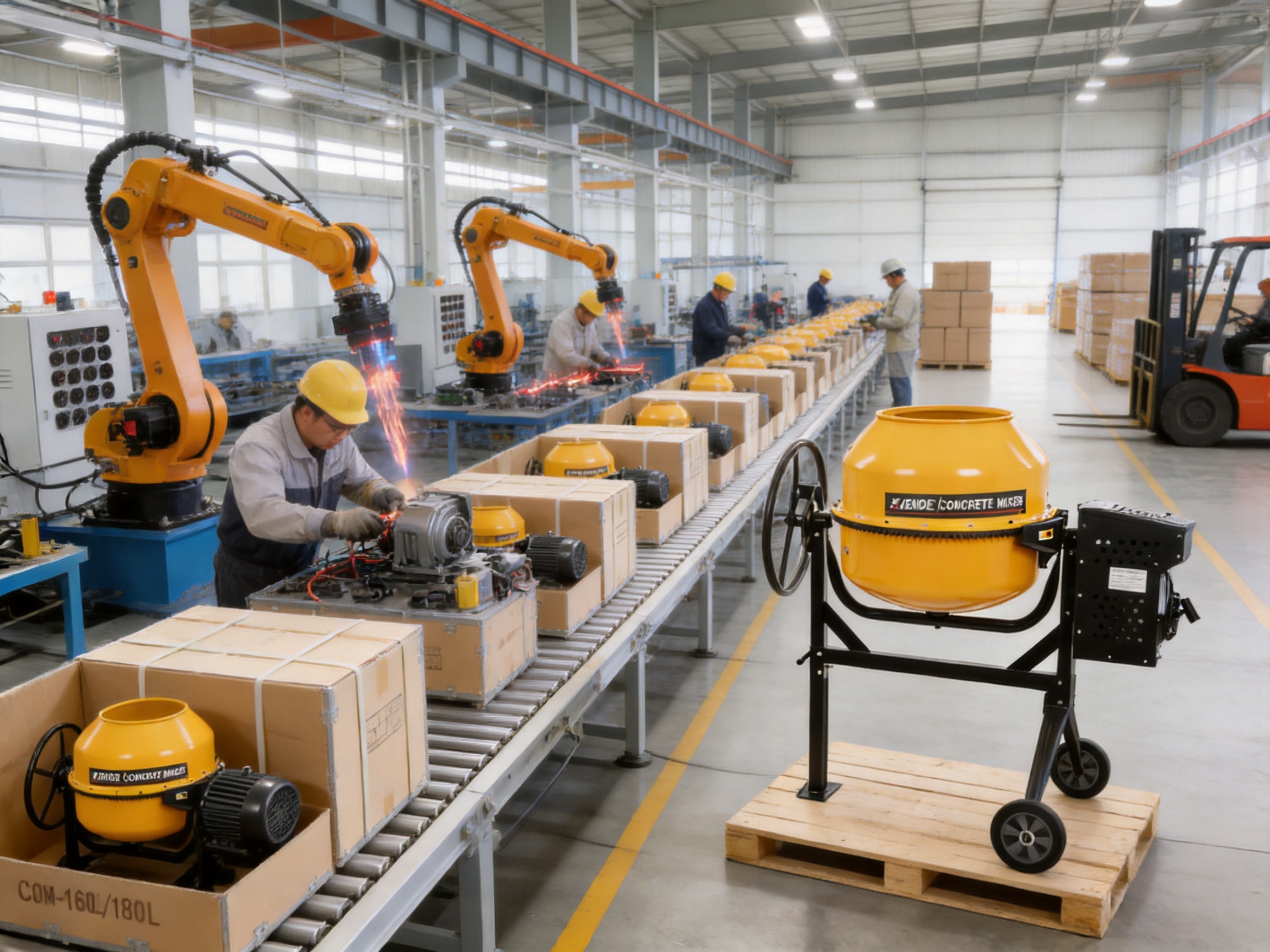
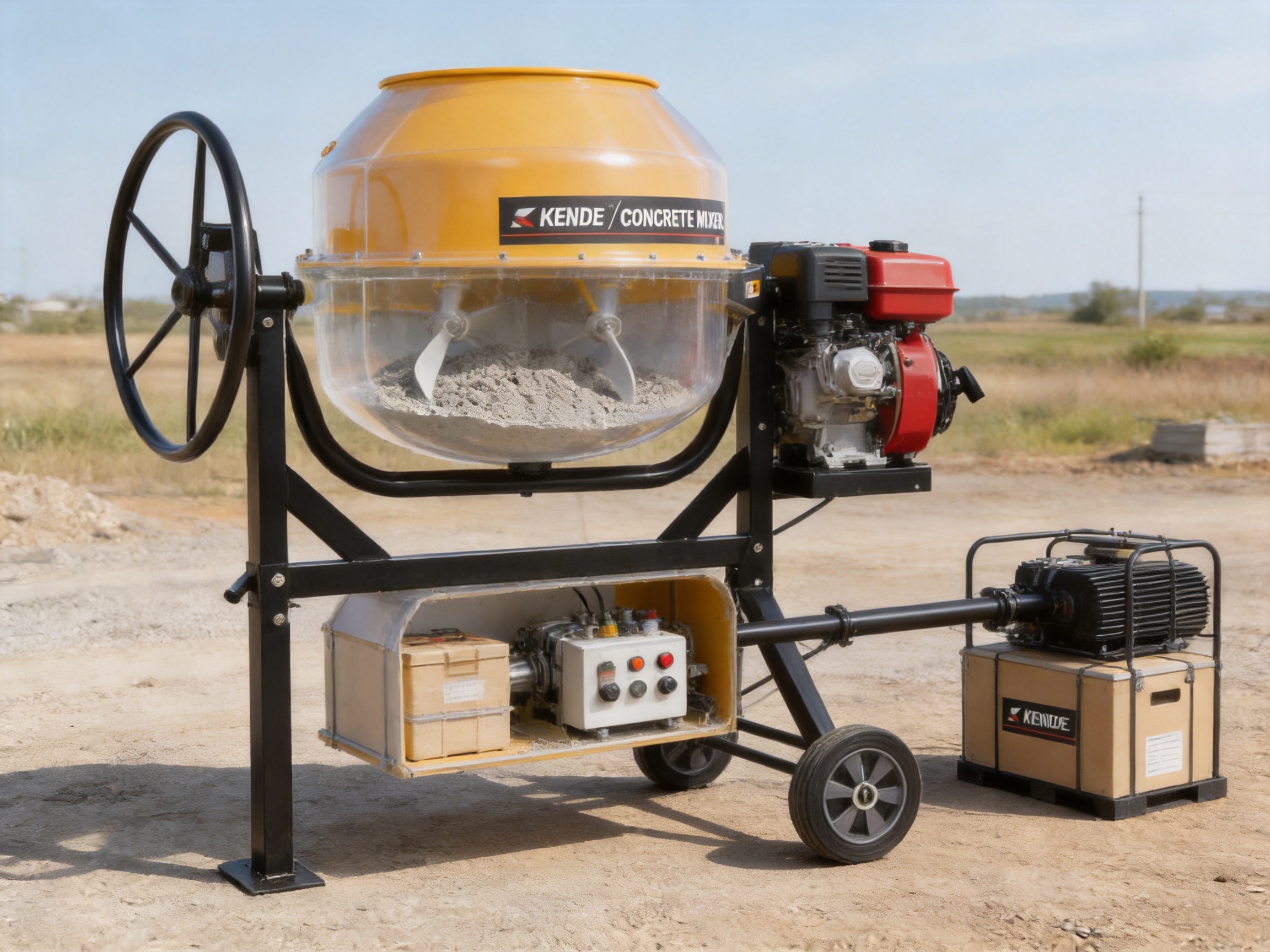
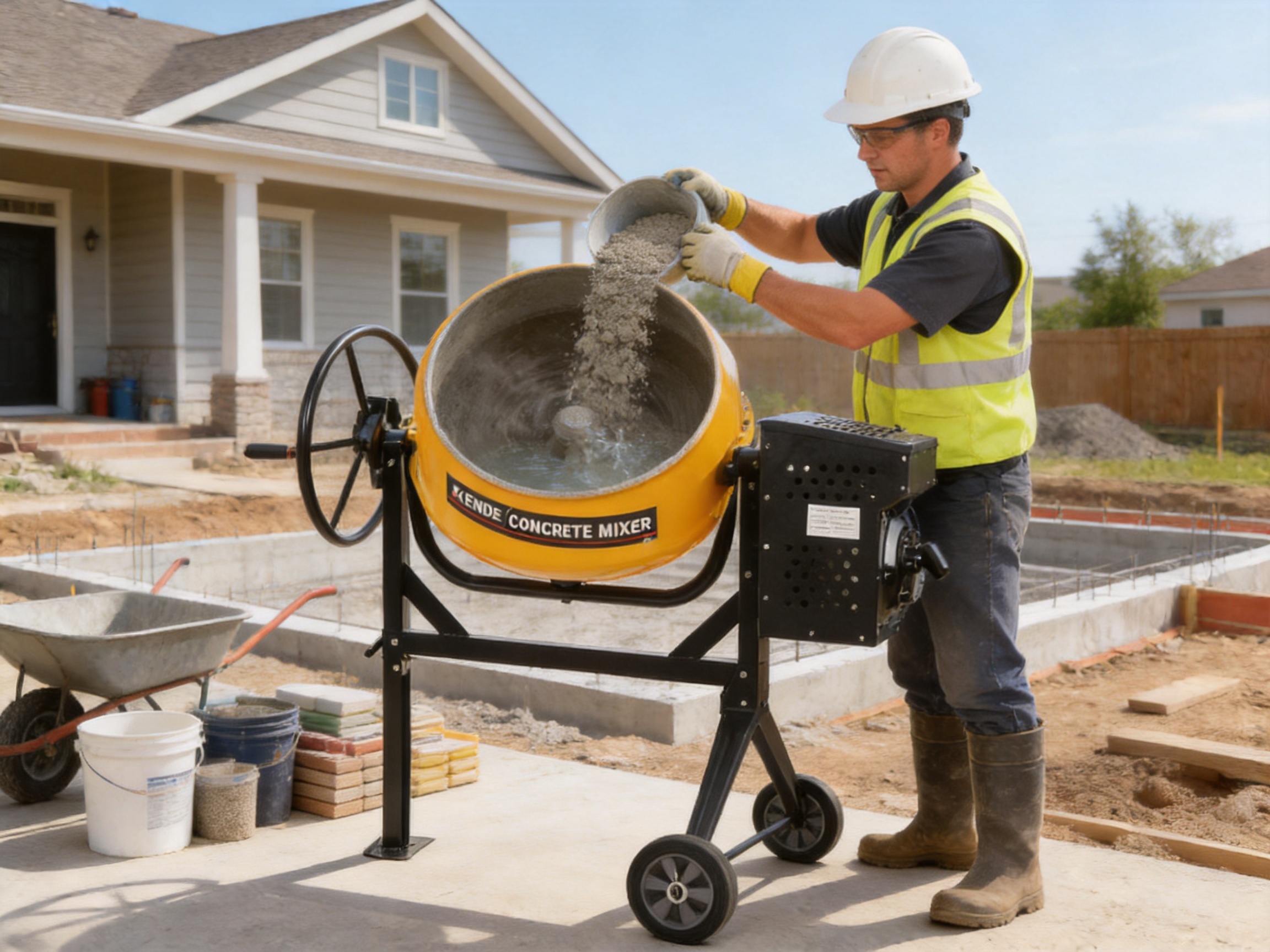

COM-160L/180L Concrete Mixer with Dual Propellers for Efficient Durable Mixing
Concrete mixing equipment plays a decisive role in construction productivity, material consistency, labor efficiency, and overall project cost. A mixer that is too large can be difficult to transport and unnecessarily expensive to operate, while a mixer that is too small may struggle with demanding materials, extended working cycles, or the production requirements of small commercial projects. The COM-160L/180L concrete mixer is designed to occupy the practical middle ground: compact enough for convenient handling, yet sufficiently capable for small-to-medium scale mass production.
Available in 160-liter and 180-liter configurations, this model combines a portable structure, flexible power options, dual-propeller mixing, simple controls, and convenient manual discharge. Its design is intended for users who need reliable mixing performance without the complexity, installation requirements, and high operating costs associated with large stationary batching systems.
The mixer is suitable for contractors, building-material suppliers, maintenance teams, small production facilities, agricultural users, renovation companies, and other professional operators that require dependable concrete and material preparation. Its dual-propeller convective agitation system supports fast and thorough blending, including the mixing of medium-to-high viscosity materials. At the same time, its straightforward mechanical layout helps reduce training requirements and simplifies routine maintenance.
Manufactured by Zhejiang Kende Mechanical & Electrical Co., Ltd., a Chinese producer with extensive experience in electric welding machines, battery chargers, heaters, and related equipment, the COM-160L/180L benefits from the company’s established engineering, production, quality-control, and export capabilities. The mixer reflects a broader manufacturing philosophy: practical design, adaptable power supply, durable components, efficient production, and suitability for different regional markets.
This article examines the product’s operating concept, technical characteristics, competitive advantages, application possibilities, manufacturing strengths, maintenance requirements, and selection considerations.
The COM-160L/180L is a portable concrete mixer developed for users who need an efficient machine with a relatively small footprint and useful working capacity. The two models share the same general design concept and are differentiated primarily by their rated mixing capacity and motor power.
The COM-160L provides a 160-liter capacity and uses a 600-watt mixing motor. The COM-180L offers a larger 180-liter capacity and an 850-watt mixing motor. Both versions support 110–120-volt or 220–240-volt single-phase electrical supplies at 50/60 Hz. This flexible voltage arrangement allows distributors and end users to select a suitable configuration for different markets and jobsite conditions.
A key feature is the dual-propeller mixing arrangement. Instead of relying only on basic drum rotation, the mixer uses propeller-driven convective agitation to promote the movement of materials throughout the mixing chamber. This helps distribute cement, aggregates, water, and other components more evenly. The result is a mixing process that is better suited to materials requiring active internal circulation rather than simple tumbling alone.
The equipment is designed around practical operation. A knob provides start-and-stop control, while discharge is performed manually. This operating method avoids unnecessary electronic complexity and makes the machine easy to understand for new operators. It also allows the user to maintain direct control over the timing and quantity of discharge.
Despite its useful capacity, the mixer is described as ultra-light and portable. Its package dimensions and net weights make it more manageable than many larger industrial mixers. This is important for contractors who frequently move equipment between locations, work in areas with limited access, or need to load machines into transport vehicles without specialized lifting equipment.
The following table summarizes the available technical information for the two configurations.
| Model | Rated Voltage | Rated Frequency | Mixing Power | Capacity | Drum Speed | Drum Opening | Working Cycle Period | Net Weight / Gross Weight | Package Dimension | Quantity per 20-Foot Container | Quantity per 40-Foot High-Cube Container |
|---|---|---|---|---|---|---|---|---|---|---|---|
| COM-160L | 110–120 V / 220–240 V | 50/60 Hz | 600 W | 160 L | 32–38 | 400 | 3 | 46.6 / 50.2 kg | 903 L × 748 W × 450 H | 90 cartons | 195 cartons |
| COM-180L | 110–120 V / 220–240 V | 50/60 Hz | 850 W | 180 L | 32–38 | 400 | 3 | 50 / 54 kg | 840 L × 720 W × 555 H | 90 cartons | 195 cartons |
The supplied specification data identifies the drum speed as 32–38 and the drum opening as 400. Because the original specification does not state the measurement units for these two values, buyers should confirm the final technical datasheet with the supplier before placing an order. The same principle applies to the stated working cycle period, which is listed as 3 without a specific time unit in the available material.
Although the COM-180L has a larger capacity and more powerful motor, both models are intended to provide a balance between output and portability. The COM-160L may be attractive to users who prioritize lower electrical consumption, lighter handling, or a smaller operating load. The COM-180L may be better for users who want additional capacity and greater motor reserve for more demanding batches.
The most important functional advantage of this mixer is its dual-propeller convective agitation system. Conventional small mixers often depend mainly on the rotation of a drum to lift and drop the material. That method can be effective for basic applications, but it may require more time to achieve uniformity when the mixture contains heavier aggregates, higher cement content, or materials with greater viscosity.
Dual-propeller agitation introduces an additional internal movement pattern. As the mixing components rotate, material is encouraged to circulate through different areas of the mixing chamber. This helps reduce stagnant zones and improves contact between dry and wet ingredients. The combined action of drum movement and propeller agitation is intended to produce a more active and complete mixing process.
For small-to-medium production, this is particularly valuable because operators often work with limited manpower and cannot afford repeated remixing. Better internal circulation can reduce the need to stop the machine, manually reposition material, or extend the batch beyond the expected cycle. It can also help improve repeatability from one batch to the next when the operator follows consistent loading and water-addition procedures.
The design is described as suitable for medium-to-high viscosity materials. This does not mean that the mixer should be overloaded or used outside the limits of the approved material recipe. Rather, it indicates that the dual-propeller system is designed to provide stronger and more purposeful agitation than a basic low-duty mixer. Proper material proportioning remains essential for safe and efficient operation.
Another benefit is the potential improvement in operator productivity. If a batch reaches a usable degree of uniformity more quickly, the operator can focus on loading, discharge, transport, and placement instead of spending additional time correcting incomplete mixing. Over the course of a workday, even small improvements in each cycle can contribute to meaningful output gains.
The two available versions allow customers to choose a suitable balance between capacity, power, and mobility. The COM-160L has a 160-liter nominal capacity and a 600-watt mixing motor. Its lighter net weight of 46.6 kilograms makes it a practical choice for renovation teams, small contractors, property maintenance departments, and users who frequently relocate equipment.
The COM-180L increases nominal capacity to 180 liters and uses an 850-watt motor. The larger motor is appropriate for users who want additional mixing power and a greater operating reserve. The model’s net weight is listed at 50 kilograms, which remains relatively manageable for a machine of this capacity.
Selection should be based not only on nominal capacity but also on the type of material, the desired batch size, the frequency of operation, available electrical power, transport requirements, and the number of workers available at the site. A user who works mostly with moderate batches and places a high priority on portability may find the COM-160L sufficient. A user with a heavier daily workload may prefer the COM-180L.
Nominal capacity should also be distinguished from recommended working load. A mixer should not normally be filled beyond the manufacturer’s operating guidance, because overloading can reduce mixing quality, increase motor stress, and make discharge more difficult. The best results are generally achieved when the operator follows a repeatable loading sequence and avoids adding all components at once.
The ability to operate with either 110–120 volts or 220–240 volts is a major advantage for international distribution. Electrical standards differ across countries and regions, and equipment that is limited to one voltage range may require additional transformers, special wiring, or separate product versions. The COM-160L/180L is designed to support common single-phase power arrangements, making it easier for distributors to serve multiple markets.
Single-phase compatibility is also valuable at smaller jobsites. Many residential, renovation, agricultural, and maintenance locations do not have access to industrial three-phase power. By using a single-phase electric motor, the mixer can be used in more places with less preparation. Operators should still confirm the correct voltage configuration before use and ensure that the power supply, extension cable, plug, circuit protection, and grounding arrangement are suitable.
The product information also identifies an optional small gasoline engine for multi-scenario power needs. This option can be useful in locations where grid power is unavailable, unreliable, or too far from the work area. It gives contractors greater flexibility when working on remote construction sites, rural properties, road repairs, landscaping projects, or emergency maintenance tasks.
Fuel-powered operation requires additional safety precautions. The engine should be used outdoors or in a properly ventilated environment, away from combustible materials. Fuel storage, refueling, exhaust exposure, and hot surfaces must be managed according to local safety regulations and the engine manufacturer’s instructions. The electric and gasoline configurations should be regarded as complementary options for different working environments.
Complex controls can create unnecessary training requirements, especially when a machine is used by different crews or moved between projects. The COM-160L/180L uses a knob-based start-stop arrangement. This straightforward control method makes the primary operation immediately understandable: start the mixer, allow the material to reach the required consistency, stop the drum or mixing action, and discharge manually.
Manual discharge provides direct control over the release of the mixed material. This can be advantageous when concrete must be placed gradually, when containers of different sizes are being filled, or when the operator needs to coordinate discharge with another worker. It also keeps the machine’s mechanism relatively uncomplicated.
A simple design can contribute to reliability because it reduces the number of electronic components exposed to dust, vibration, and moisture. It may also make troubleshooting easier. If a problem occurs, operators and service personnel can inspect the control, motor, transmission, propellers, drum, and wiring without navigating a complex automated system.
However, simple operation does not eliminate the need for proper training. Operators should understand safe loading, correct mixing proportions, emergency stopping, cleaning procedures, power isolation, and the risks associated with rotating components. The machine should never be operated with guards removed or while hands and tools are inside the mixing chamber.
Portability is one of the product’s strongest advantages over larger fixed mixers. The COM-160L and COM-180L are designed to be moved between work areas and transported as part of a contractor’s equipment fleet. Their relatively low weights and compact packaging dimensions help reduce logistical requirements.
Portable equipment is especially valuable for projects that do not justify the installation of a permanent mixing station. Examples include house extensions, pathways, small foundations, fence posts, drainage works, agricultural repairs, masonry projects, landscaping, and maintenance of commercial premises. In such applications, transporting premixed concrete from a distant supplier may be inconvenient or uneconomical.
A portable mixer also allows the operator to produce material close to the point of use. This can reduce the distance that wet concrete must be moved by wheelbarrow, bucket, or other means. Shorter material-handling distances may reduce spillage, labor, and the time between mixing and placement.
The portable format can support better use of limited storage space. Contractors may be able to keep the machine in a workshop, service vehicle, warehouse, or compact equipment area when it is not in operation. The packaging dimensions listed for both models also support efficient container loading for wholesalers and importers.
Mobility must always be managed safely. Before moving the mixer, the power supply should be disconnected, the drum should be empty, and loose components should be secured. When lifting or loading the machine, workers should use suitable handling methods and avoid placing themselves beneath suspended equipment.
The product is positioned as a durable solution for prolonged continuous operation. Durability in a concrete mixer depends on many factors, including the frame, drum construction, motor quality, transmission, bearings, propeller components, electrical protection, and resistance to abrasive material.
Concrete ingredients can be demanding. Sand and aggregate create abrasive wear, cement dust can enter poorly protected mechanisms, and wet material can cause corrosion if the machine is not cleaned properly. A durable design therefore needs not only robust components but also a layout that allows operators to clean and inspect the equipment efficiently.
The COM-160L/180L is intended to support repeated working cycles rather than occasional household use alone. Its application range can therefore include small production environments and professional contractors who need predictable operation across an extended workday. The COM-180L’s higher motor rating may be particularly beneficial when material conditions require additional torque and mixing strength.
Durability should not be confused with unlimited capacity. Even a robust mixer can be damaged by excessive loading, foreign metal objects, operation with insufficient lubrication, blocked discharge, unstable placement, or failure to clean hardened material. The longest service life is achieved when the machine is operated within its rated conditions and maintained according to a regular schedule.
Maintenance is a major factor in the total cost of ownership. A machine that is inexpensive to purchase but difficult to clean or repair may become costly over time. The COM-160L/180L is designed with a relatively simple structure to support routine inspection and maintenance.
Cleaning should begin immediately after each batch, before cementitious material has hardened inside the drum or around the propellers. Operators should remove residual material using approved methods and avoid damaging the drum, shaft seals, motor, or electrical components with high-pressure water. The exact cleaning procedure should follow the manufacturer’s instructions.
Regular checks should include the power cord, plug, switch or control knob, motor housing, fasteners, frame, drum, propeller assemblies, discharge mechanism, wheels or support points, and any exposed moving parts. Abnormal noise, excessive vibration, irregular rotation, overheating, or reduced mixing performance should be investigated promptly.
Electrical safety is particularly important for machines used outdoors. The power supply should include appropriate circuit protection, and the machine should be protected from standing water and severe weather. Any damaged cable or plug should be replaced by qualified personnel rather than repaired with temporary tape or unsuitable connectors.
For gasoline-powered configurations, maintenance also includes engine oil, air filtration, fuel system inspection, spark plug condition, exhaust components, and safe fuel storage. Operators should follow the engine supplier’s maintenance schedule and avoid using stale or contaminated fuel.
A simple machine design can reduce downtime because many common issues can be diagnosed without specialized software or advanced electronic test equipment. This is valuable for smaller companies that may not have a dedicated maintenance department.
The COM-160L/180L offers several advantages when compared with basic small mixers that rely solely on drum tumbling or provide limited power and capacity options.
The dual-propeller system provides a more active mixing pattern than simple drum rotation. It promotes convective movement and can support more uniform blending of medium-to-high viscosity materials. This feature may help reduce the time needed to reach a consistent batch, particularly when the material is properly proportioned and loaded.
The availability of 160-liter and 180-liter models allows customers to choose according to their workload. The product range can serve users who prefer lighter equipment as well as users who need a larger capacity and stronger motor.
Support for 110–120-volt and 220–240-volt single-phase systems improves market adaptability. Distributors can offer the equipment in regions with different electrical standards, subject to correct configuration and compliance requirements.
The electric version is suitable for locations with grid power, while the optional small gasoline engine can serve remote or off-grid applications. This flexibility makes the product more versatile than equipment restricted to a single power source.
The mixer provides useful capacity without the weight and installation demands of larger industrial equipment. This combination can make it more practical for contractors who need professional productivity but work across changing locations.
The knob start-stop control and manual discharge arrangement reduce operating complexity. Training can be focused on safe loading, mixing, and cleaning rather than complicated programming or automated control sequences.
The listed package dimensions and container quantities are useful for importers and distributors. Up to 90 cartons are listed for a 20-foot container and 195 cartons for a 40-foot high-cube container. Efficient packing can help reduce transportation cost per unit and support inventory planning.
The COM-160L/180L is suitable for a broad range of applications where moderate quantities of concrete or other compatible materials must be mixed close to the work area.
Residential construction is one important application. Contractors can use the mixer for small slabs, footings, garden walls, steps, paths, repair work, and extensions. The ability to produce batches on demand can be useful when access for ready-mix trucks is limited.
Renovation projects may also benefit from the machine’s compact format. Work inside courtyards, narrow access areas, older properties, and partially occupied buildings often requires equipment that can be moved without extensive site preparation.
Landscaping contractors can use a portable mixer for paving bases, edging, posts, outdoor features, small retaining structures, and hardscape repairs. Agricultural operators may find it useful for farm maintenance, equipment foundations, drainage improvements, and small structural repairs.
Small commercial and municipal maintenance teams can use the mixer for sidewalks, curbs, patching, utility work, and localized repairs. The machine may also be suitable for producing compatible non-concrete mixtures, provided that the materials, viscosity, loading quantity, and operating conditions are approved for the equipment.
Because the product is designed for small-to-medium scale mass production, it may also serve workshops or small manufacturing operations that need repeatable mixing without investing in a large automated plant. Before using the mixer for any material other than the intended application, users should confirm compatibility with the supplier.
The product is manufactured by Zhejiang Kende Mechanical & Electrical Co., Ltd., a company with a broad background in electrical machinery and equipment production. The company operates from Taizhou, Zhejiang, China, and has an area of approximately 120,000 square meters with about 600 employees.
Although the company is widely associated with welding machines, chargers, and heaters, its manufacturing capabilities are relevant to the development of compact mechanical and electromechanical equipment. The COM-160L/180L requires coordinated design of motors, switches, wiring, transmission components, rotating structures, safety features, packaging, and production quality. Experience in electrical equipment manufacturing supports the management of these interdependent systems.
The company reports annual exports of nearly 1.5 million units and annual production capacity of approximately 2 million units. Large-scale production experience can provide advantages in procurement, process control, testing, packaging, and international customer support. It can also help a manufacturer maintain stable production when serving distributors across different countries.
Kende operates research and development facilities that include a Zhejiang Provincial R&D Center, an Enterprise Technology Center, and an Intelligent Welding Technology Research Institute. The company reports a research and development team of 98 personnel. These resources demonstrate an established approach to product development, even though the mixer belongs to a different equipment category from welding machines.
The company also reports the use of advanced automatic patching, plug-in and welding systems, robot processing, laser cutting, and other manufacturing technologies. These processes can contribute to accurate electrical assembly, repeatable metal fabrication, improved component consistency, and better production efficiency.
Modern manufacturing systems are supported by OA office automation, Toyota TPS management methods, ERP K3, and MES management systems. Such systems can improve production scheduling, traceability, material coordination, work-order control, inventory management, and process monitoring. For international buyers, organized production management is important because it supports more predictable lead times and consistent model configuration.
International customers often require more than a product that operates correctly. They may also need evidence of electrical safety, electromagnetic compatibility, energy performance, environmental compliance, documentation quality, and manufacturing control. Kende reports experience with international certifications including GS, CE, EMC, ERP, US ETL, UKCA, and China CCC across its product portfolio.
Certification requirements for the COM-160L/180L should be confirmed according to the exact model, voltage version, engine option, destination market, and applicable product category. Buyers should request the relevant declarations, test reports, manuals, labels, and packaging information before importation.
The company’s involvement in national welding-machine standards and its participation in the drafting, formulation, and revision of national standards demonstrate familiarity with formal technical requirements. The company reports participation in 20 national standards and leadership in drafting one group standard. While these activities relate primarily to the company’s established welding business, they indicate experience in regulated equipment development and documentation.
For distributors, international readiness can reduce the administrative burden associated with market entry. Correct labeling, clear technical data, multilingual documentation, spare-parts support, and consistent packaging are all important elements of a successful equipment program.
A reliable concrete mixer begins with appropriate material selection and controlled fabrication. The frame and drum must be produced with sufficient dimensional consistency to support stable rotation. Propeller alignment must be controlled so that the internal components operate smoothly without unnecessary contact or vibration.
Metal cutting and forming should be followed by inspection of critical dimensions, weld quality, mounting points, and surface condition. Where automated or robotic processes are used, repeatability can be improved across production batches. Laser cutting can support accurate preparation of sheet-metal components, while controlled welding helps maintain structural strength and appearance.
Electrical assembly requires equal attention. Motors, switches, wiring, terminals, plugs, and protective components should be installed according to the intended voltage configuration. The final product should be checked for correct rotation, control operation, insulation condition, abnormal noise, vibration, and other functional indicators.
Assembly-line testing is especially important for equipment that may be exported to different countries. A factory must ensure that the correct motor, cable, plug, label, manual, and packaging materials are matched to each order. Enterprise resource planning and manufacturing execution systems can help reduce configuration errors.
Packaging should protect the mixer during container transport, warehouse handling, and final delivery. The supplied package dimensions indicate that the product has been organized for efficient shipping. Distributors should still inspect cartons upon arrival and follow recommended storage conditions to prevent moisture damage or deformation.
Before using the mixer, place it on a firm, level surface. The machine should not rock, slide, or operate close to an unprotected edge. Confirm that the power supply matches the machine’s rating and that all controls are in the correct position before connection.
Load materials according to the recommended sequence. In many concrete applications, a portion of the water and aggregates may be introduced before cement and the remaining water, but the correct sequence depends on the mix design and operating guidance. Avoid dropping large quantities of dry material into a stationary or overloaded drum.
Do not exceed the recommended working load. An overloaded mixer can experience slow rotation, motor overheating, uneven mixing, transmission stress, and difficult discharge. If a batch is too heavy or too dry, adding more force or manually pushing material into moving components can create serious hazards.
Keep hands, clothing, tools, and loose objects away from rotating parts. Never reach into the drum while the machine is connected to power. If a blockage occurs, disconnect and isolate the power source before attempting any inspection or removal.
Monitor the machine during operation. Unusual sound, excessive vibration, smoke, burning odor, repeated circuit trips, or unstable rotation indicates that the machine should be stopped and inspected. Continuing to operate under abnormal conditions may cause additional damage.
After discharge, clean the mixing chamber and propellers before material hardens. Store the machine in a dry, protected location when possible. These simple practices can significantly extend service life and preserve mixing performance.
The electric configuration is generally appropriate for urban construction, workshops, buildings, farms, and other locations with dependable grid power. It produces no direct exhaust at the point of use and can be convenient for indoor or semi-enclosed applications when ventilation and electrical safety requirements are satisfied.
The gasoline-engine option may be better for remote projects, temporary sites, emergency work, and locations where electrical infrastructure is unavailable. It provides greater independence from the grid, but it also introduces fuel management, engine maintenance, exhaust, noise, and fire-safety considerations.
Buyers should evaluate the typical work environment rather than selecting solely on initial purchase price. If the mixer will spend most of its time near electrical outlets, the electric version may offer simpler daily operation. If the equipment must travel into undeveloped areas, the gasoline option may provide valuable flexibility.
Some businesses may choose different configurations for different crews. A distributor serving multiple industries can also stock both options, subject to market demand and local regulations.
The cost of a mixer includes more than the purchase price. Transportation, electricity or fuel, labor, maintenance, replacement parts, downtime, cleaning time, and expected service life all affect the total cost of ownership.
The COM-160L/180L can help control ownership costs through its portable design, single-phase power compatibility, simple controls, and accessible maintenance concept. The ability to mix material on-site may also reduce dependence on delivered small quantities of ready-mix concrete, particularly when delivery charges are high or access is difficult.
Improved mixing efficiency can support labor productivity. If the dual-propeller system produces uniform batches with less manual intervention, workers may spend less time correcting material consistency. However, actual savings depend on the mix design, operator practices, site layout, and local energy costs.
Container-efficient packaging can also be important for wholesalers. The listed quantities per container may help lower freight cost per unit and make the product suitable for regional distribution. Importers should calculate landed cost using the confirmed carton dimensions, shipping terms, local duties, certification expenses, and after-sales requirements.
The company’s product-development experience includes the ability to develop new products according to the needs of different regions, countries, and customers. This capability can be valuable for distributors seeking market-specific configurations, provided that requested changes are technically feasible and formally confirmed.
Potential customization discussions may include voltage and frequency, plugs, labels, manuals, packaging, color, branding, engine configuration, spare-parts packages, and compliance documentation. Any customization should be clearly recorded in the purchase order and approved technical specification.
Regional distributors should also consider local service capability. A reliable product program requires access to commonly needed parts such as switches, cables, motor components, bearings, fasteners, propeller assemblies, and other wear items. Establishing a spare-parts plan before launch can reduce customer downtime.
Because the mixer may be sold to professional users, distributors should provide clear guidance about capacity, safe loading, cleaning, power requirements, and appropriate applications. Accurate product positioning prevents customers from expecting the machine to perform like a large industrial batching plant.
The COM-160L/180L is designed for small-to-medium scale production and should be selected within that intended range. It is not a substitute for a high-output stationary concrete batching plant when a project requires continuous large-volume production, automated proportioning, integrated aggregate storage, or conveyor-fed operation.
Manual discharge may be an advantage for simplicity, but users requiring automated dosing or high-speed continuous discharge may need a different equipment category. Likewise, a single-phase mixer may not provide the same motor reserve as a larger three-phase industrial unit.
The listed technical information contains values without complete units for drum speed, drum opening, and working cycle period. Customers should request a final datasheet, operation manual, wiring diagram, and confirmation of all measurements before purchase. They should also verify the exact voltage configuration and any certification applicable to the destination market.
Material compatibility should be confirmed before mixing unusual compounds, extremely abrasive materials, chemically aggressive materials, or mixtures with viscosity beyond the intended range. Correct loading volume and maintenance remain essential even when the machine is used for ordinary concrete.
The COM-160L has a 160-liter capacity and a 600-watt mixing motor. The COM-180L has a 180-liter capacity and an 850-watt motor. Both support 110–120-volt or 220–240-volt single-phase power at 50/60 Hz and use the same general dual-propeller mixing concept.
The dual-propeller system promotes convective movement inside the mixing chamber. It works with drum rotation to circulate materials more actively, supporting faster and more uniform blending, especially with medium-to-high viscosity materials.
Yes. The machine is intended for small-to-medium scale mass production and is suitable for contractors, renovation teams, maintenance departments, agricultural users, and small production facilities. Its actual productivity depends on material composition, loading practice, cycle duration, and operator efficiency.
An optional small gasoline engine is identified as an available power solution for multi-scenario use. Buyers should confirm the engine specification, fuel requirements, safety instructions, and availability for the desired model.
The mixer is designed as an ultra-light and portable model. The COM-160L has a listed net weight of 46.6 kilograms, while the COM-180L has a listed net weight of 50 kilograms. Safe lifting and transport procedures should always be followed.
The product information identifies manual discharge. This provides direct operator control and helps keep the machine’s operating system simple.
The listed configurations support 110–120 volts or 220–240 volts, single phase, at 50/60 Hz. The correct configuration must be confirmed before installation or operation.
The design is described as suitable for medium-to-high viscosity materials, but compatibility depends on the material’s density, abrasiveness, chemical properties, and loading requirements. Users should obtain supplier approval before mixing non-standard materials.
Clean the drum and propellers after each batch, inspect the motor and electrical components, check fasteners and moving parts, monitor for abnormal vibration or noise, and follow the recommended maintenance schedule. Gasoline versions require additional engine and fuel-system maintenance.
Importers should confirm the model, voltage, frequency, motor or engine configuration, complete dimensions and units, certifications, plug type, packaging, manuals, spare parts, warranty terms, lead time, and destination-market compliance requirements.
Its flexible voltage options, compact packaging, portable format, two capacity choices, and manufacturer’s experience with international exports make it suitable for distribution in different markets. Local certification and labeling requirements must still be verified.
Not necessarily. The COM-180L provides higher capacity and a more powerful motor, but the COM-160L is lighter and may be sufficient for smaller batches or users who prioritize mobility and lower power demand. The best choice depends on the application.
The COM-160L/180L concrete mixer is a practical solution for users who need more than a basic small drum mixer but do not require a large stationary production plant. Its central advantage is the combination of dual-propeller convective agitation, useful capacity, portable construction, flexible power supply, simple control, manual discharge, and maintenance-friendly design.
The COM-160L provides a balanced 160-liter configuration with a 600-watt motor, while the COM-180L adds capacity and motor power for more demanding workloads. Both models support common single-phase voltage ranges and can be configured for different operating environments, including locations where an optional gasoline engine is preferred.
Compared with conventional small mixers, the product offers more active internal material movement and greater application flexibility. Its portable format can reduce jobsite setup requirements and allow mixing close to the point of use. Its straightforward operation can also help smaller teams maintain productivity without specialized training or complex automation.
The manufacturer strengthens the product proposition through established experience in electromechanical equipment, international exporting, research and development, quality systems, advanced fabrication technologies, and organized production management. Technologies such as laser cutting, robot processing, automated electrical assembly, ERP coordination, and MES production monitoring support consistent manufacturing and global distribution.
For contractors, distributors, and professional users, the most important step is to match the model to the actual workload. Proper capacity selection, correct power configuration, safe operation, timely cleaning, and routine inspection will determine the machine’s real-world performance and service life. When used within its intended range, the COM-160L/180L offers an efficient and flexible approach to small-to-medium scale concrete and compatible material mixing.
1. Product technical information for the COM-160L/180L concrete mixer, including model specifications, power options, capacity, packaging, and operating features.
2. Zhejiang Kende Mechanical & Electrical Co., Ltd. corporate information concerning manufacturing capability, export activity, research and development, certifications, and production systems.
3. General principles of concrete mixing, material proportioning, batch consistency, and equipment operation for small-scale construction applications.
4. General occupational safety practices for rotating machinery, electrical equipment, gasoline engines, material handling, and construction jobsites.
5. General maintenance principles for portable concrete mixers, including cleaning, inspection, lubrication, electrical safety, and wear monitoring.
Recommended Products

Contact Us
No.2299, Luqiao Section, Shugang Avenue, Luqiao District, Taizhou, 318057 Zhejiang, PR China.
+86-576-82431568
 Privacy
China Welding Machine Factory
 English
 中文简体
 русский
 Español
 عربى
 Français
 Português
 Deutsch
 Український