Email: [email protected]
Email: [email protected]

Blog
 2026.09.04
 Blog
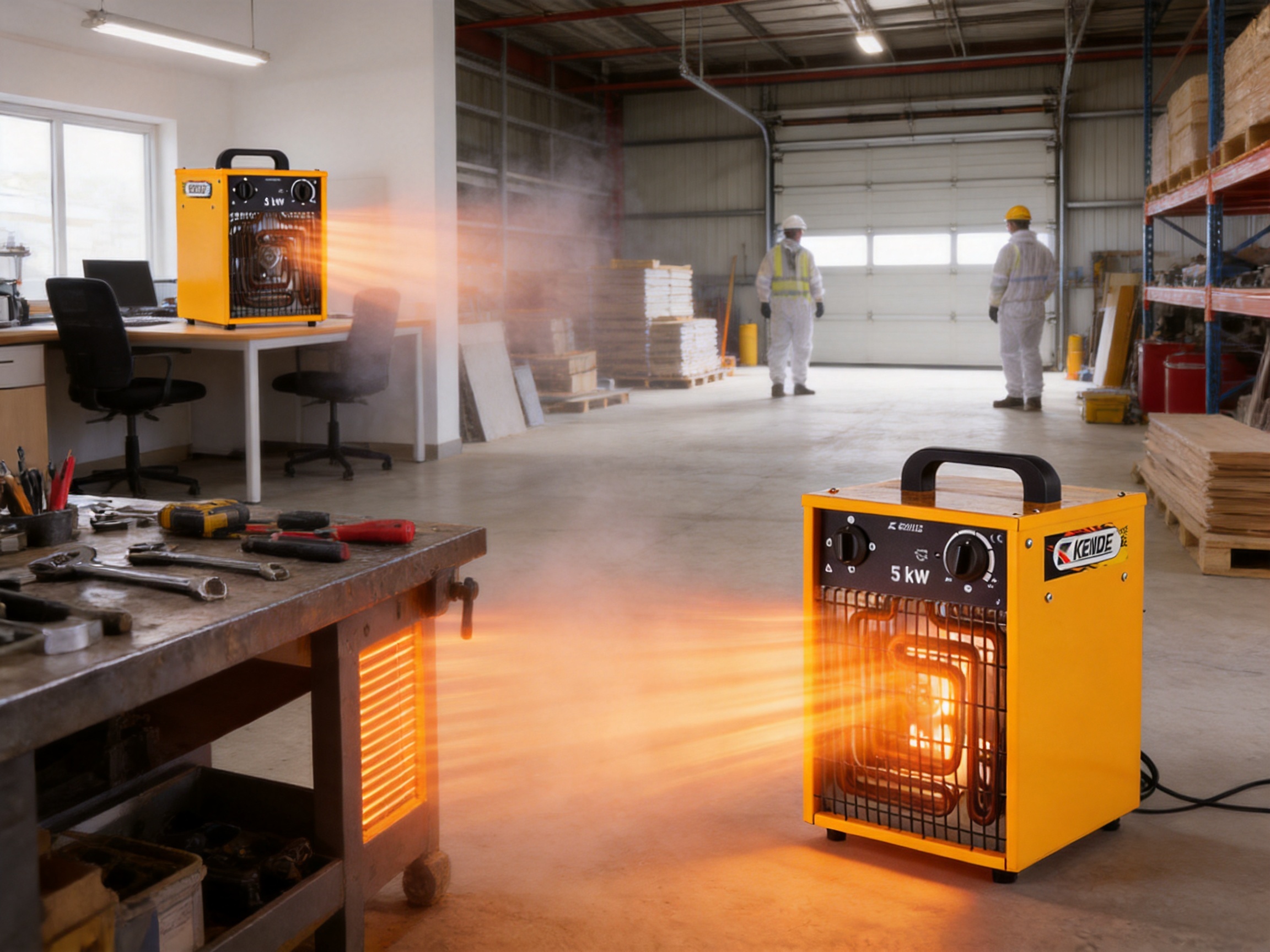
Portable electric fan heaters provide a practical way to raise indoor temperatures quickly without requiring permanent heating infrastructure. They are useful in workshops, garages, warehouses, construction areas, offices, retail spaces, utility rooms, temporary buildings, and domestic rooms where flexible supplemental heat is needed. The HB-020/030/033/050M/S series is designed around this requirement, combining compact construction, forced-air heat distribution, adjustable airflow direction, straightforward operation, and built-in safety precautions.
The series includes several output levels for different room sizes and heating demands. The supplied technical information identifies models with nominal heat outputs of 2 kW, 3 kW, 3.3 kW, and 5 kW, with corresponding heat-space ratings from approximately 60 m³ to 144 m³. The range is intended to provide a scalable solution rather than forcing users to select one oversized heater for every application.
Unlike fuel-fired heaters, these electric units do not require liquid fuel storage, gas cylinders, combustion exhaust systems, or fuel handling. Unlike fixed central heating equipment, they can be carried from one location to another and positioned close to the area requiring heat. Compared with basic radiant heaters, the fan-assisted design distributes warm air more actively throughout a room, helping reduce cold zones and accelerate perceived heating.
The product is manufactured by a large, experienced heating and electrical equipment producer with extensive capabilities in product development, automated manufacturing, quality management, certification, and export operations. Those capabilities support consistent production across multiple heating models and help the series serve both domestic and professional users.

HB-020/030/033/050M/S Electrical Fan Heater 2/3/5/9kw
The HB-020/030/033/050M/S series is a group of portable electrical fan heaters designed to deliver heated air through a compact forced-air system. The heating element warms the passing air, while the integrated fan moves that air into the room. This combination enables rapid temperature adjustment and makes the units suitable for intermittent heating, temporary heating, and localized comfort heating.
The compact format supports mobile use. A practical carrying handle is integrated into the design so that the heater can be transported conveniently between rooms, work areas, and storage locations. Mobility is especially valuable in workshops, garages, maintenance areas, renovation projects, and other spaces where heating requirements change during the day.
The heater body is designed to occupy relatively little floor space while maintaining useful airflow. The 2 kW version has listed dimensions of approximately 210 × 230 × 325 mm. The larger models are listed at approximately 260 × 275 × 415 mm. These dimensions make the units easier to place in limited areas than bulky permanent heating equipment.
A variable inclination allows the operator to adjust the direction of heat and airflow. This feature is useful when heat must be directed toward a workbench, entrance area, seating area, drying zone, or a particular section of a room. It also allows users to change the airflow path as the room warms, improving comfort and reducing the need to reposition the entire unit.
The principal characteristics of the series include compact construction, portable operation, multiple output levels, forced-air heating, adjustable inclination, carrying convenience, and protection against common operating risks. The protection class is listed as IP42 for all models in the supplied table.
The model designations provided in the technical material include HOT-020M, HOT-030M/S, HOT-033M/S, and HOT-050M/S. The product title also refers to HB-020/030/033/050M/S and describes a 2/3/5/9 kW range. Because the detailed table lists 2 kW, 3 kW, 3.3 kW, and 5 kW outputs, purchasers should confirm the exact model code, voltage, output, and configuration before placing an order.
| Model | Heat Output | Rated Input Voltage | Output Power | Airflow | Recommended Heat Space | Weight | Protection |
|---|---|---|---|---|---|---|---|
| HOT-020M | 1,720 kcal/h | AC 220–240 V, 50 Hz | 2 kW | 260 m³/h | 60 m³ | 4.5 kg | IP42 |
| HOT-030M/S | 2,580 kcal/h | AC 220–240 V, 50 Hz | 3 kW | 400 m³/h | 90 m³ | 5.5 kg | IP42 |
| HOT-033M/S | 2,838 kcal/h | AC 220–240 V, 50 Hz | 3.3 kW | 400 m³/h | 98 m³ | 6.6 kg | IP42 |
| HOT-050M/S | 4,300 kcal/h | AC 220–240 V or AC 380–400 V, 50 Hz | 5 kW | 560 m³/h | 144 m³ | 7.5 kg | IP42 |
The figures above are based on the supplied product information. Actual heating performance can vary according to insulation, outdoor temperature, ceiling height, ventilation, door opening frequency, room construction, and the desired temperature increase. The recommended heat-space figures should therefore be treated as practical reference values rather than universal guarantees for every building.
The 2 kW model is suited to smaller rooms, localized workspaces, compact offices, bedrooms, utility spaces, and areas where moderate supplemental heating is required. Its relatively low weight and smaller dimensions make it convenient for regular transport.
The 3 kW model offers a higher airflow rate and greater heating capacity for medium-sized rooms. It can be appropriate for workshops, garages, temporary offices, retail areas, and working spaces that need faster warm-up than a small domestic heater can provide.
The 3.3 kW model provides a modest increase in heat capacity while retaining the same listed airflow as the 3 kW version. It may be selected when the application requires additional heating performance without moving to the physical size and electrical requirements of the 5 kW model.
The 5 kW model is the highest-output unit shown in the technical table. Its 560 m³/h airflow and listed 144 m³ heat-space rating make it suitable for larger workshops, industrial rooms, warehouses, construction areas, and other spaces requiring stronger forced-air heating.
An electric fan heater generally operates through three basic stages. First, electrical energy is supplied to the heating assembly. Second, the fan draws room air into the heater. Third, the air passes across the heated components and exits as a warm airflow. The process continues as long as the heater is operating and the thermostat or control system calls for heat.
This operating principle provides several practical benefits. Heat is not limited to the immediate surface of the appliance, as it is with some simple radiant devices. Instead, warm air can be directed into the room and mixed with cooler air. The fan also helps the heater produce a noticeable heating effect soon after startup.
Air movement is particularly valuable in rooms with high ceilings or uneven temperature distribution. By adjusting the inclination, operators can direct heat lower into an occupied area or toward a colder zone. In a workshop, the outlet can be aimed toward a workbench. In a garage, it can be directed toward an entrance or maintenance position. In a temporary office, it can be positioned to improve comfort around desks and seating.
Forced-air heating does not eliminate the importance of building insulation. Heat will escape rapidly through open doors, uninsulated walls, roofs, windows, or ventilation systems. However, the airflow system can help the available heat reach the occupied area more effectively than a heater that depends only on natural convection.
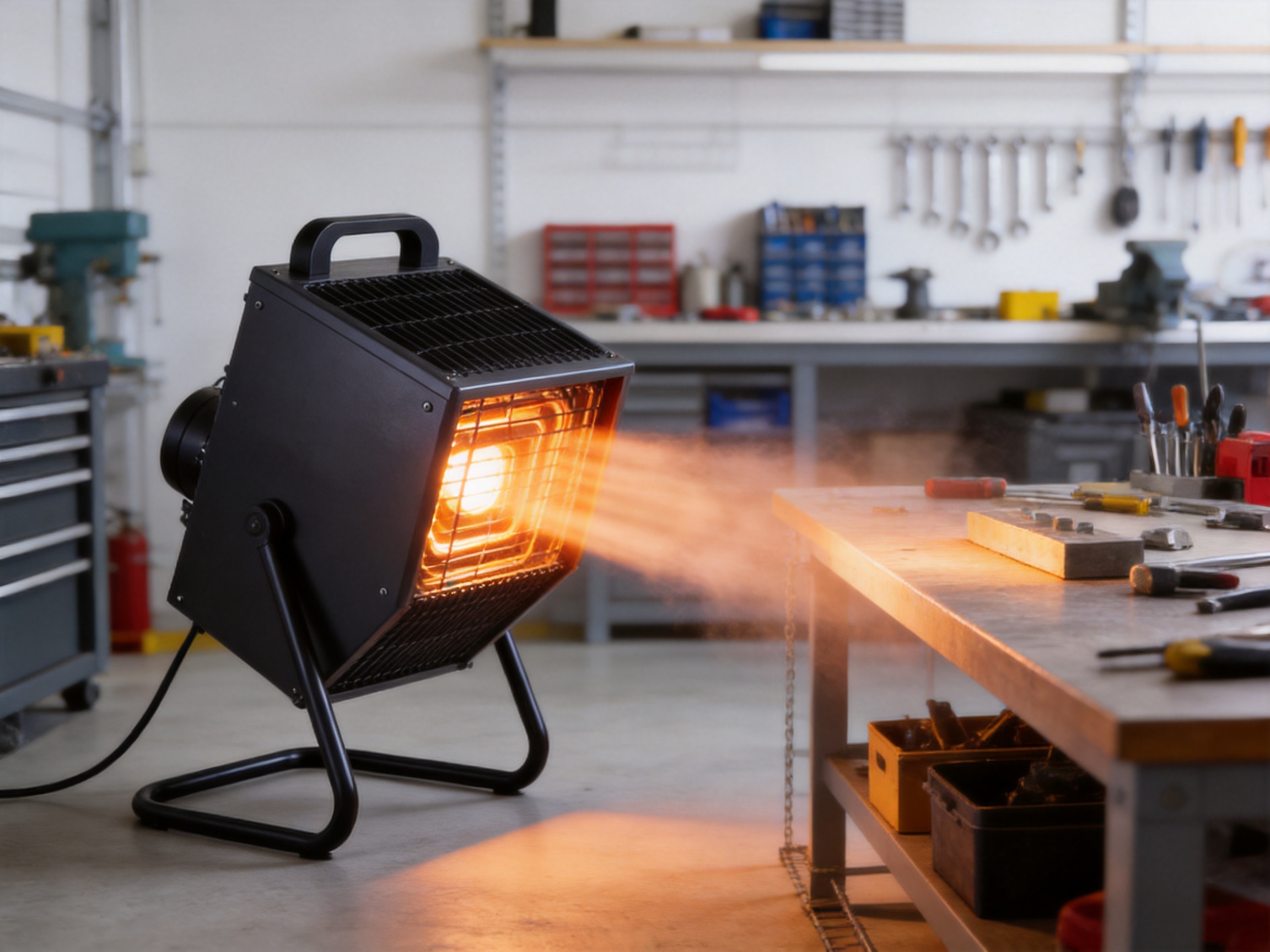
Electric fan heaters offer a cleaner and simpler operating arrangement than diesel, kerosene, fuel-oil, or LPG heaters in applications where an electrical supply is available. They do not burn fuel inside the room and therefore do not create combustion gases as part of normal operation. Users do not need to arrange fuel tanks, gas bottles, fuel pumps, ignition systems, or exhaust flues for the basic heating process.
This can simplify installation and daily operation. A fuel-fired heater may need careful positioning to manage exhaust, fuel storage, ventilation, and fire risk. An electric unit primarily requires an appropriate electrical connection and a suitable clear operating area. The reduction in fuel handling can be particularly useful in offices, indoor workshops, retail areas, classrooms, and temporary workspaces.
Electric operation also avoids the odor that may be associated with fuel handling or combustion. This is an important consideration in occupied areas, especially where people work for extended periods or where products, materials, and furnishings could be affected by fumes.
Permanent heating systems can provide whole-building comfort, but they normally require installation planning, pipework or ductwork, wall or ceiling space, and a dedicated budget. A portable fan heater is more adaptable. It can be used during renovation, moved between rooms, stored during warm seasons, or deployed in a newly constructed space before the permanent heating system is commissioned.
The carrying handle and compact dimensions help users respond to changing requirements. A facility manager can move units to different areas according to occupancy or production schedules. A contractor can use the same heater at several work locations. A homeowner can use it in a study during the day and a utility room later without installing additional equipment.
Radiant heaters warm people and nearby surfaces directly, which can be useful for localized comfort. However, they may provide limited whole-room air circulation. The fan-assisted design of this series is better suited to applications in which the user wants heated air to travel through a room.
The adjustable airflow direction gives the operator more control over heat placement. When combined with the stated airflow rates of 260 m³/h to 560 m³/h, this supports faster mixing of warm air throughout the intended space.
A broad model range is an advantage because the user can select a capacity closer to the actual room requirement. An oversized heater may consume more electricity than necessary and may create uncomfortable temperature changes in a small room. A unit that is too small may run continuously without achieving the desired temperature.
The availability of 2 kW, 3 kW, 3.3 kW, and 5 kW configurations allows distributors and end users to build a more balanced product selection. This is also beneficial for commercial suppliers serving customers with different room sizes and electrical systems.
Portability is one of the central strengths of the product. Weights range from approximately 4.5 kg to 7.5 kg in the supplied specifications. These weights are manageable for many users, particularly when the heater is moved using the dedicated carrying handle and when normal lifting procedures are followed.
A portable design is valuable when heat is needed only at certain times. It avoids tying the heating function to one fixed location. It can also support emergency heating during equipment failure, seasonal temperature changes, or temporary building use.
The variable inclination enables directional control without requiring a separate stand or complicated ducting. Users can alter the outlet angle to suit the room arrangement and current activity. This feature also helps reduce unnecessary repositioning and makes the heater more convenient in crowded workspaces.
Directional adjustment should be performed while observing the manufacturer’s safety guidance and ensuring that the heater remains stable. The air outlet must remain unobstructed, and combustible materials should be kept away from the hot airflow and heater body.
Listed airflow ranges from 260 m³/h for the 2 kW model to 560 m³/h for the 5 kW model. Higher airflow can assist with the distribution of heat over a larger space, although airflow alone does not determine heating performance. The relationship between heating power, airflow, room volume, insulation, and ambient conditions must be considered together.
The 3 kW and 3.3 kW models are both listed at 400 m³/h, providing a consistent air-moving capacity within that part of the range. This may simplify selection for customers who want similar air circulation but different heat output.
The product information identifies built-in safety precautions as part of the design. The listed IP42 protection class indicates a defined level of protection against solid objects and vertically or diagonally falling water under specified test conditions. IP42 should not be interpreted as waterproofing or permission to use the heater in rain, standing water, wash-down zones, or highly wet environments.
Safe use still depends on correct installation and operation. The heater should be placed on a stable, level, non-combustible surface. Air inlets and outlets must remain clear. The electrical supply should match the model rating, and extension leads should be properly rated where their use is permitted. The heater should not be covered during operation, and it should be kept away from curtains, packaging, dust accumulation, chemicals, and flammable liquids.
Workshops and garages often require heating only during occupied periods. Doors may open frequently, and the work area may change depending on the project. A portable electric fan heater can be positioned near a bench or service area and removed when the work is complete.
Compared with combustion heaters, electric heating may be more appropriate where fumes could interfere with finishing work, vehicle maintenance, painting, assembly, or storage. Users should still consider dust levels, electrical safety, and the heater’s suitability for the specific environment.
During renovation, a building may not yet have a functioning central heating system. Portable heaters can help maintain more workable conditions for tradespeople and may support drying or tempering activities when used according to professional guidance.
The compact design makes transport between floors or rooms easier than moving large heating equipment. Before use on a construction site, the electrical system, temporary distribution equipment, grounding arrangements, and site-specific safety requirements must be checked.
Warehouses may contain large open spaces where heating the entire building is inefficient. A portable unit can provide localized comfort for packing stations, inspection points, security desks, or maintenance areas. The 5 kW model may be useful where a larger airflow and stronger heat output are required, subject to electrical capacity and environmental conditions.
Special attention is necessary in storage areas containing flammable goods, aerosols, solvents, paper, textiles, or dust-producing materials. The heater must be positioned in accordance with applicable fire-safety rules and away from combustible stock.
In offices, meeting rooms, portable buildings, and temporary workspaces, electric fan heating can provide supplemental warmth when the main system is insufficient. The adjustable inclination helps direct heat toward occupied areas, while the portable format allows the equipment to be stored when not required.
Noise tolerance should be considered because all fan heaters produce airflow noise. The product’s suitability for a quiet office, classroom, or reception area should be evaluated through an operational sample or the manufacturer’s published sound data if available.
The smaller models may be used for bedrooms, studies, utility rooms, workshops, enclosed balconies, and other domestic spaces where supplemental heating is needed. Users should never leave a portable heater unattended for extended periods or operate it near bedding, clothing, curtains, furniture, or children and pets without appropriate supervision.
Retail stores, service centers, agricultural support buildings, event facilities, and maintenance departments can benefit from a flexible heating inventory. A supplier may stock several output levels and match each unit to a customer’s room size and electrical supply.
The product range also provides a useful option for rental companies and facility-service providers. Portable equipment can be delivered, collected, inspected, and redeployed as required.
The manufacturer’s business profile indicates extensive experience in electric welding machines, battery chargers, heaters, and related electrical equipment. Its product portfolio covers electric, gas, and oil heaters as well as several welding and charging technologies. This broad product base is relevant because it requires knowledge of electrical design, thermal management, metal fabrication, wiring, assembly, testing, and international compliance.
The company operates from a large manufacturing site in Zhejiang Province and is reported to have approximately 120,000 square meters of floor area and around 600 employees. Its annual production capacity is stated as approximately two million units, with exports approaching 1.5 million units annually. Such scale can support component sourcing, production planning, quality-control staffing, engineering resources, and overseas distribution.
The company reports a provincial research and development center, an enterprise technology center, and an intelligent welding technology research institute. It also reports a technical team of approximately 98 research and development personnel. Although the product in this article is a heater rather than a welding machine, the same engineering infrastructure can contribute to electrical safety, control design, motor integration, sheet-metal development, thermal testing, and product improvement.
The reported patent portfolio includes invention patents, utility model patents, appearance patents, and software copyrights. A broad intellectual-property base suggests a continuing focus on product development and manufacturing innovation. For buyers, this can be valuable when seeking a supplier capable of adapting product details for regional standards, voltage systems, packaging requirements, or customer-specific programs.
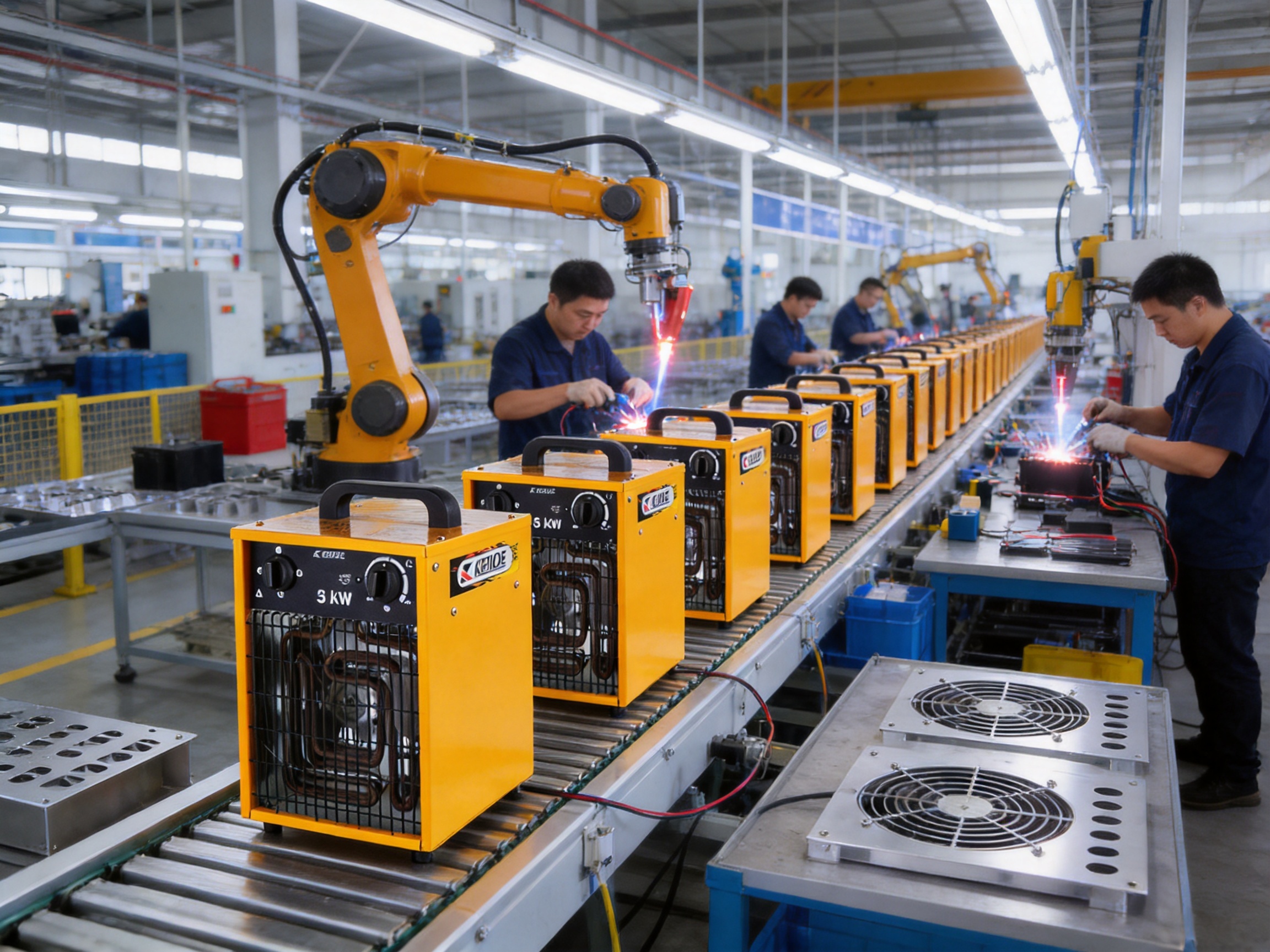
The manufacturing information identifies the use of automated patching, plug-in and welding systems, robot processing, laser cutting, and other advanced technologies. These processes can improve repeatability and productivity when properly controlled.
Laser cutting can support accurate fabrication of metal parts, ventilation openings, brackets, and housing components. Accurate cutting contributes to assembly consistency and can help maintain designed airflow paths. Robotic processing can improve repeatability in suitable operations and reduce variation caused by manual handling. Automated electrical assembly processes can support consistent placement and connection of components when paired with inspection and testing.
The use of advanced manufacturing technology does not by itself guarantee product quality. Effective quality depends on process validation, incoming inspection, operator training, equipment maintenance, traceability, and final testing. However, the reported combination of automated equipment and structured management systems provides a strong foundation for stable high-volume production.
The company reports the use of office automation, Toyota Production System-based management, ERP, and manufacturing execution systems. These systems can connect purchasing, production planning, material control, work orders, inventory, quality records, and delivery schedules.
For an international buyer, organized production management can improve communication about lead times, batch quantities, spare parts, packaging, and documentation. Manufacturing execution systems may also support the recording of production information at different stages, helping management identify delays or process deviations.
The manufacturer reports holding several international product certifications and approvals, including GS, CE, EMC, ERP, ETL, UKCA, and CCC-related credentials across its product portfolio. Certification applicability depends on the exact model, market, voltage, configuration, and current certificate scope. Buyers should request the relevant documentation for the specific heater model rather than assuming that every approval applies identically to every variant.
Electrical heating equipment must be designed with attention to insulation, temperature rise, wiring, earthing, component ratings, enclosure strength, fan operation, protection devices, and abnormal operating conditions. Electromagnetic compatibility is also important because the heater should operate appropriately alongside other electrical equipment.
For importers, product documentation should normally include the model identification, rated voltage, frequency, power, applicable warnings, operating instructions, packaging marks, and market-specific conformity information. Commercial buyers may also request factory inspection reports, batch records, component information, warranty terms, and spare-parts support.
A supplier with large export experience may be familiar with different plug systems, language requirements, labeling formats, carton specifications, palletization, and regional documentation. These details do not replace local compliance verification, but they can reduce the administrative burden involved in international sourcing.
The heat output of an electric resistance heater is closely related to its electrical input. A 2 kW model generally requires an electrical circuit capable of safely supplying its rated load, while a 5 kW model requires substantially greater current or a suitable higher-voltage configuration. The electrical installation must always be checked by a competent person.
Electric fan heaters are most effective when used for targeted or intermittent heating. They can be switched on when a room is occupied and switched off when the heating requirement ends. This operating pattern may be more practical than maintaining an entire building at a high temperature when only one area is in use.
Room preparation also affects efficiency. Closing doors, reducing drafts, improving insulation, and keeping the heater pointed toward the occupied zone can help reduce heat loss. The heater should not be placed directly in front of an open door or an uncontrolled ventilation opening unless the application specifically requires that airflow.
Thermostatic control, where provided by the particular configuration, can help prevent unnecessary continuous heating. Users should consult the model’s operating manual for control functions and should not modify the electrical or thermal protection system.
Energy efficiency should be assessed in relation to the application rather than only the nameplate output. A portable heater that warms a small occupied workspace may be more operationally appropriate than a high-capacity system that heats a much larger unoccupied area. Conversely, selecting an undersized model for a poorly insulated large room may lead to unsatisfactory comfort and continuous operation.
Inspect the heater, power cord, plug, controls, housing, fan openings, and carrying handle before operation. Do not use the unit if it has been dropped, damaged, exposed to water, or stored in conditions that may have affected the electrical system.
Confirm that the supply voltage and frequency match the rating plate. The 5 kW model is listed with AC 220–240 V and AC 380–400 V alternatives in the supplied specifications, so the exact configuration must be confirmed before connection. A model intended for a particular electrical arrangement must not be connected to an incompatible supply.
Place the heater on a stable, level surface with sufficient clearance around the air inlet and outlet. Keep the airflow path free of boxes, tools, clothing, curtains, furniture, dust, and other obstructions. Do not place the unit on an unstable platform or where it can be struck by moving equipment.
Do not use the heater in locations where water can splash onto the unit, even though the listed IP42 rating offers limited protection under defined test conditions. Avoid areas with standing water, heavy condensation, outdoor rain exposure, or wash-down operations.
Start the unit according to the supplied operating instructions. Allow the fan and heating system to operate normally, and monitor the first use for unusual noise, smell, vibration, or overheating. If an abnormal condition occurs, switch off the heater, disconnect the supply when safe, and arrange inspection by a qualified service professional.
After heating, follow the specified shutdown procedure. Some fan heaters require a cooling period so that residual heat can be removed from the heating assembly. Do not immediately cover or store a hot unit.
Disconnect the heater from the electrical supply before cleaning or maintenance. Remove dust from external surfaces and air openings using an appropriate method. Excessive dust accumulation can restrict airflow and affect thermal performance. Do not insert tools into the fan or heating chamber.
Maintenance should include checking the power cord, plug, housing, fasteners, fan operation, controls, and safety devices. Repairs involving electrical components should be carried out only by suitably qualified personnel using compatible replacement parts.
| Application Type | Suggested Starting Point | Selection Considerations |
|---|---|---|
| Small room or localized workspace | 2 kW model | Compact dimensions, 260 m³/h airflow, approximately 60 m³ reference space |
| Medium workshop or office | 3 kW model | 400 m³/h airflow, approximately 90 m³ reference space |
| Medium room requiring additional output | 3.3 kW model | 400 m³/h airflow, approximately 98 m³ reference space |
| Larger workshop or industrial room | 5 kW model | 560 m³/h airflow, approximately 144 m³ reference space |
| Multiple customer segments | Mixed inventory | Stock several outputs and verify regional voltage and plug requirements |
The table is a starting guide rather than a substitute for a heat-loss calculation. A professional selection should consider room volume, insulation, external temperature, desired indoor temperature, door openings, ventilation, ceiling height, electrical availability, and operating duration.
Importers should also confirm the precise model naming. The supplied materials use both HB and HOT references, and they include a product-title reference to 9 kW that is not represented in the detailed table. Clear confirmation of the exact model range is essential for catalogs, quotation documents, certification files, carton labels, and customer instructions.
Heating equipment is often purchased as a functional commodity, but long-term value depends on more than the initial price. Consistent component quality, stable assembly, correct wiring, reliable thermal protection, and accurate documentation all influence customer satisfaction and after-sales costs.
A manufacturer with experience in multiple electrical product categories may have established systems for testing insulation, checking electrical connections, evaluating mechanical assemblies, and managing supplier quality. Experience with welding equipment and battery chargers also indicates familiarity with high-current electrical systems, power electronics, motors, metal housings, and international product requirements.
Large-scale output can support more dependable supply for distributors. It may allow the manufacturer to maintain dedicated production planning, procure components in volume, and provide coordinated shipments. Buyers should still evaluate the supplier through samples, audits, documentation review, and agreed inspection standards.
Research and development capacity is another important advantage. Regional market requirements can differ in voltage, frequency, plug type, labeling, packaging, language, thermal expectations, and regulatory procedures. A capable engineering team is better positioned to review these requirements and develop appropriate product variations without compromising the core design.
The company’s reported participation in national welding-machine standard development also suggests engagement with technical standardization. While that activity is associated primarily with welding equipment, it reflects a broader involvement in engineering standards and product compliance.
The series may be suitable for distributors, importers, equipment rental companies, hardware retailers, and professional heating suppliers. A multi-model family allows a business to offer customers several capacity choices while maintaining a consistent visual and technical platform.
For private-label or OEM programs, buyers should discuss minimum order quantities, logo placement, packaging artwork, instruction manuals, plug configurations, warranty conditions, spare parts, production lead times, and inspection arrangements. The manufacturer’s stated ability to develop new products according to regional and customer requirements may support customization discussions, subject to technical and commercial feasibility.
Product consistency is especially important when several models share the same housing or control concept. Customers benefit when controls, operating instructions, replacement parts, and service procedures are similar across the range. Distributors can simplify staff training and after-sales support when the product family follows a common design logic.
Packaging should protect the heater, fan assembly, controls, and housing during international transport. Export buyers may need to specify carton dimensions, pallet arrangements, moisture protection, stacking limits, and shipping marks. These details should be agreed before mass production.
No portable heater is suitable for every environment. Electric fan heaters depend on a reliable electrical supply and may not be appropriate where electrical capacity is limited. High-output models can place a significant load on circuits, so the installation must be designed for the rated current.
The IP42 rating does not make the product suitable for outdoor exposure, direct water spray, submerged use, or wet industrial cleaning. The heater should not be used in explosive atmospheres or areas containing flammable vapors unless the exact product is specifically approved for that hazardous environment.
Electric fan heaters also do not remove moisture from a building or replace ventilation. If a room has condensation, dampness, or poor air quality, those underlying issues need separate attention. Heating may raise air temperature, but it does not automatically correct structural moisture problems.
The heat-space ratings are reference values. A room with poor insulation, frequent door openings, or very low outdoor temperatures may require a larger output or multiple heaters. Professional users should perform a heat-load assessment when reliable temperature control is critical.
Users must not bypass thermal cut-outs, modify the wiring, remove protective grilles, block the fan, or install unauthorized components. Such actions can create a serious fire or electric-shock hazard and may invalidate certification and warranty coverage.
Before purchasing, confirm the exact model, output power, input voltage, frequency, phase, plug type, airflow, dimensions, weight, protection class, controls, thermostat arrangement, and certification documents. The 5 kW configuration deserves particular attention because the supplied table identifies both lower- and higher-voltage alternatives.
Ask whether the quotation includes the user manual, warranty terms, spare parts, packaging, and inspection documentation. For commercial installations, request information about recommended clearances, operating temperature, storage conditions, service intervals, and replacement procedures.
For a large order, approve a production sample before mass manufacture. Check heating performance, airflow, noise, stability, controls, cable length, labeling, packaging, and appearance. Agree on an inspection standard covering electrical safety, function, workmanship, and carton condition.
Also confirm the commercial identity used in the transaction. The supplied information contains several contact references and product naming formats, so official quotations, invoices, certificates, and shipping documents should use consistent legal and model information.
It is a portable electrical fan heater. Electrical energy heats the internal heating assembly, and an integrated fan moves warm air into the room.
The detailed technical table lists 2 kW, 3 kW, 3.3 kW, and 5 kW models. The product title also contains a reference to 9 kW, but that output is not shown in the detailed table. The exact available range should be confirmed with the supplier.
The listed reference heat spaces range from approximately 60 m³ for the 2 kW model to approximately 144 m³ for the 5 kW model. Actual performance depends on insulation, outdoor temperature, ceiling height, ventilation, and door openings.
Yes. The heater has a variable inclination so the operator can adjust the direction of heat and airflow according to the room layout or work area.
Yes. They have compact dimensions and a practical carrying handle. Listed weights range from approximately 4.5 kg to 7.5 kg, depending on the model.
The supplied figures are 260 m³/h for the 2 kW model, 400 m³/h for both the 3 kW and 3.3 kW models, and 560 m³/h for the 5 kW model.
IP42 indicates limited protection against solid objects and certain falling water conditions under standardized testing. It does not mean that the heater is waterproof or suitable for rain, standing water, wash-down areas, or direct water spray.
It can provide supplemental, localized, or temporary heating, but whether it can replace a central system depends on the building, climate, heat load, electrical capacity, and operating requirements. A professional assessment is recommended for whole-building heating.
In normal operation, an electric heater does not burn fuel in the room and does not produce combustion exhaust. This can make it more convenient for many indoor applications. The electrical installation and room safety requirements still apply.
Check the model’s voltage, frequency, phase, rated power, plug, cable, and circuit capacity. The 5 kW model requires particular attention because the listed configurations include both AC 220–240 V and AC 380–400 V alternatives.
No. Keep curtains, paper, packaging, clothing, solvents, fuel, furniture, dust, and other combustible materials away from the heater and its hot-air outlet. Maintain the clearances specified in the instruction manual.
Disconnect the heater before cleaning. Keep the air inlets and outlets free of dust and obstruction, inspect the cord and plug, and monitor the fan and controls. Electrical repairs should be performed by qualified personnel.
Yes. The multi-output range can support distributors serving different room sizes and customer segments. Buyers should confirm model availability, documentation, packaging, certifications, order quantities, lead times, and after-sales support.
The HB-020/030/033/050M/S portable electric fan heater series offers a flexible approach to room heating. Its principal advantages are rapid forced-air heat distribution, selectable output levels, adjustable inclination, compact dimensions, carrying convenience, and suitability for temporary or supplemental heating.
The range provides practical alternatives to fuel-fired heaters where combustion-free indoor operation is preferred, to fixed heating systems where mobility is important, and to basic radiant heaters where active warm-air circulation is desired. The available models cover smaller spaces through larger workshops and service areas, with listed heat outputs from 2 kW to 5 kW in the detailed specification table.
The manufacturer’s reported production scale, research resources, automated processing equipment, quality systems, international certifications, and export experience add value for professional buyers. These capabilities can support stable supply, technical development, private-label programs, and regional product adaptation.
Correct model selection remains essential. Purchasers should verify the precise output, voltage, electrical configuration, certification scope, heat-space requirement, and documentation before ordering. When installed on an appropriate circuit and operated with adequate clearance and supervision, the series can provide a convenient and versatile heating solution for domestic, commercial, workshop, and temporary applications.
1. Supplied product specification for the HB-020/030/033/050M/S electrical fan heater series.
2. Supplied technical data table for HOT-020M, HOT-030M/S, HOT-033M/S, and HOT-050M/S models.
3. International Electrotechnical Commission, enclosure protection classification principles for ingress protection ratings.
4. General electrical equipment safety practices for portable heating appliances.
5. Manufacturer-provided company profile, production capability summary, certification information, and research and development overview.
Recommended Products

Contact Us
No.2299, Luqiao Section, Shugang Avenue, Luqiao District, Taizhou, 318057 Zhejiang, PR China.
+86-576-82431568
 Privacy
China Welding Machine Factory
 English
 中文简体
 русский
 Español
 عربى
 Français
 Português
 Deutsch
 Український