Email: [email protected]
Email: [email protected]

Blog
 2026.09.02
 Blog
A dependable battery charger is an essential tool for vehicle workshops, service garages, agricultural operators, fleet managers, roadside assistance providers, and private vehicle owners. When a battery is discharged, the problem is not limited to the battery itself. A vehicle may be unable to start, equipment may be forced out of service, and a production schedule may be interrupted. A practical charging and starting solution therefore needs to combine reliable electrical performance, simple operation, portability, protection, and long service life.
The CB-16S Series Battery Charger is designed as a manual battery charger and engine starter for lead-acid batteries. Its heavy-duty construction provides strong starting assistance, while its portable form makes it suitable for workshops, garages, service vehicles, and light commercial applications. The series includes models with different charging capacities, current ratings, battery reference capacities, and voltage configurations. The CB-16S model provides 12/24 V charging voltage selection and a boost current of 12 A, making it one of the more capable units within the listed series.
This article examines the product’s practical functions, electrical specifications, safety features, operating advantages, and suitability for different users. It also explains how advanced manufacturing systems, engineering resources, quality certifications, research capabilities, and production experience contribute to the consistency of the finished charger. Rather than treating a battery charger as a simple electrical accessory, the discussion considers it as a complete service tool that must perform reliably under real working conditions.
The CB-16S Series Battery Charger combines two important functions: controlled battery charging and engine starting assistance. In charging mode, the unit supplies electrical energy to a compatible lead-acid battery. In starting or boost mode, it provides additional current to support the vehicle’s starting system when the battery does not have enough energy to crank the engine independently.
The product is intended for standard, AGM, and gel batteries, subject to correct operating procedures and compatibility with the battery manufacturer’s instructions. Because the unit is a manual charger, the operator remains responsible for selecting the correct voltage, monitoring the charging process, and disconnecting the charger at the appropriate time. This manual format can be particularly valuable for experienced technicians who want direct control over the charging process rather than relying exclusively on automatic electronic programs.
The charger is designed for single-phase operation and is supplied with a 230 V rated supply voltage at 50 Hz. It includes an integrated ampere-meter, overload protection, charging cables, battery clamps, and a replaceable fuse. Its compact dimensions and retractable handle support convenient storage and movement around a workshop.
The CB-16S belongs to a wider family of chargers that includes the CB-12S, CB-13S, CB-14S, CB-15S, and CB-16S. This family approach allows users and distributors to select a model according to vehicle type, battery capacity, required charging current, and starting assistance requirements. It also gives professional buyers a coherent range for different market segments instead of forcing every application to use one oversized or undersized unit.
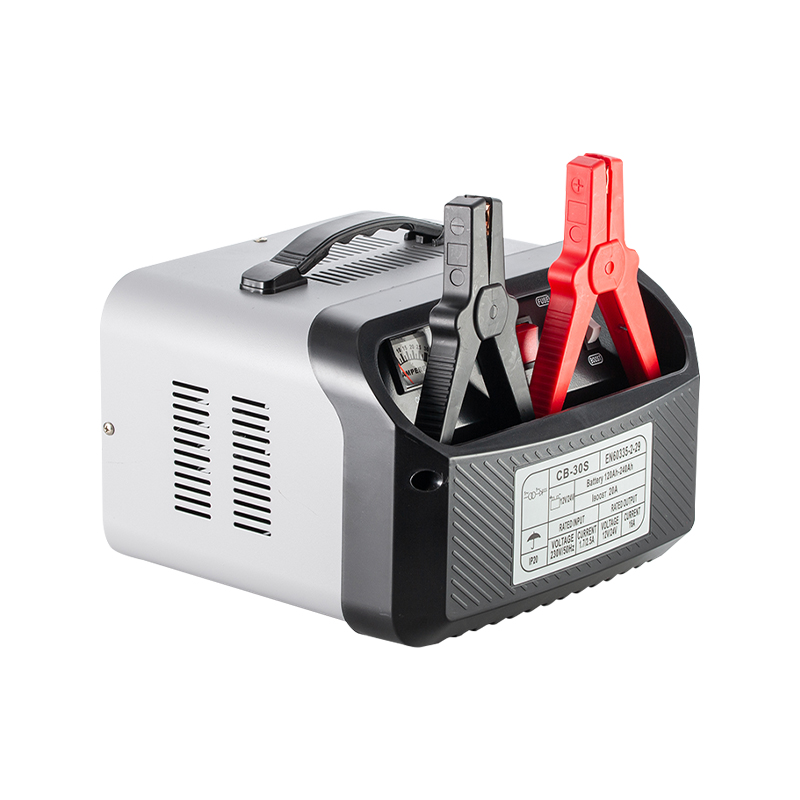
CB-16S Series Battery Charger
The CB-16S is specified with a 230 V rated supply voltage and a 50 Hz supply frequency. Its charging voltage is selectable between 12 V and 24 V, allowing it to serve a broader range of automotive and light commercial battery systems than a single-voltage charger. The model has a rated capacity listed as 160/120 W, a boost current of 12 A, and a rated current of 9/4 A. The two current values correspond to the selected operating voltage and charging configuration.
The unit uses a 2/20 A mains fuse specification and provides IP20 protection. IP20 indicates protection against solid objects larger than 12.5 mm but does not indicate protection against water. The charger should therefore be used indoors or in a dry, sheltered location unless additional site protection is provided. Correct environmental use is important for all electrical equipment and helps preserve both operator safety and product life.
The reference battery capacity for the CB-16S is listed as 28–100 Ah. This range is useful for many passenger cars, vans, and light trucks. Battery condition, temperature, age, and charging history can affect actual charging time, so the reference capacity should be treated as a selection guide rather than a guarantee of a fixed charging duration.
The machine weighs approximately 5.8 kg and measures about 300 mm in length, 210 mm in width, and 185 mm in height. These dimensions provide a balance between output capability and portability. A charger with greater electrical capacity often becomes heavier and more difficult to move, while an extremely small charger may lack the current needed for practical workshop use. The CB-16S design aims to offer useful starting support without becoming a permanently mounted, industrial-scale unit.
| Model | Rated Supply Voltage | Supply Frequency | Charging Voltage | Rated Capacity | Boost Current | Rated Current | Mains Fuse | Protection | Reference Capacity | Weight | Machine Size |
|---|---|---|---|---|---|---|---|---|---|---|---|
| CB-12S | 230 V | 50 Hz | 12 V | 85 W | Not specified | 4 A | 1/10 A | IP20 | 20–60 Ah | 3.8 kg | 285 × 215 × 180 mm |
| CB-13S | 230 V | 50 Hz | 12 V | 100 W | 6 A | 5 A | 1/10 A | IP20 | 20–90 Ah | 3.9 kg | 285 × 215 × 180 mm |
| CB-14S | 230 V | 50 Hz | 12/24 V | 105 W | Not specified | 6/3 A | 1/10 A | IP20 | 25–90 Ah | 4.1 kg | 285 × 215 × 180 mm |
| CB-15S | 230 V | 50 Hz | 12/24 V | 110 W | 9 A | 7/3.5 A | 2/15 A | IP20 | 25–135 Ah | 4.8 kg | 300 × 210 × 185 mm |
| CB-16S | 230 V | 50 Hz | 12/24 V | 160/120 W | 12 A | 9/4 A | 2/20 A | IP20 | 28–100 Ah | 5.8 kg | 300 × 210 × 185 mm |
One of the principal advantages of the series is the combination of charging and engine-starting assistance in one machine. A standard battery charger can restore battery energy over time, but it may not provide the temporary current required when an operator needs to start a vehicle immediately. A dedicated engine starter can offer high starting power, but it may not be convenient for routine battery maintenance. Combining both functions gives the user a more versatile workshop tool.
In charging mode, the operator connects the clamps to the battery terminals, selects the appropriate voltage, connects the unit to the mains supply, and monitors the ammeter during operation. The analog current indication gives a direct view of charging activity. As the battery accepts charge, the indicated current may change. This basic visual feedback is useful for technicians who need to observe the condition of the battery rather than simply wait for an automatic status light.
In boost mode, the charger provides additional current to help the vehicle starter motor operate. The 12 A boost current listed for the CB-16S gives it an advantage over smaller models in the same family. It is still important to understand that starting assistance is not a substitute for a correctly sized battery, clean terminals, a healthy starter motor, and a properly functioning vehicle electrical system. If a battery is physically damaged, frozen, leaking, or seriously shorted, it should not be connected to a charger or starter.
The manual operating format offers flexibility. Professional users may prefer to determine the charging duration and current according to battery type and condition. This can be useful in workshop environments where batteries vary widely and technicians already follow established inspection procedures. At the same time, manual equipment requires disciplined operation. The user must select the correct 12 V or 24 V setting, observe polarity, avoid unnecessary overcharging, and follow the instructions supplied with the machine.
Many low-cost chargers are designed for only one voltage, offer limited current, or rely on lightweight housings that are not well suited to repeated workshop use. The CB-16S Series addresses these limitations through a broader voltage range, a dedicated starting function, a robust portable structure, and integrated electrical protection.
First, the 12/24 V configuration expands application coverage. A 12 V-only charger is suitable for many passenger vehicles, but a 24 V system is commonly used in certain commercial vehicles, trucks, agricultural machinery, and specialized equipment. A dual-voltage charger reduces the need to purchase and store separate machines for each system. It also helps service centers standardize their equipment around a flexible platform.
Second, the series provides a selection of capacities. The CB-12S and CB-13S are compact options for smaller battery applications, while the CB-14S, CB-15S, and CB-16S provide increasingly capable 12/24 V performance. This graduated range is more practical than a one-model product strategy because it allows buyers to match equipment to actual workload requirements.
Third, the CB-16S includes an integrated ampere-meter. Some basic chargers provide no clear indication of current, leaving the user uncertain about whether the battery is accepting charge. The meter improves visibility and supports more informed operation. In a professional environment, this can help technicians identify abnormal charging behavior and make better decisions about battery testing or replacement.
Fourth, the charger includes overload protection and a replaceable mains fuse. These features do not eliminate the need for correct use, but they create additional protection against certain electrical faults and excessive operating conditions. A replaceable fuse can also make field maintenance more convenient than a permanently sealed design that requires complete replacement after a fuse failure.
Fifth, the physical design is directed toward practical handling. The retractable handle supports carrying and storage, while the front-mounted clamps help keep accessories organized. Charging cables measuring approximately 1.5 m plus 1.5 m provide useful working reach for typical vehicle service situations. A compact footprint allows the unit to be placed on a workshop shelf, service bench, or vehicle storage compartment when not in use.
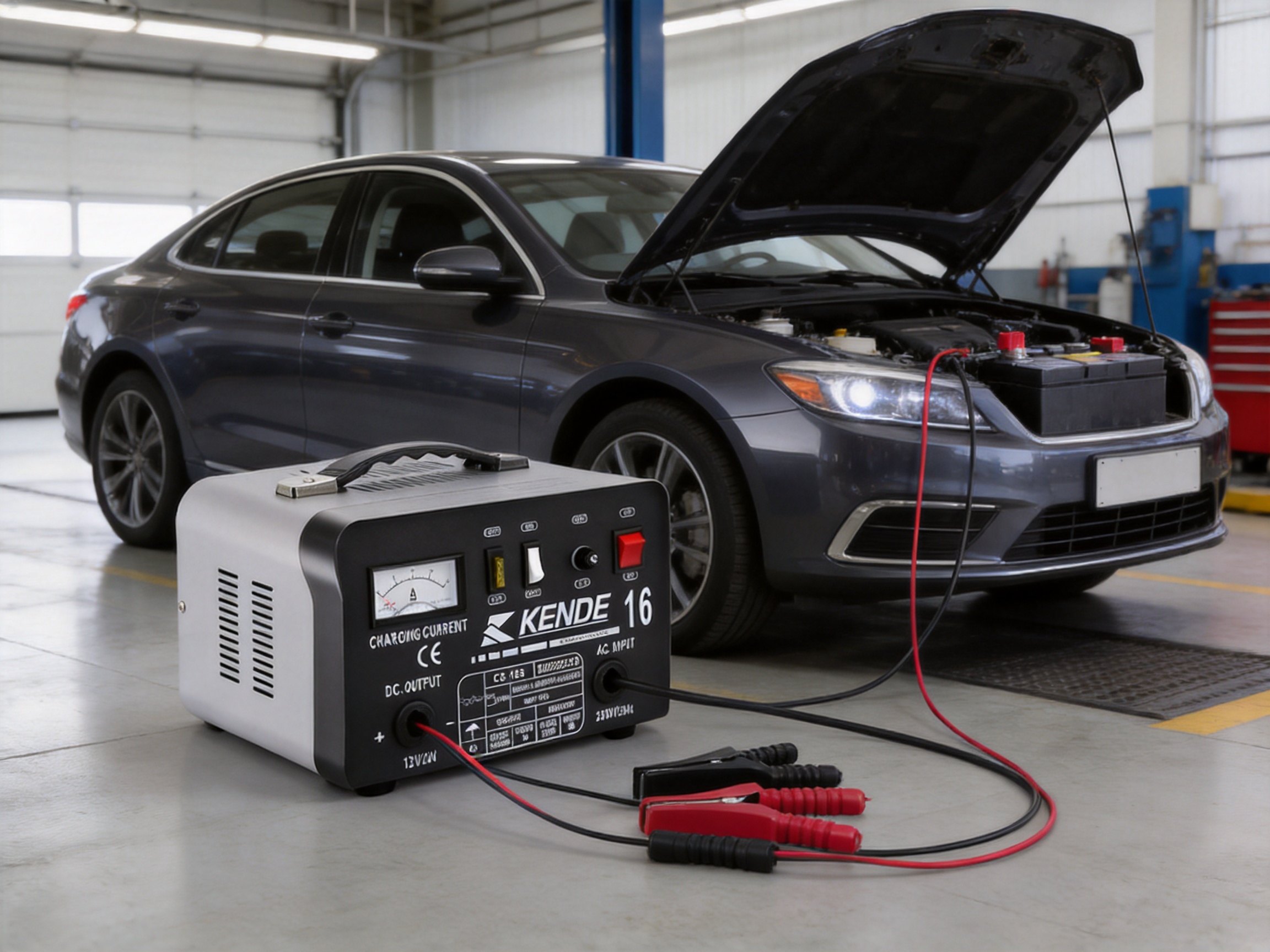
Heavy-duty construction is important for equipment that may be moved frequently, placed near vehicles, or used in demanding service environments. The CB-16S is designed with a rigid body and a compact mechanical layout intended to protect internal electrical components during ordinary handling. A strong enclosure also helps maintain alignment of switches, meters, cable connections, and ventilation openings over the product’s working life.
The retractable handle is more than a cosmetic feature. Battery chargers are often moved between work bays, vehicles, storage rooms, and service areas. A fixed or poorly positioned handle can make transport inconvenient, while a retractable handle can reduce the overall storage profile when the charger is placed on a shelf. This is particularly useful for workshops that need to keep floors and work surfaces clear.
The front arrangement of clamps gives the operator a visible and accessible place to store the leads. Proper cable storage reduces the chance of cables being bent sharply, dragged across the floor, or left in a position where they can become contaminated by oil and dirt. Organized accessories also help reduce preparation time before charging begins.
The supplied accessories include charging cables, two clamps, an exchangeable fuse, and a color box. The complete accessory package makes the product more convenient for distribution and immediate use. A buyer does not need to source basic connection components separately before placing the charger into service.
Although the unit is portable, it should be handled as electrical workshop equipment rather than as a disposable consumer accessory. The charger should be kept dry, inspected before use, and placed on a stable surface with adequate ventilation. The cable insulation, clamps, fuse, and power connection should be checked regularly. Such basic maintenance is especially important for equipment used around batteries, where sparks, acid exposure, and high current can create hazards.
The CB-16S is suitable for many passenger-car battery service situations within the stated reference capacity. It can be used in garages, vehicle dealerships, rental fleets, and private workshops. A vehicle that has remained unused for an extended period may have a partially discharged battery, and controlled charging can help restore usable capacity when the battery remains serviceable.
The product information identifies cars, vans, and light trucks as suitable applications. These vehicles often operate more frequently than private cars and may be exposed to accessories, refrigeration equipment, lighting, or repeated short trips that place additional demands on the battery. A portable charger and starter can reduce downtime by supporting both scheduled charging and emergency starting assistance.
Automotive repair shops need equipment that can be shared across multiple work bays. A dual-voltage unit such as the CB-16S can support a wider variety of vehicles than a 12 V-only product. The integrated meter allows technicians to monitor the process, while the portable enclosure makes it possible to move the charger to the vehicle rather than moving the vehicle unnecessarily.
Fleet operators can use chargers to support preventive maintenance programs. Vehicles that are parked for long periods may require periodic charging, while operational vehicles may need assistance after repeated starting cycles or accessory usage. A standardized charger range can simplify staff training, maintenance procedures, and spare-parts management.
Some agricultural and commercial equipment uses 24 V electrical systems. The 12/24 V configuration increases the potential usefulness of the CB-16S for these environments, provided the battery capacity and operating conditions are within the machine’s specifications. Operators should always confirm the battery system voltage before connection.
Battery charging involves electrical energy, chemical reactions, and potentially explosive gases. Safe operation begins with a visual inspection. The operator should check the charger housing, power cord, charging leads, clamps, fuse, and meter. Damaged insulation, loose connections, cracked housings, or signs of overheating should be addressed before use.
The battery should be positioned in a ventilated area away from flames, sparks, cigarettes, and other ignition sources. Lead-acid batteries can release hydrogen during charging. The charging location should also be protected from rain, standing water, and excessive moisture because the product is specified with IP20 protection rather than water-resistance protection.
Correct polarity is essential. The positive clamp must be connected to the positive battery terminal and the negative clamp to the negative terminal, unless a vehicle manufacturer specifies an alternative connection procedure. Reversed polarity can cause sparks, fuse operation, equipment damage, or battery damage. The voltage selector must also be set correctly before the charger is energized.
When charging is complete, the charger should be switched off or disconnected from the mains according to the operating instructions before the clamps are removed. This reduces the chance of sparks at the battery terminals. The operator should avoid placing metal tools across the battery terminals and should use suitable eye and hand protection when working with lead-acid batteries.
Overload protection and the mains fuse provide valuable protective functions, but they are not a replacement for correct procedures. Protection devices are designed to respond to certain abnormal conditions; they cannot compensate for damaged batteries, incorrect voltage selection, wet environments, or careless cable handling.
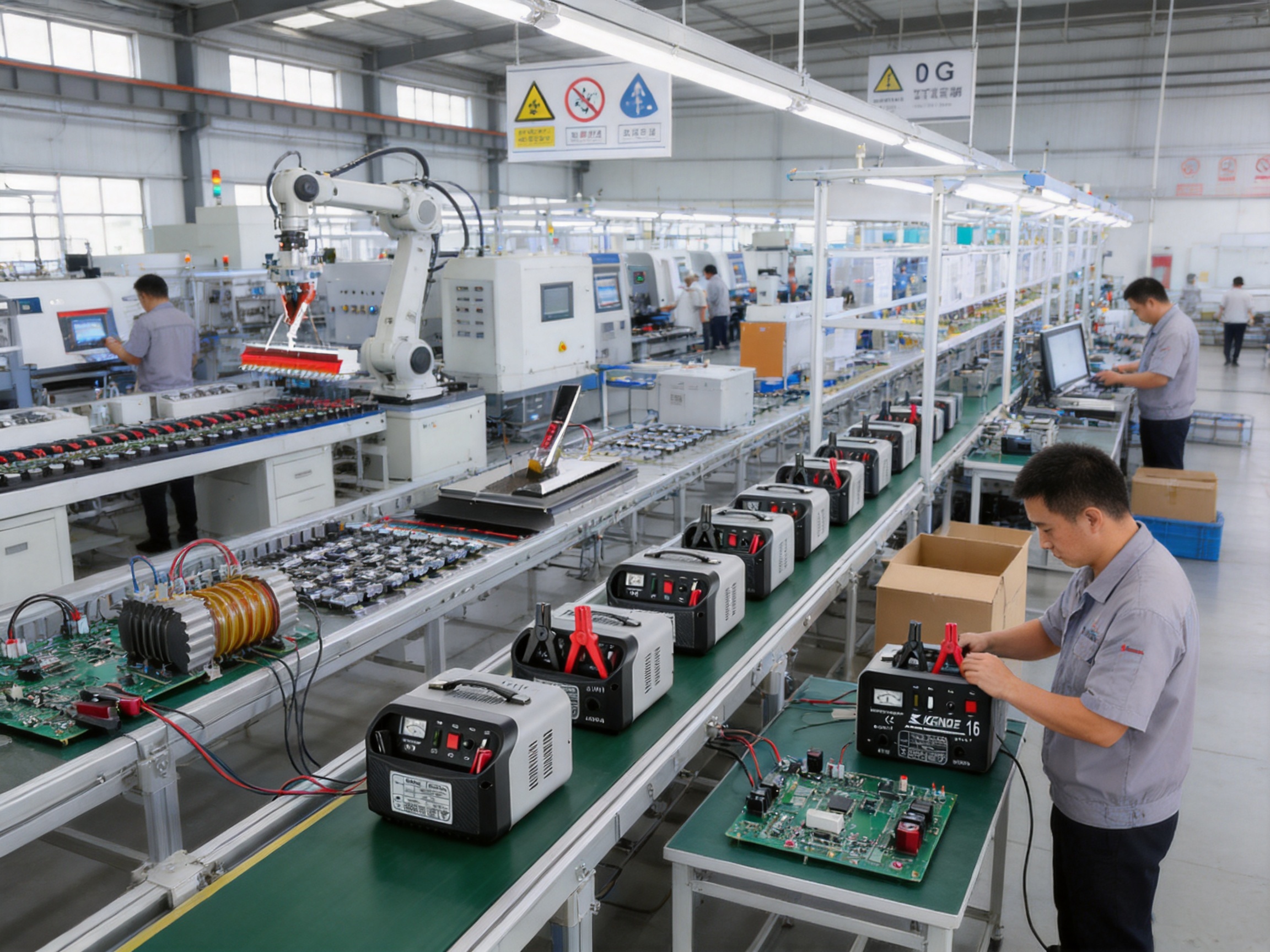
The consistency of a battery charger depends not only on its circuit design but also on the manufacturing system used to produce it. The manufacturer behind this product operates a large production and development organization in Zhejiang, China. Its facilities cover approximately 120,000 square meters and employ around 600 people. This scale provides resources for engineering, production planning, quality management, testing, procurement, and after-sales support.
The company reports annual exports of nearly 1.5 million units and an annual production capacity of approximately 2 million units. High-volume manufacturing experience can provide several advantages to buyers. Production processes are more likely to be standardized, component sourcing can be managed systematically, and recurring quality issues can be identified through larger amounts of field and factory data.
Manufacturing systems include office automation, enterprise resource planning, Toyota-style production management, and manufacturing execution systems. These tools can support production traceability, work-order management, material control, process monitoring, and delivery coordination. When properly implemented, such systems reduce avoidable variation between production batches and improve the ability to investigate quality concerns.
The company also uses automated surface-mount technology, plug-in and welding systems, robotic processing, laser cutting, and other advanced production technologies. Automated electronics assembly can improve component placement accuracy and repeatability. Robotic and laser-based processes can support consistent mechanical fabrication, while controlled welding and assembly operations can help maintain structural integrity.
Advanced equipment alone does not guarantee product quality. Its value depends on process discipline, operator training, inspection standards, maintenance, and engineering verification. The combination of automated production and experienced technical personnel is therefore important. A robust process should control incoming components, assembly parameters, electrical tests, mechanical checks, functional testing, and final packaging.

The manufacturer maintains a Zhejiang Provincial Research and Development Center, an enterprise technology center, and an intelligent welding technology research institute. Although the CB-16S is a battery charger rather than a welding machine, this broader technical infrastructure is relevant because it demonstrates experience in power electronics, electrical equipment, mechanical design, safety requirements, and high-volume product development.
The company reports having approximately 98 research and development personnel. Its engineering work includes product design, circuit development, mechanical engineering, testing, industrial design, software, process improvement, and application research. This multidisciplinary structure can support the development of products that are not only electrically functional but also practical to manufacture, transport, operate, and maintain.
The company has obtained invention patents, utility model patents, appearance patents, and software copyrights. Intellectual property activity indicates ongoing investment in design and technical improvement. For product buyers, this may translate into a broader range of configurations, more adaptable product platforms, and stronger ability to customize equipment for different regional or market requirements.
The manufacturer states that it can develop new products according to the needs of different countries, regions, and customers. This capability can be useful for importers and distributors that require specific voltage standards, packaging, documentation, accessories, labeling, or market certifications. Customization must be evaluated case by case, but an established engineering organization is generally better positioned to manage such projects than a trading company with no internal development capacity.
Electrical equipment must be designed and manufactured with attention to applicable safety and electromagnetic requirements. The manufacturer reports product certifications and approvals including GS, CE, EMC, ERP, US ETL, UKCA, and China CCC across its product portfolio. The exact certification applicable to a particular model, configuration, and destination market should be confirmed through the product’s technical file and supplied documentation.
CE marking, where applicable, relates to conformity with relevant European Union requirements. EMC requirements concern electromagnetic compatibility, including emissions and immunity. GS is associated with tested safety in applicable product categories, while UKCA applies to relevant products placed on the Great Britain market. ETL certification is used for applicable products intended for the North American market. China CCC is a mandatory certification system for covered product categories in China.
Certifications are valuable because they provide a framework for design review, testing, manufacturing controls, and market access. However, responsible users should still verify the certificate scope, model number, rated voltage, production version, and destination country. Certification should be considered alongside installation instructions, local electrical regulations, battery safety requirements, and workplace procedures.
The manufacturer also participates in national welding-machine standardization work and has contributed to the drafting, formulation, or revision of multiple national standards. While this activity is centered on welding equipment, it indicates participation in formal technical standards and a familiarity with the documentation and verification processes expected in regulated electrical-product industries.
A charger’s performance is affected by many small details. Transformer or power-conversion components must be correctly specified. Connections must be secure. Insulation distances must be maintained. The meter must be installed accurately enough to provide useful information. The fuse holder and cable terminals must withstand normal current and handling. The enclosure must provide mechanical protection without obstructing necessary ventilation.
Controlled production helps address these requirements. Incoming inspection can identify components that do not meet specification. Automated board assembly can reduce placement errors. In-process testing can detect wiring mistakes before the product reaches final assembly. Final functional tests can verify voltage selection, current output, meter operation, protection response, and basic insulation performance.
Mechanical production also matters. Accurate sheet-metal processing and consistent enclosure assembly help ensure that panels fit correctly and that controls remain protected. A poorly aligned enclosure may expose switches, create sharp edges, or place stress on cables. Laser cutting and automated fabrication can improve dimensional repeatability when supported by suitable quality controls.
Packaging is another important stage. Chargers may pass through several distribution centers before reaching the end user. A suitable color box and internal protective arrangement help reduce damage during transport. Product labels, manuals, accessory checks, and serial or batch information also support correct installation and after-sales service.
Purchase price is only one part of the cost of a battery charger. Buyers should also consider expected service life, downtime, accessory availability, maintenance requirements, ease of storage, and the number of applications supported. A single-voltage charger may have a lower initial cost, but a dual-voltage model can be more economical for a workshop servicing both 12 V and 24 V vehicles.
The CB-16S may also reduce equipment duplication because it combines charging and starting support. A workshop that would otherwise need separate devices can use one portable unit for several common tasks. This can free storage space and simplify operator training. The value is greatest when the product is used regularly and when vehicles with different electrical systems are serviced.
The exchangeable fuse is another practical ownership advantage. Fuses are consumable protective components, and a replaceable design can simplify basic service. Operators should use only the correct fuse specification and should investigate the reason for repeated fuse operation rather than repeatedly replacing fuses without diagnosis.
Durability is closely connected to total cost of ownership. A heavy-duty enclosure, organized cable storage, and a retractable handle can help reduce damage caused by routine movement. Nevertheless, long service life still depends on correct use, dry storage, regular inspection, and avoidance of overload or unsuitable battery conditions.
The product is suitable for distributors that serve automotive tools, workshop equipment, hardware, electrical products, and industrial maintenance markets. The series format allows a distributor to offer multiple models without managing completely unrelated product designs. This can simplify catalogs, product training, spare-part planning, and customer recommendations.
International distributors may also benefit from the manufacturer’s export experience and range of compliance capabilities. Different countries can require different plugs, labels, manuals, packaging languages, and certification documents. These requirements should be confirmed during the purchasing process. The manufacturer’s reported engineering and production resources provide a foundation for handling such requirements, subject to project specifications and order quantities.
For private-label or customized projects, important discussion points may include rated supply voltage, frequency, charging voltage, cable length, clamp design, fuse arrangement, meter scale, packaging, nameplate information, user manuals, and quality inspection procedures. Clear technical communication is essential because a charger designed for one electrical market may not be suitable for another without appropriate changes.
A professional operating workflow begins by identifying the battery voltage and approximate capacity. The battery should be inspected for physical damage, leakage, swelling, freezing, or severe corrosion. If the battery is unsafe or suspected to be internally damaged, it should be removed from service and evaluated by a qualified technician.
The charger should be placed on a stable, dry, ventilated surface. The correct voltage setting should be selected before connection to the mains. The clamps should be connected with correct polarity and with firm contact on clean terminals. The operator should then connect the charger to the supply and select the appropriate charging or boost function according to the operating instructions.
During charging, the integrated ampere-meter should be observed periodically. Unusual current behavior, excessive heat, unusual odor, smoke, noise, or repeated protective-device operation requires immediate attention. The charger should not be covered during use, and ventilation openings should remain unobstructed.
After charging or starting assistance, the machine should be switched off or isolated from the mains before the clamps are removed. The cables should be inspected and stored using the intended arrangement. Keeping the clamps and leads organized helps prepare the equipment for the next task and reduces accidental damage.
Small automatic chargers are convenient for maintenance charging and may be suitable for motorcycles, small cars, and long-term battery storage. However, many have limited starting assistance and cannot support a broad range of vehicle applications. The CB-16S offers manual control, a visible current meter, and stronger service-oriented functionality.
Battery-powered jump starters are highly portable and can be useful for emergency roadside starting. Their capacity depends on internal battery condition, charging status, temperature, and electronic protection settings. The CB-16S operates from a mains supply and is intended for workshop or service environments where consistent access to electrical power is available. It also provides conventional battery charging rather than only short-duration starting assistance.
Large industrial chargers may provide higher current and greater battery capacity, but they are usually heavier, more expensive, and less convenient to move. The CB-16S occupies a practical middle position. It provides 12/24 V capability and boost support in a compact format suitable for cars, vans, and light trucks.
A single-voltage charger may be adequate for a narrow application, but it limits flexibility. The CB-16S supports both 12 V and 24 V systems, giving workshops a broader operating range. This versatility can be especially valuable for service businesses that work with mixed vehicle fleets.
Battery charging should be carried out in a location with adequate ventilation and controlled access. The machine should not be exposed to rain or water because its IP20 protection classification is intended for protection against solid objects, not moisture ingress. Dust, oil, corrosive chemicals, and excessive heat should also be avoided where possible.
Workshop managers should establish procedures for cable inspection, fuse replacement, cleaning, and periodic functional checks. Employees should be trained to recognize battery hazards and to understand the difference between charging a healthy battery and attempting to recover a damaged one. Personal protective equipment should be selected according to the battery type and workplace risk assessment.
Responsible disposal is also important. Batteries, fuses, electronic components, and damaged cables should be handled according to local waste-management regulations. Extending equipment life through proper maintenance can reduce unnecessary replacement, but safety must always take priority over continued use of defective equipment.
It is a manual battery charger and engine starter designed for lead-acid battery applications. It combines charging capability with boost starting assistance in a portable machine.
The listed CB-16S specification provides selectable 12 V and 24 V charging voltage. The operator must confirm the vehicle and battery voltage before selecting the setting.
The CB-16S is listed with a 12 A boost current. Actual starting performance depends on battery condition, temperature, vehicle design, cable connections, and starter-motor requirements.
The listed reference capacity is 28–100 Ah. This range is a guide for selecting the machine and does not replace the battery manufacturer’s charging instructions.
The product information states that the manual charger and starter can be used with standard, AGM, and gel batteries. Users should still verify the specific battery manufacturer’s requirements because charging profiles and permitted charging methods can vary.
No. It is described as a manual battery charger and engine starter. The user must select the voltage, monitor operation, and disconnect the charger appropriately.
Yes. The product information specifies an integrated ampere-meter, allowing the operator to observe charging current during use.
The charger includes overload protection and a replaceable mains fuse. It is specified with IP20 degrees of protection, so it should be used in a dry, sheltered environment.
The listed accessories include charging cables of approximately 1.5 m plus 1.5 m, two clamps, an exchangeable fuse, and a color box.
The series is identified as suitable for various cars, vans, and light trucks. The CB-16S may also be useful for certain 24 V commercial or agricultural applications when the battery capacity and operating conditions are appropriate.
The listed machine size is approximately 300 × 210 × 185 mm, and the weight is approximately 5.8 kg. A retractable handle supports movement and compact storage.
The product should not be exposed to rain, splashing water, or wet conditions. Its IP20 rating does not indicate water protection. Outdoor use is acceptable only in a dry, protected location that complies with the operating instructions.
The operator should check battery voltage, battery condition, terminal polarity, cable insulation, clamp condition, fuse condition, ventilation, and the correct charger setting. Damaged or leaking batteries should not be charged.
A large technical and manufacturing organization can support repeatable assembly, component control, product testing, certification management, engineering development, and after-sales service. These factors contribute to dependable performance across production batches.
The manufacturer has substantial export experience and reports a range of international certifications across its product portfolio. Importers should confirm the exact certification, plug, labeling, documentation, and electrical configuration required for their destination market.
The CB-16S Series Battery Charger is a practical solution for users who need more than basic battery maintenance. Its combination of manual charging, engine-starting assistance, 12/24 V selection, integrated current indication, overload protection, replaceable fuse, and portable construction makes it suitable for a wide range of automotive and light commercial service tasks.
Its advantages are especially clear when compared with single-voltage chargers, low-current maintenance units, and products designed for only one function. The CB-16S can support routine charging and emergency starting assistance while remaining compact enough for workshop mobility. The broader series also allows buyers to select different capacities according to application requirements.
Product performance is reinforced by the manufacturer’s reported production scale, engineering facilities, automated manufacturing equipment, quality systems, export experience, and certification capabilities. Research centers, technical personnel, enterprise management systems, surface-mount assembly, robotic processing, laser fabrication, and structured testing all contribute to a stronger product-development and manufacturing foundation.
For the best results, users should select the correct model, verify battery compatibility, observe polarity, use the correct voltage setting, provide ventilation, keep the charger dry, and follow proper charging procedures. When these requirements are respected, the CB-16S can serve as a dependable, flexible, and cost-effective tool for vehicle maintenance and battery service.
1. Product technical information for the CB-16S Series Battery Charger, including electrical specifications, accessories, dimensions, and application notes.
2. General operating principles for lead-acid, AGM, and gel battery charging and engine-starting assistance.
3. International guidance concerning electrical equipment safety, overload protection, fuse selection, and electromagnetic compatibility.
4. Manufacturer information concerning research and development facilities, production capacity, management systems, certifications, patents, and export experience.
5. General workshop safety practices for battery handling, ventilation, personal protective equipment, and electrical inspection.
Recommended Products

Contact Us
No.2299, Luqiao Section, Shugang Avenue, Luqiao District, Taizhou, 318057 Zhejiang, PR China.
+86-576-82431568
 Privacy
China Welding Machine Factory
 English
 中文简体
 русский
 Español
 عربى
 Français
 Português
 Deutsch
 Український