Email: [email protected]
Email: [email protected]

Blog
 2026.09.26
 Blog
Portable electric fan heaters are widely used when a room, workshop, temporary facility, or work area needs fast and controllable heating. Unlike slow radiant systems, a fan heater combines an electrical heating element with forced air circulation. This arrangement allows warm air to be distributed quickly throughout the space, helping operators reach a comfortable working temperature in a comparatively short time.
The HB-02A, HB-03A, HB-05A, and HB-09A series provides four practical heating capacities: 2 kW, 3 kW, 5 kW, and 9 kW. This range enables users to select equipment according to room volume, available electrical supply, desired heating speed, and operating environment. The models are designed for straightforward operation, convenient movement, adjustable airflow direction, and dependable daily use.
Manufactured by Zhejiang Kende Mechanical & Electrical Co., Ltd., the series reflects the company’s long experience in electric heaters, welding equipment, battery chargers, and other electrical machinery. Kende combines product development, automated production, quality control, certification experience, and export-oriented manufacturing to provide heating equipment for both domestic and industrial applications.
The HB series is particularly suitable for users who need a compact and mobile alternative to permanently installed heating systems. Its applications include workshops, garages, warehouses, offices, construction areas, service rooms, retail spaces, temporary workstations, agricultural buildings, and other locations where clean electric heat is preferred.

HB-02A/03A/05A/09A Electrical Fan Heater 2/3/5/9kw
The HB-02A/03A/05A/09A electric fan heater family is a group of portable hot air blowers with output capacities from 2 kW to 9 kW. Each unit uses an electric heating system and a fan to draw in surrounding air, pass it across the heating element, and discharge warmed air into the room.
The product is designed around several practical requirements. First, it must raise the room temperature efficiently. Second, it must be easy to transport and position. Third, it must allow the user to direct heat toward the required area. Fourth, it must provide appropriate protection for routine operation. The series addresses these requirements through compact construction, high air movement, adjustable inclination, and an IPX4 protection classification.
The compact design is beneficial in environments where floor space is limited. A portable heater can be taken from one room to another, stored when not required, or positioned close to a temporary work zone. This flexibility can reduce the need for multiple fixed heating installations, especially in buildings with changing layouts or seasonal heating requirements.
Each model has a different heating capacity and airflow output. The 2 kW and 3 kW units deliver 300 cubic metres of air per hour, making them suitable for smaller rooms and localized heating. The 5 kW model increases airflow to 560 cubic metres per hour, while the 9 kW model reaches 800 cubic metres per hour for larger spaces and more demanding heating requirements.
The HB-02A supplies 2 kW of heat and is rated for a heating space of approximately 60 cubic metres. It is a practical choice for small workshops, offices, storage rooms, garages, and personal work areas.
The HB-03A supplies 3 kW of heat and is intended for spaces of approximately 90 cubic metres. It provides a useful increase in heating capacity while retaining a similarly compact external size to the 2 kW model.
The HB-05A supplies 5 kW of heat and is rated for approximately 144 cubic metres. It is suitable for medium-sized rooms, larger workshops, work areas, and commercial spaces that require faster warming.
The HB-09A supplies 9 kW of heat and is rated for approximately 225 cubic metres. With an airflow output of 800 cubic metres per hour, it is the most powerful model in the series and is intended for larger rooms and more demanding applications.
| Model | Heat Output | Rated Voltage | Output Power | Airflow | Recommended Heating Space |
|---|---|---|---|---|---|
| HB-02A | 1,720 kcal/h | AC 220–240 V, 50 Hz | 2 kW | 300 m³/h | Approximately 60 m³ |
| HB-03A | 2,580 kcal/h | AC 220–240 V, 50 Hz | 3 kW | 300 m³/h | Approximately 90 m³ |
| HB-05A | 4,300 kcal/h | AC 220–240 V or AC 380–400 V, 50 Hz | 5 kW | 560 m³/h | Approximately 144 m³ |
| HB-09A | 7,740 kcal/h | AC 380–400 V, 50 Hz | 9 kW | 800 m³/h | Approximately 225 m³ |
One of the principal advantages of an electric fan heater is its ability to distribute heat actively rather than relying only on natural convection. Natural convection gradually moves warm air upward, which may leave lower working areas cold for longer. A fan-assisted design accelerates air circulation and helps move heated air across a larger portion of the room.
The HB series is designed to bring the room temperature up quickly. The heating element produces thermal energy while the fan transfers that energy into the surrounding environment. This combination is especially useful in areas where personnel arrive at different times, doors are opened frequently, or heating is required for limited periods rather than continuously throughout the day.
Rapid warm-up can improve comfort and productivity. In a workshop, for example, workers may need a warmer environment before beginning assembly, maintenance, painting, packaging, or repair work. In an office or service room, a portable unit can provide temporary heating without modifying the building’s existing heating system.
The airflow output is matched to each power class. The HB-02A and HB-03A each provide 300 cubic metres per hour, while the HB-05A and HB-09A use higher airflow rates appropriate to their greater heat output. This model range allows users to balance heating power and air movement rather than selecting an oversized heater for every application.
The heat and air distribution can be adjusted through the heater’s variable inclination. This feature allows the user to aim the warm airflow toward a workbench, seating area, entrance zone, machinery area, or other location that requires additional heat.
Directional adjustment is valuable because room conditions are rarely uniform. One side of a building may be close to an exterior door, while another side may be protected from drafts. A heater that can be tilted helps compensate for these differences. It also allows the unit to be positioned on the floor while directing warm air upward or across the room.
Compared with fixed-direction heaters, an adjustable fan heater provides greater installation freedom. The user does not need to build a permanent support or reposition the entire electrical connection every time the airflow direction changes. The adjustment is particularly useful for temporary workstations and shared industrial spaces.
Portability is a central feature of the HB series. The models are designed to be moved between locations as heating requirements change. Their compact dimensions allow them to fit into smaller rooms, storage areas, service vehicles, workshops, and temporary workspaces.
The HB-02A and HB-03A each measure approximately 240 by 205 by 285 millimetres and weigh approximately 3.5 and 3.6 kilograms respectively. These specifications make them convenient for users who need to carry the heater or store it after use.
The HB-05A is available with dimensional variations of approximately 300 by 230 by 315 millimetres or 365 by 230 by 320 millimetres, depending on the electrical configuration. Its weight is approximately 4.8 or 5.5 kilograms. The HB-09A measures approximately 400 by 360 by 340 millimetres and weighs approximately 6.8 kilograms.
| Model | Approximate Weight | Approximate Dimensions | Protection Class |
|---|---|---|---|
| HB-02A | 3.5 kg | 240 × 205 × 285 mm | IPX4 |
| HB-03A | 3.6 kg | 240 × 205 × 285 mm | IPX4 |
| HB-05A | 4.8 or 5.5 kg | 300 × 230 × 315 mm or 365 × 230 × 320 mm | IPX4 |
| HB-09A | 6.8 kg | 400 × 360 × 340 mm | IPX4 |
The weight and dimensions represent a useful balance between heating capacity and mobility. A larger output normally requires a larger heating assembly, fan, housing, and electrical structure. The series retains a manageable form while offering up to 9 kW of output.
Easy handling also supports efficient storage and deployment. A facility may keep several heaters in a central equipment area and distribute them to different workstations as required. This can be more economical than installing fixed heating equipment in every room, particularly where occupancy or production activity changes seasonally.
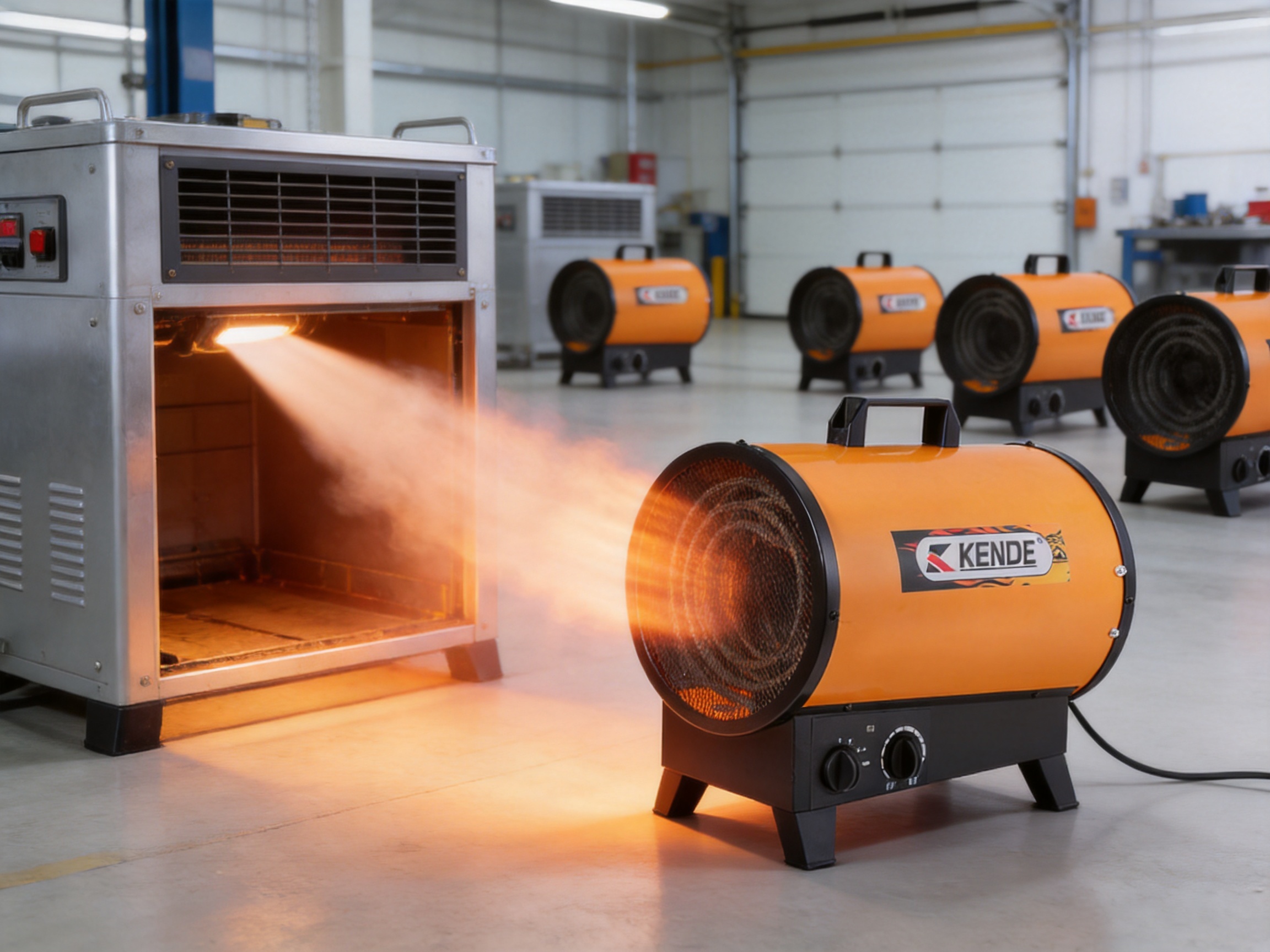
The HB series includes models designed for different electrical supplies. The HB-02A and HB-03A use AC 220–240 V at 50 Hz. The HB-05A is available for AC 220–240 V or AC 380–400 V at 50 Hz, while the HB-09A uses AC 380–400 V at 50 Hz.
This range gives distributors and professional users greater flexibility when matching the heater to regional electrical infrastructure. Smaller models can be suitable for standard single-phase supplies, while higher-output models can use three-phase power where this is available.
Electrical compatibility should always be confirmed before installation or operation. Users should verify the local voltage, frequency, phase arrangement, circuit capacity, plug and socket configuration, protective devices, and applicable electrical regulations. High-output heating equipment should be connected by a qualified professional when required by local rules.
The availability of more than one electrical configuration for the 5 kW model is particularly useful for international distribution. Different markets and buildings may use different supply arrangements, and a flexible product configuration can simplify selection for wholesalers, contractors, and equipment suppliers.
Electric heating produces heat at the point of use without burning fuel inside the room. As a result, the user does not need to store LPG, diesel, kerosene, or other fuel near the heater. There is also no combustion exhaust generated directly by the heating process.
This characteristic makes electric fan heaters attractive for occupied rooms, workshops, offices, storage areas, and applications where clean local heating is preferred. Electric operation can also simplify deployment because the user only needs a suitable electrical supply rather than a fuel tank, burner system, exhaust arrangement, and fuel management procedure.
Electric heating is not automatically the least expensive option in every region. Operating cost depends on electricity prices, insulation, ambient temperature, duty cycle, and the required temperature. However, the simple operating principle, low routine maintenance requirements, and absence of fuel handling can provide important practical benefits.
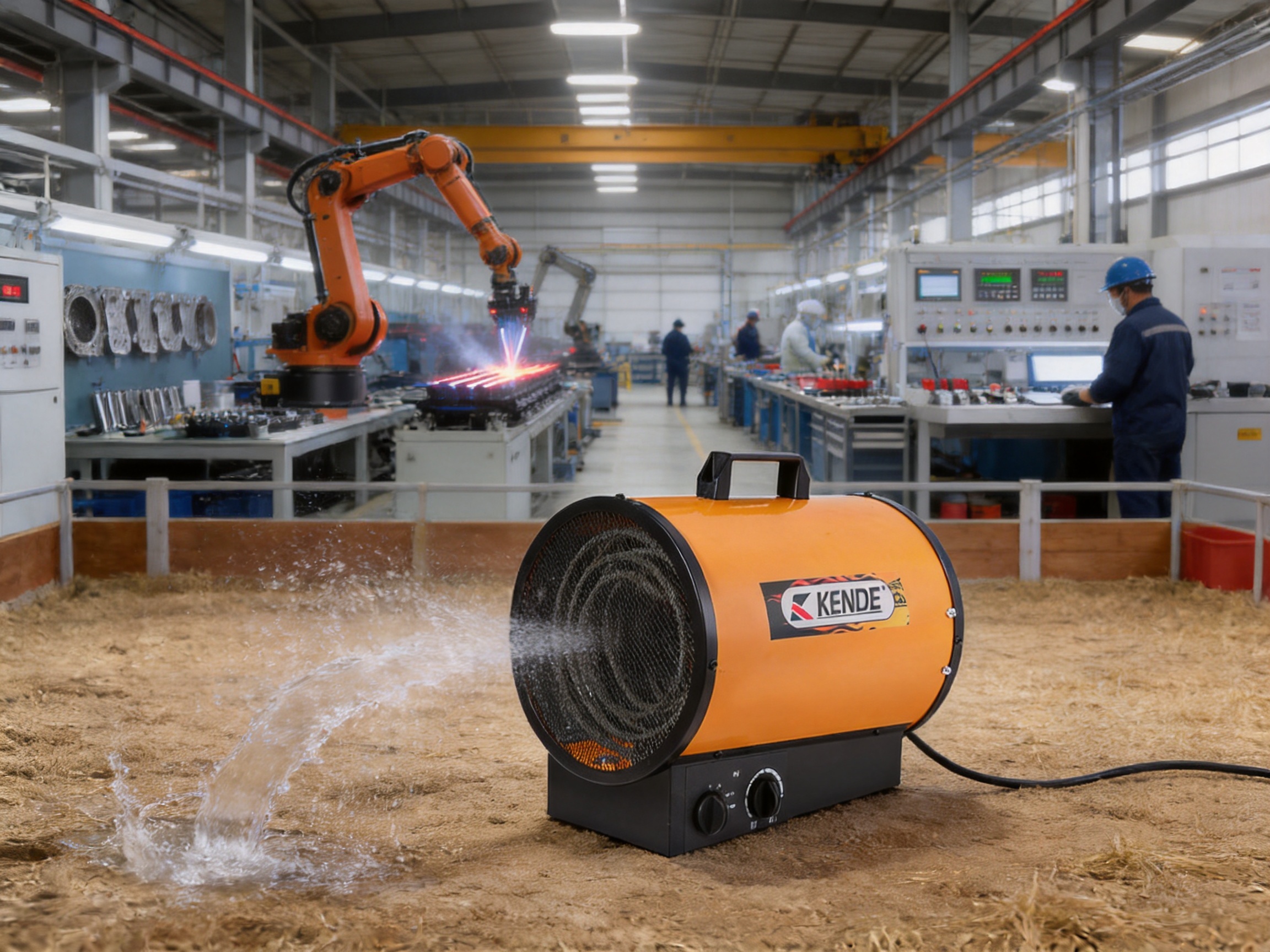
All four models are listed with an IPX4 protection class. IPX4 generally indicates protection against water splashes from different directions. This classification can be advantageous in workshops, service areas, construction environments, and other locations where occasional splashing or damp conditions may occur.
IPX4 does not mean that the heater is waterproof or suitable for immersion. The unit should not be submerged, exposed to heavy uncontrolled water flow, or operated in conditions outside the manufacturer’s instructions. Users should protect the heater from standing water and ensure that the electrical connection is appropriate for the environment.
The product information also identifies built-in safety precautions as part of the heater design. In practical use, safe operation depends on both the heater’s protective systems and the user’s handling procedures. The air inlet and outlet should remain unobstructed, combustible materials should be kept away from the hot air stream, and the heater should be positioned on a stable surface.
Users should read the operating instructions before use and follow all local safety requirements. The heater should not be covered while operating. Cables, plugs, sockets, and circuit protection should be inspected regularly. If unusual noise, overheating, burning odour, visible damage, or abnormal operation occurs, the unit should be switched off and examined by qualified service personnel.
Industrial and commercial users often require heating equipment that can withstand repeated relocation and regular operation. A protective housing and robust structure help the unit remain suitable for practical working environments. The HB series is designed as professional-style equipment rather than as a decorative household appliance.
Its compact metal-oriented equipment format, portable construction, and high airflow make it appropriate for workshops and service environments. Nevertheless, the exact suitability of any installation depends on the surrounding conditions. Areas containing flammable vapours, explosive dust, or combustible materials require special equipment and risk assessment.
For construction and renovation work, the heater can provide temporary heat while permanent HVAC systems are unavailable or insufficient. Contractors may use portable electric heaters to improve working conditions during interior finishing, drying periods, equipment installation, and cold-weather maintenance, subject to proper ventilation and electrical safety practices.
The HB series competes with several categories of portable heating equipment, including radiant electric heaters, fanless convection heaters, LPG heaters, diesel heaters, kerosene heaters, and permanently installed heating systems. Each technology has an appropriate application, but the HB series offers a particular combination of mobility, clean operation, directional airflow, and model choice.
Fanless convection heaters normally warm air through natural circulation. They can operate quietly, but they may distribute heat more slowly, especially in rooms with high ceilings, frequent door opening, or poor air movement. The HB series uses forced airflow to accelerate heat distribution and move warm air into the occupied zone.
The fan-based design is useful where fast temperature response is more important than completely silent operation. Workshops, garages, warehouses, and construction spaces commonly benefit from stronger air circulation because the primary objective is to improve comfort and working conditions quickly.
Radiant heaters transfer heat directly to people and nearby surfaces. This can be effective for spot heating, but the surrounding air may remain cold. An electric fan heater instead warms and circulates the air, making it better suited to applications where the objective is to raise the general temperature of a room.
The adjustable inclination of the HB series also provides a degree of directional control. Although it is not a radiant product, it can direct warm air toward a particular work area while gradually improving overall room conditions.
LPG, diesel, and kerosene heaters can provide high heat output in locations where electrical capacity is limited. However, fuel-fired products require fuel storage, refilling, burner maintenance, and careful handling of combustion gases. Direct-fired products may also add moisture and combustion by-products to the space.
The electric HB series avoids on-site fuel storage and produces no combustion exhaust at the point of use. This makes it a convenient option for indoor areas where a suitable electrical supply is available and clean operation is important.
Electric heaters may also be easier to start and stop. There is no burner ignition sequence or fuel priming procedure. The user can position the heater, connect it to the appropriate supply, and operate it according to the control instructions.
Fixed heating systems can provide comprehensive building-wide control, but they normally require planning, installation work, ducting, piping, or permanent electrical infrastructure. A portable heater can be placed into service more quickly and can move with changing operational needs.
The HB series is not intended to replace every central heating or HVAC system. Instead, it provides a flexible solution for supplementary heating, temporary facilities, individual rooms, seasonal workspaces, and areas where a fixed system would be uneconomical or impractical.
Workshops and garages often contain large doors, exposed walls, concrete floors, and limited insulation. These conditions can make the space uncomfortable during cold weather. A portable fan heater can be directed toward a workbench, vehicle service area, inspection station, or assembly zone.
The 2 kW and 3 kW models are suitable for smaller private garages and compact workshops. Medium-sized work areas may benefit from the 5 kW unit, while larger service spaces can consider the 9 kW model if the electrical supply and building conditions are appropriate.
Warehouses may not require full-building heating at all times. Workers may spend most of their time in one loading zone, packing area, dispatch station, or inventory aisle. A portable fan heater can supply local warmth without heating every cubic metre of the building continuously.
In storage areas, the heater must be positioned with adequate clearance from cartons, plastic packaging, fabrics, chemicals, and other combustible materials. Air inlets and outlets must remain free of obstruction, and the chosen unit must be matched to the electrical system.
Small offices, reception areas, security rooms, retail spaces, and service counters may need supplementary heating during cold mornings or transitional seasons. The compact HB-02A and HB-03A models can be convenient for these applications when local electrical and workplace requirements are satisfied.
Because the heater uses forced air, it can provide a quick improvement in perceived comfort. Adjustable inclination allows the warm airflow to be aimed away from sensitive equipment and toward the occupied area.
Construction projects frequently involve temporary rooms and unfinished buildings. Permanent heating may not yet be available, but workers may still need improved conditions for interior work, finishing, maintenance, or equipment protection.
Portable electric heaters can be moved as the project progresses. Their compact size helps contractors adapt to changing room layouts. The IPX4 classification may provide an additional level of suitability for certain work environments, although the equipment must still be protected from heavy rain, standing water, dust accumulation, and improper electrical connections.
Utility rooms, farm workshops, equipment shelters, and service buildings may require occasional heating rather than a permanent heating system. The HB series offers several capacity options that can be considered according to room volume and local power availability.
Special attention is required in agricultural environments because dust, hay, straw, chemicals, and combustible materials may be present. The heater must be used only where the application is suitable and where safe clearance and maintenance procedures can be maintained.
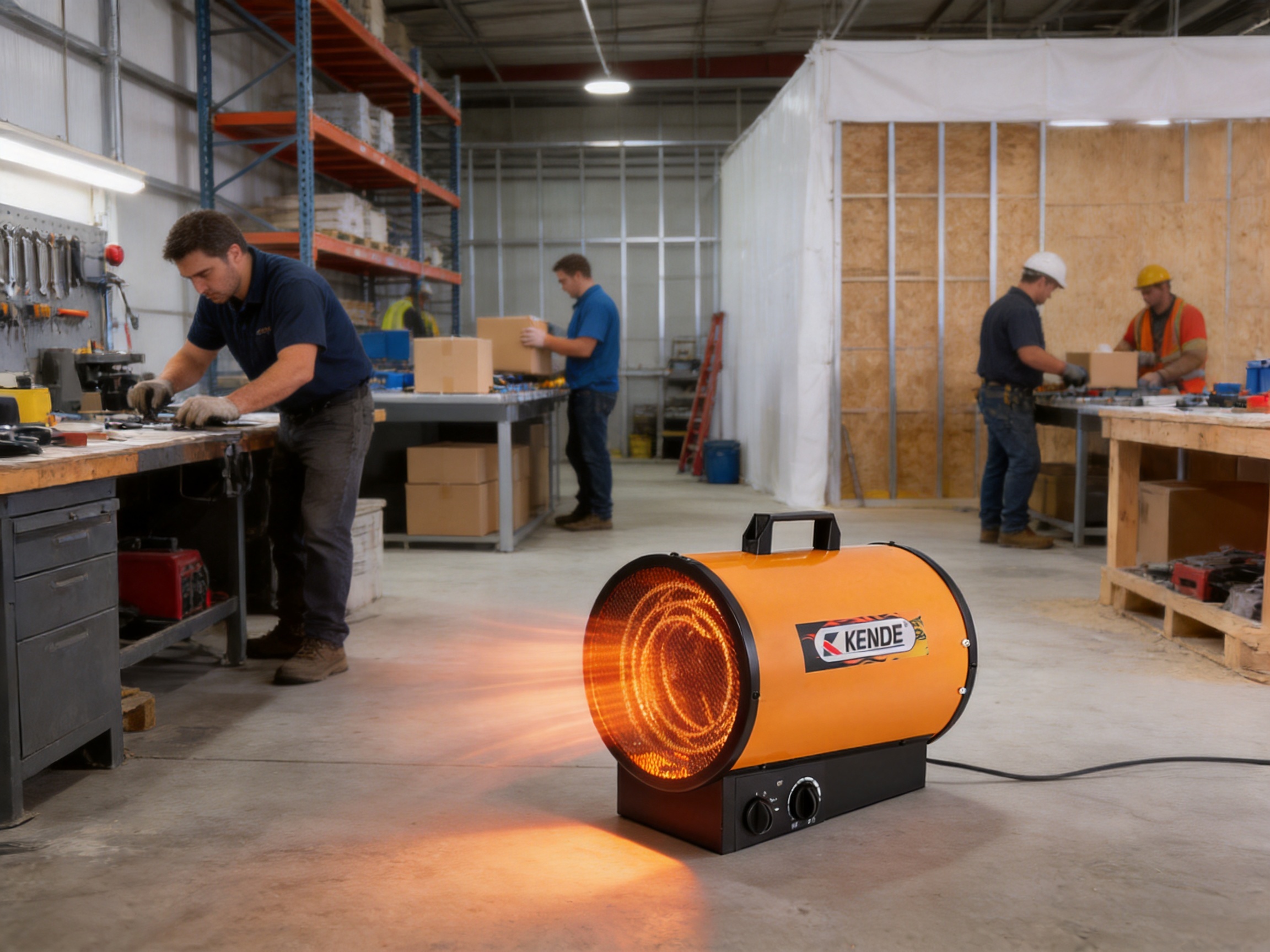
Zhejiang Kende Mechanical & Electrical Co., Ltd. operates as a large manufacturer of electric welding machines, battery chargers, heaters, and related electrical equipment. The company is located in Taizhou, Zhejiang Province, China, and covers an area of approximately 120,000 square metres with a workforce of about 600 employees.
The scale of the manufacturing base supports product development, component sourcing, assembly, testing, packaging, and export operations. The company reports annual exports of nearly 1.5 million units and an annual production capacity of approximately 2 million units. This level of output indicates experience with repeatable manufacturing processes and international order management.
Large-scale production can provide advantages for heater buyers. It may support more stable component procurement, improved production planning, standardized assembly, and better ability to handle volume orders. It can also help the manufacturer refine product designs through feedback from multiple markets and application environments.
The company’s product portfolio includes manual arc welding machines, MIG and MAG welding machines, flux-cored welding machines, TIG welding machines, plasma cutting machines, stud welding machines, submerged arc welding machines, battery chargers, and electric, gas, and oil heaters.
This broad product range reflects expertise in electrical engineering, thermal management, power conversion, motors, control systems, metal housings, and industrial equipment assembly. The technologies used in welding machines and heaters are not identical, but both require disciplined electrical design, insulation control, reliable switching, thermal protection, mechanical construction, and quality testing.
Kende also states that it can develop new products according to the requirements of different regions, countries, and customers. This capability is valuable for distributors that require specific voltage configurations, market-oriented packaging, technical documentation, or product adaptations.
The company has a Zhejiang Provincial Research and Development Center, an Enterprise Technology Center, and an Intelligent Welding Technology Research Institute. It reports a research and development team of 98 personnel.
Research and development resources can support continuous improvement in heater structure, airflow, electrical control, safety features, production efficiency, and user ergonomics. A manufacturer with in-house technical resources is better positioned to investigate field feedback and make controlled design changes than a company that only purchases generic products for resale.
Kende also reports multiple invention patents, utility model patents, appearance patents, and software copyrights. These intellectual property resources demonstrate an ongoing focus on product design and engineering development. Patent ownership alone does not determine product quality, but it can indicate that the company invests in technical innovation and formal product development.
The company applies several manufacturing and management systems, including office automation, Toyota Production System-based management, enterprise resource planning, and manufacturing execution system management. These systems can support coordination from order entry and material planning through production, inspection, inventory, and shipment.
Toyota Production System principles generally emphasize process discipline, waste reduction, standardized work, continuous improvement, and production flow. When applied effectively, these principles can reduce unnecessary movement, improve line organization, identify defects earlier, and support consistent assembly.
Enterprise resource planning systems help coordinate purchasing, inventory, sales, finance, and production information. A manufacturing execution system can provide greater visibility into shop-floor operations, work orders, process status, and production records. Together, these systems support more controlled manufacturing than an informal workshop approach.
Kende uses advanced automatic patching, plug-in, and welding systems, as well as robot processing and laser cutting. These technologies are relevant to the production of electrical equipment because they can improve repeatability and reduce variation in component placement, metal fabrication, and interconnection.
Automatic patching and plug-in processes can support the assembly of electronic control boards. Consistent placement and soldering are important for reliable electrical operation. Automated welding and robot processing can improve the repeatability of structural components and housing assemblies.
Laser cutting provides accurate processing of sheet metal and other suitable materials. Precise cutting can support better fit between housing components, cleaner openings for controls and ventilation, and more consistent dimensions across production batches.
Automation does not eliminate the need for skilled personnel. Instead, it combines equipment precision with engineering supervision, process inspection, maintenance, and final quality control. The strongest manufacturing results come from integrating automated machinery with documented procedures and experienced operators.
Kende reports holding a range of international and domestic product certifications, including GS, CE, EMC, ERP, US ETL, UKCA, and China CCC. The exact certification applicable to a specific heater model, voltage configuration, and destination market should always be confirmed in the relevant technical documentation.
Certification experience can simplify international procurement because the manufacturer is familiar with the documentation, testing, labeling, and compliance processes required in different markets. It also suggests that the company has established procedures for preparing products for regulated sales channels.
Electromagnetic compatibility is particularly important for electrical equipment. A heater must operate without causing unacceptable interference and must maintain appropriate immunity under defined test conditions. Energy-related requirements may also apply depending on the market and product category.
For importers and distributors, quality management involves more than certification marks. It also includes model identification, traceability, packaging protection, electrical documentation, spare parts support, inspection procedures, and communication during production. An experienced export manufacturer can help coordinate these details for international orders.
Kende states that it participates in the drafting, formulation, and revision of national standards related to welding machines and has contributed to group standards. Although these activities focus mainly on welding equipment, they reflect involvement in technical standardization and industrial product development.
Model selection should begin with the room volume. The stated heating spaces are approximately 60 cubic metres for the HB-02A, 90 cubic metres for the HB-03A, 144 cubic metres for the HB-05A, and 225 cubic metres for the HB-09A.
These values are practical reference points rather than universal guarantees. Actual heating performance depends on insulation, ceiling height, outdoor temperature, door opening frequency, air leakage, building materials, desired indoor temperature, and the presence of machinery or other heat sources.
| Selection Consideration | Recommended Approach |
|---|---|
| Small room or localized work area | Consider the HB-02A when approximately 2 kW is sufficient and a 220–240 V supply is available. |
| Small to medium room | Consider the HB-03A for approximately 3 kW of output and an indicative heating space of 90 m³. |
| Medium room or workshop | Consider the HB-05A, verifying whether the 220–240 V or 380–400 V configuration is required. |
| Large room or demanding work area | Consider the HB-09A where a 380–400 V supply and higher airflow capacity are available. |
| Frequent relocation | Prioritize the lighter, more compact models if the heating requirement allows. |
| Humid or splash-prone location | Review the IPX4 rating, site conditions, electrical rules, and manufacturer instructions before use. |
Electrical supply is equally important. A heater with insufficient circuit capacity may cause nuisance tripping, overheating of cables, or unsafe operation. The HB-05A requires special attention because it may be supplied in different voltage configurations. The HB-09A requires a 380–400 V, 50 Hz supply according to the listed specifications.
Users should also consider airflow. Higher airflow can improve heat distribution in larger spaces, but it may not be necessary for a small enclosed room. Selecting the correct model avoids excessive energy use and prevents the purchase of equipment that is larger than required.
Place the heater on a stable, level surface where it cannot easily be knocked over. The air inlet and hot air outlet must remain clear. Do not place clothing, paper, packaging, tools, curtains, or other objects over the housing or in front of the airflow.
Maintain sufficient clearance from walls, ceilings, stored materials, furniture, and combustible substances. The exact clearance should follow the manufacturer’s instructions and applicable local regulations. Do not use the heater as a shelf, drying rack, or permanent support for other equipment.
Before connecting the heater, confirm that the voltage and frequency match the rating information. Inspect the power cord, plug, socket, and protective device. High-output models may require dedicated circuits or professional installation.
Use the heater only in conditions appropriate for its IPX4 classification. Although the rating offers protection against splashing water, it does not authorize use in heavy rain, standing water, immersion, or uncontrolled wash-down conditions.
Do not operate the heater in areas containing explosive gases, flammable vapours, or combustible dust unless the product is specifically approved for that hazardous environment. Standard portable electric heaters are not automatically suitable for hazardous locations.
When the heater is no longer required, follow the correct shutdown procedure. Allow the equipment to cool as instructed before moving or storing it. Clean dust from the exterior and air passages using an approved method, and store the unit in a dry location.
Routine maintenance helps preserve airflow and heating performance. Dust and debris can restrict ventilation, reduce fan efficiency, and increase thermal stress. The frequency of cleaning depends on the environment. Workshops, construction sites, agricultural buildings, and dusty warehouses may require more frequent inspection than clean office spaces.
Before cleaning, disconnect the heater from the electrical supply and allow it to cool. Do not insert tools or objects into the fan or heating assembly. Electrical repairs, replacement of heating elements, wiring work, and safety-device service should be performed by qualified personnel.
Operators should check for loose covers, damaged cables, unusual vibration, fan obstruction, and signs of overheating. Early attention to these issues can reduce downtime and help prevent more serious faults.
For distributors and fleet users, it may be beneficial to maintain records of model numbers, purchase dates, inspection dates, repairs, and operating locations. Such records support planned maintenance and help identify recurring issues across multiple units.
The four-model range gives distributors a coherent product family rather than a single heater with limited application coverage. A distributor can offer small, medium, and high-output options while maintaining a consistent product concept and similar market positioning.
Multiple voltage arrangements also support international sales. The ability to select 220–240 V or 380–400 V configurations for certain models can help address regional electrical differences. Buyers should confirm the precise configuration, packaging, manuals, labels, and compliance documents required for the target market.
Kende’s experience across welding machines, chargers, heaters, and other electrical products provides a broad manufacturing foundation. Its reported production capacity and export activity can support larger orders, repeat purchasing, and coordinated product programs.
OEM and customized development may also be considered where the project requires market-specific features or documentation. Potential topics for discussion include branding, packaging, control layout, voltage configuration, technical labeling, accessory requirements, and shipment quantities. All customizations should be confirmed through formal technical and commercial documentation.
It is a portable electric fan heater and hot air blower range with output capacities of 2 kW, 3 kW, 5 kW, and 9 kW. The heaters use forced airflow to distribute warm air through a room or toward a selected working area.
The HB-02A is the smallest model and provides 2 kW of output for an indicative heating space of approximately 60 cubic metres. The HB-03A provides 3 kW and is listed for approximately 90 cubic metres. Actual performance depends on insulation, ambient temperature, ceiling height, and air leakage.
The HB-09A provides the highest output at 9 kW. It has an airflow capacity of approximately 800 cubic metres per hour and is listed for a heating space of approximately 225 cubic metres.
Yes. The heat and air distribution can be adjusted through variable inclination, allowing users to direct warm air toward a work area or improve circulation in a room.
They can be suitable for indoor rooms, workshops, offices, garages, and other appropriate spaces when installed and operated according to the manufacturer’s instructions. Users must provide adequate clearance, maintain unobstructed airflow, confirm electrical compatibility, and follow all local safety requirements.
No. The HB series uses electricity rather than LPG, diesel, kerosene, or other fuel. It produces heat without combustion at the point of use, so there is no fuel tank or burner system to manage.
IPX4 generally indicates protection against water splashes from different directions. It does not mean that the heater is waterproof or suitable for immersion, heavy rain, standing water, or uncontrolled wash-down operations.
The HB-02A and HB-03A are listed for AC 220–240 V, 50 Hz. The HB-05A is listed with AC 220–240 V or AC 380–400 V, 50 Hz configurations. The HB-09A is listed for AC 380–400 V, 50 Hz. The exact configuration should be confirmed before ordering.
Not necessarily. The listed specification for the HB-09A is AC 380–400 V, 50 Hz, so it may require a suitable three-phase supply rather than a standard household outlet. Electrical compatibility must be checked by a qualified person.
The electric heater does not require fuel storage and does not produce combustion exhaust inside the room. It can be simpler to start and maintain, provided that a suitable electrical supply is available. Fuel-fired heaters may be more suitable in locations without adequate electrical capacity, so the choice depends on the application.
It may be suitable for a warehouse or storage area if the electrical supply, room conditions, ventilation, clearances, and fire-safety requirements are appropriate. Combustible packaging and stored materials must be kept away from the heater and airflow.
The manufacturer reports large-scale production, international exports, a broad electrical product portfolio, research and development resources, automated manufacturing equipment, and experience with certifications such as CE, EMC, GS, ETL, UKCA, and CCC. Buyers should verify the exact documentation for the selected model and destination market.
The company states that it can develop new products according to the requirements of different regions, countries, and customers. Possible customization topics should be discussed and confirmed through technical specifications, samples, drawings, and commercial agreements.
Buyers should confirm the required heating capacity, room volume, voltage, frequency, phase arrangement, airflow, dimensions, weight, protection requirements, certifications, packaging, warranty terms, spare parts, and delivery conditions. For larger projects, a site assessment is recommended.
The HB-02A, HB-03A, HB-05A, and HB-09A electric fan heaters provide a flexible solution for fast, directional, and portable space heating. With outputs ranging from 2 kW to 9 kW, the series covers small rooms, localized work areas, medium workshops, and larger commercial or industrial spaces.
The main product advantages include rapid forced-air heating, adjustable inclination, compact construction, manageable weight, model choice, clean electric operation, and an IPX4 protection classification. These features make the series a practical alternative to fanless convection heaters, radiant spot heaters, and fuel-fired equipment in applications where a suitable electrical supply is available.
The manufacturing background of Zhejiang Kende Mechanical & Electrical Co., Ltd. adds further value for professional buyers. The company reports substantial production capacity, international export experience, research and development facilities, automated assembly and metal-processing equipment, structured management systems, and a broad portfolio of electrical machinery.
For the best result, users should select the model according to room volume, insulation, desired heating speed, airflow requirements, and electrical infrastructure. Proper installation, clearance, cleaning, and inspection are essential for safe and reliable operation.
As a portable heating family, the HB series is well positioned for workshops, garages, warehouses, offices, construction sites, service rooms, commercial areas, and other spaces where dependable temporary or supplementary heat is required.
Zhejiang Kende Mechanical & Electrical Co., Ltd. Product specification information for HB-02A, HB-03A, HB-05A, and HB-09A electric fan heaters.
Zhejiang Kende Mechanical & Electrical Co., Ltd. Corporate information covering manufacturing capacity, research and development, certifications, production systems, and product categories.
International Electrotechnical Commission. General principles for ingress protection classifications of electrical enclosures.
International Electrotechnical Commission. General safety principles for electrical heating appliances and portable electrical equipment.
Industrial heating equipment selection practice. Considerations for heating capacity, airflow, room volume, insulation, electrical supply, and workplace safety.
Recommended Products

Contact Us
No.2299, Luqiao Section, Shugang Avenue, Luqiao District, Taizhou, 318057 Zhejiang, PR China.
+86-576-82431568
 Privacy
China Welding Machine Factory
 English
 中文简体
 русский
 Español
 عربى
 Français
 Português
 Deutsch
 Український