Email: [email protected]
Email: [email protected]

Blog
 2026.09.14
 Blog
Modern welding users need equipment that combines dependable arc performance, easy transportation, efficient power conversion, and practical operating flexibility. The TOP-K series IGBT inverter welding machines is designed to meet these needs in household workshops, maintenance departments, construction sites, fabrication businesses, agricultural applications, and light industrial environments. Available in 120A, 140A, 160A, 180A, and 200A versions, the series provides a range of output capacities while preserving a compact and portable format.
These machines are manual metal arc, or MMA, welding systems. MMA welding is also widely known as stick welding or shielded metal arc welding. It uses a consumable coated electrode to create the arc and form the weld. Because the electrode coating produces shielding gas and slag during welding, the process does not require an external shielding gas cylinder. This makes MMA equipment especially useful for outdoor repair work, mobile maintenance, structural work, and locations where gas-shielded welding equipment would be inconvenient.
The series uses insulated-gate bipolar transistor, or IGBT, inverter technology. Compared with traditional transformer-based welding machines, an inverter platform can provide a smaller physical size, lower weight, more efficient energy conversion, and more responsive electronic control. The result is a machine that is easier to move and store while still providing useful welding current for carbon steel, alloy steel, stainless steel, and other compatible materials.
Manufactured by Zhejiang Kende Mechanical & Electrical Co., Ltd., the product family reflects the company’s experience in welding equipment, electrical manufacturing, product development, and international export. The manufacturer operates large-scale production facilities, maintains dedicated research and development resources, and uses automated and digitally managed production systems. These strengths support consistent quality across a broad range of welding machines and related equipment.
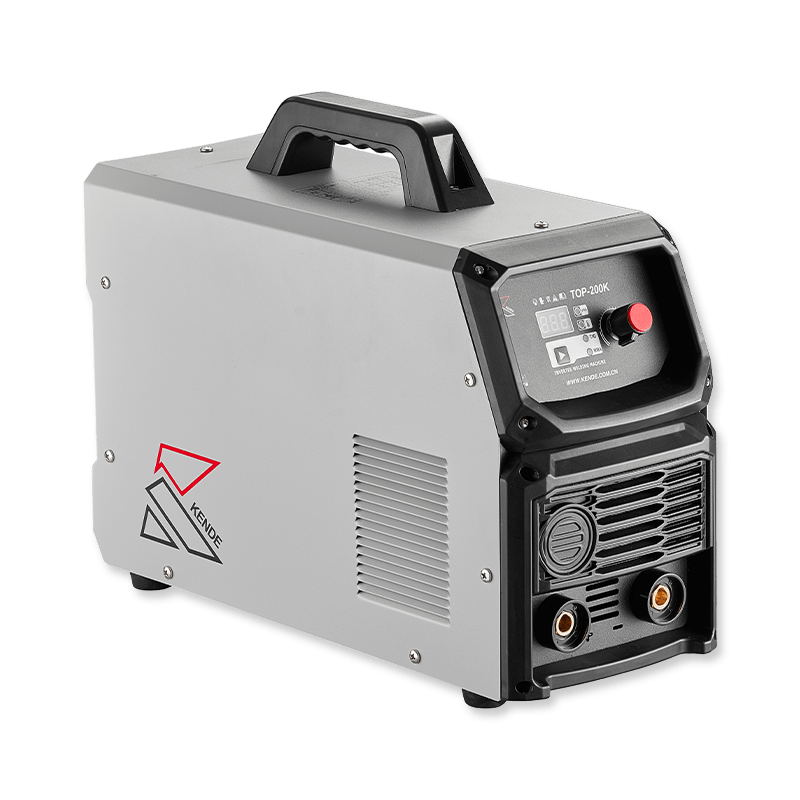
TOP-120K IGBT Inverter Welding Machine
The TOP-K series is intended for users who require a practical MMA welding machine without the bulk and operating complexity of conventional industrial transformer welders. The available models cover rated welding currents from 120A to 200A. This gives buyers the ability to select a machine according to electrode size, material thickness, expected workload, available electrical supply, and portability requirements.
The TOP-120K is the most compact output option in the range. It provides a rated welding current of 10A/20.4V to 120A/24.8V and supports electrodes from 1.6mm to 3.2mm. It is well suited to light repair work, hobby fabrication, home maintenance, small workshop projects, and occasional welding tasks.
The TOP-140K extends the output to 140A and supports electrodes from 1.6mm to 4.0mm. This extra capacity makes it suitable for users who need more flexibility when working on medium-gauge materials or using larger electrodes. It remains compact and has the same 230V working-voltage platform as the other models in the series.
The TOP-160K offers a maximum rated welding current of 160A and supports 1.6mm to 4.0mm electrodes. It provides a useful balance between portability and welding capability for repair contractors, workshops, farm maintenance, installation work, and general fabrication.
The TOP-180K and TOP-200K are the highest-output versions. They support electrodes up to 4.0mm and 5.0mm respectively. These models are intended for users who need greater penetration potential and more current capacity for heavier repair work, thicker components, and more demanding fabrication tasks. Their increased output is accompanied by higher rated input capacity and a larger power cord specification.
All models operate from a 230V supply and feature a no-load voltage of either 60V or 63.5V, depending on the model. The no-load voltage helps establish the arc before the welding current is applied. The electronic inverter design also supports rapid control of the welding current, helping the operator maintain a stable arc during normal welding conditions.
One of the main advantages of the series is its portable construction. The listed machine dimensions are approximately 355 × 165 × 315mm, allowing the equipment to fit comfortably in workshops, service vehicles, storage areas, and job-site toolboxes. Compared with large traditional transformer welding machines, the compact format makes transportation and setup significantly easier.
The net weight ranges from approximately 4.1kg to 5kg across the models. This low weight is particularly beneficial for service technicians, installation contractors, construction workers, maintenance teams, and users who need to move the welder between different work locations. A portable machine can reduce setup time and eliminate the need for lifting equipment in many routine applications.
Portability also improves workplace flexibility. Operators can bring the welding machine closer to the workpiece rather than moving a large component to a fixed welding station. This is useful for gates, agricultural machinery, steel frames, pipe supports, brackets, trailers, machinery bases, and other structures that cannot be easily transported.
The use of IGBT inverter technology is central to the performance of the series. IGBT components allow the welding power source to operate at a high switching frequency and regulate the welding output electronically. This design supports a smaller transformer and reduced overall equipment volume compared with traditional low-frequency transformer machines.
Electronic control also contributes to a more responsive arc. The welding current can be regulated efficiently as operating conditions change, helping the user maintain a consistent arc length and welding speed. Stable current control is important for reducing arc interruptions, improving bead appearance, and supporting more predictable welding results.
Inverter technology can also reduce energy consumption relative to older transformer designs. The supplied product information emphasizes high efficiency and energy saving. Lower energy demand can be valuable for workshops seeking to control operating costs, as well as for users working with limited electrical capacity or portable power systems.
The series is designed with a strong ability to resist the effects of power-supply voltage fluctuation. This is an important feature for welding locations where the electrical supply may not be perfectly stable. Construction sites, rural workshops, temporary work areas, and long extension-cable installations can experience voltage variation caused by distance, changing loads, or generator operation.
Voltage fluctuation can affect arc stability and may cause a conventional welding machine to perform inconsistently. The control system in these inverter machines is designed to help maintain usable welding characteristics when the supply voltage changes within the equipment’s operating limits. Users should still follow the recommended electrical installation requirements and avoid excessive extension-cable lengths or undersized power supplies.
This voltage-tolerance capability gives the equipment an advantage over basic welding machines that may be more sensitive to supply conditions. It does not eliminate the need for correct electrical protection, proper grounding, and a suitable power source, but it can improve practical reliability during everyday use.
The product information highlights excellent arc characteristics, good welding performance, and little spatter. These characteristics are important to both professional and occasional welders. A stable arc is easier to control, particularly when starting a weld, changing direction, welding in different positions, or working with electrodes that require careful arc management.
Reduced spatter can improve the finished appearance of a weld and reduce cleanup time. Less spatter may also help protect nearby surfaces, reduce the need for grinding, and improve the efficiency of repeated fabrication work. The final welding result still depends on electrode selection, material preparation, current adjustment, arc length, travel speed, and operator technique, but the power source provides a strong foundation for consistent work.
The no-load voltage of 60V on the TOP-120K, TOP-140K, and TOP-160K, and 63.5V on the TOP-180K and TOP-200K, supports practical arc starting. The correct electrode and current setting remain essential, but the machine’s control characteristics help users establish and maintain the arc more easily than with a poorly regulated power source.
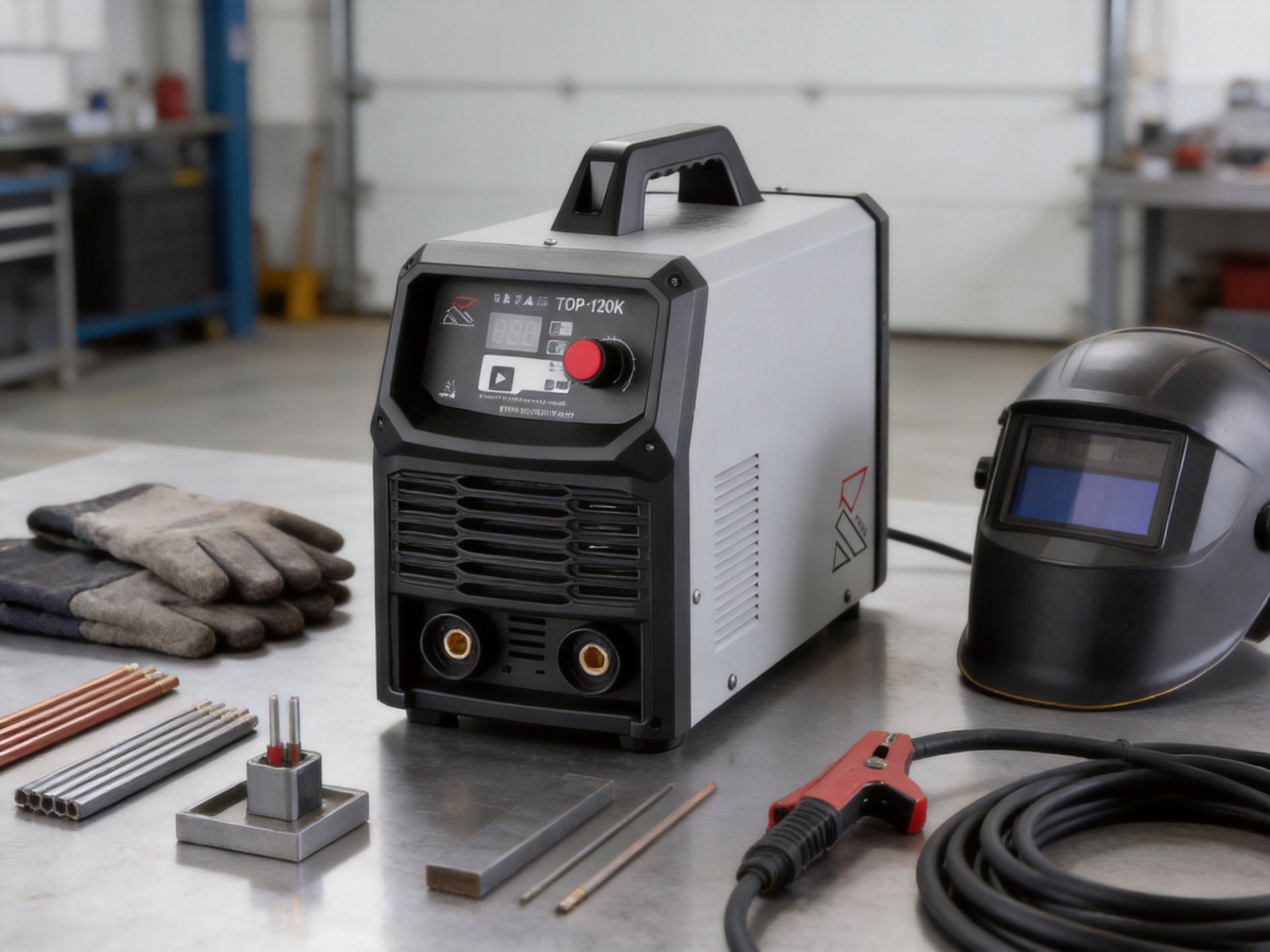
The machines can weld carbon steel, alloy steel, stainless steel, and other compatible metals when the correct electrode and settings are used. MMA welding is valued for its versatility because a broad selection of electrode types is available for different materials, joint configurations, and service conditions.
Carbon steel is the most common application. It is used in brackets, frames, repair components, gates, agricultural equipment, machinery supports, and general fabrication. Low-hydrogen and general-purpose electrodes can be selected according to the strength, appearance, and service requirements of the joint.
Alloy steel applications may include machinery parts, structural components, repair work, and components exposed to higher mechanical loads. The electrode must be matched to the base material and the required mechanical properties. Operators should also follow the electrode manufacturer’s recommendations for storage, preheating, interpass temperature, and post-weld treatment where applicable.
Stainless steel can also be welded using suitable stainless electrodes. Cleanliness is especially important because oil, dirt, carbon-steel contamination, and moisture can affect the appearance and corrosion resistance of the weld. Separate stainless-steel brushes and tools are recommended for demanding stainless-steel work.
The supported electrode range varies by model. The TOP-120K supports electrodes from 1.6mm to 3.2mm. The TOP-140K, TOP-160K, and TOP-180K support electrodes from 1.6mm to 4.0mm. The TOP-200K supports electrodes from 1.6mm to 5.0mm. Larger electrodes generally require more welding current, so users should select a model that provides sufficient output for the intended electrode diameter and duty cycle.
The following table summarizes the principal specifications supplied for the five models. Rated welding current is shown in the manufacturer’s stated voltage and amperage format. Duty cycle values are presented as supplied: 0.2 corresponds to 20 percent, while 0.15 corresponds to 15 percent under the applicable rating conditions.
| Model | Working Voltage | No-Load Voltage | Rated Input Capacity | Rated Welding Current | Duty Cycle | Electrode Range | Net Weight |
|---|---|---|---|---|---|---|---|
| TOP-120K | 230V | 60V | 5.1kVA | 10A/20.4V–120A/24.8V | 20% | 1.6–3.2mm | 4.1kg |
| TOP-140K | 230V | 60V | 6kVA | 10A/20.4V–140A/25.6V | 20% | 1.6–4.0mm | 4.4kg |
| TOP-160K | 230V | 60V | 7kVA | 10A/20.4V–160A/26.4V | 20% | 1.6–4.0mm | 4.4kg |
| TOP-180K | 230V | 63.5V | 8kVA | 20A/20.8V–180A/27.2V | 15% | 1.6–4.0mm | 4.9kg |
| TOP-200K | 230V | 63.5V | 9.2kVA | 20A/20.8V–200A/28.0V | 15% | 1.6–5.0mm | 5kg |
The TOP-120K is appropriate when low weight, low input demand, and light-to-medium welding work are the main priorities. The TOP-140K and TOP-160K offer additional output while preserving the same basic machine dimensions. The TOP-180K is appropriate for users who require a higher current ceiling, while the TOP-200K provides the highest output and the broadest listed electrode range.
Model selection should be based on the actual workload rather than maximum amperage alone. Buyers should consider the thickness of the material, the electrode diameter, the expected duration of each welding session, the available electrical supply, and the importance of portability. Selecting a model with an appropriate reserve capacity can help prevent overload during demanding work.
Duty cycle describes the amount of time a welding machine can operate at a specified output during a standard test period. The stated values are 20 percent for the TOP-120K, TOP-140K, and TOP-160K, and 15 percent for the TOP-180K and TOP-200K. In practical terms, a 20 percent duty cycle in a ten-minute period represents two minutes of welding followed by eight minutes of cooling at the specified test condition. A 15 percent duty cycle represents one and a half minutes of welding followed by eight and a half minutes of cooling.
Actual performance depends on ambient temperature, ventilation, welding current, electrode size, work pattern, and the cleanliness of the machine’s cooling passages. When welding at lower current, the usable operating time may be longer than the maximum-output rating. Conversely, continuous work at the highest setting can activate thermal protection more quickly.
The built-in thermal overload protection is an important safeguard. When the internal temperature becomes too high, the protection system can interrupt welding output and help prevent damage to the power electronics. Users should allow the machine to cool naturally rather than repeatedly attempting to restart it immediately after an overload event.
Good work planning can improve productivity. Operators can prepare and clean the next workpiece during cooling intervals, organize electrodes, inspect joints, or reposition components. Maintaining clear ventilation around the machine is also important. The air inlet and outlet should not be blocked by dust, clothing, packaging, walls, or other equipment.
The machines are supplied with practical accessories intended to support immediate MMA welding setup. The listed accessories include an electrode holder, earth clamp, welding cable, brush or hammer, and protective mask. The package also includes the relevant power cord and machine-specific cable assemblies.
The electrode holder is used to grip the consumable electrode and conduct welding current. It should be kept clean and inspected regularly for heat damage, loose connections, or worn insulation. The earth clamp completes the welding circuit by connecting the workpiece to the power source. A secure connection to clean metal is essential for stable arc performance.
The welding cable specification listed for the series is H01N2-D 1 × 16mm², with a stated length of 2 + 1.5m. The TOP-120K, TOP-140K, and TOP-160K use a 2m H07RNF-3G1.5mm² power cord, while the TOP-180K and TOP-200K use a 2m H07RNF-3G2.5mm² power cord. Buyers should verify the exact package configuration for their target market before placing a production order.
The brush and hammer are useful for removing slag after a weld has cooled sufficiently. Slag removal allows the operator to inspect the weld surface and identify visible discontinuities before applying another pass. The protective mask is intended to provide basic face and eye protection, but welding operators should use complete personal protective equipment, including suitable welding clothing, gloves, safety footwear, and appropriate ventilation.
Each model is packed in a color box. The listed export-carton dimension is 345 × 210 × 250mm, while the machine size is approximately 355 × 165 × 315mm. Because packaging dimensions and product dimensions are presented separately in the supplied specifications, importers should confirm carton configuration and pallet-loading details with the manufacturer before shipment planning.
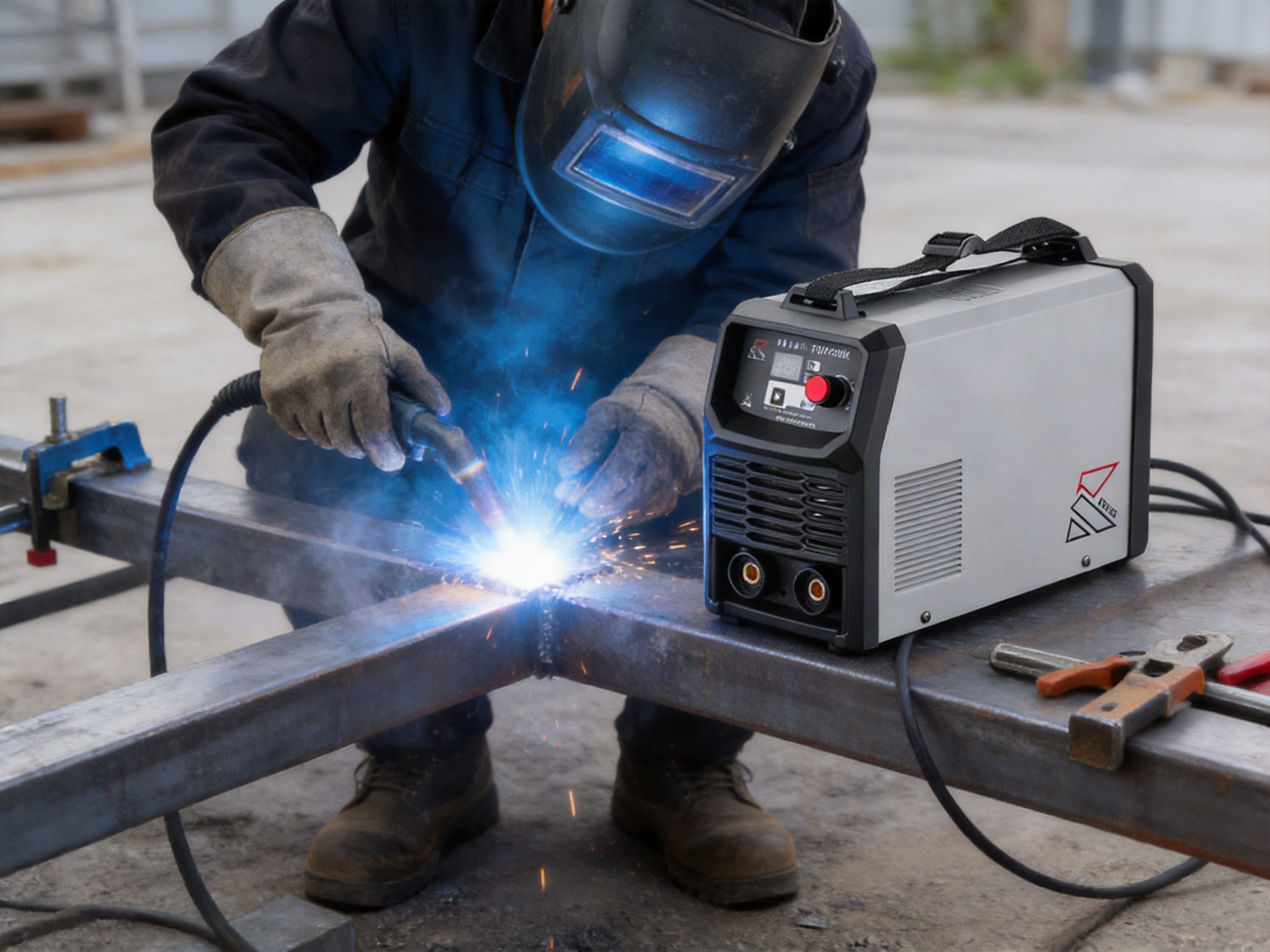
Before operation, the user should confirm that the available power supply matches the machine’s rated working voltage. These models are listed for 230V operation. The power circuit should be protected by suitable circuit protection, and the machine should be connected according to local electrical regulations.
Grounding and cable condition are essential. Damaged cables, loose plugs, exposed conductors, or overheated connections should be repaired or replaced before use. The welding machine should not be operated in rain, standing water, or excessively damp conditions. Its IP21S protection rating indicates that it is intended for controlled environments and does not make the machine waterproof.
MMA welding produces intense ultraviolet and infrared radiation, hot metal, sparks, fumes, and slag. Operators should use the correct shade of welding lens and wear flame-resistant protective clothing. Nearby workers should be protected from arc flash using screens or barriers. Flammable materials must be removed from the work area, and fire prevention procedures should be followed.
Ventilation is particularly important when welding coated, painted, galvanized, or contaminated materials. Fumes can be hazardous, and users should consult the relevant safety data and workplace regulations before welding such materials. Welding on sealed containers or vessels can be dangerous because heat may cause pressure buildup or ignite residual substances.
Regular maintenance helps preserve inverter performance. The machine should be disconnected from the electrical supply before internal inspection or cleaning. Dust should be removed from ventilation passages using approved procedures. The fan, air inlets, output terminals, cables, electrode holder, and earth clamp should be inspected periodically.
Operators should avoid placing the machine in locations where metal dust, grinding particles, water spray, oil mist, or corrosive chemicals can enter the enclosure. If the machine displays abnormal noise, burning odor, repeated thermal protection, unstable output, or visible electrical damage, it should be removed from service and inspected by qualified personnel.
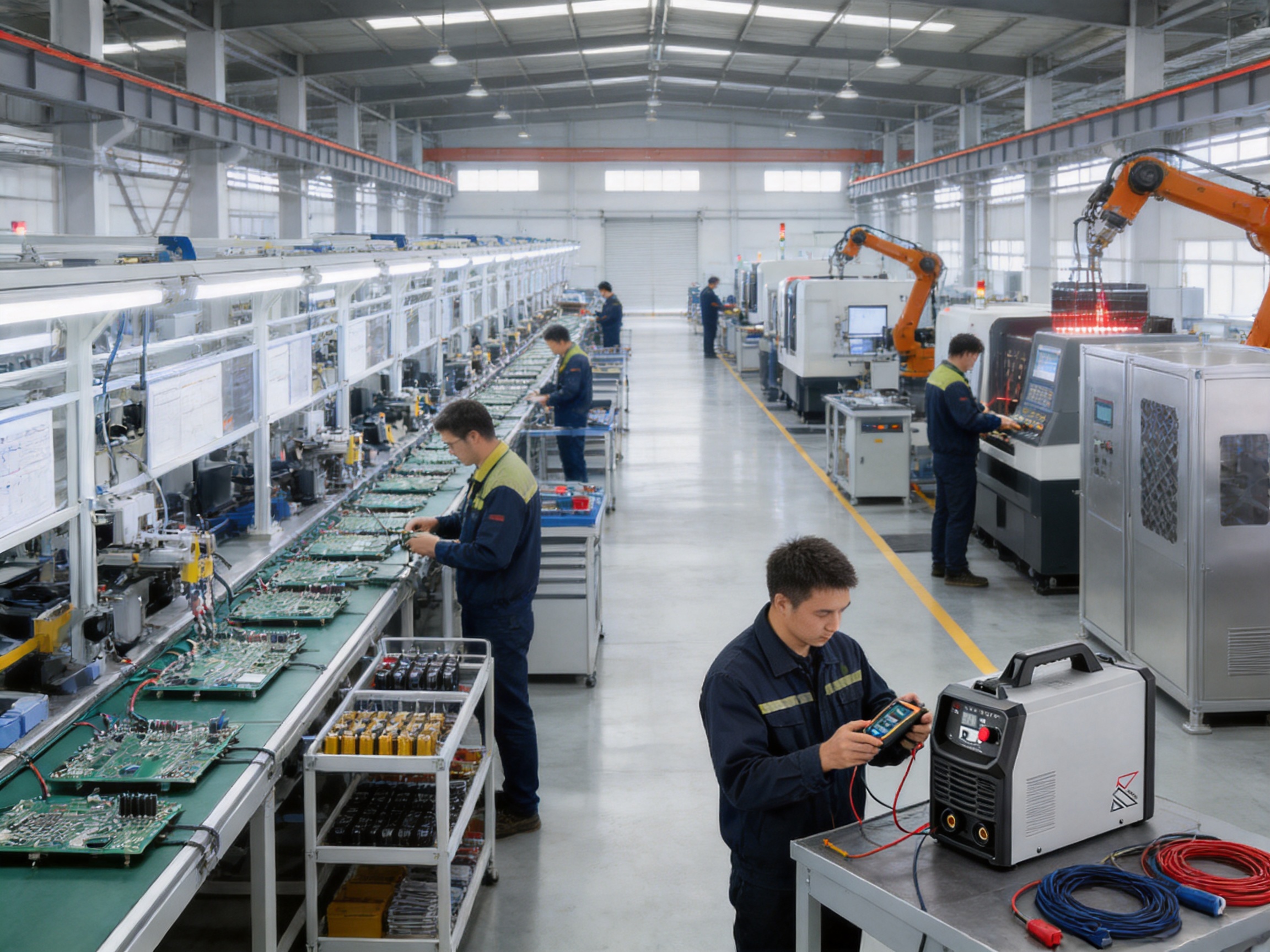
The product’s competitiveness is supported not only by its technical specification but also by the manufacturing resources of its producer. Zhejiang Kende Mechanical & Electrical Co., Ltd. is located in Taizhou, Zhejiang Province, China, and operates on a large industrial site covering approximately 120,000 square meters. The company employs around 600 people and has developed a substantial production and export organization.
The company reports annual exports of nearly 1.5 million units and annual production capacity of approximately 2 million units. Such production scale can support stable supply for distributors, importers, private-label customers, and regional market programs. It also provides experience in handling diverse electrical standards, packaging requirements, product configurations, and customer specifications.
The manufacturer produces a broad portfolio that includes MMA and stick welding machines, MIG/MAG welding machines, flux-cored welding equipment, TIG welding machines, plasma cutters, stud welding machines, submerged arc welding systems, battery chargers, and electric, gas, and oil heaters. This product breadth creates engineering knowledge across multiple power-electronics and thermal-management applications.
The company uses several advanced management and manufacturing systems, including office automation, Toyota TPS-based management, ERP K3, and MES management systems. These systems can help coordinate purchasing, production planning, material tracking, process control, inventory management, quality records, and delivery scheduling.
Its reported manufacturing technologies include automatic surface-mount assembly, plug-in and welding systems, robot processing, laser cutting, and other automated production methods. Automation can improve repeatability in circuit-board assembly, metal fabrication, enclosure production, and component handling. Laser cutting can support accurate sheet-metal processing, while robotic operations can reduce variation in repetitive manufacturing steps.
For an inverter welding machine, manufacturing consistency is especially important. The product depends on coordinated performance from the input circuit, IGBT power stage, control board, transformer, cooling system, output terminals, cables, enclosure, and protective systems. A structured production process helps ensure that these parts are assembled according to consistent procedures.
The company maintains a Zhejiang Provincial Research and Development Center, an Enterprise Technology Center, and an Intelligent Welding Technology Research Institute. It reports having 98 research and development personnel. These resources support product improvement, circuit development, thermal design, welding performance testing, structural design, and adaptation to different market requirements.
The manufacturer has obtained invention patents, utility model patents, appearance patents, and software copyrights. It also reports involvement in the drafting, formulation, and revision of 20 national standards and leadership in drafting one group standard. Participation in standards work can provide practical insight into safety, performance, terminology, testing, and product compliance expectations.
The company’s reported international certifications and approvals include GS, CE, EMC, ERP, US ETL, UKCA, and China CCC. The exact certification applicable to a particular TOP-K model, voltage version, market, and production batch should be verified through current technical documentation. Certification is most valuable when supported by traceable testing, controlled production, and accurate product labeling.
For importers and distributors, this combination of manufacturing scale, research capability, production systems, and certification experience can be a significant advantage over suppliers that offer only basic assembly or limited customization. It can help support product localization, packaging adaptation, technical documentation, and regional compliance requirements.
Compared with traditional transformer welding machines, the TOP-K series offers a more compact form factor and lower weight. This can reduce transport effort and simplify storage. The inverter platform also supports electronic output regulation and efficient power conversion, which are useful advantages for users who operate the machine frequently or move it between work areas.
Compared with very basic entry-level inverter welders, the series provides a broader model range, published technical specifications, thermal overload protection, included accessories, and a manufacturer with a large established production base. The ability to select from five output levels helps distributors serve different customer groups without changing to an unrelated product platform.
Compared with gas-shielded welding systems, MMA equipment does not require an external shielding-gas cylinder, regulator, hose, or gas-flow adjustment. This reduces setup complexity and makes the machine more suitable for outdoor work or remote locations. MMA can also tolerate less controlled working environments where wind would disturb a shielding-gas envelope. However, gas-shielded processes may be preferable for high-speed production, thin sheet metal, or applications requiring continuous wire feed.
Compared with larger industrial welding systems, these machines prioritize portability and accessibility. They are not intended to replace high-duty-cycle automated equipment in continuous production lines. Their strength lies in general-purpose manual welding, field service, repair, maintenance, small-batch fabrication, and applications where a compact power source is more valuable than maximum production speed.
The five-model structure creates opportunities for distributors to develop a clear product ladder. The TOP-120K can serve entry-level and household users. The TOP-140K and TOP-160K can target general workshops and maintenance contractors. The TOP-180K and TOP-200K can serve customers who need higher current output and larger electrodes.
Common distribution channels may include hardware stores, industrial supply companies, welding-equipment retailers, construction-supply distributors, agricultural-equipment dealers, online tool sellers, and professional maintenance suppliers. Because the machines include essential accessories, they can be marketed as practical ready-to-use packages rather than as bare power sources requiring multiple additional purchases.
Private-label and regional customization may also be possible, subject to manufacturer confirmation. Potential customization areas can include product color, packaging artwork, user manuals, rating labels, accessory combinations, cable length, plug type, language support, and market-specific certification. Buyers should define all such requirements before production and request pre-production samples where appropriate.
The manufacturer’s experience with products for different regions can support export projects requiring multiple languages, electrical configurations, packaging standards, or documentation formats. Importers should still conduct their own technical review, product inspection, and regulatory verification before placing large orders.
The TOP-120K is the logical choice for light welding work, household repair, small maintenance jobs, hobby fabrication, and users who mainly work with electrodes up to 3.2mm. Its lower input capacity and 4.1kg net weight make it easy to transport and store.
The TOP-140K and TOP-160K provide additional current capacity while maintaining the same compact machine size. They are suitable for users who require more flexibility than a 120A machine but still value a light portable package. The TOP-160K offers greater output for medium-duty work and supports the same maximum 4.0mm electrode diameter listed for the TOP-140K.
The TOP-180K and TOP-200K are suited to heavier repair and fabrication applications. The TOP-180K reaches 180A and the TOP-200K reaches 200A. The TOP-200K supports electrodes up to 5.0mm, making it the most capable model in the group for applications that demand larger electrodes. These models require higher input capacity and should be connected to an adequately rated electrical supply.
Before welding, remove rust, paint, oil, moisture, and loose scale from the joint area. Clean metal improves arc behavior and helps produce a more reliable weld. Confirm that the earth clamp is attached to clean metal near the welding area, and select an electrode appropriate for the material and joint.
Set the welding current according to the electrode manufacturer’s recommendation. Excessive current may create excessive spatter, undercut, overheating, and poor bead control. Insufficient current can cause sticking, poor fusion, and an unstable arc. The operator should maintain a suitable arc length and travel speed for the electrode type and welding position.
After welding, allow the bead to cool as appropriate before removing slag. Inspect the surface for cracks, pores, undercut, incomplete fusion, or other visible defects. For critical structures or safety-related components, visual inspection should be supplemented by the testing methods required by the applicable standard or engineering specification.
Good cable management is also important. Keep welding leads as short and straight as practical, avoid sharp bends, and protect cables from hot metal, grinding sparks, vehicle traffic, and sharp edges. Proper cable care can improve current transfer and extend accessory life.
The TOP-K IGBT inverter MMA welding machine series combines portable construction, electronic inverter control, voltage-fluctuation resistance, stable arc characteristics, thermal overload protection, and compatibility with a broad selection of electrodes. Its five output models allow users to select equipment according to welding current, electrode size, material thickness, workload, and portability requirements.
The series is especially attractive for general fabrication, repair, maintenance, construction, agricultural work, household projects, and mobile service applications. Its compact dimensions and low net weight provide practical benefits over conventional transformer machines, while the MMA process avoids the need for external shielding gas and supports outdoor operation in many situations.
The manufacturer strengthens the product offering through large-scale production, broad product expertise, automated manufacturing technologies, digital management systems, research and development facilities, patent activity, standards participation, and international certification experience. These capabilities can provide distributors and professional buyers with a more dependable supply foundation than a product sourced from a small or unstructured assembly operation.
For the best results, users should select the correct model for the intended duty, provide a suitable 230V electrical supply, follow safe welding procedures, respect duty-cycle limitations, maintain ventilation, and use appropriate personal protective equipment. With correct selection and operation, the series offers a practical balance of performance, portability, efficiency, and manufacturing support.
The machine uses MMA, also called manual metal arc welding, stick welding, or shielded metal arc welding. It uses a coated consumable electrode and does not require external shielding gas.
The product information states that the machines can weld carbon steel, alloy steel, stainless steel, and other compatible materials when the correct electrode and operating settings are selected.
IGBT inverter technology allows a compact and lightweight power source with electronic current control. It can improve portability, energy efficiency, and arc responsiveness compared with many traditional transformer-based machines.
The TOP-120K is the lightest listed model, with a net weight of approximately 4.1kg.
The TOP-200K provides the highest listed output, reaching 200A. It also supports electrodes from 1.6mm to 5.0mm according to the supplied specifications.
The TOP-120K supports 1.6mm to 3.2mm electrodes. The TOP-140K, TOP-160K, and TOP-180K support 1.6mm to 4.0mm electrodes. The TOP-200K supports 1.6mm to 5.0mm electrodes.
Yes. The listed accessories include an electrode holder, earth clamp, welding cable, brush or hammer, and protective mask. The package also includes the relevant power cord. Exact accessory configurations should be confirmed for each order.
MMA welding is often suitable for outdoor and mobile applications because it does not require external shielding gas. However, the machine itself should be protected from rain, standing water, excessive dampness, dust, and other environmental hazards. The IP21S rating does not indicate waterproof operation.
Duty cycle describes the permitted welding time during a standard test period at a specified output. The listed 20 percent rating represents two minutes of welding in a ten-minute period under the relevant test condition. The listed 15 percent rating represents one and a half minutes in ten minutes. Actual duty performance depends on current, ambient temperature, ventilation, and workload.
Yes. All listed models include thermal overload protection. If the internal temperature becomes too high, the protection system can interrupt operation until the machine cools.
The listed working voltage is 230V. Users should confirm the local supply, circuit protection, grounding, plug type, and installation requirements before operating the machine.
The inverter series is more compact and lighter than many traditional transformer machines. It also provides electronic control, high efficiency, and convenient portability. Transformer machines may still be preferred for certain high-duty-cycle or specialized applications, so selection should be based on the intended workload.
The manufacturer has experience producing and exporting welding machines, chargers, and heaters for different markets. Potential customization may include packaging, labels, accessories, plugs, manuals, and product configurations, subject to technical review and order requirements.
1. Manufacturer-supplied TOP-K series product specifications and accessory information.
2. Manufacturer-supplied company profile, production capacity, research and development information, and manufacturing systems overview.
3. General principles of manual metal arc welding, electrode selection, arc control, and welding safety.
4. General guidance on inverter welding power sources, IGBT control systems, thermal protection, and duty-cycle interpretation.
5. Applicable electrical safety, personal protective equipment, welding-fume control, and workplace welding standards.
Recommended Products

Contact Us
No.2299, Luqiao Section, Shugang Avenue, Luqiao District, Taizhou, 318057 Zhejiang, PR China.
+86-576-82431568
 Privacy
China Welding Machine Factory
 English
 中文简体
 русский
 Español
 عربى
 Français
 Português
 Deutsch
 Український