Email: [email protected]
Email: [email protected]

Blog
 2026.08.05
 Blog
Blog
The MIG-120F3 is a compact, portable MIG/MAG welding machine designed for users who need dependable welding performance without the bulk, weight, and energy consumption associated with traditional transformer-based equipment. Combining inverter technology, an integrated wire feeder, digital control functions, and a practical 120-amp output range, this machine is suitable for maintenance work, light fabrication, repair operations, automotive applications, workshops, agricultural equipment, and demanding domestic projects.
Modern welding users increasingly expect more than simply an arc and a power source. They need equipment that starts easily, produces a stable arc, supports different welding methods, consumes less electricity, protects itself under difficult operating conditions, and remains simple enough for quick setup. The MIG-120F3 is developed around these requirements. Its compact construction and 5.4-kilogram net weight make it substantially easier to transport than conventional transformer welders, while its inverter-based power system helps provide efficient electrical conversion and consistent welding characteristics.
The machine is primarily designed for MIG/MAG or gas-shielded welding. It also supports gas-shielded pulse welding, twin-pulse gas-shielded welding, and MMA welding. This multifunction capability gives users greater flexibility when working with carbon steel, alloy steel, stainless steel, aluminum alloy, and other compatible metals. Rather than purchasing separate equipment for every process, operators can use one adaptable power source for a broad range of workshop and field requirements.
With an input supply of 220/230 volts, a welding current range of 50 to 120 amperes, and compatibility with 0.6 to 1.0 millimeter welding wire, the MIG-120F3 is positioned as an accessible and practical solution for lower-current and medium-duty welding applications. Its internal wire feeder accommodates welding wire up to five kilograms, helping keep the overall package organized and reducing the need for additional external components.
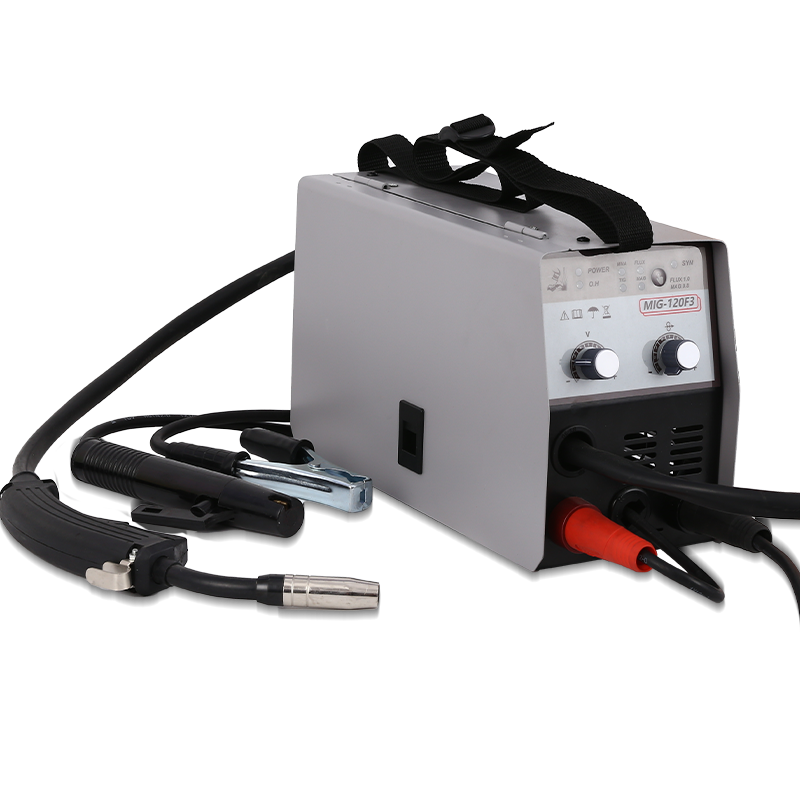
MIG-120F3
One of the most important advantages of a portable welding machine is the ability to move it easily between workstations. Traditional welding power sources often rely on large transformers, heavy steel enclosures, and oversized internal components. These designs can provide useful output, but they may be inconvenient for technicians who work in different locations or need to carry equipment to a repair site.
The MIG-120F3 weighs only 5.4 kilograms and measures approximately 330 by 140 by 200 millimeters. This compact footprint allows the machine to fit comfortably on a workbench, service vehicle, fabrication table, or storage shelf. Its portable format is particularly valuable for maintenance teams, mobile repair businesses, contractors, and users who do not have a permanently dedicated welding area.
Low weight does not mean the machine is limited to occasional use. The inverter architecture reduces the size of the power conversion components while maintaining a useful welding output. By replacing the large low-frequency transformer found in many older machines with a high-frequency switching system, the equipment can deliver welding power from a smaller and lighter enclosure.
The compact design also improves workplace organization. A smaller welding unit leaves more space for workpieces, clamps, gas cylinders, tools, and protective equipment. In crowded workshops, this can contribute to safer movement and more efficient preparation. When a job is complete, the machine can be stored quickly rather than occupying a permanent section of the production floor.
Portability is also valuable when welding large structures that cannot easily be moved to a fixed welding station. A technician can position the machine closer to the workpiece, reduce unnecessary cable length, and complete repairs with less disruption to surrounding operations. For construction maintenance, farm equipment repair, vehicle restoration, and installation work, this mobility can be a meaningful operational advantage.
The MIG-120F3 uses powerful IGBT switching technology combined with advanced inverter control. IGBT, or insulated-gate bipolar transistor, technology enables rapid electronic switching and precise control of the welding power. Compared with conventional transformer equipment, an IGBT inverter can be more compact, lighter, and more efficient.
The machine has a rated input capacity of 5.5 kVA and a rated supply current of 24.8 amperes. Its listed efficiency is 82 percent, while the power factor is 0.75. These figures reflect a power system engineered to convert incoming electrical energy into usable welding output with controlled losses.
Improved efficiency can offer several practical benefits. The machine may draw less electrical energy for comparable welding tasks than older transformer-based designs. Reduced energy waste can lower operating costs over time, particularly in workshops where welding equipment is used regularly. Lower internal heat generation can also support more reliable operation when combined with appropriate thermal protection and ventilation.
The inverter system further supports a stable direct-current welding output. Direct current is widely valued for its smooth arc behavior and consistent weld formation. A stable DC output can make it easier for the operator to maintain the correct arc length, control the molten pool, and achieve cleaner welds with less spatter when the machine is correctly adjusted.
Compared with basic low-cost welding units that provide limited adjustment, the MIG-120F3 incorporates digital, intelligent, and PWM control technology. PWM, or pulse-width modulation, allows the control system to regulate power delivery accurately. This contributes to more responsive adjustment and helps the machine maintain predictable welding characteristics under changing load conditions.
The use of advanced electronic control gives the machine an important advantage over simple transformer welders that may offer only coarse mechanical settings. Operators can fine-tune the welding output more effectively, which is particularly useful when working with different thicknesses, wire diameters, shielding gases, and material types.
Arc stability is central to welding quality. An unstable arc can cause irregular penetration, excessive spatter, inconsistent bead appearance, and difficulty controlling the molten metal. It can also increase the amount of post-weld grinding and cleaning required.
The MIG-120F3 is designed to provide a stable arc through its DC output and electronic inverter control. Stable current delivery helps the operator maintain a consistent transfer of metal from the wire electrode to the workpiece. When the wire speed, voltage, gas flow, and travel speed are correctly matched, the result can be a smoother weld bead and more uniform penetration.
The machine’s listed no-load voltage is 62 volts. This specification supports reliable arc initiation and helps the equipment establish an arc under normal operating conditions. Easy starting is important for both experienced welders and less frequent users because it reduces wasted wire, prevents repeated failed starts, and allows the operator to focus on joint preparation and technique.
The product is described as easy to use straight out of the box. Its wire feeder and gun package are supplied as a ready-to-weld combination, reducing the number of additional components required before beginning work. This can shorten setup time and make the equipment more approachable for small workshops and first-time users who may not have extensive experience configuring welding systems.
For professional users, easy setup also has a productivity benefit. Every minute spent assembling and troubleshooting equipment is time that cannot be spent fabricating or repairing. A straightforward integrated package helps operators move from inspection to welding more efficiently, provided that appropriate shielding gas, consumables, personal protective equipment, and workpiece preparation are available.
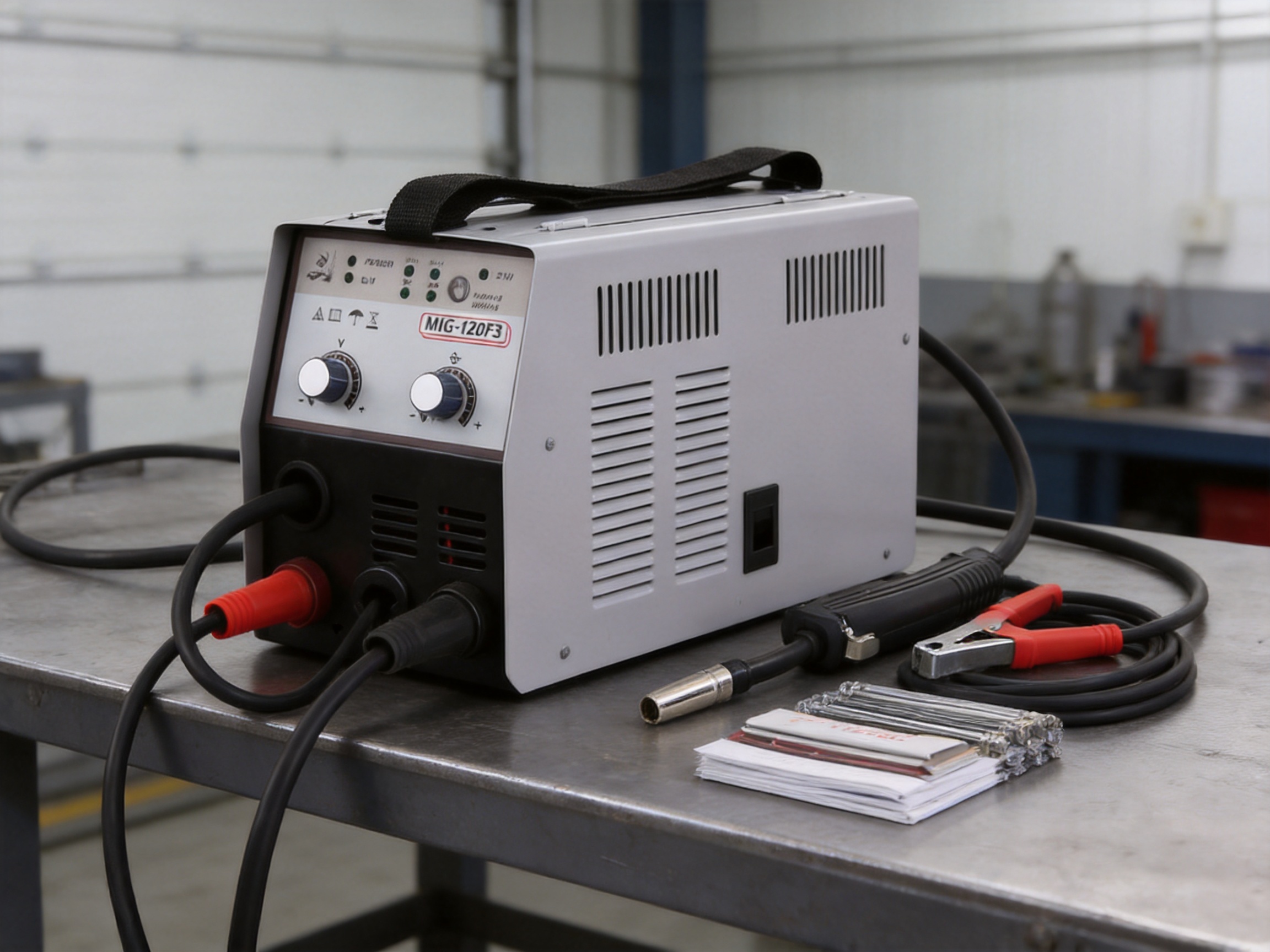
The MIG-120F3 is more versatile than a single-process welding power source. Its primary function is gas-shielded MIG/MAG welding, in which a continuously fed wire electrode creates the arc while an external shielding gas protects the molten weld pool from atmospheric contamination.
Gas-shielded welding is widely used because it supports continuous operation, high productivity, and relatively easy control. Unlike manual stick welding, the operator does not need to stop frequently to replace a consumed electrode. The internal wire feeder continuously advances the wire, allowing longer welds and smoother production flow.
The machine also provides pulse gas-shielded welding. Pulse welding alternates between different current levels to control metal transfer and heat input. This can be beneficial when working with materials or joint configurations that require greater control over penetration and distortion. Lower average heat input may help reduce deformation, especially on thinner sections or heat-sensitive components.
Twin-pulse gas-shielded welding is another advanced function identified in the product information. Twin-pulse operation can influence the appearance of the weld bead and improve control of the molten pool by combining pulsed current behavior with a secondary modulation pattern. Depending on the selected settings and material, this function can help produce a more uniform visual finish and support controlled welding on aluminum alloys and other applications where appearance and heat management are important.
In addition to MIG/MAG processes, the machine includes an MMA function. MMA, also known as stick welding or manual metal arc welding, uses coated electrodes rather than continuously fed wire and shielding gas. This process is useful for outdoor work, repair applications, thicker materials, and situations in which wind makes external shielding gas difficult to maintain.
The ability to switch between MIG/MAG and MMA gives the operator a broader working range. MIG/MAG can be selected for fast, clean fabrication in a controlled workshop environment, while MMA can be used for field repairs or jobs where simplicity and weather tolerance are more important. This dual-process capability can reduce equipment investment and simplify transportation for mobile work.
The machine supports 2T and 4T control modes, as well as S4T and spot welding control modes. These options allow the operator to select a trigger behavior appropriate to the length and style of the weld.
In 2T mode, the welding gun trigger is held during welding and released when the weld is complete. This method is straightforward and is often convenient for short welds, tacking, repairs, and operations that require frequent stopping and starting.
In 4T mode, the operator can press and release the trigger to begin welding, then press and release it again to stop. This reduces the need to continuously hold the trigger during a long weld. It can be more comfortable for extended seams and may help the operator maintain a steadier gun position.
S4T control offers additional control over the beginning and ending stages of the welding cycle. Start and finish parameters can be adjusted to help manage arc initiation, crater filling, and final weld quality. These functions are valuable when the appearance and integrity of the weld termination are important.
Spot welding control mode supports repeated short welds at defined intervals or durations. It can be useful for sheet metal assembly, overlapping panels, brackets, enclosures, and applications where continuous welding would introduce excessive heat. Correct spot settings can help limit distortion while providing adequate joining strength for the intended design.
Having multiple trigger and welding modes gives the operator more control than a basic machine with only a single on-and-off function. It also helps the same equipment serve different materials and joint designs without requiring a separate specialized power source.
The MIG-120F3 is designed to weld a range of metals, including carbon steel, alloy steel, stainless steel, and aluminum alloy. Material compatibility depends on the selected wire, shielding gas, polarity, joint preparation, thickness, and welding parameters. The machine provides the control platform needed to adapt to these variables within its rated output range.
Carbon steel is one of the most common materials used in general fabrication, equipment repair, brackets, frames, gates, supports, and workshop projects. MIG/MAG welding on carbon steel can provide high productivity and a clean working process when the correct solid or flux-cored wire and shielding gas are selected.
Alloy steel applications may include machinery components, tools, structural parts, and equipment subjected to higher mechanical requirements. Proper preheating, consumable selection, interpass temperature control, and post-weld treatment may be required depending on the alloy and engineering specification. The machine’s adjustable output and control modes allow the operator to establish a suitable process within the capabilities of the workpiece and consumables.
Stainless steel welding requires careful control of heat input, shielding, contamination, and electrode or wire selection. The pulse functions can be useful when the operator needs to manage heat and maintain a controlled bead profile. Clean preparation and dedicated stainless steel tools remain essential for achieving a high-quality result.
Aluminum alloy welding places particular demands on wire feeding, shielding gas, torch setup, and operator technique. Aluminum wire is softer than steel wire and may require suitable liners, drive rolls, and feeding adjustments. The machine’s pulse and twin-pulse functions can support controlled aluminum welding when the complete welding setup is correctly configured.
Typical applications may include automotive body and component repair, light structural fabrication, agricultural machinery maintenance, metal furniture, handrails, gates, frames, ventilation components, workshop fixtures, and general repair work. The machine is especially suitable where moderate current output, portability, and process flexibility are more important than very high-amperage industrial production.
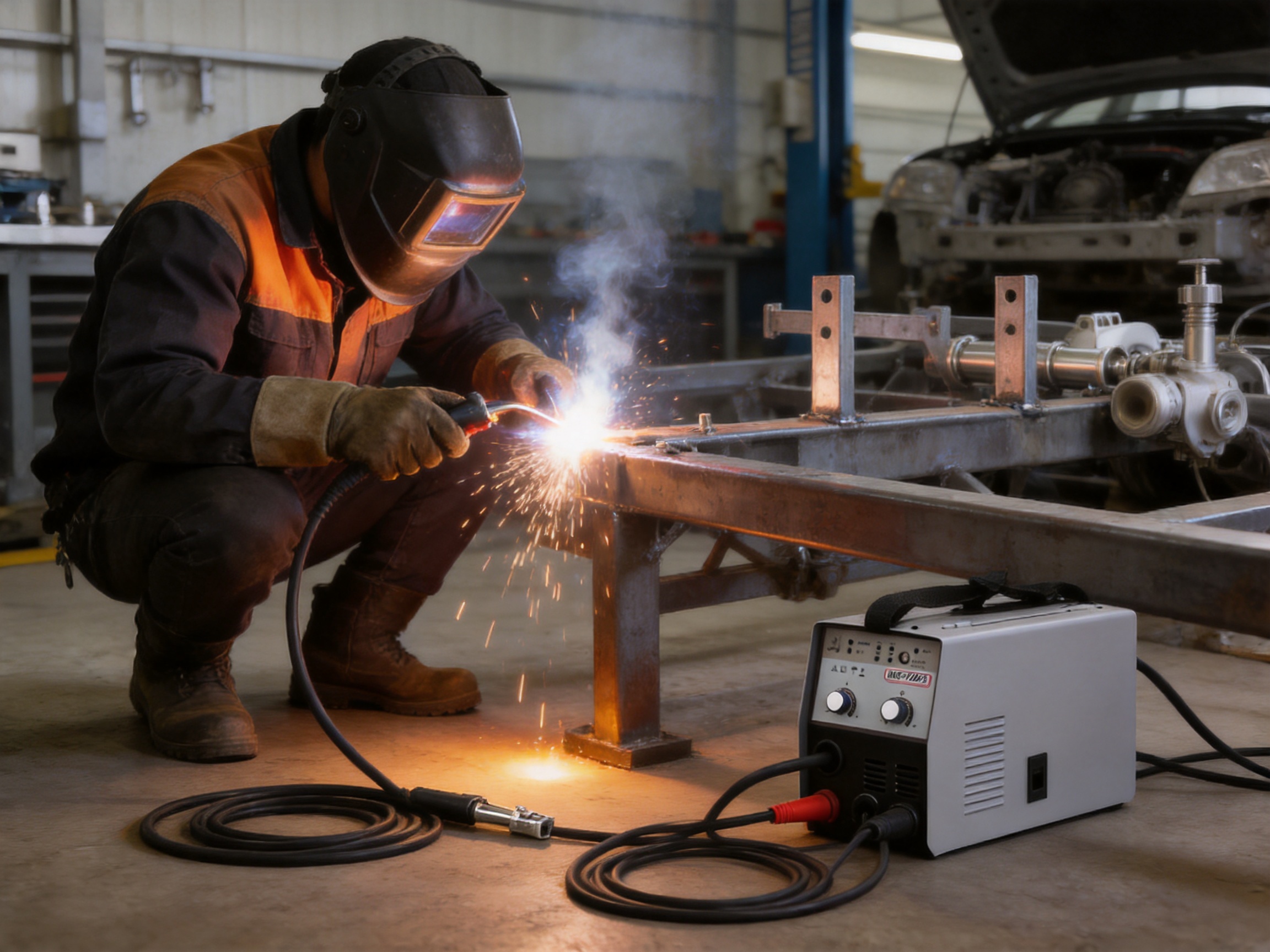
The internal wire feeder is designed to accommodate welding wire reels up to five kilograms. Integrating the feeder into the main enclosure helps create a compact package and eliminates the need for a separate external feeder in ordinary applications.
An internal feeder can make daily operation more convenient. The operator can load the wire, install the correct contact tip and liner, connect the shielding gas, and begin setup from one compact unit. This arrangement is useful for small workshops where floor space is limited and for mobile operators who need to transport the complete system between locations.
The usable wire diameter range is listed as 0.6 to 1.0 millimeters. This covers common wire sizes used for light and medium fabrication. Smaller wire can be selected for thinner materials and lower heat input, while larger wire may be appropriate for thicker sections and higher deposition requirements within the machine’s current capacity.
Wire feeding quality has a direct impact on arc stability. Smooth and consistent wire delivery helps prevent feeding interruptions, burnback, irregular transfer, and unnecessary spatter. Operators should keep the liner clean, use compatible drive rolls, maintain suitable spool tension, and ensure that the gun cable is not sharply bent during operation.
Although the machine is compact, its ready-to-weld gun and feeder package is intended to reduce installation complexity. This is an advantage over systems that require the buyer to purchase and match several separate components before the equipment can be used.
Welding equipment must be designed to manage electrical, thermal, and operational risks. The MIG-120F3 includes thermal overload protection and automatic protection against over-current and over-heating. These functions help protect the internal power components when the machine is subjected to excessive load, restricted cooling, unsuitable operating conditions, or extended use beyond its rated duty cycle.
Thermal protection monitors the operating temperature of critical components. If the internal temperature becomes too high, the machine can interrupt or limit output until it cools to a safer level. This helps reduce the risk of damage to electronic components and supports longer service life when the machine is used correctly.
Over-current protection is intended to respond to abnormal current conditions. Such conditions can occur because of electrical faults, incorrect connections, short circuits, or operating conditions outside the equipment’s normal design range. Automatic protection reduces the likelihood that a temporary fault will cause severe internal damage.
The machine also incorporates cold-start wire feeding. This function helps prevent unwanted wire movement before the welding arc is properly established. It can improve starting behavior, reduce wasted consumable material, and make the initial welding action more controlled.
The listed enclosure protection rating is IP21S. This rating indicates that the equipment is designed for protection against the entry of solid objects of a specified size and against vertically falling water under defined test conditions. It does not mean that the machine is waterproof or suitable for exposure to rain, spray, condensation, or uncontrolled outdoor environments.
Operators should always use a properly grounded electrical supply, inspect cables and connectors, keep ventilation openings clear, protect the machine from moisture, and follow appropriate welding safety procedures. A welding helmet with the correct shade, flame-resistant clothing, gloves, safety footwear, and suitable ventilation are essential. Protection features supplement safe operation; they do not replace it.
The MIG-120F3 has a listed rated duty cycle of 25 percent. Duty cycle describes the proportion of a defined operating period during which the machine can weld at its rated conditions before requiring cooling time. A 25 percent duty cycle generally means that continuous operation at the specified rated output must be balanced with rest periods.
Duty cycle should be considered when planning work. Short welds, intermittent seams, tack welding, repair tasks, and light fabrication may fit comfortably within the machine’s intended operating range. For long continuous welds at maximum output, the operator must allow appropriate pauses and avoid blocking cooling airflow.
The duty cycle specification is not a measure of poor quality. Compact portable machines commonly use a duty cycle appropriate to their size, rated output, and intended application. The main advantage is that users receive a practical welding solution that is easier to move and less demanding on space than a larger industrial power source.
To obtain dependable performance, the operator should match the job to the machine’s current range of 50 to 120 amperes. Material thickness, joint design, wire diameter, welding speed, and required penetration should all be considered. When a project requires sustained high-current welding, a larger machine with a higher duty cycle may be more suitable. For the intended class of portable MIG and MMA work, however, the available range offers useful versatility.
| Specification | MIG-120F3 | Practical Significance |
|---|---|---|
| Primary process | MIG/MAG or gas-shielded welding | Supports continuous wire welding for productive fabrication and repair |
| Additional processes | Pulse MIG, twin-pulse MIG, MMA | Provides flexibility for different materials, joints, and work environments |
| Rated supply voltage | 220/230 V | Suitable for compatible single-phase electrical supplies |
| Supply frequency | 50/60 Hz | Adaptable to common power-grid frequencies |
| Rated input capacity | 5.5 kVA | Indicates the approximate electrical input requirement at rated conditions |
| Rated supply current | 24.8 A | Important for selecting suitable circuits, plugs, and protection devices |
| No-load voltage | 62 V | Supports reliable arc initiation under normal conditions |
| Welding current range | 50–120 A | Suitable for many light and medium welding applications |
| Rated welding voltage | 20 V | Defines the listed welding voltage at rated conditions |
| Rated duty cycle | 25% | Requires cooling intervals during sustained operation |
| Usable wire diameter | 0.6–1.0 mm | Covers common wire sizes for light and medium fabrication |
| Efficiency | 82% | Reflects efficient conversion of electrical input into welding output |
| Power factor | 0.75 | Relevant to electrical system loading and power utilization |
| Protection rating | IP21S | Requires protection from rain, spray, and excessive moisture |
| Net weight | 5.4 kg | Facilitates transport between work areas |
| Machine dimensions | 330 × 140 × 200 mm | Fits compact workshops, service vehicles, and limited workspaces |
The most visible advantage of the MIG-120F3 over conventional transformer welders is its reduced size and weight. Traditional transformer machines may be mechanically robust, but their large magnetic components can make them difficult to transport. The compact inverter design addresses this limitation without removing essential welding functions.
The second advantage is electrical efficiency. Inverter technology can use power more effectively than older low-frequency designs, potentially reducing energy consumption and operating costs. The product information indicates energy savings of up to 30 percent in comparison with conventional equipment under appropriate conditions. Actual savings depend on the welding process, duty cycle, input supply, material, and operating habits.
The third advantage is control flexibility. A basic transformer welder may provide only a current adjustment or a small number of fixed settings. The MIG-120F3 uses digital and PWM-based control, along with multiple welding modes, to give operators more options for arc behavior, trigger operation, pulse welding, spot welding, and MMA work.
The fourth advantage is process integration. The built-in wire feeder and supplied gun package reduce the need for separate external equipment. This is particularly helpful for small businesses and independent technicians that need a complete welding package without investing in a larger production system.
The fifth advantage is multifunction performance. A single machine that supports MIG/MAG, pulse MIG, twin-pulse MIG, and MMA can be more practical than maintaining separate machines for different tasks. Although specialized industrial equipment may offer higher output or more advanced automation, a portable multifunction unit can deliver a strong balance of capability, affordability, and mobility for everyday work.
The machine is not intended to replace every high-capacity industrial welding system. Heavy fabrication, thick structural steel, automated production lines, and long uninterrupted welds may require higher-amperage equipment, a greater duty cycle, or a dedicated robotic platform. The strength of the MIG-120F3 lies in its compact, flexible, and efficient design for portable and moderate-duty applications.
The manufacturer behind the MIG-120F3 operates as a large-scale producer of electric welding machines, battery chargers, and heaters. Its manufacturing and research activities cover a broad portfolio that includes MMA welding machines, MIG/MAG equipment, flux-cored welding machines, TIG welding machines, plasma cutters, stud welders, submerged arc welding systems, chargers, and electric, gas, and oil heaters.
The company operates from a substantial production base covering approximately 120,000 square meters and employs around 600 people. Its reported annual production capacity is approximately two million units, with nearly 1.5 million units exported each year. This scale provides experience in procurement, production planning, quality control, international packaging, documentation, and distribution.
A large production capacity can also support consistent component sourcing and repeatable assembly processes. For electronic welding equipment, consistency is important because power modules, control boards, cooling systems, wire feeders, connectors, and protective circuits must work together reliably. Controlled manufacturing procedures help reduce variation between production batches.
The company applies a combination of modern management and manufacturing systems, including office automation, Toyota Production System-based management, enterprise resource planning, and manufacturing execution systems. These systems can help coordinate materials, production schedules, process records, quality checks, inventory, and delivery requirements.
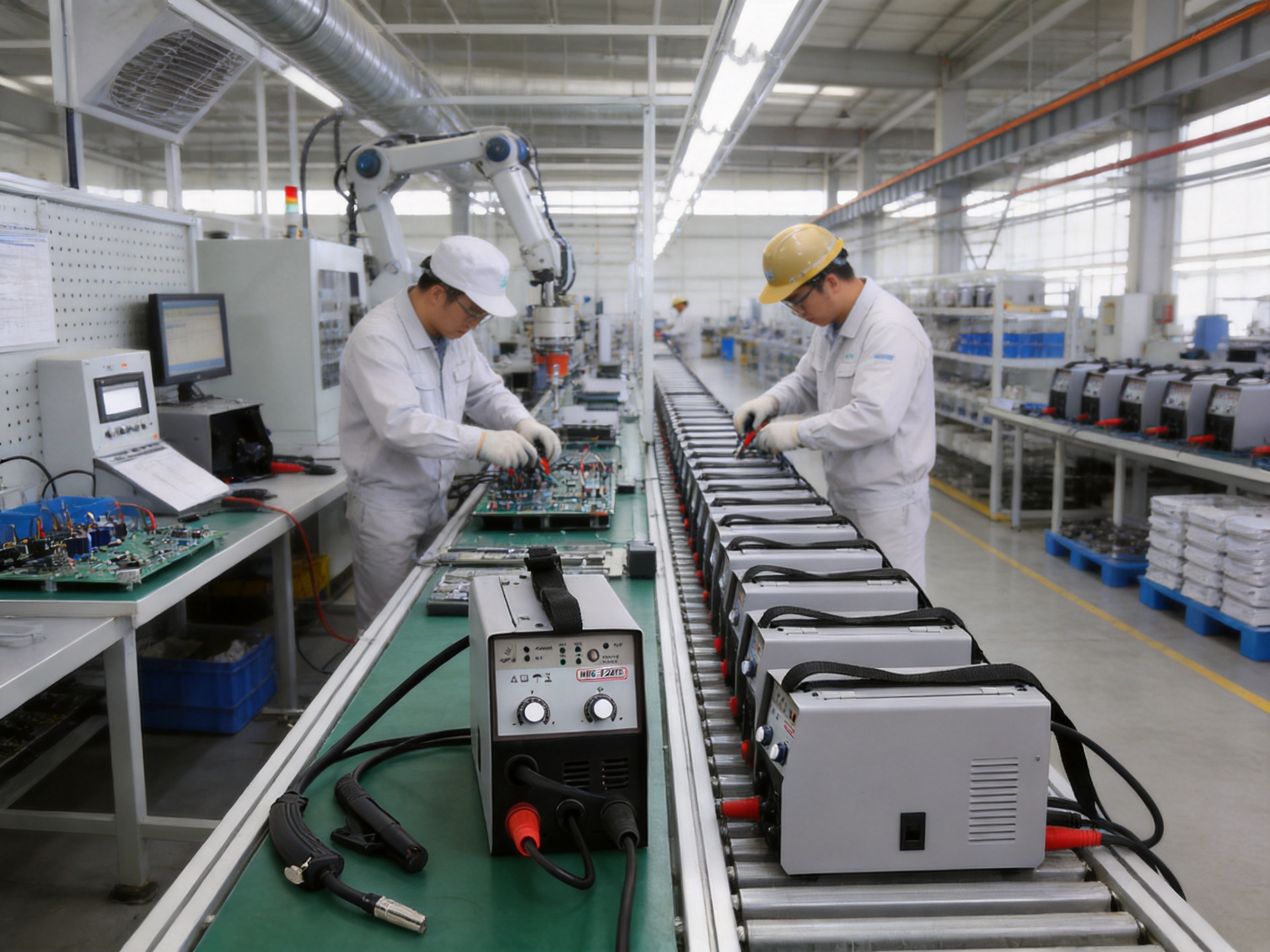
Advanced production equipment is also used in the manufacturing process. The company reports the use of automatic patching, plug-in assembly, welding systems, robotic processing, laser cutting, and related technologies. Automated and semi-automated processes can improve repeatability, reduce manual variation, and support the accurate production of metal enclosures, circuit assemblies, and mechanical parts.
Laser cutting is especially useful for producing precise enclosure panels, brackets, ventilation openings, mounting structures, and other sheet-metal components. Accurate cutting helps ensure proper fit during assembly and contributes to consistent product appearance. Robotic processing can support repeatable handling and welding of mechanical components, while automated electronic assembly can help place components accurately on circuit boards.
Manufacturing capability is strengthened by engineering infrastructure. The company maintains a provincial research and development center, an enterprise technology center, and an intelligent welding technology research institute. It has approximately 98 research and development personnel and has obtained invention patents, utility model patents, appearance patents, and software copyrights.
These resources are relevant to the MIG-120F3 because inverter welding machines are not simply metal boxes containing a transformer. They require coordinated development of power electronics, thermal management, firmware, user controls, wire feeding, protection circuits, mechanical construction, and welding process behavior. Experience in these areas supports the development of more capable and reliable products.
International buyers often require evidence that welding equipment has been evaluated against recognized safety, electromagnetic compatibility, energy, and market-access requirements. The manufacturer reports holding certifications and compliance marks that include GS, CE, EMC, ERP, United States ETL, United Kingdom UKCA, and China CCC, depending on the relevant product and market.
Certification does not eliminate the need for correct installation or safe operation, but it provides an important framework for product evaluation. Electrical safety requirements address areas such as insulation, grounding, leakage current, component selection, and protection against electrical hazards. Electromagnetic compatibility requirements help control unwanted emissions and improve the equipment’s ability to operate correctly near other electrical devices.
Energy-related requirements are increasingly important as users seek lower operating costs and reduced environmental impact. Inverter technology, efficient switching, and controlled power delivery can contribute to improved energy performance over the working life of the equipment.
The manufacturer is also identified as a national standard drafting unit associated with the National Welding Machine Standardization Committee. It has reportedly participated in the drafting, formulation, and revision of 20 national standards and led the drafting of one group standard. Participation in technical standardization can provide valuable insight into performance expectations, safety considerations, testing methods, and the changing requirements of the welding industry.
Product development is further supported by the company’s experience in regional and customer-specific requirements. Welding machines may need different input plugs, voltage configurations, control labels, documentation, certifications, packaging, and language support for different markets. An established international manufacturer is generally better positioned to manage these details than a small supplier with limited export experience.
The company also indicates that it can develop new products according to the needs of different regions, countries, and customers. This may be relevant for distributors, private-label buyers, importers, and professional users seeking customized specifications. Customization can involve branding, packaging, control layouts, cable assemblies, accessories, input configurations, or application-specific functions, subject to technical and regulatory feasibility.
For a general fabrication workshop, the MIG-120F3 can serve as a compact secondary machine, a mobile repair unit, or a primary solution for smaller jobs. Its moderate current range is appropriate for many brackets, frames, panels, fixtures, stands, and repair components. The machine can be positioned close to the workpiece without requiring a large dedicated welding bay.
For automotive repair, portability and control are especially useful. Vehicle panels and components often require controlled heat input to reduce distortion. Spot welding control, pulse capabilities, and small-diameter wire compatibility can support a careful approach when the operator has selected suitable consumables and parameters. Automotive work still requires proper cleaning, fit-up, grounding, and attention to coatings or hidden materials.
For agricultural maintenance, equipment is frequently repaired in locations away from a permanent workshop. The machine’s light weight allows it to be carried to machinery, implements, trailers, frames, and other assets. MMA capability adds flexibility when shielding gas is inconvenient or when outdoor conditions make gas-shielded welding difficult.
For small manufacturing businesses, the integrated feeder and compact size can help control initial equipment costs and reduce workspace requirements. A single multifunction unit can handle varied jobs while the business evaluates whether a higher-capacity production system is needed in the future.
For educational workshops and vocational training environments, the range of control modes can demonstrate several important welding concepts. Students can learn the differences between MIG/MAG and MMA, understand the relationship between wire diameter and current, practice 2T and 4T operation, and observe how pulse settings influence heat input and bead appearance. Training must always be supervised by qualified personnel.
Before operation, the user should verify that the electrical supply matches the machine’s rated 220/230-volt input requirement and is capable of supporting the listed current demand. The circuit should have suitable protection, grounding, connectors, and cable capacity. An undersized or poorly protected supply can lead to voltage drop, nuisance tripping, overheating, or unsafe operating conditions.
The workpiece should be clean and properly grounded. Rust, paint, oil, moisture, mill scale, and other contaminants can interfere with arc stability and weld quality. Removing contamination from the joint area helps improve electrical contact and reduces the chance of trapped impurities in the weld.
For MIG/MAG operation, the operator must select a suitable shielding gas and set the flow rate according to the material, torch configuration, nozzle condition, and working environment. Excessive gas flow can create turbulence and draw in atmospheric contamination, while insufficient flow may fail to protect the weld pool.
The correct wire diameter and drive-roll configuration should be selected for the material and application. The listed range is 0.6 to 1.0 millimeters, but the exact wire type must match the metal being welded. Solid steel wire, stainless steel wire, aluminum wire, and flux-cored wire have different requirements for polarity, liner selection, gas, and feeding pressure.
The torch nozzle, contact tip, liner, and drive rolls should be inspected regularly. Wear or contamination can cause inconsistent wire delivery and unstable arc performance. The work cable connection should remain clean and tight, and the gun cable should be routed without sharp bends or crushing.
Ventilation is essential because welding fumes and shielding gases can create health hazards. Coated, painted, galvanized, or contaminated materials may release particularly hazardous fumes when heated. Local exhaust ventilation, respiratory protection where required, and appropriate workplace controls should be used.
Routine maintenance helps preserve the performance advantages of an inverter welding machine. Cooling openings should be kept clear of dust, metal particles, and obstructions. Accumulated debris can restrict airflow and increase internal temperature, potentially causing protective shutdowns or reducing component life.
Power cables, welding leads, gas hoses, connectors, and the welding gun should be inspected before use. Damaged insulation, loose terminals, cracked hoses, or worn connectors should be repaired or replaced by qualified personnel. The machine should be disconnected from the electrical supply before internal servicing or cleaning.
The wire-feeding system should receive particular attention. Drive rolls should be matched to the wire profile and diameter. Too much drive-roll pressure can deform soft wire, while too little pressure can cause slipping. The spool brake should hold the reel securely without creating excessive resistance.
Consumable parts such as contact tips and liners naturally wear during operation. Replacing them at suitable intervals helps maintain consistent electrical contact and smooth wire movement. A clean nozzle supports reliable gas coverage and reduces the likelihood of spatter bridging between the nozzle and contact tip.
When the machine is not in use, it should be stored in a dry, clean location away from corrosive chemicals, excessive dust, direct rain, and extreme temperature changes. The IP21S rating is not a substitute for proper storage or protection from harsh environments.
Product specifications are important, but the reliability of a welding machine also depends on the organization that designs, produces, tests, and supports it. A manufacturer with broad product experience can apply knowledge from different welding processes to improve electronic controls, thermal systems, mechanical design, and user interfaces.
Large-scale production can support investment in testing equipment, automated assembly, engineering laboratories, tooling, quality systems, and supplier management. It can also make it easier to maintain spare parts and provide technical documentation for international customers.
Research and development capability matters particularly in inverter equipment. Welding performance depends on fast feedback between the electrical output and the control software. Engineers must manage switching behavior, arc response, protection thresholds, heat dissipation, electromagnetic compatibility, and manufacturing tolerances. Ongoing product development helps manufacturers refine these systems over time.
Patents and software copyrights indicate activity in both hardware and control-system development. While intellectual property alone does not guarantee a particular field result, it reflects an effort to develop proprietary solutions rather than relying entirely on generic designs.
The company’s experience with welding machines, heaters, chargers, and related electrical products also creates a broad technical base. Power electronics, thermal management, motor control, safety circuits, sheet-metal fabrication, and export compliance are relevant across several of these product categories.
A homeowner or occasional user should consider the machine if portability, straightforward operation, and process flexibility are priorities. The user should first confirm that the available electrical supply is suitable and that the intended materials and thicknesses fall within the machine’s practical operating range.
A repair technician may value the combination of MIG/MAG and MMA functions. MIG/MAG can provide efficient welding in a workshop, while MMA can offer a practical backup for outdoor or less controlled conditions. The compact design can also reduce the physical burden of carrying equipment to a repair location.
A small fabrication business should evaluate the duty cycle against expected production volume. The machine can be a strong fit for intermittent welds, light fabrication, repair work, and varied jobs. If the business requires continuous high-output welding, it should compare this model with larger machines designed for higher duty cycles.
A distributor or importer should examine market certification, input voltage, plug configuration, packaging, spare parts, technical documentation, warranty arrangements, and customer support. The manufacturer’s experience with international exports and multiple compliance systems can support a more organized supply relationship.
A professional welding trainer should treat the unit as a multifunction training platform while ensuring that students understand its limits. The ability to demonstrate pulse, twin-pulse, trigger modes, and MMA operation can be educational, but instruction must include safety, joint preparation, parameter selection, and inspection of finished welds.
It is a portable inverter MIG/MAG welding machine with additional pulse, twin-pulse, spot-control, and MMA capabilities. Its main process is gas-shielded continuous-wire welding.
The listed net weight is 5.4 kilograms. This makes it substantially easier to carry than many conventional transformer welding machines.
The listed welding current range is 50 to 120 amperes. The appropriate setting depends on the metal, thickness, wire diameter, joint design, shielding gas, and welding speed.
The specified usable wire diameter is 0.6 to 1.0 millimeters. The correct wire type and feeding components must be selected for the material and welding process.
It is designed to weld aluminum alloy, but successful aluminum welding requires suitable aluminum wire, shielding gas, liner, drive rolls, contact tip, polarity, and torch setup. Operator technique and material preparation are also important.
Yes. The product information identifies an MMA function, allowing the machine to be used with suitable coated electrodes in addition to MIG/MAG welding.
2T mode requires the operator to hold the trigger while welding. In 4T mode, the trigger can be pressed and released to begin welding and operated again to stop, which can be more comfortable during longer welds.
Twin-pulse welding modulates the welding output in a controlled pattern. It can help manage heat input, molten-pool behavior, and bead appearance in suitable applications, especially when carefully controlled welding is required.
It can be used for suitable repair work when protected from rain, spray, and excessive moisture. MMA may be preferable to gas-shielded MIG/MAG in windy conditions because external wind can disturb shielding gas coverage.
The rated supply voltage is 220/230 volts, with a listed frequency of 50/60 hertz. The supply circuit must be correctly grounded and adequately protected for the machine’s electrical demand.
It means the machine requires cooling intervals when operating at its rated conditions. Users should plan intermittent welding and avoid long uninterrupted operation at maximum output.
Yes. It has an internal wire feeder and a gun package described as ready to weld. The feeder is suitable for welding wire reels up to five kilograms.
The machine includes thermal overload protection, over-current protection, over-heating protection, and cold-start wire feeding. These features assist safe operation but do not replace proper installation, inspection, ventilation, and personal protective equipment.
The listed material range includes carbon steel, alloy steel, stainless steel, and aluminum alloy. Consumables and settings must be matched to each material.
It is best suited to portable, light, and medium-duty welding applications. Heavy continuous production may require a larger power source with a higher current rating and duty cycle.
Its main advantages are lower weight, smaller dimensions, inverter efficiency, digital control, multifunction operation, and integrated wire feeding. Conventional transformer welders may still be appropriate where extreme simplicity, high continuous duty, or specific industrial characteristics are required.
Users should keep cooling openings clean, inspect cables and connectors, maintain the wire feeder, replace worn contact tips and liners, check the gas system, and store the machine in a dry, clean environment.
The MIG-120F3 brings together the features that many modern welding users need in one compact package. Its inverter-based IGBT power system reduces size and weight while supporting efficient electrical conversion. Its DC output, digital and PWM control, and 50-to-120-amp welding range provide a practical foundation for stable arc performance and controlled weld formation.
Its usefulness extends beyond basic MIG/MAG welding. Pulse gas-shielded welding, twin-pulse operation, 2T and 4T trigger control, S4T functions, spot welding control, and MMA capability give operators flexibility across different materials and working conditions. The internal feeder, five-kilogram wire capacity, and ready-to-weld gun package further simplify installation and transportation.
The machine is especially well suited to repair technicians, small workshops, mobile fabricators, automotive users, agricultural maintenance teams, training environments, and professionals who need a portable backup unit. Its 25 percent duty cycle should be respected, and users requiring continuous high-current production should select equipment designed for that purpose.
Behind the product is a manufacturer with substantial production capacity, international export experience, research facilities, automated manufacturing technologies, certification experience, and participation in welding-machine standardization. These strengths support the development of equipment that combines practical usability with modern electronic control and repeatable manufacturing.
For buyers seeking a lightweight, energy-conscious, multifunction welding machine for general fabrication and repair, the MIG-120F3 offers a balanced solution. It is not defined solely by its compact enclosure; its value comes from the combination of inverter efficiency, process flexibility, user-oriented controls, protection functions, and manufacturing infrastructure supporting the product.
1. Product technical information for the MIG-120F3 portable MIG/MAG inverter welding machine.
2. General principles of gas metal arc welding, including wire feeding, shielding gas, arc stability, and welding parameter selection.
3. General principles of manual metal arc welding and coated-electrode applications.
4. Technical guidance on inverter welding power sources and insulated-gate bipolar transistor switching technology.
5. General electrical safety practices for arc-welding equipment and workshop power supplies.
6. General guidance on welding ventilation, fume control, personal protective equipment, and safe work procedures.
7. International conformity and product safety principles applicable to welding equipment, electromagnetic compatibility, and energy performance.
8. General manufacturing principles for automated electronic assembly, laser cutting, robotic processing, enterprise resource planning, and manufacturing execution systems.
Recommended Products

Contact Us
No.2299, Luqiao Section, Shugang Avenue, Luqiao District, Taizhou, 318057 Zhejiang, PR China.
+86-576-82431568
 Privacy
China Welding Machine Factory
 English
 中文简体
中文简体
 русский
 Español
 عربى
عربى
 Français
 Português
 Deutsch
 Український