Email: [email protected]
Email: [email protected]

Blog
 2026.08.07
 Blog
Blog
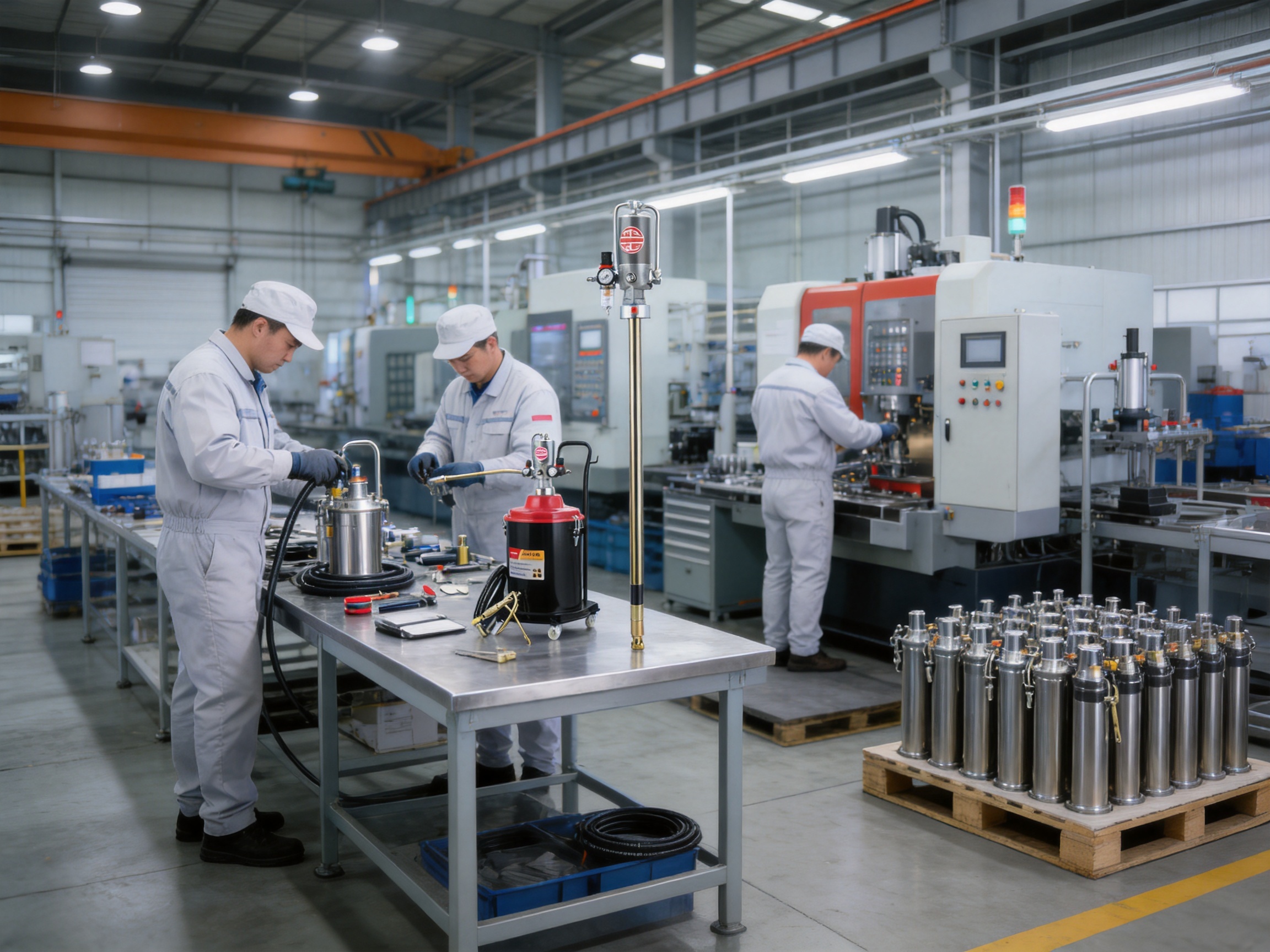
Reliable lubrication is essential to the performance, service life, and operating safety of industrial machinery. Bearings, axles, joints, pins, bushings, gears, and other moving components require an adequate supply of grease to reduce friction, control heat, prevent premature wear, and protect against contamination. When lubrication is performed inconsistently or with unsuitable equipment, the result can be increased maintenance costs, avoidable downtime, and shortened machinery life.
The 12/20/35/40L High Pressure Auto Air Grease Lubricator Operated Pneumatic Grease Dispenser Pump is designed to provide a practical, efficient, and dependable solution for these challenges. Powered by compressed air, the unit transfers grease under high pressure and delivers it through a flexible hose and grease gun. Its range of barrel capacities, specialized suction-pipe design, adjustable pneumatic pressure, and durable construction make it suitable for automotive workshops, construction equipment, agricultural machinery, mining operations, manufacturing plants, service centers, and general industrial maintenance.
Rather than relying on manual pumping, the pneumatic system uses air pressure to drive the grease-pumping mechanism. This reduces physical effort for operators and supports more consistent grease delivery during repetitive maintenance work. The product is available in 12-liter, 20-liter, 35-liter, and 40-liter configurations, allowing users to select a capacity that matches the scale of their operations.
Grease is widely used in applications where oil may run away from a contact surface, where components operate under heavy loads, or where a protective lubricant must remain in place for an extended period. However, grease is generally more difficult to move than liquid oil. It requires suitable pumping pressure, a properly designed suction system, and an outlet arrangement that can overcome resistance in hoses, fittings, and machine lubrication points.
In a small workshop, manually operated grease guns may be adequate for occasional servicing. In a professional maintenance environment, however, manual equipment can become slow and tiring. Operators may need to service dozens or hundreds of lubrication points in a single shift. Uneven manual force can also produce inconsistent delivery, while repeated pumping may contribute to fatigue and reduce maintenance productivity.
A pneumatic grease dispenser addresses these limitations by using compressed air as the driving force. Once connected to an appropriate air source, the pump can deliver grease with considerably less manual effort. The operator can concentrate on positioning the grease gun correctly, checking the condition of the fitting, and confirming that the required amount of grease has entered the component.
The high-pressure configuration is particularly useful when grease must travel through a long hose or enter a lubrication point with significant internal resistance. A stable pneumatic system helps maintain delivery performance in demanding environments and can make routine lubrication faster and more repeatable.
The product is a high-pressure, air-operated grease dispenser designed for automatic or semi-automatic lubrication work. It consists of a grease barrel, pneumatic pump assembly, suction pipe, pressure-regulating valve, delivery hose, and grease gun. Depending on the configuration, the grease gun is supplied in an iron universal version, while an aluminum alternative is available as an option.
The product family includes several models and pressure ratios. Most configurations use a 50:1 pressure ratio, while selected models provide 55:1, 65:1, or 75:1 ratios. This range gives customers the ability to choose between general-purpose operation and configurations intended for higher pressure requirements.
The main capacities are 12L, 20L, 35L, and 40L. The 12-liter model is suited to smaller workshops, mobile maintenance tasks, and users who need a relatively compact unit. The 20-liter version provides additional capacity for regular workshop use. The 35-liter and 40-liter versions are designed for higher-volume maintenance activities where reducing refill frequency is important.
Each unit is supplied with a four-meter grease hose. This length provides useful working reach around vehicles, machinery, production equipment, and other large assemblies. The operator can often service a lubrication point without moving the complete pump, improving convenience and reducing interruptions during maintenance.
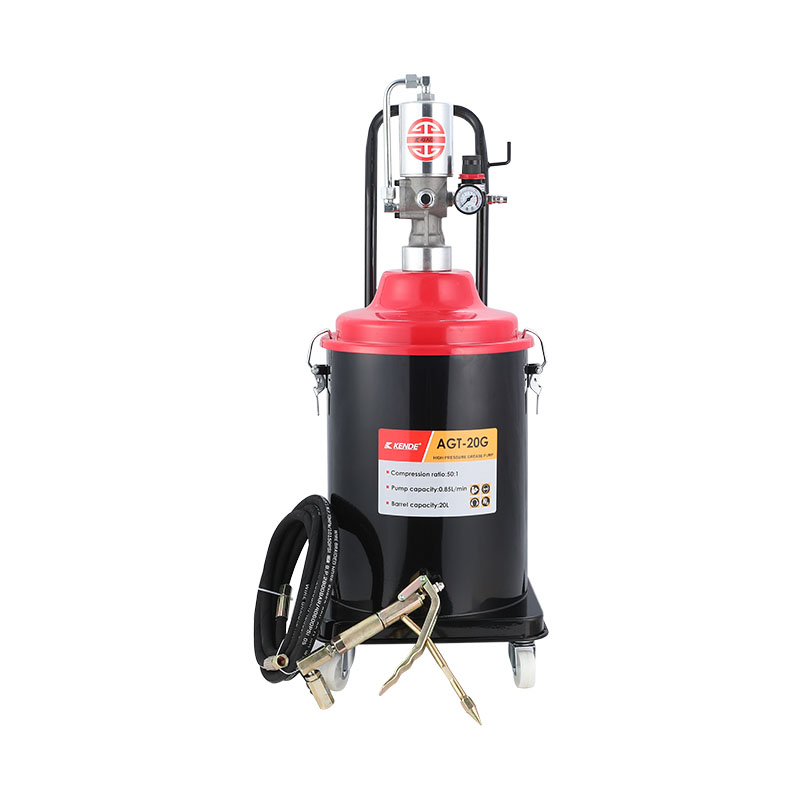
12/20/35/40L High Pressure Auto Air Grease Lubricator Operated Pneumatic Grease Dispenser Pump
One of the important design features is the specialized pump head combined with a dedicated oil suction pipe. Although the product is intended for grease rather than conventional lubricating oil, the supplied technical description identifies the component as an oil suction pipe. Its function is to draw grease from the barrel and guide it toward the pneumatic pumping mechanism.
The suction-pipe length is tailored to the size of the unit. The larger 20L, 35L, and 40L models use a pipe length of approximately 440 millimeters, while the 12L model uses a pipe length of approximately 400 millimeters. Matching the suction system to the barrel geometry helps the pump access grease more effectively across the usable depth of the container.
This dedicated configuration is an advantage over generic pumping arrangements that may use an unsuitable suction length or a poorly matched pump head. If the suction pipe is too short, grease near the bottom or at the far side of the container may not be collected efficiently. If the arrangement is poorly matched, air may enter the pumping system, causing interruption, inconsistent output, or the need for frequent operator intervention.
The specialized pump head is also intended to support stable grease movement and reduce the likelihood of clogging. Grease can vary significantly in consistency, especially in cold environments or when it has been stored for a long period. A properly designed inlet and pump head help the system handle the material more reliably than a basic, manually adapted pump.
Operators should still use grease that is compatible with the equipment and should avoid introducing foreign material into the barrel. Keeping the container clean, closing it when not in use, and inspecting the suction area during routine maintenance will help preserve pumping performance.
The pump is designed for high-pressure operation, which is one of its principal advantages in industrial maintenance. Lubrication points on heavy equipment may be partially blocked by old grease, dirt, corrosion, or hardened deposits. Other points may contain seals or narrow passages that require greater pressure before grease begins to flow.
The model range offers a pressure ratio of 50:1, 55:1, 65:1, or 75:1, depending on the selected configuration. A higher pressure ratio can be beneficial when an application requires greater force at the grease outlet. The 75:1 versions, such as the ATG-40 GH configuration, are intended for users who need a stronger pressure capability within the available product range.
The pressure ratio should not be interpreted as a reason to apply excessive pressure to every lubrication point. The correct pressure depends on the machine manufacturer’s recommendations, the condition of the fitting, the grease grade, and the condition of the component being serviced. Excessive pressure can damage seals or force grease into an unintended area. Proper operating practice combines the capability of the pump with appropriate pressure control and careful observation.
The product includes a pneumatic pressure-regulating valve. This valve allows the operator to adjust the incoming air pressure and control the grease delivery behavior. Pressure adjustment is valuable because different machines and lubrication points may require different amounts of force. A controlled setting can help avoid over-lubrication, reduce waste, and promote more consistent service procedures.
Compared with basic low-pressure manual dispensers, the pneumatic high-pressure design offers several practical advantages:
1. It reduces the physical effort required to deliver grease.
2. It supports faster servicing of multiple lubrication points.
3. It can help overcome resistance in long hoses and restricted fittings.
4. It provides adjustable pneumatic operation rather than relying solely on manual force.
5. It is suitable for a wider range of automotive, agricultural, construction, mining, and industrial equipment.
Selecting the correct barrel volume is important because capacity affects refill frequency, portability, and productivity. The 12L model offers a compact solution for users who perform maintenance on a limited number of machines or need to move the unit frequently around a workshop. It is also appropriate for businesses that use different grease types in separate units and prefer smaller containers to avoid extended storage.
The 20L configuration provides a balance between capacity and handling convenience. It can be used in vehicle repair facilities, fleet maintenance departments, agricultural service shops, and medium-sized industrial workshops. The larger barrel reduces interruptions while remaining manageable for routine movement within a work area.
The 35L and 40L versions are suited to high-demand applications. A larger grease supply means fewer refills during a maintenance shift, which can be valuable in factories, equipment depots, construction yards, and service operations responsible for many machines. These models are especially useful where the pump is positioned in a dedicated maintenance area and used repeatedly throughout the day.
Capacity selection should consider the type and quantity of grease used, the number of service points, the available storage area, and the method used to transport the pump. A high-volume model may improve productivity in a central workshop, while a smaller version may be more practical for field technicians or mobile repair teams.
The 12L option emphasizes compactness and flexibility. The 20L option is suitable for regular workshop maintenance. The 35L option provides a larger reserve for demanding service schedules. The 40L option offers the greatest listed barrel volume and is well suited to continuous or high-frequency lubrication operations.
Having multiple capacity choices is an advantage over a single-size dispenser because customers do not have to accept unnecessary bulk or insufficient capacity. The same basic pneumatic lubrication concept can be selected according to the working environment, helping distributors and industrial buyers serve different customer requirements with one product family.
The four-meter grease hose increases the practical working area of the pump. Large machinery may have lubrication points distributed across several sides, at different heights, or inside areas that cannot be reached easily with a short hose. A longer hose allows the pump body to remain in a stable location while the operator moves the grease gun to the service point.
The standard configuration includes an iron universal grease gun. This type of gun is intended for general-purpose service and offers a robust option for workshop and industrial use. An aluminum grease gun is available as an optional configuration. Aluminum can provide a lighter alternative, which may be beneficial when the operator must hold the grease gun for extended periods or reach difficult positions.
The choice between iron and aluminum should be based on the working conditions, expected frequency of use, handling preferences, and desired balance between durability and weight. The availability of both options gives buyers more flexibility than a fixed configuration.
Hose condition is important for safe and effective operation. Operators should inspect the hose for cuts, abrasion, swelling, leakage, or damage near the fittings. The grease gun should also be checked for secure connections and proper engagement with the lubrication fitting. A clean connection reduces the risk of contamination and helps prevent grease from escaping around the service point.
Manual grease guns are inexpensive and easy to use for occasional lubrication. However, they require repeated hand pumping and may be inefficient for large maintenance schedules. The pneumatic dispenser reduces operator fatigue and can deliver grease more consistently when connected to a suitable compressed-air supply.
The pneumatic pump also provides greater convenience when grease must be delivered through a longer hose or into a resistant fitting. Instead of applying repeated manual strokes, the operator controls the air supply and focuses on the lubrication task. For commercial workshops and industrial users, this can translate into better productivity during routine servicing.
Battery-powered or electric grease dispensers can be convenient where compressed air is unavailable. However, they depend on battery condition, charging arrangements, or electrical connections. A pneumatic dispenser is a practical alternative in workshops and factories that already have compressed-air infrastructure.
The air-operated design also avoids adding another battery platform to a maintenance department. For users who already operate pneumatic tools, the grease pump can fit naturally into existing work procedures. The pressure-regulating valve provides useful control without requiring a complex electronic interface.
Not all pneumatic grease pumps are designed for the same operating pressure. Basic low-pressure units may be adequate for clean, easily accessible lubrication points, but they may be less suitable for long hoses, heavy machinery, or partially restricted fittings. The available 50:1 to 75:1 pressure ratios provide a stronger range for demanding applications.
The specialized pump head and size-matched suction pipes further distinguish this product from generic pneumatic arrangements. Instead of treating the barrel and pump as unrelated parts, the product family uses dedicated configurations for different capacity classes.
Centralized automatic lubrication systems can be valuable for machines requiring continuous, programmed lubrication. However, they may require extensive installation, dedicated piping, metering devices, and higher initial investment. A mobile pneumatic grease dispenser offers a more flexible option for workshops and maintenance teams that service many different machines at different locations.
The portable approach allows one unit to be used across vehicles, production equipment, agricultural machinery, and construction equipment. It does not require every machine to be permanently modified, making it suitable for general maintenance departments and service contractors.
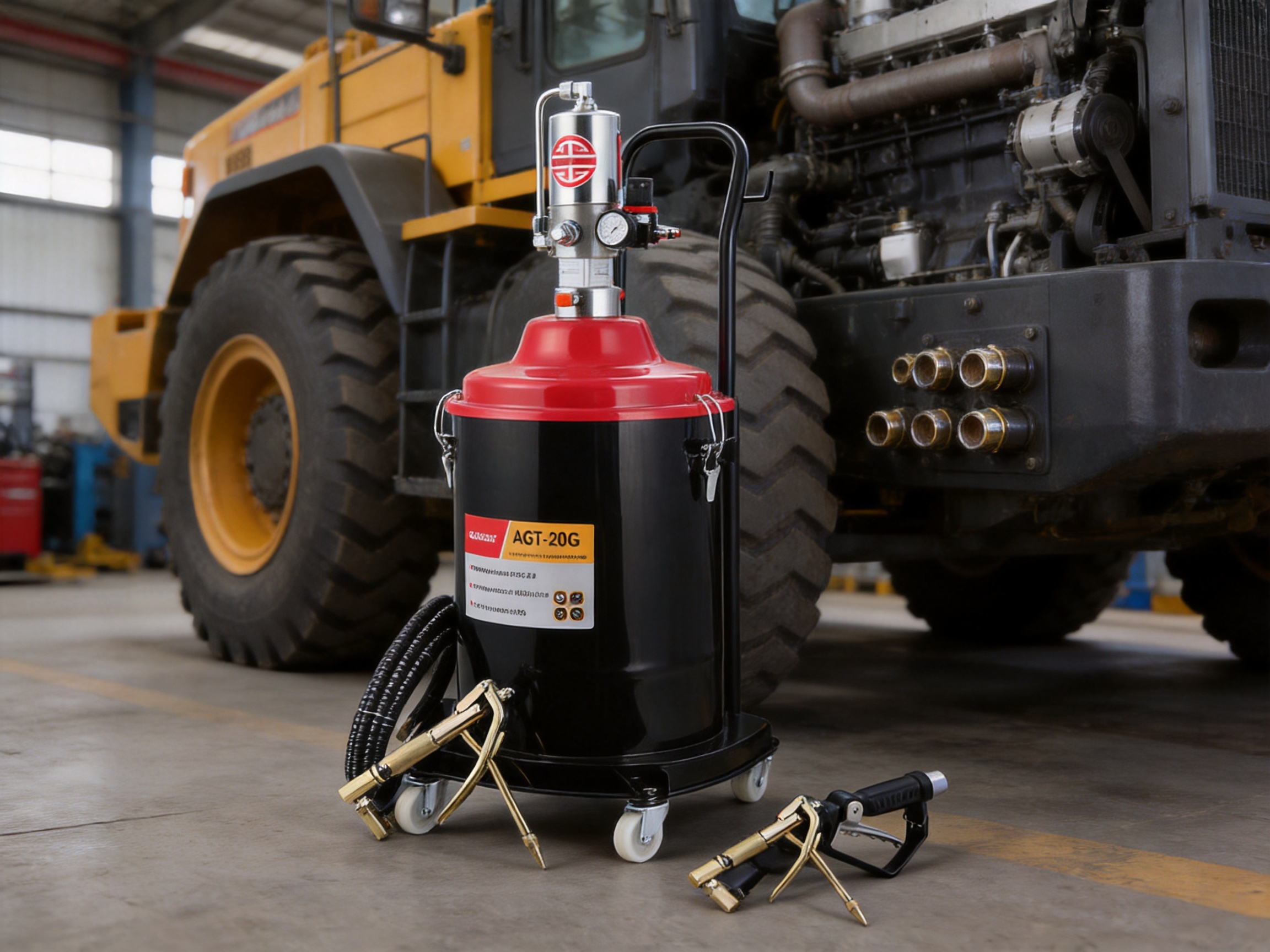
Automotive workshops use grease on numerous vehicle components, including bearings, axles, suspension joints, chassis fittings, universal joints, and other moving connections. Fleet operators may need to service many vehicles according to time, mileage, or operating conditions. The pneumatic grease dispenser can support faster routine maintenance and reduce the physical strain associated with manual pumping.
The 12L and 20L models may be convenient for smaller garages, while the 35L and 40L models can support bus fleets, truck depots, transportation companies, and larger service centers. The four-meter hose helps technicians reach lubrication points around commercial vehicles without repeatedly relocating the main unit.
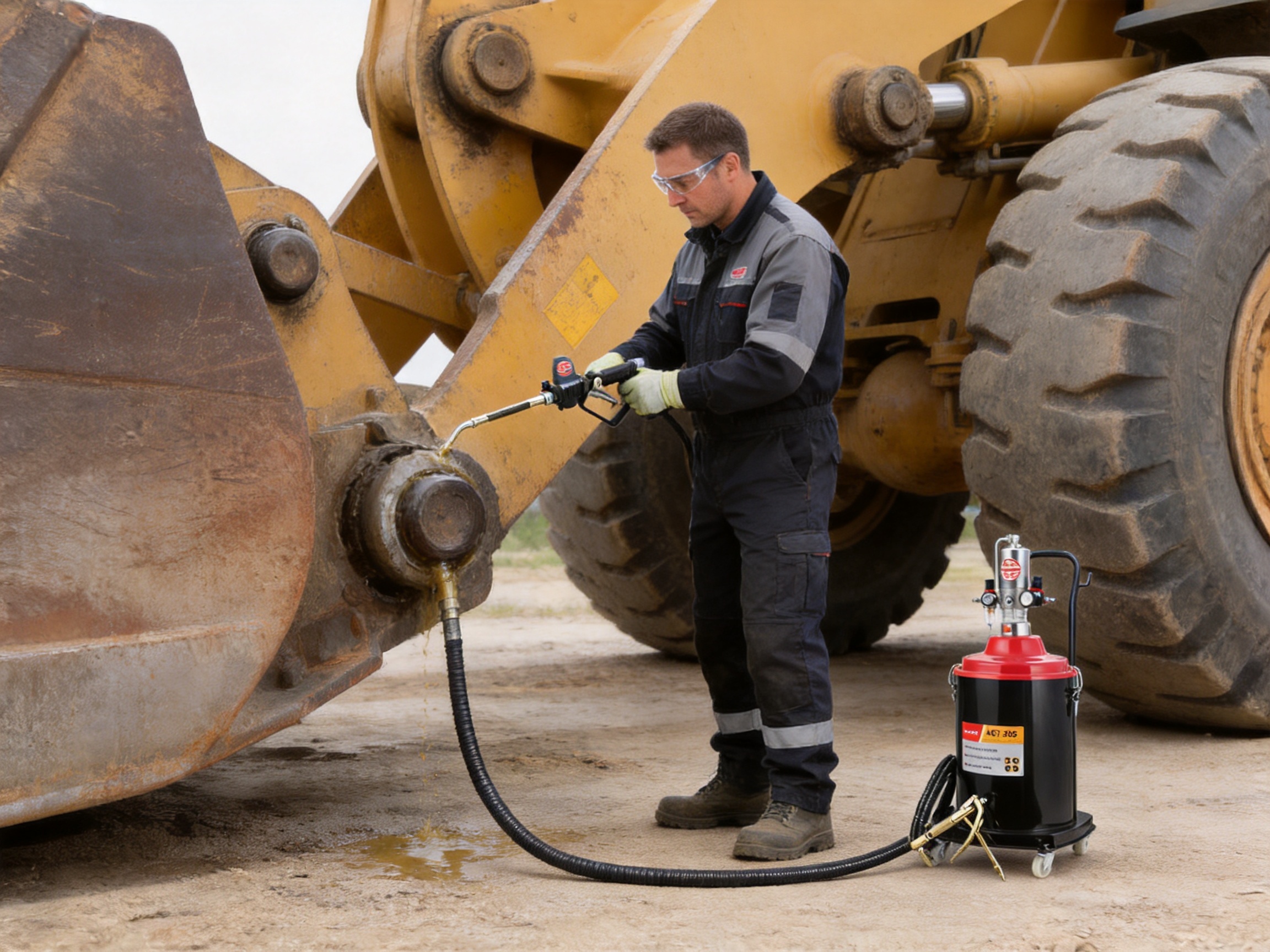
Excavators, loaders, bulldozers, cranes, drilling equipment, and other heavy machines operate under high loads, vibration, dust, and changing weather conditions. Their joints and pivot points may require frequent greasing to prevent accelerated wear. Contaminated or hardened grease can make certain fittings difficult to service, which is where a high-pressure pneumatic dispenser can be particularly useful.
Construction and mining users can select a larger barrel when several machines must be serviced in sequence. The pressure-regulating valve helps technicians adapt operation to different fittings and machine requirements. In demanding environments, routine inspection of the hose, gun, and pneumatic connections is essential.
Tractors, harvesters, balers, planters, irrigation equipment, and other agricultural machines contain numerous bearings and pivot points. Seasonal maintenance can require rapid preparation of many machines before a busy operating period. A pneumatic dispenser can improve the speed and convenience of these maintenance operations.
The product is also useful for farm repair workshops where compressed air is already available for other tools. Different barrel capacities allow the unit to be selected according to the size of the farm, the number of machines, and the distance between the maintenance area and the equipment.
Manufacturing equipment often depends on regular lubrication to maintain production continuity. Conveyors, material-handling systems, presses, machine tools, motors, and other mechanical assemblies may include grease-lubricated components. A dependable dispenser helps maintenance personnel follow scheduled lubrication routines and respond to service requirements.
In a factory, a 35L or 40L model may reduce the number of refills during planned maintenance. The pump can be stored in a maintenance area and moved to different production zones as needed. Since the dispenser does not require permanent installation, it can support a flexible maintenance strategy.
Workshops that repair pumps, industrial fans, generators, material-handling machinery, and mechanical assemblies can use the dispenser as a general-purpose lubrication tool. Its broad application range makes it appropriate for distributors and service providers that need one product family for different customer groups.
The following table summarizes the technical data supplied for the available configurations. Air pressure, oil output, discharge pressure, weight, and dimensions should be confirmed with the supplier for the exact model and regional version before purchase or installation.
| Model | Pressure Ratio | Air Pressure | Oil Output | Discharge Pressure | Barrel Volume | Weight G.W./N.W. | Dimensions |
|---|---|---|---|---|---|---|---|
| ATG-12 GD/GI | 50:1 | 0.6–0.85 | 0.9 | 20–25 | 12L | 7.7 | 300 × 325 × 810 |
| ATG-20 GD/GI | 50:1 | 0.6–0.85 | 0.9 | 20–30 | 20L | 9.41 | 390 × 320 × 830 |
| ATG-35 GD/GI | 50:1 | 0.6–0.85 | 0.9 | 25–35 | 35L | 10.2 | 430 × 430 × 790 |
| ATG-35-2 GB/GH | 50:1 / 75:1 | 0.6–0.85 | 0.9 | 25–35 | 35L | 10.2 | 430 × 430 × 790 |
| ATG-35 GB | 65:1 | 0.6–0.85 | 0.9 | 30–35 | 35L | 10.2 | 430 × 430 × 790 |
| ATG-40 GI | 50:1 | 0.6–0.85 | 0.9 | 30–40 | 40L | 11.1 | 405 × 405 × 830 |
| ATG-40 GH | 75:1 | 0.6–0.85 | 0.9 | 30–40 | 40L | 11.3 | 405 × 405 × 830 |
| ATG-40-2 GB | 50:1 | 0.6–0.85 | 0.9 | 30–40 | 40L | 15.1 | 460 × 420 × 870 |
| ATG-40 GB | 55:1 | 0.6–0.85 | 0.9 | 30–40 | 40L | 14.9 | 460 × 420 × 920 |
The supplied specification table does not identify the measurement units for every numerical field. Buyers should request the complete technical datasheet for confirmation of air pressure units, output units, discharge pressure units, and whether the listed weight represents gross weight, net weight, or both. This is particularly important when comparing the product with equipment from other manufacturers.
The product is manufactured by Zhejiang Kende Mechanical & Electrical Co., Ltd., an established Chinese manufacturer and exporter of electric welding machines, battery chargers, heaters, and related equipment. The company’s production capabilities provide an important foundation for the development and supply of pneumatic lubrication equipment.
The company is located in Taizhou, Zhejiang Province, and operates a facility covering approximately 120,000 square meters. It has approximately 600 employees and an annual production capacity of about two million units. The reported annual export volume is nearly 1.5 million units. These figures indicate a substantial manufacturing and distribution structure capable of supporting international orders and large-volume supply programs.
Although the company is widely associated with welding machines, chargers, and heaters, its experience extends across product design, metal fabrication, mechanical assembly, electrical systems, quality control, and export logistics. These capabilities are relevant to the grease dispenser because the product requires durable mechanical parts, reliable air-driven components, consistent assembly, and dependable packaging for international transport.
Kende operates a Zhejiang Provincial Research and Development Center, an Enterprise Technology Center, and an Intelligent Welding Technology Research Institute. The company reports having 98 research and development personnel. It has also obtained invention patents, utility model patents, appearance patents, and software copyrights.
A strong engineering organization can help a manufacturer improve product structures, refine production tooling, test different configurations, and respond to market requirements. For the pneumatic grease dispenser range, this type of capability supports the development of different barrel capacities, pump ratios, suction-pipe lengths, grease-gun configurations, and color options.
The ability to develop products for different regions and customer requirements is also useful for distributors. Commercial buyers may need specific packaging, documentation, colors, fittings, labeling, or capacity combinations. A manufacturer with established product-development resources is better positioned to evaluate and implement such requirements than a trading company with limited engineering control.
The company applies several management and manufacturing systems, including office automation, Toyota Production System-based management, ERP K3, and MES management systems. These systems are intended to improve production planning, material control, process coordination, traceability, and information flow between departments.
Manufacturing systems such as ERP and MES can help coordinate purchasing, inventory, production scheduling, work orders, inspection records, and shipment planning. For customers, the practical benefit is improved consistency and greater visibility when ordering multiple models or arranging repeat production.
The company also uses automatic patching, plug-in and welding systems, robot processing, laser cutting, and other advanced technologies. While these technologies are especially important to its electrical and welding-machine production, they also demonstrate experience with automated fabrication and repeatable assembly processes. Such experience can contribute to the accurate production of mechanical frames, brackets, barrels, fittings, and other components used in industrial equipment.
Kende reports holding international product certificates and compliance marks including GS, CE, EMC, ERP, United States ETL, United Kingdom UKCA, and China CCC for applicable product categories. The exact certifications available for a particular grease dispenser model should be confirmed separately, because certification requirements vary by product type, market, and electrical or pneumatic configuration.
The company is also described as a national standard drafting unit of the National Welding Machine Standardization Committee. It has participated in the drafting, formulation, and revision of 20 national standards and has led the drafting of one group standard. This standards experience indicates familiarity with technical documentation, testing requirements, manufacturing discipline, and product compliance processes.
For international distributors, documentation quality is an important consideration. Clear technical specifications, model identification, packaging information, operating instructions, and inspection records support smoother purchasing and after-sales service. A manufacturer accustomed to international markets is generally better prepared to provide this type of support.
A grease dispenser used in workshops and industrial sites must withstand repeated movement, contact with grease, vibration, and regular connection to compressed-air equipment. Durability depends on the combined quality of the barrel, pump head, hose, fittings, pressure valve, grease gun, wheels or support structure where applicable, and assembly process.
The high-pressure design is intended for demanding work, but durability also depends on correct operation. The unit should be used within the recommended air-pressure range, and the pressure-regulating valve should be adjusted gradually. Operators should not attempt to force grease through a blocked fitting indefinitely. The fitting and lubrication channel should be inspected if grease does not flow normally.
Serviceability is another important advantage of a mechanical pneumatic product. Compared with complex electronically controlled systems, the dispenser uses a relatively straightforward air-driven pumping arrangement. This can make routine inspection easier for workshop personnel who are familiar with pneumatic tools. Hoses, connectors, seals, and the grease gun can be checked as individual service components.
Regular maintenance should include cleaning the barrel area, checking for air leaks, inspecting the suction pipe, examining the delivery hose, and ensuring that the grease gun remains free from contamination. The compressed-air supply should be clean and properly regulated. Water or debris in the air line can affect pneumatic equipment and should be controlled through suitable filtration and drainage.
Before operation, place the dispenser on a stable surface and confirm that the barrel contains the correct grease. Different grease types should not be mixed unless compatibility has been verified. Check the grease for foreign particles, excessive hardening, or contamination.
Connect the pneumatic inlet to a suitable compressed-air source. Inspect the air hose and fittings before opening the supply. Confirm that the grease hose is securely attached to the pump outlet and that the grease gun is properly connected.
Open the air supply gradually and use the pneumatic pressure-regulating valve to set an appropriate operating pressure. Begin with a conservative setting and increase it only when necessary. The correct setting should be determined according to the pump model, grease consistency, hose length, and requirements of the machine being serviced.
Allow the pump to prime if the barrel has been refilled or if the unit has been stored for an extended period. Air pockets may affect the initial grease flow. If output is irregular, stop operation and check the suction area, grease condition, air supply, and connections.
Clean the lubrication fitting before attaching the grease gun. This prevents dirt from being pushed into the bearing or joint. Engage the gun with the fitting and operate the pump while observing the flow and the condition of the component.
Apply only the quantity of grease recommended for the machine. More grease is not always better. Over-lubrication can increase operating temperature, damage seals, contaminate surrounding surfaces, or cause other mechanical problems. After servicing, release pressure safely and remove the grease gun without damaging the fitting.
Close the air supply and release residual pressure according to the operating instructions. Wipe excess grease from the gun, hose fittings, and exterior surfaces. Store the dispenser in a clean, dry area and protect the barrel from dust and moisture.
If the equipment will not be used for a prolonged period, inspect the pump and hose before returning it to service. A short functional test can identify air leaks, hardened grease, or connection problems before the unit is needed for urgent maintenance.
Users should begin by estimating the amount of grease required during a typical maintenance period. A small workshop that services several passenger vehicles may not need the capacity of a 40-liter model. A fleet depot or heavy-equipment operation may benefit from a 35-liter or 40-liter version because fewer refills can improve workflow.
The required discharge pressure is another consideration. General-purpose applications may be adequately served by a 50:1 configuration. More demanding service conditions may justify a 65:1 or 75:1 model, provided the machine’s lubrication system can safely accept the pressure.
Mobility and workspace should also be considered. Check the available storage area, doorways, vehicle access, and the distance between the pump and the service points. The listed dimensions and weights can help with planning, but the exact packaging dimensions and shipping weight should be confirmed before purchase.
Finally, buyers should choose the grease-gun material and color configuration according to their operational requirements. An aluminum gun may be attractive for users who prioritize lower handling weight, while the iron universal gun may be preferred for general-purpose robustness. Color selection can help identify different grease types, maintenance teams, or customer-owned equipment.
For distributors, the product family offers several models that can serve different market segments. A distributor can stock compact, medium-capacity, and high-capacity units without changing to a completely different product category. This simplifies product training and allows sales teams to explain a consistent operating concept across the range.
For original equipment buyers and industrial purchasers, the manufacturer’s broad production base can support repeat orders, model customization discussions, and coordinated sourcing. Kende’s experience with export markets and international compliance is relevant to customers who require stable supply and organized documentation.
The company’s manufacturing scale may also be useful for private-label or regional distribution programs, subject to commercial agreement and technical evaluation. Customers should discuss branding, packaging, color, accessories, grease-gun options, hose specifications, and inspection requirements before placing a production order.
In comparison with purchasing from an unknown supplier, working with an established manufacturer can reduce uncertainty related to production continuity, spare parts, technical communication, and quality procedures. Customers should still conduct normal supplier qualification, sample testing, document review, and incoming inspection.
High-pressure grease equipment must be operated carefully. Never point the grease gun at a person or attempt to check a leak with a hand or finger. Pressurized grease can penetrate skin and cause a serious medical emergency. Any suspected injection injury requires immediate professional medical attention, even if the wound appears small.
Wear suitable eye protection and work clothing. Keep hands away from moving machinery and ensure that equipment is shut down and isolated before lubrication unless the machine manufacturer specifically requires another procedure. Do not lubricate components near rotating shafts, belts, chains, or other moving parts without following an approved safety method.
Use only compatible air connections and do not exceed the recommended operating range. Inspect hoses and fittings regularly. Replace damaged components rather than attempting temporary repairs that may fail under pressure.
Grease and cleaning materials should be handled according to their safety data and local regulations. Spilled grease can create slip hazards and should be cleaned promptly. Used grease, contaminated wipes, and damaged components should be disposed of responsibly.
Preventive maintenance begins with cleanliness. Keep the grease barrel covered when possible and avoid using dirty tools to transfer grease. Contamination can damage the pneumatic pump, clog the suction system, and shorten the service life of lubricated machinery.
Inspect the suction pipe during refill operations. Confirm that it is correctly positioned and free from hardened grease. Check the pump head for signs of leakage or abnormal noise. A change in pump speed, pressure behavior, or output may indicate an air supply issue, an obstruction, an empty barrel, or worn internal components.
The four-meter hose should be coiled without sharp bends. Avoid dragging it across sharp edges or allowing vehicles to drive over it. Store the grease gun in a position that protects the connector and outlet from dirt.
Maintenance personnel should keep records of lubrication dates, grease types, serviced machines, and any pressure adjustments. These records can help identify recurring equipment problems and ensure that each machine receives the correct lubrication interval and quantity.
The product is designed to dispense grease under pneumatic power for the lubrication of vehicles, industrial machinery, agricultural equipment, construction equipment, mining machines, and other grease-lubricated assemblies.
The product family includes 12-liter, 20-liter, 35-liter, and 40-liter barrel options. The appropriate size depends on the required grease volume, mobility needs, and frequency of maintenance work.
The pump uses compressed air to drive a grease-pumping mechanism. Air enters through the pneumatic connection, the pressure-regulating valve controls the operating condition, and grease is delivered through the hose and grease gun.
Depending on the model, the listed pressure ratios include 50:1, 55:1, 65:1, and 75:1. Higher-ratio models may be suitable for applications requiring greater outlet pressure, but users must follow the lubrication equipment manufacturer’s pressure limits.
The standard grease hose length is four meters. This provides useful reach around large vehicles and machinery while allowing the main unit to remain in a convenient position.
The standard configuration includes an iron universal grease gun. An aluminum grease gun is available as an optional alternative for users who prefer a lighter tool.
The 12-liter model uses a suction-pipe length of approximately 400 millimeters. The 20-liter, 35-liter, and 40-liter models use a suction-pipe length of approximately 440 millimeters. The larger units also provide more grease capacity for high-volume maintenance.
Yes. The dispenser includes a pneumatic pressure-regulating valve. Operators should adjust the pressure gradually and select a setting appropriate for the grease, hose, lubrication fitting, and equipment manufacturer’s instructions.
It can be suitable for mobile or semi-mobile maintenance, especially when a suitable compressed-air source is available. The best capacity depends on how far the unit must be transported and how much grease is required at each location.
Typical applications include automotive service, fleet maintenance, construction, mining, agriculture, manufacturing, equipment rental, transportation, and general mechanical repair.
Customers should confirm the exact model, pressure ratio, air-pressure units, output units, discharge-pressure units, weight definition, dimensions, grease compatibility, fittings, available certifications, packaging, and after-sales support.
A substantial production base, engineering team, automated manufacturing equipment, quality systems, and international export experience can support consistent supply, model development, documentation, and long-term distributor relationships.
The 12/20/35/40L High Pressure Auto Air Grease Lubricator Operated Pneumatic Grease Dispenser Pump provides a practical combination of pressure capability, adjustable operation, capacity flexibility, and working reach. Its specialized pump head and suction-pipe configuration are designed to support stable grease transfer, while the four-meter hose and available grease-gun options improve day-to-day usability.
The product offers meaningful advantages over basic manual dispensers, low-pressure pneumatic pumps, and fixed lubrication systems when users need a mobile, high-pressure, workshop-oriented solution. The available 50:1 to 75:1 pressure ratios allow the product family to address both general maintenance and more demanding equipment-service applications.
Zhejiang Kende Mechanical & Electrical Co., Ltd. adds value through its large manufacturing base, research and development resources, automated production technologies, management systems, certification experience, and international export capabilities. These strengths make the company a suitable manufacturing partner for distributors, maintenance-equipment suppliers, workshops, and industrial customers seeking a reliable pneumatic grease-dispensing range.
As with all pressurized maintenance equipment, successful results depend on correct model selection, compatible grease, proper pressure adjustment, safe operation, and regular inspection. When these requirements are followed, the dispenser can help improve lubrication efficiency, reduce manual effort, limit maintenance interruptions, and support the long-term performance of industrial machinery.
1. Zhejiang Kende Mechanical & Electrical Co., Ltd., High-Pressure Pneumatic Grease Dispenser Pump Technical Characteristics and Model Data.
2. Zhejiang Kende Mechanical & Electrical Co., Ltd., Corporate Manufacturing, Research and Development, Certification, and Production Information.
3. General industrial lubrication practice for grease application, equipment maintenance, contamination control, and preventive servicing.
4. General pneumatic equipment safety principles concerning compressed air, hoses, fittings, pressure regulation, and injection hazards.
5. General maintenance-management principles for automotive, construction, agricultural, mining, and manufacturing equipment.
Recommended Products

Contact Us
No.2299, Luqiao Section, Shugang Avenue, Luqiao District, Taizhou, 318057 Zhejiang, PR China.
+86-576-82431568
 Privacy
China Welding Machine Factory
 English
 中文简体
中文简体
 русский
 Español
 عربى
عربى
 Français
 Português
 Deutsch
 Український