Email: [email protected]
Email: [email protected]

Blog
 2026.08.09
 Blog
Blog
Reliable space heating is essential in workshops, garages, warehouses, construction areas, offices, retail spaces, service rooms, and temporary work environments. When a heating solution must be compact, easy to transport, simple to operate, and suitable for locations where fuel combustion is undesirable, a portable electric fan heater with a PTC heating element can provide an effective answer. The PTC-02 and PTC-03 Electrical Fan Air Heater models are designed for quick heating and ventilation, combining ceramic PTC technology, forced-air circulation, adjustable thermostat control, overheating protection, and a rugged portable housing.
Available in 2 kW and 3 kW versions, these heaters provide different heating capacities for spaces of approximately 60 and 90 cubic meters. Both models operate from a standard single-phase AC 220–240 V, 50 Hz power supply and are protected to IPX4. Their design is suited to users who need a practical heating appliance without the storage, emissions, refueling, or maintenance requirements associated with gas, diesel, kerosene, and fuel-oil heaters.
The product is manufactured by Zhejiang Kende Mechanical & Electrical Co., Ltd., an established Chinese manufacturer of welding equipment, battery chargers, heaters, and related electrical products. The company combines large-scale production, engineering development, automated manufacturing, international certification experience, and export capability. These strengths support consistent product quality and make the PTC-02 and PTC-03 suitable for distributors, professional users, contractors, industrial facilities, and household applications.
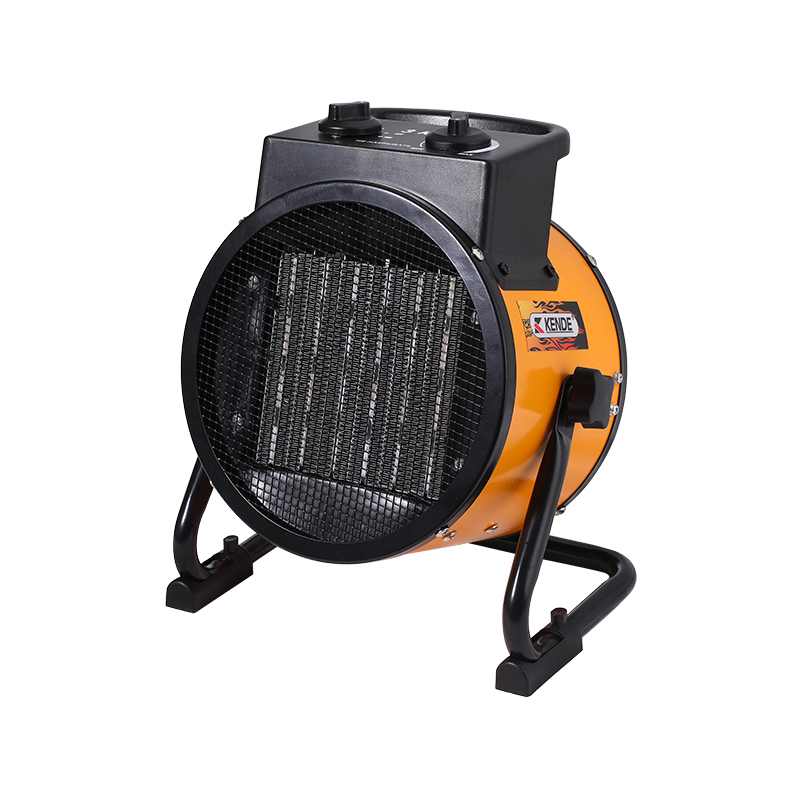
PTC-02/03 Electrical FAN AIR HEATER, PTC 2/3KW
The PTC-02 and PTC-03 are portable electrical fan air heaters built around a positive temperature coefficient heating element. PTC technology is widely used in modern electric heating equipment because it can produce heat rapidly while offering a naturally self-limiting heating behavior. As the temperature of the ceramic element rises, its electrical resistance increases. This helps moderate the heating element’s power demand and supports safer operation than many conventional fixed-resistance heating designs.
Each model uses a fan to draw air through the heater and distribute warmed air into the surrounding room. The airflow function also allows the appliance to be used as a fan without active heating. This dual-purpose operation makes the product useful throughout the year. During colder periods, it provides supplementary or primary heat for appropriately sized rooms. During warmer periods, the fan function can improve air movement and ventilation.
The PTC-02 produces a rated heat output of 2 kW, equivalent to approximately 1,720 kcal/h. The larger PTC-03 produces 3 kW, equivalent to approximately 2,580 kcal/h. Their stated heat-space capacities are approximately 60 cubic meters and 90 cubic meters respectively, although actual performance depends on insulation, outdoor temperature, room height, air leakage, wall construction, door opening frequency, and the desired indoor temperature.
Both versions include an adjustable thermostat and two heat settings. Users can select an appropriate heating level instead of operating continuously at maximum output. This helps improve comfort and may reduce unnecessary electricity consumption when only moderate heating is required. When the target temperature is reached, the thermostat can regulate operation by cycling the heating function as needed.
The main product features include quick heating, forced-air circulation, a compact electric design, a long-lasting PTC heating element, adjustable thermostat control, two heat settings, fan-only operation, automatic overheating protection, a protective grille on both sides, a stable stand, a carrying handle, and anti-slip feet.
The combination of these features makes the heater convenient for mobile use. It can be moved between work areas, placed on a stable floor, and adjusted according to changing heating requirements. The carrying handle is integrated into the portable design so that the user can transport the unit comfortably and safely after switching it off and allowing it to cool when necessary.
| Specification | PTC-02 | PTC-03 |
|---|---|---|
| Product type | Electrical fan air heater | Electrical fan air heater |
| Rated input voltage | AC 220–240 V, 50 Hz, single phase | AC 220–240 V, 50 Hz, single phase |
| Rated heat output | 2 kW | 3 kW |
| Approximate heat output | 1,720 kcal/h | 2,580 kcal/h |
| Heat air output | 180 m³/h | 300 m³/h |
| Recommended heat space | Approximately 60 m³ | Approximately 90 m³ |
| Weight | 1.9 kg | 2.7 kg |
| Protection class | IPX4 | IPX4 |
| Dimensions | 245 × 170 × 255 mm | 265 × 185 × 320 mm |
| Control method | Adjustable thermostat | Adjustable thermostat |
| Heat settings | Two heat settings | Two heat settings |
| Operating modes | Heating and fan-only operation | Heating and fan-only operation |
The specifications show a clear separation between the two models. The PTC-02 is the more compact and lighter option, making it particularly practical for smaller rooms, personal work areas, offices, workshops, and mobile service applications. The PTC-03 provides higher heat output and greater airflow for larger rooms, more demanding work areas, or spaces with higher heat loss.
The selection should be based on room size and operating conditions rather than output alone. A 2 kW heater may be sufficient in a well-insulated room of approximately 60 cubic meters, while the 3 kW version may be more appropriate for a larger or less insulated room of approximately 90 cubic meters. In a poorly insulated environment, either model may be used as supplementary heating rather than as the sole heat source.
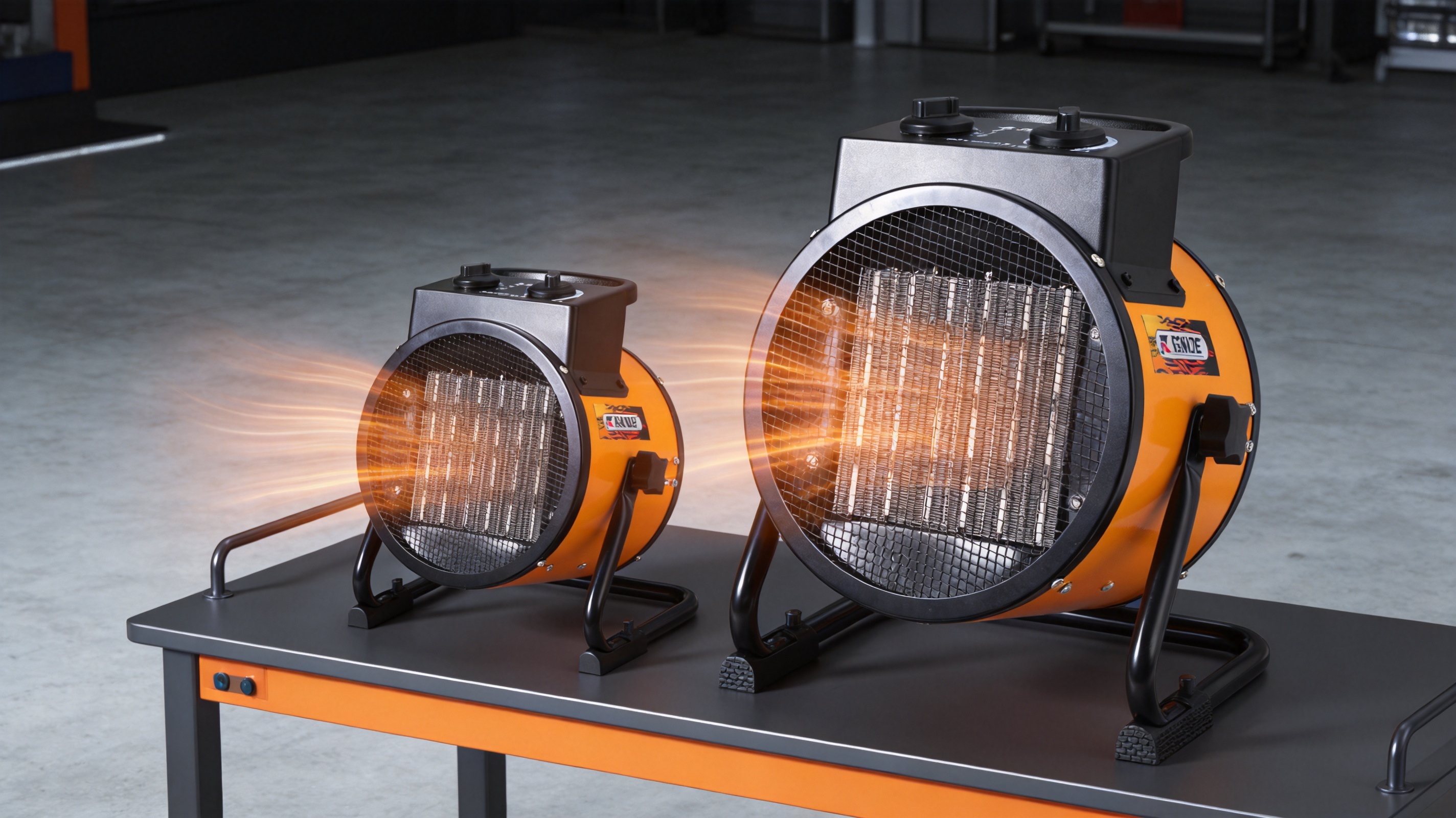
PTC means positive temperature coefficient. In a PTC ceramic heating element, electrical resistance increases as the element becomes hotter. This characteristic helps the element regulate its own temperature. When the element is relatively cool, it can draw more current and produce heat quickly. As the element warms, electrical resistance rises and limits the current. The result is a heating component designed for fast warm-up and stable operation.
A fan heater uses airflow to transfer heat from the heating element into the room. The fan draws cooler room air into the appliance, passes it over the heated ceramic element, and sends warmer air outward through the front grille. Continuous air movement helps distribute heat more evenly than a stationary radiant heater in many room layouts.
PTC technology offers several practical benefits. It does not require an open flame, fuel tank, burner, chimney, or combustion exhaust. This eliminates the direct combustion products associated with fuel-burning heaters and simplifies installation. Users generally need only a suitable electrical supply, adequate clearance around the unit, and a stable surface.
The heating element is also designed for long service. Unlike some disposable or fragile heating components, a PTC ceramic element can provide repeated heating cycles when used according to the operating instructions. Its self-regulating characteristic supports a balance between fast heat production and temperature control.
Compared with LPG, diesel, kerosene, or fuel-oil heaters, an electric PTC heater offers a cleaner and simpler operating arrangement. There is no requirement to purchase, store, or transport fuel. There is no burner nozzle to clean, no fuel filter to replace, and no combustion chamber to maintain. The product also avoids the odor and exhaust management concerns that may arise with fuel-burning equipment.
Fuel-burning heaters can be highly useful in locations without sufficient electrical capacity, but they require careful ventilation and fuel handling. Electric heating is often preferred for indoor areas where clean operation, low routine maintenance, and ease of use are priorities. The PTC-02 and PTC-03 are therefore well suited to workshops, offices, temporary rooms, enclosed job areas, and other locations with access to a suitable AC power source.
Compared with traditional electric resistance heaters, the PTC models add forced-air circulation and adjustable operating modes. A basic radiant heater may warm nearby objects or a small area, whereas a fan heater actively moves heated air through the room. This can help occupants feel the heating effect more quickly and can improve general air distribution.
Quick heat delivery is one of the most important reasons to use a fan air heater. Workers entering a cold workshop or service area may need immediate comfort rather than waiting for a large building heating system to warm the entire space. The PTC-02 and PTC-03 respond quickly after activation, and their fans distribute warm air into the occupied area.
The PTC-02 provides an air output of approximately 180 cubic meters per hour. This airflow is appropriate for its 2 kW heating capacity and recommended space of approximately 60 cubic meters. The PTC-03 provides approximately 300 cubic meters per hour, supporting its higher 3 kW heat output and larger recommended space of approximately 90 cubic meters.
Airflow performance is important because the heater’s practical value depends not only on the heat generated but also on how effectively the heat reaches the room. A properly positioned fan heater can assist with the circulation of warm air, reduce cold zones, and improve perceived comfort around workstations or occupied areas.
Users should avoid blocking the inlet or outlet grilles. Sufficient clearance should be maintained around the appliance, and the warm-air outlet should not be directed at combustible materials, curtains, paper, chemicals, or objects that could be damaged by heat. The heater should be operated on a stable, level surface where it cannot easily be knocked over.
The adjustable thermostat gives the user control over the desired room temperature. Instead of running the heating element continuously, the thermostat can help regulate operation according to changing room conditions. This provides greater comfort and can limit unnecessary heating when the room has reached an acceptable temperature.
Two heat settings allow the operator to select a lower or higher heating level. The lower setting can be useful for maintaining comfort, reducing heat output in a smaller room, or operating during periods when the temperature difference is modest. The higher setting is suitable for initial warm-up or colder conditions, subject to the available electrical supply and the requirements of the installation.
The thermostat and heat selector are particularly useful in commercial environments where different users may operate the same equipment. A straightforward control system reduces training time and allows users to make adjustments without complicated programming. This is an advantage for workshops, rental equipment fleets, maintenance departments, and building service teams.
The heater can also be used as a fan. This feature improves its year-round usefulness and helps avoid the need to purchase separate equipment for basic air movement. Fan-only operation may be helpful during warmer periods, after painting or cleaning activities, or when improved circulation is needed without additional heat.
For distributors and retailers, a dual-purpose product can be easier to position across multiple seasonal sales periods. The same appliance can be marketed for winter heating and general air circulation, improving its value to end users. For professional users, the fan function allows the unit to remain useful outside the heating season.
Safety is a central consideration in any portable heating product. The PTC-02 and PTC-03 include overheating protection with automatic switch-off. If internal temperatures rise beyond the intended operating range, the protection system is designed to interrupt operation. This feature provides an additional layer of protection against overheating caused by abnormal operating conditions, restricted airflow, or other problems.
The automatic switch-off function should not be treated as a replacement for proper operation. The heater must still be kept away from combustible materials, protected from unauthorized access where necessary, and operated with unobstructed air inlets and outlets. The appliance should not be covered while operating, and users should follow appropriate electrical safety practices.
The protective grille on both sides helps shield the internal fan and heating components from accidental contact while permitting the required movement of air. The grille also contributes to the robust appearance of the housing, which is important for equipment intended for workshops, garages, service areas, and other working environments.
The stable stand supports upright positioning and helps maintain a consistent airflow direction. Anti-slip feet improve contact with the floor and help reduce movement during operation. The carrying handle supports controlled movement between locations and reduces the need to handle the hot housing directly.
Both models are specified with an IPX4 protection class. In general terms, IPX4 indicates protection against water splashing from different directions. This does not mean that the appliance is waterproof, submersible, or suitable for direct exposure to heavy rain. It should never be immersed in water, sprayed deliberately, or used in a location where water can enter the electrical components.
The IPX4 rating can be beneficial in practical work environments where occasional splashes may occur, provided the product is used within its intended conditions. Operators should keep the electrical connection, controls, and housing in good condition and should disconnect the unit before cleaning or inspecting it.
Portability is one of the strongest advantages of the PTC product range. The PTC-02 weighs approximately 1.9 kg and measures 245 × 170 × 255 mm. The PTC-03 weighs approximately 2.7 kg and measures 265 × 185 × 320 mm. These dimensions allow the heaters to be moved without the need for wheels or specialized lifting equipment.
The compact format is valuable in locations where floor space is limited. A workshop may need heat near a temporary assembly station in the morning and near a repair bench later in the day. A contractor may need to move equipment between rooms on a job site. An office or retail store may need temporary heating in a particular zone rather than throughout the entire building.
The carrying handle is designed for convenient transport. Users should turn the unit off, disconnect it when appropriate, and allow hot components to cool before moving it. The light weight of both models helps reduce operator fatigue and makes the product suitable for service vehicles, tool storage areas, and mobile maintenance teams.
Compact dimensions can also simplify storage. During warm seasons, the heater can be placed in a cabinet, equipment room, warehouse shelf, or service vehicle compartment, subject to safe storage practices. Its relatively small footprint makes it easier for distributors to handle, display, package, and stock.
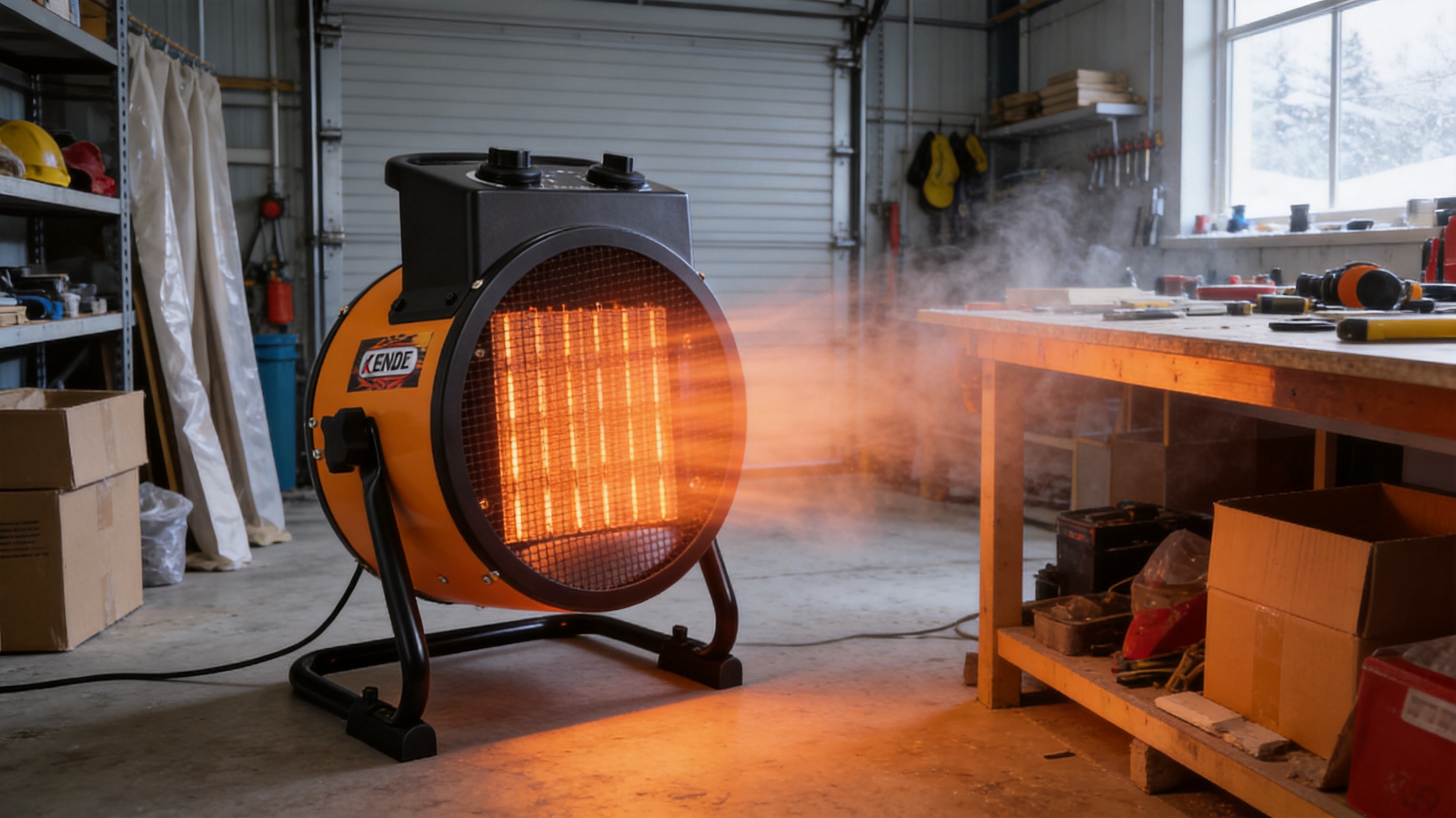
Workshops and garages are often difficult to heat because doors open frequently, ceilings may be high, and insulation may be limited. The PTC-02 can provide localized warmth near a workbench, tool area, or inspection station. The PTC-03 can deliver more heat and airflow for a larger enclosed garage or work area.
Electric heating is particularly convenient in these environments because it does not introduce fuel storage requirements. When used correctly, it can provide supplementary heat without the fumes and combustion exhaust associated with fuel-fired units. The protective housing and stable stand also support use in practical work settings.
During renovation projects, permanent heating systems may be unavailable or switched off. A portable heater can provide temporary comfort for workers and help maintain a more usable indoor environment. The PTC-02 and PTC-03 can be moved as work progresses, allowing contractors to heat selected rooms or enclosed areas.
Construction environments require careful risk assessment. Dust, moisture, combustible materials, extension cords, and unfinished electrical systems may create hazards. The heater should be used only where the power supply, floor surface, ventilation, clearances, and environmental conditions are suitable. The IPX4 rating should not be interpreted as permission to use the product in exposed or wet conditions.
Small offices, reception areas, meeting rooms, retail spaces, and guard rooms may require additional heat during cold periods. The compact design allows the heater to be positioned without occupying excessive floor space. Thermostat control can help maintain comfort without requiring complex building management controls.
Because the appliance can operate as a fan, it may remain useful during warmer months. This is a practical advantage for businesses seeking equipment with more than one seasonal purpose.
Warehouses may contain individual workstations or packing areas where localized heating is more practical than heating the entire building. The PTC-03 can be used for supplementary heat in a suitable enclosed area, while the PTC-02 can serve smaller personnel stations or inspection points.
Care is required around stored goods. The heater should be kept away from packaging, solvents, aerosols, dust accumulations, and other combustible or heat-sensitive materials. Airflow should not be obstructed by pallets, boxes, curtains, or partitions.
For household users, the heaters may be suitable for rooms, workshops, utility spaces, home offices, enclosed balconies, or other appropriate indoor areas. Their simple controls make them accessible to users who do not need advanced programmable heating functions.
Domestic users should pay close attention to outlet capacity, cable condition, placement, and supervision. The appliance should not be left operating unattended for extended periods unless the operating environment and manufacturer’s instructions specifically permit it. Children and pets should be kept away from the hot-air outlet and protective grille.
The PTC-02 and PTC-03 offer a balanced combination of heating speed, portability, control, and operational simplicity. Their advantages become especially clear when compared with several alternative product categories.
| Feature | PTC-02 and PTC-03 | Fuel-fired portable heaters | Basic radiant electric heaters |
|---|---|---|---|
| Energy source | AC electricity | LPG, diesel, kerosene, or fuel oil | AC electricity |
| Combustion exhaust | None from the heating process | Requires ventilation and exhaust management | None from the heating process |
| Fuel storage | Not required | Required | Not required |
| Air circulation | Forced-air fan system | Depends on the heater design | Often limited |
| Portability | Compact with carrying handle | Can be heavier and require fuel handling | Usually portable |
| Heat control | Thermostat and two heat settings | Varies by model | Varies by model |
| Fan-only operation | Available | Generally unavailable | Generally unavailable |
| Routine maintenance | Primarily cleaning and inspection | Burner and fuel-system maintenance | Primarily cleaning and inspection |
| Typical strength | Fast, clean, mobile supplementary heat | High heat where electrical supply is limited | Simple local radiant heating |
Fuel-fired heaters remain appropriate for certain outdoor, industrial, or high-output applications, particularly where electrical power is unavailable or inadequate. However, they may require more attention to ventilation, emissions, fuel supply, and maintenance. The PTC models are advantageous where a standard electrical connection is available and the user values simplicity and clean indoor operation.
Radiant electric heaters can provide effective localized warmth, but they do not always distribute heat through the room as quickly as a fan-assisted unit. The PTC heaters combine direct electrical heating with active air movement, making them more versatile for temporary room heating and mobile work areas.
The product is manufactured by Zhejiang Kende Mechanical & Electrical Co., Ltd., a company located in Taizhou City, Zhejiang Province, China. The company operates on a site covering approximately 120,000 square meters and employs around 600 people. Its scale supports dedicated functions for product development, component sourcing, production, quality management, logistics, and export service.
Kende has annual production capacity of approximately 2 million units and exports nearly 1.5 million units each year. This level of output indicates experience in managing volume manufacturing, international orders, product consistency, and delivery requirements. For distributors and importers, manufacturing scale can be important because it supports more predictable supply and the ability to serve multiple markets.
The company’s product portfolio includes manual MMA or stick welding machines, MIG/MAG welding machines, flux-cored welding equipment, TIG welding machines, plasma cutting machines, stud welding machines, submerged arc welding machines, battery chargers, and electric, gas, and oil heaters. This broad product range demonstrates experience with power electronics, electrical heating, motors, control systems, metal housings, thermal management, and industrial product assembly.
Kende maintains a Zhejiang Provincial Research and Development Center, an Enterprise Technology Center, and an Intelligent Welding Technology Research Institute. The company has approximately 98 research and development personnel. These resources provide a foundation for product design, testing, process improvement, reliability development, and the creation of products adapted to different regional requirements.
The company has obtained invention patents, utility model patents, appearance patents, and software copyrights. Its reported intellectual property portfolio reflects ongoing development rather than reliance solely on basic catalog products. For heater customers, research capability can support improvements in thermal performance, control systems, protection functions, housing design, noise management, and manufacturability.
Although the PTC-02 and PTC-03 are straightforward products from the user’s perspective, a reliable portable heater depends on coordinated engineering. The heating element, fan motor, thermostat, protective switch, grille, housing, wiring, plug, stand, and feet must work together. Manufacturing experience in related electrical products helps the producer manage these interactions.
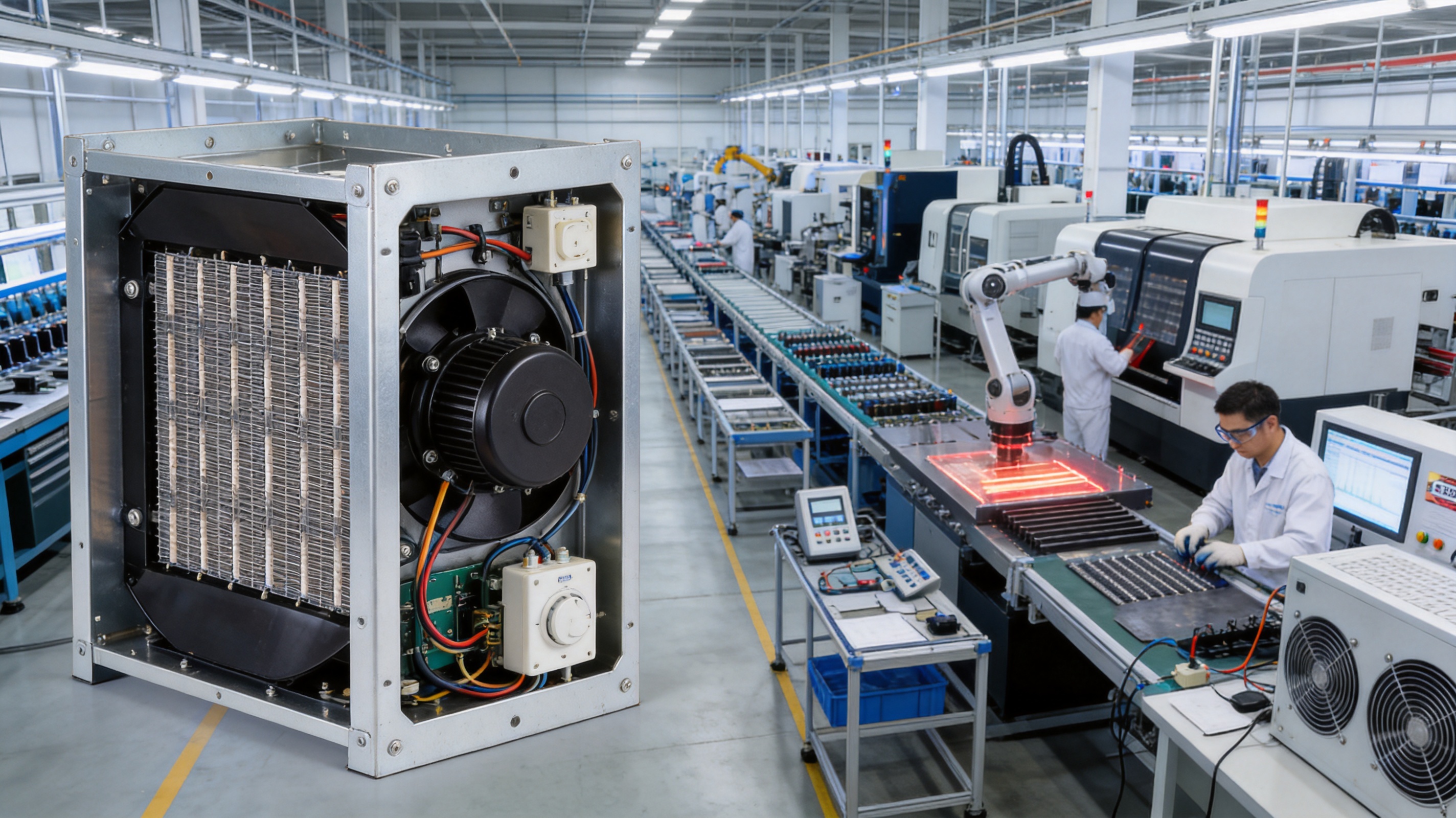
The company applies several organized management and manufacturing systems, including office automation, enterprise resource planning, manufacturing execution systems, and Toyota-style production management practices. These systems can help coordinate purchasing, production scheduling, inventory, work instructions, traceability, quality records, and delivery planning.
Production also uses advanced automatic placement, plug-in, and welding systems, together with robotic processing and laser cutting. These technologies are especially relevant to electrical products and metal housings. Automated processes can improve repeatability, reduce variation, and support stable production when large quantities are manufactured.
Electrical heating products require secure and consistent connections. Automated or controlled assembly processes can help ensure that wires, terminals, switches, protective devices, and control components are installed according to defined procedures. Consistency is important because a loose connection or incorrectly routed wire can affect safety, reliability, and service life.
Production controls may include component verification, assembly inspection, electrical testing, functional testing, and final inspection. The exact inspection sequence can vary according to production requirements and applicable market regulations, but a systematic approach is essential for products connected to mains electricity.
The heater’s protective housing, grille, stand, and other structural parts must be accurately formed and assembled. Laser cutting can support precise processing of metal components, while controlled forming and welding can help maintain dimensional consistency. A well-fitted housing supports airflow, protects internal parts, and contributes to the product’s durability in everyday use.
The stable stand and anti-slip feet are not merely cosmetic features. They affect the position of the appliance, airflow direction, and resistance to accidental movement. Accurate assembly helps ensure that the heater sits properly on a suitable surface.
Enterprise resource planning and manufacturing execution systems can improve the connection between engineering data, material planning, production orders, and inspection records. This is valuable for export products because customers may require consistent specifications across repeat orders, clear packaging information, and dependable documentation.
Toyota-style production principles emphasize organized workflows, waste reduction, standardization, and continuous improvement. When applied effectively, these methods can help a manufacturer improve efficiency without sacrificing product quality. They may also support faster response to design changes, regional electrical requirements, packaging updates, and customer-specific production needs.
Kende reports experience with a range of international product certifications, including GS, CE, EMC, ERP, United States ETL, United Kingdom UKCA, and China CCC. Certification requirements vary according to the product, market, electrical system, testing scope, and applicable version of the relevant standards. Importers should verify the specific certification documents and product versions required for their destination market.
Certification experience is valuable because international distribution requires more than manufacturing a functional product. Products may need technical files, declarations, labeling, instructions, packaging information, electrical test records, energy-related documentation, and market-specific marks. A manufacturer familiar with these requirements can better support importers and distributors during product registration and compliance review.
Electromagnetic compatibility is also important for electrical heaters. The product should operate without creating unacceptable interference and should be sufficiently resistant to relevant disturbances under applicable test conditions. Energy-related requirements may also apply depending on the market and product category.
Customers should request current documents for the exact PTC model, rated voltage, plug configuration, and destination market. Certification marks should not be assumed to cover every variant automatically. Proper verification helps protect both the supplier and the buyer.
A portable heater is often purchased for practical reliability rather than decorative appeal. Users expect it to start when required, produce heat consistently, respond to controls, remain stable during operation, and provide protection against abnormal temperature conditions. The PTC-02 and PTC-03 are designed around these everyday expectations.
Long-term reliability depends on both product design and operating conditions. Dust accumulation can restrict airflow and reduce performance. Blocked grilles can cause overheating. Improper extension cords can create voltage drop or excessive heating. Moisture can damage electrical parts. The best product performance is achieved when users follow the operating instructions and maintain suitable clearances.
Routine care is generally straightforward. The appliance should be disconnected before cleaning. Dust and lint can be removed from accessible external surfaces and grilles using an appropriate method. Abrasive chemicals, excessive water, and unauthorized disassembly should be avoided. If the power cord, plug, housing, control, grille, or feet are damaged, the heater should not be used until it has been inspected and repaired by a qualified person.
For distributors, after-sales support should include clear operating instructions, spare-part or service guidance where available, warranty procedures, and accurate technical information. The manufacturer’s experience in exporting large volumes of electrical products can support these commercial requirements.
The PTC-02 is the preferred choice when portability, compact size, and moderate heating capacity are the primary priorities. At 1.9 kg, it is easier to move and store. Its 2 kW output and approximately 180 m³/h airflow are suitable for smaller enclosed spaces and localized heating applications.
The PTC-03 is more appropriate when higher heat output and airflow are needed. Its 3 kW capacity, approximately 300 m³/h airflow, and recommended heat space of approximately 90 cubic meters make it better suited to larger rooms or areas with greater heat loss. Its 2.7 kg weight remains manageable for portable use.
| Application requirement | Recommended model | Reason |
|---|---|---|
| Small office or personal work area | PTC-02 | Compact size and moderate 2 kW heat output |
| Portable heating near a workbench | PTC-02 | Lower weight and easy relocation |
| Medium garage or service room | PTC-03 | Higher heat output and greater airflow |
| Larger enclosed work area | PTC-03 | Designed for approximately 90 m³ of heat space |
| Seasonal heating and air movement | Either model | Both provide heating and fan-only operation |
| Mobile equipment fleet | PTC-02 or PTC-03 | Selection depends on room size and available power |
The rated power should be checked against the electrical installation. A 2 kW or 3 kW appliance can draw substantial current from a standard supply. Users should avoid overloading circuits and should use suitable cables, plugs, sockets, and extension equipment. Where several high-power devices operate simultaneously, the total electrical load must be assessed.
Before operation, inspect the heater for visible damage and confirm that the voltage shown on the product is compatible with the electrical supply. Place the appliance upright on a level, stable, non-combustible surface. Ensure that the air inlet and warm-air outlet are unobstructed.
Maintain a safe distance from curtains, furniture, paper, packaging, chemicals, fabrics, and other combustible materials. Do not place clothing or objects on the heater. Do not cover the unit, even when using it at a low heat setting. The warm-air outlet can become hot during operation.
Choose the desired operating mode and heat setting. The thermostat can then be adjusted gradually to the preferred comfort level. During initial operation, users should observe the appliance and confirm that airflow is normal and that no unusual smell, noise, vibration, or electrical behavior is present.
When stopping the heater, switch it off according to the operating controls. If the fan-only cooling function or manufacturer’s shutdown procedure is specified in the instructions, it should be followed. Allow the unit to cool before moving or storing it.
The appliance should not be used in bathrooms, shower areas, swimming pool surroundings, or other locations where water exposure may exceed its intended protection. IPX4 protection does not permit immersion or direct water jets. It should also not be used in explosive atmospheres or near volatile flammable vapors unless the exact product is specifically approved for that environment.
The PTC-02 and PTC-03 offer several advantages for distributors. Their product positioning is easy to understand: compact portable electric heaters for quick heating and ventilation. The two-model range allows a distributor to cover different room sizes without carrying an excessively broad selection of nearly identical products.
The appliances are suitable for multiple sales channels, including heating equipment distributors, hardware stores, industrial supply companies, workshop equipment suppliers, electrical product retailers, building material dealers, and online commerce platforms. Their compact dimensions can reduce storage requirements compared with larger heating systems.
The manufacturer’s broad production experience can also support mixed-product purchasing. A customer sourcing welding machines, battery chargers, plasma cutters, or other workshop equipment may be able to coordinate heater procurement with the same supplier. This can simplify supplier management and provide opportunities for bundled product offerings.
Customization may be possible depending on order quantity and technical feasibility. Potential areas for discussion can include packaging, labeling, plug configuration, language of instructions, color, branding, regional documentation, and product adaptations. Any such changes should be confirmed in writing and validated for compliance before mass production.
For professional buyers, the most important evaluation points include electrical compatibility, certification status, minimum order quantity, production lead time, packaging method, warranty policy, spare parts, inspection arrangements, and shipping dimensions. A clear technical specification helps prevent misunderstandings between the manufacturer, importer, distributor, and end user.
Electric heating does not produce combustion exhaust at the point of use. This can be beneficial in enclosed rooms where users want to avoid fuel odors, smoke, and combustion gases. The absence of a fuel tank also reduces the logistical burden associated with fuel delivery and storage.
Environmental performance depends on the source of electricity and the way the heater is used. Electricity generated from lower-emission sources can reduce the overall impact compared with electricity from fossil-fuel generation, although a complete assessment requires consideration of the local energy mix and product life cycle.
The thermostat and two heat settings support more controlled operation. Users can select a lower output when full power is unnecessary and can switch the heater off when the space is no longer occupied. Efficient use is achieved through appropriate sizing, good room insulation, reduced door opening, and avoidance of heating unoccupied areas.
Because the heater can be used as a fan, it may serve two functions over its service life. This can be more resource-efficient for the user than purchasing separate heating and air-circulation appliances, provided the product is used, maintained, and eventually disposed of responsibly.
The quality of a portable heater depends on more than its nominal wattage. Thermal control, electrical connections, airflow design, housing strength, protective devices, component sourcing, inspection, and production consistency all influence the user’s experience. A manufacturer with experience in welding machines, chargers, and heaters understands the demands of mains-connected electrical equipment.
Kende’s reported production scale, research infrastructure, patents, international certifications, and automated manufacturing systems provide a strong foundation for producing this type of equipment. Its factory resources support both standard product manufacturing and the development of new products for different markets.
The company’s participation in national welding machine standardization activities also indicates involvement in technical standards and industry development. Although the PTC heater belongs to a different product category, an organization accustomed to standards, testing, and regulated electrical products is better positioned to manage technical documentation and quality systems.
Customers should still conduct appropriate due diligence. They should review current certificates, request samples where necessary, confirm inspection procedures, and ensure that the product specification matches the intended application. Strong manufacturer capability reduces risk, but correct product selection and responsible use remain essential.
They are portable electrical fan air heaters with ceramic PTC heating elements. The PTC-02 has a rated heating output of 2 kW, while the PTC-03 has a rated heating output of 3 kW. Both models provide forced-air heating and fan-only operation.
The PTC-02 is smaller, lighter, and designed for approximately 60 cubic meters of heat space. The PTC-03 is larger and more powerful, with a recommended heat space of approximately 90 cubic meters. The PTC-03 also provides higher airflow and heat output.
Both models are specified for single-phase AC 220–240 V, 50 Hz power. Users must confirm that the local electrical supply and outlet are suitable for the rated appliance load.
Yes. The product can operate as a fan, allowing air circulation without activating the heating element.
Yes. Both models include an adjustable thermostat and two heat settings. The thermostat allows users to adjust the desired temperature and manage heating operation according to room conditions.
PTC technology provides a self-regulating heating characteristic, and these models also include overheating protection with automatic switch-off. However, safe operation still requires proper placement, unobstructed airflow, suitable electrical connections, and compliance with the operating instructions.
It can replace a fuel-burning heater in many indoor applications where a suitable electrical supply is available and the required heat output is within the product’s capacity. Fuel-fired heaters may remain more suitable for locations without adequate electricity or for applications requiring much higher heat output.
IPX4 generally indicates protection against water splashing from different directions. It does not mean that the heater is waterproof or suitable for immersion, heavy rain, direct water jets, or deliberately wet environments.
Yes, it can be suitable for an enclosed workshop when placed on a stable surface with adequate clearance and ventilation. It must be kept away from combustible materials, flammable vapors, dust accumulations, and obstructions. The specific workshop conditions should always be assessed before use.
The choice depends on garage size, insulation, outdoor temperature, and the desired heating speed. The PTC-02 is suitable for smaller areas and localized heating, while the PTC-03 is better for larger enclosed garages or areas with greater heat loss.
Disconnect the heater before cleaning. Remove dust from external surfaces and grilles using an appropriate dry or carefully controlled cleaning method. Do not pour water into the appliance, use abrasive chemicals, or disassemble electrical parts without qualified authorization.
Yes. Zhejiang Kende Mechanical & Electrical Co., Ltd. manufactures a broad range of welding machines, plasma cutting machines, battery chargers, and electric, gas, and oil heaters. Its product portfolio serves industrial, commercial, workshop, and domestic users.
The company operates a large production facility, employs approximately 600 people, maintains research and development centers, uses automated electrical and metal-processing equipment, and applies enterprise resource planning and manufacturing execution systems. It also reports experience with international certifications and large-scale export production.
Potential customization may be available depending on order quantity, technical requirements, market regulations, and production feasibility. Customers should discuss options such as packaging, labeling, plug type, documentation, and other requirements directly with the manufacturer.
The PTC-02 and PTC-03 Electrical Fan Air Heater models provide a practical solution for users seeking rapid, portable, and clean electric heating. Their PTC ceramic heating elements, forced-air circulation, adjustable thermostat, two heat settings, fan-only mode, automatic overheating protection, protective grilles, stable stands, carrying handles, and anti-slip feet create a well-balanced product for everyday use.
The PTC-02 is optimized for compactness and lighter-duty applications, while the PTC-03 offers higher heat output and airflow for larger enclosed spaces. Both models avoid the fuel storage, combustion exhaust, and burner maintenance associated with many gas and oil heaters. They can support workshops, garages, offices, warehouses, construction areas, service rooms, retail spaces, and domestic applications when used with a suitable electrical supply.
The product’s value is further supported by the manufacturing capabilities of Zhejiang Kende Mechanical & Electrical Co., Ltd. The company combines large-scale production, international export experience, research and development resources, automated manufacturing technologies, organized management systems, and experience with a broad range of regulated electrical products. These strengths make the heaters suitable for customers who require more than a basic heating appliance and who value stable production, technical support, and international market readiness.
For the best result, users should choose the model according to room volume and heat loss, verify the electrical supply, maintain clearances, keep the airflow path unobstructed, and follow all applicable safety instructions. When properly selected and operated, the PTC-02 and PTC-03 can deliver dependable supplementary heating and useful year-round air circulation in a compact, easy-to-manage format.
1. Product technical information for PTC-02 and PTC-03 Electrical Fan Air Heater, including rated output, airflow, dimensions, weight, thermostat control, and protection class.
2. General engineering references on positive temperature coefficient ceramic heating elements and self-regulating electrical heating technology.
3. General electrical safety guidance for portable mains-powered heating appliances.
4. International product compliance information concerning CE, EMC, ERP, GS, ETL, UKCA, and CCC certification systems.
5. Manufacturer information concerning Zhejiang Kende Mechanical & Electrical Co., Ltd., its production facilities, research and development resources, product portfolio, patents, and manufacturing systems.
6. General guidance on ingress protection ratings and the interpretation of IPX4 for electrical equipment.
Recommended Products

Contact Us
No.2299, Luqiao Section, Shugang Avenue, Luqiao District, Taizhou, 318057 Zhejiang, PR China.
+86-576-82431568
 Privacy
China Welding Machine Factory
 English
 中文简体
中文简体
 русский
 Español
 عربى
عربى
 Français
 Português
 Deutsch
 Український