Email: [email protected]
Email: [email protected]

Blog
 2026.08.11
 Blog
Blog
Concrete mixing is one of the most important preparation stages in construction. The quality, consistency, and speed of mixing influence nearly every later activity, from foundation work and masonry to paving, repair, landscaping, and small-scale infrastructure projects. A mixer that is difficult to operate, slow to discharge, or unreliable under demanding conditions can increase labor costs and delay the entire project. For this reason, contractors, builders, rental companies, agricultural users, and maintenance teams need equipment that combines practical capacity with dependable performance.
The COM-350S, COM-400S, and COM-450S concrete mixers are economical-model machines designed for users who need efficient mixing, fast material handling, flexible power choices, and straightforward maintenance. Their design is intended to support a broad range of working environments, including construction sites with stable electricity, outdoor locations with limited grid access, and projects that require engine-powered operation. The machines can be configured with electric motors, Honda, Zonsen, or Lifan gasoline engines, and Koop diesel engines, allowing users to select a suitable power source according to local conditions and job requirements.
These mixers are produced by Zhejiang Kende Mechanical & Electrical Co., Ltd., an established Chinese manufacturer with extensive experience in welding equipment, battery chargers, heaters, and other mechanical and electrical products. The company’s production capability, research resources, quality systems, and export experience provide a strong foundation for manufacturing concrete mixers that are practical for both domestic and international markets.
The COM-350S series is built around a compact but productive concrete mixing platform. The model group includes the COM-350S, COM-400S, and COM-450S. Based on the supplied technical information, each model is listed with a 350-liter capacity, a 3,000-watt mixing power rating, a drum speed range of 20/32, and a 445-millimeter drum opening. The machines are designed to support regular mixing cycles while maintaining convenient loading and discharge operations.
The product is particularly suitable for customers who do not require a large stationary industrial batching plant but still need more output and consistency than manual mixing can provide. A compact mixer can be moved between work areas, used on projects with changing locations, and operated by a relatively small team. It can help reduce repetitive manual labor while improving the uniformity of cement, sand, aggregate, water, and admixture distribution.
The series is described as an economical model because it focuses on essential jobsite performance without adding unnecessary complexity. Its value is not limited to the initial purchase price. A useful cost evaluation also includes productivity, ease of operation, availability of power, maintenance requirements, transport, and the ability to adapt to different applications. By supporting both electrical and engine-driven configurations, the series can serve users with different infrastructure and budget conditions.
Efficient mixing is the primary function of any concrete mixer. The COM-350S series is designed to combine mixing power, drum movement, and practical loading access in a way that supports fast preparation of concrete batches. A properly designed drum helps circulate materials through the mixing zone, allowing dry ingredients and water to combine more evenly than they typically would through manual mixing.
Consistent mixing is important because unevenly distributed cement paste or aggregate can affect workability, strength, surface quality, and curing behavior. Although the final performance of concrete also depends on material proportions, water control, aggregate grading, and curing, the mixer provides a reliable mechanical process for bringing the ingredients together.
The listed 3,000-watt mixing power rating gives the equipment a substantial power foundation for its stated capacity. It is intended for regular construction applications rather than occasional light-duty hand mixing. The operating speed specification of 20/32 supports practical drum movement for loading, mixing, and discharge operations. The exact operating behavior may vary according to the selected drive system, material load, moisture content, and site conditions, but the specification indicates that the machine is designed for productive batch work.
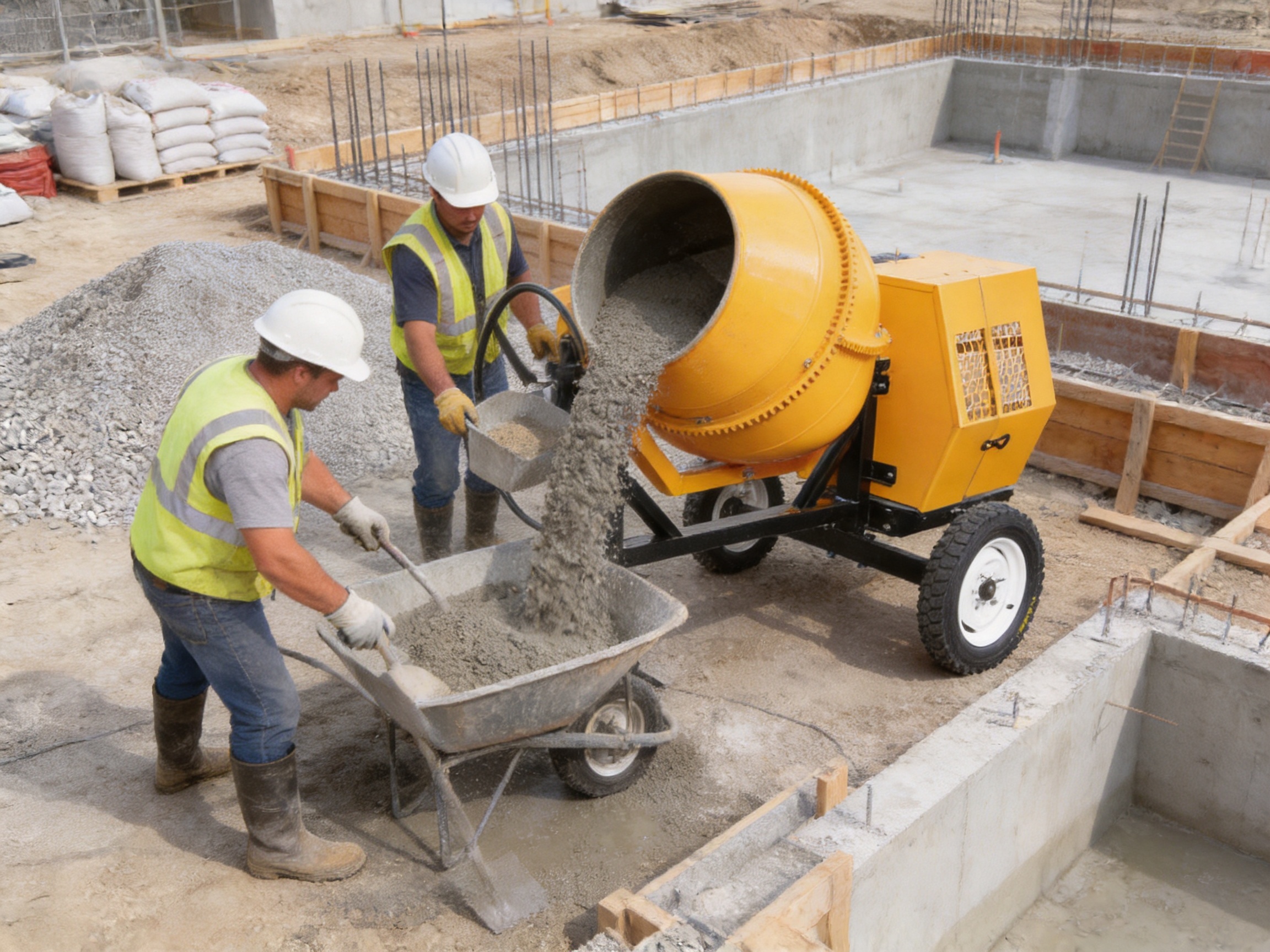
Fast discharge is essential when concrete must be placed without unnecessary interruption. Delayed discharge can increase labor requirements, cause material buildup, and create scheduling problems. The COM-350S series emphasizes fast discharging so that a completed batch can be transferred efficiently to wheelbarrows, forms, ground-level work areas, or other receiving points.
The 445-millimeter drum opening provides a practical loading and access dimension for a mixer in this category. It is large enough to support regular loading of cement, sand, aggregate, and water while helping operators maintain a manageable workflow. A suitable opening also assists cleaning and inspection after use.
On a busy jobsite, productivity is influenced by the complete cycle rather than mixing alone. Operators need to load materials, mix them thoroughly, discharge the batch, and prepare the drum for the next cycle. The listed working cycle period of three minutes indicates a compact operating rhythm for repeated production. Actual cycle time depends on the recipe, loading method, operator experience, material conditions, and discharge arrangement, but the specification demonstrates that the machine is intended for efficient batch turnover.
One of the most practical advantages of this product family is its range of power options. The machines can work with electric motors, Honda, Zonsen, and Lifan gasoline engines, as well as Koop diesel engines. This makes the series adaptable to markets and jobsites with different fuel availability, electrical standards, and operating preferences.
Electric configurations are well suited to workshops, urban construction sites, factories, warehouses, and projects where a stable power supply is available. Electric operation can offer convenient starting, relatively low local emissions, and straightforward daily use. It may also be preferred in enclosed or noise-sensitive environments, subject to appropriate ventilation and electrical safety requirements.
Gasoline engine configurations are useful for mobile work and locations where grid electricity is unavailable or unreliable. A gasoline-powered mixer can be transported to remote building sites, rural properties, roadwork areas, agricultural projects, and emergency repair locations. The Honda, Zonsen, and Lifan engine options provide flexibility for customers who have existing service networks or established preferences for particular engine suppliers.
Diesel power can be suitable for users who prioritize long-duration operation, fuel availability, or torque characteristics for demanding outdoor work. The availability of Koop diesel engine configurations gives customers another option for projects that require independent power. The correct choice should be made according to local regulations, service support, fuel cost, expected operating hours, transport requirements, and environmental conditions.
Compared with a single-power-source mixer, a multi-configuration product family is easier to adapt across different countries and customer segments. Importers can select a version that matches local voltage, frequency, fuel practices, and market expectations. Contractors can also select equipment that fits the power resources already present on their projects.
Construction conditions are rarely identical from one project to another. A mixer may be used beside a permanent power outlet one week and at an undeveloped outdoor location the next. It may be operated by a professional contractor, a rental customer, a farm owner, or a maintenance team. The COM-350S series is designed with this variety in mind.
The voltage options listed for the series include 110–120 volts and 220–240 volts, with a rated frequency of 50/60 hertz. These specifications make the product relevant to a broad range of electrical markets, although the buyer must confirm the exact configuration before ordering. Correct voltage and frequency selection is important for motor performance, safety, and service life.
The ability to choose between electricity, gasoline, and diesel allows the equipment to serve both fixed and mobile applications. This is an important advantage over machines that are limited to one type of power. For international distributors, the range can simplify product planning because the same basic mixer platform can be matched to regional requirements.
Potential applications include residential construction, commercial building work, foundation preparation, concrete repair, paving, block and brick production, fence installation, agricultural improvements, drainage work, landscaping, road maintenance, and small municipal projects. The mixer may also be useful for contractors who need supplementary capacity in addition to a larger central mixing system.
A concrete mixer must tolerate dust, vibration, repeated loading, material impact, moisture, and frequent operating cycles. The COM-350S series is positioned as a durable and reliable product for regular use. Its value depends on the interaction of its mechanical structure, power system, drum assembly, controls, transmission components, and maintenance access.
Reliability is particularly important for contractors because equipment downtime can affect labor scheduling and concrete placement. A delayed batch may interrupt a pour, require additional workers to remain on site, or create waste if materials have already been prepared. A robust mixer helps reduce these risks when it is operated within its intended capacity and maintained according to the manufacturer’s instructions.
Durability also matters for rental companies and equipment distributors. Machines used by multiple operators need a design that is understandable, serviceable, and capable of handling varied user habits. A practical economical model can provide a favorable balance between acquisition cost, utilization, and maintenance when it is supported by a clear operating procedure.
Noise control is becoming increasingly important in construction. Projects located near homes, schools, hospitals, offices, and commercial areas may face restrictions on operating hours and sound levels. Electric versions of the mixer can help reduce local engine noise and eliminate direct exhaust emissions at the point of use. Engine-powered versions remain valuable for remote work, but operators should follow local requirements concerning noise, fuel storage, ventilation, and emissions.
The product information highlights low noise and eco-friendly operation as design objectives. These characteristics can support a more comfortable working environment and help reduce disturbance to nearby personnel. Lower noise may also make it easier for operators to communicate during loading and discharge activities.
Environmental performance is influenced by more than the power source. Efficient mixing, correct batch sizing, reduced rework, proper material handling, and timely cleaning can all reduce waste. A mixer that supports a predictable cycle can help users prepare only the amount of concrete required for a particular task, rather than relying on inefficient manual batches.
Maintenance should be considered before equipment is purchased. A machine that is difficult to inspect or clean may cost more to operate over time, even if its initial price is attractive. The COM-350S series is designed for flexible operation and easy maintenance, supporting routine attention to the drum, power system, moving parts, controls, and structural components.
Operators should remove residual concrete before it hardens, inspect the drum and opening, check fasteners, monitor belts or transmission elements where applicable, and keep moving components properly serviced. Electric versions require inspection of cables, plugs, switches, grounding, and motor protection. Engine-powered versions require regular attention to oil, filters, fuel systems, starting components, exhaust systems, and cooling areas.
Maintenance requirements vary according to the selected configuration. Customers should use the correct service schedule and approved replacement parts for the actual machine. Regular maintenance can extend service life, preserve mixing performance, improve starting reliability, and reduce unexpected downtime.
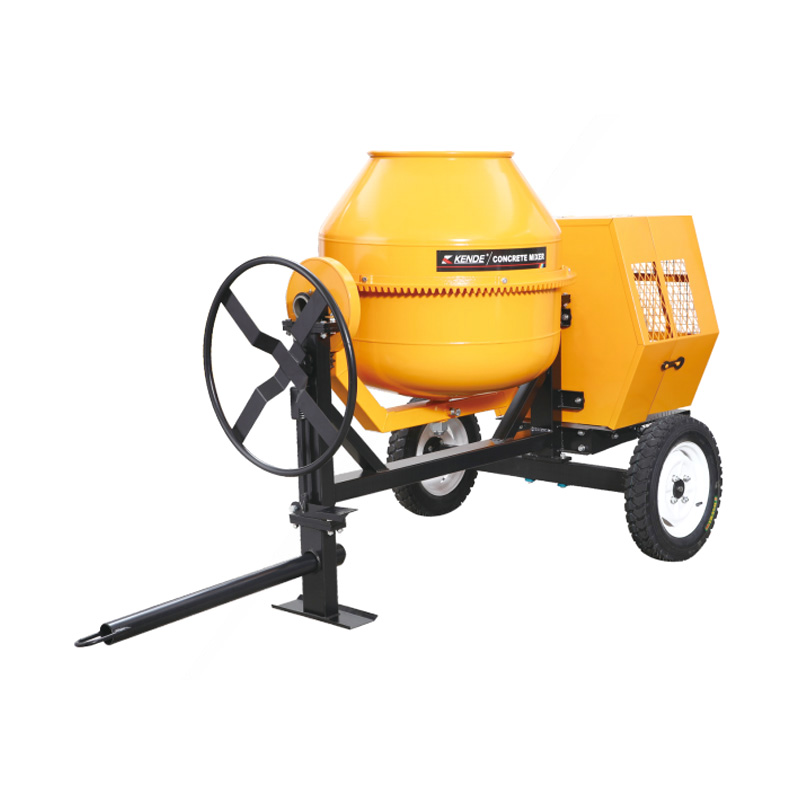
COM-350S/400S/450S Concrete Mixer Economical Model with Efficient Mixing and Versatile Power
The following table summarizes the technical information supplied for the three models. Buyers should confirm the final configuration, especially power source, rated voltage, packaging arrangement, and regional compliance requirements, before placing an order.
| Model | Rated Voltage | Rated Frequency | Mixing Power | Capacity | Drum Speed | Drum Opening | Working Cycle Period | Net/Gross Weight | Package Dimension | Quantity per 20-foot Container | Quantity per 40-foot High-Cube Container |
| COM-350S | 110–120 V / 220–240 V | 50/60 Hz | 3,000 W | 350 | 20/32 | 445 mm | 3 | 223/253 kg | 2000 L × 900 W × 1200 H mm | 12 cartons | 26 cartons |
| COM-400S | 110–120 V / 220–240 V | 50/60 Hz | 3,000 W | 350 | 20/32 | 445 mm | 3 | 233/263 kg | 2000 L × 900 W × 1300 H mm | 12 cartons | 26 cartons |
| COM-450S | 110–120 V / 220–240 V | 50/60 Hz | 3,000 W | 350 | 20/32 | 445 mm | 3 | 242/273 kg | 2000 L × 900 W × 1280 H mm | 5 cartons | 20 cartons |
The capacity field is presented as 350 for all three listed models in the supplied specifications. Customers should request a final technical datasheet if they require confirmation of whether this value represents liters, nominal drum capacity, or another measurement convention. The same confirmation should be obtained for the drum-speed and working-cycle entries, as the source data lists these values without additional units or explanatory notes.
Productivity is not simply a matter of installing a larger motor. It involves the coordination of loading, mixing, discharge, labor, materials, transport, and scheduling. A properly selected 350-class mixer can provide a useful balance between batch size and mobility. It is large enough to support repeated construction work, yet more manageable than a large stationary plant for small and medium projects.
When preparing a batch, operators can organize cement, aggregate, water, and additives before starting the mixer. Consistent loading order and measured quantities help produce more repeatable results. The machine’s drum opening supports practical loading, while the mixing system helps combine the ingredients. After the desired consistency is reached, the discharge process transfers the batch to the work area and allows the next cycle to begin.
A three-minute listed working cycle can support a structured workflow when material preparation is well organized. One worker may manage loading while another positions wheelbarrows or receiving containers. On smaller sites, a single trained operator may control the process, provided that the jobsite layout and safety procedures permit it.
Compared with manual mixing, mechanical mixing can reduce physical strain and make output more predictable. It also helps reduce the variation that may occur when different workers mix materials by hand. For contractors, this can contribute to better scheduling and a more professional production process.
The mixer can also serve as a backup unit. A company that already owns a large mixer may use the COM-350S series for small repair jobs, remote sections of a project, or supplementary batches. This avoids moving a large machine for tasks that do not justify its transport and setup requirements.
Contractors need equipment that supports reliable delivery without creating excessive operating complexity. The COM-350S series offers a practical capacity, multiple power choices, and a compact format that can fit a broad range of construction activities. Contractors can select an electric model for regular urban work or an engine-powered model for sites without dependable electricity.
The series may be useful for foundations, footings, columns, slabs, pathways, retaining structures, masonry work, and repairs. It can support multiple small projects in a working day when the materials and receiving arrangements are organized efficiently. The economical design can also help contractors add capacity without making the investment required for a full batching plant.
Rental companies often look for equipment that is easy to explain, simple to operate, and serviceable between rentals. A model family with several power options can help rental businesses serve customers with different site conditions. The durable structure and maintenance-focused design may also support repeated commercial use.
Rental operators should provide customers with clear instructions covering safe loading, maximum recommended batch size, electrical connection, engine operation, cleaning, transport, and emergency shutdown. They should also inspect the mixer before and after each rental period.
Distributors benefit from products that can address multiple regional markets. The 110–120-volt and 220–240-volt options, 50/60-hertz compatibility, and engine alternatives make the series suitable for different electrical and fuel environments. Container quantities listed in the specifications can assist preliminary logistics and inventory planning.
Distributors should verify packaging dimensions, actual carton count, gross weight, and container loading arrangements before final shipment. They should also confirm labeling, manuals, spare-parts availability, warranty terms, and required certifications for the destination market.
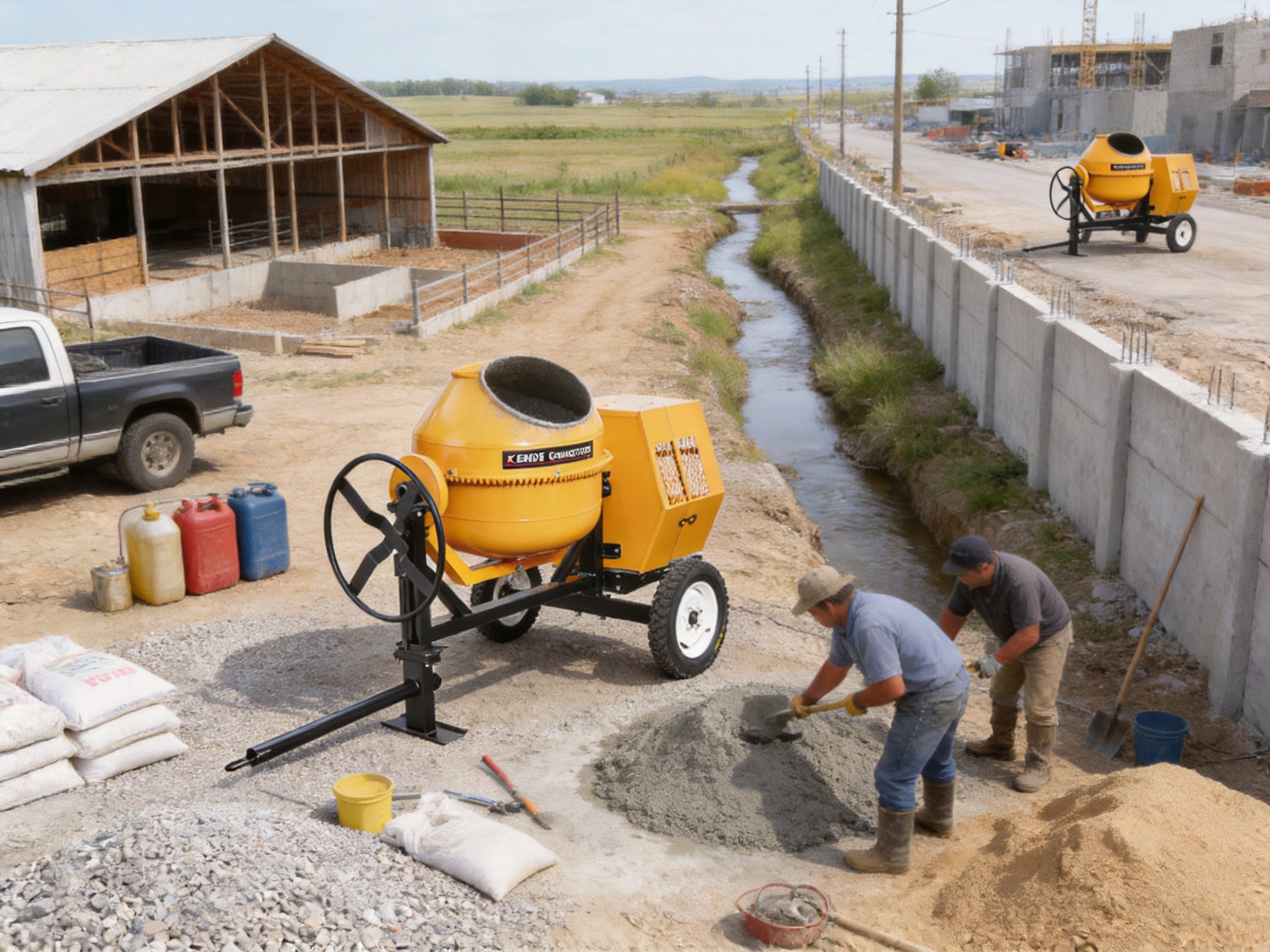
Farm owners and rural users may need concrete for animal shelters, drainage channels, fence posts, equipment bases, storage areas, paving, and repair work. These locations may not have reliable grid electricity, making gasoline or diesel configurations especially useful. A mobile mixer can be moved to the area where the concrete is required, reducing the need to transport wet concrete over long distances.
Maintenance departments and municipal teams often handle varied repair tasks rather than continuous large-volume production. The mixer can support sidewalk repair, roadside work, drainage improvements, small structural repairs, and public-facility maintenance. Its flexible power options allow departments to choose a configuration appropriate for depots, vehicles, or remote work locations.
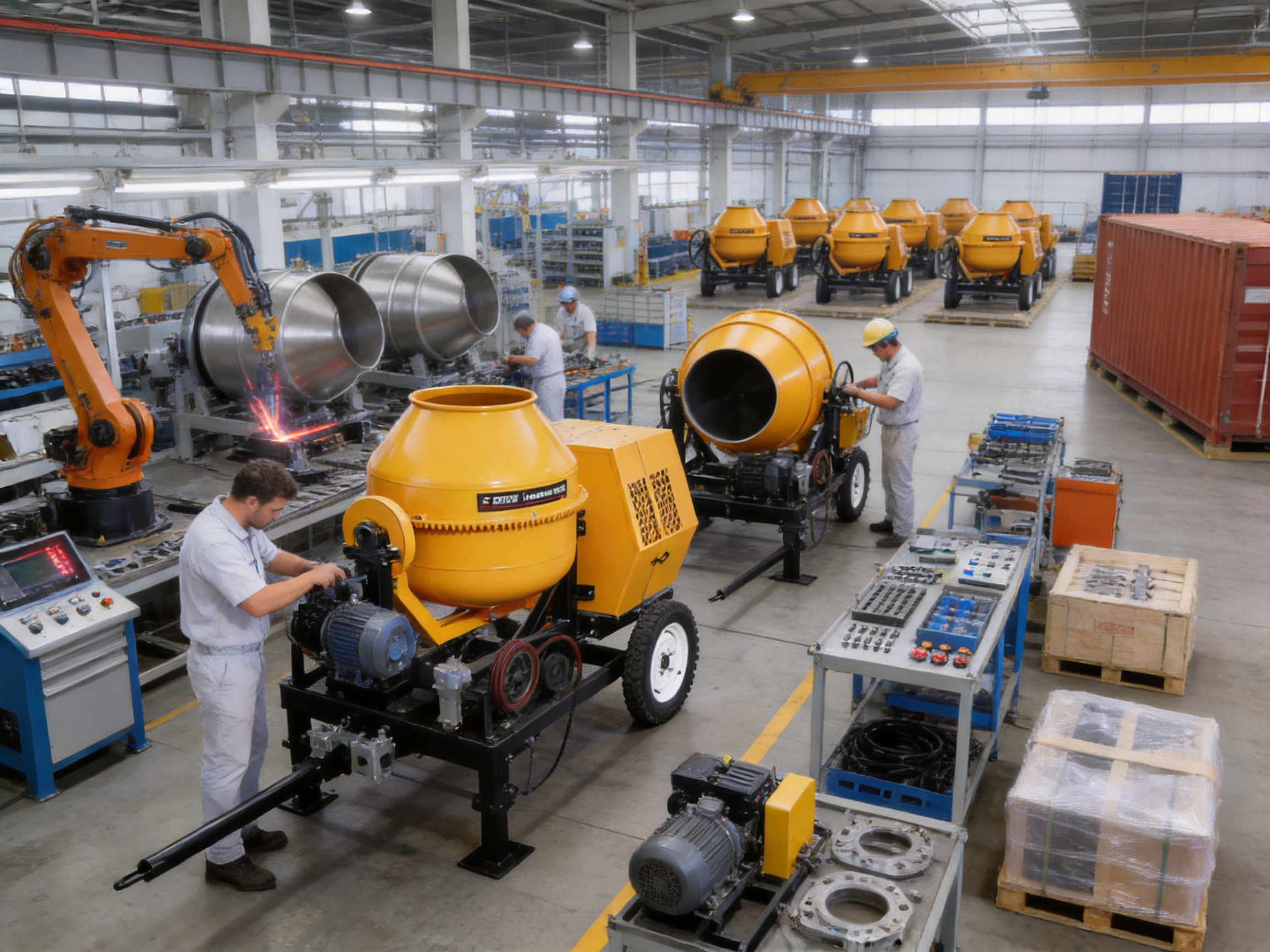
The manufacturer behind the product has a substantial industrial foundation. Zhejiang Kende Mechanical & Electrical Co., Ltd. is located in Taizhou City, Zhejiang Province, China, and operates across a site of approximately 120,000 square meters with around 600 employees. This scale supports coordinated research, production, quality management, warehousing, and export operations.
The company reports annual exports of nearly 1.5 million units and annual production capacity of approximately 2 million units. Although its major product categories include electric welding machines, chargers, and heaters, the same manufacturing experience is relevant to the development of mechanical and electrical equipment such as concrete mixers. High-volume production requires structured processes, repeatable assembly methods, component control, inspection procedures, and supply-chain coordination.
The company has developed products for industrial and domestic users and has experience supporting different regional requirements. This international orientation is important for customers purchasing equipment for markets with different electrical systems, certification expectations, operating conditions, and language requirements.
The manufacturer maintains a Zhejiang Provincial Research and Development Center, an Enterprise Technology Center, and an Intelligent Welding Technology Research Institute. It employs 98 research and development personnel and has obtained invention patents, utility model patents, appearance patents, and software copyrights.
These resources demonstrate an emphasis on product development rather than simple assembly. Engineering capability can influence the performance of a mixer in areas such as mechanical layout, drive matching, structural stability, drum operation, control design, material selection, and ease of service. It also helps the manufacturer adapt products for different markets and customer requirements.
The company states that it can develop new products according to the needs of different regions, countries, and customers. For distributors and project buyers, this may support discussions about regional configurations, power systems, product labeling, packaging, and application-specific requirements.
The company applies several management and manufacturing systems, including office automation, Toyota TPS management, ERP K3, and MES management systems. These systems can support planning, production coordination, material tracking, process control, data collection, and operational efficiency.
Toyota Production System principles are generally associated with waste reduction, organized workflows, process discipline, and continuous improvement. ERP systems can help coordinate purchasing, inventory, production orders, sales, and logistics. MES systems can provide greater visibility into production activities and manufacturing data. Together, these systems can help improve consistency across a large product portfolio.
The manufacturer also uses automatic patching, plug-in and welding systems, robotic processing, laser cutting, and other advanced technologies. While these technologies are especially relevant to its electrical and welding product lines, they reflect a broader ability to manage precision fabrication, automated production, and repeatable assembly. Such capabilities can contribute to the quality of structural and mechanical components used in equipment like concrete mixers.
Quality assurance is important for machinery that combines electrical, mechanical, and engine-related systems. The manufacturer holds or works with international product certifications including GS, CE, EMC, ERP, US ETL, UKCA, and China CCC across its product portfolio. The applicable certification for a particular concrete mixer depends on the exact model, power configuration, destination market, and regulatory category. Buyers should request the relevant compliance documents for the selected version.
Certification can help demonstrate that products have been evaluated against specified safety, electromagnetic compatibility, energy, or market-access requirements. However, certification is only one part of responsible equipment selection. Users must also install, operate, maintain, and transport the machine correctly. Electrical connections, grounding, engine ventilation, fuel handling, and site conditions remain important factors.
The manufacturer is also described as a national standard drafting unit of the National Welding Machine Standardization Committee. It has participated in drafting, formulating, and revising 20 national standards and led the drafting of one group standard. This experience indicates familiarity with technical requirements, structured evaluation, and industry-level product development.
International export experience can provide additional advantages for overseas customers. A manufacturer accustomed to international shipments is more likely to understand packaging, documentation, container planning, regional voltage requirements, and communication with distributors. The listed container quantities for the three models provide a starting point for logistics planning, although final loading should be confirmed against the actual package configuration.
The best power source depends on the work environment. An electric model is generally appropriate when the site has a stable supply that matches the machine’s rated voltage and frequency. Users should confirm the availability of suitable outlets, cable capacity, circuit protection, grounding, and safe cable routing.
A gasoline engine model is more suitable when the mixer must travel between locations or operate where grid power is unavailable. Users should consider fuel storage, refueling procedures, ventilation, exhaust direction, noise, and local emissions rules. Engine-powered machines should never be operated in enclosed spaces without adequate ventilation and proper safety controls.
A diesel configuration may be preferred for extended outdoor use or locations where diesel fuel and service support are readily available. The total cost of ownership should include fuel consumption, oil changes, filter replacement, engine maintenance, and operator training.
The supplied specifications show similar mixing power, capacity, drum speed, drum opening, and working cycle information for the COM-350S, COM-400S, and COM-450S. Their listed net and gross weights, package dimensions, and container quantities differ. Customers should therefore compare the models according to the intended configuration, physical dimensions, transport plan, and distributor availability.
The COM-350S has a listed net/gross weight of 223/253 kilograms and package dimensions of 2000 by 900 by 1200 millimeters. The COM-400S is listed at 233/263 kilograms with package dimensions of 2000 by 900 by 1300 millimeters. The COM-450S is listed at 242/273 kilograms with package dimensions of 2000 by 900 by 1280 millimeters.
The different container quantities may be important for importers. The COM-350S and COM-400S are listed at 12 cartons per 20-foot container and 26 cartons per 40-foot high-cube container, while the COM-450S is listed at 5 cartons per 20-foot container and 20 cartons per 40-foot high-cube container. These figures should be checked with the supplier because final packing may vary according to power configuration, accessories, protective materials, and shipping requirements.
Operators should place the mixer on stable, reasonably level ground before use. The machine should have sufficient clearance for loading, discharge, cleaning, and inspection. The discharge area should be prepared in advance so that workers do not need to move heavy containers into position while the mixer is operating.
Materials should be measured consistently. Large variations in cement, aggregate, or water can affect workability and final concrete performance. The loading sequence should follow the operating instructions supplied with the machine and the concrete mix design being used. Overloading should be avoided because excessive material can reduce mixing quality, increase strain on the drive system, and accelerate wear.
Operators should keep hands, clothing, tools, and loose materials away from moving components. Guards and protective covers should remain in place. Power should be disconnected before maintenance, cleaning, adjustment, or clearing a blockage. Engine-powered versions should be shut down and allowed to cool before service work involving hot surfaces, fuel, or oil.
Cleaning is particularly important because hardened concrete can interfere with drum movement, reduce effective capacity, increase imbalance, and make future cleaning more difficult. Residual material should be removed using safe procedures that do not damage the drum, controls, bearings, seals, or electrical components.
A preventive maintenance plan should be adapted to the frequency and intensity of use. Daily checks may include visual inspection of the frame, drum, opening, discharge mechanism, power cable, controls, fasteners, and visible moving parts. Operators should listen for unusual noise and watch for vibration, slippage, leakage, or irregular drum movement.
Periodic maintenance may include lubrication where specified, tightening of fasteners, inspection of belts and transmission components, checking of motor or engine mounting, and examination of wear points. Electric models should be checked for insulation damage and secure connections. Engine models require the appropriate oil, fuel, air-filter, spark-plug, cooling, and exhaust service.
Replacement parts should be selected according to the exact model and power configuration. Keeping frequently used service items available can reduce downtime. Distributors may wish to stock wear parts, electrical components, engine service items, fasteners, and operating controls suited to the versions sold in their markets.
Training is also a form of maintenance. A properly trained operator is less likely to overload the mixer, misuse the controls, ignore abnormal sounds, or allow concrete to harden inside the drum. Clear instructions can extend the service life of the machine and improve workplace safety.
The COM-350S series competes in a segment where customers often compare price, capacity, power flexibility, durability, service requirements, and transport convenience. Its main competitive strength is the combination of these factors in one economical platform.
Some low-cost mixers may offer limited power choices or be designed mainly for one regional market. The COM-350S series provides electric and engine-driven alternatives, along with voltage and frequency options intended for international use. This flexibility can be especially valuable for distributors serving customers with different site conditions.
Some larger mixers may offer greater nominal capacity but require more space, more transport effort, or a larger investment. For small and medium construction tasks, a 350-class mixer may provide a more balanced solution. It can deliver mechanical mixing without the complexity of a full batching installation.
Some highly specialized machines may include advanced automation that is unnecessary for basic building work. The economical design of the COM series emphasizes essential performance, accessible operation, and maintainability. This can make the equipment easier to deploy and more suitable for customers who prioritize practical output over sophisticated control systems.
The company’s broader manufacturing base is another competitive consideration. Experience in welding machines, chargers, heaters, automation, laser cutting, robotic processing, and international production gives the manufacturer a wide technical background. Its research centers, patents, production systems, certification experience, and export volume further support its ability to develop and supply equipment for varied customers.
Concrete mixers contain rotating and moving components that can cause serious injury if used carelessly. Only trained operators should start or operate the machine. Children and unauthorized persons should remain away from the work area. Operators should wear suitable work clothing, protective footwear, gloves where appropriate, and eye protection during loading, cleaning, and maintenance.
Electrical models must be connected to a suitable power supply with appropriate protection. Damaged cables, exposed conductors, wet connectors, or improvised extensions should not be used. The machine should be protected from conditions that could allow water to enter electrical components.
Engine-powered versions require safe fuel handling. Fuel should be stored in approved containers, away from ignition sources. Refueling should take place after the engine has been shut down and cooled. Adequate ventilation is essential because engine exhaust contains hazardous gases.
The mixer should not be moved while operating unless the specific configuration and operating instructions expressly permit such movement. Before transport, the machine should be shut down, secured, and protected from impact. Lifting and loading should be carried out with equipment and procedures suitable for the listed weight.
A concrete mixer is a long-term working tool, and supplier support can be as important as the initial product specification. Buyers should clarify manuals, spare parts, warranty conditions, technical assistance, recommended maintenance, and response procedures before purchase.
The manufacturer’s experience in international markets can help distributors and project buyers communicate technical requirements clearly. Customers can request information about the exact model, power source, motor or engine brand, electrical configuration, packaging, available accessories, and compliance documentation.
For large orders, customers may also discuss customized labeling, packaging, regional manuals, container loading, spare-parts packages, and product development requirements. The company’s stated ability to develop new products for different regions and customers may be useful for importers with specific market needs.
The COM-350S series can be considered for a wide range of applications where controlled batch mixing is required. These include residential foundations, small commercial buildings, renovation projects, concrete floors, walkways, garden structures, fence bases, drainage channels, farm buildings, paving repairs, masonry work, block production, landscaping features, and general maintenance.
It is also suitable as a supplementary mixer for larger construction teams. A secondary unit can prepare small batches near a remote work area while the main mixer continues serving a higher-volume operation. This can reduce travel time and improve labor utilization.
The equipment is not a replacement for every type of industrial batching plant. Projects requiring very large continuous output, automatic aggregate weighing, computerized recipe control, or highly specialized concrete production should be evaluated separately. The COM series is best positioned as a practical, economical, and flexible batch mixer for small and medium-scale work.
They are economical-model concrete mixers designed for efficient mixing, fast discharge, flexible operation, and multiple power configurations. The supplied specifications list a 3,000-watt mixing power rating and a 350 capacity for each model.
The series can be configured with electric motors, Honda, Zonsen, or Lifan gasoline engines, and Koop diesel engines. The appropriate option depends on site electricity, mobility requirements, fuel availability, local regulations, and service support.
Yes. Gasoline and diesel engine configurations are intended for outdoor or remote locations where grid electricity is unavailable or unreliable. Engine-powered equipment must be operated with proper ventilation and fuel-safety procedures.
The supplied information lists 110–120 volts and 220–240 volts, with a rated frequency of 50/60 hertz. Buyers should confirm the exact electrical configuration before ordering or connecting the equipment.
The listed mixing power is 3,000 watts for the COM-350S, COM-400S, and COM-450S models.
The listed drum opening is 445 millimeters for all three models.
The supplied table lists a working cycle period of three minutes. Actual cycle performance can vary according to material proportions, loading method, operator practice, moisture content, and discharge conditions.
No. The supplied information lists different net and gross weights and different package dimensions. The COM-350S is listed at 223/253 kilograms, the COM-400S at 233/263 kilograms, and the COM-450S at 242/273 kilograms.
The choice should be based on the required configuration, package size, transport plan, local distributor availability, and customer preference. Since the supplied table lists similar core mixing specifications, buyers should request a complete final datasheet when comparing the models.
Yes. It is designed for practical batch mixing in construction and related applications. Professional users should operate it within its recommended capacity and follow the manufacturer’s instructions for loading, cleaning, inspection, and maintenance.
Yes. Its multiple configurations and practical operating concept may suit rental businesses. Rental companies should provide operator guidance, inspect the equipment between rentals, and keep appropriate service parts available.
Maintenance includes cleaning residual concrete, inspecting the frame and drum, checking fasteners and moving components, servicing the electric motor or engine, and following the recommended lubrication and replacement schedule. The exact requirements depend on the selected power configuration.
The manufacturer has extensive international export experience and provides products for different regional markets. Buyers should confirm shipment terms, packaging, certifications, manuals, warranty arrangements, and spare-parts support for their destination.
The economical design focuses on essential mixing performance, practical capacity, flexible power choices, manageable maintenance, and broad application. This can provide useful value for customers who do not need a large automated batching plant.
The COM-350S, COM-400S, and COM-450S concrete mixers are designed to provide a practical solution for construction users who need consistent mechanical mixing without the cost and complexity of a large stationary system. Their key advantages include a listed 3,000-watt mixing power rating, 350 capacity, 445-millimeter drum opening, three-minute working cycle specification, fast discharge concept, and multiple power options.
The electric, gasoline, and diesel configurations allow the product family to serve urban, rural, mobile, and no-power working conditions. Voltage and frequency options support international market use, while the different model weights and package dimensions give buyers choices for logistics and project planning.
The manufacturer adds value through its large production base, export experience, research and development resources, patents, technical centers, advanced manufacturing systems, automation, robotic processing, laser cutting, and broad certification experience. These strengths support the company’s ability to produce equipment for varied markets and to respond to customer requirements.
For contractors, rental companies, distributors, farms, maintenance teams, and other users, the series offers a balanced combination of productivity, adaptability, durability, and maintainability. Final selection should always be based on a confirmed technical datasheet, the intended power source, local regulations, expected workload, service support, and safe operating conditions.
1. Product technical information for the COM-350S, COM-400S, and COM-450S economical concrete mixer series.
2. Manufacturer-provided company profile and production capability information.
3. Manufacturer-provided information concerning research and development centers, patents, certifications, and technical personnel.
4. Manufacturer-provided information concerning ERP, MES, Toyota Production System management, robotic processing, laser cutting, and automated manufacturing technologies.
5. General principles of concrete mixing, construction equipment operation, preventive maintenance, and jobsite safety.
Recommended Products

Contact Us
No.2299, Luqiao Section, Shugang Avenue, Luqiao District, Taizhou, 318057 Zhejiang, PR China.
+86-576-82431568
 Privacy
China Welding Machine Factory
 English
 中文简体
中文简体
 русский
 Español
 عربى
عربى
 Français
 Português
 Deutsch
 Український