Email: [email protected]
Email: [email protected]

Industry News
 Home / News / Industry News / Car Battery Charger Factory: What's Inside the Box That Brings a Dead Battery Back
  2026.07.03
 Industry News
A car battery charger sits on a garage shelf for months, then gets clamped onto a flat battery on a cold morning. It has to diagnose the battery state, deliver the right charge curve, and not overheat or overcharge. The ones that fail do so quietly—boiling a cell dry, undercharging so the car won't start next time, or simply dying because a capacitor rated for indoor use baked inside a hot garage. A car battery charger factory building units that last starts with the charging algorithm and the thermal design, not the peak amps printed on the front.
Modern chargers handle flooded lead-acid, AGM, gel, and sometimes lithium-iron-phosphate. Each chemistry needs a different voltage profile. A flooded battery can absorb a higher bulk voltage and benefit from an equalization stage. AGM and gel batteries need lower voltages and no equalization, which dries out the electrolyte mat. A car battery charger factory that builds a single-profile charger and labels it "suitable for all types" is cutting corners. The charger should auto-detect battery voltage, assess sulfation, and select the correct multi-stage curve: desulfation, soft start, bulk, absorption, and float.
The microcontroller that manages this needs a reliable power supply section. A charger that works from a vehicle's jumpy alternator voltage or a generator on a job site has to handle input noise without resetting mid-charge. A car battery charger factory that uses an industrial-grade power supply with wide input tolerance produces chargers that don't reboot when a compressor kicks on. One that uses a bare-minimum phone-charger-style supply ships units that flicker and restart.
Chargers come in two architectures: transformer-based linear and switch-mode. Linear chargers are heavy, simple, and durable. They ride out voltage spikes and run cool at the cost of weight. Switch-mode chargers are light and compact, but the high-frequency switching generates heat in a small enclosure. A car battery charger factory building switch-mode units has to manage that heat with careful PCB layout, adequate heatsinks, and venting that works when the charger is sitting on a dusty floor.
The fan is a common failure point. A sleeve-bearing fan runs quiet for a few months, then gets noisy and seizes. A dual-ball-bearing fan lasts longer but costs more. A car battery charger factory that specs ball-bearing fans and thermally controlled fan speed is thinking about the five-year life of the product. One that uses a constant-speed sleeve-bearing fan is shipping a unit that will cook itself when the fan dies.
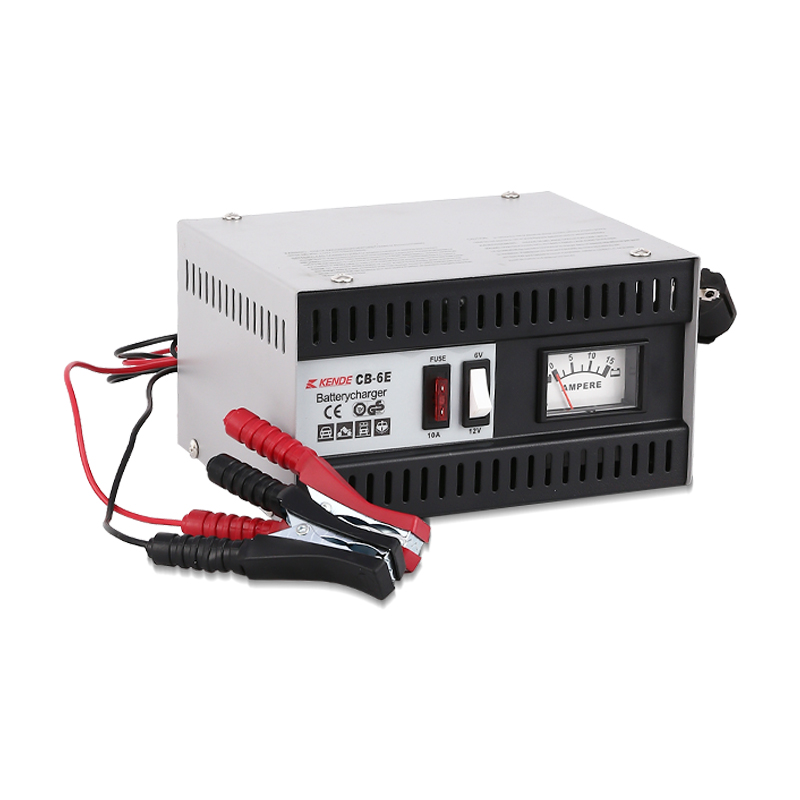
The output clamps and cables matter more than they look. Copper-coated steel clamps look like copper but resist more, heat up, and corrode faster. Solid copper or copper-plated brass clamps conduct better and last. The cables should be welding-grade flexible cable with thick insulation that stays pliable in cold. Thin PVC cables stiffen in winter, and a stiff cable pulls the clamp off the battery terminal. A car battery charger factory that uses cold-flex insulation and a strain relief where the cable enters the housing has tested its product in the real world.
Reverse polarity protection is basic. A charger that sparks when you hook it up backwards is missing a relay or a diode check. Spark-proof clamps with a built-in voltage sense circuit that only closes the relay when connected correctly are the standard for any charger above a trickle-maintenance unit.
Over-temperature protection should reduce output current rather than shutting the charger off entirely. A charger that turns off mid-charge and never restarts leaves the battery partially charged, which is worse for the battery than a slow charge. A car battery charger factory that programs a thermal fold-back curve rather than a hard cut-off understands battery chemistry.
Short-circuit protection should trigger instantly. The charger should survive a dead short across the output terminals without blowing an internal fuse that requires a service centre visit. A field-replaceable fuse is acceptable. An internal soldered fuse that bricks the unit is not.

Clamp a sample to a deeply discharged battery and log the charge curve. The voltage should climb through the stages without sudden drops. Run the charger at full rated current for an hour in a warm environment. Measure the case temperature near the transformer or switching FETs. It should stay below the rating of the internal components. Short the output clamps together momentarily. The charger should shut off and recover when the short is removed. Reverse the clamps on a low-voltage battery. The charger should remain off and indicate a fault, not arc. Run the charger from a generator or a variac at low input voltage. It should continue charging without resetting.
A car battery charger factory that does these tests on every design before release, and spot-checks production units against the same tests, will ship chargers that work when someone needs them most. The ones that fail are the ones tested only at room temperature on a fully charged battery with clean input power. That is not how a dead battery gets revived. It happens in a cold garage, on a corroded battery, with a long extension cord. The charger that works under those conditions earns its shelf space. The rest get returned.
Recommended Products

Contact Us
No.2299, Luqiao Section, Shugang Avenue, Luqiao District, Taizhou, 318057 Zhejiang, PR China.
+86-576-82431568
 Privacy
China Welding Machine Factory
 English
 中文简体
中文简体
 русский
 Español
 عربى
عربى
 Français
 Português
 Deutsch
 Український