Email: [email protected]
Email: [email protected]

Industry News
 Home / News / Industry News / Portable Spot Welder Manufacturer: Duty Cycle and Electrode Force Decide Whether the Unit Holds Up
 2026.11.20
 Industry News
A portable spot welder manufacturer is judged less on catalogue range than on whether its units survive being carried to a job and used on thin sheet for a full shift. Buyers comparing quotations usually look at current output, weight, and price, while the differences that decide whether a portable spot welder performs sit in duty cycle, electrode force, and how the transformer and cables handle heat when the unit is used away from a bench.
Portable spot welders are often rated at a current that can only be sustained briefly, and the duty cycle tells the buyer how long the unit can actually run. Two points deserve attention:
Buyers should ask at what current and temperature the duty cycle was measured, whether the unit has thermal protection, and how it behaves when the protection trips.
Spot welding depends on pressure as much as current, and the electrode force decides whether the weld forms properly. Buyers should ask how the electrode force is applied, whether it is adjustable, and how the tips are cooled. A unit that relies on hand pressure alone varies from operator to operator, and a unit without tip cooling wears electrodes quickly, which changes the weld quality over a shift.
Portable units carry current through cables that flex constantly, and the cables are a common failure point. Buyers should ask about cable gauge, insulation flexibility, and how the cable connects to the transformer and the gun. A cable that is too thin heats up and wastes current, and a cable that is stiff cracks at the connector. The transformer should be rated for the duty cycle, not just the peak output.
A portable spot welder is carried to the work, often up a ladder or into a confined space, so weight and balance matter. Buyers should ask how the unit is carried, whether the weight is distributed for one-handed use, and how the gun is balanced when the cable is attached. A unit that is light but awkward to hold tires the operator faster than one that is slightly heavier but balanced.
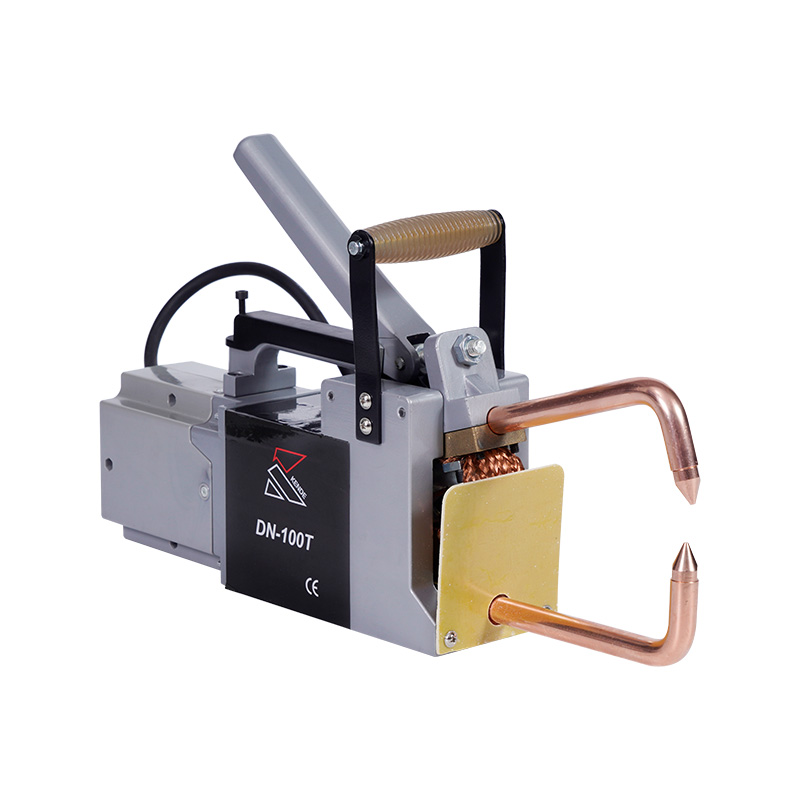
Rather than comparing current output and price, buyers can ask at what conditions the duty cycle was measured, how electrode force is applied and whether tips are cooled, what cable and transformer are used, and how the unit balances when carried. Suppliers who answer with test conditions and component detail are easier to trust than those who answer with a current figure. The unit is a familiar tool; the difference lies in whether duty cycle and electrode force were matched to the work it will do.
Recommended Products

Contact Us
No.2299, Luqiao Section, Shugang Avenue, Luqiao District, Taizhou, 318057 Zhejiang, PR China.
+86-576-82431568
 Privacy
China Welding Machine Factory
 English
 中文简体
 русский
 Español
 عربى
 Français
 Português
 Deutsch
 Український