Email: [email protected]
Email: [email protected]

Blog
 2026.11.15
 Blog
Industrial welding requires more than a high current rating. A productive welding machine must deliver a stable arc, repeatable parameters, efficient power conversion, dependable protection, convenient operation, and enough process flexibility to handle changing production requirements. The 350A and 500A industrial MIG welding machines described in this article are designed around those practical needs. They combine digital microprocessor control, IGBT inverter technology, multiple welding processes, high current output, and a robust industrial design in two power classes.
These machines are suitable for professional workshops, fabrication plants, maintenance departments, construction operations, agricultural equipment production, vehicle repair, structural steelwork, and other applications requiring dependable wire welding and manual arc welding. Their operating modes support pulse MIG, conventional DC MIG/MAG, gasless flux-cored wire welding, and MMA or stick welding. This range enables one power source to serve multiple materials, joint types, wire systems, and working environments.
The 350A model is intended for high-performance general industrial work where a balance of output, portability, and installation capacity is important. The 500A model provides a higher current ceiling and a greater power reserve for heavy fabrication, large assemblies, thicker sections, and longer welding cycles. Both models use a full digital control system that helps operators achieve more consistent results than basic analog machines.
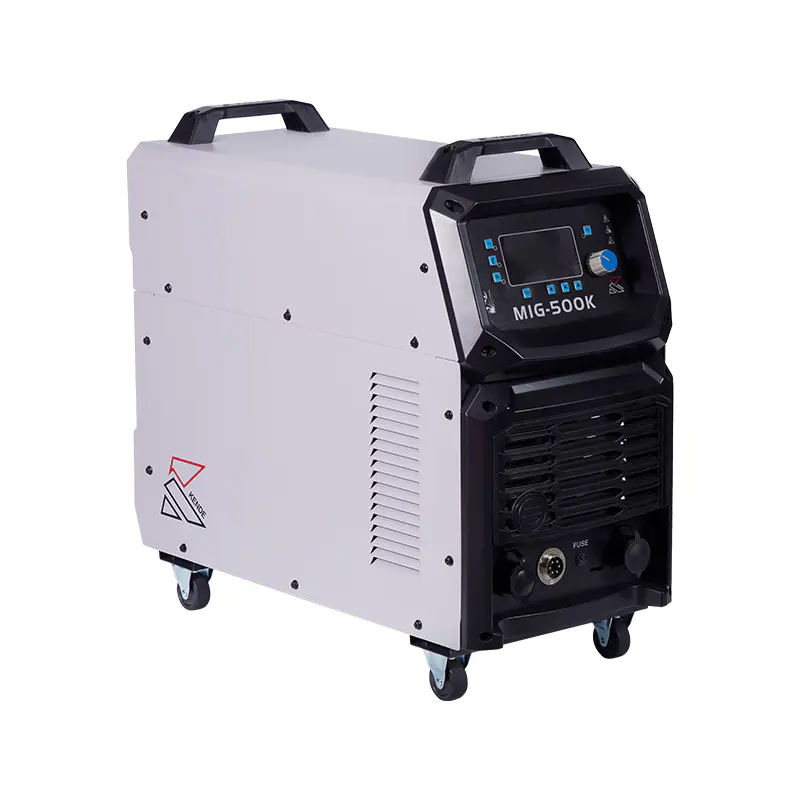
350A/500A INDUSTRIAL MIG WELDER, Full digital control. Can weld ordinary carbon steel, stainless steel, aluminum magnesium, aluminum silicon and other materials, MIG/MIG/MAG/No gas shielded Flux wire welding
The industrial MIG welder is a digitally controlled inverter welding system available in MIG-350K and MIG-500K configurations. Both versions use a three-phase 380 V, 50 Hz supply and are engineered for professional applications. The machines provide high current output while maintaining an efficient and relatively compact form compared with traditional transformer-based power sources of similar capacity.
The product title identifies the range as a 350A/500A industrial MIG welder. In practical terms, the MIG-350K offers a MIG welding current range of 40A to 350A, while the MIG-500K provides a MIG range of 60A to 500A. Both machines also include an MMA function. The MMA range is 20A to 350A for the 350K and 20A to 480A for the 500K.
The machines can weld ordinary carbon steel, alloy steel, stainless steel, and other compatible metals when the correct wire, shielding gas, polarity, and welding parameters are selected. The supplied product information also identifies support for aluminum-related applications, including aluminum-magnesium and aluminum-silicon materials. Welding these alloys requires suitable wire-feeding equipment, consumables, shielding gas, torch configuration, and operator technique.
Unlike a machine limited to conventional gas-shielded MIG/MAG welding, this product family also supports no-gas shielded flux-cored wire welding. This is useful in outdoor or mobile applications where wind makes external shielding gas difficult to maintain, or where the operator wants to reduce dependence on a gas cylinder. The MMA function further extends the machine’s usefulness for repair work, site fabrication, and applications where stick electrodes are preferred.
The welding system uses an advanced microprocessor control unit. Digital control allows the machine to monitor and regulate key operating conditions rapidly during welding. Instead of relying solely on fixed analog circuitry, the control system can coordinate current, voltage, wire feed speed, arc behavior, and other selected parameters.
This approach contributes to a more stable welding arc and makes it easier to reproduce successful settings. In a production environment, repeatability is essential. When several operators or shifts use the same equipment, digital parameter control can help reduce variation caused by inconsistent manual adjustment.
The control system also supports process-specific programming. MIG welding, pulse MIG, flux-cored wire welding, and MMA welding have different operating requirements. A digital platform can adjust the machine’s behavior according to the selected process rather than forcing every mode to operate through the same basic output characteristics.
IGBT inverter technology is a major reason why modern industrial welding machines can provide high output in a smaller and lighter package than older transformer-based equipment. The inverter converts and controls electrical power at high frequency, allowing the power source to respond quickly to changes in the arc.
The advantages include reduced machine size, lower weight, improved electrical efficiency, and more responsive output control. The published efficiency rating for both models is 85 percent, with a power factor of 0.9. These figures indicate an efficient power conversion platform suitable for regular industrial use, although actual operating consumption depends on welding current, duty cycle, material, process, and site conditions.
The inverter design also supports a high current-to-size ratio. The MIG-350K has a net weight of approximately 23 kilograms and measures 625 millimeters in length, 275 millimeters in width, and 580 millimeters in height. The MIG-500K weighs approximately 41 kilograms and measures 710 millimeters in length, 330 millimeters in width, and 650 millimeters in height. These dimensions provide a practical compromise between industrial output and equipment mobility.
The front control interface includes an LCD screen, touch buttons, and an encoder for parameter adjustment. This combination gives the operator clear access to machine settings without requiring complicated mechanical controls.
An LCD display can show selected values and process information in a more direct manner than a simple analog scale. The encoder allows the user to increase or decrease a setting with controlled, repeatable movement. Touch-button operation reduces the number of separate switches and supports a cleaner control panel layout.
For training and production purposes, a digital display is especially useful because it makes it easier to record or reproduce settings. Welding supervisors can establish recommended parameter ranges for common materials, wire diameters, and plate thicknesses. Operators can then make controlled adjustments while observing the displayed values.
Pulse MIG is designed to transfer droplets of molten metal in a controlled pulsed pattern. When properly adjusted, pulse operation can help reduce spatter, improve arc control, and provide a more controlled heat input than some conventional transfer modes. It can be useful for stainless steel, aluminum alloys, thin-to-medium sections, positional welding, and applications where appearance and control are important.
The machine’s digital control system is particularly valuable in pulse welding because pulse operation requires accurate coordination between current peaks, background current, wire feed, and arc timing. A stable control platform helps the operator achieve a smoother transfer pattern and more consistent bead formation.
Conventional DC MIG/MAG welding is widely used for carbon steel, alloy steel, stainless steel, and many general fabrication applications. The process is productive because the wire electrode is continuously fed, allowing long welds and high deposition rates with fewer stops than manual stick welding.
Depending on the material and wire, the operator can select an appropriate shielding gas mixture and polarity. Carbon steel commonly uses carbon dioxide or argon-rich mixtures, while stainless steel and aluminum require gas and consumable choices appropriate to the alloy. The machine supplies the adjustable current and voltage range needed for different joint designs, wire sizes, and thicknesses.
The MIG-350K covers 40A to 350A in MIG mode, while the MIG-500K covers 60A to 500A. These ranges allow the machines to handle both lower-current work and high-output production welding, provided the torch, wire feeder, cables, and consumables are correctly matched to the selected current.
Gasless flux-cored wire welding is supported under the MIG/MAG function. It is valuable for field repair, outdoor fabrication, and work in locations where shielding gas cylinders are inconvenient. The flux inside the wire produces shielding during welding, reducing dependence on an external gas supply.
One of the main advantages of this mode is operational flexibility. A workshop can use gas-shielded wire for clean indoor production and switch to flux-cored wire for outdoor maintenance or repair tasks. The same power source can therefore cover different operating environments without requiring a separate machine.
Flux-cored welding can produce more smoke and slag than solid-wire MIG welding, so ventilation, personal protective equipment, and post-weld slag removal remain important. The operator must also select a wire and polarity compatible with the specific machine configuration and application.
The MMA function allows the machine to use coated stick electrodes. This is useful for repairs, construction, maintenance, and jobs where a wire feeder or shielding gas system is not practical. Stick welding is also valued for its ability to operate outdoors and on less accessible joints.
The MIG-350K provides an MMA range of 20A to 350A, while the MIG-500K provides an MMA range of 20A to 480A. These ranges support a broad selection of electrodes and workpiece thicknesses. The operator must choose the electrode type, diameter, polarity, and current according to the material and welding position.
Including MMA in a high-output MIG system gives the purchaser a more versatile asset. Instead of investing in separate equipment for wire welding and stick welding, one machine can serve both functions. This can reduce equipment duplication and make maintenance planning simpler.
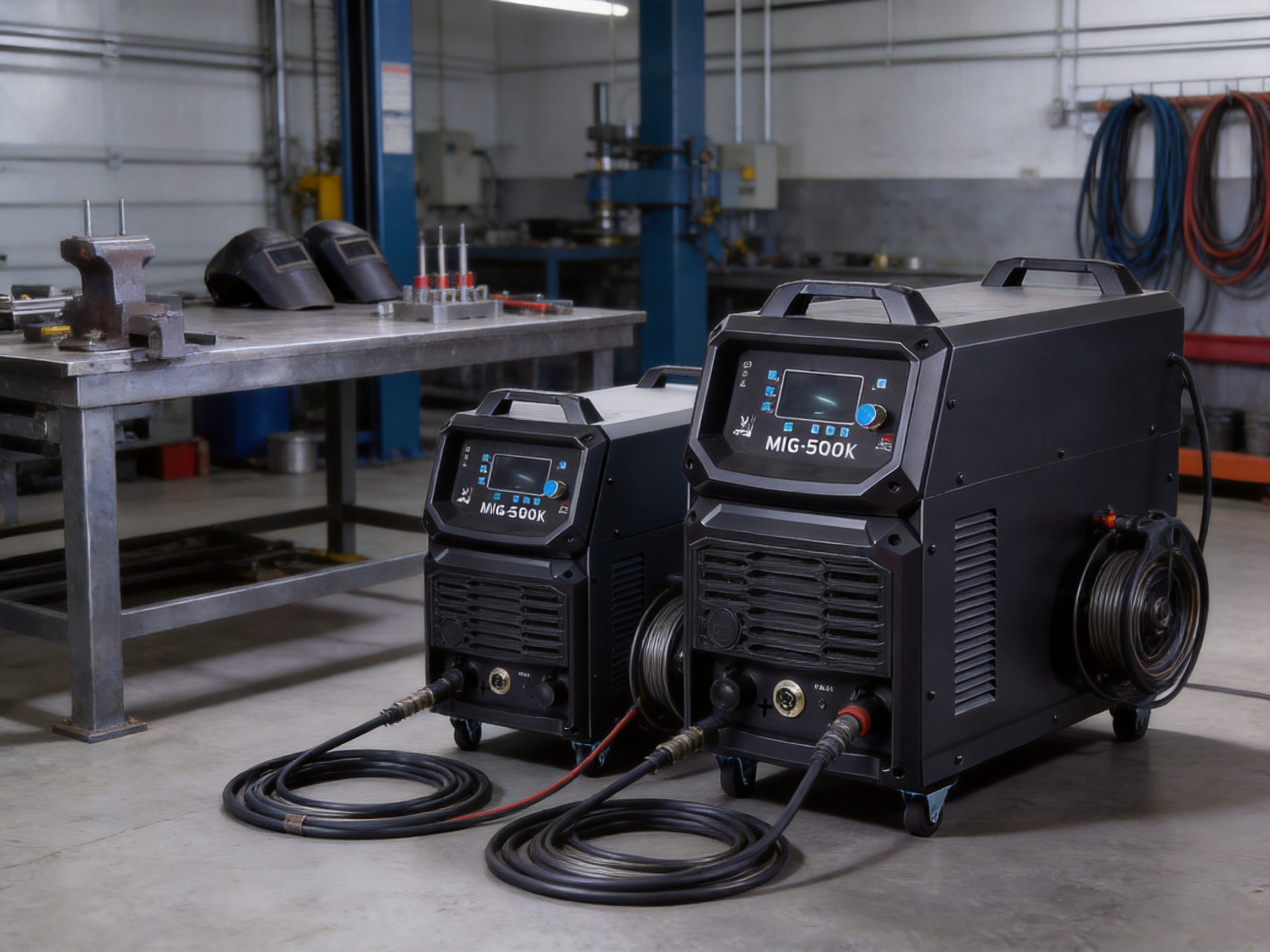
The control system provides access to several important welding parameters. These include current, wire feed speed, plate thickness, voltage, arc length, and induction. The availability of these settings allows the machine to be adapted to different materials and joint conditions rather than operating with one fixed output profile.
Current is one of the primary factors controlling penetration and deposition. Wire feed speed is closely related to welding current in MIG/MAG operation because increasing wire feed generally increases the amount of electrode entering the arc. The operator should adjust these settings together according to wire diameter, material thickness, joint design, transfer mode, and shielding gas.
A stable relationship between current and wire feed helps avoid common problems such as wire stubbing, irregular arc starts, excessive spatter, insufficient penetration, or an unstable arc. Digital control makes it easier to set and repeat this relationship.
Voltage influences the arc length and the shape of the weld bead. Higher voltage can produce a longer arc and a wider bead, while lower voltage generally produces a shorter arc and can increase the risk of the wire contacting the workpiece if the settings are not balanced.
The machine provides voltage and arc-length adjustment so the operator can refine the welding response. This is particularly useful when changing between materials, shielding gases, wire diameters, and welding positions. Fine adjustment can help achieve the desired bead profile and reduce unnecessary spatter.
Inductance adjustment influences the dynamic response of the welding current. It can affect arc softness, droplet transfer, short-circuit behavior, and spatter characteristics. The best setting depends on the wire, gas mixture, material, joint, and operator preference.
Providing induction control gives experienced welders a useful additional adjustment beyond basic current and voltage. It also allows the machine to be tuned for different production conditions without changing the entire power source.
A plate-thickness setting can assist operators in selecting an appropriate starting point. This feature is helpful when a workshop handles many different material gauges and wants to simplify setup for less experienced users. The thickness value should be treated as a starting reference rather than an automatic substitute for qualified welding procedure development.
Final settings should be verified through test welds, visual inspection, dimensional checks, and, where required, destructive or non-destructive testing. Material grade, joint preparation, position, preheat, interpass temperature, wire type, gas flow, and fit-up all influence the final result.
The manufacturer identifies stable arc performance, small spatter, good welding performance, and high weld quality as key characteristics of the product family. These benefits are supported by the combination of digital control and inverter power conversion.
Arc stability is important for both productivity and quality. A stable arc helps maintain a consistent transfer pattern, reduces operator fatigue, and makes it easier to guide the torch at a steady travel speed. It can also reduce the time required for grinding and cleaning after welding when spatter is controlled.
Lower spatter is valuable in visible fabrication, painted assemblies, and applications where post-weld finishing is expensive. It can improve the appearance of fillet and butt welds, reduce consumable waste, and help protect nearby surfaces from unwanted droplets. Spatter performance still depends on correct polarity, gas flow, wire condition, contact-tip condition, stick-out, travel angle, and parameter selection.
High-quality welds require more than the power source alone. Joint design, surface preparation, material cleanliness, consumables, operator skill, and inspection procedures all remain essential. The machine provides the control platform needed to support quality, but the complete welding system must be configured correctly.
Both models are specified with a rated duty cycle of 60 percent. Duty cycle describes the proportion of a defined operating period during which the machine can weld at its rated output under specified test conditions. A 60 percent rating generally indicates that the machine can weld for six minutes during a ten-minute period at the relevant rated condition, followed by a cooling interval.
The exact duty-cycle interpretation should always be confirmed against the product manual and applicable testing standard. Actual duty cycle can change with ambient temperature, current level, process, extension-cable length, ventilation, and machine condition. Welding at a lower current may permit longer operation than welding continuously at the maximum rated current.
The 350A model is suitable for workshops that need strong output while keeping equipment weight and input demand moderate. The 500A model is better suited to heavy-duty welding where additional current reserve is valuable. Selecting the correct capacity can improve productivity and prevent operators from routinely running a smaller machine at its limits.
The MIG-350K has a rated input capacity of 15 kVA and a rated supply current of 23A. Its no-load voltage is 56 V. In MIG mode, the current range is 40A to 350A, with a listed MIG welding voltage range of 16 V to 31.5 V. In MMA mode, the current range is 20A to 350A, with a listed voltage range of 20.8 V to 34 V.
With a net weight of approximately 23 kilograms, the 350K provides useful mobility for a machine of its class. Its dimensions of 625L by 275W by 580H millimeters allow it to fit into many workshop layouts while still providing industrial-level output.
The MIG-500K has a rated input capacity of 30 kVA and a rated supply current of 46A. Its no-load voltage is 80 V. The MIG current range extends from 60A to 500A, and the listed MIG voltage range is 17 V to 39 V. The MMA current range is 20A to 480A, with a listed voltage range of 20.8 V to 39.2 V.
The 500K weighs approximately 41 kilograms and measures 710L by 330W by 650H millimeters. Its larger enclosure and higher input capacity reflect its increased output capability. It is intended for installations where a suitable three-phase electrical supply and appropriate protection are available.
| Specification | MIG-350K | MIG-500K |
|---|---|---|
| Rated supply voltage | 380 V | 380 V |
| Supply frequency | 50 Hz | 50 Hz |
| Rated input capacity | 15 kVA | 30 kVA |
| Rated supply current | 23 A | 46 A |
| No-load voltage | 56 V | 80 V |
| MIG welding current range | 40–350 A | 60–500 A |
| MMA welding current range | 20–350 A | 20–480 A |
| MIG voltage range | 16–31.5 V | 17–39 V |
| MMA voltage range | 20.8–34 V | 20.8–39.2 V |
| Rated duty cycle | 60% | 60% |
| Efficiency | 85% | 85% |
| Power factor | 0.9 | 0.9 |
| Degree of protection | IP21S | IP21S |
| Insulation class | H | H |
| Net weight | Approximately 23 kg | Approximately 41 kg |
| Machine size | 625L × 275W × 580H mm | 710L × 330W × 650H mm |
The specifications above are based on the supplied product information. Final electrical installation requirements, included accessories, torch configurations, wire-feeder arrangements, and operating limitations should be confirmed with the official technical documentation for the selected configuration.
A basic MIG machine may support only conventional solid-wire welding. This product family combines pulse MIG, DC MIG/MAG, gasless flux-cored welding, and MMA. The broader process selection can reduce the need to purchase and maintain several separate power sources.
For a workshop serving different customers, this flexibility can be a major commercial advantage. One job may require clean pulse welding on stainless steel, another may involve high-deposition carbon-steel fabrication, and a third may require outdoor flux-cored repair. A multi-process machine can move between these applications with fewer equipment changes.
Analog machines can deliver excellent welds when operated by experienced users, but their settings may be more difficult to reproduce precisely. Digital control, LCD display, and encoder adjustment make it easier to document and repeat successful settings.
This is particularly valuable for businesses working toward standardized procedures. A supervisor can record a starting current, voltage, wire feed speed, and induction setting for a particular material and joint. Operators can then use the recorded values as a controlled starting point for production.
The use of IGBT inverter technology allows the machines to provide high output without the bulk traditionally associated with large transformer machines. The 350K’s approximately 23-kilogram net weight is advantageous where equipment must be moved around a plant or loaded into a service vehicle. The 500K remains manageable for industrial equipment in its output class.
Compact size can also improve workshop organization. More machines, wire systems, and fixtures can be accommodated within the same floor area, while the equipment can be positioned closer to the workpiece when required.
The specified 85 percent efficiency and 0.9 power factor indicate a modern electrical design. Higher efficiency can help reduce energy losses within the machine and lower unnecessary heat generation. A favorable power factor can also support more effective use of electrical capacity, subject to the installation and local electrical regulations.
Energy savings should be evaluated over the complete operating profile rather than assumed from a single rating. Actual results depend on utilization, welding current, idle time, process selection, and the site’s electricity costs.
The product information highlights multiple protective measures and strong resistance to power supply voltage changes. The machines are listed with an IP21S degree of protection and Class H insulation. These features support use in suitable industrial environments, although IP21S does not mean that the equipment is waterproof or suitable for exposure to rain.
Protection systems are important because welding equipment may encounter thermal stress, electrical variation, dust, and demanding duty cycles. Operators should still provide correct ventilation, keep air passages clean, use appropriate circuit protection, and follow the operating manual.
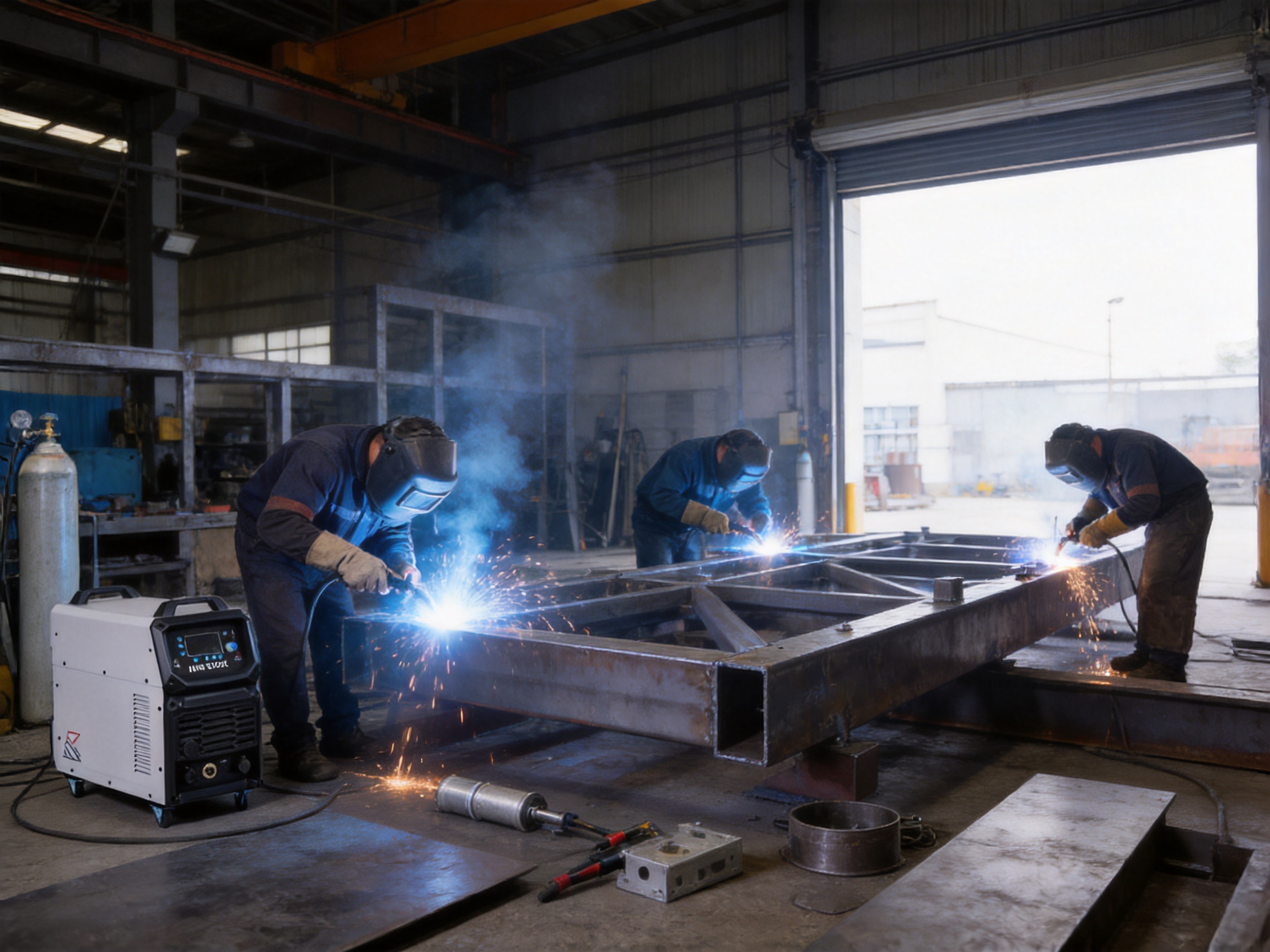
The high-current output and MIG/MAG capability make these machines suitable for structural components, frames, brackets, platforms, supports, and general steel assemblies. The 500A model is particularly appropriate for heavy sections and long welds where a higher output reserve can improve deposition rates.
The MMA function is useful for tack welding, repair work, difficult access areas, and outdoor installation. Flux-cored welding can provide another practical option for large structures assembled outside the controlled environment of a workshop.
Stainless steel fabrication demands careful control of heat input, shielding, cleanliness, and consumables. Pulse MIG can help the operator manage heat and transfer characteristics, while digital parameter adjustment makes it easier to refine the process for different stainless grades and thicknesses.
Suitable stainless wire, shielding gas, liner, contact tip, and torch components must be selected. Carbon-steel contamination should be avoided by using properly prepared tools and dedicated cleaning materials where necessary.
The product description identifies aluminum-magnesium and aluminum-silicon materials among the supported applications. Aluminum welding requires specialized preparation because the metal has high thermal conductivity, a tenacious oxide layer, and a relatively low melting point compared with the oxide surface.
Successful aluminum MIG welding generally requires an appropriate aluminum wire, suitable drive rolls, a liner or linerless torch arrangement designed for aluminum, proper shielding gas, correct contact-tip sizing, and controlled wire feeding. Pulse MIG can be beneficial in aluminum applications because it supports controlled droplet transfer and heat management.
Maintenance departments often need one machine for many types of repair. The ability to use solid wire, flux-cored wire, and stick electrodes means the machine can adapt to workshop repairs, field maintenance, machinery restoration, and emergency fabrication.
The 350K may be especially practical for mobile maintenance teams because of its lower weight. The 500K can serve centralized maintenance shops that routinely repair large frames, thick components, industrial vehicles, or heavy equipment.
Manufacturers of agricultural equipment, construction machinery, trailers, frames, and industrial machinery require repeatable welding parameters and reliable arc performance. Digital operation can support production standardization, while pulse and conventional MIG modes provide flexibility for different assemblies.
The machine’s multiple control parameters also help accommodate changes in plate thickness, joint design, and material grade. Production engineers can develop setup tables for frequently welded components, reducing trial and error on the shop floor.
The equipment is produced by Zhejiang Kende Mechanical & Electrical Co., Ltd., a Chinese manufacturer with a substantial product portfolio covering welding machines, battery chargers, and heaters. The company is located in Taizhou, Zhejiang Province, and operates a facility covering approximately 120,000 square meters with around 600 employees.
The company reports annual exports of nearly 1.5 million units and annual production capacity of approximately 2 million units. Such scale can provide advantages in procurement, manufacturing organization, quality systems, component sourcing, and after-sales support. It also indicates experience serving multiple regional markets with different technical requirements.
The manufacturer’s product range includes MMA or stick welders, MIG/MAG machines, gasless flux-cored welding machines, TIG welding machines, plasma cutters, stud welders, submerged arc welding systems, battery chargers, and electric, gas, and oil heaters.
This breadth is relevant to industrial customers because the company is not limited to one welding process. Experience across multiple equipment categories can contribute to a better understanding of power electronics, thermal management, control systems, motorized wire feeding, electrical protection, and product certification.
The company also states that it can develop new products according to the needs of different countries, regions, and customers. Customization may include electrical configurations, labeling, documentation, packaging, process functions, and market-specific compliance requirements, subject to technical feasibility and commercial agreement.
The manufacturer reports operating a Zhejiang Provincial Research and Development Center, an Enterprise Technology Center, and an Intelligent Welding Technology Research Institute. It also identifies approximately 98 research and development personnel.
These resources support continued development of inverter power supplies, intelligent welding controls, process programming, thermal systems, and production automation. An established R&D structure is valuable in a rapidly changing welding market where customers increasingly expect digital control, energy efficiency, compact construction, and process integration.
The company reports holding numerous invention patents, utility model patents, appearance patents, and software copyrights, with nearly 200 patents referenced in its company description. Intellectual property alone does not guarantee product performance, but a significant patent and software portfolio can indicate sustained investment in engineering and product improvement.
Digital welding equipment depends on both hardware and software. Power modules, sensors, control boards, display systems, parameter algorithms, and protective functions must operate together. In-house development capability can help the manufacturer optimize these elements as a complete system.
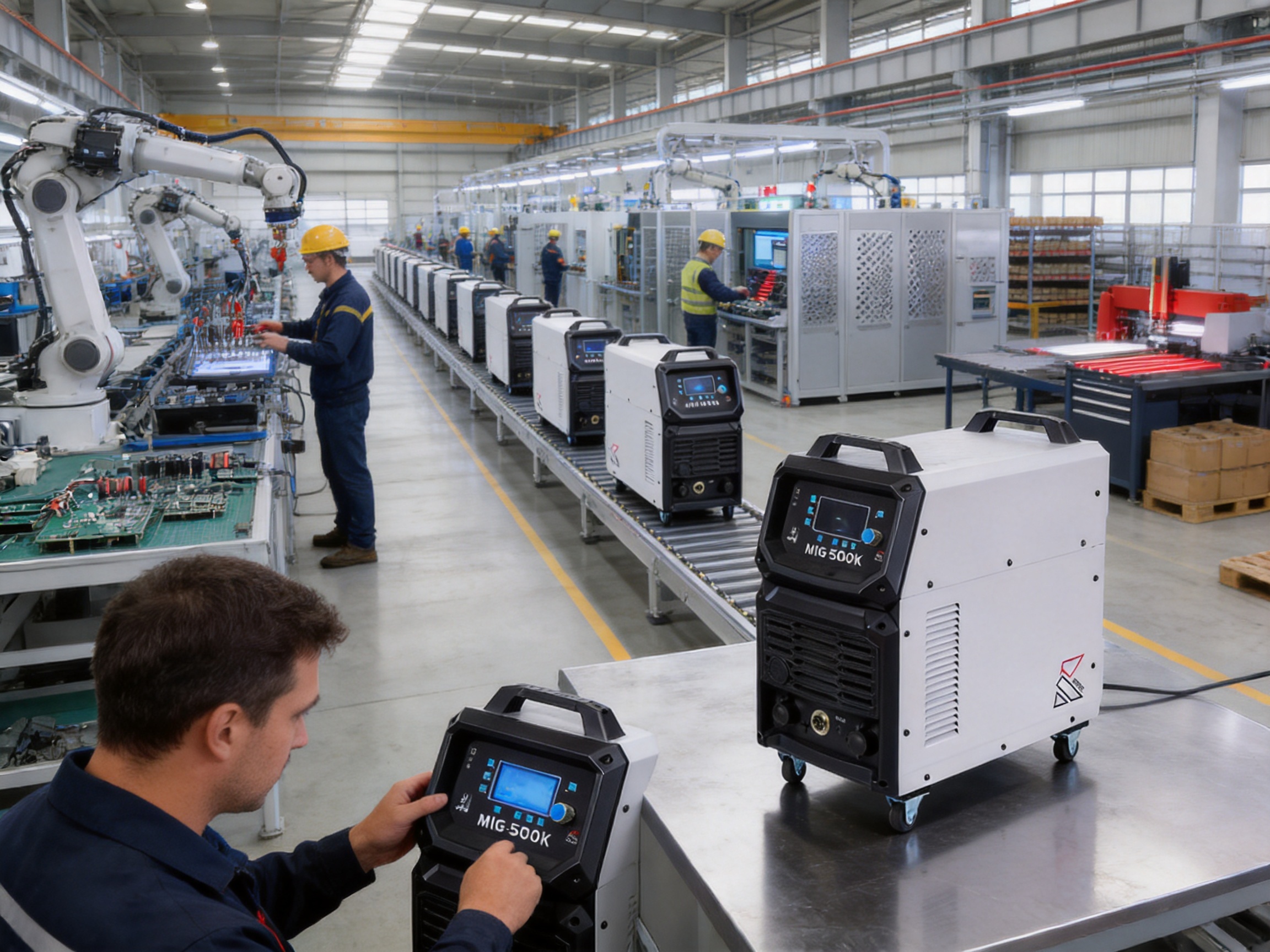
The producer reports using advanced management and manufacturing systems, including office automation, Toyota Production System methods, ERP K3, and MES management systems. These tools can connect planning, purchasing, production, traceability, inventory, quality control, and delivery activities.
The use of automatic patching and plug-in systems supports consistent placement and soldering of electronic components. Inverter welding machines contain control boards and power electronics that require reliable assembly. Automated processes can reduce placement errors and improve repeatability when combined with inspection and process verification.
Electronic assembly quality is important because a welding power source operates under electrical and thermal stress. Correct component placement, solder integrity, insulation, and board protection all contribute to long-term reliability.
Robot processing can improve consistency in repetitive manufacturing operations. Robots may be used for handling, welding, assembly, or other production stages depending on the product and line design. Automation helps reduce variation and can improve worker safety by limiting exposure to repetitive or hazardous tasks.
The company also reports the use of laser cutting technology. Laser cutting can produce accurate sheet-metal components with repeatable dimensions and clean edges. Consistent enclosure panels and brackets contribute to a better fit during assembly and help maintain product quality across large production volumes.
A manufacturing execution system can provide visibility into production status, work orders, process steps, material usage, inspection results, and equipment performance. When applied effectively, MES systems help identify quality trends and support corrective action.
For international customers, manufacturing traceability can also improve confidence in batch consistency. It allows the producer to connect products with specific production periods, components, inspection records, and packaging information where the system is configured to retain those records.
The company reports holding several international product certificates and compliance marks, including GS, CE, EMC, ERP, US ETL, UKCA, and China CCC. The exact applicability of each certification depends on the specific model, voltage version, market, and product configuration. Buyers should request current certificates and declarations for the exact machine being ordered.
Certification is important because welding machines are electrical products used in environments where electromagnetic compatibility, electrical safety, energy performance, and mechanical protection matter. Market-specific documentation can support import clearance, workplace compliance, distributor registration, and customer acceptance.
The company also reports participation in the drafting, formulation, and revision of 20 national standards and leadership in drafting one group standard through its role connected with China’s welding machine standardization activities. Participation in standards work can provide manufacturers with useful technical insight into evolving safety and performance expectations.
These are industrial three-phase machines specified for 380 V and 50 Hz supply. Before installation, the purchaser should confirm the available electrical service, upstream circuit protection, grounding arrangement, cable size, phase balance, and local regulations. The 500K has a rated input capacity of 30 kVA and a rated supply current of 46A, so its installation requirements are considerably greater than those of a small single-phase workshop welder.
The machine should be installed in a dry, adequately ventilated location with sufficient clearance around air inlets and outlets. Dust, metal particles, oil vapor, and moisture can shorten the life of electronic equipment. The enclosure’s IP21S rating should not be interpreted as protection against water jets, rain, flooding, or heavy contamination.
Welding cables should be selected according to current, length, duty cycle, and applicable standards. Undersized or excessively long cables can cause voltage drop, heat buildup, and reduced welding performance. The work clamp should make clean, secure contact with the workpiece or welding table.
For MIG/MAG operation, the wire feeder, torch, liner, drive rolls, contact tip, gas regulator, and shielding gas hose must be matched to the process. Gas flow should be set appropriately for the torch, nozzle, joint, and working environment. Excessive flow can cause turbulence and draw air into the shielding zone, while insufficient flow can lead to porosity.
For flux-cored operation, the correct wire polarity and consumable type must be confirmed. For MMA operation, electrode storage and condition are important, particularly for low-hydrogen electrodes. Operators should follow the electrode manufacturer’s recommendations for storage, drying, current, and polarity.
Regular maintenance helps preserve arc performance and extend equipment life. The machine should be disconnected from power before internal service. Only qualified personnel should open the enclosure or work on high-voltage components.
External maintenance includes checking cables for cuts, burned insulation, loose connections, and excessive heat marks. The torch should be inspected for worn contact tips, damaged liners, blocked gas passages, and nozzle spatter. Wire-feed components should be cleaned and adjusted so that the wire moves smoothly without excessive pressure.
Ventilation openings should be kept clear. In dusty environments, cleaning intervals may need to be shortened. Compressed-air cleaning should be performed carefully because excessive pressure or moisture can damage electronic components or force contamination deeper into the machine.
Operators should monitor unusual fan noise, repeated thermal protection, unstable output, display errors, abnormal odor, or unexplained changes in arc behavior. Early attention to these symptoms can prevent more serious failures and reduce unplanned downtime.
Welding produces ultraviolet radiation, infrared radiation, intense visible light, fumes, heat, sparks, and electrical hazards. Operators must use a correctly rated welding helmet, flame-resistant clothing, gloves, safety footwear, and suitable eye protection. The work area should be screened to protect nearby personnel from arc radiation.
Ventilation or local fume extraction is necessary to control welding fumes. The correct approach depends on the material, coatings, consumables, process, and workplace layout. Painted, galvanized, oily, or chemically treated materials may release hazardous substances when heated and should be cleaned or assessed before welding.
Flammable materials, pressurized containers, fuel, and combustible dust should be removed from the work area. Fire-watch procedures may be required when welding near hidden spaces, walls, floors, or other locations where sparks can travel. Gas cylinders must be secured upright and protected from impact and heat.
Electrical safety is equally important. The welding circuit, power supply, work clamp, cables, and grounding system must be properly configured. Operators should not weld in wet conditions or handle energized components. Any internal repair should be performed by trained service personnel using appropriate lockout and verification procedures.
The 350K is a strong choice for general industrial fabrication, maintenance, equipment repair, and workshops that value lower weight and moderate installation requirements. It provides up to 350A in both MIG and MMA operation and is suitable for a wide range of steel, stainless steel, and compatible aluminum applications when correctly configured.
The 500K is more appropriate for heavy fabrication, large structural components, thick material, long welds, and production environments where additional current capacity can improve productivity. Its higher input demand, larger dimensions, and greater weight should be considered during electrical planning and material handling.
Buyers should evaluate more than maximum current. Important factors include actual duty cycle, typical material thickness, welding position, wire diameter, process mix, available electrical supply, required portability, accessory compatibility, service support, certification, and total cost of ownership.
A machine should be selected according to normal operating requirements rather than occasional peak demand. Oversizing can increase purchase and installation costs, while undersizing can lead to thermal interruptions, lower productivity, and premature wear if the machine is constantly operated at its limits.
The value of a multi-process inverter welder comes from the work it can perform over its service life. A single machine supporting pulse MIG, conventional MIG/MAG, gasless flux-cored welding, and MMA can replace or supplement several specialized machines. This can reduce floor-space requirements and simplify operator training.
Digital controls may also reduce setup time and help standardize recurring jobs. More consistent settings can reduce rework, grinding, consumable waste, and production interruptions. Energy efficiency can contribute to lower electrical operating costs, especially in facilities with significant welding hours.
Serviceability, spare-part availability, documentation, and distributor support should be included in the purchasing assessment. A competitively priced machine that is difficult to service may cost more over time than equipment supported by a strong manufacturer and established supply network.
The machine can support a structured quality program by providing repeatable process settings. Welding supervisors can establish approved parameter ranges for each material and joint type. Operators can be trained to verify wire, gas, polarity, current, voltage, and travel speed before beginning production.
Visual inspection should check bead appearance, profile, fusion, undercut, overlap, porosity, cracks, crater filling, and spatter. Where required by the application, additional inspection methods such as dye penetrant, magnetic particle, ultrasonic, or radiographic testing may be used.
Procedure qualification and welder qualification requirements depend on the industry, material, component, and governing standard. Digital control supports compliance work but does not replace formal qualification, inspection, or engineering review.
The product supports pulse MIG, DC MIG/MAG, no-gas shielded flux-cored wire welding, and MMA or stick welding. This combination allows the machine to serve gas-shielded, gasless, and electrode-based applications.
The MIG-350K provides up to 350A in MIG and MMA operation, while the MIG-500K provides up to 500A in MIG and 480A in MMA. The 500K also has greater input capacity, higher rated supply current, a larger enclosure, and greater weight.
The product information identifies aluminum-magnesium and aluminum-silicon materials among the supported applications. Aluminum welding requires compatible wire, drive rolls, liner, torch components, shielding gas, polarity, and carefully selected parameters. The complete configuration should be confirmed before ordering.
Yes. It supports no-gas shielded flux-cored wire welding. This mode is useful outdoors or where using a shielding gas cylinder is inconvenient. The correct flux-cored wire and polarity must be used.
Yes. Both models include an MMA function. The MIG-350K has an MMA range of 20A to 350A, and the MIG-500K has an MMA range of 20A to 480A.
A 60 percent duty cycle generally indicates six minutes of welding within a ten-minute test period at the specified rated condition, followed by cooling. The exact conditions should be confirmed in the official manual, and actual performance varies with current, ambient temperature, ventilation, and process.
The published specifications identify a three-phase 380 V, 50 Hz supply for both models. The 350K has a rated input capacity of 15 kVA and a rated supply current of 23A. The 500K has a rated input capacity of 30 kVA and a rated supply current of 46A. Electrical installation should be completed according to local regulations by qualified personnel.
The LCD screen, touch buttons, and encoder provide a clear method for selecting and adjusting parameters. They can make setup more intuitive and improve repeatability, although operators still require training in welding processes and safe machine operation.
The machine is specified for ordinary carbon steel, alloy steel, stainless steel, and other compatible materials. The product description also includes aluminum-magnesium and aluminum-silicon applications. Material compatibility depends on consumables, process configuration, shielding gas, joint preparation, and procedure settings.
The 350K weighs approximately 23 kilograms, making it relatively manageable for an industrial machine of its capacity. The 500K weighs approximately 41 kilograms and is designed more for heavy-duty shop or fixed-location use, although it can still be moved with suitable handling equipment.
Both models are listed with an IP21S degree of protection and Class H insulation. They should be kept dry, properly ventilated, and protected from rain, flooding, excessive dust, and conductive contamination.
The product is manufactured by Zhejiang Kende Mechanical & Electrical Co., Ltd., a Taizhou-based producer of welding machines, battery chargers, and heaters. The company reports extensive export activity, large-scale production capacity, R&D facilities, patents, and international product certifications.
The buyer should confirm the exact model, input voltage and frequency, process functions, wire-feeder arrangement, supplied accessories, certifications, duty-cycle conditions, dimensions, warranty, spare parts, and documentation. These details should be verified for the specific order rather than assumed from a general product family description.
The 350A and 500A industrial digital MIG welding machines provide a flexible solution for workshops and production environments that need more than basic wire welding. Their combination of microprocessor control, IGBT inverter technology, LCD operation, encoder adjustment, pulse MIG, conventional MIG/MAG, gasless flux-cored welding, and MMA capability gives users a broad operating range from one platform.
The MIG-350K offers a practical balance of output and mobility for general industrial fabrication, repair, maintenance, and mixed-material work. The MIG-500K provides greater current capacity and power reserve for heavy fabrication, thicker materials, and demanding production schedules. Both models are specified with an 85 percent efficiency rating, 0.9 power factor, 60 percent duty cycle, IP21S protection, and Class H insulation.
The manufacturer strengthens the product proposition through large-scale production, a broad product portfolio, dedicated research and development facilities, reported patent activity, international certifications, and advanced manufacturing systems. Automated electronic assembly, robot processing, laser cutting, ERP, MES, and Toyota Production System practices support consistent production and ongoing product development.
For the end user, the main advantages are process flexibility, repeatable digital settings, high current output, efficient inverter construction, and the ability to use one machine for many fabrication requirements. Correct installation, suitable accessories, qualified operators, safe working practices, and proper maintenance remain essential for achieving the expected performance.
Zhejiang Kende Mechanical & Electrical Co., Ltd. Product technical information for MIG-350K and MIG-500K industrial digital MIG welding machines.
Zhejiang Kende Mechanical & Electrical Co., Ltd. Corporate information concerning production capacity, research and development, manufacturing systems, certifications, patents, and product categories.
International Electrotechnical Commission. Welding power sources: safety and performance principles for arc welding equipment.
International Organization for Standardization. Quality requirements for fusion welding of metallic materials.
American Welding Society. Welding processes, consumable selection, safety practices, and inspection principles.
Manufacturer operating manuals and technical documentation for the applicable machine configuration.
Recommended Products

Contact Us
No.2299, Luqiao Section, Shugang Avenue, Luqiao District, Taizhou, 318057 Zhejiang, PR China.
+86-576-82431568
 Privacy
China Welding Machine Factory
 English
 中文简体
 русский
 Español
 عربى
 Français
 Português
 Deutsch
 Український