Email: [email protected]
Email: [email protected]

Blog
 2026.06.24
 Blog
Blog
Plastic parts are everywhere in modern vehicles, household equipment, workshop tools, electrical housings, garden products, motorcycles, scooters, appliances, and do-it-yourself projects. When a bumper, dashboard bracket, lamp holder, radiator frame, plastic ring, fairing, or housing cracks, replacement can be expensive, time-consuming, and wasteful. A compact plastic welder offers a practical alternative: it reinforces the damaged area from inside the material, restores structural strength, and helps extend the service life of parts that might otherwise be discarded.
The 50W Plastic Welder, Plastic Welding Kit, Hot Stapler Kit with 200PCS staples is designed for exactly this kind of repair work. It is a lightweight, easy-to-control, hand-operated Mini Welding Machine for plastic repair, combining portability, controlled heating, staple reinforcement, and user-friendly handling. With a maximum power of 50W, AC 230V input, 50Hz frequency, 0-3V output voltage, and 0-15A output current, it provides the concentrated heating needed to embed repair staples into cracked or broken plastic components.
Unlike large industrial plastic welding systems that require a dedicated bench, long training, and higher investment, this hot stapler kit is built for accessible repair. The operator can quickly position the heated staple across a crack, allow it to sink into the plastic, trim the excess, and finish the surface. The result is a strong internal reinforcement that helps the repaired part resist vibration, shock, twisting, and daily wear.
.jpg)
50W Plastic Welder, Plastic Welding Kit, Hot Stapler Kit, 200PCS Staples, Plastic Welder Gun
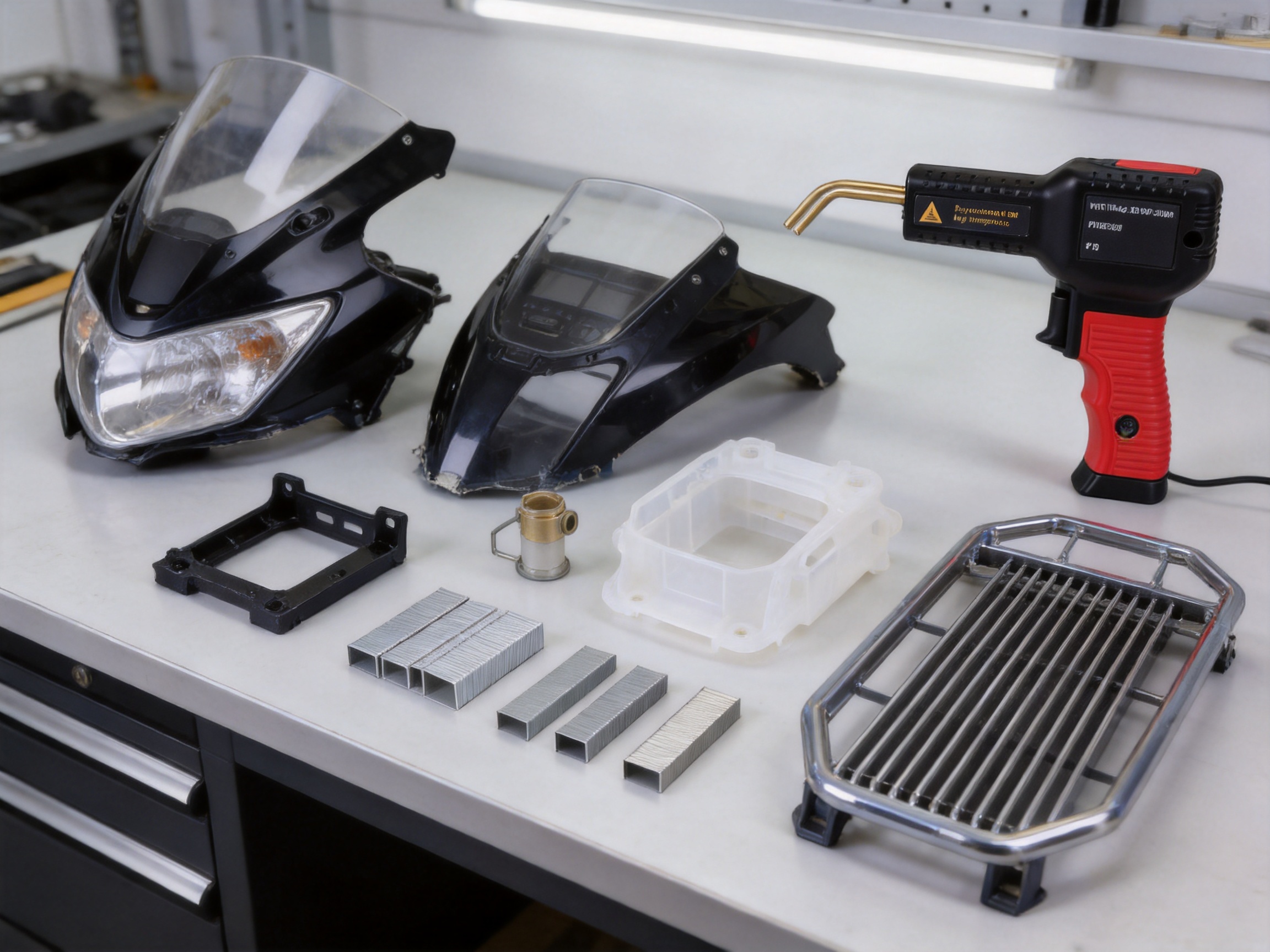
The 50W plastic welder is developed for users who need a compact, reliable, and simple solution for plastic crack repair. It is suitable for automotive repair shops, body repair technicians, motorcycle maintenance, home workshops, maintenance departments, and DIY users. Its function is not limited to one type of part; it can be used on car bumpers, dashboards, lamp holders, plastic rings, radiators, plastic casings, and a wide variety of everyday plastic products.
The product is supplied as a plastic welding kit with a hot stapler gun and a total of 200 staples in different shapes and sizes. These staples allow the user to select the right reinforcement form for flat cracks, outside corners, inside corners, and more complex shapes. The included staples help the repair adapt to different geometries rather than forcing the operator to use a one-size-fits-all approach.
At only approximately 0.53 kg, the unit is light enough for comfortable long-term handling. The dimensions of 220 x 154 x 42 mm make it compact for storage and portable for on-site repair work. The packing case further improves convenience, keeping the machine and accessories organized and ready for transport.
A maximum temperature of 400C° gives the unit the thermal ability to heat repair staples effectively. The power output is controlled within the intended operating range for plastic repair, helping users embed staples without relying on oversized heating equipment. The spacing between torch centers is 13 mm, supporting consistent staple positioning during repair.
Plastic replacement is often more expensive than many users expect. A damaged bumper cover, dashboard mounting tab, lamp support, or fairing panel may not be structurally complicated, but sourcing and replacing it can require time, painting, fitting, and labor. In many cases, the damage is limited to a crack or broken joint, while the rest of the component remains usable. Repairing the part instead of replacing it can reduce cost, shorten downtime, and decrease material waste.
The environmental value is also important. Plastic parts are often difficult to recycle in a way that fully recovers their original value. Extending their working life helps reduce disposal, lowers demand for new parts, and supports more sustainable maintenance practices. For workshops, being able to repair rather than replace also adds a valuable service option for customers who want economical and practical solutions.
The 50W plastic welder supports this repair-first approach. It does not simply melt the surface; it mechanically reinforces the crack with heated metal staples. This method is especially useful for parts exposed to vibration or movement because the staple bridges the damaged area and distributes stress across a wider zone. When the surface is finished properly, the repair can be strong, neat, and long-lasting.
Traditional plastic repair methods include glue, adhesive mesh, chemical filler, soldering irons, hot air guns, and full part replacement. Each method has a place, but each also has limitations. Adhesives may fail under vibration or heat if surface preparation is imperfect. Fillers can restore shape but may not provide enough internal strength. Hot air tools can work well but often require more experience to avoid overheating, distortion, or uneven bonding. Replacement is reliable but expensive.
The hot stapler method offers a more direct reinforcement solution. The heated staple enters the plastic across the crack, creating a physical bridge. After cooling, the embedded staple remains inside the material and resists separation. This gives the repair structural support even before surface finishing is applied. The process is fast, repeatable, and easy to understand, which makes it attractive for both professional and non-professional users.
Compared with basic soldering irons, this plastic welder is shaped and configured specifically for staple insertion. The ergonomic gun-style handle gives better control than a generic heating tool. The spacing and staple compatibility help the user place reinforcements consistently. The supplied accessories also reduce the need to search for matching repair staples separately.
Compared with larger industrial plastic welding machines, the 50W kit is more portable and easier to store. It does not require compressed air, a complex control panel, or a large working area. For many daily repairs, especially cracked automotive plastic parts, this compact Mini Welding Machine provides a better balance of cost, portability, and practical strength.
A repair tool must be easy to hold, especially when the operator needs to control the position of a hot staple precisely. This plastic welding gun uses a scientific ergonomic design with a comfortable rubber handle. The handle shape helps reduce fatigue during repeated repairs and provides better grip control for careful staple placement.
Ease of use is one of the product’s strongest advantages. The operation does not require long training. The user selects a staple, inserts it into the welding gun tips, positions the staple across the damaged area, presses the trigger or activates heating according to the tool operation, allows the staple to heat and enter the plastic, releases, waits briefly for cooling, and then trims the protruding staple ends. Surface finishing can then be completed with sanding, filling, or refinishing if needed.
This simple workflow is valuable in workshops where speed matters. A technician can repair mounting tabs, cracks, and plastic brackets without setting up a large machine. For DIY users, the low learning barrier makes the kit practical for home projects, vehicle maintenance, and hobby repair.
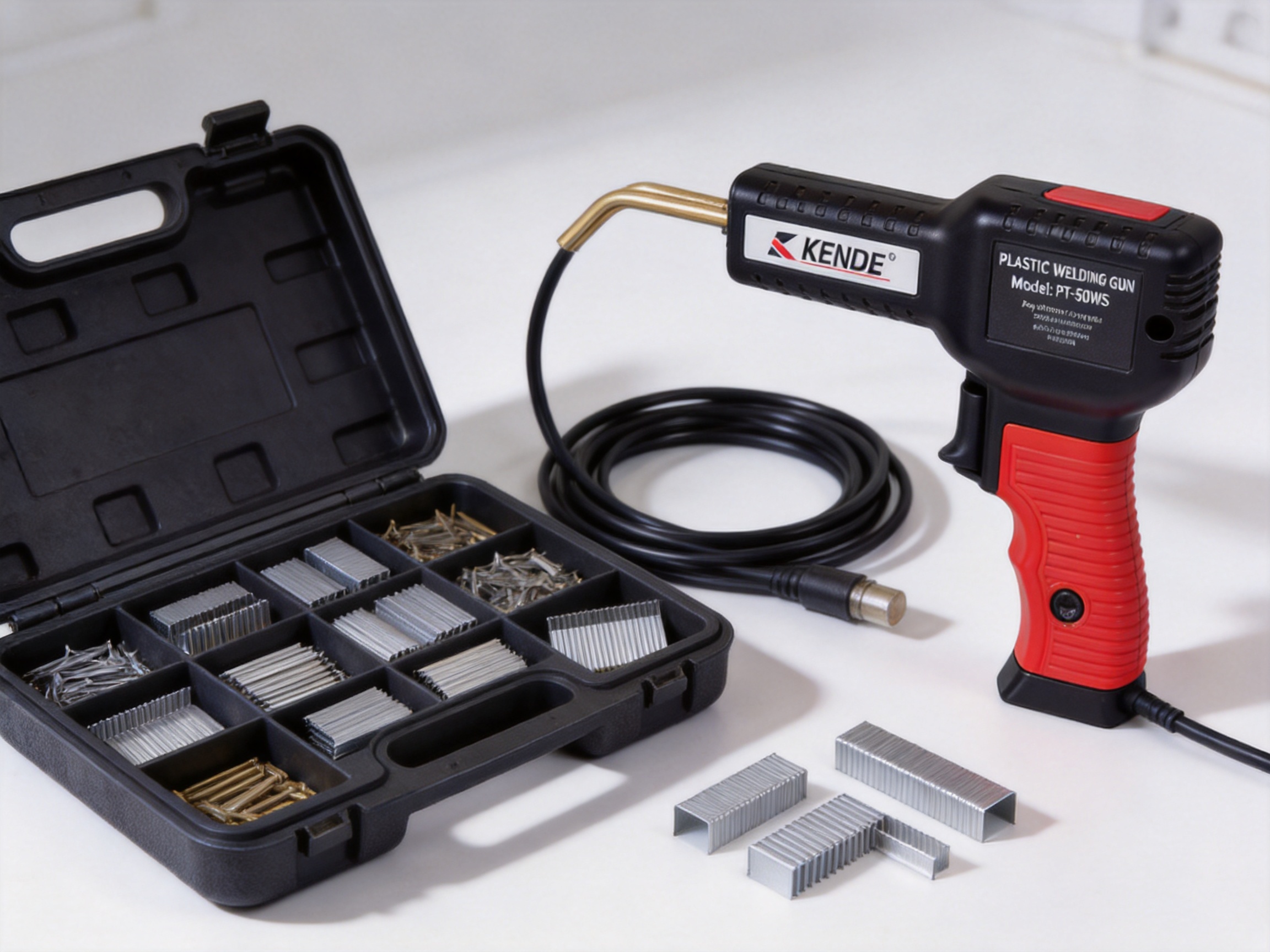
The specifications show that the product is designed as a compact, purpose-built plastic repair tool. It has enough power for hot staple repair while remaining lightweight and convenient to handle.
|
Model Name |
PW 50D |
|
Product Type |
50W Plastic Welder / Hot Stapler Kit |
|
Input Voltage |
AC 230V |
|
Frequency |
50Hz |
|
Maximum Temperature |
400C° |
|
Dimensions |
220 x 154 x 42 mm |
|
Weight |
0.53 kg |
|
Power |
Maximum 50W |
|
Output Voltage |
0-3V |
|
Output Current |
0-15A |
|
Spacing Between Torch Centers |
13 mm |
|
Power Cable |
2 m cable, H05VH2-F 2 x 0.75 mm2 |
|
Accessories |
200PCS staples, including flat clips, outside corner clips, and inside corner clips |
|
Packing |
Case |
|
Packing Size |
286 x 240 x 47 mm |
Automotive plastic repair is one of the most important uses for this product. Modern vehicles use plastic extensively for exterior trim, interior structures, lighting supports, ventilation parts, and under-hood components. Many of these parts are subject to vibration, impact, temperature changes, and repeated handling. Cracks are common, especially around mounting points and corners.
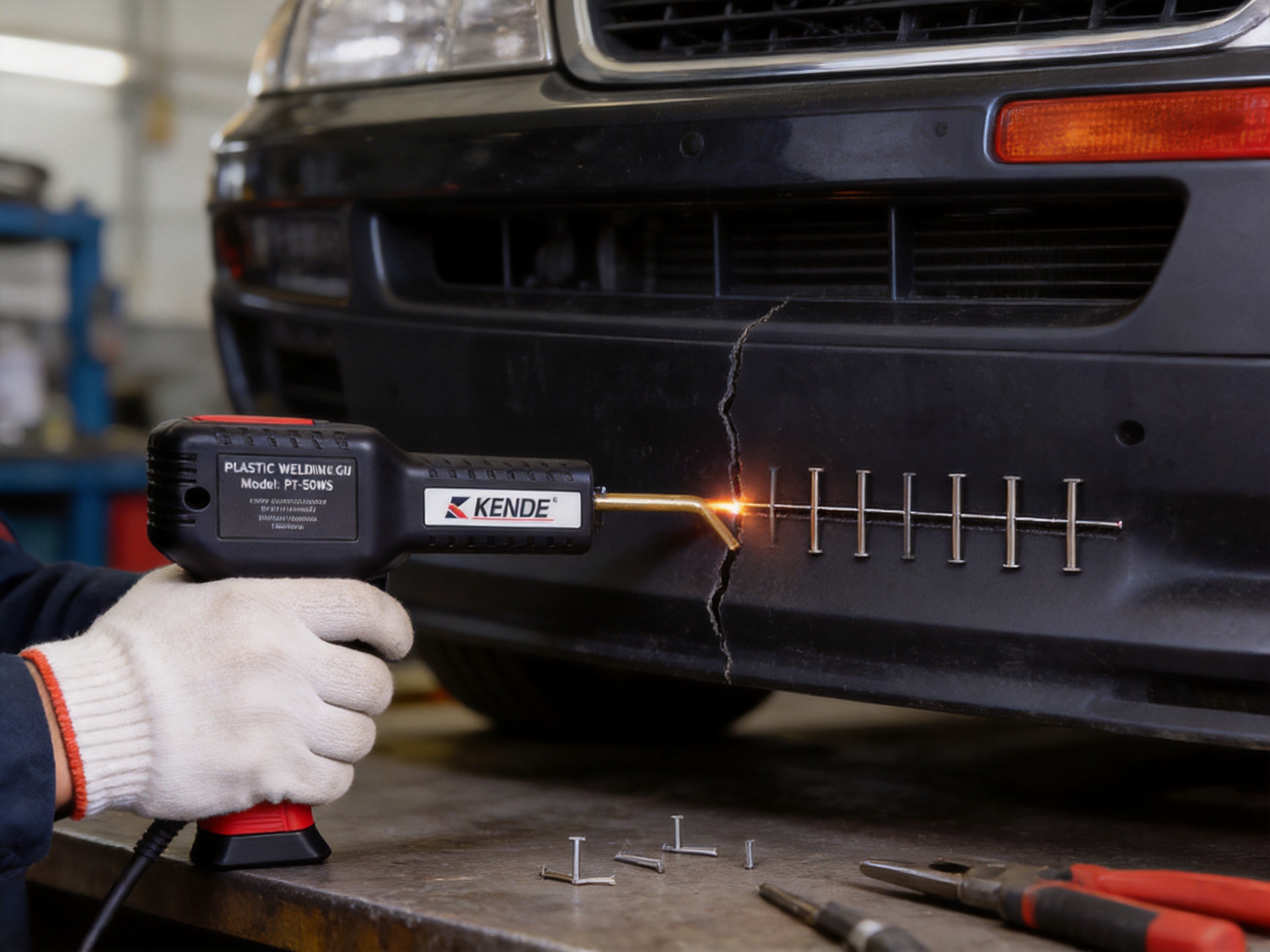
A cracked bumper cover can often be repaired from the back side using staples placed perpendicular to the crack. After the internal reinforcement is completed, the outer surface can be finished and painted if needed. This can save the cost of purchasing a new bumper cover and reduce the time required for ordering replacement parts.
Dashboard and interior trim repairs are also practical. Broken tabs and cracked brackets can make an interior panel loose or noisy. By using the hot stapler to reinforce the damaged zone, the technician can restore the mounting strength and reduce rattles. Since many interior parts are expensive or difficult to source for older vehicles, the ability to repair them is highly valuable.
Lamp holders and headlight brackets are another common application. A small broken mounting point may make an otherwise usable light assembly unstable. Replacing the entire lamp unit may be costly. A hot stapler repair can reinforce the broken bracket and help restore proper installation.
Motorcycle and scooter fairings also benefit from this repair approach. Fairing panels often crack around fastener holes and edges. The 50W plastic welder is light enough to use in detailed areas and can apply small reinforcements without requiring large equipment.
Although automotive repair is a major use case, the tool is not limited to vehicles. It is suitable for repairing many plastic items used in homes, workshops, farms, and commercial facilities. Plastic storage boxes, tool housings, garden equipment covers, appliance panels, toys, recreational products, and custom DIY plastic assemblies can all be candidates for repair depending on the plastic type and damage condition.
Maintenance departments can use the kit to extend the life of plastic guards, covers, and brackets. Instead of discarding a component after a crack appears, the team can reinforce it quickly and return it to service. This can be especially useful when replacement parts have long delivery times.
For DIY users, the product encourages practical creativity. Broken plastic rings, frames, and household parts can be repaired at home. The compact case makes storage simple, and the tool can be brought out whenever a repair is needed. This convenience helps make plastic repair a normal part of household maintenance rather than a specialized industrial task.
Safety is essential for any tool that uses heat and electrical power. This plastic welding gun includes internal overheating protection. If overheating occurs, the tool stops working and can be used again after the temperature is reduced. This design helps protect the tool and supports safer operation.
The low output voltage range of 0-3V and controlled output current range of 0-15A are appropriate for the hot staple function. The device is designed to heat the staple rather than operate as a general-purpose high-voltage tool. The power cable is 2 meters long, giving the user enough working reach while maintaining manageable cable control.
Users should still follow standard precautions. The staple becomes hot during operation and can burn skin or damage surfaces if mishandled. The tool should be used in a stable working area, away from flammable materials. Eye protection is recommended when trimming staple ends. Ventilation is also important because heating plastic may release fumes depending on the material. The repaired part should be allowed to cool before handling or finishing.
The hot staple repair process is based on a simple mechanical principle. A metal staple is heated by the welding gun and then pressed into the plastic across the crack. As the plastic softens around the heated staple, the staple sinks into the part. When the plastic cools, it hardens around the staple, locking it in place. The staple acts like an internal bridge that holds both sides of the crack together.
The first step is cleaning the damaged area. Dirt, grease, and loose fragments should be removed. If the crack is under tension, the part should be aligned correctly before reinforcement. Clamps or tape may be used to hold the shape temporarily.
The second step is choosing the correct staple type. Flat staples are useful for straight cracks and flat areas. Outside corner staples are useful for outer edges and angled parts. Inside corner staples are useful where the crack occurs on an internal angle or recessed section. Selecting the right staple improves repair strength and makes insertion easier.
The third step is insertion. The staple is placed into the tool tips and positioned across the crack. The operator applies heat and pressure until the staple enters the plastic to the desired depth. It should be embedded enough to hold securely but not pushed completely through the visible surface unless the repair plan allows for that.
The fourth step is cooling and trimming. After insertion, the staple is allowed to cool. The protruding ends are cut off with suitable cutters. The surface can then be sanded, filled, or refinished. For hidden parts, finishing may be minimal. For visible automotive panels, additional cosmetic work may be needed.
The 50W Plastic Welder stands out because it focuses on the needs of real repair work: portability, comfort, reliable heating, accessory readiness, and user safety. Some competing tools are either too basic, with limited accessory support and less comfortable handling, or too complex, with functions that increase cost without improving common crack repairs. This kit provides a practical middle ground.
One competitive advantage is the ergonomic handle. Plastic repair often requires precision and patience, especially when reinforcing irregular shapes. A comfortable rubber grip improves control and reduces fatigue. Low-cost alternatives may have hard handles or less balanced designs, which can make accurate placement more difficult during repeated repairs.
Another advantage is the included 200PCS staple set. A hot stapler is only as useful as the staples available for it. By including different staple types, the kit is ready for multiple repair conditions. Users do not need to immediately purchase separate staple packs to begin common repairs.
The internal overheating protection is also a strong advantage. Lower-quality tools may rely only on operator judgment, increasing the risk of overheating during extended use. Built-in protection helps preserve tool life and improves confidence, especially for users who are not professional repair technicians.
The compact weight of 0.53 kg gives the product a practical advantage over heavier repair devices. A lighter tool is easier to control, easier to transport, and more suitable for working around vehicles and irregular parts. It can be used in a body shop, garage, maintenance room, or home workspace without requiring a dedicated installation area.
The maximum 50W power rating is well matched to the tool’s function. More power is not always better in plastic repair. Excessive heat can deform plastic, burn surfaces, or create more finishing work. The product’s controlled heating is suitable for staple embedding, making it more practical for many users than oversized heating equipment.
The product is supported by the manufacturing experience of Zhejiang Kende Mechanical and Electrical Co., Ltd., a large-scale manufacturer and exporter of welding machines, chargers, heaters, and related equipment. The company operates from Taizhou, Zhejiang Province, China, with a modern production base covering approximately 120,000 square meters and a workforce of around 600 employees. This scale provides strong support for stable production, quality control, and international supply.
The company exports nearly 1.5 million units annually and has an annual production capacity of approximately 2 million units. Such production capability is important because it reflects not only factory size but also supply chain organization, process repeatability, and experience in meeting the requirements of different markets. For a compact tool such as a plastic welder, consistent assembly and component control are essential to long-term reliability.
The company has extensive experience in product development and manufacturing across many categories, including MMA or stick welding machines, MIG/MAG gas-shielded welding machines, TIG arc welding machines, CUT plasma arc cutting machines, submerged arc welding systems, battery chargers, and electric, gas, and oil heaters. This wide technical background strengthens the development of compact repair tools because the company already understands electrical safety, thermal control, ergonomic design, and durable tool construction.
Advanced manufacturing systems are a major part of the company’s strength. The factory applies office automation, Toyota-style production management, ERP systems, and MES manufacturing management. These systems support planning, traceability, inventory coordination, production scheduling, and quality consistency. In competitive manufacturing, a good product is not only a design; it is also the result of disciplined production control.
The use of automatic patching, plug-in and welding systems, robot processing, laser cutting, and other advanced technologies further improves manufacturing precision and efficiency. Even for compact products, modern production equipment can improve repeatability, reduce human error, and support stable output quality. This is one reason the company can serve both domestic and international customers with broad product lines.
Strong research and development capability is another important advantage. The company has a Zhejiang Provincial R&D Center, an Enterprise Technology Center, and an Intelligent Welding Technology Research Institute. It has a dedicated R&D team and holds numerous patents, including invention patents, utility model patents, appearance patents, and software copyrights. This innovation foundation helps the company continuously improve product structure, usability, safety, and performance.
For the 50W plastic welder, R&D strength matters in several ways. The heating structure must be practical and stable. The handle must be comfortable and safe. The tool must be easy to manufacture at scale while maintaining quality. The accessory system must match common repair applications. Overheating protection must be integrated in a way that supports safe operation without making the product difficult to use.
Innovation is especially important because repair markets evolve. As vehicles and appliances use more plastic components, users need tools that are compact, affordable, and capable of producing strong repairs. A company with long-term development capability can respond to these market needs more effectively than a supplier that only copies existing designs.
International product acceptance requires attention to safety, electrical performance, and regulatory expectations. The company holds many international product certificates across its product range, including GS, CE, EMC, ERP, US ETL, UKCA, and China CCC. These certifications demonstrate experience with compliance requirements in different regions and support confidence in the company’s quality management culture.
The company is also one of the national standard drafting units of the National Welding Machine Standardization Committee and has participated in the drafting, formulation, and revision of multiple national standards. This standards experience is meaningful because it shows deep involvement in the technical framework of welding equipment manufacturing. A manufacturer that understands standards can better design products for safety, consistency, and market acceptance.
While a compact plastic welder is different from a large industrial arc welding machine, the same manufacturing discipline applies. Electrical tools must be built with controlled materials, correct assembly, safe wiring, and dependable thermal behavior. Standards awareness helps guide these details from design through production.
The term Mini Welding Machine often brings to mind small arc welders for metal, but in the context of repair work, a compact plastic welder performs a similar role for plastic materials. It brings welding-style reinforcement into a small hand tool that can be used on parts too delicate, too small, or too inconvenient for large equipment.
Modern workshops increasingly need flexible tools. A technician may repair metal brackets, plastic covers, electrical housings, and vehicle trim in the same day. Having a compact plastic welding kit expands the range of services a workshop can provide. It allows technicians to handle plastic damage without outsourcing or replacing parts unnecessarily.
The 50W plastic welder is especially useful because it is easy to store in a case, quick to set up, and suitable for common repair tasks. It does not require a large bench or complicated training. This makes it a valuable addition to automotive body shops, mechanical repair facilities, farm maintenance rooms, and home garages.
For mobile repair services, portability is even more important. A lightweight plastic welder can be carried to the job site and used where the damaged part is located. This reduces disassembly time and makes certain repairs more efficient. The 2 m power cable provides useful reach while keeping the tool compact.
The included staples are a major part of the kit’s practical value. A plastic welder without enough staple variety may limit repair options. This kit includes 200PCS staples, covering common repair shapes such as flat clips, outside corner clips, and inside corner clips. These accessories allow the user to reinforce different damage patterns with more appropriate geometry.
Flat clips are typically used for straight cracks or broad surfaces. They are effective when the two sides of a crack can be aligned and reinforced across the break. Multiple flat staples can be placed along a long crack to distribute load and improve strength.
Outside corner clips are useful for external angles. Many plastic parts crack at edges because corners concentrate stress. A staple shaped for an outside corner can follow the geometry more naturally than a flat staple, producing better reinforcement and a cleaner repair.
Inside corner clips are useful for recessed or internal angles. These areas are often hard to repair with adhesives alone because access is limited and stress can be concentrated. A properly placed inside corner staple can strengthen the joint from within the plastic.
Having these staple types included saves time and improves readiness. Users can begin working immediately on a range of repairs rather than adapting the wrong staple to the job. This is a clear advantage over lower-cost kits that include fewer accessories or only one staple shape.
One of the product’s key promises is helping restore broken parts with a repair that can withstand shock and twist. This is important because many plastic parts fail not from simple static load but from repeated movement. Vehicle bumpers flex. Dashboard components vibrate. Lamp holders experience road shock. Plastic covers may be removed and installed repeatedly. A repair method that cannot handle movement may fail quickly.
Hot staple reinforcement improves resistance to these forces by creating a mechanical connection across the crack. Instead of depending only on surface adhesion, the staple is embedded inside the material. The load is shared by the plastic and the metal reinforcement. When multiple staples are used in the correct pattern, the repair can resist reopening more effectively.
For best results, staple spacing should match the severity and length of the crack. A small crack may need only one or two staples. A longer crack may need several, placed at intervals. Corners and stress points may require additional reinforcement. Surface finishing can improve appearance, but the internal staple structure provides the main mechanical support.
Good technique improves repair quality. Before welding, the user should inspect the plastic and determine whether it is suitable for hot staple repair. Severely degraded, oily, contaminated, or burned plastic may not hold staples well. The damaged area should be cleaned and aligned. If a crack has missing material, additional filling or backing may be needed after staple reinforcement.
Staples should be embedded carefully. Pushing too shallow may reduce holding strength, while pushing too deep may mark or damage the visible side. On thin plastic, extra care is needed to avoid penetration. The operator should practice on scrap plastic when learning the tool, especially before repairing visible vehicle parts.
Heat should be applied only as long as needed. The goal is to soften the plastic enough for staple insertion, not to burn or excessively melt the part. If the plastic smokes heavily or deforms, the user may be applying too much heat or pressure. The internal overheating protection helps protect the tool, but proper technique protects the workpiece.
After trimming staple ends, sharp points should be removed. A flush cut and light sanding can make the repair safer and cleaner. If the repaired area will be visible, filler and finishing may be used. If the repair is hidden, the focus may be primarily on strength.
Adhesives are common in plastic repair, but they depend heavily on surface preparation, material compatibility, curing time, and environmental conditions. Some plastics are difficult to bond. Even when the adhesive bonds well, the repair may remain vulnerable if the crack is under flexing stress.
The 50W plastic welder provides internal mechanical reinforcement. This does not mean adhesives are never useful. In fact, staple reinforcement and suitable adhesive or filler can be combined for strong and clean repairs. The staple holds the structure, while the filler restores surface shape. This combined method is often better than adhesive alone.
Compared with adhesive-only repair, hot stapling is usually faster in terms of achieving handling strength. There is no long curing time before the part can be moved, although cooling and finishing are still required. For busy workshops, this speed can improve productivity.
Hot air plastic welding can create strong repairs when performed by skilled operators using compatible filler rods and correct temperature control. However, it requires more training and a deeper understanding of plastic types. Incorrect temperature or filler selection can result in weak bonds or surface damage.
The hot stapler method is more accessible. It reinforces the crack mechanically rather than requiring full fusion welding of the base plastic and filler rod. For many common repairs, especially hidden structural reinforcement, hot stapling is faster and easier to learn.
Hot air welding remains valuable for certain professional applications, especially when a continuous plastic weld is required. However, the 50W plastic welder offers a simpler solution for everyday cracks, brackets, tabs, and corner damage. Many workshops may benefit from having both methods available, using the hot stapler for reinforcement and hot air or filler finishing when necessary.
The compact size and case packing make this kit easy to store and transport. A tool that is difficult to store often gets left unused. This product can be placed on a shelf, in a service vehicle, or in a workshop cabinet without taking much space. The packing size of 286 x 240 x 47 mm is slim and practical.
Portability also supports better workflow. Instead of bringing every damaged part to a dedicated repair bench, the user can bring the tool to the part. This is helpful when working on large bumper covers, vehicle interiors, or equipment housings that are awkward to move.
The light 0.53 kg weight reduces wrist strain and improves control. During detailed repair work, tool weight matters. A heavy tool can cause fatigue and reduce precision. This plastic welder’s compact body supports careful handling, especially around corners, tabs, and narrow spaces.
Professional users value the tool because it can create additional repair opportunities. A body shop can offer economical bumper and trim repair. A mechanic can restore cracked covers and brackets. A maintenance department can reduce replacement costs. The tool’s quick setup and simple operation make it useful for routine tasks.
DIY users value the tool because it makes plastic repair approachable. Many people can identify a cracked plastic part but do not know how to repair it strongly. Glue may fail, and replacement may be costly. A hot stapler kit provides a clear method that can be learned with practice.
The kit’s balance of simplicity and function is important. It is powerful enough for practical repairs but not so complex that new users are intimidated. It includes accessories but remains compact. It is designed for comfort but also includes safety protection. These qualities make it suitable for a wide range of users.
Users may not always see the manufacturing process behind a compact tool, but they feel the results through reliability, consistency, and ease of use. A comfortable handle, stable heating behavior, safe cable construction, and reliable accessory fit all depend on design and production control.
The manufacturer’s use of ERP and MES systems supports controlled production. ERP helps coordinate materials, planning, and supply, while MES supports manufacturing execution and traceability. These systems reduce disorder and help ensure that products are produced according to defined processes.
Automatic patching, plug-in and welding systems contribute to electrical assembly consistency. Robot processing and laser cutting support precision in broader manufacturing operations. Toyota-style production management encourages efficiency, continuous improvement, and waste reduction. Together, these practices help create products that are not merely assembled but systematically manufactured.
This matters in competitive markets. Many tools may look similar from the outside, but differences in manufacturing discipline can affect durability, safety, and long-term satisfaction. A product supported by experienced manufacturing and quality systems has an advantage over generic alternatives from less controlled production environments.
A manufacturer that exports large volumes must understand the expectations of many markets. Different countries and regions have different electrical systems, safety requirements, packaging needs, documentation practices, and customer preferences. Experience with international customers helps improve product readiness and service capability.
The company’s broad export activity and annual production scale indicate established supply capability. For distributors, wholesalers, and professional buyers, stable supply is critical. A useful product must be available consistently, with repeatable specifications and dependable packaging.
For end users, global manufacturing experience can mean better product maturity. Products that serve diverse markets often benefit from feedback across many use conditions. This can lead to improvements in ergonomics, accessories, packaging, and reliability.
This 50W plastic welder is recommended for automotive body repair technicians who regularly repair bumpers, trim, lamp brackets, and interior panels. It is also recommended for motorcycle repair shops that handle fairings and plastic covers. General mechanical workshops can use it for cracked guards, covers, and equipment housings.
It is suitable for maintenance teams in factories, farms, warehouses, and service facilities where plastic parts are frequently damaged but still repairable. It is also a practical option for DIY users who want a compact Mini Welding Machine for household and vehicle plastic repair.
The product is not intended to replace all plastic repair methods. Instead, it fills an important role: fast, strong, internal staple reinforcement for cracked or broken plastic parts. When used correctly and combined with proper finishing when needed, it can produce repairs that are economical, durable, and practical.
The main purpose is to repair cracked or broken plastic parts by embedding heated metal staples across the damaged area. This reinforces the plastic internally and helps restore strength.
Yes. It is suitable for many bumper repair tasks, especially cracks that can be reinforced from the back side. After stapling, the surface can be finished with sanding, filler, and painting if required.
Yes. The tool is designed for easy operation and does not require long training. However, beginners should practice on scrap plastic before repairing important or visible parts.
The kit includes 200PCS staples in different forms, including flat clips, outside corner clips, and inside corner clips. These help support different crack shapes and repair positions.
Hot stapling creates a mechanical bridge across the crack. Glue depends mainly on surface bonding, while an embedded staple physically holds both sides of the crack together and improves resistance to vibration and twisting.
Yes. The plastic welding gun includes internal overheating protection. If overheating occurs, the tool stops working and can be used again after the temperature decreases.
The maximum temperature is 400C°, which is suitable for heating staples and embedding them into many repairable plastic components.
Yes. It can be described as a compact Mini Welding Machine for plastic repair. Unlike metal welding machines, it is designed for hot staple reinforcement of plastic parts.
It is lighter, easier to store, faster to set up, and more convenient for everyday crack repair. Larger equipment may be useful for specialized work, but this kit is more practical for many common repairs.
The product is supported by Zhejiang Kende Mechanical and Electrical Co., Ltd., a large manufacturer with advanced production systems, broad welding equipment experience, international certifications, and strong research and development capability.
The 50W Plastic Welder, Plastic Welding Kit, Hot Stapler Kit with 200PCS staples is a practical and efficient tool for modern plastic repair. It helps users repair car bumpers, dashboards, lamp holders, plastic rings, radiators, motorcycle fairings, household items, and many other plastic products. By embedding heated staples into cracked plastic, it provides internal reinforcement that can withstand shock, vibration, and twisting better than many surface-only repair methods.
Its advantages are clear: compact 0.53 kg body, ergonomic rubber handle, easy operation, 50W controlled power, 400C° maximum temperature, internal overheating protection, 2 m cable, organized case packing, and a useful 200PCS staple set. These features make it suitable for professionals and DIY users alike.
Behind the product is a manufacturer with significant industrial strength, advanced production systems, large-scale capacity, international market experience, standards participation, and strong research and development resources. This manufacturing foundation helps distinguish the product from ordinary low-cost alternatives and supports consistent quality, practical design, and reliable supply.
For workshops, repair technicians, maintenance departments, and home users seeking an economical way to extend the life of plastic parts, this compact plastic welder is a valuable addition. It is not only a repair tool; it is a cost-saving, waste-reducing, service-expanding Mini Welding Machine for the growing world of plastic component maintenance.
Weman, K. Welding Processes Handbook. Woodhead Publishing.
Gooch, J. W. Encyclopedic Dictionary of Polymers. Springer.
Strong, A. Brent. Plastics: Materials and Processing. Pearson.
Kalpakjian, S., and Schmid, S. Manufacturing Engineering and Technology. Pearson.
International Electrotechnical Commission. Safety Principles for Electrical Tools and Heating Equipment.
Society of Automotive Engineers. Automotive Plastics and Polymer Repair Technical Literature.
Recommended Products

Contact Us
No.2299, Luqiao Section, Shugang Avenue, Luqiao District, Taizhou, 318057 Zhejiang, PR China.
+86-576-82431568
 Privacy
China Welding Machine Factory
 English
 中文简体
中文简体
 русский
 Español
 عربى
عربى
 Français
 Português
 Deutsch
 Український