Email: [email protected]
Email: [email protected]

Blog
 2026.06.24
 Blog
Blog
Modern vehicle owners, service workshops, farms, fleet operators, and equipment maintenance teams need battery charging equipment that is fast, safe, adaptable, and easy to understand. The 400A battery charger and engine starter described here is designed for that exact environment: a practical, high-output charging and starting unit for 6-volt and 12-volt batteries, with multiple charging rates, clear LED indicators, button controls, automatic charge-cycle management, and essential electronic protection functions. It is built for users who need more than a basic trickle charger, but who also require more control and dependability than a simple booster.
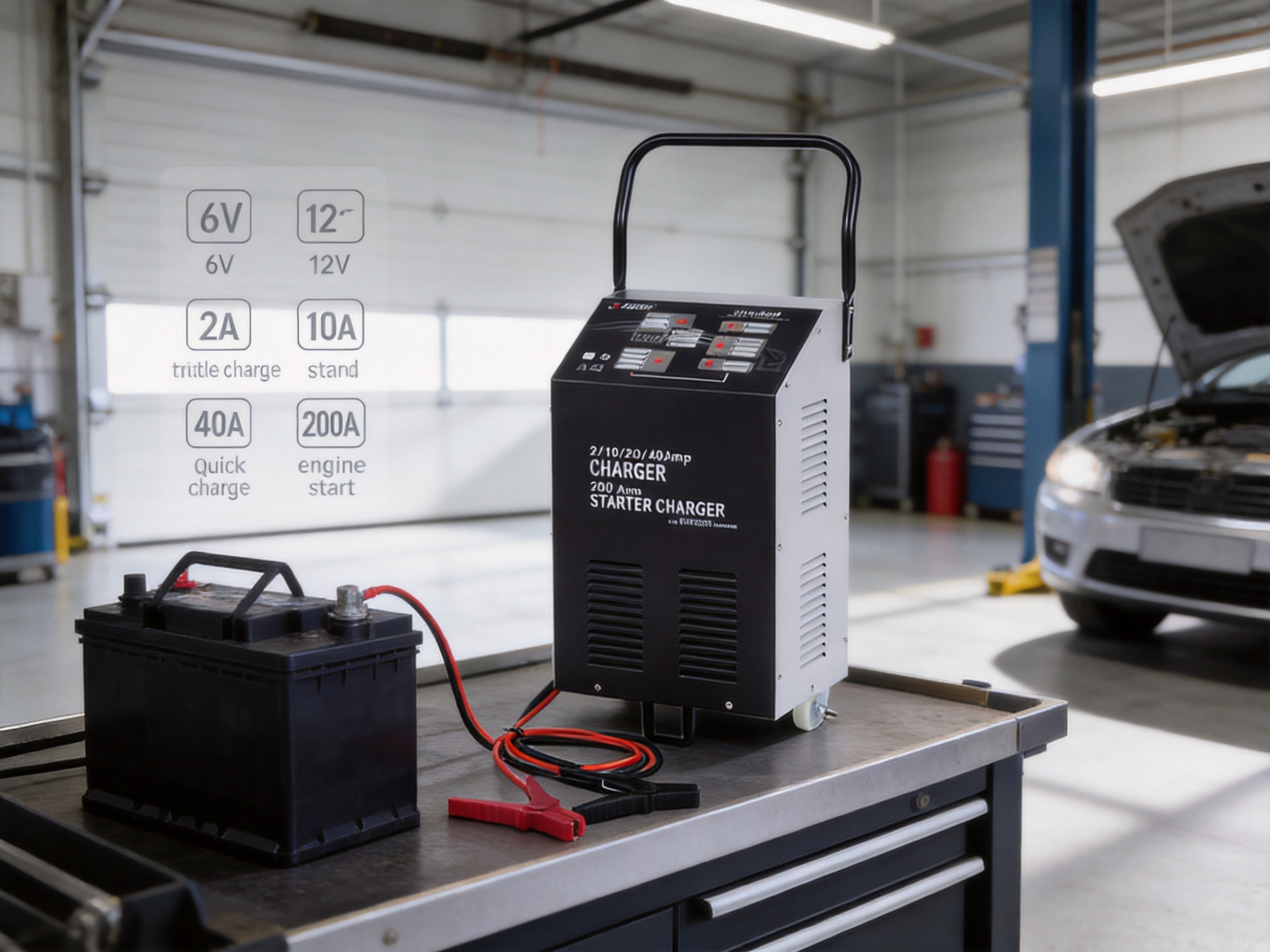
This product belongs to the Battery Charging/Starter category and is intended to support a wide range of everyday and professional applications. It can charge 6V and 12V batteries at a 2A trickle rate, provide 10A standard charging, and deliver a 40A quick-charge mode when time matters. At 12 volts, it also provides 200A engine start capability, helping revive vehicles or machines that need immediate starting assistance. Its 120V input voltage configuration makes it suitable for markets and facilities using this power standard, while its control interface is designed to be readable, accurate, and convenient for users with different experience levels.
Unlike many conventional chargers that require users to estimate charging status or manually disconnect the unit at the correct moment, this model integrates an automatic charge cycle that switches to float mode after the battery is fully charged. Float mode helps maintain the battery safely without unnecessary overcharging, making the charger more suitable for maintenance use, seasonal storage, and workshop environments where several batteries may be handled over the course of a day. With LED indicators, active charging information, error notification, and safety protections against short circuit, overheating, and reverse polarity, the product is engineered to reduce guesswork and improve operating confidence.
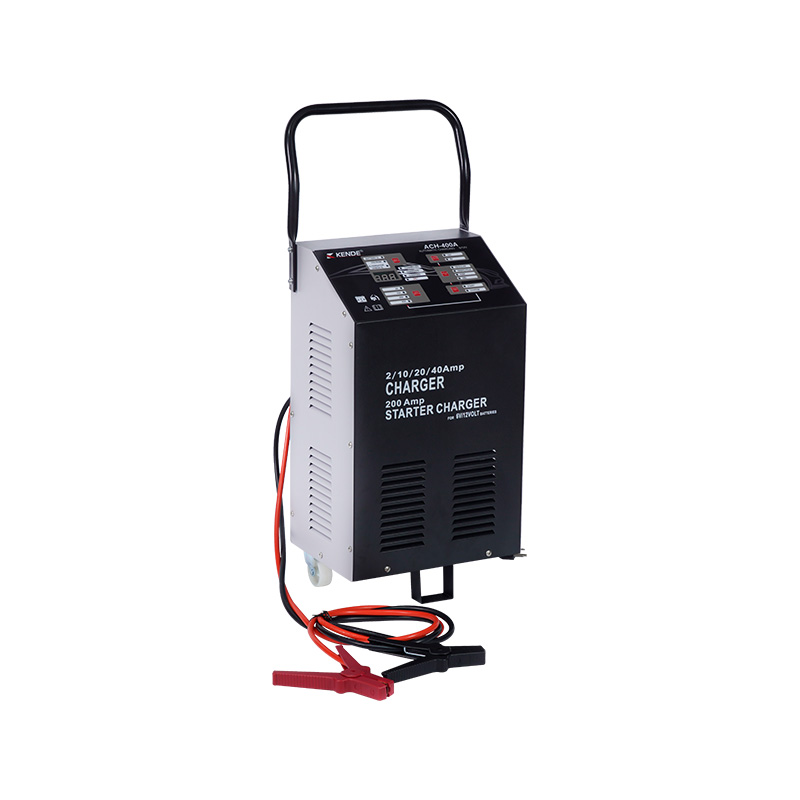
AHA 400A 120V input voltage, 10 A(standard) and 40Amp(Quick Charge)
A battery charger and engine starter must solve two different problems. First, it must restore battery energy correctly and safely. Second, it must provide enough instant output to help start an engine when the battery cannot deliver sufficient cranking power by itself. Some low-cost chargers perform only the first function slowly. Some jump-start devices provide a short burst but do not offer proper charging management. This 400A-class charging and starting unit bridges those functions by offering trickle, standard, quick-charge, and 12V engine-start support in one machine.
The 2A trickle charge mode is useful for slower, gentler charging and maintenance. It is suitable when battery health is the priority and time is available. Trickle charging can be helpful for motorcycles, garden equipment, small vehicles, standby power batteries, and batteries stored during off-season periods. The 10A standard mode is a practical everyday setting for many automotive and equipment batteries, balancing charging time with battery care. The 40A quick-charge mode provides a faster recovery option when downtime must be reduced, such as in repair shops, fleet yards, agricultural operations, delivery vehicles, and emergency maintenance situations.
The 200A engine start function at 12V gives the product a major practical advantage over basic chargers. When a weak 12V battery is unable to crank an engine, the starter function supplies additional current to assist ignition. This is not simply a convenience feature; in professional settings, a failed start can delay work schedules, occupy workshop bays, slow service queues, and increase operational costs. By combining charging and starting in one device, the unit helps reduce the need for multiple pieces of equipment.
Another notable advantage is compatibility with multiple battery types. The product is suitable for AGM, GEM, deep cycle, and standard batteries. This versatility matters because modern users often maintain different kinds of batteries across cars, trucks, utility vehicles, boats, recreational vehicles, lawn tractors, generators, and workshop equipment. A charger that is limited to one battery style may be inexpensive at purchase, but it can become inconvenient or risky when the user’s battery mix changes. A more adaptable charger provides better long-term value.
The product is built around a simple idea: give the user flexible charging levels, readable status information, and protection functions that make operation more secure. The following table summarizes the main product features and their practical benefits.
| Feature | Specification or Function | User Benefit |
|---|---|---|
| Input Voltage | 120V | Designed for facilities and markets using 120V power supply systems. |
| Battery Voltage Compatibility | 6V and 12V | Works with a broad range of small and automotive batteries. |
| Trickle Charge | 2A | Gentle charging and maintenance for batteries that do not require rapid recovery. |
| Standard Charge | 10A | Balanced everyday charging for common service and household applications. |
| Quick Charge | 40A | Faster charging when downtime must be reduced. |
| Engine Start Capability | 200A at 12V | Assists engine starting when the battery is weak. |
| Controls | Button controls with LED indicators | Improves readability, accuracy, and ease of operation. |
| Charge Management | Automatic charge cycle with float mode | Helps prevent overcharging and supports safe battery maintenance. |
| Safety Protection | Short circuit, overheat, and reverse polarity protection | Reduces operating risk and protects both user and equipment. |
| Diagnostic Display | Error notification and active charging indicator | Alerts users to connection problems and displays charging progress. |
These specifications show that the product is positioned above entry-level chargers. Its multi-rate design, engine-start function, diagnostic feedback, and automatic float mode make it more versatile for real-world use. In a competitive market where many chargers are selected only by price or amp rating, the combined value of safety, control, and usability is what distinguishes this model.
Battery charging is not a one-size-fits-all process. A lightly discharged battery may need only a small maintenance current. A deeply discharged automotive battery may require a longer recovery period. A busy repair shop may need faster charging to move vehicles through service. A user preparing to start a vehicle immediately may need engine-start support rather than a full charge. By offering 2A, 10A, 40A, and 200A start assistance, this charger gives users a structured way to match the machine to the task.
The 2A setting is a low-current mode suited for careful charging and maintenance. It can be especially useful for batteries that sit unused for extended periods, such as those in motorcycles, seasonal vehicles, boats, generators, or stored equipment. Instead of forcing high current into a battery that may not need it, trickle charging helps gradually restore or maintain charge. This can support longer battery service life when used properly.
Compared with low-end chargers that provide only one fixed current, the 2A option gives the user better control. It also helps avoid a common problem: using excessive charging current on smaller batteries. A charger that can operate gently is often more useful in mixed-vehicle environments than a unit built only for speed.
The 10A standard setting is the practical middle ground. It is suitable for many automotive and workshop charging tasks where the user wants a reasonable charging speed without using the maximum quick-charge current. This mode is valuable for daily service work because it provides a predictable balance between time efficiency and battery treatment.
In many garages, maintenance departments, and home workshops, 10A charging can handle routine battery recovery. For users who frequently manage standard 12V batteries, this mode may become the default choice because it is fast enough for convenience while still controlled enough for regular use.
The 40A quick-charge mode is one of the strongest competitive advantages of the product. In business environments, time is often more valuable than the difference in purchase price between a basic charger and a more capable machine. A vehicle that waits hours for slow charging may block workflow, delay deliveries, or interrupt field operations. With a 40A quick-charge setting, users can recover battery capacity faster when immediate use is needed.
Quick charging must be supported by safety and charge-management features, and this product includes protections and automatic cycle functionality to help reduce risk. This is a key distinction from low-quality high-current chargers that may deliver power but provide little intelligence. A powerful charger is most useful when it combines output capacity with control and protection.
The 200A engine start function is designed for situations where a vehicle or machine must be started with assistance. At 12V, the charger can provide high current to help turn the engine over. This feature is particularly valuable for automotive repair shops, roadside support, farms, fleet maintenance facilities, and home users who cannot afford to be stranded by a weak battery.
Many battery chargers lack engine-start capability, while many portable boosters do not provide proper multi-stage charging. Combining both functions makes this unit a flexible piece of equipment. A user can attempt engine starting when necessary, then continue charging the battery afterward to restore its state of charge. This integrated workflow is more efficient than switching between separate tools.
Usability is one of the most important qualities in any electrical service device. A charger may have impressive specifications, but if users cannot easily understand its status, errors, or settings, the equipment can cause frustration or misuse. This model uses LED indicators and button controls for easy reading and improved accuracy. The control interface is intended to help operators select charging functions, monitor progress, and respond to notifications without complicated procedures.
The active charging indicator cycles between volts, amps, and battery percent. This is a significant advantage compared with chargers that show only a vague charging light. Voltage information helps the user understand battery condition and charging stage. Amp information helps show how much current is being delivered. Battery percent gives a more intuitive view of progress, especially for less technical users. By rotating through these values, the charger communicates useful information without requiring separate measuring equipment.
The error notification is another practical feature. If a bad connection is detected, the notification will light up. This can save time and reduce troubleshooting confusion. Poor clamp contact, incorrect setup, damaged cables, or connection mistakes are common in workshop and home environments. A charger that identifies problems clearly helps prevent wasted charging time and reduces the chance that a user will assume a battery is defective when the real issue is connection quality.
Button controls also improve the user experience. Instead of relying on mechanical switches that may become unclear or worn, button-based operation can provide more controlled selection and cleaner interface design. Combined with LED indicators, the machine supports a more modern charging experience. This is especially important for users who manage several batteries and need fast, repeatable operation.
One of the most important product advantages is automatic charge-cycle functionality that switches to float mode after the battery is fully charged. Float mode is designed to maintain the battery at an appropriate level after charging is complete. This helps reduce the risk of overcharging and makes the charger more useful for maintenance situations.
Overcharging can damage batteries, shorten service life, increase heat, and waste energy. Basic manual chargers often require the user to monitor charging time and disconnect the unit at the right moment. In real life, users may become distracted, leave a charger connected overnight, or forget a battery in a service area. Automatic float mode adds a layer of intelligence that helps compensate for human error.
Float mode is especially valuable for stored batteries. Equipment used seasonally may remain idle for weeks or months. A charger that can maintain charge safely is useful for keeping batteries ready without repeated manual checking. This helps vehicle owners, farm operators, marine users, and facility managers avoid the common problem of dead batteries after long storage periods.
Compared with competitor products that advertise only high amp output, the automatic charge-cycle function demonstrates a more complete engineering approach. Fast charging is useful, but battery preservation is equally important. The best charger is not simply the one with the highest current number; it is the one that provides the correct charging behavior for different stages of the battery recovery process.
Battery charging involves electrical current, chemical energy storage, and sometimes unpredictable battery condition. For that reason, safety features are not optional extras; they are essential elements of product quality. This charger includes short circuit protection, overheat protection, and reverse polarity protection. These functions help protect the machine, the battery, and the user.
Short circuit protection helps reduce the danger that can occur if output clamps accidentally touch each other or if there is an abnormal current path. In a workshop, cables can be moved, dropped, tangled, or connected in rushed conditions. Short circuit protection improves resilience in these real-world operating environments.
Overheat protection is important because charging equipment can generate heat during operation, especially when delivering higher current in quick-charge or engine-start scenarios. Thermal management helps protect internal components and contributes to longer product service life. A charger that can detect and respond to excessive heat is better suited for demanding use than one that simply runs until failure.
Reverse polarity protection helps protect against incorrect clamp connection. Connecting positive to negative and negative to positive is a common user error, particularly in poor lighting or when battery terminals are dirty or difficult to access. Reverse polarity protection helps prevent damage and improves user confidence. For less experienced users, this feature may be one of the most important safeguards.
Safety systems are a major competitive differentiator. Some low-cost chargers reduce price by simplifying internal protection. That may appear economical until one mistake damages a battery, a vehicle electrical system, or the charger itself. A product with robust protection functions can deliver a lower total cost of ownership because it is less likely to fail under common misuse conditions.
The product is suitable for AGM, GEM, deep cycle, and standard batteries. Compatibility is important because battery technology has become more diverse. Automotive, marine, recreational, industrial, and standby power users may own several battery types. Each battery type can have different construction characteristics and charging needs.
AGM batteries are widely used because they can offer reliable performance, vibration resistance, and maintenance-free operation. Deep cycle batteries are common in applications where repeated discharge and recharge cycles occur, such as marine systems, recreational vehicles, solar storage, mobility equipment, and utility devices. Standard batteries remain common in many cars, trucks, tractors, and general vehicles. A charger that can serve these categories gives the user more flexibility and reduces the need to buy separate charging tools.
For competitors with narrower battery compatibility, the limitation becomes obvious in mixed-use environments. A household may have a car battery, a motorcycle battery, and a deep cycle battery for recreational equipment. A farm may have tractors, utility vehicles, generators, and storage batteries. A workshop may service many battery types every week. The more battery formats a charger can support, the more valuable it becomes as a general service tool.
The market for battery chargers includes everything from inexpensive low-current maintainers to heavy-duty workshop chargers. This product stands out because it combines versatility, intelligent control, and engine-start support in a single unit. Its main advantages over ordinary competitors can be summarized in five areas: output flexibility, diagnostic clarity, automatic maintenance, built-in safety, and multifunction value.
Many chargers provide only one or two current levels. This product offers 2A trickle, 10A standard, 40A quick charge, and 200A engine start support at 12V. This broad output structure means users can select a suitable mode instead of forcing every battery into the same charging pattern. Flexibility is especially important for users who handle batteries of different sizes and discharge conditions.
Basic chargers may show a single red or green light, leaving users uncertain about voltage, current, or charge percentage. This product’s active charging indicator cycles through volts, amps, and battery percent. That information improves transparency and helps users make better decisions. Error notification for bad connections further reduces confusion and wasted time.
The automatic charge cycle and float mode give the product an advantage over manual chargers. Once the battery is fully charged, the machine can transition to a maintenance state, helping reduce overcharge risk. This is particularly valuable for users who cannot constantly supervise the charging process.
A charger that can also assist engine starting provides more practical value than a charger alone. The 200A start function at 12V can help in urgent situations. For workshops and vehicle owners, this can reduce downtime and eliminate the need to keep a separate starting assistant for many common tasks.
Short circuit, overheat, and reverse polarity protection make the product better suited to real-world environments where mistakes happen. Safety functions protect not only the charger but also connected batteries and user equipment. This is a major advantage over lower-cost units with minimal protection.
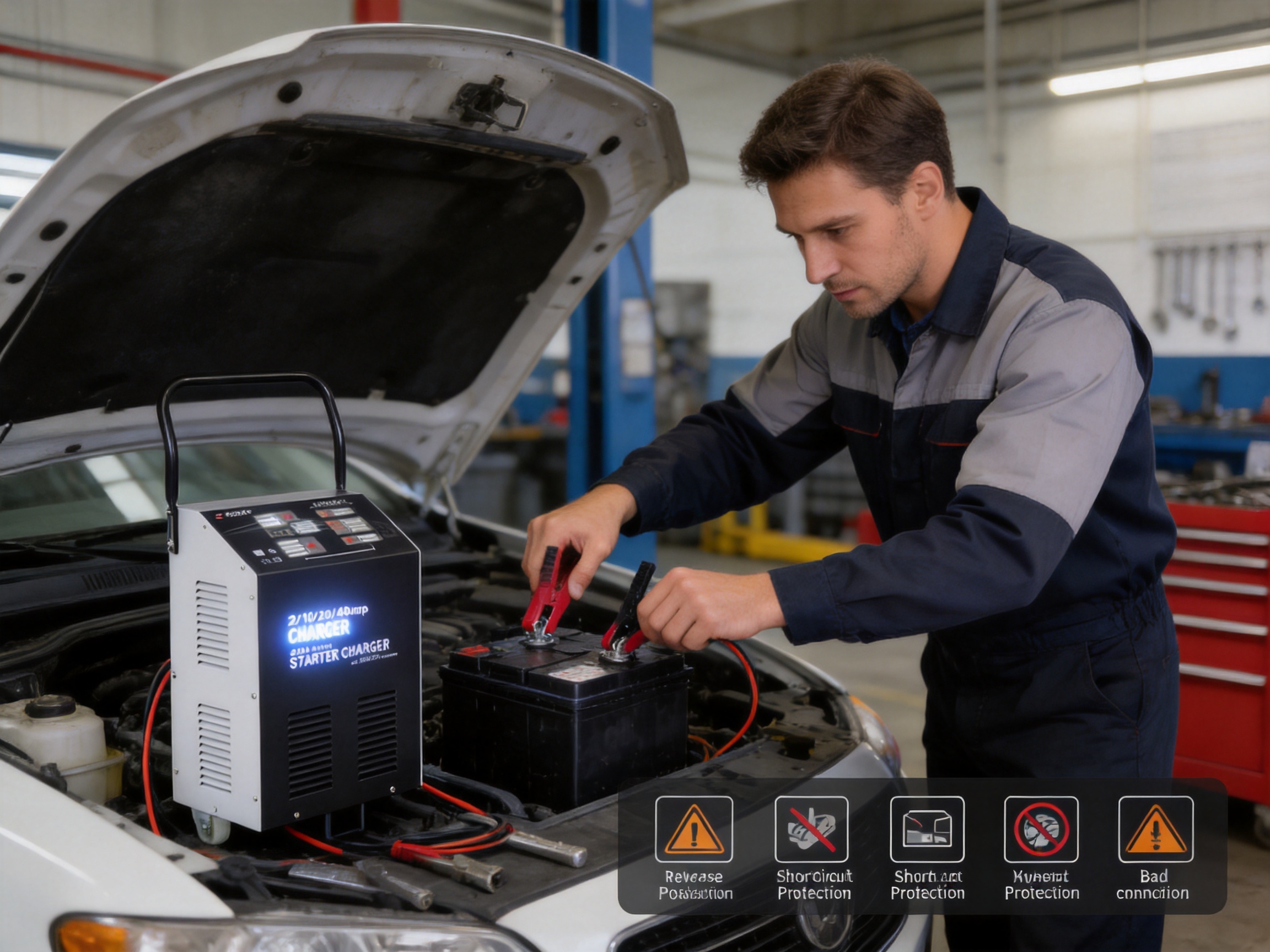
The product’s wide functionality makes it suitable for many application environments. In the home garage, it can maintain car batteries, help start a vehicle after battery drain, charge motorcycle or small equipment batteries at a lower current, and support seasonal storage. For automotive repair shops, it provides routine charging, faster recovery, diagnostic feedback, and starting assistance in one machine. For fleet operators, it helps keep vehicles ready and reduces downtime caused by weak batteries.
In agricultural environments, batteries often sit in equipment that is used seasonally or intermittently. Tractors, sprayers, generators, utility vehicles, and pumps may not run every day, which increases the risk of battery discharge. A charger with trickle and quick-charge modes gives farm operators flexibility: maintain a battery slowly when time is available, or recover it faster when equipment must return to work.
Marine and recreational users also benefit from compatibility with deep cycle batteries. Boats, campers, trailers, and recreational vehicles often use batteries that discharge over longer periods. A charger that can handle deep cycle applications and automatically transition to float mode is useful during storage or preparation before travel.
Small businesses that operate service vehicles, delivery vans, landscaping equipment, or maintenance machines can use the charger as part of preventive maintenance. Instead of waiting for a battery to fail, staff can monitor and maintain charge levels. The active indicator showing volts, amps, and battery percent supports a more informed maintenance process.
The quality of a charger is shaped not only by its design but also by the strength of the manufacturer behind it. Zhejiang Kende Mechanical and Electrical Co., Ltd. is located in Taizhou, Zhejiang Province, China, and operates on a large manufacturing base covering 120,000 square meters. With approximately 600 employees, the company has developed into an internationally recognized manufacturer and exporter of electric welding machines, chargers, and heaters. Its annual export volume reaches nearly 1.5 million units, and its annual production capacity is approximately 2 million units.
This manufacturing scale provides important advantages for buyers. Large production capacity can support stable supply, consistent quality control, and the ability to serve distributors, private-label customers, industrial buyers, and regional markets. The company’s broad product range also means it has experience with demanding electrical equipment, including MMA or stick welding machines, MIG/MAG gas-shielded welding machines, flux wire welding machines, TIG arc welding machines, CUT plasma arc cutting machines, stud welding machines, automatic submerged arc welding machines, battery chargers, and electric, gas, and oil heaters.
Although this article focuses on the 400A battery charger and engine starter, the manufacturer’s background in power electronics and welding equipment is highly relevant. Welding machines require stable output control, thermal management, durable components, safety engineering, and strict manufacturing discipline. These capabilities translate well into battery charging and starting equipment. The same commitment to electrical reliability, circuit protection, and manufacturing consistency can be applied to charger production.
The company is also known in industrial search contexts such as Aluminum TIG Welding Machine Factory, but its capabilities extend beyond TIG welding equipment. Its charger line benefits from an engineering culture built around power conversion, electrical safety, high-volume assembly, and international compliance. This diversified experience gives the product a stronger foundation than a charger made by a supplier with limited electrical equipment expertise.
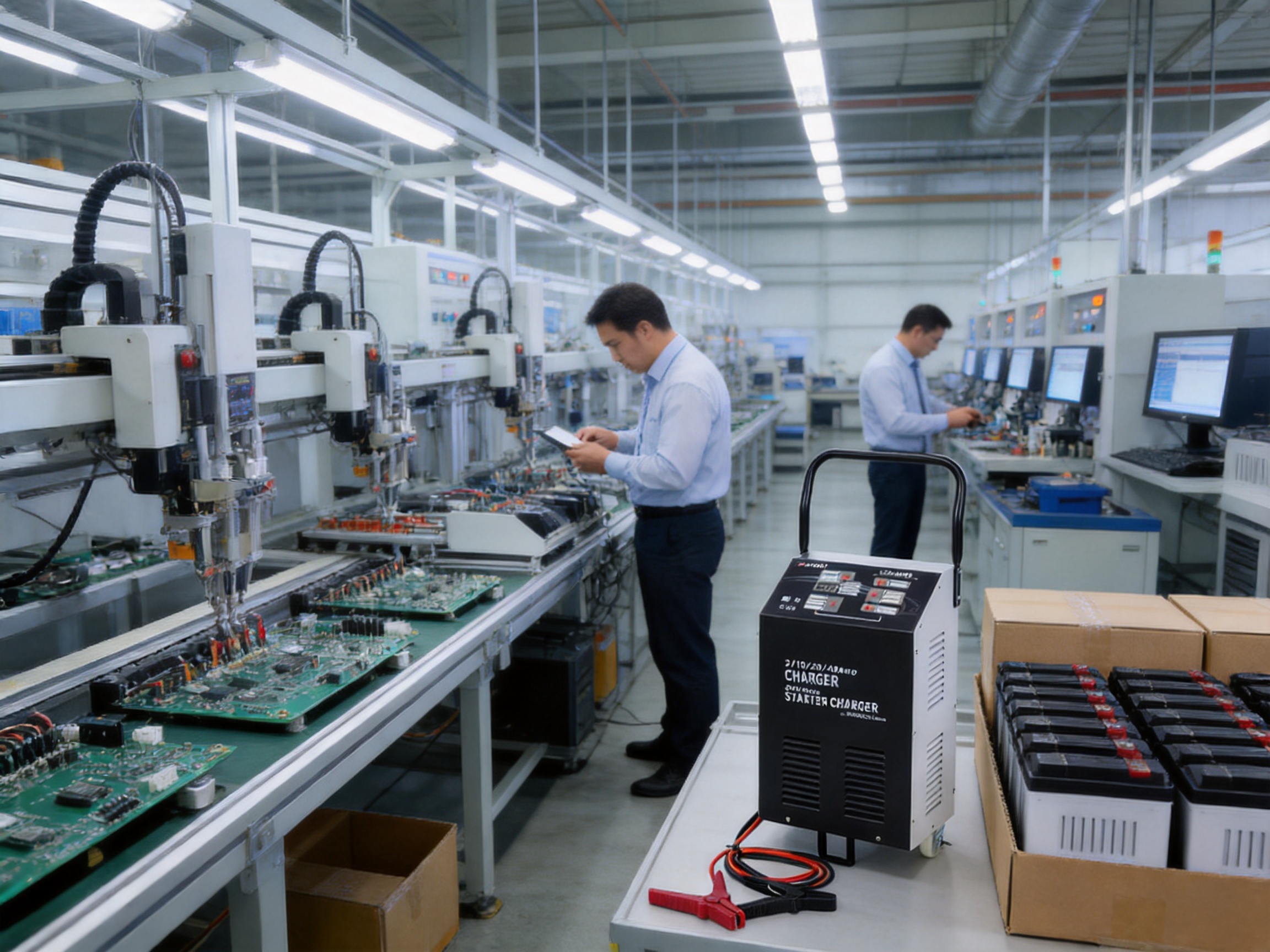
Modern electrical products require controlled production systems. The manufacturer applies advanced management and manufacturing methods, including OA office automation, Japan Toyota TPS management, ERP K3, and MES management systems. These systems help coordinate planning, production, inventory, quality tracking, and process control. For customers, this means the company is not relying only on manual experience; it uses structured systems to improve consistency and traceability.
TPS-inspired management emphasizes efficiency, waste reduction, standardized work, and continuous improvement. In a factory environment producing chargers, welding machines, and heaters at scale, this approach can improve assembly flow, reduce defects, and support stable delivery times. ERP systems help connect purchasing, production, warehousing, and order management, while MES systems can provide production-floor visibility and process data. Together, these systems support a more reliable supply chain and more controlled manufacturing output.
The company also uses advanced automatic patching, plug-in and welding systems, robot processing, laser cutting, and related technologies. Automatic component placement and electronic assembly processes are important for products that depend on circuit-board quality. Consistent placement, soldering, and inspection help ensure that electronic controls, protection circuits, and display functions operate reliably. Robot processing and laser cutting support structural precision and manufacturing repeatability.
For the battery charger, these capabilities matter because the product includes electronic control, LED indicators, automatic charge management, safety functions, and high-current output capability. Each of these features depends on stable internal manufacturing quality. A charger with poor soldering, weak thermal design, inconsistent wiring, or inadequate assembly control may fail even if its design appears competitive on paper. Advanced manufacturing systems help transform design intent into dependable products.
The manufacturer has strong research, development, and innovation capability. It operates a Zhejiang Provincial R&D Center, an Enterprise Technology Center, and an Intelligent Welding Technology Research Institute. The company has 98 R&D personnel and has obtained multiple invention patents, utility model patents, appearance patents, and software copyrights. This background demonstrates long-term investment in product development rather than simple assembly work.
R&D strength is important for battery charger buyers because charging technology continues to evolve. Users expect clearer displays, safer operation, smarter charging logic, more compact construction, better energy efficiency, and broader battery compatibility. A manufacturer with an active technical team can refine circuit design, improve software logic, test safety functions, and adapt products for different regional market requirements.
Innovation is also essential for balancing cost and quality. Competitive products must be affordable, but cost reduction must not weaken safety or reliability. Engineering teams can optimize component selection, cooling structure, housing design, user interface layout, and production processes so that the final product remains practical and durable. This charger’s combination of multiple charge rates, engine-start support, active indicators, automatic float mode, and protection functions reflects that type of integrated design thinking.
The company holds many international product certificates, including GS, CE, EMC, ERP, US ETL, UKCA, and China CCC for various product lines. Certification experience is meaningful because it shows familiarity with safety, electromagnetic compatibility, energy, and market-entry requirements. For distributors and importers, working with a manufacturer that understands certification processes can reduce risk and simplify product introduction.
The company is also one of the national standard drafting units of the National Welding Machine Standardization Committee. It has participated in the drafting, formulation, and revision of 20 national standards and has led the drafting of one group standard. This level of standards involvement indicates strong technical credibility and industry participation.
While a battery charger is different from a welding machine, both are electrical power products where safety and performance standards matter. A manufacturer that actively participates in standardization is more likely to understand structured testing, documentation, and compliance requirements. This benefits buyers who need products suitable for professional distribution, retail markets, and long-term brand reputation.
Welding machines and battery chargers may serve different end uses, but both involve controlled electrical energy. Welding equipment must manage current output, thermal load, protection circuits, and user safety under demanding conditions. Battery chargers must manage voltage, current, charging states, connection errors, and safety events. The engineering disciplines overlap in important ways.
A manufacturer experienced in MIG/MAG or GMAW machines, TIG or GTAW welding machines, IGBT inverter MMA or stick welding machines, submerged arc welding machines, plasma cutting machines, resistance spot welding machines, robot welding systems, and laser welding equipment develops deep knowledge of electrical design, power control, cooling, insulation, component durability, and production testing. That expertise supports the development of reliable chargers and starters.
For example, thermal management knowledge gained from welding machine production can inform charger heat protection and internal layout. Experience with high-current output can support engine-start functionality. Electronic control expertise can improve automatic charge-cycle logic and display feedback. Production testing discipline used for welders can be applied to charger inspection. This cross-category competence is a real advantage over suppliers that manufacture only simple low-current chargers.
A good battery charger should not be complicated for the sake of appearing advanced. It should give users the information and options they need, while keeping operation clear. This product follows a practical-intelligence design philosophy. It provides multiple charging modes, but they are organized around real user needs: trickle, standard, quick charge, and start assistance. It provides active charging information, but through readable LED indicators. It includes automatic float mode, but does not require the user to manage complex charging theory.
This balance is important because battery charging equipment is used by many types of operators. A professional mechanic may understand voltage and amperage in detail. A home user may only want to know whether the battery is charging and when it is ready. A farm operator may need a rugged, understandable tool that works in busy conditions. By showing volts, amps, and battery percent, the charger serves both technical and nontechnical users.
Competitors sometimes fall into two extremes. Some are too basic and provide little control or information. Others add unnecessary complexity that makes operation confusing. This model takes a middle path: enough intelligence to improve safety and performance, but enough simplicity for everyday use.
When evaluating a charger, buyers should consider total value rather than only the purchase price. A cheaper charger may cost less at first, but it may charge slowly, lack start assistance, provide limited information, or require constant supervision. If it causes delays, damages batteries through improper charging, or fails under common workshop conditions, the real cost becomes higher.
This 400A-class battery charger and starter delivers value by reducing downtime through 40A quick charging and 200A engine start capability. It improves battery management through multiple charge rates and automatic float mode. It reduces user error through LED indicators, active charging feedback, bad connection notification, and reverse polarity protection. It supports varied applications through compatibility with 6V and 12V batteries and multiple battery types.
For distributors, the product is also attractive because it addresses a broad customer base. Home users, auto service businesses, fleet operators, agricultural customers, recreational users, and equipment maintenance teams can all see practical benefits. A product with wide application potential is easier to position in retail, wholesale, and professional markets.
To get the best performance from any battery charger and engine starter, users should follow safe operating procedures. The battery and charger should be placed in a well-ventilated area. The clamps should be connected correctly, and the user should verify positive and negative polarity before starting. Battery terminals should be clean enough to allow strong contact. The correct charging mode should be selected according to battery voltage, battery type, and urgency.
The 2A trickle mode should be considered when maintaining smaller batteries or when slow charging is acceptable. The 10A standard mode is appropriate for many routine tasks. The 40A quick-charge mode should be used when faster recovery is needed and the battery is suitable for higher-current charging. The 200A engine start function should be used for 12V starting assistance according to product instructions and safe operating procedures.
Users should also pay attention to error notifications. If the charger indicates a bad connection, the clamps and terminals should be checked before continuing. If overheat protection activates, the charger should be allowed to cool and the operating environment should be reviewed. Safety functions are designed to protect the user and equipment, but they work best when the user responds properly.
Zhejiang Kende Mechanical and Electrical Co., Ltd. has developed a strong international position through years of manufacturing and export experience. Its products are widely welcomed by customers in China and abroad. The company’s ability to export around 1.5 million units annually reflects strong production planning, market experience, and supply-chain coordination.
For international buyers, supplier stability is a major consideration. A product may look attractive, but if the manufacturer cannot maintain consistent supply, spare parts, documentation, quality control, or customization support, the business relationship becomes risky. A company with large-scale production capacity, advanced systems, broad product expertise, and certification experience offers a more secure foundation.
The company can also develop new products according to the needs of different regions, countries, and customers. This flexibility is valuable in the battery charger market because input voltage, plug type, certification requirements, labeling, packaging, and charging preferences may vary by region. A manufacturer capable of regional adaptation can support importers and distributors more effectively.
It can charge both 6-volt and 12-volt batteries, making it useful for a wide range of small equipment, automotive, workshop, and maintenance applications.
The charger provides 2A trickle charging, 10A standard charging, and 40A quick charging. These options allow users to choose a slower maintenance charge, a balanced everyday charge, or a faster recovery mode.
Yes. At 12 volts, the unit provides 200A engine start assistance, helping start vehicles or machines with weak batteries.
It is suitable for AGM, GEM, deep cycle, and standard batteries. This broad compatibility makes it practical for users who maintain different battery types.
After the battery is fully charged, the automatic charge cycle switches to float mode. This helps maintain the battery and reduce the risk of overcharging.
The product includes short circuit protection, overheat protection, and reverse polarity protection. These functions help reduce risks during daily operation.
Its active charging indicator cycles between volts, amps, and battery percent. This gives users a clearer understanding of the charging process than a simple light-only display.
An error notification will light up if a bad connection is detected, helping users identify and correct connection problems quickly.
It offers multiple charging modes, 12V engine-start support, active charging feedback, automatic float mode, and key safety protections. Basic chargers often lack several of these functions.
The manufacturer’s experience in electrical power products, including welding machines and plasma cutting equipment, supports strong capabilities in current control, safety design, thermal management, and production quality.
The 400A battery charger and engine starter is designed for users who need flexible charging, dependable start assistance, and safer battery maintenance. Its 120V input configuration, 6V and 12V battery compatibility, 2A trickle mode, 10A standard mode, 40A quick-charge function, and 200A 12V engine start capability make it a practical tool for home garages, workshops, fleets, farms, marine users, recreational vehicles, and equipment maintenance teams.
Its greatest strengths are not limited to output numbers. The product also delivers user-friendly LED indicators, button controls, active charging feedback, bad connection notification, automatic float mode, and essential protections against short circuit, overheating, and reverse polarity. These functions make the charger easier to use, safer in real conditions, and more valuable than many basic competitors.
Behind the product is a manufacturer with large-scale production capacity, advanced manufacturing systems, strong R&D capability, international certification experience, and deep expertise in electrical power equipment. Zhejiang Kende Mechanical and Electrical Co., Ltd. combines modern management, automated production technologies, product development resources, and broad industry knowledge to support reliable manufacturing. For buyers seeking a charger that balances power, intelligence, safety, and supply confidence, this model offers a compelling solution.
Battery Council International. Battery Service Manual and Technical Guidelines.
International Electrotechnical Commission. Safety Requirements for Battery Chargers and Electrical Power Conversion Equipment.
Society of Automotive Engineers. Automotive Battery Testing and Charging Practices.
National Electrical Manufacturers Association. Guidelines for Electrical Equipment Manufacturing and Quality Control.
Underwriters Laboratories. Safety Considerations for Battery Chargers, Engine Starters, and Related Electrical Equipment.
International Organization for Standardization. Quality Management Systems and Process Control Principles.
Recommended Products

Contact Us
No.2299, Luqiao Section, Shugang Avenue, Luqiao District, Taizhou, 318057 Zhejiang, PR China.
+86-576-82431568
 Privacy
China Welding Machine Factory
 English
 中文简体
中文简体
 русский
 Español
 عربى
عربى
 Français
 Português
 Deutsch
 Український