Email: [email protected]
Email: [email protected]

Blog
 2026.07.22
 Blog
Blog
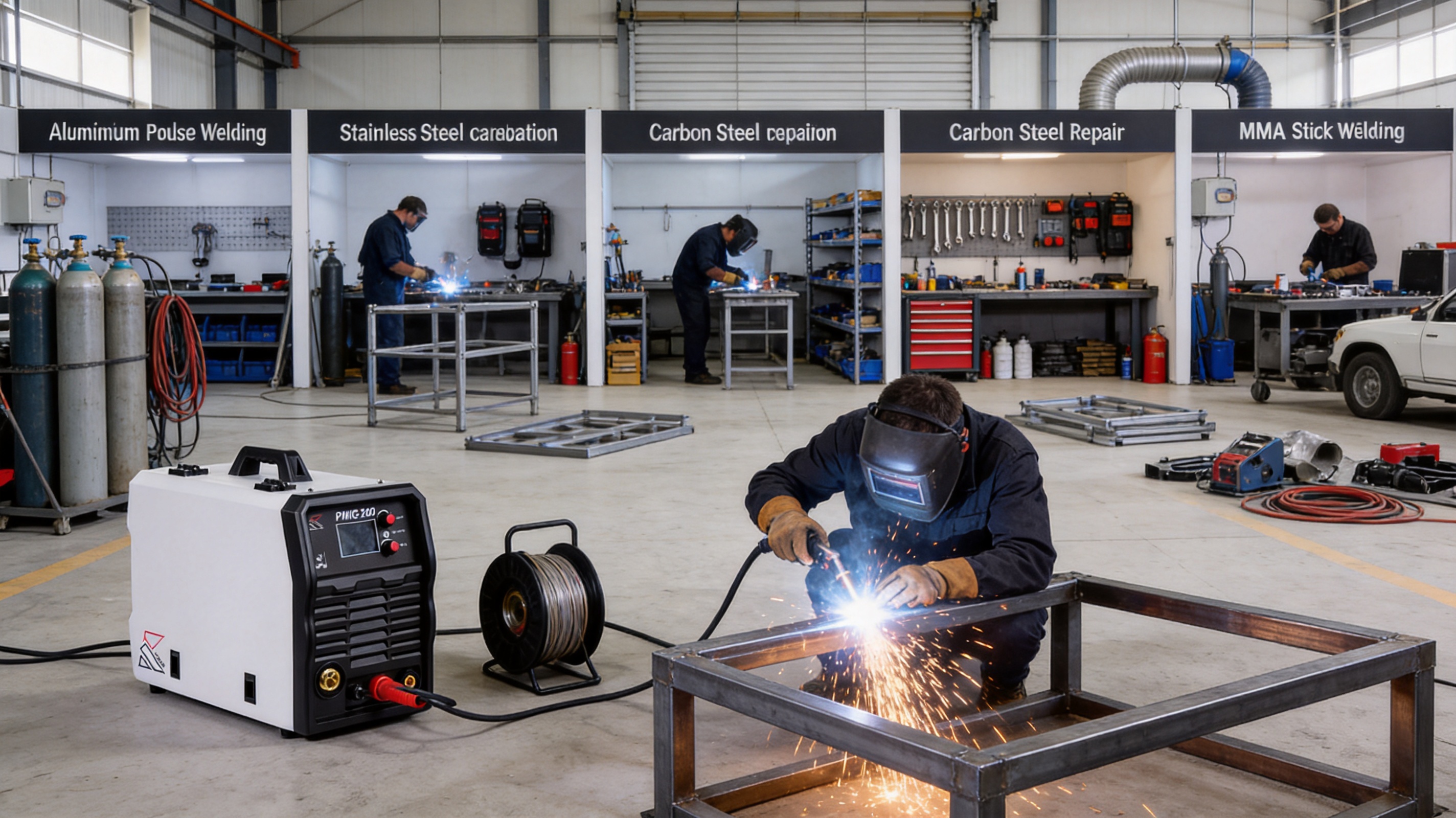
Modern fabrication workshops increasingly require welding equipment that can handle several materials, welding modes, and production conditions without occupying the space or demanding the investment associated with multiple specialized machines. The PMIG-200 is designed for this requirement. It is a compact inverter welding machine that combines high-speed pulse MIG/MAG welding, single-pulse MIG/MAG, double-pulse MIG/MAG, conventional MIG/MAG welding, and MMA welding in one unit.
With a welding current range of 30 to 200 amperes, a 220/230-volt single-phase supply, an internal wire feeder, and support for 0.8 to 1.2 millimeter welding wire, the machine is suitable for a broad range of repair, maintenance, light industrial, automotive, metalworking, and fabrication applications. Its design is especially relevant to users who work with aluminium alloy, stainless steel, carbon steel, and alloy steel.
The machine combines powerful IGBT switching technology with digital microcomputer control and pulse-width modulation. These technologies help provide stable arc behavior, accurate parameter control, energy efficiency, and automatic protection against excessive current and overheating. The result is a flexible welding platform intended to deliver repeatable results while remaining practical for workshops with limited floor space.
The PMIG-200 is a multi-function gas-shielded welding machine with an integrated wire-feeding system. It is engineered for users who need more than basic short-circuit MIG/MAG welding. Its pulse functions allow the operator to manage heat input, droplet transfer, arc stability, and weld appearance more effectively, particularly when working with aluminium and other materials that can be sensitive to excessive heat.
In addition to gas-shielded welding, the machine provides an MMA or stick welding function. This gives the operator an alternative process for outdoor repairs, heavier steel work, and applications where a shielding gas cylinder is inconvenient or unavailable. A single machine can therefore support both wire-based production welding and electrode-based maintenance work.
The product is rated for a maximum welding current of 200 amperes. Its specified welding range is 30 to 200 amperes, giving the user room to adjust the output for thinner sheet, medium-gauge components, brackets, frames, vehicle parts, machinery, and general steel fabrication. The rated welding voltage is 24 volts, while the no-load voltage is listed as 57 volts.
The machine has a rated input capacity of 8.0 kVA and a rated supply current of 53 amperes. It operates at 50 or 60 hertz and is designed for 220/230-volt supply systems. Its stated efficiency is 85 percent, and its power factor is 0.92. These figures indicate a power-efficient inverter platform that can convert a substantial proportion of incoming electrical power into usable welding output.
The rated duty cycle is 15 percent under the stated technical specification. Duty cycle is affected by output current, ambient temperature, ventilation, and operating conditions. Users should consult the product nameplate and operating instructions when planning continuous production work. A correct duty-cycle assessment helps prevent thermal overload and supports safe, reliable operation.
| Technical Characteristic | Specification |
|---|---|
| Product model | PMIG-200 |
| Primary welding processes | Pulse MIG/MAG, single-pulse MIG/MAG, double-pulse MIG/MAG, conventional MIG/MAG, and MMA |
| Rated supply voltage | 220/230 V |
| Supply frequency | 50/60 Hz |
| Rated input capacity | 8.0 kVA |
| Rated supply current | 53 A |
| No-load voltage | 57 V |
| Welding current range | 30–200 A |
| Rated welding voltage | 24 V |
| Rated duty cycle | 15% |
| Usable wire diameter | 0.8–1.2 mm |
| Efficiency | 85% |
| Power factor | 0.92 |
| Protection rating | IP21S |
| Insulation class | H |
| Net weight | 14 kg |
| Machine dimensions | 540 L × 225 W × 390 H mm |
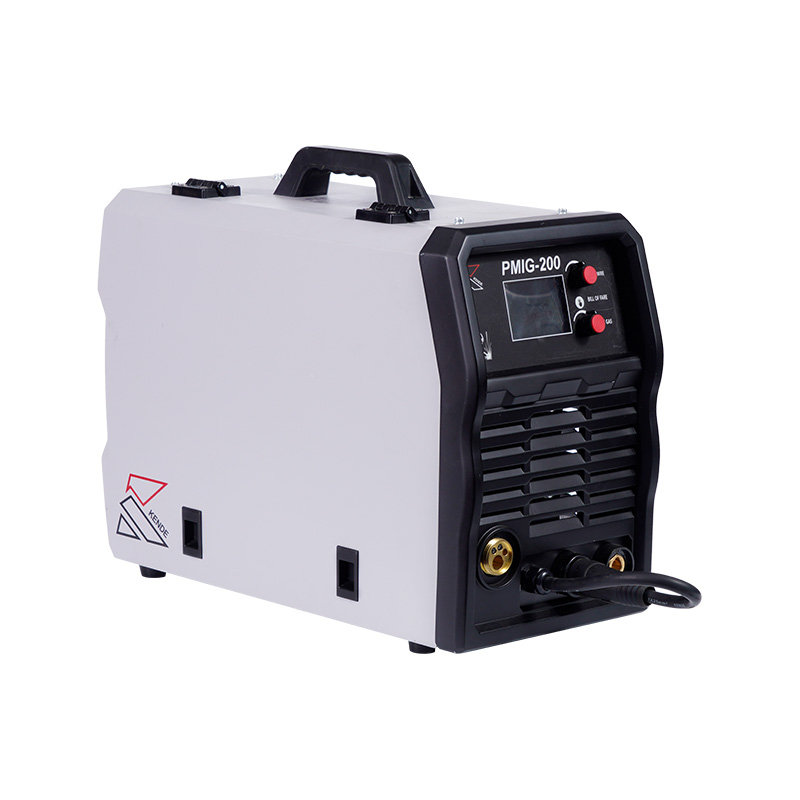
PMIG-200 Heavy Using Multi Function Singal pulse, double Pulse Aluminium MIG Gas welder 200 1-5kg wireInverter Welding Machine PM-200
The most important advantage of the PMIG-200 is its ability to combine several welding processes in one platform. Traditional workshops may need separate equipment for standard MIG/MAG, aluminium pulse welding, and MMA welding. Purchasing and maintaining several machines can increase capital costs, storage requirements, training time, and service demands. A multi-process inverter can reduce this duplication when its capabilities match the user’s requirements.
For routine production, conventional MIG/MAG welding offers a familiar and productive process. A continuously fed wire electrode increases productivity compared with manually replacing stick electrodes. The operator can work with a suitable shielding gas and wire combination to create a stable arc for carbon steel, stainless steel, or aluminium applications.
Single-pulse MIG/MAG adds controlled pulsed transfer to the process. Instead of relying only on conventional short-circuit or spray transfer behavior, the machine regulates the transfer of molten metal through controlled current pulses. This can help reduce spatter, improve arc control, and produce a more refined weld profile. Pulse operation is particularly useful where appearance, heat management, or positional welding is important.
Double-pulse MIG/MAG, also known as twin-pulse welding, alternates between two pulse conditions. This creates a controlled variation in wire melting and arc energy. When properly adjusted, the visual effect can resemble a series of regular ripples, which is often desirable in aluminium fabrication and appearance-sensitive work. The process can also help manage heat input and reduce the tendency toward excessive fluidity on aluminium components.
The machine also includes MMA welding. Stick welding remains valuable in construction, field repairs, agricultural equipment maintenance, structural work, and locations where a gas cylinder or wire-feeding arrangement is impractical. The ability to switch between MIG/MAG and MMA makes the machine useful for both workshop and maintenance environments.
Four welding methods are identified for the product, including gas-shielded welding, pulse gas-shielded welding, twin-pulse gas-shielded welding, and MMA. This range gives operators more process choices than a basic single-process inverter. It also allows a workshop to select an appropriate process based on material, thickness, weld position, required appearance, available consumables, and operating environment.
Aluminium welding places special demands on equipment. Aluminium wire is softer than many steel wires, making wire feeding more sensitive to liner condition, drive-roll selection, tension adjustment, and torch configuration. Aluminium also conducts heat rapidly and has a surface oxide layer with a much higher melting point than the underlying metal. These factors make arc stability and heat control especially important.
The PMIG-200 is designed to support aluminium alloy welding through pulse and double-pulse MIG/MAG functions. Pulsed transfer can help the operator control molten metal while limiting unnecessary heat accumulation. Double-pulse operation may further improve bead appearance and provide a more controlled welding rhythm. Actual results depend on the alloy, material thickness, wire type, shielding gas, torch setup, joint preparation, and operator technique.
The product is also specified for carbon steel, alloy steel, and stainless steel. Carbon steel is commonly used in frames, brackets, repair work, machinery, and general fabrication. Alloy steel may require careful control of preheating, interpass temperature, filler selection, and post-weld treatment. Stainless steel requires attention to shielding gas quality, contamination control, heat input, and surface protection. A versatile welding machine does not remove the need for correct procedure qualification, but it gives the operator a broader technical platform.
The 0.8 to 1.2 millimeter wire range covers many common wire sizes used in light and medium fabrication. Smaller wire can be suitable for thinner material and lower current settings, while larger wire can support higher deposition rates when the machine, torch, and material thickness are properly matched. The internal wire feeder is designed for welding wire packages up to 5 kilograms, making the unit practical for compact workshops and service operations.
Pulse welding is valuable because it provides an additional level of control over the relationship between arc current, wire melting, and droplet transfer. In a conventional process, the operator may need to balance wire speed, voltage, travel speed, and torch angle while managing spatter and heat. A digitally controlled pulse program can coordinate some of these variables more precisely.
When suitable parameters are selected, pulse MIG/MAG can provide a concentrated and controlled arc. This may improve weld appearance, reduce spatter, and make it easier to work on materials that are sensitive to distortion. It can also support welding in positions where a large, fluid weld pool would be difficult to control.
Double-pulse welding provides an additional modulation of the welding arc. The low-frequency variation can influence the appearance and cooling behavior of the bead. For aluminium, this may help create an attractive, consistent surface pattern while giving the operator better control over the weld pool. It is important to understand that a decorative ripple pattern is not by itself evidence of weld quality. Penetration, fusion, porosity control, joint preparation, and mechanical performance remain the primary technical considerations.
The product description identifies high-speed pulse MIG/MAG operation. High-speed switching is made possible by the inverter power stage and IGBT components. Compared with older transformer-based systems, inverter technology can respond more rapidly to changes in welding conditions. Faster electronic control may improve the consistency of current and voltage regulation, especially when the operator changes settings or when the arc length varies during welding.
Pulse performance also depends on correct shielding gas. Aluminium is commonly welded with argon or an argon-rich mixture, while steel and stainless steel may require different gas compositions depending on wire type, transfer mode, material thickness, and desired weld characteristics. Poor gas flow, leaks, drafts, contaminated fittings, or an incorrectly selected gas can compromise any pulse welding system.
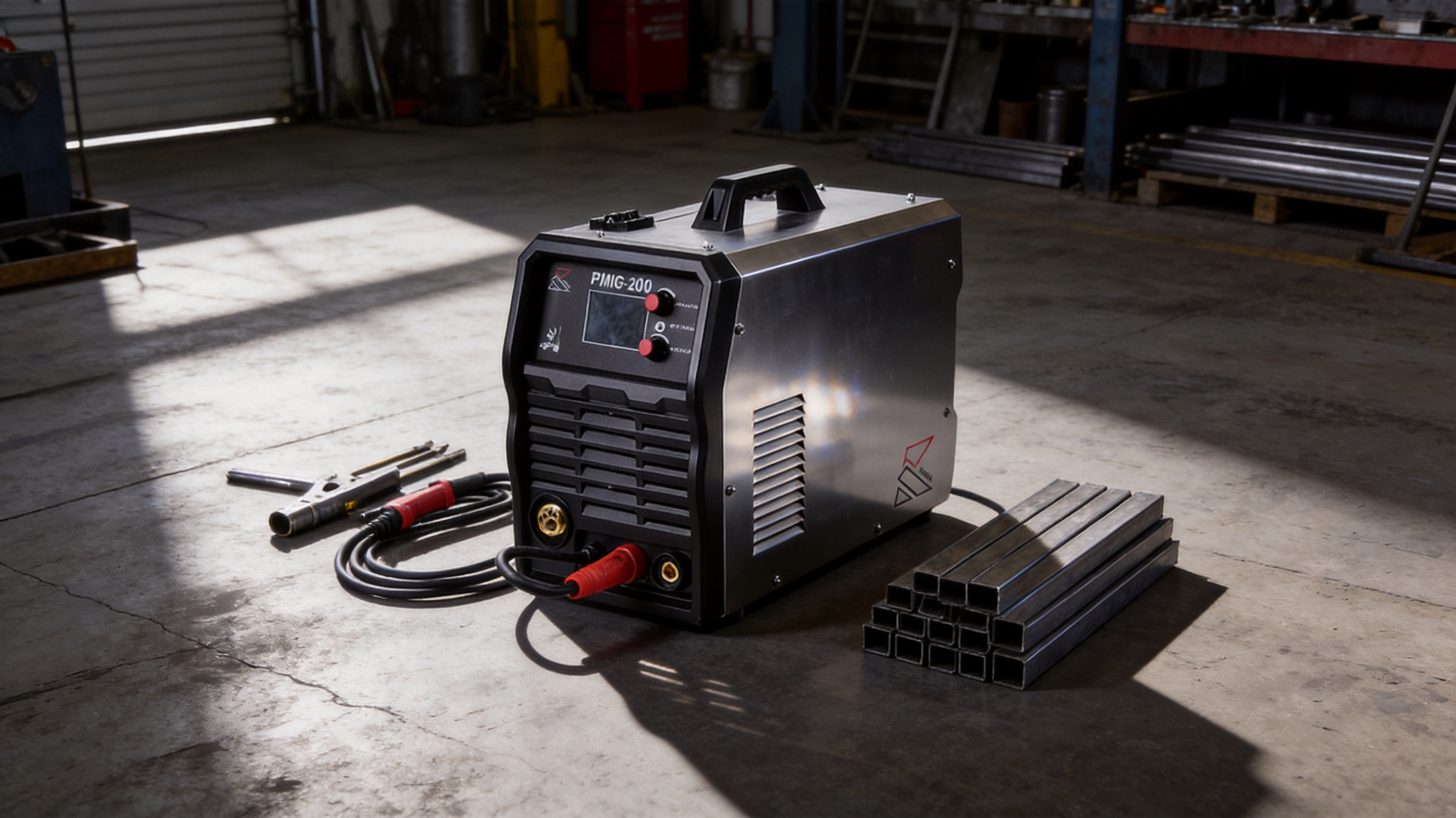
The PMIG-200 uses powerful IGBT switching technology. IGBT components are widely used in modern welding inverters because they can switch electrical power at high speed while supporting compact equipment design. High-frequency switching allows the welding transformer and related magnetic components to be smaller than those used in many conventional low-frequency welding machines.
The compact inverter structure contributes to the machine’s net weight of 14 kilograms and dimensions of 540 by 225 by 390 millimeters. This makes the machine easier to position in a workshop, move between workstations, or transport for service work. A smaller footprint can be particularly valuable for automotive repair shops, maintenance contractors, training facilities, and fabrication businesses where floor space is limited.
Digital microcomputer control helps coordinate welding parameters and operating modes. The control system is described as all-digital and intelligent, with pulse-width modulation technology. PWM allows the power electronics to regulate the timing and duration of switching pulses. By adjusting these electronic pulses, the inverter can manage output power and welding behavior with a high level of repeatability.
Digital control can also make it easier to include multiple welding programs and operating choices in a single interface. The operator can select the required process and configure settings for the workpiece rather than using a separate machine for each application. This reduces equipment changes and can simplify the training process for users who regularly move between welding methods.
Four gun switch modes are available according to the product information. The specified choices include 2T, 4T, S4T, and spot welding control modes. In 2T operation, the torch trigger is held during welding and released to stop. In 4T operation, the trigger can be pressed and released to begin welding, allowing the operator to weld without continuously holding the trigger. S4T functions may provide more advanced start and finish control, depending on the machine’s programming. Spot mode is intended for controlled weld durations in suitable applications.
These trigger modes can improve operator comfort and process consistency. Long welds can be tiring when the trigger must be held continuously. A latching mode may reduce hand fatigue, while spot control can support repeated short welds when the workpiece and procedure are appropriate. Operators should select the mode that matches the joint, safety requirements, and welding procedure.
High weld quality is identified as a key product characteristic. The machine is described as providing a deep weld pool and strong welds while using lower heat input. In practical terms, lower controlled heat input can help reduce distortion, limit discoloration, and protect thin or heat-sensitive components. It may also help improve productivity by reducing the need for post-weld correction.
Heat input is influenced by current, voltage, travel speed, arc efficiency, and welding technique. The machine’s pulse modes can assist with this control, but the operator must still maintain an appropriate travel speed and torch angle. Excessively slow travel, an oversized wire, or an unsuitable parameter combination can create too much heat even when pulse welding is selected.
A stable arc contributes to consistent penetration and bead formation. Instability may lead to spatter, irregular transfer, incomplete fusion, or an inconsistent weld profile. The combination of inverter switching, digital control, and PWM regulation is intended to provide a controlled output that responds effectively to changes in the welding arc.
The machine’s ability to support several materials also gives fabricators more flexibility in controlling heat according to the workpiece. Aluminium may require a different balance of current, wire speed, pulse conditions, and gas flow than carbon steel. Stainless steel may require reduced heat input to protect corrosion resistance and appearance. Process selection can therefore be used as part of a broader strategy for weld quality.
For professional work, operators should use qualified welding procedures and verify the finished weld through appropriate inspection. Visual inspection, dimensional checks, dye penetrant testing, radiographic testing, ultrasonic testing, or mechanical testing may be required depending on the application. The machine provides process capability, while weld quality depends on equipment setup, consumables, joint design, operator skill, and inspection.
The specified efficiency of 85 percent and power factor of 0.92 support efficient electrical operation. A higher power factor means that the machine uses incoming electrical power more effectively, reducing the proportion of reactive power in the supply system. This can be beneficial for workshops operating several electrical machines or working with limited electrical capacity.
The product information states that energy savings can reach up to 30 percent. Actual savings depend on comparison conditions, duty cycle, welding current, process selection, machine loading, and the efficiency of the equipment being replaced. Nevertheless, inverter welding technology generally offers advantages in size and power conversion compared with older transformer-based systems.
Reduced energy consumption can contribute to lower operating expenses over the service life of the machine. It may also reduce the thermal load placed on the workshop and support more efficient use of electrical infrastructure. For businesses that operate welding equipment regularly, energy performance can become an important part of total cost of ownership.
Energy efficiency should be considered together with productivity. Pulse MIG/MAG can reduce spatter and post-weld cleanup in suitable applications. Better control of heat may reduce distortion correction and grinding. A multi-process machine can also reduce the cost of purchasing, storing, servicing, and powering several separate units.
Operators can improve efficiency by selecting the correct wire diameter, setting suitable gas flow, maintaining the torch liner, keeping earth connections clean, and preventing unnecessary idle time. Proper preventive maintenance helps ensure that the electrical and mechanical systems continue to operate close to their intended performance.
The PMIG-200 includes automatic protection functions for over-current and over-heating. These protections are important because welding inverters operate under significant electrical and thermal stress. Over-current may occur because of a short circuit, an unsuitable connection, a component fault, or abnormal operating conditions. Overheating may result from excessive duty cycle, blocked ventilation, high ambient temperature, or internal contamination.
An automatic protection system can interrupt or limit operation when unsafe conditions are detected. This helps protect the power electronics and other internal components. Protection does not replace correct use. The machine should be installed in a clean, dry, well-ventilated location, and air passages should remain clear.
The stated protection rating is IP21S. This rating indicates protection against the entry of solid objects above a specified size and protection against vertically falling water under defined test conditions. The machine is not intended to be treated as waterproof or exposed to rain, spray, condensation, or severe contamination. It should be protected from metal dust, corrosive vapors, and excessive humidity.
Insulation class H is specified for the machine. Insulation classification relates to the temperature capability of insulating materials used in electrical equipment. Even with high-temperature insulation, the equipment should not be operated beyond its rated conditions. Adequate ventilation and adherence to the duty cycle remain essential.
Reliability also depends on the quality of installation and accessories. The power cable, grounding connection, welding torch, wire feeder, drive rolls, gas regulator, earth clamp, and welding leads should be correctly rated and maintained. Loose electrical connections can create heat, voltage drop, unstable arc performance, and safety risks.
The internal wire feeder is designed to accommodate welding wire packages up to 5 kilograms. Integrating the feeder into the main machine helps create a compact and organized system. It avoids the need for a separate feeder cabinet and can make the machine easier to move around the workshop.
A compact internal feeder is useful for repair and fabrication businesses that change between workstations. The operator can transport the machine with the required torch and earth lead, connect the gas supply, install the appropriate wire, and begin work after completing the required setup checks.
Wire feeding quality is essential to MIG/MAG performance. The drive rolls must match the wire type and diameter. Excessive roll pressure can deform soft aluminium wire, while insufficient pressure can cause slipping. The liner should be suitable for the material, and the contact tip should match the wire diameter. A clean, correctly configured feed path helps maintain stable wire delivery.
For aluminium work, users may need to pay particular attention to the torch liner and feeding arrangement. A suitable liner, correct drive-roll profile, moderate roll tension, and an appropriately supported torch cable can reduce feeding resistance. These details are important regardless of the welding machine brand or model.
The machine’s 14-kilogram net weight provides a balance between portability and capability. It is lighter than many traditional industrial transformer machines while retaining a 200-ampere output class. The dimensions allow it to fit into many workshop layouts, service vehicles, and compact production areas.
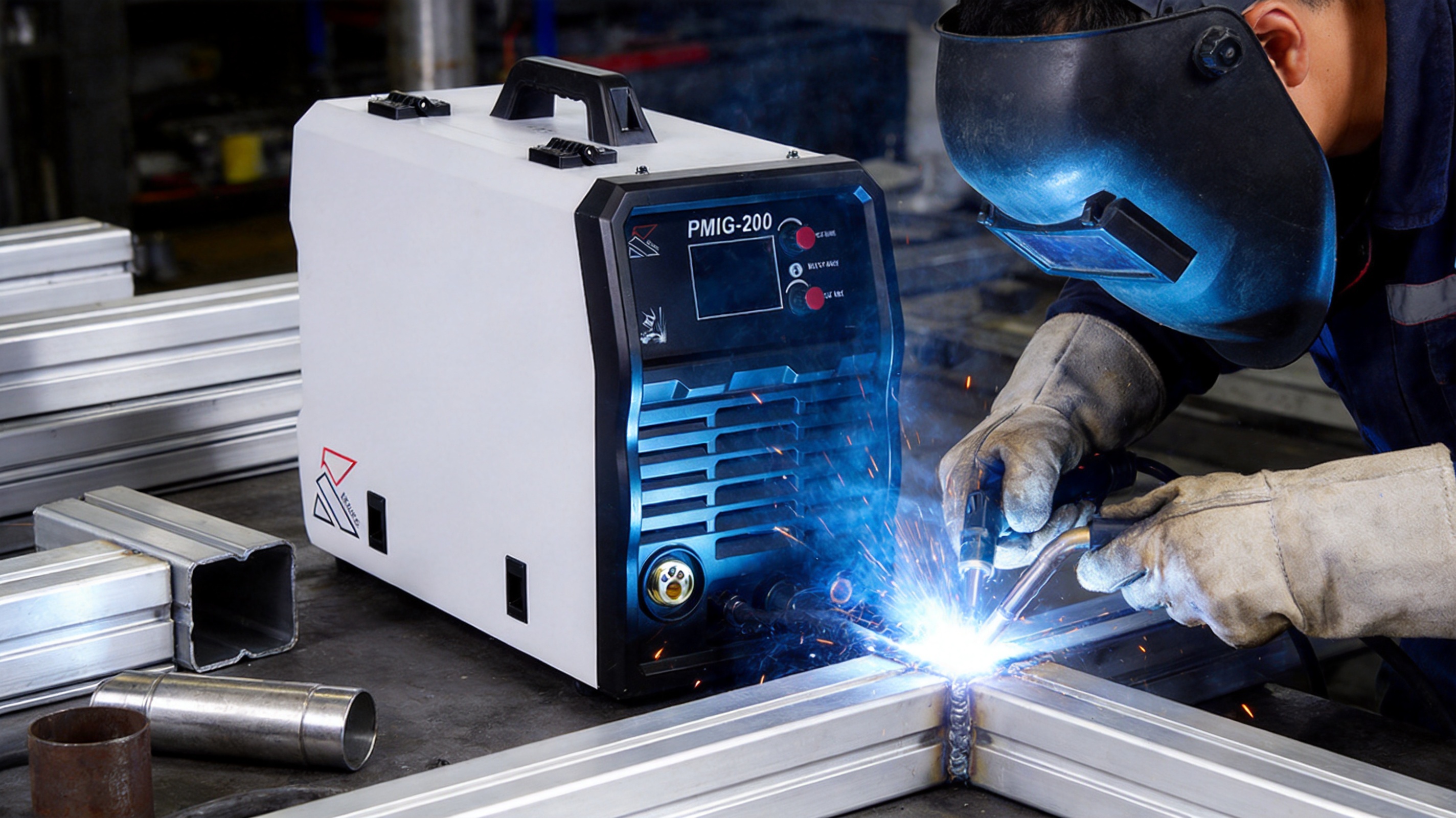
Compared with a basic single-process MIG/MAG machine, the PMIG-200 provides a wider range of process options. The operator can use conventional MIG/MAG for general work, pulse MIG/MAG for improved control, double-pulse MIG/MAG for aluminium and appearance-sensitive applications, and MMA for work that does not require a shielding gas system.
Compared with a conventional transformer-based welding machine, its inverter structure offers lower weight, a more compact design, digital parameter control, and potentially improved electrical efficiency. The machine can be moved more easily and may require less storage space. Its high-frequency electronic control also enables operating functions that are difficult or impractical to achieve with a basic transformer design.
Compared with a simple non-pulse inverter, the PMIG-200 offers additional control over droplet transfer and heat input. This can be valuable when welding aluminium, thin sections, visible joints, or materials that are prone to distortion. It also gives the operator more flexibility when adapting the process to different wire and gas combinations.
Compared with purchasing separate MIG/MAG, pulse, and MMA machines, a multi-process unit can simplify equipment management. One machine can serve multiple tasks, reducing the number of power connections, work areas, service schedules, and operator interfaces. This can be especially attractive to small and medium-sized fabrication companies.
The machine also has advantages in process adaptability. A workshop can use MMA for outdoor repair work, standard MIG/MAG for fast steel fabrication, and pulse or double-pulse operation for aluminium and stainless steel. The ability to select the process according to the job can improve equipment utilization and reduce the risk of using an unsuitable welding method.
These advantages should be evaluated against the requirements of the specific application. The rated duty cycle, maximum current, wire capacity, available electrical supply, and desired level of automation should all be considered. For heavy continuous industrial welding, a larger power source or dedicated production system may be more appropriate. For flexible light and medium fabrication, the PMIG-200 offers a strong combination of capability and portability.
The manufacturer, Zhejiang Kende Mechanical & Electrical Co., Ltd., operates a large manufacturing and research organization in Taizhou, Zhejiang Province, China. The company reports a site area of approximately 120,000 square meters and a workforce of about 600 employees. Its production portfolio includes welding machines, battery chargers, and electric, gas, and oil heaters.
The company reports annual exports of nearly 1.5 million units and an annual production capacity of approximately 2 million units. Such production scale can support purchasing efficiency, standardized manufacturing procedures, quality-control systems, spare-parts planning, and experience across a broad range of electrical equipment.
Its product development capabilities cover MMA or stick welding machines, MIG/MAG gas-shielded machines, flux-cored welding machines, TIG welding machines, plasma cutting machines, stud welding machines, submerged arc welding machines, battery chargers, and heating equipment. This broad product range gives the company experience with power electronics, thermal management, transformers, control systems, motors, wire-feeding mechanisms, and electrical safety requirements.
The company reports participation in the development and revision of national welding machine standards and involvement in multiple standards activities. Engagement with technical standards can help manufacturers understand performance terminology, safety expectations, testing methods, and industry requirements. It also provides a foundation for product development and quality assurance.
Research and development resources reportedly include a provincial research and development center, an enterprise technology center, and an intelligent welding technology research institute. The company also reports a research and development team of 98 personnel. These resources are relevant to products such as the PMIG-200, where control software, power electronics, pulse algorithms, thermal design, and wire-feeding performance must work together.
The company reports holding invention patents, utility model patents, appearance patents, and software copyrights. Software capability is particularly important for digitally controlled welding equipment. Pulse timing, current regulation, trigger modes, protection functions, parameter storage, and user-interface behavior all depend on embedded control technology.
Advanced management and manufacturing systems are also reported, including office automation, Toyota production system methods, enterprise resource planning, and manufacturing execution management. These systems can support production scheduling, traceability, inventory control, process monitoring, and quality documentation. Effective manufacturing management is essential when producing large quantities of power electronic equipment with consistent electrical and mechanical performance.
Manufacturing technologies reported by the company include automated component placement, plug-in and soldering systems, robotic processing, and laser cutting. Automated production can improve repeatability and reduce variation in assembly. Robotic and laser-based processes can support accurate fabrication of enclosures, brackets, panels, and other components used in welding machines.
For a welding inverter, manufacturing quality is not limited to the visible enclosure. Internal assembly quality, solder-joint reliability, thermal interface materials, cable routing, insulation distances, connector retention, cooling-fan performance, and calibration all influence service life. A systematic manufacturing process helps address these details throughout production.
The manufacturer reports international certifications and approvals including GS, CE, EMC, ERP, United States ETL, United Kingdom UKCA, and China CCC across its product range. Certification requirements vary by product, model, market, and applicable standard. Buyers should confirm the exact certification documents and markings for the PMIG-200 configuration being supplied.
Electromagnetic compatibility is an important consideration for inverter welding machines. High-frequency switching can produce electrical noise if the equipment is not designed and installed correctly. EMC-related design and testing help limit unwanted interference and support compatibility with other equipment in the working environment.
Electrical safety certification can provide assurance that the product has been assessed against applicable requirements. However, safe operation also depends on installation, grounding, power supply quality, ventilation, protective equipment, and operator training. Certification should be considered part of a complete safety program rather than a substitute for correct workplace practice.
International market experience can also support packaging, documentation, regional power requirements, replacement parts, and customer service. Because the company exports to many markets, it has experience adapting products to different electrical systems and regulatory environments. Buyers should still verify plug type, input voltage, language requirements, local service arrangements, and import documentation before ordering.
The PMIG-200 is suitable for general metal fabrication where a 220/230-volt supply is available. Typical applications may include frames, racks, brackets, gates, light structural assemblies, equipment repairs, sheet-metal components, and workshop maintenance.
Automotive and vehicle repair businesses can benefit from the machine’s combination of compact size and process flexibility. MIG/MAG is commonly used for steel body and chassis-related fabrication, while pulse capability can be useful for aluminium components when the correct wire, gas, and torch setup are used. MMA can provide a practical backup process for heavier repair work.
Aluminium fabricators can use the double-pulse function for suitable aluminium alloy joints, visible welds, and components where heat control and bead appearance are important. The process should be selected alongside suitable joint preparation, gas coverage, wire storage, cleaning procedures, and operator training.
Maintenance departments can use the machine for repair work on carbon steel, stainless steel, alloy steel, and aluminium components. The ability to switch between wire welding and stick welding can be useful when repairing equipment in different locations or under changing site conditions.
Training centers and technical schools may also find a multi-process machine useful because it exposes students to several welding methods through one platform. Instructors can demonstrate conventional transfer, pulsed transfer, twin-pulse operation, and MMA fundamentals. Proper supervision and safety procedures remain essential.
The machine may be less suitable for continuous high-volume production that requires a much higher duty cycle, automated wire handling, water-cooled torches, or integration with robotic welding cells. In those cases, a higher-capacity industrial power source may be required. The PMIG-200 is best viewed as a flexible portable machine for light and medium-duty work within its published ratings.
Before welding, inspect the power cable, earth connection, welding torch, gas hose, regulator, wire spool, contact tip, and drive rolls. Confirm that the input voltage matches the machine specification and that the electrical circuit can support the rated supply current. The machine should be placed on a stable surface with sufficient clearance for cooling air.
Select the welding process according to the material and joint. Use conventional MIG/MAG for appropriate general work, single pulse for controlled transfer and heat management, double pulse for suitable aluminium applications and appearance-sensitive welds, and MMA when a stick electrode process is more practical.
Install the correct wire and verify the wire diameter setting. The drive rolls, contact tip, and liner should match the wire. For aluminium, use a feeding configuration designed to reduce wire deformation and friction. Thread the wire carefully and adjust drive-roll pressure so that the wire feeds consistently without slipping or being crushed.
Choose a shielding gas that matches the wire and material. Check the cylinder connection for leaks and set gas flow according to the torch, nozzle, joint, and working environment. Excessive gas flow can create turbulence and draw air into the shielding zone, while insufficient flow can result in porosity and oxidation.
Set the trigger mode according to the weld length and operator preference. Two-touch operation is suitable for conventional start and stop control. Four-touch or related latching modes may be more comfortable for long welds. Spot mode should be used only where a controlled weld duration is appropriate for the joint and procedure.
During welding, maintain a consistent torch angle, travel speed, stick-out, and distance from the workpiece. Observe the arc and weld pool rather than relying only on the machine display. If spatter, porosity, lack of fusion, excessive penetration, or irregular bead formation occurs, stop and check the gas supply, polarity, wire feed, contact tip, joint cleanliness, and parameter selection.
After welding, close the gas supply when appropriate, inspect the weld, remove spatter if necessary, and allow the machine to cool according to the operating instructions. Keep the ventilation openings clean and schedule periodic inspection of cables, connectors, fans, and the wire-feeding mechanism.
Welding produces ultraviolet radiation, visible light, heat, fumes, sparks, and molten metal. Operators must use a suitable welding helmet, protective clothing, gloves, safety footwear, and eye protection. The work area should be free from combustible materials, and appropriate fire protection should be available.
Ventilation or local exhaust should be provided to control welding fumes. Stainless steel, coated metals, painted components, and contaminated surfaces may produce hazardous fumes. Materials should be cleaned and identified before welding, and the operator should follow workplace exposure-control procedures.
Shielding gas cylinders must be secured upright and handled with approved regulators and hoses. Cylinders should be kept away from heat, impact, and unauthorized access. Gas leaks can create safety hazards and can also cause poor weld quality.
Never operate the machine in rain or wet conditions. The IP21S rating does not indicate waterproof construction. Keep the machine away from water, conductive dust, corrosive chemicals, and excessive humidity. Disconnect the power supply before internal maintenance, and allow only qualified personnel to service electrical components.
When using MMA mode, select electrodes and current settings according to the material and electrode manufacturer’s recommendations. When using MIG/MAG or pulse modes, confirm polarity and consumable compatibility. Incorrect polarity or an unsuitable wire and gas combination can create poor welds and may damage components.
Routine maintenance helps preserve performance and extend service life. Remove dust from external ventilation openings using an approved method. Inspect the cooling fan and ensure that airflow is not blocked. Check the welding torch for worn contact tips, damaged liners, loose nozzles, and signs of overheating.
The wire-feeding system should be kept clean. Dust, rust, shavings, and wire debris can interfere with smooth feeding. Replace worn drive rolls and contact tips. Check that the earth clamp makes firm electrical contact with clean base metal, since a poor return path can cause arc instability and excessive heating.
Inspect cables and connectors regularly for cuts, exposed conductors, loose terminals, or heat damage. Damaged cables should be replaced or repaired by qualified personnel. Do not continue operating equipment when a safety-related electrical fault is suspected.
The machine’s multi-process capability can increase long-term value because it supports more types of work than a basic welding unit. As a workshop’s needs change, the same machine may continue to serve different applications rather than becoming obsolete after a single process is no longer sufficient.
Value should also be measured through productivity, reduced equipment duplication, lower storage requirements, energy efficiency, and reduced post-weld cleanup. A machine that can be used effectively for several jobs may deliver a stronger return than a lower-cost unit with only one process, provided that its output and duty cycle match the application.
The PMIG-200 brings together a 200-ampere output, pulse and double-pulse MIG/MAG functions, MMA capability, digital control, an internal wire feeder, and a compact 14-kilogram format. This combination addresses the needs of users who want professional process flexibility without moving to a large, permanently installed production system.
Its particular strength is the balance between aluminium-oriented pulse capability and general-purpose welding performance. Many basic MIG/MAG machines can weld carbon steel effectively but provide limited control for aluminium or appearance-sensitive work. The PMIG-200 adds pulse and twin-pulse functions while retaining conventional MIG/MAG and MMA operation.
The machine also benefits from the manufacturer’s broader engineering and production background. Experience in welding equipment, chargers, heaters, automated assembly, software control, research, and international certification supports the development of a product intended for diverse markets.
For workshops that need one adaptable machine for repair, fabrication, aluminium work, stainless steel, carbon steel, and occasional stick welding, the PMIG-200 offers a practical solution. Its performance should always be evaluated within the published specifications, especially the 15 percent rated duty cycle and 200-ampere maximum output.
The machine supports conventional MIG/MAG welding, single-pulse MIG/MAG, double-pulse or twin-pulse MIG/MAG, and MMA or stick welding. These modes allow users to select a suitable process for the material, joint, welding position, and working environment.
Yes. The machine is designed to weld aluminium alloy using pulse and double-pulse MIG/MAG functions. Correct aluminium wire, liner, drive rolls, contact tip, shielding gas, polarity, and parameter settings are required for satisfactory results.
The product information identifies carbon steel, alloy steel, stainless steel, and aluminium alloy as suitable materials. The correct filler metal, shielding gas, current, voltage, wire speed, joint preparation, and welding procedure must be selected for each material.
The maximum specified welding current is 200 amperes. The adjustable welding current range is 30 to 200 amperes.
The stated usable wire diameter range is 0.8 to 1.2 millimeters. The wire feeder is designed for welding wire packages up to 5 kilograms.
The machine is specified for a rated supply voltage of 220/230 volts and a supply frequency of 50/60 hertz. Users should confirm local electrical requirements and ensure that the circuit can support the rated supply current.
Double-pulse welding alternates between two pulse conditions and can provide improved control of the weld pool, heat input, and bead appearance. It is especially useful for suitable aluminium applications. Final weld quality still depends on correct setup and operator technique.
Yes. MMA or stick welding is included. This function can be useful for outdoor repairs, heavy steel components, maintenance work, and situations where shielding gas is inconvenient.
The product information identifies 2T, 4T, S4T, and spot welding control modes. These modes support different operating preferences, long-weld requirements, and controlled spot-welding applications.
The machine has a stated net weight of 14 kilograms and dimensions of 540 by 225 by 390 millimeters. Its compact inverter design makes it easier to move and store than many conventional transformer-based welding machines.
The published rated duty cycle is 15 percent. Users should consult the machine nameplate and instruction manual for the test conditions and should allow appropriate cooling time during operation.
Yes. Automatic protection functions for over-current and over-heating are identified in the product information. These functions help protect the equipment, but they do not replace correct installation, ventilation, duty-cycle management, and maintenance.
It is suitable for many light and medium-duty professional workshop applications, including fabrication, repair, maintenance, automotive work, and aluminium welding. Businesses requiring continuous high-duty production should compare the published duty cycle and output with their specific workload.
Buyers should confirm input voltage, plug and cable requirements, welding torch configuration, wire-feeder specifications, included accessories, certification documents, warranty terms, spare-parts availability, and local service support. They should also verify that the machine’s duty cycle and current range match the intended work.
The PMIG-200 is a versatile 200-ampere inverter welding machine developed for users who require more flexibility than a basic MIG/MAG or MMA unit can provide. Its combination of conventional MIG/MAG, single pulse, double pulse, and MMA welding supports a wide range of fabrication and repair tasks.
Its pulse capabilities are particularly valuable for aluminium alloy and heat-sensitive work, while its conventional MIG/MAG mode remains practical for general steel fabrication. Digital microcomputer control, PWM regulation, IGBT switching, automatic protection, and an internal 5-kilogram wire feeder contribute to a compact and adaptable system.
The machine’s stated 85 percent efficiency, 0.92 power factor, 14-kilogram net weight, and 220/230-volt operation make it suitable for many compact workshops and service environments. Its manufacturer adds value through large-scale production, research and development resources, automated manufacturing, welding-industry experience, and international certification capability.
When correctly configured and operated within its ratings, the PMIG-200 can help workshops reduce equipment duplication, manage a broader range of metals, improve control over heat and weld appearance, and support more efficient day-to-day fabrication.
Product technical specification sheet for the PMIG-200 multi-function pulse MIG/MAG and MMA welding machine.
Manufacturer-provided product information covering IGBT inverter technology, digital control, pulse welding modes, trigger modes, protection functions, and welding materials.
Manufacturer-provided company profile covering production capacity, research and development, manufacturing systems, certifications, and welding equipment product categories.
General principles of gas metal arc welding, pulse transfer, aluminium welding, welding power-source efficiency, and welding equipment safety.
General guidance on welding ventilation, shielding gas handling, electrical safety, personal protective equipment, and preventive maintenance.
Recommended Products

Contact Us
No.2299, Luqiao Section, Shugang Avenue, Luqiao District, Taizhou, 318057 Zhejiang, PR China.
+86-576-82431568
 Privacy
China Welding Machine Factory
 English
 中文简体
中文简体
 русский
 Español
 عربى
عربى
 Français
 Português
 Deutsch
 Український