Email: [email protected]
Email: [email protected]

Blog
 2026.07.24
 Blog
Blog
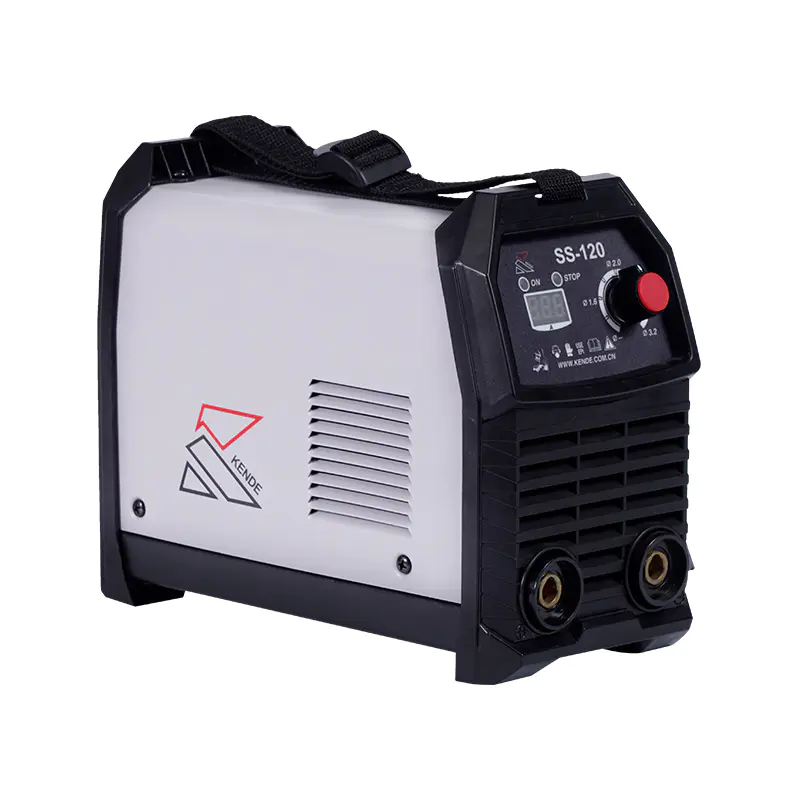
The MMA-120 is a compact manual metal arc welding machine designed for users who need dependable welding performance in a portable format. Combining inverter technology, microprocessor control, a broad input-voltage tolerance, and a practical electrode range, this machine is suitable for maintenance work, light fabrication, repair operations, installation tasks, workshops, farms, and household projects. Its small size and low weight make it especially useful where welding equipment must be transported frequently or used in locations with limited working space.
Although the MMA-120 is a lightweight machine, it is engineered to provide a useful real welding current range from 20 amperes to 120 amperes. It can work with electrodes from 1.6 millimeters to 3.2 millimeters and is intended for welding low-carbon steel and stainless steel. Its stated welding thickness range is 1.6 to 5.0 millimeters, giving the operator flexibility for thin sheet materials as well as a variety of small and medium repair jobs.
The product is manufactured by Zhejiang Kende Mechanical & Electrical Co., Ltd., an established Chinese producer of welding equipment, battery chargers, and heating products. The company combines large-scale production, dedicated research and development, automated manufacturing, certification experience, and international export capabilities. These strengths support the MMA-120’s position as a practical alternative to larger, heavier, and less transportable welding machines.
The MMA-120 belongs to the MMA or stick welding category. MMA welding is one of the most widely used arc-welding processes because it does not require an external shielding-gas cylinder. Instead, the flux coating on the electrode produces shielding gases and slag during welding. This makes the process convenient for outdoor maintenance, construction, agricultural repair, and general fabrication.
The machine uses a single-phase electrical supply. Its rated input is 230 volts at 50 hertz, while the adapted input-voltage range is specified as 180 to 260 volts. This broad range is important in areas where the electrical supply may fluctuate. A machine that can tolerate voltage variation is less likely to stop unexpectedly during operation and can be more suitable for workshops, job sites, and regions with inconsistent mains power.
With a maximum welding current of 120 amperes, the MMA-120 is intended for light-duty and general-purpose welding rather than large-scale structural fabrication. Its current range begins at 20 amperes, allowing the operator to work with smaller electrodes and thinner materials. At the upper end, the machine can use electrodes up to 3.2 millimeters in diameter, which is appropriate for many repair, maintenance, and fabrication applications.
The machine’s open-circuit voltage is rated at 62 volts. This provides a useful starting condition for striking the arc and maintaining stable welding operation when the correct electrode and workpiece preparation are used. The equipment has a rated duty cycle of 15 percent, so users should follow appropriate operating intervals and allow the machine to cool when working near its maximum output.
The enclosure is made from engineering plastic. This material helps reduce overall weight while providing electrical insulation and a protective outer shell. The case protection degree is IP21S, meaning the machine is designed for indoor or suitably protected working conditions. It should not be exposed to rain, standing water, excessive dust, or other environments outside its rated protection level.
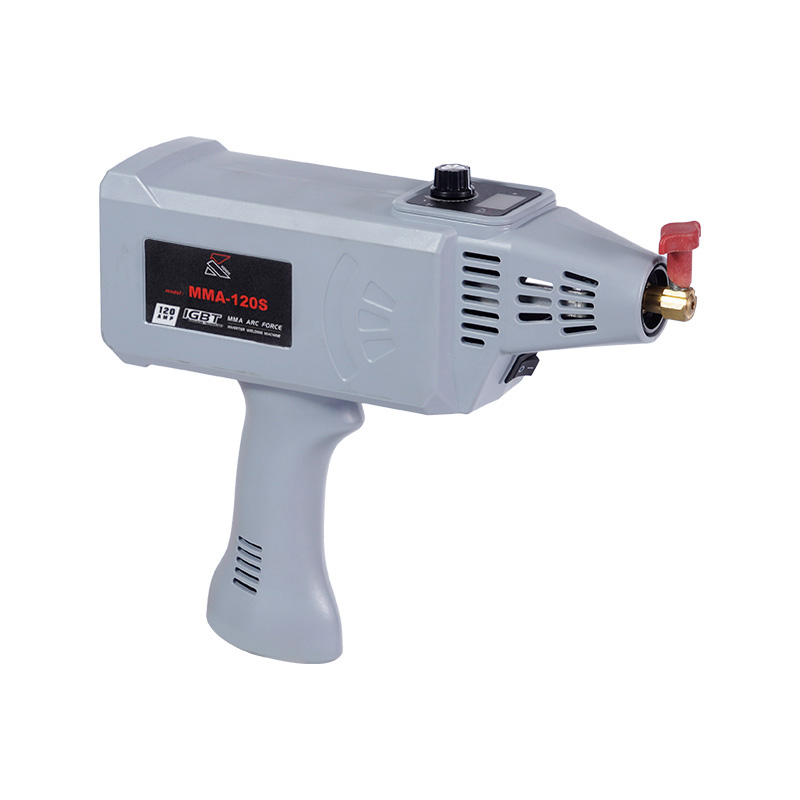
MMA-120
| Specification | MMA-120 Value |
|---|---|
| Product category | Manual metal arc welding machine |
| Factory model | MMA-120 |
| Power supply | Single-phase, 230 V, 50 Hz |
| Adapted input-voltage range | 180–260 V |
| Capacity | 3.5 kW |
| Open-circuit voltage | 62 V |
| Real current range | 20 A/20.8 V to 120 A/24.8 V |
| Recommended welding thickness | 1.6–5.0 mm |
| Rated duty cycle | 15% |
| Usable electrode diameter | 1.6–3.2 mm |
| Insulation class | H |
| Case protection | IP21S |
| Net weight | 1.9 kg |
| Listed additional weight field | 2.55 kg as recorded in the supplied specification |
| Listed package or item dimensions | 310 × 100 × 315 mm |
| Included cable equipment | 2 m welding cable and 2 m ground cable |
The specification table shows why the MMA-120 is best understood as a portable general-purpose welding machine. Its output is sufficient for many thin and medium-gauge welding tasks, while its 1.9-kilogram net weight supports easy transportation. The machine’s compact enclosure also helps users work in locations where a conventional transformer-based welder would be inconvenient.
The MMA-120 uses IGBT inverter technology. Inverter welding machines convert incoming electrical power through high-frequency electronic switching rather than relying on a large traditional low-frequency transformer. This approach can reduce the physical size and weight of the power unit while allowing the control system to respond more rapidly to changes in the welding arc.
One of the main advantages of an inverter platform is improved power efficiency. A more efficient power conversion system can reduce unnecessary energy loss and may help lower operating costs over the service life of the equipment. It can also make a compact machine capable of delivering useful welding output without the bulk associated with older transformer designs.
For users who frequently transport equipment, the weight advantage is particularly significant. A heavy welding machine may require a trolley, vehicle space, or two-person handling. By comparison, the MMA-120 can be carried by one person and moved quickly between work areas. This characteristic is valuable for maintenance technicians, installers, agricultural workers, building contractors, and home workshop users.
Inverter technology also supports a more compact internal arrangement. Reduced transformer size leaves more flexibility for airflow design, electronic protection, cable routing, and enclosure construction. When combined with a microprocessor-controlled system, the inverter platform can deliver a more consistent response than a basic low-cost welding unit with limited electronic regulation.
Energy efficiency should not be confused with unlimited operating capacity. The MMA-120 has a specified 15 percent rated duty cycle. Operators should select an appropriate current, use suitable electrodes, maintain clean ventilation openings, and observe cooling periods. Correct use protects the electronics and contributes to longer service life.
The MMA-120 incorporates microprocessor control technology. The control system supervises and coordinates the operation of the inverter power circuit, helping the machine respond to the selected welding current and changing arc conditions. High integration can reduce the number of separate control components and support reliable operation when the machine is used within its rated limits.
Arc stability is one of the most important characteristics of a stick welder. A stable arc helps the operator maintain a consistent weld pool, reduce unnecessary spatter, and achieve a more uniform bead. While welding results also depend on electrode type, surface preparation, polarity, travel speed, arc length, and operator skill, electronic control provides a strong foundation for predictable performance.
The available current range of 20 to 120 amperes gives the user room to adjust the machine according to the material thickness and electrode diameter. Smaller electrodes and lower currents can be used for thin materials, while larger electrodes and higher currents can be selected for heavier sections within the machine’s capacity.
For low-carbon steel, the operator can select a suitable electrode based on the required strength, welding position, and joint design. Stainless steel electrodes may also be used when the proper electrode classification and welding procedure are selected. The machine itself does not replace the need for correct consumable selection, but its current capacity and MMA operating mode are compatible with these common material applications.
The 62-volt open-circuit rating is useful during arc initiation. A properly prepared electrode can be struck against the workpiece and lifted to establish the arc. Good technique remains essential: the workpiece should be clean, the ground connection should be secure, and the operator should maintain an appropriate arc length.
Electrical supply conditions are not identical in every workshop or region. Long extension cables, overloaded circuits, remote work locations, and local grid conditions can cause voltage fluctuations. The MMA-120 is designed for an adapted input range of 180 to 260 volts, giving it a degree of tolerance that can be valuable in practical use.
This voltage adaptability can provide several benefits. First, it reduces the likelihood that moderate supply variations will immediately interrupt the welding process. Second, it gives distributors and users greater flexibility across different markets that use compatible single-phase voltage systems. Third, it can make the product more suitable for temporary job-site use where supply conditions are not as controlled as they are in a modern industrial workshop.
Users should still connect the machine to a properly rated circuit. Voltage tolerance does not mean that the machine can be connected to any electrical source. The supply must provide adequate current, the extension cable must be correctly sized, and the installation should be protected by suitable electrical safety devices. Qualified personnel should address any uncertainty about local electrical requirements.
The MMA-120 has been designed as a portable handheld welding machine. The compact structure and low weight are central product advantages rather than secondary features. A portable welder can be carried directly to a gate, railing, pipe support, agricultural implement, vehicle component, or repair location without moving the workpiece to a permanent welding station.
The engineering-plastic shell contributes to the lightweight design. In addition to reducing mass, the material offers good insulation performance. The enclosure also gives the internal components a defined protective structure and creates a clean, modern appearance suitable for retail distribution and professional use.
Portability can improve productivity in several ways. Technicians spend less time arranging lifting equipment, users can set up closer to the repair area, and small welding jobs do not require a large machine to be transported. The benefit is particularly noticeable for service businesses that handle many short jobs in different locations.
The compact form factor can also be helpful in crowded workshops. Equipment can be stored on a shelf, in a service vehicle, or in a compact tool cabinet. The user should nevertheless ensure that ventilation openings remain unobstructed during operation and that the machine is positioned on a stable, dry surface.
The supplied cable configuration includes a 2-meter welding cable and a 2-meter ground cable. This gives the operator a practical working radius for many bench and floor-level applications. Cable length should be considered together with the work environment, and any additional cable or extension arrangement should be selected according to applicable electrical and welding safety requirements.
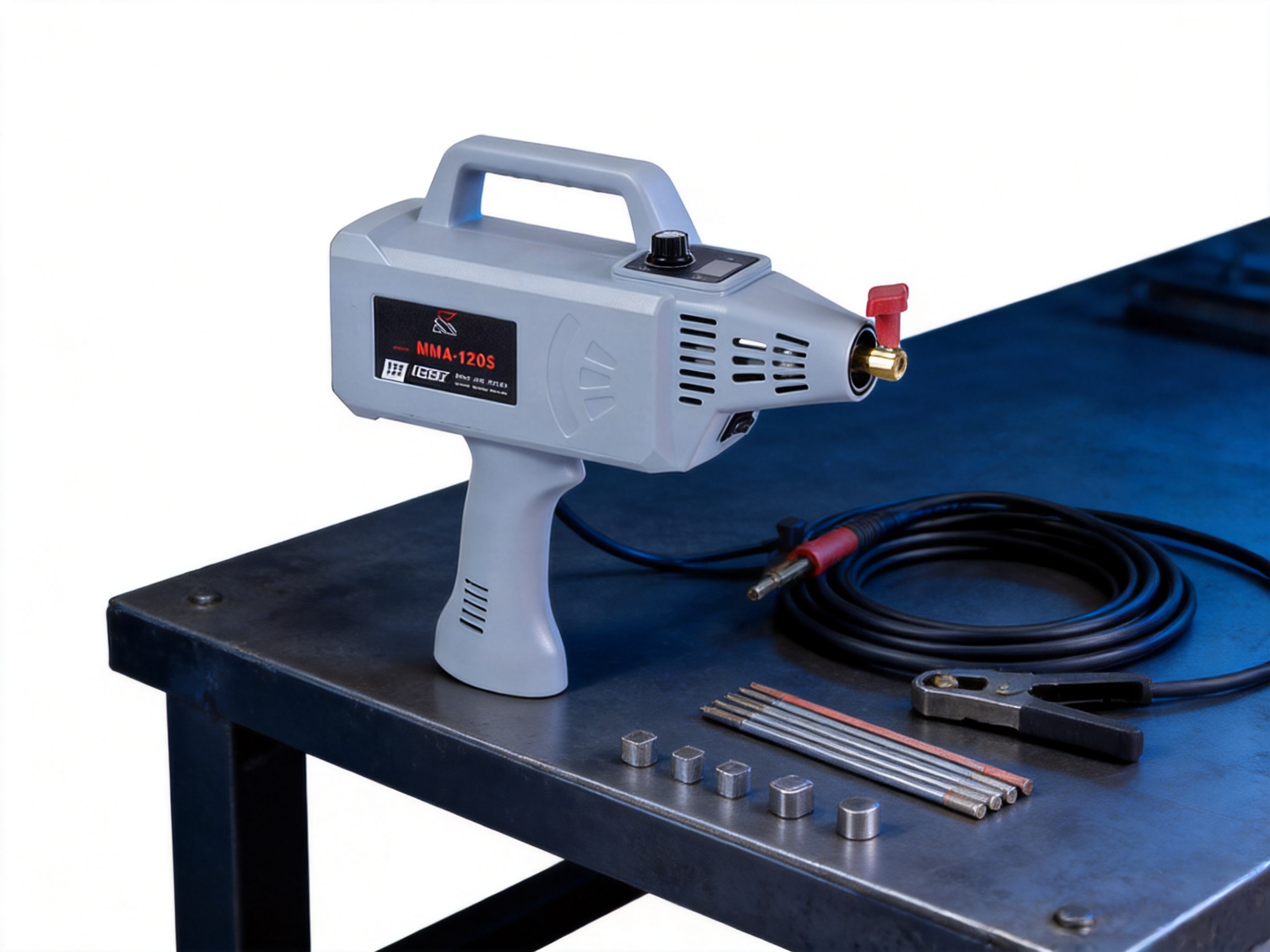
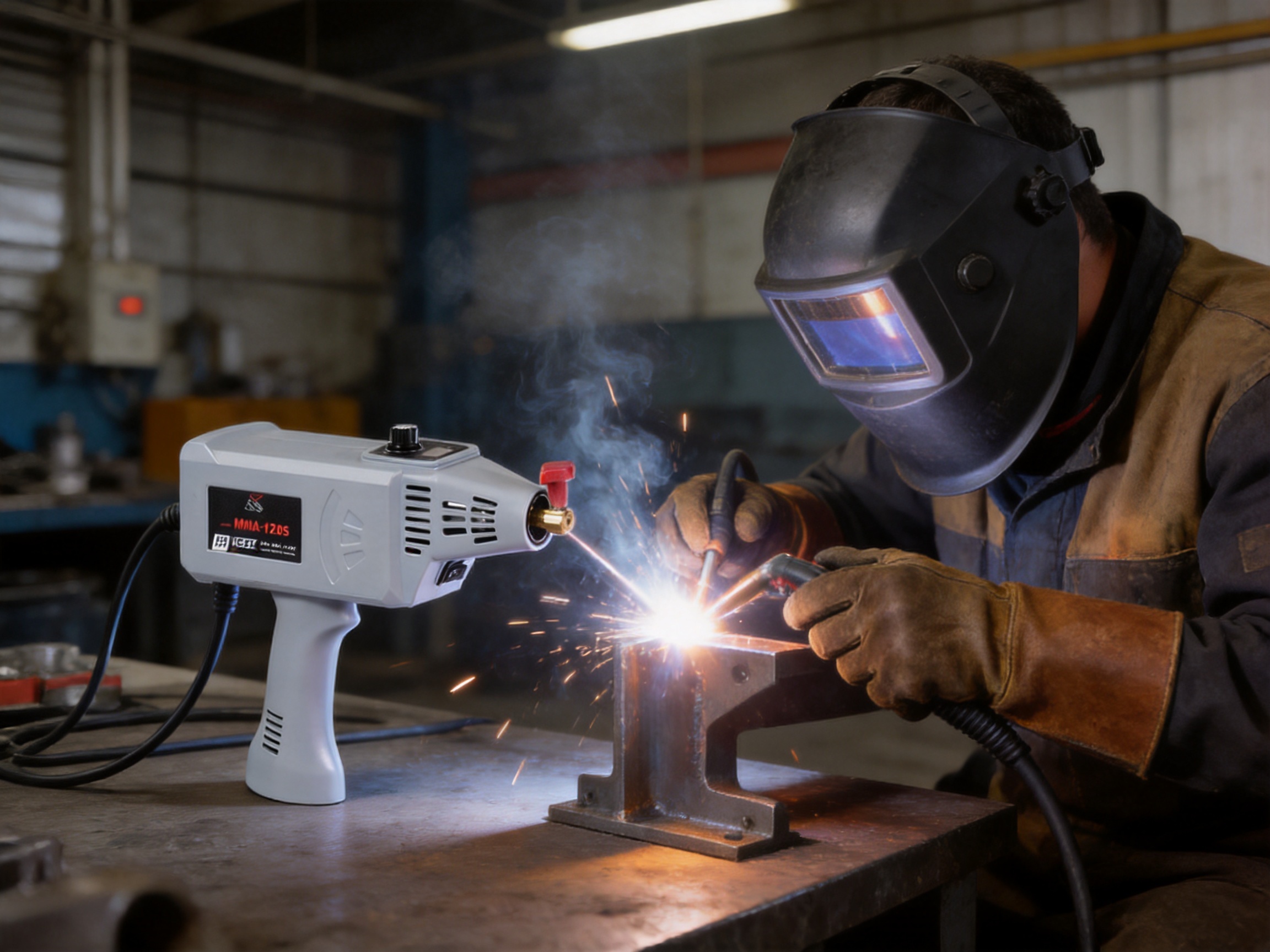
The MMA-120 is suitable for a broad range of light-duty welding applications. It can be used for repair and maintenance work on low-carbon steel components, brackets, frames, supports, gates, agricultural tools, workshop fixtures, and general metal structures. It can also be used for selected stainless steel welding tasks when compatible electrodes and correct procedures are applied.
The product information identifies manual arc welding of thin plate materials as a primary use. Thin material requires careful control because excessive heat can cause burn-through, distortion, or an oversized weld bead. The machine’s lower current setting and compatibility with smaller electrodes allow the operator to reduce heat input compared with using a large electrode at a high current.
Successful thin-material welding also depends on joint preparation. Short weld segments, correct travel speed, suitable electrode selection, and intermittent welding can help control heat. The MMA-120 provides the adjustable current platform, but the operator must apply the correct technique for the material thickness and joint configuration.
Low-carbon steel is one of the most common materials used in general fabrication and repair. It appears in frames, brackets, handrails, equipment supports, agricultural components, and household structures. The MMA-120’s 1.6- to 3.2-millimeter electrode range covers many commonly available stick electrodes used for this material.
Before welding, rust, oil, paint, moisture, and other contamination should be removed from the joint area. A secure ground connection is necessary to complete the electrical circuit. The operator should choose the correct polarity and current setting according to the electrode manufacturer’s instructions.
The machine can be used with stainless steel electrodes for appropriate stainless steel applications. Stainless steel requires attention to heat input, contamination control, and post-weld cleaning. Carbon-steel tools or brushes should not be used carelessly on stainless surfaces if surface contamination could affect corrosion resistance or appearance.
Because stainless steel can be sensitive to heat, the user should avoid excessive current and unnecessary dwelling. The MMA-120’s adjustable output supports controlled operation, but welding procedure requirements remain important. For critical stainless components, users should follow qualified welding procedures and applicable standards.
Compared with traditional transformer-based machines of similar general-purpose capacity, the MMA-120 offers a clear advantage in size and weight. Conventional units can be durable and straightforward, but they are often heavy and less convenient for mobile work. The MMA-120’s inverter architecture provides a more compact alternative for users who prioritize portability.
The product also offers a more modern control structure. A basic transformer machine may provide limited regulation, whereas the MMA-120 uses microprocessor control and electronic inverter switching. This can support faster response, more consistent output, and easier adjustment within the specified range.
Another advantage is input-voltage flexibility. A machine designed only for a narrow supply range may perform poorly when the mains voltage falls or rises. The MMA-120’s stated 180- to 260-volt adapted range gives it a broader operating window, subject to proper electrical installation and rated usage.
Compared with larger professional welding systems, the MMA-120 is easier to transport and simpler to deploy. It does not require an external shielding-gas cylinder, wire feeder, or complex setup. This makes it suitable for users who need the essential function of arc welding without the cost, space, and logistics associated with a larger MIG, TIG, or automated system.
Compared with very small low-cost welders that may use minimal control electronics, the MMA-120 benefits from a more integrated control platform and a defined manufacturing system. The combination of IGBT inverter technology, microprocessor control, engineering-plastic insulation, and documented electrical specifications provides a clearer basis for product evaluation and distribution.
These advantages do not mean that MMA welding replaces every other welding process. MIG/MAG welding is often faster for long production seams, TIG welding is preferred for precise and highly finished work, and automated systems are more suitable for repetitive industrial production. The MMA-120’s strength is its balance of portability, simplicity, versatility, and practical output.
Welding produces intense light, heat, ultraviolet radiation, sparks, fumes, and electrical hazards. Operators must use a suitable welding helmet, protective clothing, welding gloves, safety footwear, and appropriate eye and respiratory protection. Flammable materials should be removed from the work area, and adequate ventilation must be provided.
The IP21S protection rating indicates that the machine is intended for protected conditions. It should be kept away from rain, water spray, condensation, and wet floors. The case should not be opened by unqualified personnel. Internal capacitors and electrical components may retain hazardous energy even after the power supply has been disconnected.
The ground cable should be attached securely to clean metal near the welding area. Loose or contaminated connections can cause unstable arc behavior, overheating, and unnecessary electrical resistance. Welding leads should be inspected regularly for cuts, crushed sections, exposed conductors, or damaged connectors.
Users should observe the rated duty cycle. A 15 percent duty cycle means that operation at a stated rating must be balanced with cooling time according to the applicable testing convention and product instructions. The machine should not be forced to operate continuously at maximum current. If thermal protection activates, allow the unit to cool before resuming work.
Ventilation openings must remain clear. Dust, metal particles, and workshop debris should not be allowed to accumulate inside or around the housing. Periodic external cleaning and professional internal inspection can help preserve cooling performance and electrical reliability.
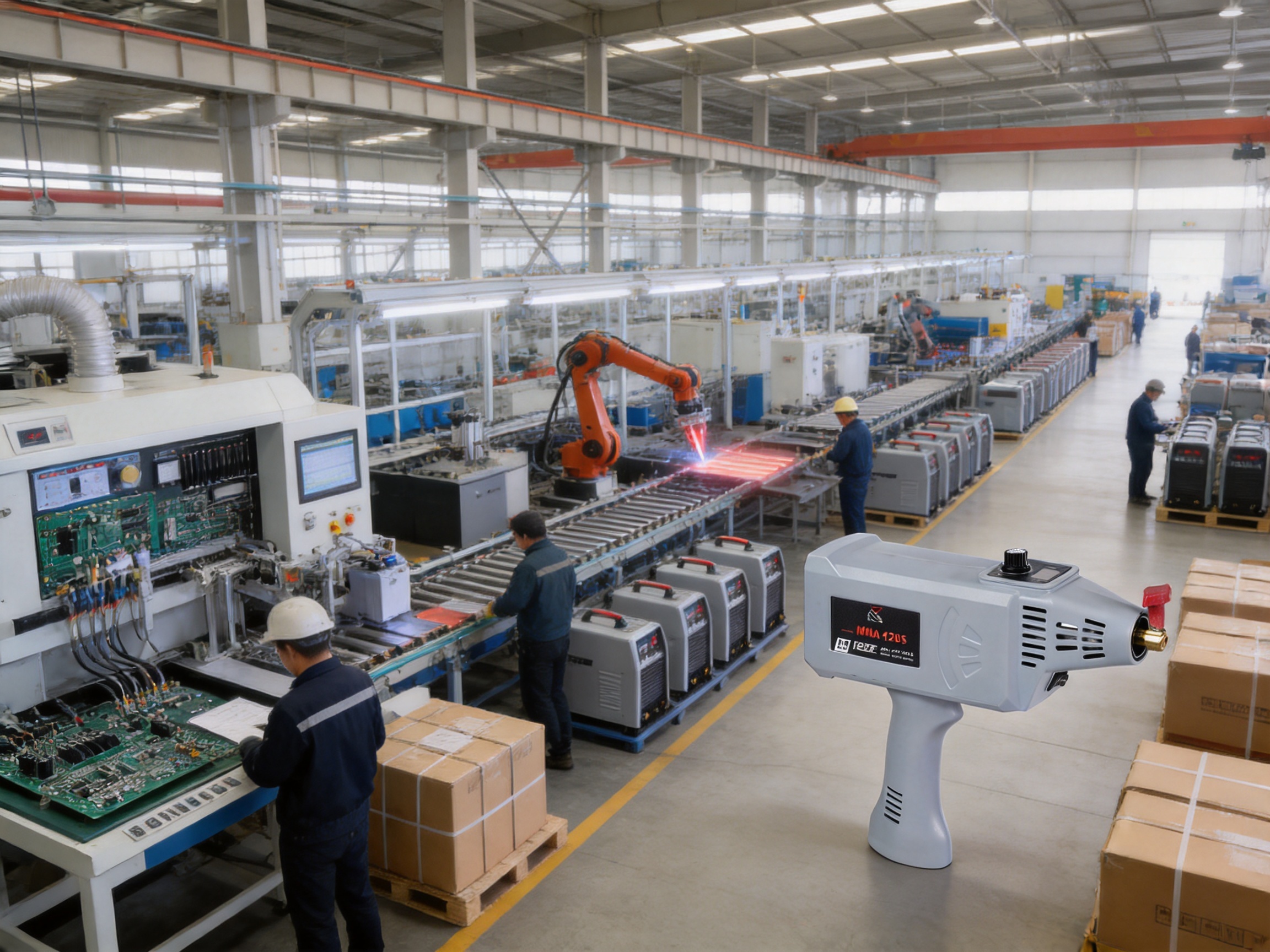
The MMA-120 is supported by the manufacturing capabilities of Zhejiang Kende Mechanical & Electrical Co., Ltd. The company operates from a facility in Taizhou, Zhejiang Province, covering approximately 120,000 square meters and employing about 600 people. This scale provides resources for engineering, procurement, production, quality management, testing, packaging, and international distribution.
The company reports annual exports of nearly 1.5 million units and annual production capacity of approximately 2 million units. Such volume indicates experience with standardized production, supply-chain coordination, product consistency, and high-throughput order fulfillment. For importers and distributors, production capacity can be an important factor because it supports more reliable scheduling and the ability to serve different market requirements.
Kende’s product range includes MMA or stick welding machines, MIG/MAG equipment, flux-cored welding machines, TIG machines, plasma cutters, stud welding machines, submerged arc welding systems, battery chargers, and electric, gas, and oil heaters. This broad product portfolio gives the company experience across several power-electronics and thermal-equipment categories.
Manufacturing equipment reportedly includes automatic surface-mount technology, plug-in and welding systems, robot processing, laser cutting, and other advanced production technologies. Automated patching, electronic assembly, and controlled welding processes can improve repeatability and reduce variation between units. Robot processing and laser cutting can also support accurate enclosure production and consistent component fit.
For a compact inverter welder, electronic assembly quality is especially important. The machine contains power semiconductors, control boards, connectors, cooling components, and protective circuits. Automated placement and controlled soldering processes can help maintain consistent assembly standards, while inspection and testing are needed to confirm electrical performance.
The company also applies management systems that include office automation, Toyota Production System methods, ERP software, and MES manufacturing management. These systems can help connect purchasing, production planning, inventory, quality records, process control, and shipment information. Better production visibility supports traceability and helps manufacturers respond to customer requirements more efficiently.
Kende reports a Zhejiang Provincial Research and Development Center, an Enterprise Technology Center, and an Intelligent Welding Technology Research Institute. These facilities demonstrate an emphasis on continuing product development rather than relying solely on established designs.
The company has approximately 98 research and development personnel and has obtained invention patents, utility model patents, appearance patents, and software copyrights. Intellectual-property activity can reflect ongoing work in circuit design, mechanical construction, control systems, product appearance, manufacturing processes, and user-oriented functions.
The company also reports participation in national welding-machine standardization work. It has participated in the drafting, formulation, and revision of 20 national standards and has led the drafting of one group standard, according to the supplied company information. Involvement in standardization can help a manufacturer understand technical requirements and market expectations at an industry level.
Reported product certifications include GS, CE, EMC, ERP, US ETL, UKCA, and China CCC. The exact certification applicable to a particular MMA-120 model, production batch, and destination market should always be confirmed through the relevant documentation. Nevertheless, experience with multiple certification systems is valuable for international distributors and private-label customers.
Certification experience also supports export readiness. Different markets may impose requirements concerning electrical safety, electromagnetic compatibility, energy performance, labeling, documentation, and product traceability. A manufacturer familiar with these requirements can more effectively prepare technical files and adapt products for regional compliance.
Reliability is determined by more than a single headline specification. It depends on the quality of electronic components, thermal design, mechanical construction, assembly consistency, inspection, testing, packaging, transportation, and the user’s operating practices. The MMA-120’s design addresses several of these areas through IGBT power conversion, integrated control, an insulated engineering-plastic enclosure, and a defined cable configuration.
Microprocessor control can support repeatable electrical behavior between units when the control boards and power sections are assembled correctly. Automated manufacturing processes may reduce manual variation, while production management systems can assist with process records and quality checkpoints.
The case construction is also relevant to reliability. Engineering plastic offers electrical insulation and helps keep the product light. However, lightweight equipment still requires careful handling. The machine should not be dropped, used as a step, exposed to excessive impact, or stored in damp conditions.
Appropriate packaging is essential for a portable electrical product. The supplied specification lists a package or item dimension of 310 by 100 by 315 millimeters. Distributors should confirm the final carton dimensions, gross weight, labeling, and pallet information with the manufacturer before arranging shipment, especially when calculating container loading or courier costs.
For professional users, serviceability and documentation are also important. Product manuals should explain connection, electrode selection, current adjustment, duty cycle, maintenance, and fault handling. Distributors should maintain records of model versions and certification documents so that replacement parts and technical support can be managed efficiently.
The MMA-120 has characteristics that can make it attractive for retail and distribution channels. Its compact size reduces storage requirements, its lightweight construction supports convenient handling, and its single-phase power supply is familiar to many household and small-workshop users. The MMA category itself is widely recognized, which can simplify product positioning.
The machine can be marketed to several customer groups: maintenance professionals, small fabrication shops, agricultural users, construction workers, vehicle repair technicians, vocational training centers, home workshop owners, and hardware retailers. Each group may value a different feature, but portability and simple MMA operation are relevant across the majority of these applications.
For private-label or regional distribution programs, the manufacturer’s broader engineering and production resources may support packaging changes, documentation adaptation, market-specific labeling, and product development discussions. Any customization should be confirmed according to minimum order quantities, technical feasibility, certification requirements, and production schedules.
The machine’s specifications should be presented accurately. It should not be promoted as a heavy industrial continuous-duty power source when its rated duty cycle is 15 percent. Honest positioning improves customer satisfaction and reduces the risk of misuse. The strongest commercial message is that the product is a lightweight, energy-efficient, general-purpose MMA inverter for portable welding and repair applications.
Before welding, inspect the machine, cables, electrode holder, ground clamp, and power connection. Make sure the work area is dry, adequately ventilated, and free of flammable materials. Select an electrode suitable for the base material and joint type, then set the current according to the electrode manufacturer’s recommendation.
Clean the joint area to remove rust, paint, oil, moisture, and loose scale. Position the ground clamp securely on clean metal. If the workpiece is coated or contaminated, arc stability and weld quality may suffer. Good preparation is especially important when working with thin materials, because defects are more difficult to correct after burn-through or excessive distortion.
Use a controlled arc length and steady travel speed. A long arc can increase spatter and reduce penetration control, while an excessively short arc can cause the electrode to stick. The correct technique varies with electrode type and welding position. Beginners should practice on scrap material before working on a finished component.
After welding, allow the slag to cool sufficiently before removing it with the correct tool. Inspect the bead for cracks, undercut, porosity, incomplete fusion, excessive spatter, or inconsistent profile. Critical joints should be evaluated according to the applicable engineering standard or inspection procedure.
When the machine is not in use, disconnect it from the power supply, coil the cables without sharp bends, and store the equipment in a clean, dry location. Regular care helps protect the cables and connectors and reduces the chance of damage during transport.
MMA welding has a number of practical advantages over gas-shielded processes. It does not require a gas cylinder, regulator, gas hose, or wire-feeding system. This makes setup simpler and improves mobility. It can also be used outdoors where wind might disturb the shielding gas of a MIG or TIG process, although strong wind can still affect the arc and should be controlled whenever possible.
MIG/MAG welding can provide higher productivity and is often preferred for long seams, thin sheet production, and repetitive fabrication. TIG welding generally offers better control and appearance for precision work, stainless steel, and non-ferrous metals. Plasma cutting is intended for cutting rather than joining. The MMA-120 is not designed to replace these specialized systems; instead, it offers an economical and portable solution for jobs where stick welding is appropriate.
Compared with a gas-shielded welder, the MMA-120 has fewer accessories and lower setup complexity. Compared with a large transformer welder, it offers lower weight and a smaller footprint. Compared with a high-end industrial inverter, it is more limited in output and duty cycle but may be more affordable and practical for general repair work.
This balanced positioning is important. Product selection should be based on material, thickness, welding duration, work environment, required finish, available power, and operator skill. When the job matches the machine’s intended range, the MMA-120 can offer a useful combination of convenience and performance.
The MMA-120 is a single-phase manual metal arc welding machine, also known as a stick welder. It uses coated electrodes rather than a continuously fed welding wire or an external shielding-gas cylinder.
The rated input is 230 volts at 50 hertz. The adapted input-voltage range is 180 to 260 volts. The supply circuit must still be properly rated and installed according to local electrical requirements.
The machine is intended for low-carbon steel and can also be used with suitable stainless steel electrodes. Correct electrode selection, polarity, current, joint preparation, and welding procedure are necessary for satisfactory results.
The stated usable electrode range is 1.6 to 3.2 millimeters. The maximum electrode diameter is 3.2 millimeters. Actual selection should follow the electrode manufacturer’s recommendations and the thickness of the workpiece.
The supplied specification lists a welding thickness range of 1.6 to 5.0 millimeters. Results depend on material type, joint design, electrode selection, welding position, operator technique, and the number of passes.
It can be useful for portable repair work, but the IP21S enclosure rating means it should be used in protected, dry conditions. The machine must be shielded from rain, water, and excessive moisture.
The listed net weight is 1.9 kilograms. The supplied specification also includes a 2.55-kilogram value in a separate weight-related field. Distributors should confirm the exact gross weight and package data for the intended production version.
The listed accessories include a 2-meter welding cable and a 2-meter ground cable. The supplied cable description identifies H01N2-D 1 × 16 square millimeter cable for both cable assemblies.
Yes. The product information identifies IGBT inverter technology. This technology supports a compact design, efficient power conversion, and responsive electronic control.
The rated duty cycle is 15 percent. Operators should follow the product manual and allow adequate cooling, particularly when welding at higher current settings.
It is primarily a portable general-purpose welding machine. It may be useful for maintenance and occasional fabrication within its capacity, but continuous automated production should use equipment specifically designed for the required duty cycle, output, and process.
The manufacturer reports large production capacity, international export experience, research and development facilities, automated production equipment, and experience with certifications such as CE, EMC, ERP, GS, ETL, UKCA, and CCC. Specific documentation should be verified for each target market and model.
The MMA-120 is a compact and practical inverter welding machine for users who need portable stick-welding capability without the bulk of a traditional transformer unit. Its 20- to 120-ampere real current range, 1.6- to 3.2-millimeter electrode compatibility, 62-volt open-circuit rating, and 180- to 260-volt adapted input range make it suitable for many light fabrication and repair tasks.
Its principal advantages are the combination of low weight, small size, IGBT inverter technology, microprocessor control, engineering-plastic insulation, and simple single-phase operation. These features make the machine convenient for mobile technicians, workshops, maintenance teams, farms, construction sites, and household users working in protected conditions.
The product is further supported by the manufacturer’s substantial production infrastructure, research resources, automated manufacturing technologies, management systems, export experience, and certification background. Together, these capabilities provide a foundation for consistent production and international market support.
For the best results, the MMA-120 should be used within its rated output and duty cycle. With suitable electrodes, correct electrical connections, proper workpiece preparation, and responsible safety practices, it can provide an efficient and dependable solution for everyday MMA welding requirements.
1. Supplied product specification for the MMA-120 portable handheld welding machine.
2. Supplied company profile for Zhejiang Kende Mechanical & Electrical Co., Ltd.
3. General principles of manual metal arc welding, electrode selection, arc control, and weld preparation.
4. General guidance concerning inverter welding equipment, IGBT power conversion, electrical protection, and duty-cycle operation.
5. General workplace safety practices for arc welding, including personal protective equipment, ventilation, fire prevention, and electrical safety.
Recommended Products

Contact Us
No.2299, Luqiao Section, Shugang Avenue, Luqiao District, Taizhou, 318057 Zhejiang, PR China.
+86-576-82431568
 Privacy
China Welding Machine Factory
 English
 中文简体
中文简体
 русский
 Español
 عربى
عربى
 Français
 Português
 Deutsch
 Український