Email: [email protected]
Email: [email protected]

Blog
 2026.07.26
 Blog
Blog
Spot welding remains one of the most practical methods for joining overlapping metal sheets in automotive repair, appliance production, light fabrication, electrical enclosures, hardware manufacturing, and general workshop applications. A well-designed spot welder must deliver consistent current, maintain dependable electrode pressure, operate safely in demanding environments, and remain simple enough for daily use. The DN-100T Series Spot Welding Machine is designed around these requirements, combining portable construction, single-phase electrical operation, high duty cycle performance, microprocessor control, and a robust transformer-based welding system.
With a rated input capacity of 8 kVA, a 50% rated duty cycle, and a welding capacity of 1.5 mm plus 1.5 mm, the DN-100T is suited to the joining of mild steel, stainless steel, and many non-ferrous metals. Its compact dimensions of 550 × 155 × 355 mm and net weight of approximately 13 kg make it easier to move between workstations than many larger stationary resistance welding systems. At the same time, its high-efficiency electrical design provides the output required for repeated spot welding operations.
The machine is intended for users who need a practical balance between welding performance, portability, control, and maintenance convenience. It is appropriate for professional workshops, production support areas, repair businesses, metalworking classrooms, maintenance departments, and small manufacturing lines. Its technology is also useful for operators who require a dedicated resistance welding solution rather than a general-purpose arc welding machine.
The DN-100T is a single-phase portable spot welding machine developed for resistance welding of overlapping metal components. Unlike arc welding, resistance spot welding does not require a continuous visible arc, shielding gas, or filler metal. Instead, the machine passes a controlled electrical current through the workpieces while the electrodes apply pressure. Electrical resistance at the contact area generates heat, creating a weld nugget that joins the sheets together.
This process is especially valuable when clean, repeatable, and relatively fast sheet-metal joining is required. It can reduce the need for grinding, finishing, or additional filler material. When the material, electrode condition, pressure, and welding time are properly matched, multiple spot welds can be created rapidly with a consistent appearance.
The DN-100T incorporates an advanced microprocessor and two-way thyristor control technology. These control features help regulate the welding process and provide operators with a more straightforward way to select and monitor operating conditions. LED indicators make the control interface easier to understand, particularly for users who need to identify selected functions or operating status quickly.
The machine’s new external design is paired with a higher ingress protection class. This improvement is important for workshops where the equipment may be exposed to metal dust, production debris, or occasional environmental contaminants. Although every welding machine should be kept clean and protected from water, enhanced protection can support more dependable operation in normal industrial and workshop conditions.
| Specification | DN-100T Value |
|---|---|
| Product type | Portable spot welding machine |
| Power supply | Single-phase |
| Rated supply voltage | 230 V |
| Supply frequency | 50/60 Hz |
| No-load voltage | 1.8 V |
| Rated input capacity | 8 kVA |
| Rated duty cycle | 50% |
| Insulation class | H |
| Recommended welding thickness | 1.5 mm + 1.5 mm |
| Net weight | 13 kg |
| Machine dimensions | 550 × 155 × 355 mm |
| Included accessories | Electrode tips and carton packaging |
The specification table shows why the DN-100T occupies a useful position between small hobby equipment and larger fixed industrial resistance welders. Its 8 kVA input capacity provides meaningful welding power, while the 13 kg net weight preserves portability. The 50% duty cycle allows the machine to work through repeated production sequences while providing appropriate time for thermal recovery.
The stated welding thickness is 1.5 mm plus 1.5 mm. This means the machine is designed to join two overlapping sheets, each with a nominal thickness of up to 1.5 mm under suitable material and process conditions. Actual results depend on the metal type, surface condition, electrode geometry, contact pressure, welding time, electrical supply quality, and spacing between weld points.
Portability is one of the most important advantages of the DN-100T. Many resistance welding machines are permanently installed because of their size, weight, and electrical requirements. A portable machine, by comparison, can be moved to the component, vehicle, fabrication bench, or repair area. This can reduce handling time and simplify work on large or awkward assemblies that cannot easily be carried to a fixed welding station.
The compact 550 × 155 × 355 mm design allows the machine to occupy limited floor or bench space. It can be positioned in a repair workshop, production cell, tool room, or maintenance department without requiring a large installation footprint. Its relatively low weight also makes it more practical for service teams that need to transport equipment to different locations.
Portability does not eliminate the need for a suitable work environment. The machine should be placed on a stable, dry, adequately ventilated surface. Operators should provide sufficient clearance around ventilation openings and keep cables, electrode arms, and workpieces arranged so that they cannot create a trip hazard. Proper placement helps preserve the machine’s electrical and thermal performance.
Compared with improvised transformer-based spot welders, the DN-100T provides a more integrated solution. The transformer, control system, enclosure, indicators, and electrode accessories are supplied as part of a coordinated product design. This supports more predictable operation than assembling separate components with uncertain compatibility.
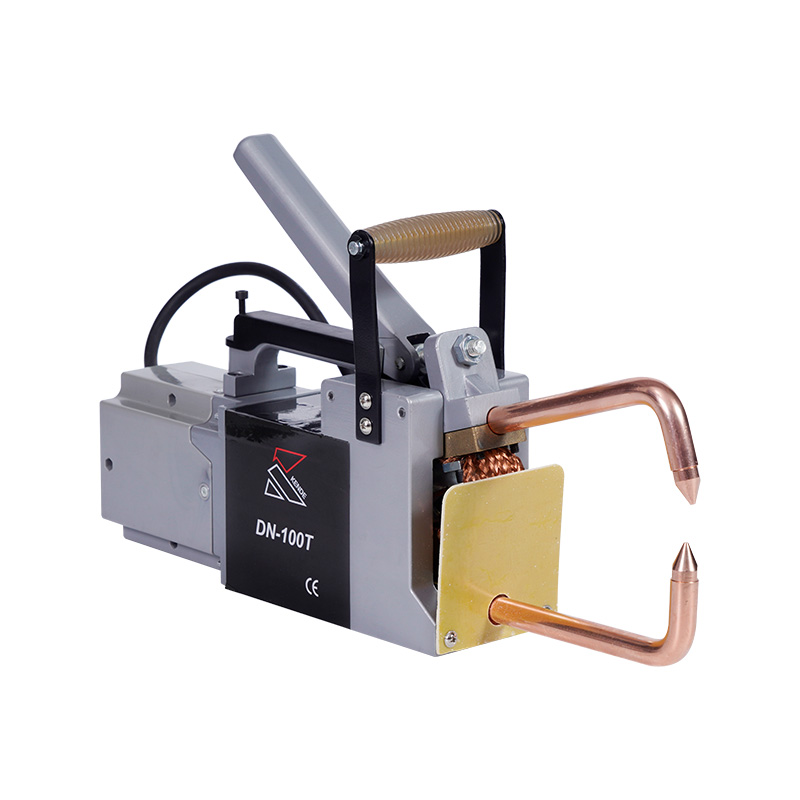
DN-100T Series Spot Welding Machines DN-100T
The DN-100T is built for a 50% rated duty cycle. In resistance welding, duty cycle expresses the proportion of a specified operating period during which the equipment can weld at its rated capacity. A 50% duty cycle is useful for applications that involve repeated welding with intervals for positioning parts, inspecting the joint, moving the electrode, and allowing the transformer and other components to manage heat.
A higher duty cycle can offer a practical advantage over basic low-duty portable welders. Operators can complete more work in a given shift without needing excessively long pauses between welds. The actual production rate will still depend on the workpiece design and operator technique, but the machine’s rating provides a stronger foundation for repeated use.
The product information also emphasizes lower no-load current and lower power consumption. No-load current is the current drawn when the machine is energized but not actively welding. Reducing unnecessary current consumption can help improve operating efficiency, limit idle losses, and make the equipment more economical in a workshop that performs frequent stop-and-start work.
Energy efficiency is valuable not only because of electricity cost. Lower idle consumption can reduce unnecessary heating within the electrical system and may support more comfortable operation in smaller workshops. It can also be beneficial where several machines share the same electrical distribution system, although the installation must always be designed according to the rated input capacity and applicable electrical regulations.
One of the machine’s important technical features is its advanced microprocessor control system. Microprocessor control allows operating functions to be managed electronically rather than relying exclusively on basic mechanical switching. This can make the machine easier to operate and can help create more repeatable welding sequences when the correct settings are selected.
The DN-100T also uses two-way thyristor control technology. Thyristors are solid-state power-control devices that can regulate the flow of alternating current through the welding transformer. In a resistance welding application, controlled current delivery is essential because the weld nugget depends on the relationship between current, time, pressure, and material resistance.
Electronic control can provide a more stable operating experience than a simple uncontrolled transformer. It can help reduce unnecessary variation between weld cycles and support better process management. This is especially useful when an operator must produce a series of similar spot welds on components with consistent material thickness.
The electronic system does not replace correct setup. A clean contact surface, suitable electrode tips, correct pressure, appropriate weld spacing, and a stable power supply remain necessary. The control system is most effective when it is combined with disciplined preparation and a repeatable operating procedure.
LED indicators further simplify operation. Clear visual indicators can help the operator identify the machine’s status without relying on complicated menus or extensive technical training. For workshops with multiple users, this straightforward interface can shorten familiarization time and reduce the possibility of selecting an unsuitable operating mode.
The welding transformer is a central component of any resistance spot welding machine. It converts the available supply voltage into the low-voltage, high-current output required to create localized heat between the electrodes. In the DN-100T, the welding transformer windings are made of aluminium wires.
Aluminium winding material can contribute to a practical balance of weight, electrical performance, and manufacturing efficiency when appropriately engineered. Transformer design must account for conductor cross-section, insulation, heat dissipation, winding arrangement, magnetic performance, and long-term reliability. The winding material is only one element of the overall transformer system, but its integration with the machine’s control and cooling design is important.
The DN-100T has a listed no-load voltage of 1.8 V. Resistance welding normally operates at a low output voltage and high current. This is appropriate for heating the interface between overlapping metal sheets while reducing the risk associated with high open-circuit arc-welding voltages. Operators must nevertheless follow all electrical safety requirements because the machine contains hazardous mains voltage and can deliver very high welding current.
The 230 V single-phase supply makes the machine suitable for many standard workshop electrical installations, subject to local requirements and proper circuit protection. The stated 50/60 Hz frequency supports use in regions operating on either of these common supply frequencies. Users should verify voltage compatibility, circuit capacity, grounding, plugs, and protection devices before installation.
The machine can be widely used for spot welding mild steel, stainless steel, and most non-ferrous metals, provided that the material combination and thickness are suitable for the machine’s operating range. Mild steel is a common application because it offers predictable electrical resistance and is widely used in brackets, cabinets, frames, panels, and general fabrication.
Stainless steel can also be joined by resistance spot welding. Because stainless grades differ in electrical resistance, thermal conductivity, surface condition, and oxide behavior, operators should validate the welding schedule for each application. Correct electrode maintenance and suitable pressure are particularly important when a clean, consistent joint is required.
Many non-ferrous metals may be suitable, but their properties can vary significantly. Aluminium and copper-based alloys, for example, generally conduct heat and electricity differently from mild steel. Their welding conditions may require careful adjustment, specialized electrode materials, or additional process testing. The product’s broad material capability should therefore be understood as an application range rather than a guarantee that every alloy and thickness will produce identical results.
Common applications include joining sheet-metal covers, small brackets, instrument panels, appliance parts, metal boxes, ventilation components, furniture hardware, automotive repair pieces, and light structural assemblies. The machine can be useful for prototype work as well as repeated production, particularly where the components are small enough to be positioned comfortably between the electrodes.
In repair work, a portable spot welder can help restore sheet-metal assemblies without introducing the visible bead associated with arc welding. This may reduce post-welding grinding and preserve a cleaner surface. In production support, it can be used for subassemblies, temporary fixture work, or low-volume components that do not justify a large automated resistance welding line.
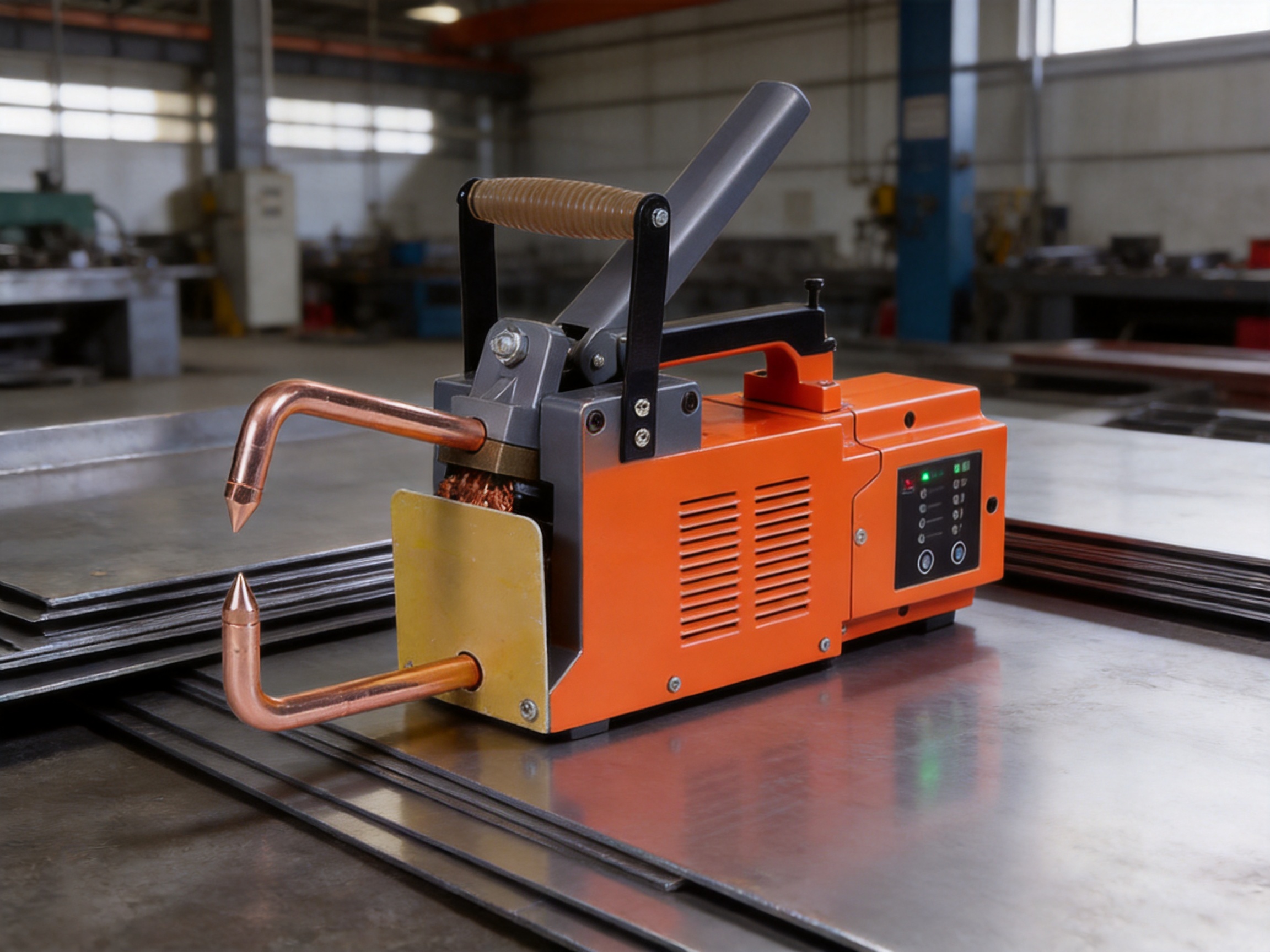
The DN-100T offers several advantages over simpler spot welding equipment. First, its 50% duty cycle is suited to more demanding repeated use than many entry-level machines with limited thermal capacity. This can improve productivity in workshops where operators must complete a series of welds rather than perform occasional repairs.
Second, the microprocessor and two-way thyristor control system provides a more modern approach to current management. Basic machines may rely on less sophisticated switching arrangements, which can make process control less consistent. Electronic control can help the operator achieve more repeatable results, especially when the same material and joint design are used repeatedly.
Third, the machine combines a relatively compact body with an 8 kVA rated input capacity. This combination makes it more flexible than large fixed resistance welders while offering greater capability than very small portable units. It is therefore suitable for users who need equipment that can move between work areas without sacrificing useful welding power.
Fourth, the higher IP-class appearance and enclosure design can provide an additional level of protection against ordinary workshop contamination. This is not a substitute for cleaning, inspection, or correct storage, but it reflects attention to the realities of industrial use.
Fifth, the product is supplied with electrode tips and carton packaging. Complete basic accessories help users begin setup without immediately sourcing essential consumable components. Replacement tips and other consumables should still be selected according to the material, welding current, electrode geometry, and maintenance plan.
Finally, the machine is designed for easy adjustment, operation, and maintenance. This can reduce the learning curve for new operators and help maintenance personnel inspect the equipment more efficiently. Ease of use is a meaningful productivity factor because a technically capable machine can still underperform if its controls and service points are unnecessarily complicated.
Electrode condition has a direct influence on spot weld quality. The electrode tips transfer current and pressure to the workpiece, so their shape, alignment, cleanliness, and wear condition must be monitored. The DN-100T is supplied with tips, providing a starting set for operation.
Over time, repeated welding can cause tip deformation, surface contamination, mushrooming, or pitting. These conditions can enlarge the contact area and reduce current density, potentially producing weak or inconsistent welds. Regular inspection and appropriate dressing or replacement can help maintain stable results and extend electrode life.
The product information specifically highlights long electrode life. Long service life can reduce consumable costs, decrease interruptions, and support more consistent production. Actual electrode life depends on the number of welds, material coatings, surface contamination, current settings, pressure, cooling conditions, and the quality of maintenance.
Galvanized, painted, oily, rusty, or heavily oxidized surfaces may affect the welding process. Whenever practical, surfaces should be cleaned and prepared before welding. Coatings can change electrical resistance and may produce fumes or spatter. Operators should follow appropriate safety procedures for coated materials and provide effective ventilation.
Electrode alignment is equally important. The two tips should meet squarely and apply pressure to the intended welding location. Misalignment can create uneven contact, reduce nugget quality, and accelerate tip wear. A simple inspection routine before each shift can prevent many avoidable defects.
Before using the DN-100T, inspect the housing, supply cable, plug, electrode arms, tips, controls, and work area. Confirm that the machine is connected to a suitable 230 V single-phase supply and that the circuit is protected according to local electrical requirements. Do not operate the equipment if insulation, grounding, or mechanical components appear damaged.
Prepare the metal sheets by removing excessive oil, dirt, loose scale, and contamination from the intended weld area. Arrange the sheets so that they overlap correctly and lie flat against each other. Gaps between the sheets can reduce heat transfer and pressure consistency, making it more difficult to obtain a sound weld.
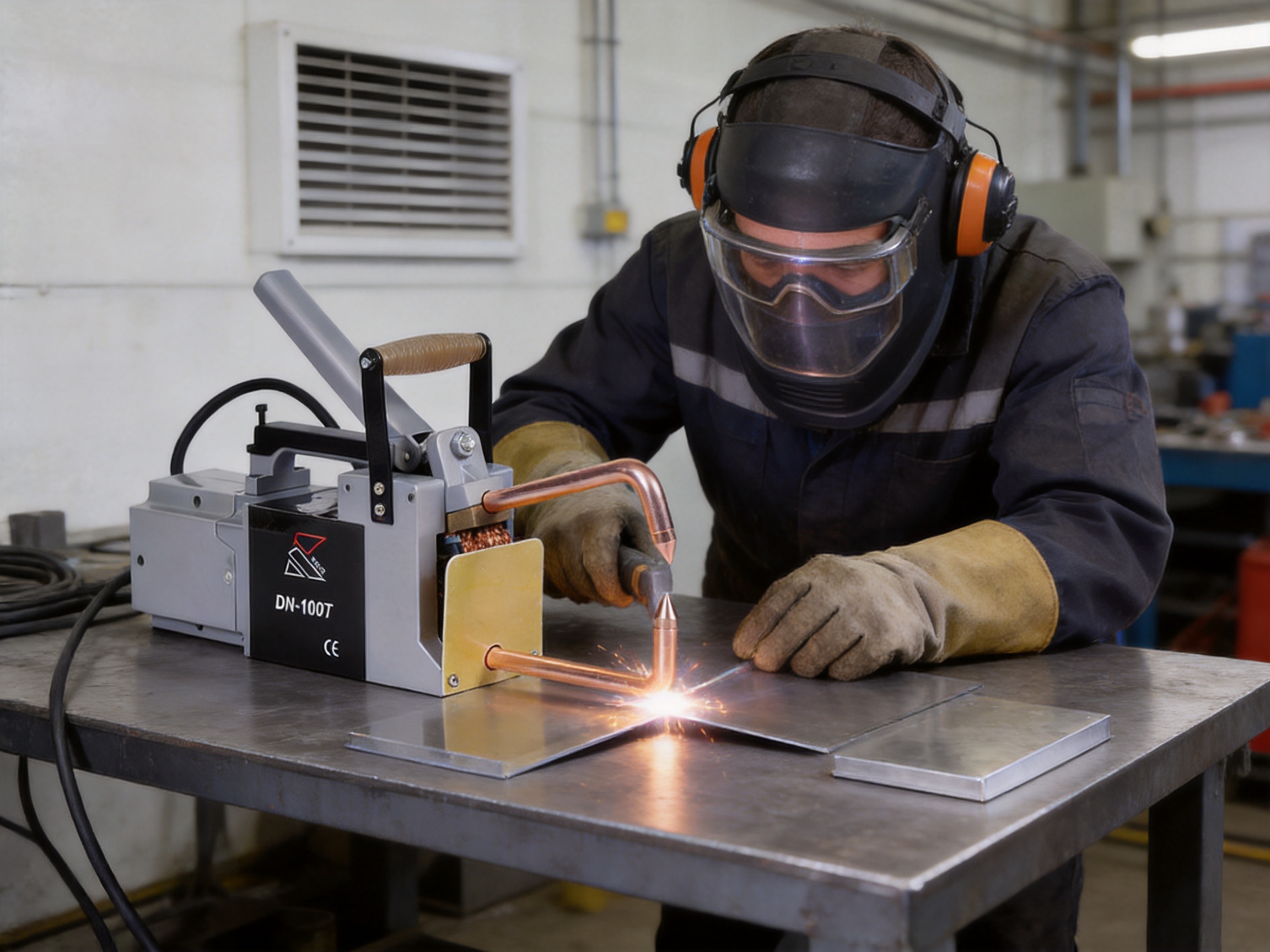
Place the workpiece between the electrode tips and position the welding point. Keep hands clear of the pinch area. Activate the machine according to the operating controls and allow the electrodes to apply pressure before and during the welding cycle. The exact sequence depends on the machine configuration and the selected operating mode.
After the welding cycle, release the electrodes and inspect the joint. A suitable weld should provide firm attachment without excessive burning, deep indentation, expulsion, or unacceptable surface damage. For critical work, perform destructive testing, peel testing, tensile-shear testing, or another appropriate quality-control method based on the application.
Operators should develop a consistent pattern for weld spacing and sequence. Excessively close welds can affect current distribution because previous welds may alter the electrical path through the sheet. A controlled sequence can also reduce distortion and help distribute heat evenly across the component.
When changing material thickness or type, conduct trial welds before beginning production. Adjustments may be necessary because mild steel, stainless steel, and non-ferrous metals do not respond identically. Process validation is particularly important where the assembly has safety, structural, pressure-containing, or regulatory significance.
Resistance welding equipment presents electrical, thermal, mechanical, and fume-related hazards. Only trained personnel should operate the machine. Operators should read the applicable instruction manual, understand the controls, and use appropriate personal protective equipment.
Even though spot welding does not produce the same continuous arc as MIG, TIG, or MMA welding, bright flashes, hot metal, sparks, and molten particles may still be generated. Safety glasses with suitable side protection should be worn, and additional face or eye protection should be used when the application creates a greater risk of ejected material.
The electrode area creates a powerful pinch point. Keep fingers, loose clothing, jewelry, and tools away from the electrode arms during operation. Components should be held with suitable fixtures or tools when necessary. Never place hands between the electrodes while the machine is energized or under pressure.
Ventilation is important when welding coated, painted, galvanized, or contaminated materials. Heating surface coatings can release hazardous fumes. The work area should have suitable general ventilation or local exhaust, and operators should follow workplace exposure-control procedures.
Flammable materials must be removed from the welding area. The machine should not be used near combustible vapors, leaking fuel, explosive atmospheres, or materials that can ignite from heat or sparks. A suitable fire extinguisher and emergency procedure should be available where required.
Maintenance should be performed with the machine disconnected from the electrical supply. Internal components may retain hazardous energy, and access to the enclosure should be limited to qualified service personnel. Inspection, cleaning, and repair must follow the manufacturer’s procedures and applicable safety standards.
The DN-100T is designed for easy maintenance, but routine care remains essential. Keep the enclosure and ventilation areas free from dust, metal particles, and debris. Accumulated contamination can restrict cooling or affect the operation of controls and moving electrode components.
Inspect the electrode tips regularly. Remove suitable surface buildup when permitted, and replace tips that are excessively worn, cracked, badly deformed, or contaminated. Check that the tips remain aligned and that the electrode arms move smoothly without unusual resistance.
Inspect cables and connections for cuts, abrasion, loose terminals, discoloration, or signs of overheating. Any damaged cable or connector should be repaired or replaced by qualified personnel. Do not continue operating a machine that shows evidence of electrical arcing, burning insulation, or repeated circuit-tripping.
Keep the control panel clean and dry. LED indicators should be checked during startup and operation. If an indicator behaves unexpectedly, the machine should be taken out of service until the cause has been identified.
Maintenance records can be valuable in production environments. Recording electrode changes, cleaning activities, fault conditions, and inspection dates helps identify recurring issues. It can also support preventive maintenance planning and improve overall equipment availability.
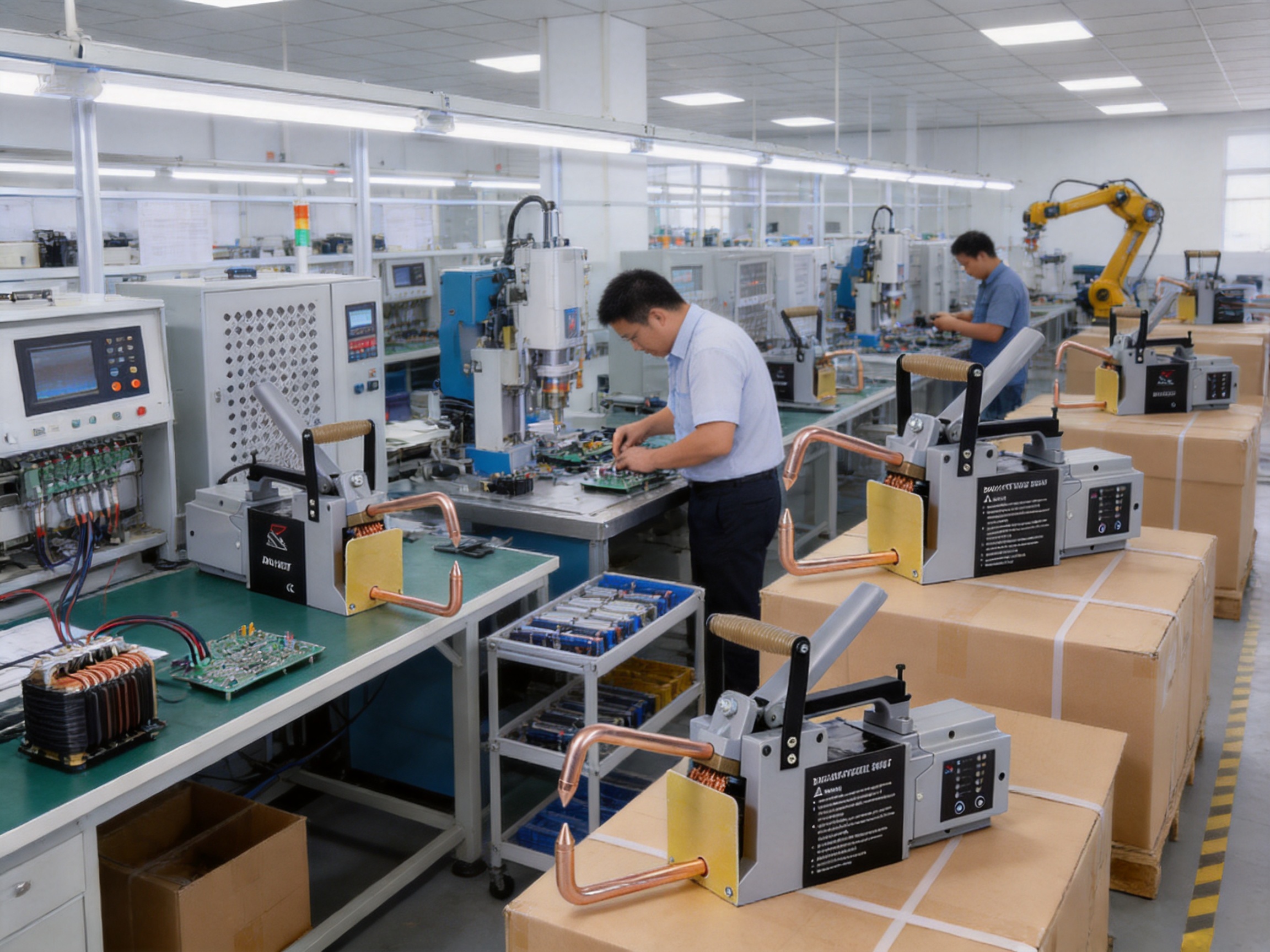
The manufacturer of the DN-100T, Zhejiang Kende Mechanical & Electrical Co., Ltd., operates as a large-scale producer of welding machines, battery chargers, and heaters. Its facilities cover approximately 120,000 square meters and employ around 600 people. The company reports an annual production capacity of approximately two million units and exports nearly 1.5 million units annually.
This scale provides several potential advantages for a product such as the DN-100T. High-volume production can support dedicated assembly processes, established supplier relationships, structured quality-control procedures, and repeatable manufacturing documentation. It can also help the manufacturer refine product designs based on experience from different markets and application environments.
The company manufactures a broad portfolio that includes MMA or stick welding machines, MIG/MAG machines, flux-cored welding equipment, TIG machines, plasma cutters, stud welders, submerged arc welding equipment, battery chargers, and electric, gas, and oil heaters. This broad product knowledge is relevant because it requires expertise in transformers, power electronics, thermal management, electrical insulation, control systems, sheet-metal enclosures, and product safety.
The reported manufacturing systems include automatic surface-mount and plug-in production, robotic processing, laser cutting, and other automated technologies. These processes can improve repeatability in circuit-board assembly, mechanical fabrication, and enclosure production. Laser cutting can support accurate sheet-metal parts, while robotic processing can provide consistent handling and joining in appropriate production stages.
The company also uses management and production systems identified as OA office automation, Toyota TPS management, ERP K3, and MES management. Integrated management and manufacturing systems can help coordinate purchasing, production planning, traceability, inventory, process control, and quality records. For international customers, organized production systems can support more dependable delivery and documentation.
Research and development is another stated strength. The company reports a Zhejiang Provincial R&D Center, an Enterprise Technology Center, and an Intelligent Welding Technology Research Institute, supported by approximately 98 research and development personnel. Such resources can contribute to improvements in welding controls, inverter technology, thermal design, mechanical structures, user interfaces, and product reliability.
The manufacturer also reports numerous invention patents, utility model patents, appearance patents, and software copyrights. Intellectual-property activity does not by itself guarantee the performance of a particular machine, but it indicates an ongoing emphasis on product development and engineering innovation.
The company reports holding several international and regional product certifications, including GS, CE, EMC, ERP, US ETL, UKCA, and China CCC for applicable products. These certifications and marks address different regulatory or market requirements. Their relevance to a specific DN-100T configuration should be confirmed through the product’s current technical documentation, nameplate, declaration, and certification records.
Certification is important for distributors and professional users because it can simplify product evaluation and support compliance with local rules. Electromagnetic compatibility requirements are particularly relevant for electronically controlled welding machines. A well-designed machine should limit unacceptable interference and should continue operating appropriately in an industrial electrical environment within its specified limits.
Energy-related requirements may also apply to certain categories of electrical equipment. Although a spot welder is primarily evaluated for welding performance and electrical safety, manufacturers increasingly consider standby consumption, production efficiency, and overall resource use during product development.
The company’s participation in national welding-machine standardization activities is another indication of technical involvement. It reports participation in the drafting, formulation, and revision of 20 national standards and leadership in drafting one group standard. Standards activity can give engineers greater familiarity with testing methods, safety principles, performance definitions, and industry trends.
A reliable spot welder depends on the interaction of many components. The transformer must provide suitable electrical performance; the thyristor system must control current correctly; the microprocessor must manage operating logic; the enclosure must protect internal parts; and the electrode assembly must transfer pressure and current efficiently.
Quality control should therefore cover incoming components, circuit-board assembly, transformer construction, wiring, mechanical fit, insulation, grounding, control functions, output performance, and finished-product inspection. Automated electronic assembly can help create consistent solder joints and component placement, while process checks can identify defects before final assembly.
Mechanical parts also require attention. Accurate electrode alignment, secure fasteners, correct cable routing, and reliable enclosure assembly all contribute to safe operation. Laser-cut or formed sheet-metal components can help maintain repeatable dimensions when the production process is properly controlled.
Finished machines should be checked for electrical safety, functional operation, control response, indicator behavior, and general appearance. Packaging inspection is also important because portable welding machines may experience vibration and handling during transportation. The supplied carton packaging is intended to support shipment from the manufacturing facility to the customer or distributor.
The DN-100T can help improve productivity by shortening the time required to create each joining point. Resistance spot welding generally produces a joint in a short cycle, allowing operators to move efficiently from one location to the next. Since no filler rod or shielding gas is normally required, material handling and consumable management can be simpler than with many arc-welding processes.
The clean, localized nature of the process can reduce finishing work. Depending on the application, a spot-welded assembly may require little or no grinding after joining. This can preserve surface appearance and reduce the time spent correcting weld beads or removing spatter.
Portability can also improve labor efficiency. Rather than moving a large component to a fixed machine, an operator may be able to bring the DN-100T to the component. This is useful for vehicle panels, cabinets, large enclosures, repair structures, or assemblies that are inconvenient to reposition.
The simple control layout and LED indicators can reduce setup time. When multiple operators use the same machine, clear controls can make it easier to maintain a consistent process. Training remains necessary, but a straightforward interface supports faster adoption than a highly complex control system intended for automated production lines.
The DN-100T is a portable spot welding machine, not a universal replacement for MIG/MAG, TIG, MMA, laser, or submerged arc welding equipment. It is most appropriate for overlapping sheet-metal joints where access for the electrodes is available. It is not intended to create long continuous seams, fill large gaps, join thick structural sections, or perform work that requires a visible continuous weld bead.
Workpiece geometry must also be considered. The electrode arms and throat arrangement determine whether the welding point can be reached. Deep boxes, narrow recesses, or assemblies with restricted access may require a different electrode configuration or another welding method.
Material combinations should be validated before production. Differences in electrical resistance, thickness, coatings, and thermal conductivity can affect weld quality. The 1.5 mm plus 1.5 mm specification should not be exceeded without engineering evaluation and controlled testing.
Electrical installation is another consideration. The machine has an 8 kVA rated input capacity, so users must ensure that the supply circuit can support the equipment without excessive voltage drop or nuisance tripping. A qualified electrician should evaluate the installation where required.
When selecting a portable spot welder, buyers should evaluate the required metal thickness, material types, production volume, available voltage, duty cycle, electrode access, machine weight, and service support. The DN-100T is a strong candidate for users who need a 230 V single-phase machine with a 50% duty cycle and a 1.5 mm plus 1.5 mm nominal welding range.
Buyers should also examine the control system. Microprocessor and thyristor control can offer benefits in repeatability and ease of use, particularly when the machine is operated by several people or used for repeated batches. LED indicators are useful where fast status recognition is important.
After-sales support should be considered before purchase. Confirm the availability of replacement electrode tips, cables, switches, control components, technical documentation, and qualified service. A machine’s long-term value depends not only on its initial specification but also on the ability to keep it operating reliably.
For distributors, the manufacturer’s broad product portfolio and international production experience may simplify supplier coordination. A supplier that produces multiple welding categories can potentially support a wider equipment range, including MMA, MIG/MAG, TIG, plasma cutting, chargers, and heating products.
Efficient equipment use begins with correct process selection. A spot welder should be used only for joints that are appropriate for resistance welding. Avoiding unnecessary trial cycles, maintaining clean surfaces, and using properly conditioned electrode tips can reduce wasted energy and consumables.
Lower no-load current is also relevant to responsible operation. Although welding energy is primarily consumed during active cycles, minimizing unnecessary idle consumption can contribute to more efficient workshop practices. Operators should switch off and isolate the machine when it will not be used for an extended period, following workplace procedures.
At the end of the machine’s service life, electrical and electronic components should be handled according to applicable waste-management regulations. Metals, circuit boards, cables, and other parts may be suitable for specialized recycling. Users should not dispose of the equipment with ordinary household waste where local regulations prohibit such disposal.
| Inspection Area | Recommended Check |
|---|---|
| Electrical supply | Verify 230 V single-phase compatibility, grounding, protection, and cable condition. |
| Electrode tips | Check alignment, cleanliness, wear, deformation, and secure installation. |
| Workpiece preparation | Remove excessive dirt, oil, loose scale, paint, or other unsuitable contamination. |
| Material thickness | Confirm that the two sheets are within the recommended 1.5 mm plus 1.5 mm range. |
| Control operation | Confirm that indicators and selected functions respond correctly. |
| Weld appearance | Inspect for excessive indentation, burning, expulsion, cracking, or incomplete joining. |
| Process consistency | Compare sample welds and perform application-specific strength testing when required. |
| Ventilation | Ensure that cooling openings and the work area remain clear. |
| Maintenance records | Record tip replacement, inspections, faults, and service activities. |
The DN-100T performs resistance spot welding. It joins overlapping metal sheets by applying electrode pressure and controlled electrical current to create localized heat at the contact area.
The stated welding thickness is 1.5 mm plus 1.5 mm. This refers to joining two overlapping sheets, each with a nominal thickness of up to 1.5 mm under suitable process conditions.
The machine can be used for mild steel, stainless steel, and many non-ferrous metals. Because material properties differ, operators should conduct application tests before production, especially with coated metals, aluminium alloys, copper alloys, or unusual material combinations.
The machine is designed for a 230 V single-phase supply and supports 50/60 Hz operation. However, its rated input capacity is 8 kVA, so the circuit must be properly sized and protected. Electrical installation should be checked by a qualified professional.
A 50% duty cycle indicates that the machine is designed to weld for half of a specified operating period at its rated conditions, with the remaining time available for positioning workpieces, pauses, and thermal recovery. The exact production rate depends on the application and operating method.
They help manage the welding current and operating sequence electronically. This can make adjustment easier, improve process repeatability, and provide clearer operation than a basic uncontrolled switching system.
No. Resistance spot welding normally does not require shielding gas or filler metal. The joint is created through electrical resistance heating and pressure between the electrodes.
The product information states that the machine is supplied with electrode tips and carton packaging. Users should confirm the exact accessory list with the supplier for the ordered configuration.
Keep the tips aligned and clean, use suitable pressure, prepare workpiece surfaces properly, avoid unnecessary overheating, and inspect the tips regularly. Dressing or replacing worn tips at the correct time helps maintain weld quality and can prevent additional stress on the machine.
No. The DN-100T is designed for localized spot welds in overlapping sheet metal. MIG and TIG machines are more suitable for continuous seams, visible weld beads, varied joint geometries, and applications requiring filler metal or shielding gas.
The DN-100T is described as a portable machine and is primarily suited to manual or semi-manual work. Automated production requirements may require a dedicated resistance welding system with integrated fixtures, robot handling, programmable controls, and production-line safety systems.
Stop and inspect the electrode tips, workpiece cleanliness, sheet overlap, electrode alignment, pressure, electrical supply, and selected welding conditions. Perform controlled sample tests before continuing production. Critical assemblies should be evaluated using an appropriate strength-testing method.
Keep the enclosure and ventilation areas clean, inspect cables and connections, check the electrode assembly, monitor LED indicators, and replace worn tips. Disconnect the machine before maintenance, and allow qualified personnel to service internal electrical components.
The manufacturer reports large production facilities, automated assembly and processing technologies, ERP and manufacturing execution systems, research centers, technical personnel, broad certification experience, and a substantial portfolio of welding and electrical products. These resources support product development, manufacturing consistency, and international distribution.
The DN-100T Series Spot Welding Machine is a practical solution for users who need portable, efficient, and repeatable resistance welding of sheet metal. Its 230 V single-phase supply, 8 kVA rated input capacity, 50% duty cycle, microprocessor control, two-way thyristor technology, LED indicators, compact dimensions, and 13 kg net weight create a balanced specification for workshop and light industrial applications.
Its ability to weld mild steel, stainless steel, and many non-ferrous metals gives it a useful application range, while the 1.5 mm plus 1.5 mm welding specification defines the principal material thickness target. The machine’s lower no-load current, long electrode-life design, higher IP-class enclosure approach, and easy maintenance further support economical daily operation.
The manufacturing background behind the product adds value. The producer’s reported scale, automated manufacturing technologies, research facilities, international certification experience, production systems, and broad welding-equipment portfolio demonstrate substantial capability in electrical and welding-equipment development. These strengths can help support consistent production, product improvements, technical documentation, and customer service.
For best results, the DN-100T should be matched to suitable materials and joint designs, installed on an appropriate electrical circuit, operated by trained personnel, and maintained through regular electrode and cable inspection. When applied within its intended range, it can provide a cleaner and faster alternative to many conventional joining methods while remaining flexible enough for changing workshop requirements.
1. Manufacturer-provided DN-100T Series Spot Welding Machines product specifications and application information.
2. Manufacturer-provided corporate profile, manufacturing capabilities, product portfolio, certification information, and research and development overview.
3. General principles of resistance spot welding, including the relationship between welding current, time, electrode pressure, material resistance, and weld-nugget formation.
4. General workshop guidance for electrical safety, welding fume control, electrode maintenance, grounding, personal protective equipment, and preventive equipment inspection.
5. General industrial quality-control practices for sheet-metal joining, including sample testing, weld inspection, process validation, and maintenance documentation.
Recommended Products

Contact Us
No.2299, Luqiao Section, Shugang Avenue, Luqiao District, Taizhou, 318057 Zhejiang, PR China.
+86-576-82431568
 Privacy
China Welding Machine Factory
 English
 中文简体
中文简体
 русский
 Español
 عربى
عربى
 Français
 Português
 Deutsch
 Український