Email: [email protected]
Email: [email protected]

Blog
 2026.07.06
 Blog
Blog
Resistance spot welding remains one of the most efficient, economical, and repeatable methods for joining sheet metal and many conductive metal components. The DN-100E and DN-10/16/25 Series Spot Welding Machines are designed for users who need dependable spot welding performance, straightforward operation, and practical portability in workshops, fabrication plants, repair environments, and light industrial production lines.
These machines focus on what professional users value most: stable welding output, easy adjustment, reduced power consumption, long electrode life, and dependable results on mild steel, stainless steel, and many non-ferrous metals. Their single-phase configuration and portable design make them suitable for many workplaces where large fixed resistance welding systems are not practical.
DN-100E and DN-10/16/25 Series Spot Welding Machines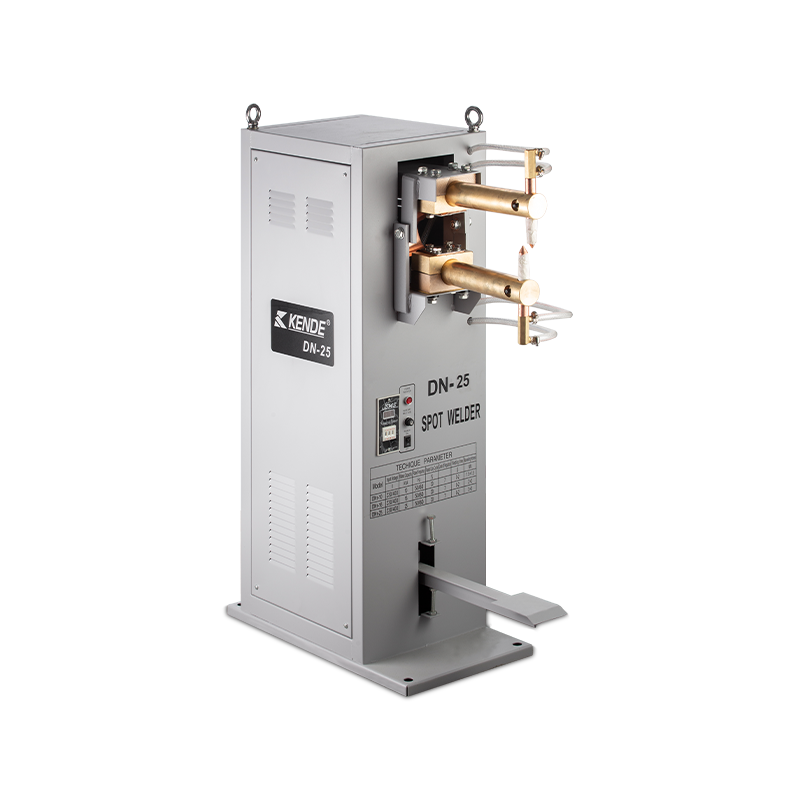
The DN-100E and DN-10/16/25 Series Spot Welding Machines belong to the spot welding category and are built for resistance welding applications. Unlike arc welding processes that use a visible arc and filler metal, resistance spot welding joins overlapping metal sheets by applying pressure through electrodes while passing current through the joint area. The electrical resistance at the contact interface generates heat, forming a weld nugget that bonds the workpieces together.
This welding method is widely used because it is fast, clean, and highly productive. It does not normally require shielding gas, filler wire, or flux. For many sheet metal products, spot welding is easier to automate and more economical than many alternative joining processes. The DN Series machines are especially suitable for users who need a practical balance between compact structure, controlled performance, and cost-effective operation.
The product series features a new external appearance, an improved protection concept, and a higher operating efficiency. The machines are designed with advanced microprocessor control and two-way thyristor control technology, helping users obtain more consistent weld timing and current control compared with simpler conventional machines. LED indicators support easier parameter selection and operation, making the machines accessible to experienced technicians as well as operators who need a clear and intuitive control interface.
One of the main strengths of this product line is its combination of portability and industrial usefulness. Many traditional spot welding systems are heavy, fixed, and difficult to reposition. The DN-10, DN-16, and DN-25 models provide a more flexible solution for users who need to weld different workpieces in different areas of a workshop. Their structure supports practical movement and installation while retaining the performance required for common sheet metal joining tasks.
The machines use a single-phase power supply, which simplifies installation in many facilities. In comparison with equipment that requires more complex electrical infrastructure, single-phase operation can reduce setup barriers and make the machines more suitable for small and medium workshops, repair centers, and distributed production areas.
Another important advantage is reduced no-load current and lower power consumption. In spot welding, the machine may spend significant time waiting between welding operations. A design with less no-load current helps reduce wasted energy during idle periods. For users who operate welding equipment daily, this can contribute to lower operating costs over time.
The DN Series also emphasizes long electrode life. Electrode wear is a major cost factor in resistance welding because poor electrode condition can affect weld quality, increase spatter, and require frequent maintenance. The product design supports stable output and practical operation, helping users maintain electrode performance over a longer period when proper welding practices are followed.
The machines are supplied with complete accessories, including tips and carton packaging. This improves convenience for distributors, workshops, and end users because essential accessories are available from the start. Practical packaging also supports storage, transportation, and delivery efficiency.
The DN-10, DN-16, and DN-25 models provide different welding capacities to match different sheet thickness requirements. Users can select a model according to material type, thickness, production frequency, available power supply, and required weld strength. The following table summarizes the main technical parameters provided for the DN-10/16/25 models.
| Model | Rated Supply Voltage | Supply Frequency | No-Load Voltage | Rated Input Capacity | Rated Duty Cycle | Insulation Class | Welding Thickness | Net Weight | Machine Size |
| DN-10 | 230/400 V | 50 Hz | 2 V | 10 | 30% | H | 1.5 + 1.5 mm | 83 kg | 830 L × 360 W × 1050 H mm |
| DN-16 | 230/400 V | 50 Hz | 2.5 V | 16 | 30% | H | 2 + 2 mm | 87 kg | 830 L × 360 W × 1050 H mm |
| DN-25 | 230/400 V | 50 Hz | 3 V | 25 | 30% | H | 3 + 3 mm | 95 kg | 830 L × 360 W × 1050 H mm |
These specifications show a clear progression across the series. The DN-10 is suitable for lighter sheet welding, the DN-16 supports moderate thickness requirements, and the DN-25 is intended for heavier spot welding within the listed range. All three models share the same machine size, which simplifies workshop planning and allows users to upgrade capacity without changing the overall floor space requirement significantly.
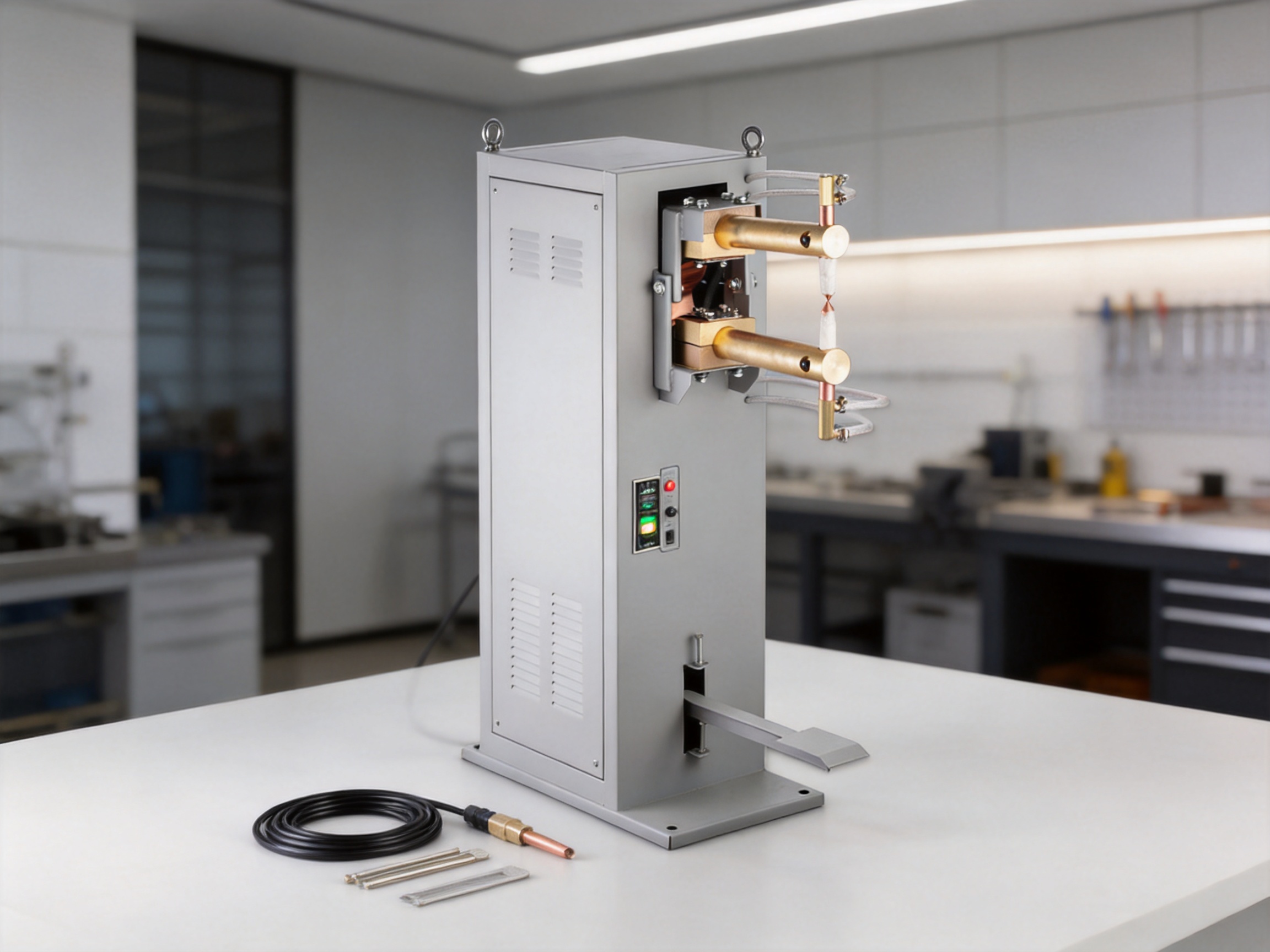
Spot welding is valuable because it offers rapid joining without the need for extensive surface finishing after welding. In many applications, a spot weld can be completed in a fraction of the time required for manual arc welding or mechanical fastening. This makes the process attractive for batch production, metal furniture, cabinets, electrical enclosures, automotive repair components, household appliance parts, ventilation products, stainless steel fabrications, and many light metal structures.
Compared with screw fastening or riveting, spot welding can reduce the number of consumable parts required. It can also produce a cleaner external appearance because the weld is localized between the sheets rather than involving protruding fasteners. Compared with adhesive bonding, spot welding offers immediate joint strength and does not require curing time. Compared with many arc welding methods, it produces less visible distortion when properly applied to suitable sheet thicknesses.
The DN Series is designed to make these process advantages available in a practical machine format. Users benefit from a welding method that is efficient by nature, supported by a machine design that focuses on easy adjustment, lower idle power consumption, and reliable mechanical performance.
A major difference between entry-level resistance welders and more capable equipment is the quality of control. In spot welding, welding current, welding time, electrode force, surface condition, and material thickness all influence the final weld. If control is unstable, weld quality may vary from one spot to another, causing weak welds, excessive indentation, spatter, or inconsistent nugget formation.
The DN-100E and DN-10/16/25 Series are designed with advanced microprocessor control and two-way thyristor control technology. This is an important advantage over simpler machines that rely on less precise switching or manual timing methods. Microprocessor-based control helps the machine manage welding sequences more accurately, while thyristor control supports stable power regulation during the weld cycle.
For the operator, the benefit is practical: once suitable parameters are selected, the machine can help repeat the welding process with better consistency. This is especially important in production environments where hundreds or thousands of spots may be required. Consistent weld quality reduces rework, improves product reliability, and supports better production efficiency.
Ease of operation is not only a convenience; it is a productivity factor. Equipment that is difficult to understand can lead to incorrect settings, wasted materials, slower training, and greater dependence on highly experienced operators. The DN Series supports easier operation through LED indicators and a user-oriented control design. Operators can select and monitor settings more clearly, helping them work with confidence.
Simple operation is also important for workshops that handle different jobs during the same day. A machine may need to weld mild steel in the morning, stainless steel in the afternoon, and a different sheet thickness later. Clear adjustment and indicator feedback help reduce setup time and make the equipment more flexible for mixed production.
Maintenance is also designed to be straightforward. Easy adjustment, operation, and maintenance reduce downtime and help keep the machine available for productive work. In many small and medium manufacturing environments, equipment reliability is measured not only by welding performance but also by how quickly the team can maintain and return the machine to service.
The DN-10, DN-16, and DN-25 models are described as single-phase portable spot welding machines. Their portability is a strong advantage for users who do not want to dedicate a fixed welding station to every job. In a modern workshop, flexibility is valuable because production layouts may change, small batches may move between stations, and operators may need to bring the welding machine closer to the workpiece.
Although the models are substantial machines with net weights from 83 kg to 95 kg, their portable design gives them more flexibility than large stationary resistance welding installations. The consistent machine dimensions of 830 mm length, 360 mm width, and 1050 mm height allow users to plan workspace efficiently. The narrow width is useful in crowded production areas where floor space is limited.
Portability also benefits repair and maintenance environments. When fabricators repair metal covers, frames, brackets, or sheet assemblies, moving the machine near the work area may be easier than moving the workpiece to a fixed station. This can improve workflow and reduce handling time.
The machines can be widely used for spot welding mild steel, stainless steel, and most non-ferrous metals. This broad compatibility makes the DN Series useful across multiple industries. Mild steel remains one of the most common materials in fabrication and manufacturing. Stainless steel is widely used in food equipment, kitchen products, medical furniture, decorative metalwork, and corrosion-resistant applications. Non-ferrous metals may be used in electrical components, light structures, specialty assemblies, and consumer products.
Different materials require different welding practices. Stainless steel, for example, generally has different resistance and thermal behavior than mild steel. Non-ferrous metals can require careful parameter selection because of their conductivity and heat dissipation characteristics. A machine with practical adjustment and stable output helps users adapt to these material differences more effectively.
For best results, operators should prepare clean surfaces, use suitable electrodes, confirm electrode alignment, select appropriate welding time and current, and verify the weld through testing. Even a capable machine depends on correct welding practice. The DN Series supports this process by providing a stable equipment platform with easy operation and adjustment.
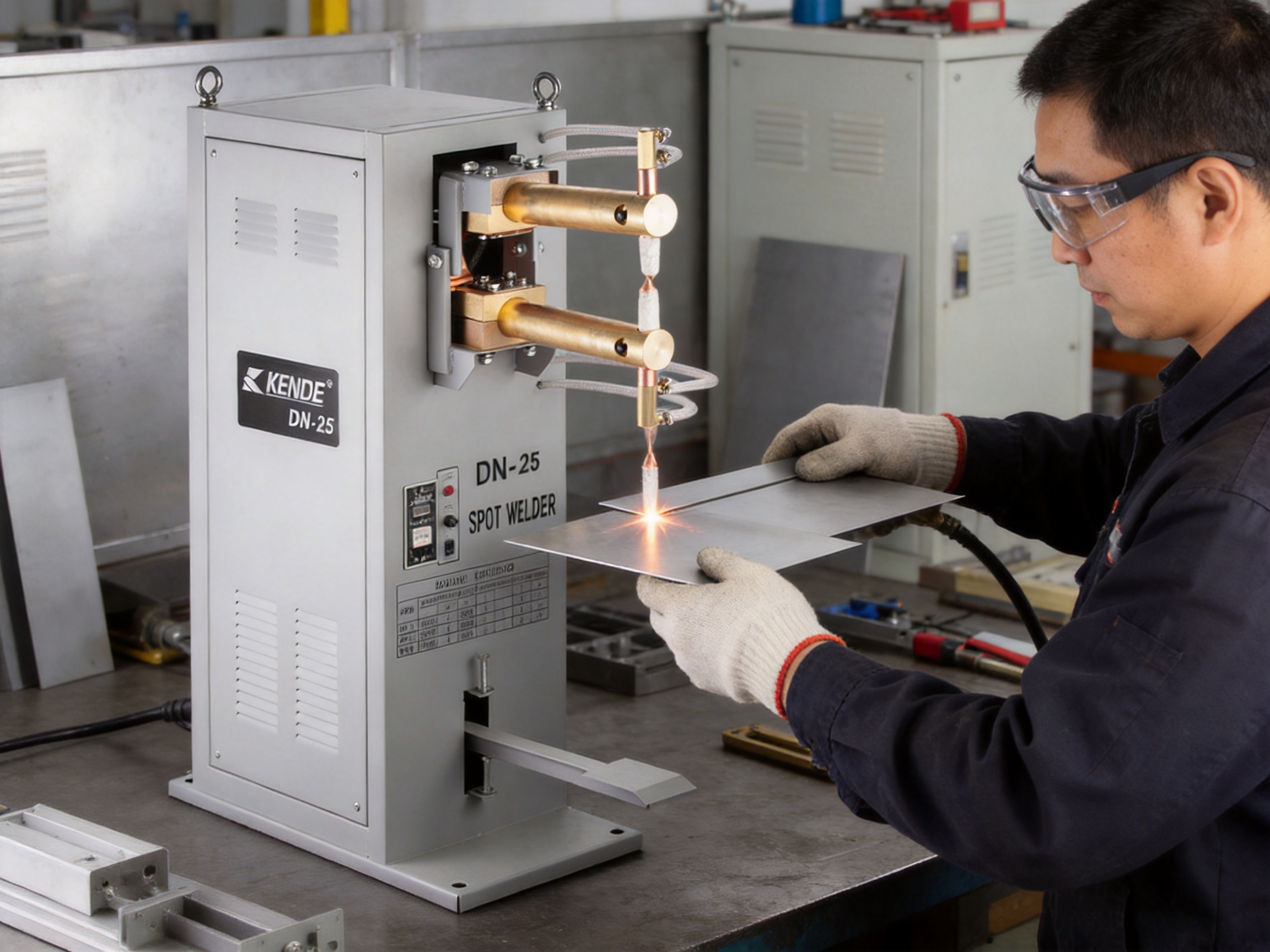
Many competing spot welding machines in the same general category may provide basic joining capability, but the DN Series offers several practical advantages. First, its advanced microprocessor and thyristor control provide a more refined welding control platform than very basic resistance welders. Better control can lead to more repeatable welds, less operator uncertainty, and improved production confidence.
Second, the machines are designed for lower no-load current and reduced power consumption. Competing products that consume more power while idle can increase long-term operating costs, especially in shops where the machine remains energized during the working day. Lower power consumption supports both cost control and energy-conscious manufacturing.
Third, the product line emphasizes easy operation through LED indicators. Some machines may require operators to rely on less intuitive dials or minimal feedback. Clear indicator support helps reduce training time and enables more efficient daily use.
Fourth, the machines are designed for long electrode life. Electrode replacement, dressing, and downtime are hidden costs in resistance welding. A machine that supports stable welding and appropriate electrode performance can help users reduce maintenance frequency and improve production continuity.
Fifth, the DN-10/16/25 models provide a clear capacity range in the same physical size. This is useful for buyers who want to standardize workshop layout while choosing different capacity levels. A company may install several machines for different materials or production lines without redesigning the workspace for every model.
Finally, the equipment is supported by a manufacturer with broad welding machine experience, advanced production systems, and international certification capability. For industrial buyers, the strength of the manufacturer matters almost as much as the machine itself. A reliable manufacturer can provide consistent quality, stable supply, technical improvement, and product development support over time.
The product is manufactured by Zhejiang Kende Mechanical & Electrical Co., Ltd., a company located in Taizhou, Zhejiang Province, China. The company operates on a large manufacturing base covering 120,000 square meters and employs about 600 people. This scale supports stable production, systematic quality management, and the ability to serve international markets.
The company is an internationally recognized manufacturer and exporter of electric welding machines, battery chargers, and heaters. It exports nearly 1.5 million units annually and has an annual production capacity of approximately 2 million units. This production capability demonstrates the company’s ability to manage large-scale manufacturing while supporting a diverse product range.
The company’s welding product portfolio includes MMA or stick welding machines, MIG/MAG gas-shielded welding machines, flux wire welding machines, TIG arc welding machines, plasma cutting machines, stud welding machines, submerged arc welding machines, battery chargers, and heaters. This broad technical foundation is important because resistance spot welding machines benefit from a company culture already experienced in electrical power conversion, welding control, thermal management, mechanical structure design, and product safety.
Advanced manufacturing processes are part of the company’s strength. The company applies OA office automation, Toyota TPS management concepts, ERP K3, and MES management systems. These systems support more organized production planning, material tracking, workflow control, and quality management. For customers, this means the product is not only assembled, but produced within a structured manufacturing environment.
The company also uses advanced automatic patching, plug-in and welding systems, robot processing, laser cutting, and other modern technologies. These processes can improve manufacturing repeatability, reduce human error, enhance component consistency, and support efficient production. In welding machine manufacturing, consistency of electrical components, transformer assembly, mechanical parts, and control systems is essential. Advanced processes help ensure that each machine conforms more closely to design requirements.
A product’s long-term competitiveness depends on continuous technical improvement. The manufacturer has strong research, development, and innovation resources, including a Zhejiang Provincial R&D Center, an Enterprise Technology Center, and an Intelligent Welding Technology Research Institute. The company has 98 R&D personnel and has obtained multiple invention patents, utility model patents, appearance patents, and software copyrights.
This R&D foundation supports product upgrades such as improved control systems, better machine appearance, enhanced safety features, and more user-friendly operation. For spot welding machines, innovation may involve welding parameter control, transformer efficiency, electrode system durability, thermal management, structural design, and operator interface improvement.
The company is also one of the national standard drafting units of the National Welding Machine Standardization Committee. It has participated in the drafting, formulation, and revision of 20 national standards and has led the drafting of one group standard. This role demonstrates technical recognition and deep involvement in the welding equipment industry. Customers purchasing equipment from such a manufacturer benefit from a supplier that understands not only production, but also standardization, safety expectations, and industry development.
International customers often need equipment that aligns with recognized safety and performance requirements. The manufacturer holds many international product certificates, including GS, CE, EMC, ERP, US ETL, UKCA, and China CCC. These certifications demonstrate the company’s ability to design and manufacture products for different regulatory and market requirements.
For distributors and industrial buyers, certification capability reduces purchasing risk. It indicates that the manufacturer has experience preparing products for regulated markets and understands the documentation, testing, and compliance requirements that accompany international trade. This is especially important for welding equipment because electrical safety, electromagnetic compatibility, and product reliability are central concerns.
The welding transformer is a core component of a resistance spot welding machine. The DN-10/16/25 product information states that the windings of the welding transformer are made of aluminium wires. Aluminium windings can support a practical balance of performance, weight, and cost when properly designed. The machines are also designed for less no-load current and lower power consumption, which helps users control operating cost.
Energy efficiency in resistance welding is not only about power consumption during the weld. It also involves idle losses, transformer design, control accuracy, and the ability to make a good weld without repeated attempts. A machine that produces consistent welds can reduce scrap and rework, which saves not only electricity but also materials, labor, and time.
In production environments, the total cost of ownership includes purchase price, power consumption, electrode wear, maintenance, downtime, operator training, and rework. The DN Series addresses these cost factors by combining practical machine design with easy operation, long electrode life, and stable control technology.
The DN Series can be used in many sheet metal applications. In metal furniture manufacturing, it can join panels, brackets, support frames, and reinforcement parts. In electrical enclosure production, it can help assemble mild steel and stainless steel cabinet parts. In household product manufacturing, it can support the production of covers, housings, racks, and frames.
Automotive repair and small component production can also benefit from portable spot welding. Spot welding is common in vehicle body structures and sheet repairs, and a flexible machine can be useful for shops handling metal panels and reinforcement parts. For stainless steel products, the machines may be used in kitchen equipment, display fixtures, and decorative metal assemblies where clean joints are valuable.
Because the machines can weld most non-ferrous metals when correctly applied, they may also be considered for specialty parts and custom fabrication. However, users should always confirm material suitability through welding trials, because non-ferrous metals vary significantly in conductivity, thickness, surface condition, and weldability.
Choosing the correct model depends mainly on sheet thickness, material, required weld strength, expected production frequency, and available electrical supply. The DN-10 model supports welding thickness of 1.5 + 1.5 mm and is suitable for lighter sheet metal work. The DN-16 model supports 2 + 2 mm thickness and is suitable for medium sheet applications. The DN-25 model supports 3 + 3 mm thickness and is appropriate when greater welding capacity is required.
Users should avoid selecting a machine only by maximum thickness. It is better to consider the full range of workpieces. If most jobs involve thinner sheets, a lighter model may be more economical and easier to operate within the desired range. If the workshop frequently processes thicker material, selecting a higher-capacity model may reduce strain and improve consistency.
Available power supply should also be considered. The listed models support 230/400 V rated supply voltage at 50 Hz. Buyers should verify local electrical conditions before ordering and installation. Proper electrical installation is essential for safe operation and stable welding performance.
Even with a strong machine, spot weld quality depends on correct process control. Important factors include workpiece cleanliness, material thickness, electrode shape, electrode force, welding current, welding time, and cooling between welds. Contaminants such as oil, paint, heavy oxide, or plating residue may affect current flow and weld formation. Proper surface preparation improves repeatability.
Electrode alignment is also essential. If the electrodes do not contact the workpiece evenly, heat generation may be uneven and the weld nugget may form incorrectly. Operators should inspect electrode tips regularly and dress or replace them when needed. Long electrode life is an advantage of the DN Series, but good maintenance practices are still necessary.
Weld testing should be part of any production setup. Peel tests, chisel tests, visual inspection, and destructive sample testing may be used depending on the application. For safety-critical components, users should establish formal quality procedures and inspection intervals.
Resistance spot welding does not use an open arc like arc welding, but safety remains important. Operators should keep hands clear of the electrode area, avoid contact with live electrical components, wear appropriate eye and hand protection, and follow the operating instructions. The machine should be installed on a stable surface and connected according to electrical safety requirements.
Because spot welding applies pressure and current simultaneously, pinch hazards and heat hazards must be controlled. Welded parts may remain hot after welding. Operators should use suitable handling tools when necessary. The work area should be kept clean and free from flammable materials.
Regular inspection of cables, connections, electrodes, control panels, and mechanical parts helps reduce risk. Maintenance should be performed by qualified personnel. If abnormal sound, overheating, unstable output, or visible damage occurs, the machine should be stopped and checked before further use.
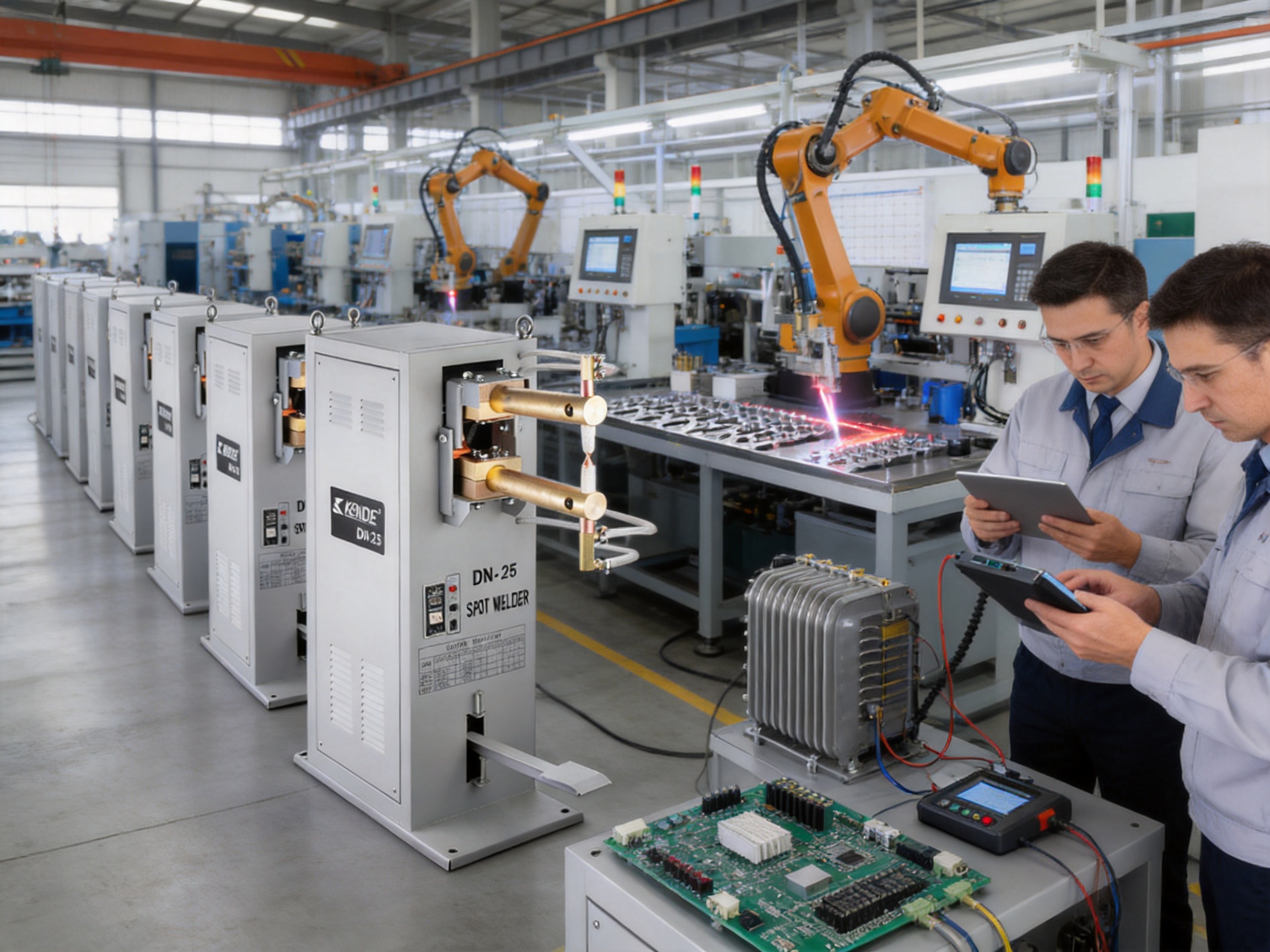
The DN Series fits well into modern manufacturing environments that value lean workflow and flexible equipment deployment. The manufacturer’s use of Toyota TPS management concepts reflects an understanding of efficient production, waste reduction, and process standardization. These same principles are relevant to users of spot welding equipment. A well-positioned spot welding machine can reduce part movement, shorten production cycles, and improve workstation efficiency.
For batch production, users can create dedicated fixtures to hold parts in consistent positions. This improves weld repeatability and reduces operator fatigue. For mixed production, the machine’s easy adjustment and LED indicators support faster changeovers. For repair work, the portable structure helps users handle different jobs without excessive layout changes.
The machines can also complement other welding and cutting processes. A workshop may use MIG/MAG welding for structural seams, TIG welding for precision or visible welds, plasma cutting for material preparation, and spot welding for fast sheet assembly. Because the manufacturer produces multiple types of welding and cutting equipment, it understands the broader needs of fabrication customers.
Durability is a core purchasing concern for welding equipment. A spot welding machine must handle repeated current cycles, mechanical pressure, heat, and daily operator use. The DN Series supports long-term value through Class H insulation, practical construction, and easy maintenance. Class H insulation indicates strong thermal resistance for electrical insulation systems, which is beneficial in equipment exposed to repeated heating cycles.
Maintenance value comes from designs that are easy to inspect and service. Easy adjustment and operation reduce accidental misuse, while complete accessories help users start working with the proper components. Long electrode life reduces maintenance frequency, but users should still schedule routine checks of electrode tips, holders, cables, transformer condition, and control function.
Keeping a maintenance log is recommended. Recording electrode changes, weld quality issues, cleaning intervals, and electrical inspections can help identify patterns and prevent unexpected downtime. In production settings, preventive maintenance is usually less costly than emergency repair.
For distributors, the DN Series offers a clear product story: portable single-phase spot welding machines with practical capacities, easy operation, advanced control, and complete accessories. The models address common welding needs and can be positioned for workshops, small factories, maintenance teams, and sheet metal users.
The manufacturer’s high annual export volume and broad certification portfolio add commercial confidence. Buyers often prefer suppliers that can provide stable production, product documentation, and consistent quality. The company’s manufacturing scale, R&D resources, and standardization participation strengthen the product’s market position.
For end users, the commercial value lies in productivity and reliability. A machine that is easy to operate can reduce training costs. A machine that consumes less idle power can reduce operating expense. A machine with stable control can reduce rework. A machine with long electrode life can reduce consumable costs. Together, these factors make the DN Series a practical investment for metal joining operations.
They use resistance spot welding. This process joins overlapping metal sheets by applying pressure through electrodes while current passes through the joint area. The heat generated by electrical resistance forms a weld nugget between the sheets.
The machines can be widely used for spot welding mild steel, stainless steel, and most non-ferrous metals. Actual results depend on material thickness, surface condition, electrode selection, and parameter settings.
The main difference is welding capacity. DN-10 is listed for 1.5 + 1.5 mm thickness, DN-16 for 2 + 2 mm thickness, and DN-25 for 3 + 3 mm thickness. They share the same listed machine size but differ in no-load voltage, rated input capacity value, and net weight.
Microprocessor control helps improve welding sequence management and parameter consistency. In spot welding, consistent timing and current control are important for repeatable weld quality.
Two-way thyristor control supports controlled power regulation during welding. This can improve output stability compared with simpler control methods and helps the machine produce more consistent welds.
Yes. Their single-phase and portable design makes them suitable for small and medium workshops, repair facilities, and flexible production environments, provided the available power supply matches the machine requirements.
No. Resistance spot welding normally does not require shielding gas, filler wire, or flux. This reduces consumable costs and simplifies the welding process.
Users can extend electrode life by keeping workpieces clean, maintaining correct electrode alignment, avoiding excessive current or welding time, using proper electrode force, and dressing or replacing tips when necessary.
The product information states that the machines come with complete accessories, including tips and carton packaging.
Manufacturer strength affects product consistency, supply reliability, technical support, and long-term improvement. The manufacturer behind this product has large-scale production capacity, advanced manufacturing systems, R&D centers, international certifications, and experience across many welding equipment categories.
The DN-100E and DN-10/16/25 Series Spot Welding Machines provide a practical and efficient solution for resistance spot welding applications. Their advantages include single-phase portability, advanced microprocessor control, two-way thyristor technology, easy LED-supported operation, lower no-load current, reduced power consumption, long electrode life, and broad material compatibility.
The DN-10, DN-16, and DN-25 models offer a useful capacity range for sheet metal welding from lighter to heavier applications, while maintaining consistent machine dimensions for convenient workshop planning. Their ability to weld mild steel, stainless steel, and most non-ferrous metals makes them valuable for metal fabrication, repair, furniture, enclosures, appliance components, and general sheet metal production.
Beyond the machines themselves, the manufacturing background adds significant value. Zhejiang Kende Mechanical & Electrical Co., Ltd. combines large-scale production, advanced manufacturing processes, modern management systems, strong R&D resources, extensive certification experience, and recognized participation in welding machine standardization. This gives buyers confidence not only in the product’s performance, but also in the company’s ability to support consistent quality and long-term development.
For users seeking a reliable, efficient, and easy-to-operate spot welding machine, this series offers a strong combination of process performance, practical design, and manufacturing credibility.
Resistance Welding Manual, Resistance Welding Manufacturing Alliance.
Welding Handbook, Volume 2: Welding Processes, American Welding Society.
Recommended Practices for Resistance Welding, American Welding Society.
Electrical Resistance Welding Fundamentals, Manufacturing Engineering Reference Series.
Industrial Welding Equipment Safety and Application Guidelines, International Welding Technology Publications.
Recommended Products

Contact Us
No.2299, Luqiao Section, Shugang Avenue, Luqiao District, Taizhou, 318057 Zhejiang, PR China.
+86-576-82431568
 Privacy
China Welding Machine Factory
 English
 中文简体
中文简体
 русский
 Español
 عربى
عربى
 Français
 Português
 Deutsch
 Український