Email: [email protected]
Email: [email protected]

Blog
 2026.07.08
 Blog
Blog
Modern vehicle maintenance depends on battery equipment that is dependable, easy to use, and strong enough to support real starting demands. The FC-12C Series Battery Charger is designed for users who need more than a simple maintenance charger. It combines battery charging, engine starting assistance, and alternator checking in a compact, portable machine intended for standard lead-acid batteries, AGM batteries, and gel batteries. With 6V and 12V output capability, heavy-duty construction, protective functions, and practical accessories, it offers a strong solution for garages, farms, repair shops, home users, small fleets, and emergency support applications.
Unlike many basic chargers that only supply current with limited feedback, this model is built around advanced microcomputer control technology. That gives the charger a more intelligent operating foundation and helps support safer, more controlled charging behavior. The product also includes reverse polarity protection with indication, overheating protection, and short-circuit protection. These functions are especially valuable in real-world environments where batteries may be deeply discharged, cables may be connected in low-light conditions, and users may work under time pressure.
As part of a wider manufacturing program that includes welding machines, plasma cutting machines, battery chargers, heaters, and industrial equipment, this charger benefits from a production environment focused on electrical safety, power conversion experience, and large-scale quality control. The manufacturer operates with advanced management systems, automated production technologies, research and development resources, and international certification experience. For buyers, this means the product is not only a standalone charger, but also the result of a broader electrical equipment manufacturing capability.
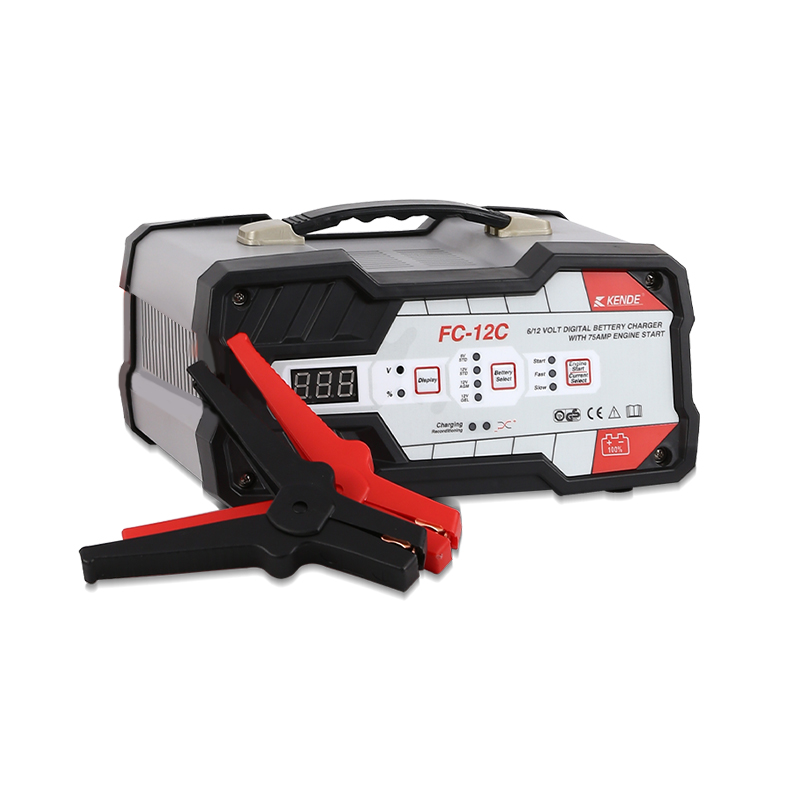
The FC-12C Series Battery Charger is a manual battery charger and engine starter with a rated supply voltage of 230V and a 50Hz supply frequency. Its charging voltage is 6V/12V, making it suitable for a wide range of small and medium battery applications. The rated current range is 2A to 12A, while the boost current is 12A and the start current reaches 75A. These specifications make it useful not only for routine battery charging, but also for helping start engines when the battery condition is weak.
The product is designed for lead-acid battery systems and is compatible with standard, AGM, and gel batteries. This compatibility is important because modern users often encounter different battery types across vehicles, motorcycles, garden equipment, boats, generators, and utility machines. A charger that can support multiple lead-acid battery formats reduces the need for separate equipment and simplifies workshop organization.
The machine is also equipped for alternator checking. This function adds diagnostic value. When a vehicle has repeated battery problems, the battery itself may not be the only issue. A poor alternator, weak charging system, or electrical fault may cause repeated discharge. By including an alternator check function, the charger helps users move beyond simple recharging and toward more complete battery system maintenance.
The charger’s compact storage profile also supports practical use. It includes front clamp storage and a retractable handle, helping users keep accessories organized and making transport easier. In many garages, tools are moved frequently between work bays, storage shelves, vehicles, and outdoor spaces. A charger that is easier to carry and store is more likely to be used correctly and maintained in good condition.
| Item | Specification | Practical Meaning |
| Model | FC-12C | Compact battery charger and engine starter for workshop, garage, and general maintenance use. |
| Rated Supply Voltage | 230V | Designed for standard mains supply environments using 230V input. |
| Supply Frequency | 50Hz | Suitable for regions and applications using 50Hz electrical supply. |
| Charging Voltage | 6V/12V | Supports both 6V and 12V lead-acid battery charging needs. |
| Rated Capacity | 0.35kW | Provides useful output capacity while remaining portable and compact. |
| Boost Current | 12A | Helps deliver stronger charging performance when faster recovery is needed. |
| Start Current | 75A | Provides engine starting assistance for weak batteries within the suitable application range. |
| Rated Current | 2A to 12A | Allows charging across a practical current range for different battery capacities. |
| Mains Fuse | 30A | Supports circuit protection and safer operation. |
| Degree of Protection | IP20 | Designed for dry indoor environments such as workshops and garages. |
| Reference Battery Capacity | 4Ah to 120Ah | Suitable for a broad selection of small and medium lead-acid batteries. |
| Weight | 6.8kg | Heavy enough for robust construction while still portable. |
| Machine Size | 290mm L x 215mm W x 145mm H | Compact footprint for storage, transport, and bench use. |
| Included Accessories | 1.5m + 1.5m charging cable, two clamps, color box | Ready-to-use accessory package for convenient battery connection and storage. |
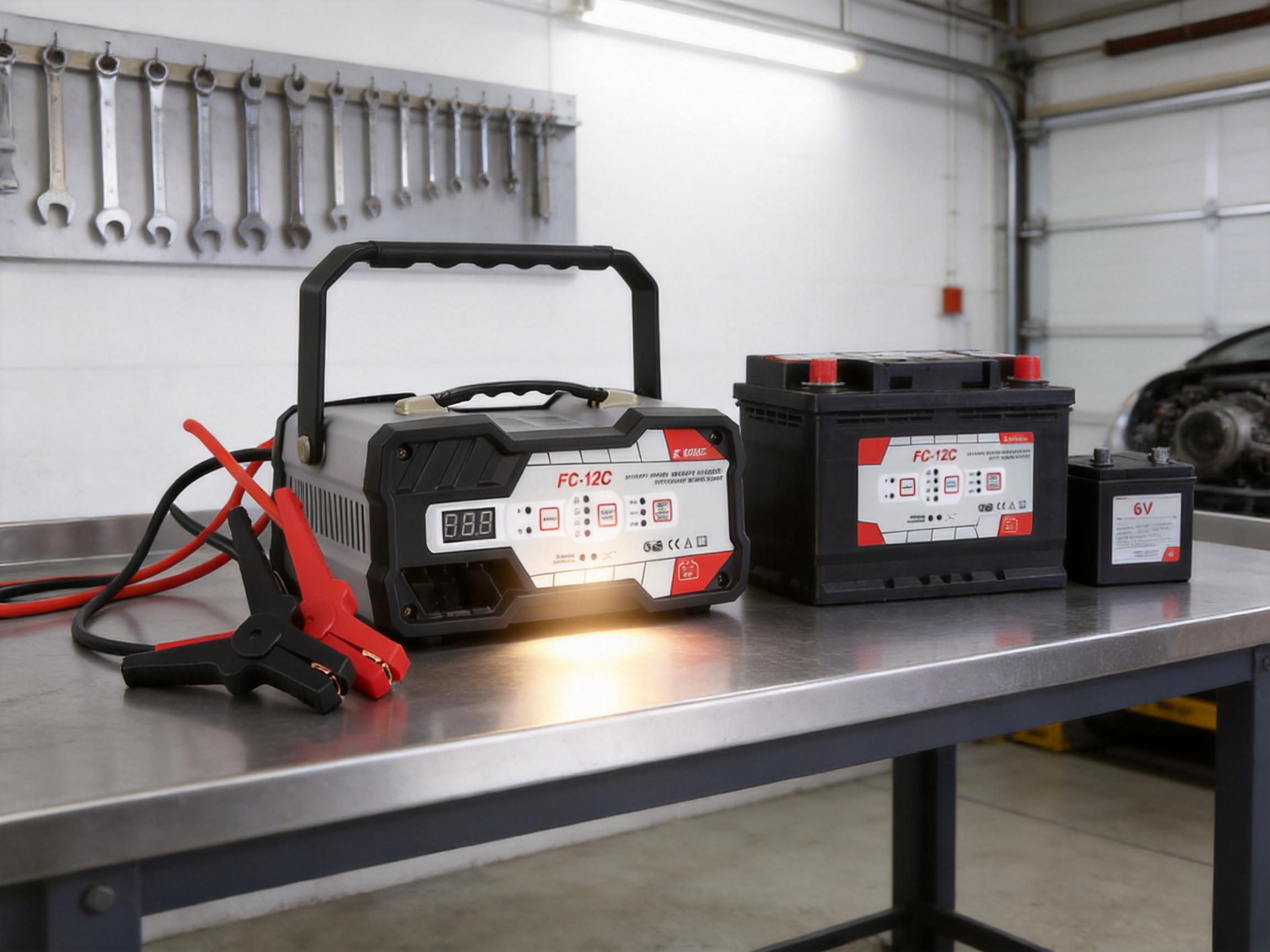
A reliable charger must do more than provide current. It must support predictable battery recovery, help prevent common user errors, and remain stable in repeated use. The FC-12C Series Battery Charger is designed for lead-acid battery maintenance across common 6V and 12V applications. Its 2A to 12A rated current range gives users flexibility when charging batteries with different capacities. A smaller battery can be charged at a lower current, while a larger battery can benefit from a stronger charging output within the machine’s range.
The reference capacity of 4Ah to 120Ah covers many practical battery categories. These may include motorcycle batteries, small vehicle batteries, lawn and garden batteries, light commercial vehicle batteries, generator batteries, and other maintenance applications. For users who regularly service different equipment, this range makes the charger a versatile addition to the workshop.
The inclusion of advanced microcomputer control technology is one of the product’s important advantages. Traditional low-cost chargers may depend on simple transformer-based output with limited regulation and minimal protection. While these units may perform basic charging, they often offer less support against connection mistakes, overheating, or abnormal battery conditions. A microcomputer-controlled design provides a more modern operating platform and helps the charger deliver a controlled charging process.
Battery charging also requires consistency. Batteries that are charged too aggressively may heat up, lose water, or suffer reduced service life. Batteries that are charged too weakly may remain undercharged, leading to sulfation and poor starting performance. A charger with a controlled output range and protective functions helps users maintain better charging habits and reduce preventable battery damage.
One of the strongest selling points of the FC-12C Series Battery Charger is its engine starting function. A battery charger is useful for planned maintenance, but an engine starter adds emergency value. When a vehicle or machine must be started quickly, waiting for a long charging cycle may not be acceptable. With a start current of 75A, this unit can provide starting assistance for suitable engines and battery systems, helping users restore operation more quickly.
This feature is especially useful in seasonal equipment, workshops, farms, small vehicle fleets, and home garages. Vehicles that sit unused for long periods often suffer from battery discharge. Motorcycles, small tractors, compact utility vehicles, generators, classic cars, and garden machines may all experience weak starting after storage. The ability to both charge and assist starting reduces downtime and improves convenience.
Compared with a basic charger that only replenishes the battery slowly, a charger and starter combination provides more value per unit. It reduces the need to purchase a separate starting device for many applications. For distributors and retailers, this combined function also improves product appeal because customers can clearly understand the benefit: one machine can charge, help start, and support electrical checking.
However, proper use remains important. Users should always match the charger to the battery type and vehicle requirements, ensure correct polarity connection, and follow safe starting procedures. The unit’s reverse polarity protection and indicator help reduce risk, but good user practice is still essential. In professional environments, training and clear operating procedures further improve safety and equipment life.
Battery problems are not always battery problems. A vehicle may repeatedly fail to start even after the battery has been charged. In such cases, the charging system may be at fault. The alternator may be weak, the belt may be slipping, the regulator may be malfunctioning, or the wiring may have high resistance. A charger with alternator check capability helps users investigate whether the vehicle charging system is contributing to battery failure.
This diagnostic function gives the FC-12C Series Battery Charger an advantage over products that only provide charging output. For a home user, it can help identify when professional vehicle service may be needed. For a workshop, it can support faster preliminary checks and reduce guesswork. For a fleet operator, it can help prevent repeated battery replacement when the underlying problem is actually a charging system fault.
In competitive product comparisons, diagnostic functions often separate basic chargers from more useful maintenance equipment. A low-cost charger may appear attractive at purchase, but if it does not help users identify charging system problems, it may not solve the real issue. By adding alternator checking, this model becomes a more complete battery service tool.
Battery charging involves electrical risk. Batteries store significant energy, and incorrect handling can lead to sparks, overheating, cable damage, or equipment failure. The FC-12C Series Battery Charger includes several protective functions designed to make operation safer and more reliable.
Reverse polarity protection with indication is one of the most important features. Connecting clamps to the wrong battery terminals is a common user error. In older or very basic chargers, reverse connection can cause sparks, blown fuses, damaged electronics, or battery hazards. Protection and indication help warn the user and reduce the chance of serious damage.
Overheating protection is another important advantage. Chargers may be used in warm workshops, during long charging periods, or under demanding conditions. Overheating protection helps guard the machine from thermal stress and supports longer service life. This is especially valuable for users who operate chargers frequently and expect consistent performance over time.
Short-circuit protection provides an additional layer of safety. Accidental clamp contact, damaged cables, or incorrect connection can create short-circuit conditions. Protection against short circuits helps prevent immediate equipment damage and reduces operational risk. For professional users, these protective functions also support workplace safety standards and reduce the likelihood of downtime caused by avoidable incidents.
Many competitors in the lowest price segment may reduce cost by simplifying protection circuits or using lower-grade components. While such products may seem economical, they can be less forgiving in real-world use. The FC-12C Series Battery Charger is positioned as a more practical and safer option for users who value reliability, protection, and long-term usability.
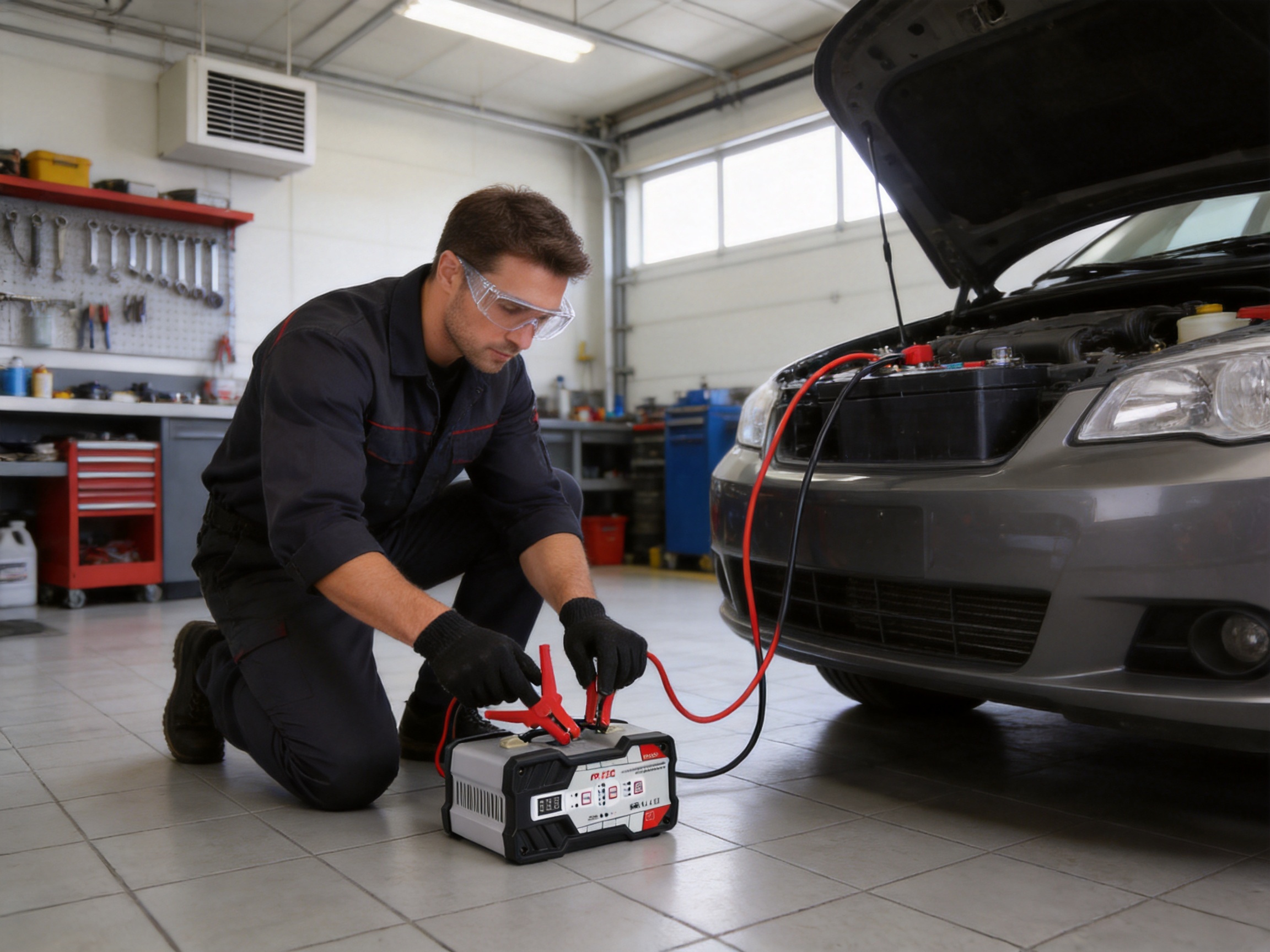
A charger’s physical design matters as much as its electrical performance. In real use, chargers are carried, stored, pulled from shelves, moved near vehicles, and exposed to the normal wear of workshop environments. The FC-12C Series Battery Charger has a machine size of 290mm by 215mm by 145mm and a weight of 6.8kg. This balance supports portability while maintaining a robust feel.
The retractable handle makes transport easier and helps reduce awkward lifting. A charger that is easy to carry is more useful in multi-vehicle households, garages with limited space, and mobile maintenance situations. The front clamp storage is also a practical detail. Loose clamps can become damaged, tangled, or misplaced. By keeping the clamps organized on the front of the unit, users can store the charger more neatly and reduce setup time.
The included 1.5m plus 1.5m charging cables and two clamps provide the essential connection hardware for normal operation. Cable length is important because the charger must often be positioned safely near a battery while still reaching the terminals comfortably. The included accessories help users begin working immediately without needing to purchase basic connection items separately.
The product’s IP20 protection rating indicates that it is intended for dry indoor use. This makes it suitable for garages, workshops, service areas, and storage rooms. Users should avoid outdoor use in rain or wet environments and should keep the charger away from water, corrosive liquids, and excessive dust. Proper operating environment helps preserve both safety and service life.
The FC-12C Series Battery Charger is suitable for lead-acid batteries, including standard, AGM, and gel types. This compatibility is important because lead-acid battery technology remains widely used across vehicles and equipment. Even as lithium batteries become more common in certain markets, lead-acid batteries remain dominant in automotive starting applications, backup systems, garden equipment, motorcycles, and many utility machines.
Standard flooded lead-acid batteries are common in many vehicles and machines. AGM batteries are often used where vibration resistance, sealed construction, and higher performance are desired. Gel batteries are used in applications where spill resistance and deep-cycle characteristics may be important. A charger that supports these types gives users flexibility and reduces the chance of choosing the wrong equipment for a common battery maintenance job.
The 4Ah to 120Ah reference capacity range makes the charger suitable for many practical uses. For example, a small motorcycle battery may fall near the lower end of the range, while a car or light equipment battery may fall in the middle or upper portion. Users should always check the battery manufacturer’s recommended charging current and charging procedure before use, but the charger’s range gives it broad utility.
For households, this machine can help maintain car, motorcycle, lawn tractor, and generator batteries. For workshops, it can support service reception, used vehicle preparation, and routine battery recovery. For agricultural and rural users, it can help manage machines that may remain idle between work seasons. For retailers, the product is easy to explain because it addresses a common need: weak batteries and unreliable starting.
The battery charger market contains many product levels, from small trickle chargers to high-current professional workshop starters. The FC-12C Series Battery Charger occupies a useful position by combining portability, 6V/12V charging, starting assistance, alternator checking, and protection functions. This combination creates several competitive advantages.
First, it offers multifunction value. A single unit can charge batteries, assist engine starting, and check alternator function. Competitors that only provide charging may be less useful in urgent situations. Competitors that only provide jump starting may not support proper battery recovery. By combining these functions, the FC-12C model gives users a broader tool for battery maintenance.
Second, the product provides protective features that matter in daily operation. Reverse polarity protection with indication, overheating protection, and short-circuit protection improve user confidence. Products that lack these functions may depend heavily on perfect user behavior, which is unrealistic in busy garages or emergency situations.
Third, the product supports multiple common lead-acid battery types. Compatibility with standard, AGM, and gel batteries makes it more versatile than chargers designed only for one battery style. This is particularly important for workshops and distributors serving customers with mixed equipment.
Fourth, the compact and organized design improves usability. A retractable handle, front clamp storage, and included cables help make the product convenient to transport and store. Some competing chargers may have similar electrical ratings but less practical physical design, which can reduce user satisfaction over time.
Fifth, the product is backed by a manufacturer with broad electrical equipment experience, large production capacity, and advanced production systems. In competitive sourcing, the factory behind the product matters. A charger is not only a set of specifications; it is the result of design control, component selection, assembly quality, testing discipline, and supply chain management.
The manufacturer, Zhejiang Kende Mechanical and Electrical Co., Ltd., is located in Taizhou City, Zhejiang Province, China, and operates on a large industrial scale. The company covers 120,000 square meters and has approximately 600 employees. It exports nearly 1.5 million units annually and has an annual production capacity of 2 million units. This scale is significant because it supports stable output, production efficiency, and the ability to serve international markets.
The company is known for electric welding machines, battery chargers, and heaters. Its broader product categories include MMA or stick welding machines, MIG/MAG gas-shielded welding machines, flux wire welding machines, TIG arc welding machines, CUT plasma cutting machines, stud welding machines, submerged arc welding equipment, battery chargers, and electric, gas, and oil heaters. This product diversity reflects deep experience in electrical power equipment and thermal management.
Battery chargers and welding machines share important manufacturing concerns: electrical reliability, heat control, circuit protection, power handling, durable housing, and safety compliance. Experience in welding machine production can support charger development because both categories require attention to current control, component protection, and rugged workshop use.
The company applies modern management and manufacturing systems, including office automation, Toyota Production System management methods, ERP K3, and MES management systems. These systems help control workflow, production planning, material tracking, process discipline, and quality consistency. For buyers, such systems can reduce delivery uncertainty and support repeatable product quality.
Advanced production technologies are also used, including automatic patching, plug-in and welding systems, robot processing, laser cutting, and other modern equipment. These methods help improve precision, reduce manual variation, and support large-scale production. In electrical equipment manufacturing, consistent assembly quality is essential because small variations in wiring, soldering, insulation, or component placement can affect performance and safety.
The manufacturer has strong research, development, and innovation resources. It operates a provincial research and development center, an enterprise technology center, and an intelligent welding technology research institute. The company has 98 research and development personnel and has obtained multiple invention patents, utility model patents, appearance patents, and software copyrights.
This innovation capability matters for a product such as the FC-12C Series Battery Charger because battery service equipment must continue evolving. Users expect safer operation, better compatibility, more compact size, clearer indication, and improved reliability. A company with dedicated research personnel is better positioned to refine product design, respond to market feedback, and develop new models for different regional requirements.
Microcomputer control technology is an example of product modernization. Electrical equipment that once depended mainly on mechanical or analog controls increasingly uses digital control and smarter protection logic. This can improve charging control, fault response, and user interaction. A strong research and development foundation helps manufacturers adopt these technologies in a practical, cost-effective way.
The company’s participation in national standard drafting work also demonstrates technical involvement beyond routine production. It has participated in the drafting, formulation, and revision of national standards and has led the drafting of a group standard. This indicates familiarity with technical requirements, safety expectations, and industry development trends. For customers evaluating suppliers, such involvement can provide confidence that the manufacturer understands product standards and regulatory expectations.
International buyers often require more than a functional product. They need documentation, compliance awareness, stable packaging, and product designs aligned with destination market requirements. The manufacturer holds or works with a wide range of product certificates, including GS, CE, EMC, ERP, ETL for the United States, UKCA, and CCC for China. These certificates are important indicators of experience with safety, electromagnetic compatibility, efficiency, and market access requirements.
For the FC-12C Series Battery Charger, certification experience supports buyer confidence. Battery chargers connect directly to mains power and batteries, so safety expectations are high. Markets may require evidence of electrical insulation, overheating protection, mechanical stability, labeling accuracy, and electromagnetic behavior. A manufacturer with international certification experience is more likely to understand these needs during design and production.
Certification experience also helps distributors reduce risk. Importers, wholesalers, and private-label customers must consider whether a supplier can support documentation and compliance needs. A factory that already exports at high volume and works with international standards can be a stronger long-term partner than a small producer with limited regulatory familiarity.
Large-scale manufacturing alone does not guarantee quality. Quality depends on process control, staff training, inspection discipline, component management, and continuous improvement. However, when scale is combined with advanced systems such as ERP and MES, it can support better consistency. Material batches can be tracked, production steps can be monitored, and deviations can be identified more efficiently.
The FC-12C Series Battery Charger benefits from this kind of industrial environment. Its electrical functions must be assembled accurately, including mains input, charging output, protection circuits, clamps, cables, housing, and indicators. If any part is inconsistent, the user experience can suffer. A structured production process helps ensure that each unit follows defined standards.
The use of automatic patching and plug-in processes can improve electronic assembly consistency. Robotic processing and laser cutting can improve mechanical precision. These technologies reduce dependence on purely manual work and help achieve repeatable results. For a buyer comparing products from different suppliers, this manufacturing discipline can be a decisive advantage.
Quality is also connected to product design. A charger intended for real workshop use must withstand repeated handling, cable movement, temperature variation, and occasional user mistakes. Heavy-duty construction, protective functions, and organized storage features all contribute to long-term usability. The manufacturer’s background in rugged equipment categories supports this design philosophy.
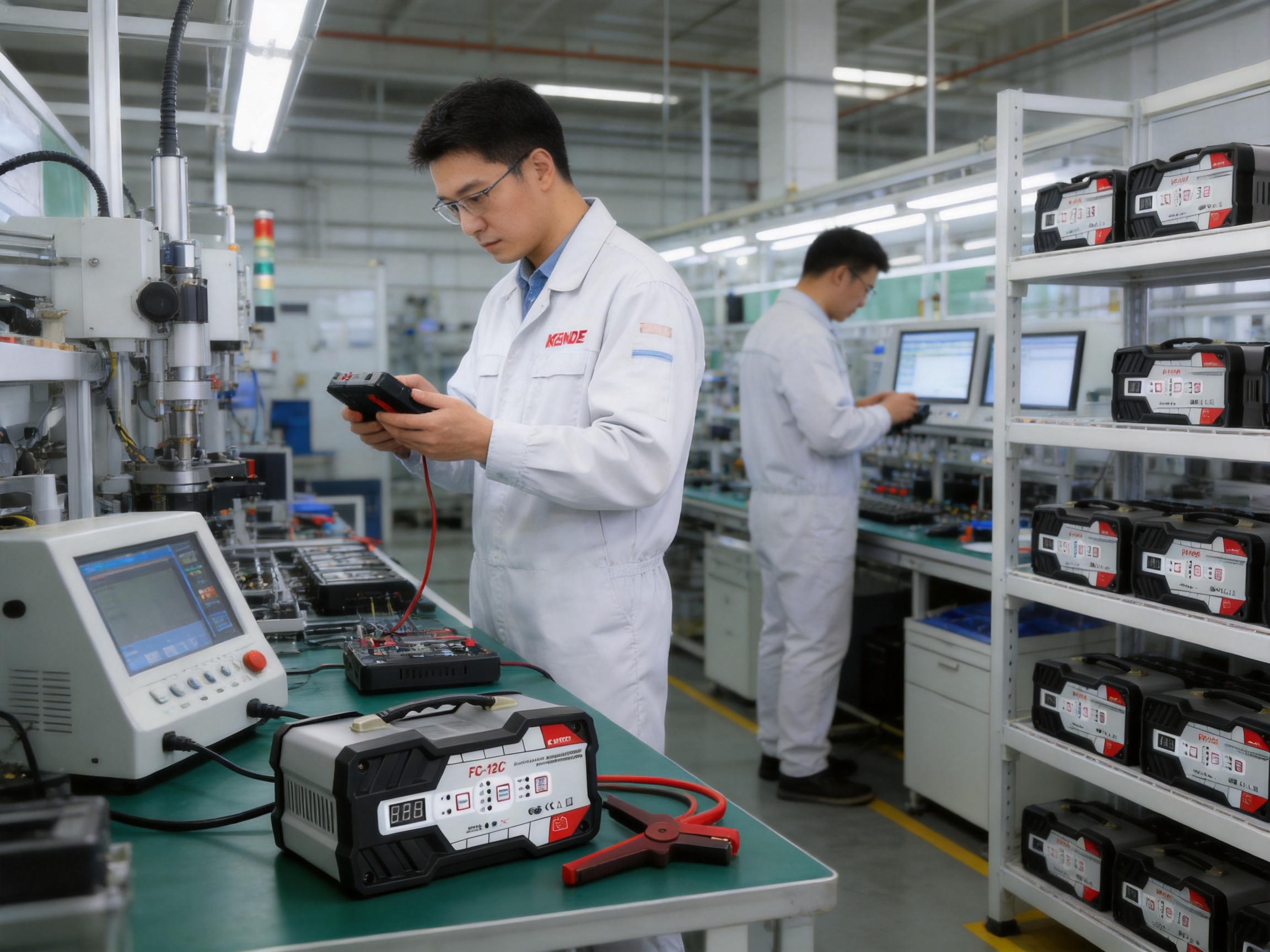
In an automotive workshop, the charger can be used to recover weak batteries, prepare vehicles for delivery, support diagnostic checks, and assist engine starting. Vehicles may sit in storage or on a lot for days or weeks, leading to battery drain. A portable charger and starter helps technicians move quickly between vehicles and restore battery function.
In a home garage, the charger can maintain seasonal equipment and reduce the inconvenience of unexpected dead batteries. Motorcycles, lawn tractors, classic cars, recreational vehicles, and generators often need charging after storage. The 6V/12V capability is useful for households with older equipment or mixed battery systems.
In agricultural environments, machines may be used intensely during certain seasons and then remain idle. Weak batteries can delay work at critical times. A portable charger and engine starter provides practical support for tractors, pumps, utility vehicles, and other machines within the appropriate battery range.
For small fleets, battery reliability affects operating schedules. Delivery vehicles, service vans, and facility vehicles may suffer from battery drain caused by short trips, accessory loads, or infrequent use. A charger with alternator checking can help fleet managers identify whether repeated battery issues are caused by battery age or charging system failure.
For distributors and retailers, the product is easy to position because it addresses common customer pain points. Customers understand weak batteries, starting problems, and the need for safe charging. The product’s multifunction nature, protection features, and compact design provide strong selling points.
To achieve the best results, users should apply safe charging practices. The charger should be used in a dry, well-ventilated indoor area. Since the unit has an IP20 protection rating, it should not be used in wet or outdoor rainy conditions. The battery area should be free from open flames, sparks, and smoking materials because lead-acid batteries can release explosive gases during charging.
Before connection, users should confirm the battery voltage and type. The charger is designed for 6V and 12V lead-acid batteries within the appropriate capacity range. Connecting to incompatible batteries may cause poor performance or safety risks. Users should also inspect the battery for cracks, leakage, swelling, or severe corrosion before charging.
Correct polarity connection is essential. The positive clamp should be connected to the positive battery terminal, and the negative clamp should be connected according to the recommended procedure for the battery or vehicle. The reverse polarity protection and indicator help reduce risk, but users should not rely on protection as a substitute for careful connection.
During charging, the charger should be placed on a stable surface with adequate airflow. The ventilation openings should not be covered. Overheating protection helps protect the machine, but proper ventilation improves reliability and charging performance. Cables should be arranged to prevent tripping, pulling, or accidental clamp contact.
When using the engine starting function, users should follow the recommended procedure and avoid excessive repeated starting attempts. Engine starting creates a high-demand condition. If the engine does not start after suitable attempts, the user should investigate other problems such as fuel supply, ignition, engine condition, or severe battery failure.
For buyers evaluating battery chargers, the purchase decision should consider not only price but also functionality, safety, reliability, and supplier capability. The FC-12C Series Battery Charger offers a balanced package. It supports common 6V and 12V batteries, provides charging and starting functions, includes alternator checking, and incorporates key protection features.
The product is also practical to handle. Its compact dimensions, 6.8kg weight, retractable handle, front clamp storage, and included accessories make it suitable for everyday use. These details may seem simple, but they influence customer satisfaction. A charger that is difficult to carry, awkward to store, or missing essential accessories can quickly become frustrating.
From a distributor perspective, the product benefits from a manufacturer with large-scale production, international export experience, advanced management systems, and broad electrical equipment expertise. These factors support more stable supply and better long-term cooperation. In competitive markets, supplier stability can be as important as product design.
The charger also fits well into a broader product portfolio that may include welding machines, plasma cutters, heaters, and workshop accessories. For customers purchasing multiple categories, working with a manufacturer that offers a wide range of power equipment can simplify sourcing and improve supply chain efficiency.
The main purpose is to charge 6V and 12V lead-acid batteries and provide engine starting assistance when a battery is weak. It also includes an alternator check function, making it useful for basic battery system maintenance and troubleshooting.
It is designed for lead-acid batteries, including standard flooded batteries, AGM batteries, and gel batteries. Users should always confirm that the battery voltage and capacity are suitable before charging.
The reference capacity range is 4Ah to 120Ah. This covers many small and medium batteries used in motorcycles, cars, garden equipment, generators, and light utility applications.
It can do both. The unit provides normal charging and also offers engine starting assistance with a start current of 75A for suitable applications.
Alternator checking helps users determine whether a vehicle’s charging system may be responsible for repeated battery problems. If a battery keeps losing charge, the alternator or related charging system components may need inspection.
The charger includes reverse polarity protection with indication, overheating protection, and short-circuit protection. These functions help improve safety and reduce the risk of equipment damage caused by common operating errors.
The product has an IP20 protection rating, so it is intended for dry indoor environments such as garages and workshops. It should not be used in rain, wet areas, or locations where water may contact the machine.
The product includes 1.5m plus 1.5m charging cable, two clamps, and a color box. The front clamp storage and retractable handle also improve storage and portability.
Compared with basic chargers, this model offers multifunction use, protective functions, engine starting assistance, alternator checking, and a practical portable design. It is also supported by an experienced electrical equipment manufacturer with advanced production systems.
It is suitable for home users, garages, vehicle repair shops, small fleets, agricultural users, equipment maintenance teams, distributors, and retailers looking for a practical charger and starter for common lead-acid battery applications.
The FC-12C Series Battery Charger is a practical and versatile solution for users who need reliable 6V/12V lead-acid battery charging and engine starting assistance. Its 2A to 12A rated charging current, 75A start current, 4Ah to 120Ah reference capacity range, alternator check function, and key protection features make it a strong choice for garages, homes, farms, workshops, and small fleet environments.
Its advantages over many competing products come from the combination of controlled charging, multifunction capability, safety protections, portable design, and manufacturing support. The charger is not only designed to recharge batteries, but also to help users respond to weak starting situations and identify possible alternator issues. This makes it more valuable than a simple charger and more practical than equipment with only one function.
The product is also supported by a manufacturer with extensive electrical equipment experience, large production capacity, advanced management systems, automated manufacturing processes, research and development resources, and international certification experience. These strengths help create a product that is practical for end users and attractive for distributors seeking dependable supply.
For customers who want a compact, capable, and protective battery charger and engine starter, this product offers a balanced combination of performance, safety, and everyday usability.
Battery Council International. Technical Manual for Lead-Acid Battery Care and Maintenance.
International Electrotechnical Commission. Safety Requirements for Battery Chargers and Electrical Power Equipment.
Society of Automotive Engineers. Automotive Battery Testing and Charging Practices.
International Organization for Standardization. Quality Management Systems and Manufacturing Process Control Guidelines.
Automotive Electrical Systems Handbook. Charging Systems, Starting Systems, and Battery Diagnostics.
Recommended Products

Contact Us
No.2299, Luqiao Section, Shugang Avenue, Luqiao District, Taizhou, 318057 Zhejiang, PR China.
+86-576-82431568
 Privacy
China Welding Machine Factory
 English
 中文简体
中文简体
 русский
 Español
 عربى
عربى
 Français
 Português
 Deutsch
 Український

.jpg)