Email: [email protected]
Email: [email protected]

Blog
 2026.07.10
 Blog
Blog
For contractors, renovation teams, landscape builders, farms, maintenance crews, and home-improvement users, a compact concrete mixer is valuable only when it delivers reliable mixing, easy movement, fast cleaning, and stable operation in real jobsite conditions. The PDM-100L Concrete Mixer is designed around those practical requirements. With a 100-liter mixing capacity, a durable PE drum, a tripod stand, large-wheel mobility, and a lightweight body suitable for single-person operation, it addresses the everyday problems that users often experience with small and medium concrete mixers.
This article presents a detailed product-focused overview of the PDM-100L Concrete Mixer, including its design advantages, technical specifications, application value, manufacturing background, and comparison with common alternatives. It also explains how advanced production systems, research capability, and quality-management experience support consistent product reliability. The goal is to show why this mixer is a practical choice for users who need clean operation, stable placement, simple transportation, and dependable performance.
PDM-100L Concrete Mixer with PE Drum Tripod Stand Easy Mobility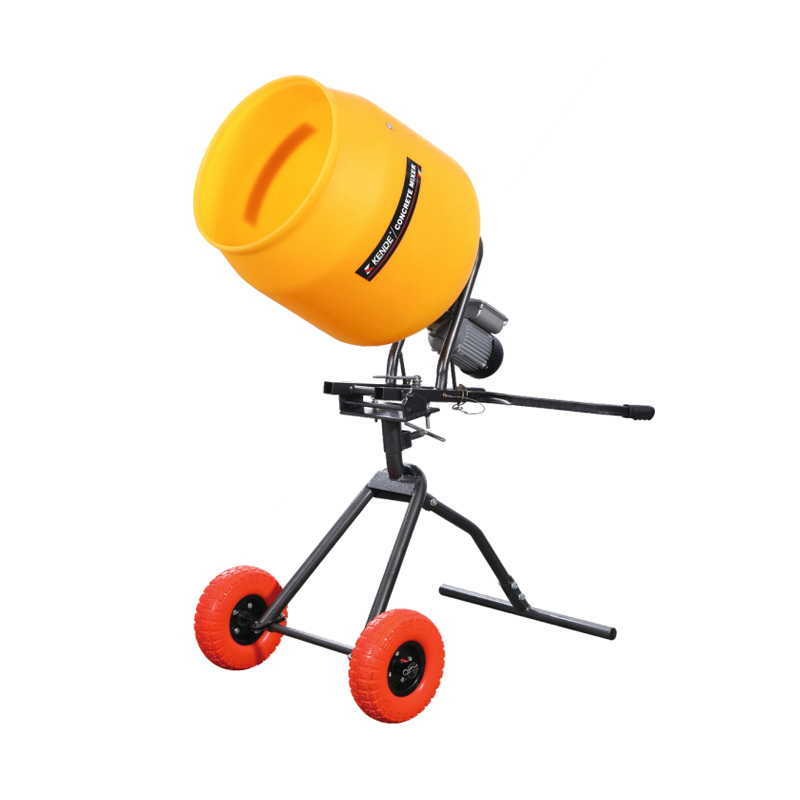
The PDM-100L Concrete Mixer is a portable concrete mixer with a PE drum and tripod stand. It is built for users who need a compact but capable machine for mixing concrete, mortar, grout, and similar construction materials. Its 100-liter capacity places it in a useful working range: large enough for productive batch mixing, yet compact enough to be moved around a site without heavy equipment.
The mixer is equipped with a 450 W mixing motor and supports rated voltage options of 110–120 V and 220–240 V, with a rated frequency of 50/60 Hz. This makes it suitable for different regional electrical environments and for a wide range of users, from professional construction teams to domestic renovation users. The drum speed is listed as 28/36, giving the mixer a practical rotation range for consistent material turnover.
One of the most important design features is the PE drum. Compared with conventional steel drums, PE material helps reduce material adhesion and makes cleaning easier after each batch. Anyone who has used a traditional mixer understands that hardened residue can reduce efficiency, increase cleaning time, and shorten equipment life. The PE drum design helps minimize these issues by providing a surface that is easier to rinse and less likely to hold sticky cement-based material.
The mixer also uses a tripod stand for stable placement. Stability is essential when mixing wet concrete or mortar because vibration, load shifting, and uneven ground can affect safety and mixing efficiency. The tripod-style support is intended to reduce shaking and provide a secure operating posture. For jobsite users working on temporary surfaces, small building projects, farm areas, or outdoor renovation environments, stable support can make a meaningful difference.
Large wheels improve mobility. Instead of requiring two people or a lifting device to reposition the mixer, the machine is designed for easier on-site transfer. The lightweight body further supports single-person handling. This is especially useful when the operator needs to move the mixer between a driveway, garden, construction corner, repair area, or material storage point.
The following table summarizes the key specifications of the PDM-100L Concrete Mixer. These specifications provide a clear view of its electrical requirements, capacity, working characteristics, weight, and shipping dimensions.
| Model | Rated Voltage | Rated Frequency | Mixing Power | Capacity | Drum Speed | Drum Opening | Working Cycle Period | Net/Gross Weight | Package Dimension | QTY/20 | QTY/40H |
| PDM-100L | 110–120 V / 220–240 V | 50/60 Hz | 450 W | 100 L | 28/36 | 400 mm | 3 | 36/39 kg | 570 L × 570 W × 620 H mm | 120 CTNS | 320 CTNS |
A concrete mixer must match the scale of the job. Oversized mixers may be expensive, difficult to transport, and inefficient when small batches are required. Very small mixers may not provide enough capacity, forcing the user to repeat batches too frequently. The 100-liter size of the PDM-100L offers a balanced solution for many applications.
For residential repairs, small foundations, garden paths, fence posts, wall repairs, tiling bases, farm maintenance, and landscaping projects, 100 liters provides a productive batch volume without making the unit too heavy or inconvenient. This size also helps users maintain better control over mix quality. Smaller controlled batches are often easier to manage than large loads, especially when working with limited manpower.
The mixer is also suitable for users who value flexibility. A contractor might use it for smaller jobs where a truck delivery is unnecessary or impractical. A homeowner may use it for weekend projects. A maintenance team may keep it available for patching, setting posts, installing equipment bases, or repairing surfaces. A farm or rural property owner may use it for animal housing repairs, drainage work, or utility pads. In each situation, the mixer’s portability and simple cleaning design are central advantages.
The PDM-100L is not merely a scaled-down industrial mixer. It is built around the needs of users who frequently move between work points and who may not have a large crew available. Its combination of 100-liter capacity, 450 W power, large wheels, tripod stability, and PE drum cleaning convenience makes it practical for demanding but manageable work.
The PE drum is one of the most distinctive features of the PDM-100L. Concrete and mortar mixing creates residue. If the drum surface allows material to stick, cleaning becomes harder, the drum becomes heavier over time, and dried residue may interfere with future batches. A drum that is difficult to clean also increases downtime because operators must spend more time scraping and washing after work.
PE material helps solve this problem by reducing adhesion. While proper cleaning is still required after each use, the PE drum makes the process easier and faster than many traditional drum surfaces. This benefit is especially important for users who mix multiple batches in a day, switch between different materials, or work in locations where water and cleaning tools are limited.
Compared with many conventional steel-drum compact mixers, the PE drum can also provide a more user-friendly maintenance experience. Steel drums may be strong, but they often collect cement residue if not cleaned thoroughly. Over time, buildup can reduce effective capacity and create imbalance during operation. By helping reduce adhesion, the PE drum contributes to consistent use and easier upkeep.
Another advantage is practical handling. A mixer that remains cleaner is easier to move, easier to store, and easier to prepare for the next task. For rental businesses, maintenance teams, and contractors, this can reduce labor cost and improve turnaround time. For homeowners, it reduces frustration and makes the machine more likely to be properly maintained.
Stability is a key requirement for safe and efficient mixing. A concrete mixer holds dense material, rotates under load, and may operate on uneven ground. If the base is unstable, the mixer can shake, shift, or feel unsafe during use. The tripod stand design of the PDM-100L provides stable placement and helps reduce shaking.
The tripod structure supports the mixer in a balanced way and is well suited for portable equipment. Unlike flimsy frames that may wobble under load, a stable stand helps keep the drum aligned during mixing. This contributes to smoother operation and gives the user more confidence while adding materials, monitoring the mix, or discharging the batch.
For outdoor worksites, the ground is rarely perfect. Soil, gravel, construction debris, or sloped surfaces can make equipment placement challenging. A stable tripod stand does not eliminate the need for proper setup, but it helps create a secure operating foundation. Users should still place the mixer on a firm, level surface whenever possible, but the tripod design supports dependable working posture.
Compared with some compact mixers that use narrow frames or less stable support structures, the PDM-100L’s stand is designed for real jobsite use. It supports practical operation rather than just showroom appearance. This is important because the value of a mixer is measured not only by motor power or drum volume, but also by how confidently it performs when loaded.
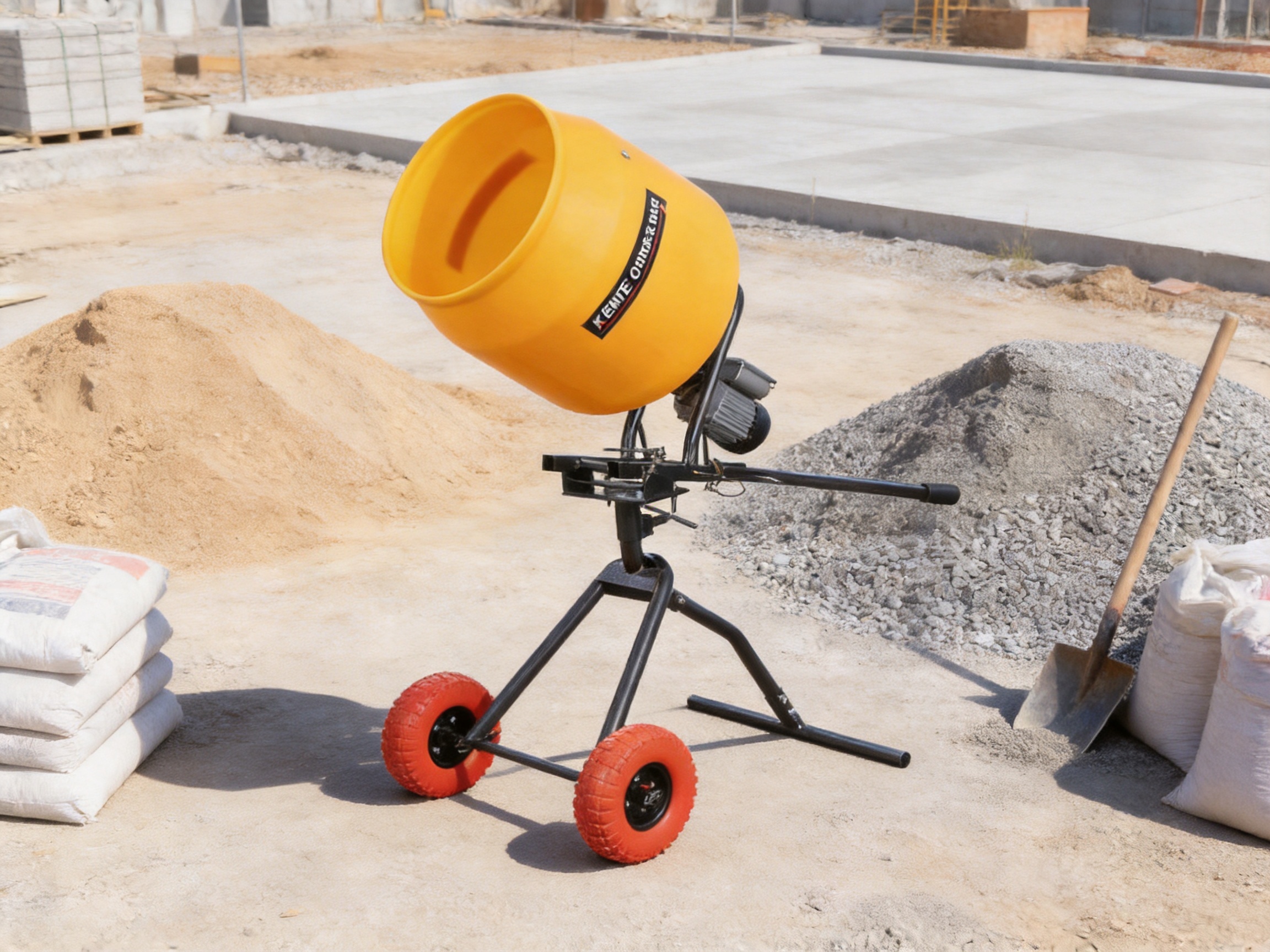
Mobility is one of the strongest advantages of the PDM-100L. Construction projects often require movement. Materials may be stored in one area while the work point is located elsewhere. A user may need to mix near a wall in the morning, move to a pathway in the afternoon, and store the unit in a shed or vehicle at the end of the day. Large wheels make this process easier.
The large-wheel mobility design reduces the effort required to reposition the mixer. This is especially valuable on outdoor surfaces where small wheels may get stuck or require excessive pushing force. By improving rolling capability, the mixer supports a smoother workflow and reduces unnecessary physical strain.
Compared with heavier mixers that require two-person handling, the PDM-100L is designed for single-person operation. Its net weight is approximately 36 kg, with a gross weight of approximately 39 kg. This is light enough to support practical movement while still being substantial enough for stable working. The result is a machine that can be moved without sacrificing usability.
Mobility also improves productivity. When the mixer can be moved closer to the work area, users spend less time carrying heavy wet material. This can reduce fatigue and improve safety. Wet concrete and mortar are heavy, and repeated carrying over long distances can slow down a project. A portable mixer helps bring the mixing process closer to where the material is needed.
The lightweight body of the PDM-100L is a major benefit for small teams and individual users. Many construction tasks are performed by one or two people. If a mixer requires several people to move, lift, or adjust it, the equipment becomes less convenient. The PDM-100L is designed so one person can operate and reposition it with greater ease.
Single-person operation does not mean the mixer is only for light use. Rather, it means the design respects the way many real projects are performed. A homeowner may not have a crew available. A maintenance worker may need to complete a repair alone. A small contractor may need to reduce labor cost. In these situations, the ability to move, set up, clean, and store the mixer without a large team is valuable.
The manageable weight also helps during transport. The package dimension of 570 L × 570 W × 620 H mm supports efficient storage and shipping. For distributors and retailers, this compact packaged size helps optimize inventory and container loading. For end users, it makes the product easier to receive, store, and move through gates, garages, workshops, or small storage rooms.
Compared with bulkier equipment, the PDM-100L provides a better balance of capacity and maneuverability. It is designed for users who want productivity without excessive complexity. This balance is one of the reasons portable mixers remain popular across construction, landscaping, and repair markets.
The PDM-100L is equipped with 450 W of mixing power. For a compact 100-liter mixer, this power rating is suited to practical batch preparation. It supports regular mixing tasks while helping keep the machine compact and energy-conscious. Users should always follow recommended load practices and avoid overloading, but the power specification aligns with the intended work range.
Efficient mixing depends on more than power alone. Drum geometry, rotation speed, material sequence, and correct water ratio all influence final results. The PDM-100L combines its motor power with drum rotation and a usable opening size to support convenient loading and mixing. The 400 mm drum opening helps users add materials more easily and monitor the mixing process.
In comparison with underpowered portable mixers, the 450 W rating provides stronger support for consistent use. In comparison with much larger machines, it avoids unnecessary size, weight, and power consumption for small and medium jobs. This makes the mixer a practical choice for users who want reliable daily convenience rather than oversized capacity.
The rated voltage options of 110–120 V and 220–240 V further expand usability. Different markets and worksites use different power supplies, and the ability to support common voltage ranges is important for global suitability. The 50/60 Hz frequency compatibility also helps match different electrical standards.
The PDM-100L Concrete Mixer is useful for a wide variety of jobs. Its compact size makes it appropriate for residential, agricultural, commercial, and maintenance tasks where moderate batches are needed. It is especially valuable when ready-mix delivery would be too expensive, inaccessible, or excessive for the job size.
In residential renovation, the mixer can support patio repairs, pathway construction, post setting, wall bases, small slabs, garden features, and tile bedding. For these jobs, the user often needs multiple controlled batches rather than one large delivery. The PDM-100L provides a way to mix on demand and reduce waste.
In landscaping, the mixer can be used for edging, decorative concrete, stepping stones, retaining wall footings, fence posts, and drainage structures. Landscapers often move across a site, and the large-wheel design supports this movement. The PE drum also helps when working with different mixes that need cleaning between batches.
In agricultural and rural environments, the mixer can assist with repairs to animal pens, water trough supports, gate posts, equipment pads, and drainage channels. Rural sites may have uneven ground and longer distances between work points, so portability and stability are important.
For professional contractors, the PDM-100L is useful as a secondary or support mixer. Even contractors with access to larger equipment may need a smaller mixer for remote corners, upper-level work areas, interior repairs, or small finishing tasks. Its compact design makes it easier to deploy quickly.
The PDM-100L stands out against many competing compact mixers because it combines several practical features in one design. Some mixers offer portability but lack stable support. Others have stable frames but are heavy and difficult to move. Some use traditional drums that require more cleaning effort. The PDM-100L addresses these concerns together.
First, the PE drum improves cleaning convenience. In the compact mixer market, many models still use metal drums that can retain residue. A drum that is easier to clean saves time after every batch. Over the life of the machine, this advantage can be significant. It helps users maintain effective capacity and reduces the buildup that can cause imbalance or poor mixing.
Second, the tripod stand improves stability compared with less secure compact frames. Stability is not just a comfort feature; it affects safe handling and confidence during operation. A mixer that shakes excessively may cause users to reduce load, stop work, or spend time adjusting the setup. The PDM-100L’s stable placement supports more efficient use.
Third, large wheels improve mobility compared with small-wheel or fixed-frame mixers. When a mixer is hard to move, users may leave it in one place and carry mixed material farther than necessary. This increases labor and reduces productivity. A mobile mixer can follow the work, saving time and physical effort.
Fourth, the lightweight body supports single-person operation. Competing products that are heavier may appear more rugged, but they can become inconvenient for small teams. A practical mixer must be strong enough for the job while remaining manageable. The PDM-100L balances these needs.
Fifth, the 100-liter capacity provides a useful middle ground. Small hobby mixers may require too many batches, while larger machines may be excessive for repair and renovation work. The PDM-100L is positioned for users who need real productivity without losing portability.
A good mixer should make the entire workflow easier, not just the mixing stage. The PDM-100L is designed to support a straightforward process from setup to cleaning. The user positions the mixer on a stable surface, connects it to the appropriate power source, loads materials according to the desired mix ratio, operates the drum, discharges the batch, and cleans the PE drum after use.
The large drum opening helps with loading. A 400 mm opening gives users practical access for adding cement, sand, aggregate, water, or prepared mix. It also makes visual inspection easier during the mixing process. Being able to see the material helps users judge consistency and adjust water or dry ingredients when necessary.
After mixing, cleaning is simplified by the PE drum. The best practice is to clean immediately after use before material hardens. Because the PE drum helps reduce adhesion, rinsing and light brushing are typically easier than dealing with stubborn buildup in conventional drums. This encourages proper maintenance and helps keep the machine ready for the next task.
The lightweight body and large wheels also make end-of-day storage easier. Users can move the mixer away from the work area, rinse it, and store it in a garage, shed, workshop, or service vehicle. This convenience matters because equipment that is easy to maintain is more likely to remain in good condition.
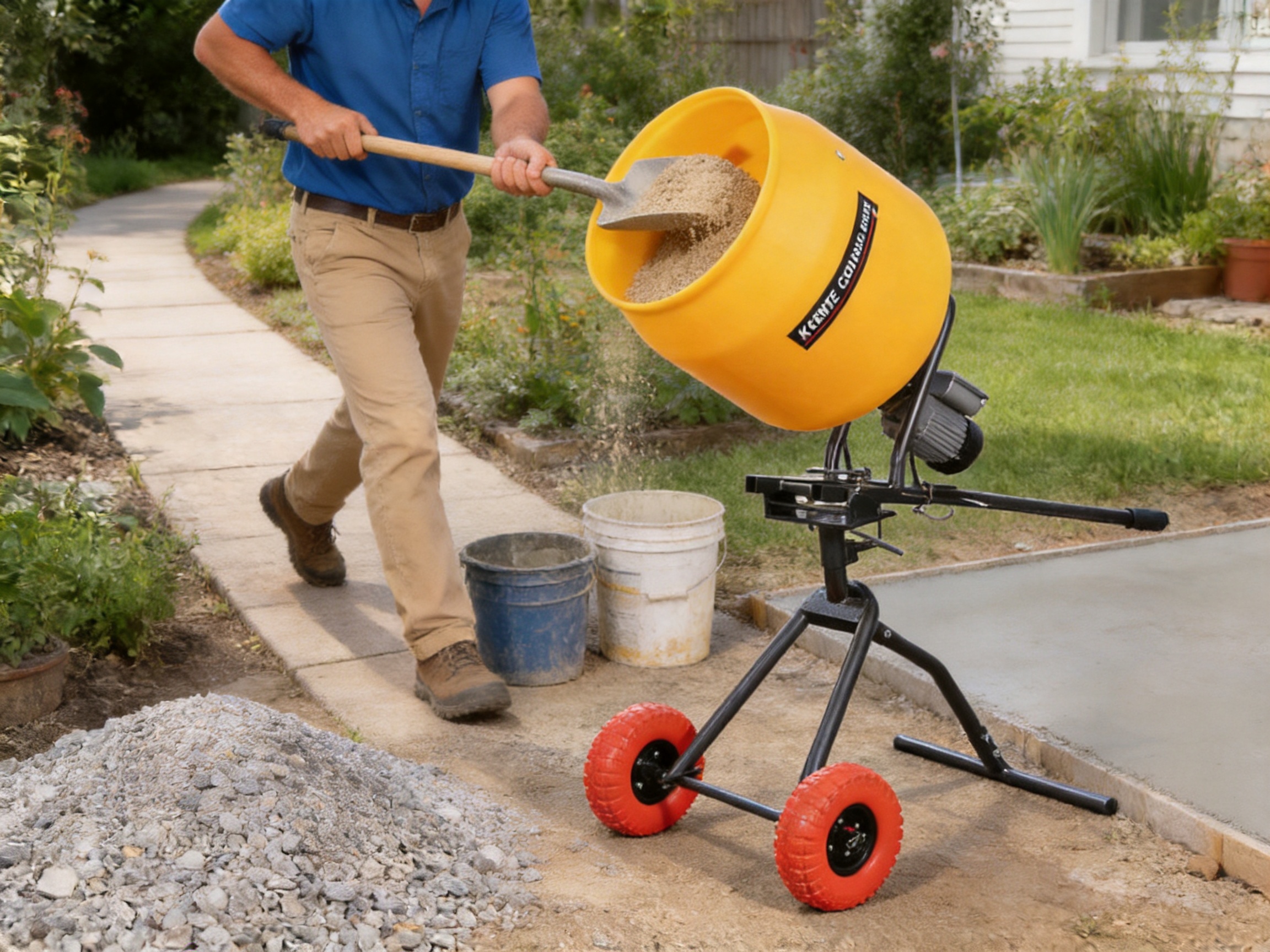
The PDM-100L is supported by the manufacturing capabilities of Zhejiang Kende Mechanical & Electrical Co., Ltd., a company located in Taizhou City, Zhejiang Province, China. The company operates on a large industrial foundation, covering an area of approximately 120,000 square meters and employing about 600 people. This scale provides the production environment needed to support consistent manufacturing, quality control, and product development.
The company is internationally known as a manufacturer and exporter of electric welding machines, chargers, heaters, and related mechanical and electrical products. It exports nearly 1.5 million units annually and has an annual production capacity of approximately 2 million units. Such production experience is important because high-volume manufacturing requires process discipline, component management, testing systems, and continuous improvement.
Although the PDM-100L belongs to the concrete mixer category, it benefits from the same manufacturing culture used across the company’s broader product portfolio. The company’s experience with electrical products, power equipment, and mechanical assemblies supports reliable production practices. Products such as welding machines, plasma cutting machines, battery chargers, heaters, and other equipment require careful attention to electrical safety, assembly accuracy, component selection, and durability. These capabilities are relevant to producing a dependable portable mixer.
The company has built a modern management structure and uses advanced systems such as OA office automation, ERP K3, MES management, and production-management methods influenced by Japan Toyota TPS principles. These systems help coordinate orders, materials, production scheduling, assembly processes, and quality records. For customers, this means the product is not made in an informal or inconsistent environment; it is supported by organized manufacturing infrastructure.
Modern manufacturing depends on repeatability. A product may have a good design, but if production processes are not controlled, quality can vary. The company applies advanced manufacturing technologies such as automatic patching, plug-in and welding systems, robot processing, laser cutting, and other modern production methods. These technologies support accuracy, efficiency, and consistency across product lines.
Robot processing and laser cutting are particularly valuable for metal frames, brackets, structural parts, and production fixtures. Accurate cutting and repeatable processing help ensure that components fit correctly during assembly. For a product such as a concrete mixer, frame alignment and structural consistency influence stability, vibration control, and service life.
Automated and semi-automated systems also help reduce human error in repetitive operations. While skilled workers remain essential, process automation can improve consistency in tasks that require uniform results. When combined with inspection procedures and production tracking, these systems help ensure that each finished product meets expected standards.
MES management can provide visibility into production stages. It helps manufacturers monitor workflow, trace materials, control process steps, and identify improvement opportunities. ERP systems support supply chain coordination, inventory planning, and delivery management. Together, these systems create a manufacturing environment capable of supporting both domestic and international customers.
The company’s experience with electrical and mechanical products also supports component quality. A concrete mixer must combine mechanical structure, motor performance, electrical compatibility, and user-safe design. Manufacturing experience across multiple power-equipment categories helps build the engineering discipline needed for such integrated products.
Product reliability begins before production. It starts with research, development, testing, and improvement. The company has a Zhejiang Provincial R&D Center, an Enterprise Technology Center, and an Intelligent Welding Technology Research Institute. It has a dedicated R&D team of 98 personnel and has obtained multiple invention patents, utility model patents, appearance patents, and software copyrights.
This R&D background is a strength because it demonstrates continuous product-development capability. In competitive markets, manufacturers must improve usability, safety, efficiency, packaging, assembly, and cost performance. The PDM-100L reflects these priorities through its PE drum, stable stand, mobility-focused wheel design, and lightweight structure.
Innovation is not limited to advanced electronics or industrial machines. In a product like a concrete mixer, innovation often appears in practical details: a cleaner drum surface, a more stable support structure, easier movement, better packaging efficiency, and a user-friendly operating layout. These improvements directly affect the customer’s daily experience.
The company’s participation in national standard drafting for welding-machine standards also shows technical engagement and industry responsibility. While those standards are related to another major product area, the experience of working with standards strengthens a company’s overall quality mindset. A manufacturer that understands standards, testing, documentation, and compliance is better positioned to develop reliable products across categories.
International markets require products that meet different safety and performance expectations. The company holds many international product certificates, including GS, CE, EMC, ERP, US ETL, UKCA, and China CCC for relevant product categories. These certifications show long-term experience with compliance systems, testing requirements, and global market access.
For customers considering the PDM-100L, this certification culture matters because it reflects an organization that is familiar with regulated markets and quality documentation. Even when certifications vary by product type and destination market, the company’s broader compliance experience helps support disciplined development and production.
Quality is also supported by production scale. Exporting nearly 1.5 million units annually requires supply-chain control, inspection routines, packaging management, and after-sales awareness. Large-volume export experience helps manufacturers understand the expectations of distributors, importers, retailers, and end users.
A concrete mixer may seem simple compared with electronic welding equipment, but it still requires dependable quality. The motor must operate reliably, the frame must hold steady, the drum must rotate properly, the electrical configuration must match the market, and the packaging must protect the product in transit. A manufacturer with broad quality-management experience is better equipped to control these factors.
The PDM-100L is packaged in dimensions of 570 L × 570 W × 620 H mm. This compact packaging supports efficient logistics and storage. According to the provided loading information, the quantity is 120 cartons for a 20-foot container and 320 cartons for a 40-foot high-cube container. These figures are important for distributors and importers because container efficiency affects landed cost.
Efficient packaging can make a product more competitive. A mixer that performs well but ships inefficiently may become expensive for international buyers. The PDM-100L’s carton loading data indicates attention to distribution practicality. Compact packaging also helps retailers manage warehouse space and display planning.
For end users, reasonable packaging dimensions can make delivery and handling easier. A compact carton is easier to receive, move, and store before assembly or use. This is especially relevant for online sales, hardware-store distribution, and regional dealer networks.
The combination of manageable product weight and compact packaging creates advantages across the supply chain. Manufacturers can ship efficiently, distributors can store more units, retailers can manage inventory more easily, and users can handle the product with less difficulty.
The PDM-100L fits a market segment that values practical performance. It is not designed to replace large industrial mixers or ready-mix trucks. Instead, it serves users who need flexible, portable, and clean mixing for small and medium work. This positioning is important because many users do not need excessive capacity; they need dependable convenience.
The product delivers value in several ways. It reduces labor by allowing mixing close to the work area. It reduces cleaning effort through the PE drum. It supports safer and steadier operation with the tripod stand. It improves mobility with large wheels. It supports individual users through its lightweight design. These benefits directly relate to time, effort, and jobsite efficiency.
Compared with low-cost basic mixers, the PDM-100L offers a more complete feature set. Users who choose only by the lowest purchase price may later spend more time cleaning, moving, stabilizing, or repairing equipment. A better-designed mixer can reduce these hidden costs. The PDM-100L’s advantages are therefore not limited to the initial specification sheet; they appear in daily use.
Compared with larger professional mixers, it offers lower handling burden and better suitability for smaller tasks. Large machines are valuable for high-volume work, but they may be inconvenient for quick repair jobs or confined sites. The PDM-100L offers the practical middle ground that many users need.
To obtain the best performance from the PDM-100L, users should follow good mixing and maintenance practices. The mixer should be placed on a firm and level surface before operation. The tripod stand helps provide stability, but proper setup remains essential. Users should avoid unstable slopes, loose piles of material, or surfaces that may shift under load.
Materials should be loaded according to recommended mixing procedures. Users should avoid overloading the drum beyond practical working capacity. Overloading can reduce mixing quality, strain the motor, and create unsafe operating conditions. It is better to mix controlled batches and maintain consistent material ratios.
Electrical supply should match the rated voltage and frequency. The model supports 110–120 V or 220–240 V and 50/60 Hz, depending on configuration. Users should confirm the correct version for their market and use appropriate extension cords and electrical protection according to local safety rules.
Cleaning should be performed immediately after use. Although the PE drum helps reduce adhesion, cement-based materials can harden if left inside. Rinsing the drum and removing residue after each batch or work session will help preserve performance. Users should also inspect wheels, supports, fasteners, and moving parts periodically.
Storage should be dry and protected when possible. Keeping the mixer clean and covered helps maintain appearance and function. For seasonal users, cleaning before long-term storage is especially important.
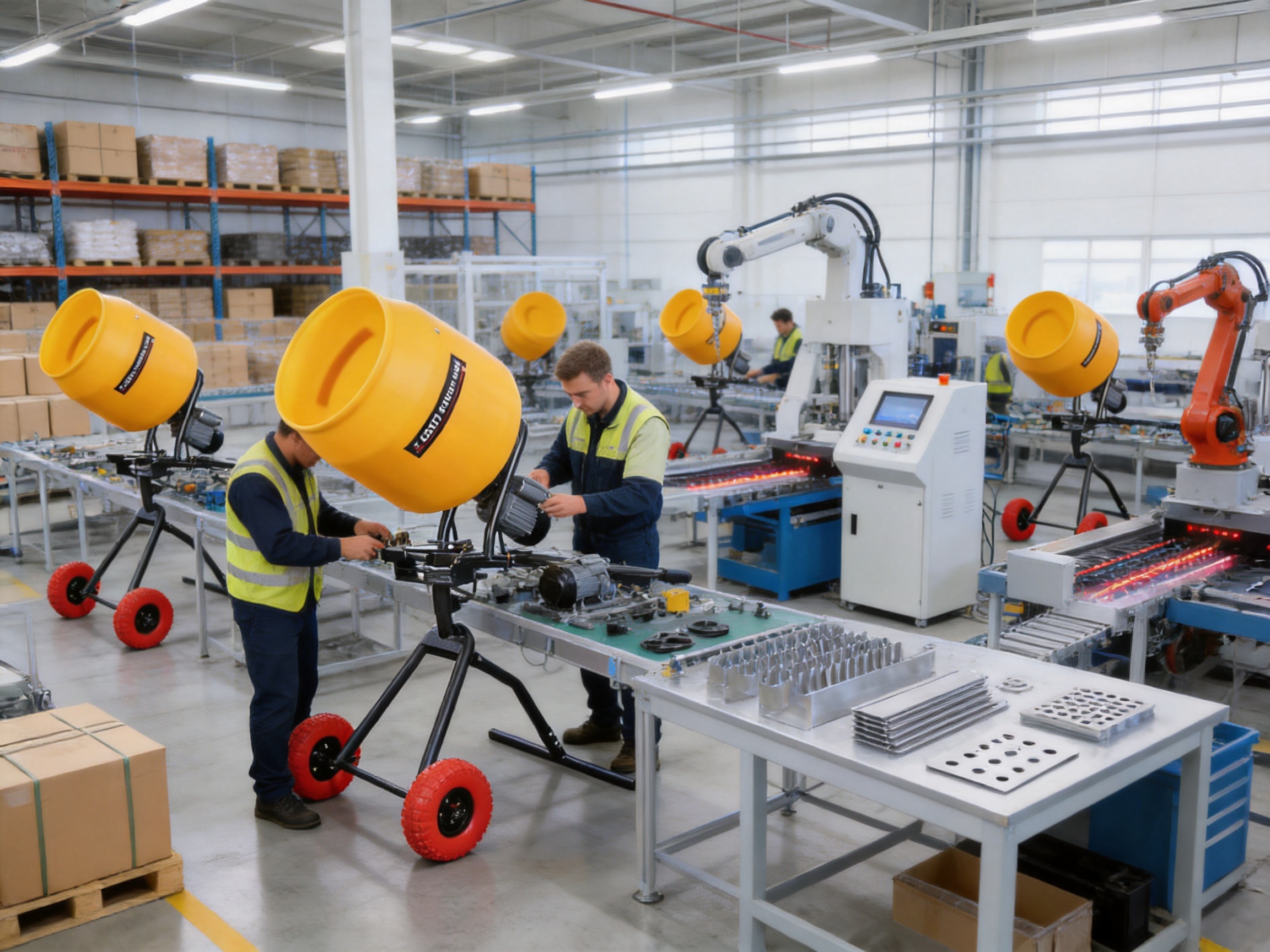
The strongest reason to choose the PDM-100L is its combination of convenience and capability. Many products offer one advantage but compromise another. A mixer may be lightweight but unstable, stable but hard to move, affordable but difficult to clean, or powerful but too bulky for practical transport. The PDM-100L brings together the features that users repeatedly need: a 100-liter capacity, PE drum, stable tripod stand, large wheels, 450 W power, and manageable weight.
This combination makes it suitable for buyers who care about total user experience. A mixer is not just a motor and a drum. It is a tool that affects job pace, labor demand, cleaning time, material handling, and storage. By reducing friction across these steps, the PDM-100L creates real value.
The product also benefits from the manufacturing strength behind it. Zhejiang Kende Mechanical & Electrical Co., Ltd. has extensive production experience, modern management systems, advanced processing technologies, and a strong R&D background. These capabilities support consistent manufacturing and help the product compete in international markets.
For distributors, the product offers practical shipping efficiency and a clear selling proposition. For retailers, it is easy to explain: cleaner drum, stable stand, large wheels, lightweight movement, and 100-liter capacity. For end users, those same features translate into easier work.
The main advantage is its balanced design. It combines a 100-liter capacity, a PE drum for easier cleaning, a tripod stand for stable placement, large wheels for jobsite mobility, and a lightweight body suitable for single-person operation.
The PE drum helps reduce material adhesion, making cleaning easier after mixing concrete, mortar, or similar materials. This can save time, reduce residue buildup, and help keep the mixer ready for repeated use.
Yes. The PDM-100L is designed with large wheels and a lightweight body. Its net weight is approximately 36 kg, making it practical for one person to move and position in many jobsite situations.
It is suitable for homeowners, small contractors, landscapers, farm users, maintenance teams, and renovation workers who need portable batch mixing for small and medium jobs.
The mixer has a 450 W mixing power rating, which is suitable for its compact 100-liter working category when used according to proper loading practices.
The product supports rated voltage options of 110–120 V and 220–240 V, with a rated frequency of 50/60 Hz. Users should select the correct configuration for their local power supply.
The tripod stand is designed to provide stable placement and reduce shaking. Users should still place the mixer on a firm, level surface for best results and safe operation.
Compared with many traditional steel-drum compact mixers, the PE drum can be easier to clean and less prone to material adhesion. This improves maintenance convenience and may reduce downtime after work.
Yes. The lightweight body and large-wheel design support single-person operation and movement, making it useful for small teams and individual users.
The package dimension is 570 L × 570 W × 620 H mm. This compact packaging supports efficient storage, transport, and container loading.
The product is supported by a manufacturer with a 120,000-square-meter production base, about 600 employees, advanced production systems, R&D capability, robot processing, laser cutting, ERP and MES management, and extensive export experience.
The PDM-100L Concrete Mixer is a practical and well-balanced solution for users who need portable concrete mixing without unnecessary complexity. Its 100-liter capacity supports productive small and medium batches, while its PE drum reduces cleaning effort and material adhesion. The tripod stand improves stability, large wheels support on-site movement, and the lightweight body makes single-person operation more realistic.
Its advantages over many competing compact mixers are clear. It is easier to clean than many traditional drum designs, easier to move than heavier fixed-frame units, more stable than many lightweight alternatives, and more convenient for users who need flexible mixing in different work areas. These are not abstract benefits; they directly affect daily work speed, labor effort, and equipment maintenance.
Behind the product is a strong manufacturing foundation. Zhejiang Kende Mechanical & Electrical Co., Ltd. brings large-scale production experience, modern management systems, advanced processing technologies, research capability, international certification experience, and a disciplined quality culture. This background strengthens confidence in the product’s consistency and market suitability.
For contractors, homeowners, landscapers, maintenance teams, and distributors, the PDM-100L offers a compelling combination of practical features and manufacturing support. It is designed for real users who need reliable mixing, easy cleaning, stable placement, and convenient movement on actual jobsites.
Company product specification materials for the PDM-100L Concrete Mixer.
Internal company profile information for Zhejiang Kende Mechanical & Electrical Co., Ltd.
General construction equipment practice guides for portable concrete mixers.
Common electrical equipment manufacturing and quality-management references for international production environments.
Industry literature on small-batch concrete mixing, jobsite mobility, and equipment maintenance best practices.
Recommended Products

Contact Us
No.2299, Luqiao Section, Shugang Avenue, Luqiao District, Taizhou, 318057 Zhejiang, PR China.
+86-576-82431568
 Privacy
China Welding Machine Factory
 English
 中文简体
中文简体
 русский
 Español
 عربى
عربى
 Français
 Português
 Deutsch
 Український