Email: [email protected]
Email: [email protected]

Blog
 2026.07.12
 Blog
Blog
In every welding operation, the visible arc often receives the most attention, but the quality of the final result depends just as much on the small parts and accessories that support the welding process. Contact tips, nozzles, torch components, clamps, holders, connectors, liners, cutting consumables, protective parts, and service components all influence arc stability, heat control, operator comfort, and equipment life. A welding machine can only perform at its best when the accessories connected to it are accurate, durable, and compatible with demanding workshop conditions.
The product focus of this article is welding accessories and parts designed for practical use across fabrication, maintenance, repair, industrial production, and workshop applications. These parts are not merely replacement items; they are performance components that help maintain consistent current transfer, stable gas shielding, dependable mechanical connection, and safer operation. For welding professionals, choosing high-quality accessories is one of the most cost-effective ways to improve productivity and reduce downtime.
Zhejiang Kende Mechanical & Electrical Co., Ltd. provides a broad foundation for the development and supply of welding-related products, including MMA or stick welding machines, MIG/MAG or GMAW machines, TIG or GTAW welding machines, plasma cutting machines, submerged arc welding systems, resistance spot welding machines, robot welding systems, laser welding machines, laser cleaning machines, chargers, heaters, and welding accessories. This wide manufacturing background gives the company a practical understanding of how each accessory interacts with real welding equipment and real workplace demands.
Because welding accessories must support many processes, they must be engineered with attention to conductivity, wear resistance, heat resistance, dimensional accuracy, corrosion protection, and ease of replacement. A poorly made part may seem inexpensive at first, but it can cause unstable arcs, excess spatter, wire feeding problems, overheating, gas leakage, poor weld appearance, and premature torch failure. In contrast, a well-made accessory helps the machine deliver its intended performance consistently.
Welding parts and accessories are the connection between the welding machine, the operator, the consumable material, and the workpiece. In MIG/MAG welding, for example, the contact tip transfers welding current to the wire, the nozzle controls shielding gas coverage, and the liner guides the wire from the feeder to the torch. In TIG welding, the collet, collet body, ceramic cup, back cap, and tungsten holder all influence arc precision and gas flow. In plasma cutting, electrodes, nozzles, swirl rings, shields, and retaining caps directly affect cut quality and consumable life.
Accessories also support manual arc welding and general workshop use. Electrode holders, ground clamps, cable connectors, adapter plugs, torch bodies, protective covers, air fittings, hoses, regulators, and maintenance parts are essential to safe, efficient operation. Although these components may appear simple, their reliability affects every stage of welding and cutting.
Modern fabrication environments require higher repeatability than ever before. Operators expect equipment to start reliably, run smoothly, and produce consistent results with minimal adjustment. High-quality accessories make this possible by reducing variation. Stable wire feeding, accurate alignment, good electrical contact, and controlled gas flow all contribute to dependable weld formation.
For manufacturers, distributors, and end users, accessory quality also affects inventory and service management. If parts fail often or vary from batch to batch, workshops must carry more spare stock and spend more time troubleshooting. Reliable parts simplify maintenance planning and support more predictable production schedules.
The major advantage of well-manufactured welding accessories is that they are designed as performance parts rather than generic replacements. Ordinary accessories may fit the machine physically, but they may not deliver the same consistency in electrical transfer, thermal performance, or mechanical stability. Precision parts are developed with a better understanding of the welding process and the stress each component experiences during use.
One important advantage is dimensional consistency. A contact tip with inaccurate bore size can cause wire feeding resistance, arcing inside the tip, burnback, or unstable current transfer. A nozzle with uneven geometry can disturb shielding gas flow. A connector with poor tolerance can loosen under vibration. Precision manufacturing reduces these problems by ensuring that parts meet intended dimensions repeatedly.
Another advantage is material selection. Welding accessories work in environments involving heat, electric current, abrasion, spatter, and mechanical wear. High-conductivity copper alloys, heat-resistant ceramics, durable insulating materials, and properly treated metal components help extend service life. Better materials also improve energy transfer and reduce unnecessary heat buildup.
Surface treatment and finishing are also important. Smooth surfaces reduce friction in wire-feeding components. Proper plating and anti-corrosion treatment help maintain conductivity and appearance during storage and use. Clean machining reduces burrs that might interfere with assembly or cause premature wear. These details are often the difference between an accessory that simply fits and one that performs reliably.
The product category of welding accessories also benefits from wide compatibility. Because Zhejiang Kende Mechanical & Electrical Co., Ltd. manufactures and exports a broad range of welding and cutting equipment, its accessory development is supported by knowledge of different welding processes, power sources, machine structures, and user habits. This makes it easier to design parts that match industrial and domestic user requirements.
Welding accessories can be grouped by function. Some parts conduct current, some guide consumables, some protect the torch, some control gas or air flow, and others provide connection or operator handling. Understanding these functions helps users choose the correct part for each application and avoid problems caused by mismatched or low-grade accessories.
| Accessory Type | Main Function | Performance Benefit | Typical Application |
| Contact tips | Transfer welding current to wire | Stable arc, reduced burnback, smoother feeding | MIG/MAG and flux-cored welding |
| Nozzles | Direct shielding gas around the weld pool | Better gas coverage, reduced porosity, cleaner welds | MIG/MAG welding |
| Torch liners | Guide wire through the torch cable | Lower feeding resistance, improved wire stability | MIG/MAG welding |
| Ceramic cups | Shape gas flow around tungsten and arc | Improved shielding and arc control | TIG welding |
| Collets and collet bodies | Hold tungsten electrode accurately | Precise tungsten positioning and stable arc | TIG welding |
| Electrode holders | Clamp welding electrodes and transfer current | Secure grip, safer operation, reliable current flow | MMA or stick welding |
| Ground clamps | Complete electrical circuit with workpiece | Reduced resistance and stable welding output | All arc welding processes |
| Plasma electrodes and nozzles | Shape and maintain plasma arc | Cleaner cuts, longer consumable life | Air plasma cutting |
| Cable connectors | Connect welding cables and machines | Fast setup, reliable contact, reduced overheating | Workshop and field welding |
| Protective covers and insulators | Protect components from heat and electrical contact | Improved safety and longer equipment life | Welding torches and machine connections |
The value of these parts becomes clear when welding under continuous or high-duty-cycle conditions. In such environments, the accessory must resist heat buildup, vibration, repeated handling, and contamination. Even a small failure can stop production. Therefore, accessories that offer stable quality reduce direct replacement costs and indirect costs caused by downtime.
Another benefit is operator confidence. When parts fit correctly and perform predictably, welders spend less time adjusting equipment and more time producing acceptable welds. This is especially important for training environments, repair shops, production lines, and export-oriented fabrication businesses where consistency is essential.
Arc stability is one of the most important indicators of welding quality. A stable arc helps produce uniform bead shape, controlled penetration, reduced spatter, and lower defect rates. Accessories contribute to arc stability in several ways, beginning with electrical conductivity.
In MIG/MAG welding, the contact tip must maintain reliable contact with the wire while allowing it to feed smoothly. If the contact tip wears too quickly or has an inconsistent internal diameter, current transfer becomes irregular. This can produce arc wandering, burnback, spatter, or inconsistent bead appearance. A precisely manufactured contact tip supports stable current transfer and predictable wire movement.
In TIG welding, the components holding the tungsten electrode must maintain exact alignment. A loose or poorly machined collet can allow movement, creating arc instability and poor control over the weld pool. Correctly made TIG parts help the operator maintain arc length, angle, and direction.
Grounding accessories are equally important. A weak ground clamp or poor cable connection increases electrical resistance. This can lead to overheating, unstable current, and inconsistent performance. Durable clamps and connectors help ensure a complete electrical path from machine to workpiece and back.
Gas shielding also affects arc quality. Nozzles, cups, diffusers, and gas-related components must support smooth, controlled flow. Turbulent or insufficient shielding can allow oxygen and nitrogen to enter the weld pool, causing porosity, discoloration, and weak welds. Carefully formed gas-control accessories help protect the molten metal and improve weld integrity.
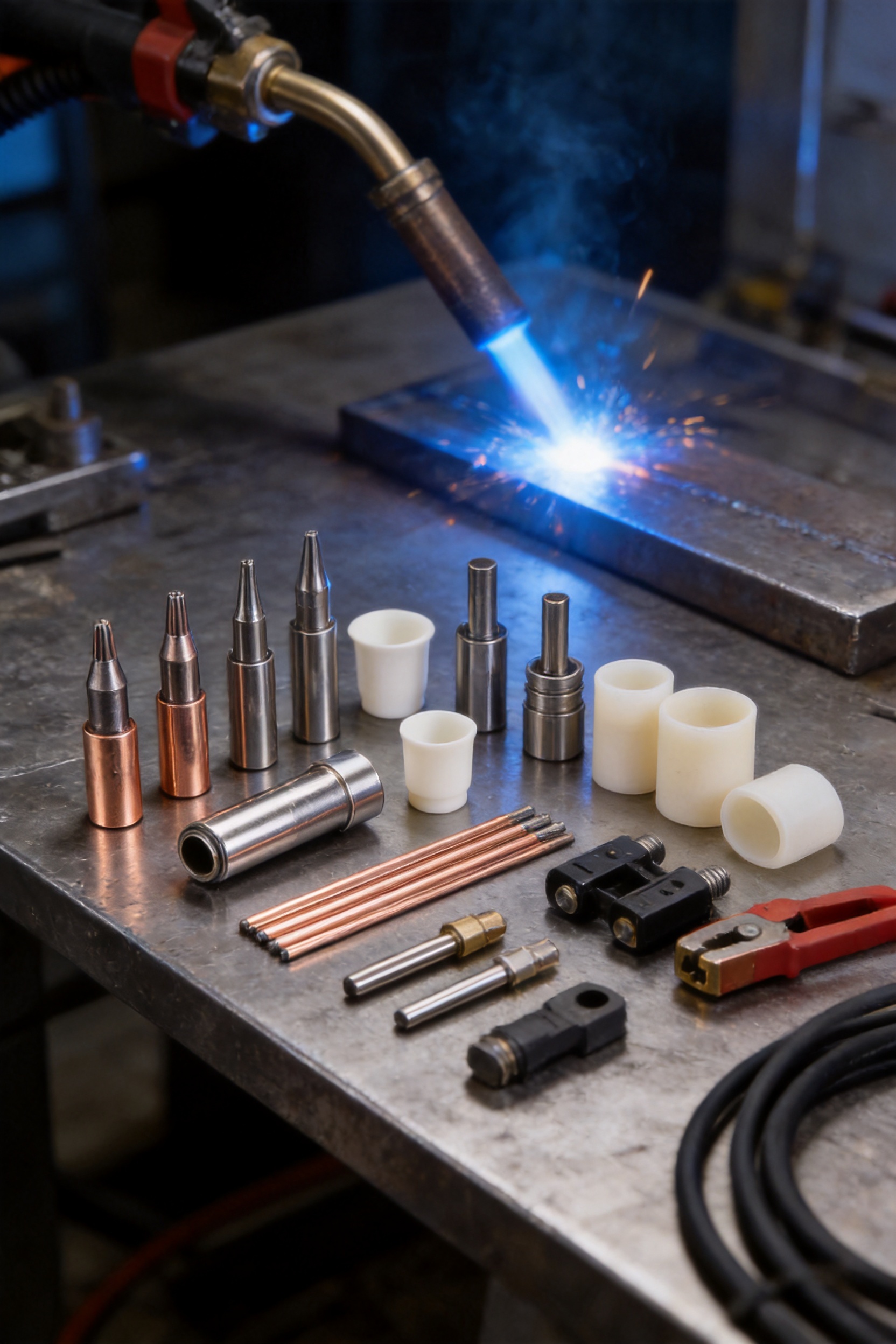
Welding accessories are exposed to intense conditions. Heat, sparks, molten spatter, abrasive dust, repeated bending, impact, and electrical load are common in workshops and construction sites. High-quality parts are designed to withstand these conditions longer than ordinary low-cost alternatives.
Durability begins with material choice. Conductive parts must balance electrical performance with mechanical strength. Heat-facing components must resist deformation and oxidation. Insulators must maintain safety performance even after repeated exposure to elevated temperatures. Springs, clamps, and fasteners must retain tension and shape after repeated use.
Machining and assembly also determine durability. Sharp edges, poor thread quality, inaccurate mating surfaces, and loose assembly can cause rapid failure. Precision processing reduces stress concentration and ensures better fit. In accessories such as connectors and holders, secure assembly improves both safety and service life.
For plasma cutting consumables, durability is closely related to cut consistency. If a nozzle or electrode wears unevenly, the plasma arc can become distorted, causing wider kerf, rough cut edges, and slower cutting speed. Better consumables support cleaner cutting and longer operating intervals between replacements.
Longer accessory life does not only mean fewer purchases. It also means less machine interruption, lower labor waste, fewer rejected parts, and more predictable production. For professional users, this operational stability can be more valuable than the initial price difference between premium and ordinary accessories.
A strong accessory program must support the broad range of welding and cutting processes used in modern industry. The product category described here is associated with welding accessories, but the company’s wider product portfolio includes MIG/MAG or GMAW machines, TIG or argon gas-shielded arc welding machines, IGBT inverter MMA or stick welding machines, submerged arc welding machines, air plasma arc cutting machines, resistance spot welding machines, robot welding systems, laser welding machines, handheld laser welding systems, laser cleaning machines, plastic welding products, and other workshop equipment.
This diversity is important because many fabrication businesses use more than one process. A workshop may use MMA welding for outdoor repair, MIG/MAG welding for production fabrication, TIG welding for stainless steel or precision joints, plasma cutting for material preparation, and spot welding for sheet metal assembly. Reliable accessories allow each process to operate efficiently.
For distributors, broad compatibility also simplifies sourcing. Instead of purchasing unrelated accessories from many suppliers, they can work with a manufacturer that understands multiple process families. This improves supply efficiency and supports more consistent quality standards across product lines.
Compatibility is not limited to physical fit. It also includes performance compatibility with current levels, duty cycles, operating environments, and operator expectations. A part that fits a torch but cannot handle the heat or electrical load is not truly compatible. Therefore, accessory selection should consider the full welding system.
Zhejiang Kende Mechanical & Electrical Co., Ltd. operates from Taizhou City, Zhejiang Province, China, with a production base covering approximately 120,000 square meters and a workforce of about 600 employees. The company exports a large volume of equipment annually and has an annual production capacity of about 2 million units. This scale supports stable supply, standardized production, and continuous improvement.
The company’s manufacturing strength is especially relevant for welding accessories because accessory quality depends on process control. A manufacturer that understands welding machines, power electronics, machine assembly, and real application requirements is better positioned to produce accessories that match actual equipment performance.
The company applies modern management and production systems, including office automation, Toyota Production System management principles, ERP K3, and MES management systems. These systems support production planning, material tracking, quality control, and efficiency improvement. For accessory manufacturing, this means better batch consistency, more accurate order management, and improved traceability.
Advanced manufacturing technologies are also used, including automatic patching, plug-in and welding systems, robot processing, laser cutting, and other modern production methods. While these technologies are often associated with machine manufacturing, they also support accessory quality by improving precision, repeatability, and process reliability throughout the production chain.
Robotic processing can reduce manual variation. Laser cutting can improve dimensional accuracy for suitable components. Automated assembly and testing systems improve consistency. MES management allows production data to be monitored and analyzed. Together, these methods support a more reliable product supply than traditional workshop-style production.
Product quality improves when manufacturing is supported by strong research and development. Zhejiang Kende Mechanical & Electrical Co., Ltd. has a Zhejiang Provincial R&D Center, an Enterprise Technology Center, and an Intelligent Welding Technology Research Institute. The company has a professional R&D team and has obtained invention patents, utility model patents, appearance patents, and software copyrights.
This R&D foundation helps the company understand changes in welding technology and user expectations. As welding machines become more efficient, compact, digitally controlled, and application-specific, accessories must also evolve. Modern inverter machines, synergic MIG systems, TIG machines, plasma cutters, robot welding systems, and laser welding equipment require accessories that support stable operation and user-friendly maintenance.
Innovation in accessories may involve improved materials, better ergonomics, easier replacement, enhanced connection design, improved heat dissipation, or compatibility with new torch and machine designs. Even small improvements can have a significant impact on daily workshop performance.
The company’s participation in national welding machine standardization work also strengthens its technical foundation. Being involved in the drafting, formulation, and revision of national standards gives the manufacturer insight into safety, performance, testing, and industry development. This background supports accessories that align with professional expectations rather than short-term market trends.
Although individual accessories may not always carry the same certification requirements as complete welding machines, they benefit from being produced within a quality culture shaped by international certification experience. Zhejiang Kende Mechanical & Electrical Co., Ltd. holds various international product certificates, including GS, CE, EMC, ERP, US ETL, UKCA, and China CCC for relevant products. This certification background reflects familiarity with international requirements and testing disciplines.
A strong quality system helps ensure that materials, dimensions, assembly, finish, and performance are controlled consistently. For welding accessories, quality assurance may include incoming material inspection, dimensional checks, conductivity assessment, fitting tests, heat-resistance evaluation, appearance inspection, and packaging verification.
Quality control is especially important for export markets. Different countries and regions may have different user habits, machine preferences, safety expectations, and climate conditions. Accessories must arrive in good condition, fit correctly, and perform reliably after storage and transportation.
Consistent packaging is also part of product quality. Small parts can be damaged, mixed, or contaminated if packaging is poor. Clear identification and proper packaging help distributors manage inventory and help end users select the correct replacement part quickly.
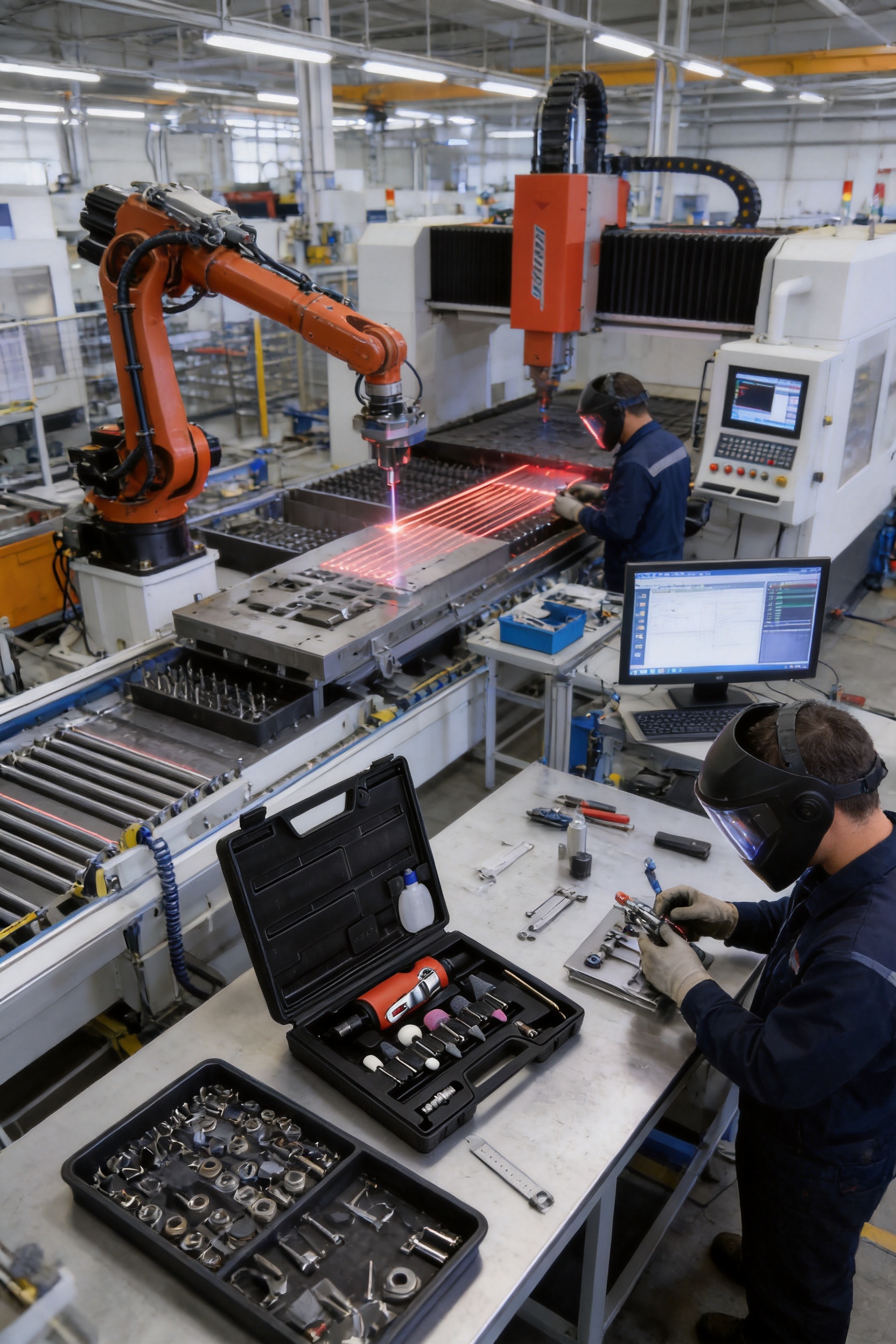
Welding accessories are used in a wide range of industries and working environments. In metal fabrication shops, they support daily production of frames, brackets, equipment housings, structural components, and machinery parts. In maintenance departments, they help repair worn or damaged equipment. In construction, they support installation and field repair. In automotive, agriculture, ship repair, and household workshops, accessories keep welding and cutting equipment ready for practical tasks.
MIG/MAG accessories are common in fabrication environments where speed and productivity are important. Contact tips, nozzles, diffusers, liners, and torch parts must support continuous wire feeding and gas shielding. Their quality affects productivity directly.
TIG accessories are important where precision and clean weld appearance are required. Stainless steel, aluminum, thin sheet, pipe, and high-quality repair work often depend on stable TIG torch components. A good ceramic cup, collet, and tungsten holder can help an experienced welder achieve better control.
MMA or stick welding accessories are valued for portability and ruggedness. Electrode holders, cable connectors, and ground clamps must withstand outdoor use, frequent movement, and tough handling. A reliable holder helps maintain arc control while improving operator safety.
Plasma cutting accessories are essential for clean, efficient cutting. Electrodes and nozzles are consumables, but their quality strongly influences cutting speed, edge quality, and consumable cost per meter of cut. Reliable plasma parts reduce rework and improve material preparation.
Accessories are also relevant to automated and robotic welding systems. In automated production, part consistency is even more important because the system repeats the same operation many times. A small variation in a consumable can affect many workpieces before the problem is noticed. Therefore, stable accessory quality is essential for automation.
Many buyers compare welding accessories mainly by purchase price, but the true cost includes service life, downtime, weld quality, labor time, and machine protection. A low-cost part that fails quickly or causes defects can become more expensive than a better part with a higher initial price.
For example, a poor contact tip may lead to frequent burnback. Each burnback requires the operator to stop welding, trim wire, replace or clean the tip, and reset the torch. If this happens repeatedly, the lost time may cost more than the part itself. Similarly, a poor ground clamp can cause unstable current and overheating, leading to troubleshooting and possible cable damage.
Better accessories reduce hidden costs by supporting stable operation. They help operators maintain correct settings, reduce the chance of defects, and protect the machine from unnecessary stress. In production environments, even small improvements in uptime can produce significant savings over time.
Inventory efficiency is another cost factor. Reliable accessories with consistent quality allow businesses to forecast consumption more accurately. This reduces emergency purchases and helps distributors maintain appropriate stock levels.
Welding accessory buyers are not only end users. Distributors, wholesalers, and OEM partners also need products that are reliable, marketable, and supported by stable production capacity. A manufacturer with broad welding equipment expertise can provide accessories that fit market needs and support long-term cooperation.
For distributors, the advantage lies in product range, supply stability, and brand credibility. A supplier with large-scale production, export experience, and international certification knowledge can support multiple markets with more confidence. Accessories can be offered alongside welding machines, plasma cutters, chargers, heaters, and related equipment, creating a more complete product portfolio.
For OEM partners, manufacturing capability and R&D support are important. Custom development may involve packaging, specifications, fitting requirements, material adjustments, or application-specific accessory sets. A company experienced in developing products for different regions and customers is better prepared to support such requirements.
Because the company has experience exporting nearly 1.5 million units annually across its product range, it understands the importance of logistics, documentation, product consistency, and market adaptation. These capabilities benefit accessory customers as well.
Good welding accessories should be easy to install, easy to identify, and dependable in use. User experience begins with correct fit. A replacement part should install smoothly without forcing, excessive adjustment, or modification. Threads should engage cleanly, connectors should seat firmly, and consumables should align correctly.
Ergonomics also matter. Electrode holders, clamps, torch components, and connectors are handled frequently. Comfortable grip, secure clamping force, proper insulation, and practical shape can reduce fatigue and improve safety. In professional welding, operator comfort contributes to consistent work quality.
Maintenance convenience is another design principle. Consumables should be replaceable with minimal downtime. Parts that are difficult to remove after heat exposure can slow production. Proper material and thread design help avoid seizure, deformation, and excessive wear.
Clear product identification helps prevent mistakes. Similar-looking parts may have different sizes, current ratings, or process applications. Proper packaging and labeling support correct selection by distributors and end users.
Welding involves electric current, heat, ultraviolet radiation, fumes, sparks, and moving consumables. Accessories contribute to safety by maintaining electrical insulation, secure connections, proper current flow, and controlled operation. Poor accessories can create risks such as overheating, electrical contact, gas leakage, torch damage, or unstable arc behavior.
Electrode holders and connectors should be designed to reduce accidental contact with live conductors. Ground clamps should maintain secure contact to avoid arcing at unintended points. Insulators should resist heat and physical damage. Gas accessories should support leak-free operation. Plasma cutting parts should be installed correctly to avoid abnormal arc behavior.
Safety also depends on compatibility. Using an accessory beyond its rated capacity can lead to overheating or failure. Users should select parts appropriate for the welding current, duty cycle, torch model, wire size, electrode size, gas type, and application environment.
High-quality manufacturing helps reduce safety risks by producing parts that meet intended tolerances and material performance. However, safe use also requires operator training, regular inspection, correct installation, and proper personal protective equipment.
Modern manufacturing strength is not only about equipment; it is also about management systems. The use of ERP and MES systems helps coordinate materials, production schedules, work orders, inspection data, and delivery. For customers, this can translate into better on-time supply and more consistent product quality.
The Toyota Production System approach emphasizes efficiency, waste reduction, standard work, and continuous improvement. When applied to manufacturing, these principles help reduce variation and improve process discipline. In accessory production, this can mean fewer defects, cleaner assembly, better inventory control, and faster response to quality feedback.
Office automation supports communication and management efficiency. When combined with production data systems, it helps align departments such as purchasing, production, quality control, research and development, sales, and export operations.
Advanced processing technologies also support consistency. Automatic patching and plug-in systems are relevant to electrical product manufacturing, while robot processing and laser cutting improve precision and repeatability in suitable production stages. These capabilities reflect the company’s broader commitment to modern industrial production.
Some suppliers treat welding accessories as simple commodity items. However, real performance depends on understanding the machine, the process, and the operator. A manufacturer that produces welding machines and related equipment has direct knowledge of how accessories behave during operation.
For example, contact tip performance cannot be fully understood without considering wire feed speed, welding current, torch angle, heat buildup, and wire material. TIG torch parts must be understood in relation to shielding gas flow, tungsten size, current type, and weld position. Plasma consumables must match arc starting method, air quality, cutting current, and torch design.
Because Zhejiang Kende Mechanical & Electrical Co., Ltd. manufactures many welding and cutting product categories, its accessory development can be informed by complete-system thinking. This is a competitive advantage over suppliers that only produce generic parts without deep welding equipment experience.
Complete-system thinking helps reduce mismatch problems. Accessories can be designed, tested, and improved with awareness of real machine performance. This supports better compatibility and helps customers obtain more dependable results.
The company’s product range serves both industrial and domestic users. This dual market experience is valuable because accessory needs differ by user type. Industrial users often prioritize durability, consistency, and high-duty-cycle performance. Domestic or light workshop users may prioritize easy installation, affordability, and broad compatibility.
Good accessory design balances these needs by offering dependable performance at practical cost. Professional users appreciate long service life and stable output, while smaller workshops appreciate parts that are easy to replace and widely applicable.
In many regions, welding equipment is used in diverse conditions, from clean production shops to outdoor repair sites. Accessories must be rugged enough for variable environments. Moisture, dust, temperature changes, rough handling, and inconsistent power conditions can all affect welding performance. Reliable accessories help maintain stability despite these challenges.
Weld quality is influenced by machine settings, operator skill, base material, filler material, shielding gas, joint design, and accessory condition. Accessories contribute directly to several quality factors, including arc consistency, shielding effectiveness, heat control, and feeding smoothness.
In MIG/MAG welding, a worn contact tip can cause the wire to wander, creating inconsistent arc length. A blocked nozzle can reduce shielding gas coverage. A dirty or damaged liner can cause feeding interruptions. Each issue can result in spatter, porosity, lack of fusion, or irregular bead shape.
In TIG welding, poor tungsten holding can reduce arc precision. A damaged ceramic cup can disturb gas coverage. Improper accessory selection can make it difficult to weld thin materials or maintain clean weld appearance.
In plasma cutting, worn consumables reduce cut quality and may require grinding or rework. A good accessory program helps maintain cleaner starts, straighter cuts, and more consistent edge finish.
By selecting better parts and replacing them at the correct interval, users can improve weld appearance, reduce defects, and improve overall production quality.
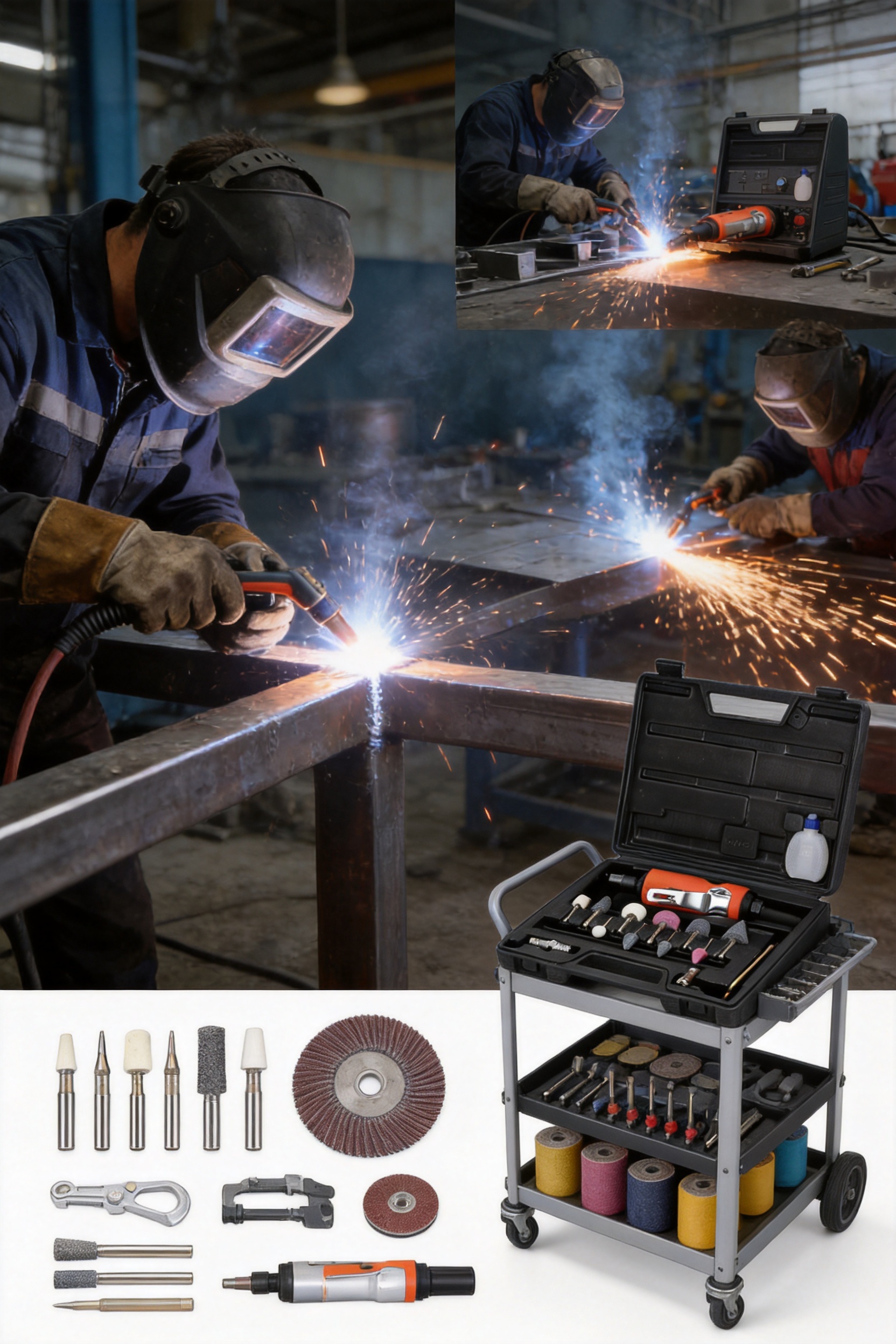
Even high-quality accessories require proper care. Regular inspection and cleaning can extend service life and prevent unexpected failures. Operators should check contact tips for wear, nozzles for spatter buildup, liners for feeding resistance, clamps for secure grip, connectors for heat marks, and cables for damage.
For MIG/MAG torches, nozzles should be cleaned regularly to maintain gas flow. Anti-spatter practices can help reduce buildup, but mechanical damage should be avoided. Contact tips should be matched to wire size and replaced when feeding or arc stability declines.
For TIG torches, ceramic cups should be inspected for cracks, and collets should be replaced if they no longer hold the tungsten securely. Tungsten electrodes should be prepared correctly, and gas flow should be checked to avoid contamination.
For plasma cutting systems, consumables should be replaced before severe wear causes poor cut quality or torch damage. Air quality is also important; moisture or oil in compressed air can shorten consumable life.
For MMA welding, electrode holders and ground clamps should be checked for firm contact and insulation condition. Loose or overheated connectors should be repaired or replaced promptly.
Reliable accessories can also support environmental efficiency. Longer-lasting parts reduce waste. Stable welding reduces scrap and rework. Efficient current transfer can reduce unnecessary energy loss. Clean cuts and accurate welds help conserve material and labor.
Manufacturing efficiency also contributes to responsible production. The use of modern management systems, process control, and continuous improvement can reduce waste during production. Better quality control reduces defective products and unnecessary returns.
In welding operations, reduced rework is especially important. Reworking defective welds consumes additional electricity, filler wire, shielding gas, abrasives, and labor. Accessories that help prevent defects therefore contribute indirectly to more efficient resource use.
The welding accessory market includes many low-cost alternatives, but not all offer reliable performance. The competitive strength of the parts discussed in this article comes from the combination of manufacturing scale, welding equipment expertise, R&D capability, quality culture, and advanced production management.
Compared with ordinary suppliers, Zhejiang Kende Mechanical & Electrical Co., Ltd. has the advantage of being an established manufacturer and exporter of welding machines, chargers, and heaters. Its experience with complete welding systems gives it a deeper understanding of accessory requirements. This helps ensure that parts are designed for real use rather than only for appearance or basic fit.
The company’s production capacity supports stable supply for larger orders. Its international certification experience supports global market expectations. Its R&D centers and patent portfolio demonstrate technical commitment. Its management systems support consistent production and traceable quality.
These advantages matter to customers because accessories are frequently reordered. A supplier must be able to deliver not only one acceptable batch, but repeated batches with consistent quality. Long-term consistency is a major competitive advantage in the accessory market.
Choosing a welding accessory supplier should involve more than price comparison. Buyers should evaluate product range, manufacturing capability, quality control, technical understanding, export experience, packaging, and after-sales communication. A good supplier can help reduce sourcing risk and support business growth.
Key questions include whether the supplier understands the welding process, whether the parts are produced with consistent tolerances, whether materials are suitable for the application, whether packaging protects the product, and whether the supplier can provide stable delivery.
For distributors, it is also important to consider whether the supplier can support multiple product categories. A broad welding and cutting product portfolio can help distributors build a complete offering and reduce sourcing complexity.
For industrial users, technical reliability and availability are crucial. Production cannot depend on parts that are difficult to replace or inconsistent in performance. A strong manufacturer can provide continuity and support.
In daily use, high-quality welding accessories provide practical benefits that operators can feel immediately. Wire feeds more smoothly. Torches assemble more easily. Connections remain tighter. Gas shielding is more stable. Consumables last longer. The arc feels more predictable. Troubleshooting becomes simpler.
These benefits improve morale as well as productivity. Welders prefer equipment that responds consistently. When accessories perform well, operators can focus on technique, joint fit-up, travel speed, and weld quality rather than fighting equipment problems.
Supervisors benefit from fewer interruptions and more predictable output. Purchasing teams benefit from reduced emergency orders. Distributors benefit from fewer complaints. End customers benefit from better finished products.
The welding industry continues to change as digital control, automation, lightweight materials, laser processes, and intelligent manufacturing become more common. Accessories will also continue to evolve. Future parts may place greater emphasis on improved heat resistance, longer life, easier installation, sensor compatibility, enhanced ergonomics, and process-specific optimization.
As robotic welding and automated systems expand, consumable consistency will become even more important. Automated production requires parts that behave the same way from one replacement to the next. Variation that might be manageable in manual welding can cause major issues in automated systems.
Laser welding and laser cleaning are also growing in many markets. While these processes use different accessory systems than conventional arc welding, the same principles apply: precision, safety, durability, and compatibility are essential.
Manufacturers with broad technical platforms and strong R&D capability are well positioned to support this future. Zhejiang Kende Mechanical & Electrical Co., Ltd. has already developed capabilities across arc welding, plasma cutting, robotic welding, laser welding, and related equipment, giving it a strong base for accessory innovation.
A high-quality welding machine needs reliable accessories to transfer current, guide wire, control gas, hold electrodes, and complete the welding circuit. Poor accessories can limit the machine’s performance and cause unstable arcs, overheating, gas shielding problems, and frequent downtime.
A good contact tip has accurate internal diameter, stable conductivity, suitable material hardness, clean machining, and consistent heat performance. These qualities help maintain smooth wire feeding and stable current transfer, reducing burnback and spatter.
Accessories affect weld quality by influencing arc stability, gas shielding, current flow, and consumable alignment. Worn or poorly made parts can cause porosity, spatter, irregular bead shape, feeding problems, and inconsistent penetration.
In many cases, yes. Premium accessories may cost more initially, but they can reduce downtime, last longer, improve weld consistency, and lower rework rates. The total operating cost is often lower than with cheaper parts that fail quickly.
Users should check contact tips for wear, nozzles for spatter buildup, liners for feeding resistance, clamps for grip strength, connectors for overheating, TIG cups for cracks, collets for secure holding, and plasma consumables for erosion.
A manufacturer with welding machine experience understands how accessories interact with power sources, torches, cables, shielding gas, wire feeding systems, and real welding conditions. This helps produce parts that are more compatible and reliable in practical use.
Yes. A supplier with a broad product portfolio can support accessories for MIG/MAG, TIG, MMA, plasma cutting, spot welding, submerged arc welding, robotic welding, and other processes. This is useful for distributors and workshops that operate multiple systems.
Systems such as ERP, MES, automated processing, robotic manufacturing, and controlled quality inspection improve traceability, consistency, production planning, and defect prevention. These systems help ensure that repeated batches meet stable quality expectations.
Welding parts and accessories are essential to reliable fabrication performance. They may be small compared with welding machines, but they influence arc stability, safety, productivity, weld quality, operating cost, and equipment life. High-quality accessories provide measurable advantages through better fit, stronger materials, improved conductivity, heat resistance, accurate gas control, and longer service life.
The welding accessories discussed here are supported by the broader manufacturing strength of Zhejiang Kende Mechanical & Electrical Co., Ltd., a company with extensive experience in welding machines, cutting equipment, chargers, heaters, and related technologies. Its large production base, R&D centers, international certification experience, advanced production systems, and participation in welding standardization provide a strong foundation for consistent product quality.
For professional welders, distributors, industrial users, and workshop owners, choosing reliable accessories is a practical investment. Better parts reduce downtime, protect equipment, improve weld quality, and support more efficient production. In a competitive market where many parts look similar, the real difference is found in engineering, manufacturing control, and long-term consistency.
American Welding Society. Welding Handbook: Welding Science and Technology.
International Organization for Standardization. Quality Management Systems and Welding-Related Manufacturing Guidelines.
National Welding Machine Standardization Committee. Technical Standards for Welding Equipment and Safety Performance.
Manufacturing Engineering Reference Manual. Principles of Process Control, Precision Machining, and Industrial Quality Assurance.
Industrial Arc Welding Practice Guide. Consumable Selection, Torch Maintenance, and Weld Quality Control.
Recommended Products

Contact Us
No.2299, Luqiao Section, Shugang Avenue, Luqiao District, Taizhou, 318057 Zhejiang, PR China.
+86-576-82431568
 Privacy
China Welding Machine Factory
 English
 中文简体
中文简体
 русский
 Español
 عربى
عربى
 Français
 Português
 Deutsch
 Український