Email: [email protected]
Email: [email protected]

Blog
 2026.09.10
 Blog
Modern fabrication workshops increasingly require equipment that can perform more than one welding or cutting task. A machine may need to join carbon steel in the morning, repair stainless steel components in the afternoon, gouge defective welds before finishing, and cut metal plate before the end of the working day. Traditionally, each of these operations required a separate power source, separate control system, and separate set of accessories. That approach increased capital expenditure, occupied valuable floor space, complicated operator training, and made maintenance more demanding.
The NBC-500KS Digital Control IGBT Inverter Air Plasma Arc Cutting Machine is designed to address these challenges through a multi-process platform. It combines MIG welding, MAG welding, no-gas flux-cored wire welding, MMA or stick welding, lift TIG welding, air carbon arc cutting and gouging, and air plasma arc cutting in one industrial machine. Its digital microprocessor control unit, IGBT inverter technology, LCD interface, touch-button operation, and broad current ranges make it suitable for workshops that need flexibility without sacrificing process control.
The machine is rated for a three-phase 380V input and offers a real current range extending to 500 amperes in MIG operation. It is therefore positioned as a powerful industrial solution rather than a light domestic welder. At the same time, inverter construction allows the equipment to remain more compact, lighter, and easier to relocate than many traditional transformer-based machines with similar output capability.
This article examines the product’s operating concept, process capabilities, technical specifications, practical advantages, manufacturing background, quality systems, and suitable applications. It also explains how the equipment compares with conventional single-process machines and why digital multi-process technology can provide measurable operational benefits.

NBC-500KS Digital Control IGBT Inverter Air Plasma Arc Cutting machines
The NBC-500KS is built around a digitally controlled IGBT inverter power source. IGBT, or insulated-gate bipolar transistor, technology allows the machine to convert and regulate electrical power at high switching frequencies. Compared with older low-frequency transformer designs, an inverter can provide more responsive control of welding current and voltage while reducing the size and weight of the main power components.
The digital control unit acts as the operating center of the machine. It monitors and regulates key welding or cutting parameters, supports process selection, and helps maintain a stable arc. Instead of relying only on mechanical switches and analog adjustment circuits, the machine uses microprocessor-based control to coordinate the power source with the selected process.
An LCD screen displays operating information, while touch-button controls provide access to process selection and parameter adjustment. This interface is particularly valuable in a machine with several operating modes. Operators can select the required process without changing to a separate power source, reducing setup time and limiting the possibility of connecting the wrong equipment for a job.
The design supports both manual and more parameter-guided operation. In MIG, MAG, and no-gas flux-cored wire modes, a single-knob or synergic control approach can simplify adjustments. This is useful when operators must change wire diameter, welding material, current, or voltage during production. Experienced welders can still refine parameters, while less experienced users can benefit from a more structured setup procedure.
The machine is also intended to accommodate external compressed air for plasma cutting, while the supplied product information indicates that cutting can be performed with or without an external compressed-air system. Users should confirm the exact air arrangement, torch configuration, and required consumables before purchase, because cutting thickness, cut quality, and operating cost depend substantially on the available air supply.
The NBC-500KS supports seven principal processes or process groups:
1. MIG welding with shielding gas.
2. MAG welding with active shielding gas.
3. No-gas flux-cored wire welding.
4. MMA or stick welding.
5. Lift TIG welding.
6. Air carbon arc cutting and gouging, also known as CAC-A.
7. Air plasma arc cutting.
This combination gives the product a broader operating range than a conventional MIG-only or MMA-only power source. It can be used for fabrication, repair, material preparation, removal of defective welds, and cutting operations without requiring separate primary machines for each activity.
The following table summarizes the principal technical information supplied for the NBC-500KS. Values should be confirmed against the final technical datasheet, nameplate, local electrical requirements, and the configuration supplied for a particular order.
| Item | Specification |
|---|---|
| Factory model | NBC-500KS |
| Machine description | MIG, plasma cutting, lift TIG, and MMA multi-process machine |
| Rated input voltage | 380V, three-phase configuration as specified by the manufacturer |
| Input capacity | 30 kVA |
| MMA current range | 20–460A |
| TIG current range | 20–460A |
| MIG current range | 40–500A |
| Plasma cutting current range | 30–100A |
| MMA welding voltage range | 20.8–38.4V |
| TIG welding voltage range | 10.8–28.4V |
| MIG welding voltage range | 16–39V |
| Plasma cutting voltage range | 92–120V |
| MMA electrode diameter range | 1.6–5.0mm |
| TIG electrode diameter range | 1.0–5.0mm |
| MIG wire diameter range | 0.8–1.6mm |
| Plasma cutting specification | Listed as 0.1–35 in the supplied data; final interpretation should be confirmed with the manufacturer |
| Rated duty-cycle information | 0.6 as listed in the supplied specification |
| Insulation class | H |
| Case protection degree | IP21S |
| Control system | Microprocessor digital control with LCD display and touch-button operation |
The specification table demonstrates that the machine is intended for a wide range of metalworking requirements. Its MIG current range reaches 500A, while the MMA and TIG ranges extend to 460A. The 30–100A plasma cutting range provides a high-output cutting platform for appropriate conductive metals, subject to the torch, air pressure, consumables, material type, and final operating conditions.
The stated electrode and wire ranges also support different job sizes. Small MMA electrodes can be used for controlled repair work, while larger electrodes are available for heavier fabrication. MIG wire sizes from 0.8mm to 1.6mm cover common thin- and medium-section fabrication requirements and extend into higher-deposition industrial work.
The product information lists a duty-cycle value of 0.6. In practical purchasing decisions, users should verify whether this represents a 60 percent duty cycle at a stated ambient temperature and output current. Duty cycle is not meaningful without its test conditions. A machine may deliver its maximum current for a shorter period than a lower current setting, so production planning should use the manufacturer’s complete duty-cycle curve rather than relying on one figure alone.
One of the principal advantages of the NBC-500KS is its digital control architecture. Welding and cutting performance depends on the ability to regulate current, voltage, wire feed behavior, arc initiation, and protection functions quickly and consistently. A microprocessor can process feedback from the power circuit and adjust output behavior in a controlled manner.
Stable arc behavior can improve several aspects of production. It may reduce unnecessary spatter, support more consistent bead appearance, improve operator control, and reduce the need for post-weld cleaning. In plasma cutting, controlled output can contribute to a more uniform arc and more predictable material separation. The final result still depends on correct air pressure, torch stand-off, travel speed, consumable condition, material preparation, and operator technique.
Digital control also allows the manufacturer to integrate multiple processes into one platform. The same fundamental power source can be configured through software and electrical control logic for MIG, MAG, flux-cored, MMA, TIG, carbon arc gouging, and plasma cutting. This is more practical than building each machine around a completely independent analog control system.
Touch-button operation is another useful feature. Physical controls can be easier to understand in industrial environments where operators wear gloves or work under time pressure. The LCD screen provides a central location for viewing selected settings. A clear interface can reduce setup mistakes, especially when a machine is used by several shifts or in workshops where operators perform different jobs each day.
In MIG, MAG, and no-gas flux-cored wire welding, the relationship between welding current, voltage, wire feed, material thickness, wire diameter, and shielding conditions can be complex. A synergic control system is intended to simplify this relationship by coordinating related parameters around a selected operating point.
For production work, this can shorten setup time and help operators achieve repeatable results. Instead of making large independent changes to several controls, the operator can adjust the main parameter and then make smaller corrections where necessary. This is particularly helpful for routine fabrication, where the same material and wire combinations are used repeatedly.
Synergic control does not replace process knowledge. Operators still need to choose the correct shielding gas, polarity, wire type, contact-tip size, torch liner, travel speed, and welding position. However, it provides a more accessible starting point and can reduce the learning curve compared with a fully manual analog system.
MIG and MAG welding use a continuously fed wire electrode and an externally supplied shielding gas. MIG generally uses an inert gas or gas mixture, while MAG uses active components such as carbon dioxide or oxygen in the shielding mixture. These processes are widely used because they offer high productivity, continuous welding, and relatively easy integration into fabrication workflows.
The NBC-500KS supports a MIG current range of 40–500A and a listed welding voltage range of 16–39V. This provides room for lower-current work and higher-deposition operations. The practical operating range will depend on wire diameter, material thickness, joint design, welding position, gas selection, and the required bead profile.
For structural components and general fabrication, MIG or MAG operation can reduce the number of electrode changes compared with stick welding. Continuous wire feed also makes long welds more efficient. A multi-process machine gives workshops the option to use MIG or MAG for production runs while retaining MMA or TIG for specialized work.
No-gas flux-cored wire welding is valuable for outdoor work, maintenance, and applications where shielding gas cylinders are inconvenient. The flux inside the wire produces shielding as it burns, allowing welding in locations where wind or limited gas-handling facilities would make conventional MIG or MAG operation more difficult.
This process can improve mobility and reduce dependence on gas cylinders. It is also useful for repair teams that need to carry one machine and a spool of wire rather than a complete gas-shielding setup. As with any flux-cored process, operators must manage slag removal, wire selection, polarity, and ventilation correctly.
MMA welding uses a coated consumable electrode and is one of the most adaptable manual arc processes. It is suitable for repair, maintenance, construction, outdoor fabrication, and work on materials or surfaces that are not perfectly clean. Because it does not require a shielding-gas cylinder or wire feeder, MMA is often preferred for portable field work.
The NBC-500KS provides an MMA current range of 20–460A and supports electrodes from 1.6mm to 5.0mm according to the supplied specifications. This range covers light repair work and heavier welding applications. The correct electrode type, polarity, preheating procedure, and welding current must be selected for the base material and joint.
Lift TIG provides a controlled method for welding applications requiring a clean and precise arc. The operator initiates the arc by lightly touching and lifting the tungsten electrode rather than striking it in the same way as a stick electrode. This can reduce tungsten contamination compared with conventional scratch starting.
The listed TIG current range is 20–460A, and the electrode diameter range is 1.0–5.0mm. TIG operation is appropriate for work where bead appearance, heat control, and precision are important. It can be used on stainless steel, carbon steel, and other compatible conductive metals when the proper shielding gas and torch accessories are installed.
Because this is a lift-TIG function rather than a dedicated high-frequency TIG system, users should verify the exact starting method and available TIG controls before specifying the machine for applications requiring advanced TIG features such as high-frequency arc initiation, pulse control, or specialized AC operation.
Air carbon arc gouging uses an electric arc to melt metal while compressed air removes the molten material. It is used for weld removal, back-gouging, defect excavation, groove preparation, and heavy repair work. The inclusion of this function expands the machine beyond welding and cutting into essential preparation and corrective operations.
A workshop can therefore use one primary power source to remove a defective weld, prepare the joint, and complete the replacement weld. This can simplify equipment planning and reduce the movement of large components between work areas. Adequate compressed air, suitable carbon electrodes, protective equipment, and effective fume extraction are essential for safe gouging.
Plasma cutting uses a constricted electric arc and compressed air or another suitable gas to melt and remove conductive metal. It can cut carbon steel, stainless steel, aluminum, and other electrically conductive materials when the operating parameters and consumables are appropriate.
The NBC-500KS lists a plasma cutting current range of 30–100A. This high-current range is intended for industrial cutting requirements, although the actual cutting capacity must be confirmed for each material and thickness. Cut quality depends on amperage, travel speed, torch height, air quality, air pressure, electrode and nozzle condition, and the geometry of the workpiece.
Compared with mechanical cutting methods, plasma cutting can be faster for many shapes and can reduce the need for saw blades or abrasive wheels. It is particularly useful for irregular profiles, repair openings, plate preparation, and workshop fabrication. The machine’s multi-process arrangement allows the same unit to cut a component and then weld it without changing to a separate power source.
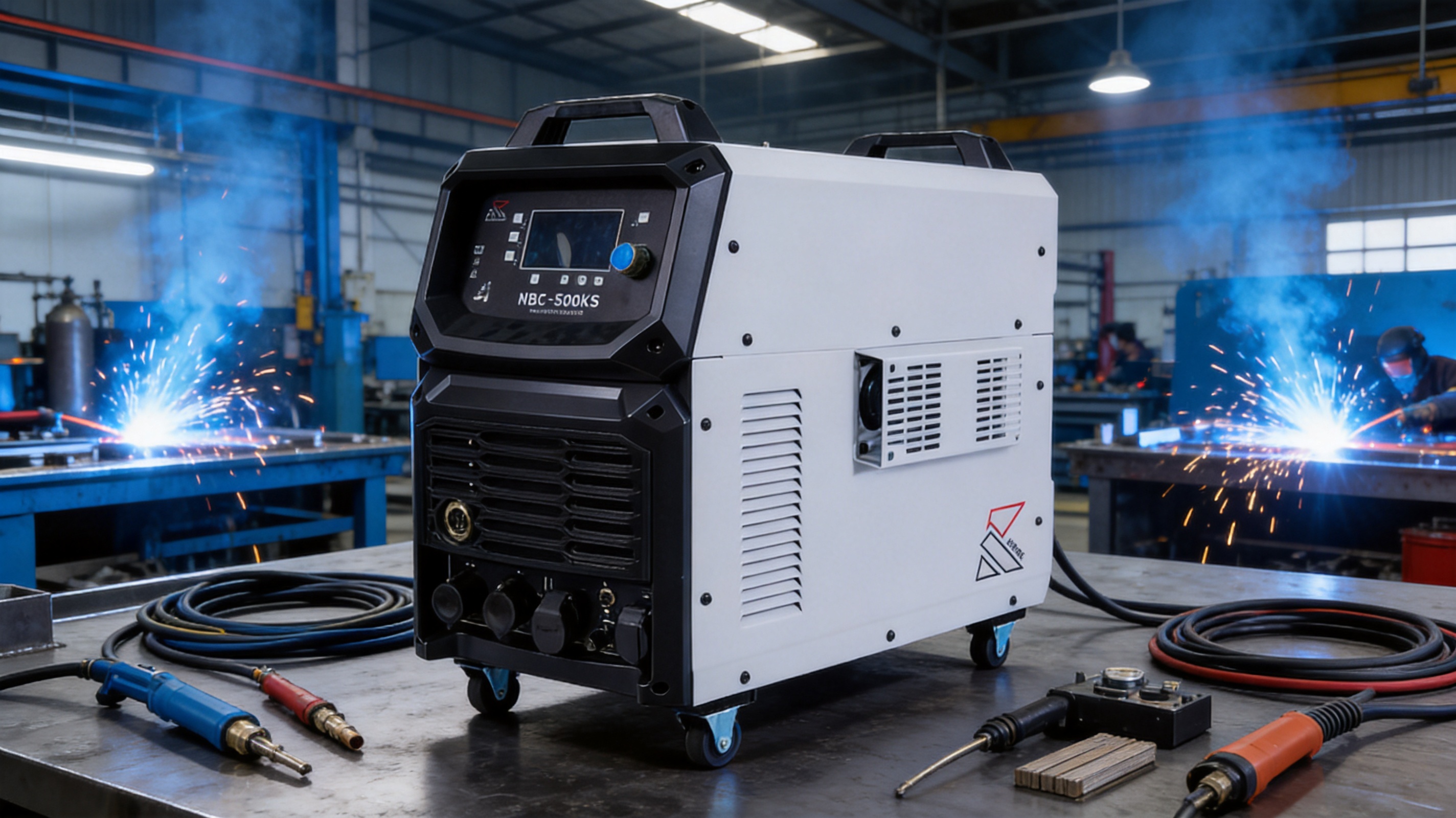
The most obvious advantage is consolidation. A workshop that needs MIG, MMA, TIG, carbon arc gouging, and plasma cutting would traditionally purchase several machines. The NBC-500KS combines these functions in one platform, potentially reducing the number of power sources, electrical connections, storage locations, and maintenance schedules.
Consolidation is particularly attractive for small and medium-sized fabrication businesses, maintenance departments, mobile repair teams, educational workshops, and contractors that must transport equipment between locations. A single multi-process machine may be easier to load, organize, and protect than several separate units.
Industrial floor space is expensive and often limited. Multiple welding machines can occupy substantial room even when they are not being used continuously. A multi-process power source allows more operations to be performed from one equipment position. This can support a cleaner workshop layout and make it easier to reorganize production areas.
Changing from one machine to another creates downtime. Operators must disconnect cables, move equipment, locate accessories, and confirm settings. With an integrated system, many process changes can be made through the control interface and accessory connection arrangement. This can be valuable in repair shops where job requirements change frequently.
Although each welding process still requires specific knowledge, a common digital interface can make equipment familiarization more efficient. Operators learn one primary control panel and one set of protection procedures rather than several unrelated systems. The LCD display and touch-button controls can make parameter selection more systematic.
IGBT inverter construction generally permits a smaller and lighter design than a traditional transformer-based power source with comparable current output. Portability is important for on-site repair, large structures, construction projects, and production lines where machines must be repositioned.
Portability does not mean that the machine is intended to be carried casually by one person in every configuration. The complete working system may include a wire feeder, torch, work cable, plasma torch, compressed-air equipment, gas cylinder, and accessories. A safe lifting and transport procedure should be established according to the final machine configuration.
The manufacturer describes the inverter system as energy-saving and high-efficiency. Inverter equipment can reduce losses associated with large low-frequency transformers and can provide more efficient control of delivered power. Actual energy consumption depends on output current, duty cycle, process, input supply, idle time, and the efficiency of connected accessories.
Energy efficiency can provide benefits beyond electricity cost. Lower losses may reduce heat generation inside the machine, support a more compact enclosure, and improve the practicality of high-output operation. Users should still provide suitable ventilation and keep air passages clean.
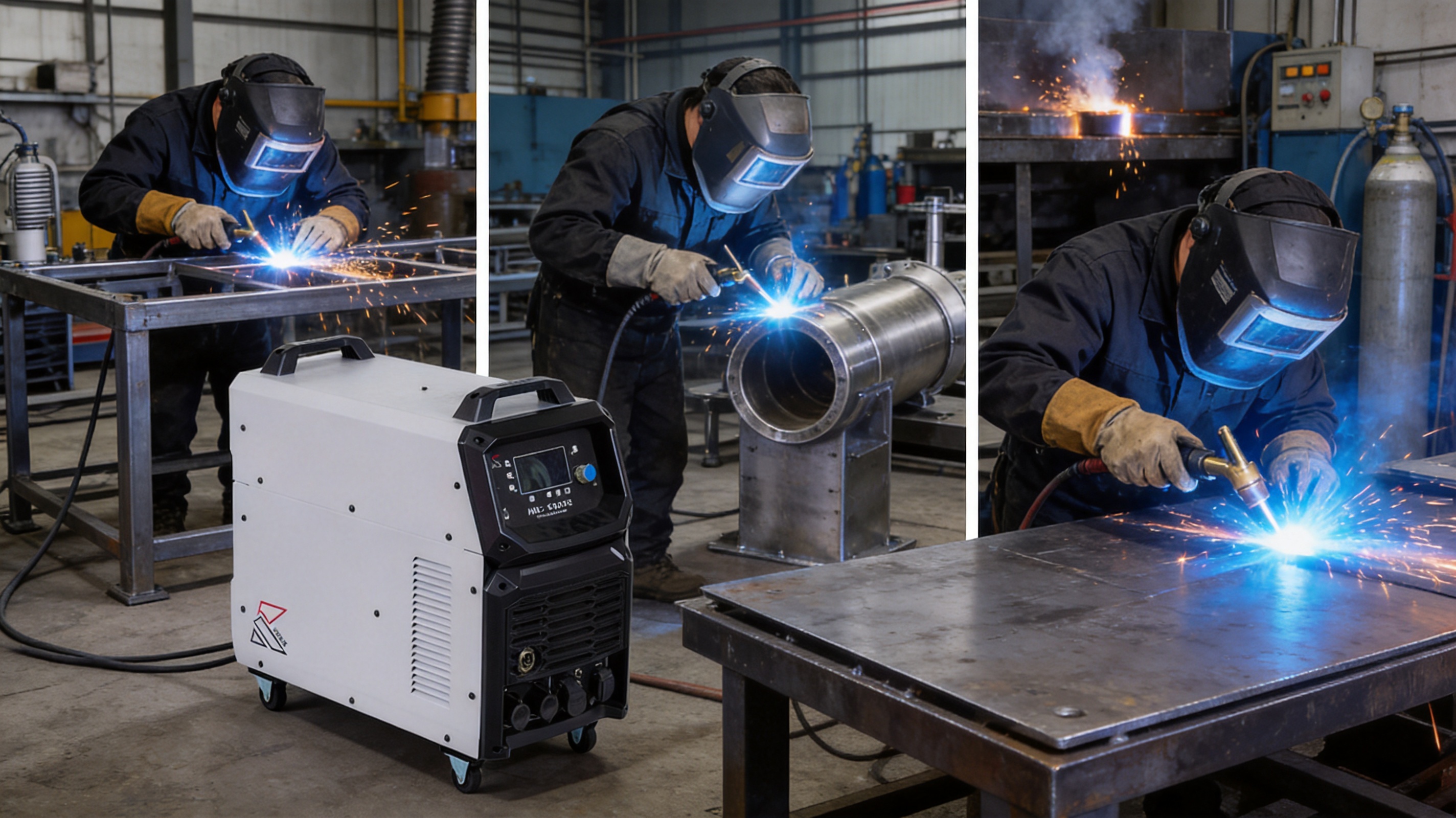
The product information states that the machine can weld or cut carbon steel, alloy steel, stainless steel, and other materials. The machine is therefore applicable to a wide range of metalworking activities, including general fabrication, equipment repair, agricultural machinery maintenance, structural component production, vehicle and trailer repair, plant maintenance, and metal preparation.
Fabrication shops can use MIG or MAG welding for regular production, MMA for outdoor or corrective work, TIG for precision joints, and plasma cutting for plate preparation. The same machine can support a project from initial cutting through final welding, reducing the need to coordinate multiple equipment stations.
Maintenance departments often encounter unpredictable materials, access limitations, and urgent repair requirements. The combination of MMA, flux-cored welding, TIG, gouging, and plasma cutting offers flexibility when the original job specification changes. Gouging can remove cracked or defective welds, while plasma cutting can create access openings or remove damaged sections.
Field-service teams may benefit from the choice between gas-shielded and no-gas welding. Flux-cored operation can be useful when transporting gas cylinders is impractical, while MMA remains a dependable option for outdoor work. The machine’s inverter format can also make transportation more manageable than a comparable conventional power source.
In industrial production, a multi-process machine can serve as a flexible backup unit, a repair station, or a dedicated work-cell power source. It may be especially valuable where product variety is high and production volumes do not justify separate equipment for every process.
For high-volume automated welding, users should distinguish between a flexible manual multi-process machine and a dedicated robotic welding power source. The NBC-500KS is described as a digitally controlled multi-process machine; automation compatibility, communication interfaces, and robot integration should be confirmed separately if required.
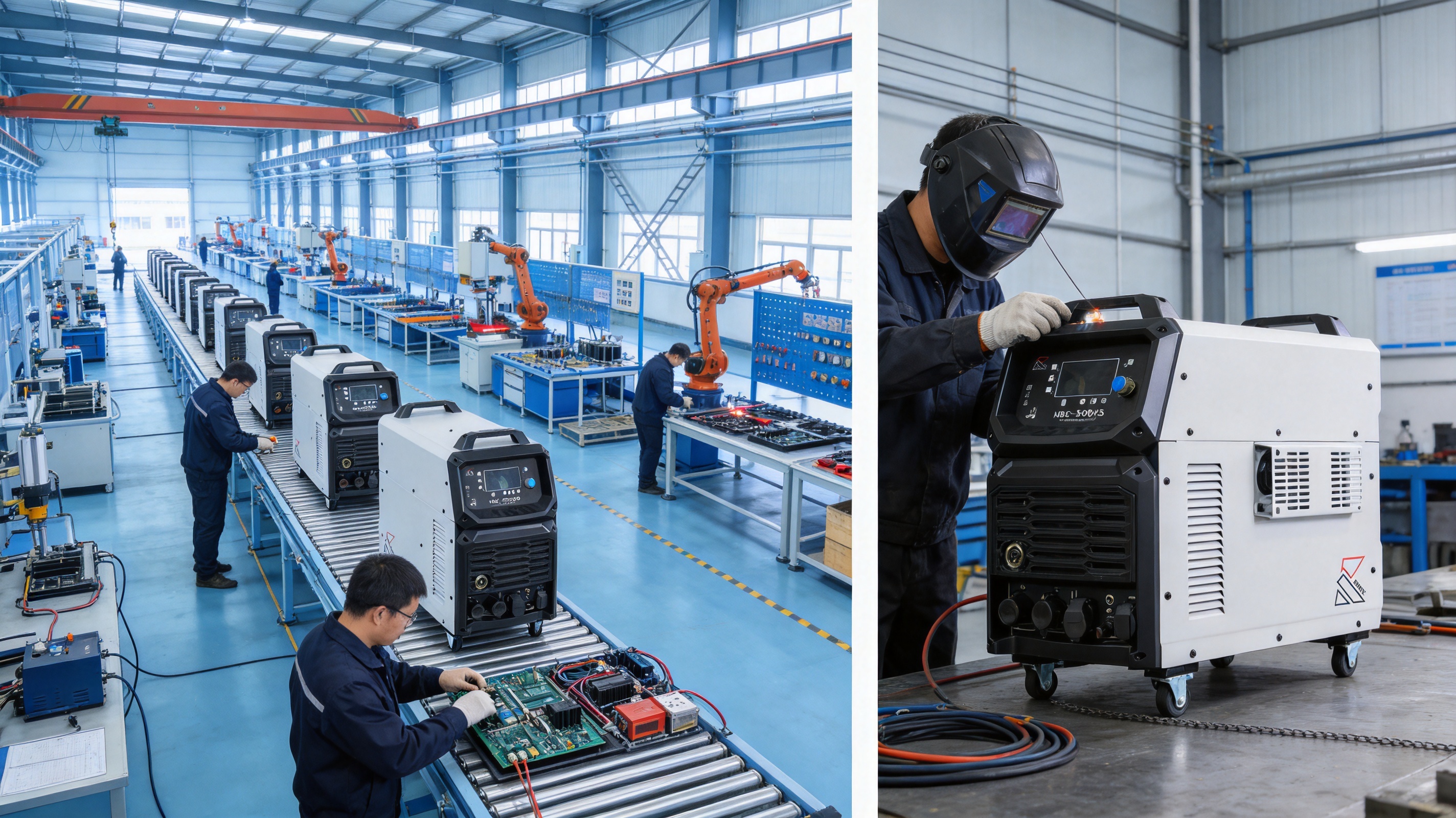
The manufacturer, Zhejiang Kende Mechanical & Electrical Co., Ltd., operates a substantial production and development organization in Taizhou, Zhejiang, China. The supplied company information states that the company covers approximately 120,000 square meters and employs about 600 people. It also reports annual exports of nearly 1.5 million units and annual production capacity of approximately 2 million units.
Such production scale can provide advantages in component sourcing, assembly organization, quality-process development, and supply continuity. A large manufacturing base can also support separate teams for engineering, production, purchasing, testing, certification, and after-sales service. These capabilities are important for a product such as the NBC-500KS, which combines power electronics, digital controls, welding outputs, plasma circuitry, thermal management, and safety protection in one enclosure.
The company reports a Zhejiang Provincial Research and Development Center, an Enterprise Technology Center, and an Intelligent Welding Technology Research Institute. It also reports 98 research and development personnel. These facilities and personnel support the development of inverter power supplies, welding process control, product safety, thermal design, software, and production improvements.
Research capability is particularly important in multi-process equipment. Different processes impose different electrical and thermal demands. Plasma cutting, for example, requires a controlled cutting arc and appropriate air management, while MIG welding requires stable wire-feed and arc behavior. MMA and TIG have different starting, current, and arc characteristics. Integrating them into one machine requires coordinated hardware and software engineering.
The company states that it uses automated patching, plug-in and welding systems, robot processing, laser cutting, and other advanced manufacturing technologies. Automated printed-circuit-board assembly can improve placement consistency for electronic components. Automated insertion and soldering systems can support repeatable electrical connections. Robotic processing can increase consistency in suitable mechanical production steps, while laser cutting can improve enclosure and sheet-metal fabrication accuracy.
The company also reports the use of OA office automation, Toyota TPS management, ERP K3, and MES management systems. These systems can help connect engineering, material planning, production scheduling, shop-floor execution, inventory, and quality information. When implemented effectively, manufacturing information systems improve traceability and help identify production bottlenecks.
For equipment buyers, advanced manufacturing is not merely a marketing concept. Consistency in circuit-board assembly, wiring, sheet-metal fabrication, cooling design, and final testing directly affects machine reliability. A stable production process can reduce variation between units and help ensure that controls, connectors, protective devices, and power modules perform as intended.
The company reports international product certifications including GS, CE, EMC, ERP, United States ETL, United Kingdom UKCA, and China CCC. Certification requirements vary by product category and market, and the applicable approval should be confirmed for the exact model and destination country. Nevertheless, experience with multiple certification systems indicates familiarity with electrical safety, electromagnetic compatibility, energy requirements, and market-specific documentation.
The company also states that it participates in national welding-machine standardization activities and has contributed to the drafting, formulation, and revision of 20 national standards, while leading the drafting of one group standard. Standards participation can provide engineering teams with a deeper understanding of safety, performance, testing, and terminology requirements.
The supplied company profile reports multiple invention patents, utility model patents, appearance patents, and software copyrights. It also states that the company has nearly 200 patents in total. Intellectual property alone does not determine product quality, but it can indicate sustained investment in product development, control technology, mechanical design, and manufacturing methods.
The NBC-500KS includes multiple protective measures and is described as having strong resistance to power-supply voltage changes. Industrial welding environments can expose equipment to dust, heat, vibration, fluctuating loads, and accidental cable damage. Protection functions are therefore essential for both machine safety and service life.
The listed insulation class is H, indicating a high-temperature insulation system category for relevant electrical components. The case protection degree is listed as IP21S. IP21S equipment is generally intended for indoor use and protection against vertically falling water under specified conditions, but it is not equivalent to a sealed outdoor enclosure. Users should protect the machine from rain, direct water spray, excessive dust, conductive contamination, and corrosive atmospheres.
Regular maintenance should include cleaning air passages, checking cooling fans, inspecting cables and connectors, examining the work clamp, checking the torch and consumables, and verifying the condition of the power supply. Plasma cutting requires particular attention to the electrode, nozzle, shield cap, torch height, and compressed-air quality. Worn consumables can cause poor cut quality, increased spatter, unstable arcs, and unnecessary stress on the power source.
Welding cables should be correctly sized and kept as short as practical for the application. Loose or damaged connections can create heat, voltage drop, and unstable operation. Gas hoses should be checked for leaks, and compressed-air lines should be drained and filtered where necessary. Maintenance personnel should follow the product manual and isolate electrical power before opening the enclosure.
Multi-process welding and plasma cutting equipment must be operated by trained personnel. Welding arcs and plasma arcs produce intense ultraviolet and infrared radiation, visible light, heat, fumes, and sparks. Operators must use an appropriate welding helmet, protective clothing, gloves, safety footwear, and respiratory or ventilation controls suitable for the material and process.
Plasma cutting and carbon arc gouging can produce substantial noise, sparks, molten metal, and fumes. Effective local exhaust ventilation is important, especially when cutting coated, painted, galvanized, or contaminated material. Hazardous coatings should be identified and removed or managed according to applicable workplace procedures before heating or cutting.
The machine should be connected by qualified personnel to a suitable 380V supply with correct grounding and protection. The installation must comply with local electrical regulations. Input capacity, cable size, circuit protection, phase balance, and generator compatibility should be assessed before commissioning.
Compressed air and shielding gases must be handled correctly. Air used for plasma cutting should be clean and sufficiently dry. Moisture or oil contamination can damage consumables and impair cut quality. Gas cylinders should be secured upright and kept away from heat, impact, and unauthorized handling.
Operators should never bypass protective devices, use damaged torches, work with exposed conductors, or operate the equipment in conditions outside the rated environment. The IP21S rating should be respected, and the machine should not be treated as weatherproof.
Before purchasing the NBC-500KS, buyers should define the main processes, materials, thicknesses, working environment, power supply, and expected production schedule. If plasma cutting is a primary function, the buyer should request detailed cutting-capacity charts for carbon steel, stainless steel, aluminum, and other intended materials. The charts should distinguish recommended cutting thickness from maximum separation thickness.
Accessory compatibility should also be confirmed. A complete working package may require a MIG torch, wire feeder, electrode holder, work clamp, TIG torch, plasma torch, air regulator, gas regulator, hoses, cables, consumables, and suitable grounding arrangements. The final configuration may differ depending on the market and customer requirements.
For businesses that intend to use all seven processes, operator training should be planned in stages. Training can begin with machine controls and safety, followed by MMA, MIG or MAG, flux-cored welding, lift TIG, plasma cutting, and carbon arc gouging. Written parameter guides for common materials can help maintain consistency between operators and shifts.
Workshops should also calculate the total cost of ownership. The purchase price is only one part of the cost. Consumables, compressed air, shielding gas, electricity, maintenance, downtime, operator training, and replacement torches should all be considered. A multi-process machine may provide economic value by reducing the number of separate power sources and simplifying maintenance, but savings depend on how frequently its different functions are used.
The NBC-500KS competes through versatility, high output, digital control, and manufacturing scale. Many welding machines are optimized for one process. That can be beneficial when a workshop performs one operation continuously, but it can be limiting when job requirements vary. The NBC-500KS provides a broader set of capabilities without requiring separate primary machines for every operation.
Its 500A MIG range and 100A plasma cutting range position it above many light-duty multi-process products. Its MMA and TIG ranges also extend to 460A, giving users additional capacity for heavy fabrication and repair. Actual performance must always be evaluated at the required duty cycle and under the intended material and environmental conditions, but the published ranges indicate an industrial orientation.
The digital control unit and LCD interface provide a more modern operating platform than basic transformer machines with limited adjustment. Synergic control can simplify wire-process setup, while the microprocessor provides the foundation for coordinated protection and process control.
The company’s reported production volume, engineering facilities, automated manufacturing technologies, certification experience, standards participation, and research personnel further strengthen the product’s competitive position. These factors support not only the initial product design but also the ability to manufacture, test, document, and improve equipment at scale.
For buyers comparing alternatives, the most important evaluation criteria should include verified output at the intended duty cycle, input-power requirements, process compatibility, service support, spare-parts availability, consumable availability, certification for the destination market, and the clarity of the technical manual. The NBC-500KS is most compelling when a customer needs several processes in one industrial power source and values operational flexibility over a single-purpose design.
The machine is specified for MIG, MAG, no-gas flux-cored wire welding, MMA or stick welding, lift TIG welding, air carbon arc cutting and gouging, and air plasma arc cutting.
The listed MIG current range is 40–500A. The usable current at a particular duty cycle must be confirmed from the final technical documentation.
The supplied specification lists a 380V input. Buyers should confirm the exact phase arrangement, frequency, tolerance, input current, and installation requirements for their local electrical system.
Yes. It supports no-gas flux-cored wire welding. This process uses flux-cored wire rather than conventional solid MIG or MAG wire and is useful where transporting shielding gas is inconvenient.
Yes. The machine supports lift TIG welding and lists a TIG current range of 20–460A. Users should confirm torch, gas, polarity, starting method, and available TIG functions before specifying it for specialized TIG work.
The supplied information identifies carbon steel, alloy steel, stainless steel, and other materials. Plasma cutting requires the material to be electrically conductive and must be performed with suitable current, air, torch, and consumables.
The product information indicates that plasma cutting can be used with or without an external compressed-air system. Because configuration and cutting performance may vary, customers should confirm the required air source, pressure, flow rate, and torch arrangement for the specific machine supplied.
Some of its processes, particularly MMA and no-gas flux-cored welding, are suitable for field applications. However, the listed IP21S enclosure rating does not make the machine weatherproof. It should be protected from rain, direct water, excessive dust, and other unsuitable conditions.
IGBT inverter technology enables high-frequency power conversion and precise electronic regulation. It can support a more compact design, responsive arc control, lower weight than comparable traditional transformer equipment, and improved energy efficiency.
The supplied information describes a digitally controlled multi-process welding and cutting machine. It should not be assumed to include robotic integration, automatic seam tracking, or production-line communication functions unless those features are confirmed separately.
Buyers should verify input power, duty-cycle conditions, process accessories, plasma cutting capacity, air requirements, wire-feed configuration, certifications, spare parts, local service support, and the exact interpretation of any ambiguous specification fields.
The NBC-500KS Digital Control IGBT Inverter Air Plasma Arc Cutting Machine is designed as a flexible industrial platform for welding, cutting, gouging, and repair. Its seven-process capability reduces the need for separate equipment and allows users to move from metal preparation to welding with fewer changes in the workshop.
Its key technical strengths include digital microprocessor control, LCD and touch-button operation, synergic parameter adjustment, IGBT inverter construction, a 40–500A MIG range, a 20–460A MMA and TIG range, and a 30–100A plasma cutting range. These features make it suitable for fabrication, maintenance, field service, and diverse industrial applications.
The product is supported by a manufacturer with reported large-scale production capacity, research and development facilities, automated manufacturing systems, international certification experience, standards participation, and a broad history of welding, charging, and heating equipment production. These manufacturing strengths are relevant to customers seeking not only a capable machine but also a supplier able to support product development, quality management, and international distribution.
As with any industrial power source, the machine should be selected according to the actual material, thickness, duty cycle, input supply, working environment, and operator requirements. When properly configured, installed, maintained, and operated, it offers a practical combination of high output, process flexibility, digital control, and space-saving equipment consolidation.
1. Manufacturer-supplied product information for the NBC-500KS Digital Control IGBT Inverter Air Plasma Arc Cutting Machine.
2. Manufacturer-supplied technical specification table for the NBC-500KS multi-process welding and cutting platform.
3. Manufacturer-supplied corporate profile covering production capacity, research and development, certifications, patents, and manufacturing systems.
4. General principles of MIG, MAG, flux-cored, MMA, lift TIG, air carbon arc gouging, and plasma arc cutting technology.
5. General guidance on welding-machine electrical safety, duty cycle, enclosure protection, grounding, ventilation, and maintenance.
6. General industrial practices for inverter power-source operation, welding consumable selection, compressed-air preparation, and plasma torch maintenance.
Recommended Products

Contact Us
No.2299, Luqiao Section, Shugang Avenue, Luqiao District, Taizhou, 318057 Zhejiang, PR China.
+86-576-82431568
 Privacy
China Welding Machine Factory
 English
 中文简体
 русский
 Español
 عربى
 Français
 Português
 Deutsch
 Український