Email: [email protected]
Email: [email protected]

Blog
 2026.10.28
 Blog
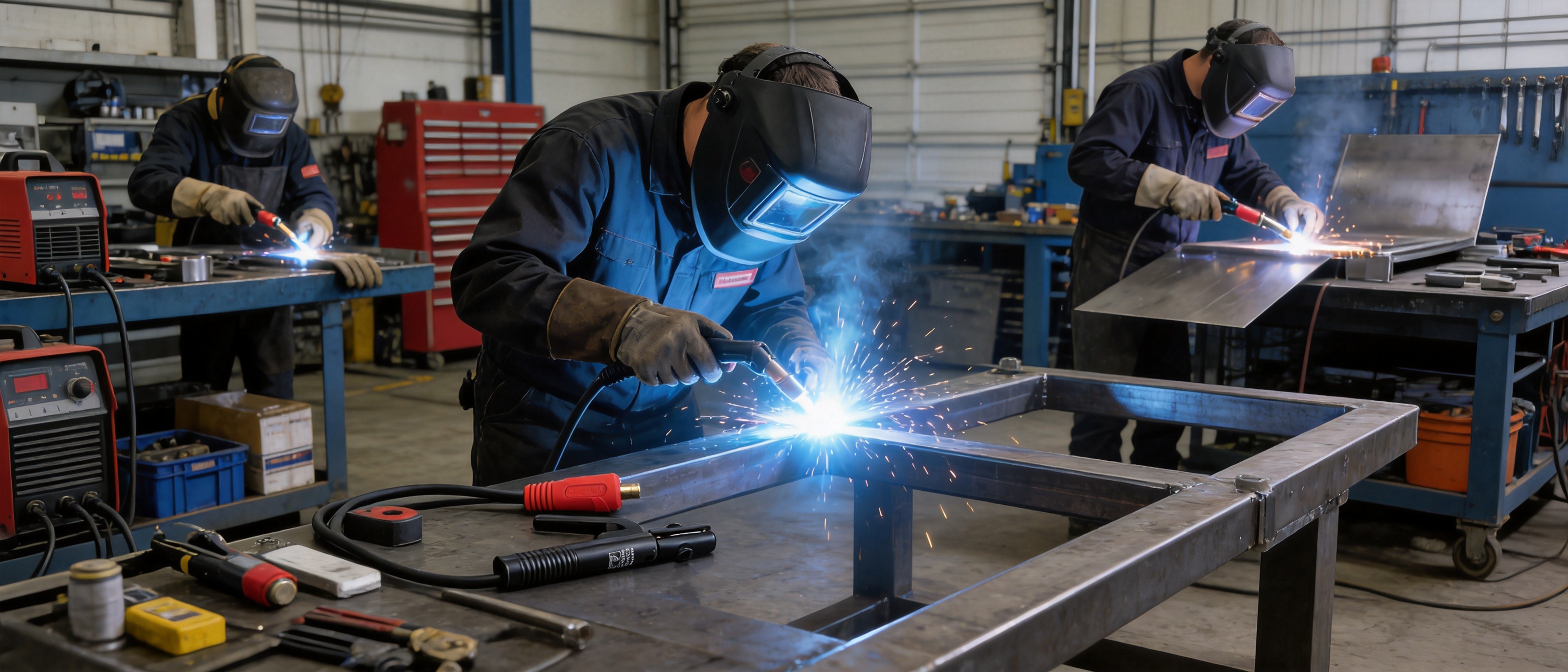
Welding quality depends on much more than the power source alone. A welding machine may contain advanced inverter technology, precise control circuits, and a durable enclosure, but its performance also relies on the condition and compatibility of its supporting parts. Torches, electrode holders, earth clamps, cables, connectors, contact tips, nozzles, regulators, cooling components, and other accessories form the operating system around the machine. When these components are correctly selected and properly maintained, they help improve arc stability, operator safety, productivity, and service life.
Welding accessories and replacement parts are therefore essential products for fabrication workshops, construction companies, automotive repair centers, agricultural machinery manufacturers, maintenance departments, and home users. They allow users to keep equipment operating without replacing an entire welding machine. They also make it possible to configure a machine for different materials, welding processes, workpiece geometries, and production requirements.
This article examines the role of welding machine parts and accessories, explains how they support MIG/MAG, TIG, MMA, plasma cutting, resistance welding, and related processes, and outlines the technical and manufacturing strengths expected from a dependable parts supplier. It also discusses how advanced production systems, research capability, certification, quality control, and international experience contribute to reliable accessory performance.
Welding machine parts are the components that transfer electrical current, shielding gas, filler metal, mechanical force, cooling capacity, or control signals between the power source and the welding operation. Some parts are installed inside the machine, while others are external consumables or replacement accessories used directly by the operator.
Although many accessories appear simple, each one must meet important electrical, thermal, mechanical, and ergonomic requirements. A cable that is too small for the welding current may overheat. A loose connector may create resistance, voltage loss, and unstable arc behavior. A worn contact tip can interrupt wire feeding. A damaged gas nozzle can disturb shielding coverage and cause porosity. An unsuitable electrode holder may create a safety risk or make welding uncomfortable.
Proper accessories improve the complete welding system in several ways:
They maintain efficient current transfer between the power source and the workpiece.
They support consistent shielding gas delivery and protect the molten weld pool from atmospheric contamination.
They help the operator control the torch, electrode, or work clamp safely and comfortably.
They protect internal and external equipment from excessive heat, abrasion, impact, dust, and moisture.
They reduce downtime by enabling fast replacement of worn or damaged components.
They help welding machines meet the operating requirements of different processes and applications.
A complete accessory range is especially valuable for businesses that use several types of equipment. A workshop may operate MMA welding machines for repair work, MIG/MAG systems for production, TIG equipment for stainless steel or aluminum, and plasma cutters for material preparation. Each process requires different accessories, and compatibility must be considered before purchase.
Manual metal arc welding, commonly called MMA or stick welding, uses a flux-coated consumable electrode. The most common accessories include electrode holders, earth clamps, welding cables, cable connectors, hand shields, head shields, and electrode storage equipment.
An electrode holder must grip the electrode securely while insulating the operator from the welding current. Its jaw positions should allow the electrode to be held at different angles. A strong spring or locking mechanism helps prevent the electrode from slipping during operation. The insulating materials must resist heat and accidental contact with conductive surfaces.
The earth clamp completes the welding circuit by connecting the workpiece to the power source. A quality clamp should maintain firm contact with clean metal and resist loosening when the welding cable is moved. Weak contact can produce unstable current flow, increased heat, and unnecessary spatter.
Welding cables are selected according to current rating, length, flexibility, and working environment. Longer cables create greater voltage drop and may require a larger conductor size. Cables used in construction or outdoor work should have durable insulation that can withstand abrasion, bending, oil, and moderate exposure to weather.
MIG and MAG welding machines use a continuously fed wire electrode. MIG generally uses an inert shielding gas, while MAG uses an active gas or gas mixture. Both processes depend on a reliable welding torch and a coordinated wire-feeding system.
Common MIG/MAG parts include welding torches, liners, contact tips, gas nozzles, diffuser rings, swan necks, trigger assemblies, torch handles, wire guides, drive rolls, gas hoses, Euro-style connectors, and replacement torch cables.
The contact tip transfers welding current to the wire. It must be manufactured with accurate internal dimensions so that the wire can pass smoothly while maintaining electrical contact. Excessive wear increases electrical resistance and may cause inconsistent arc ignition, wire burnback, or irregular feeding.
The liner guides the wire from the drive system to the contact tip. A liner that is contaminated, kinked, or incorrectly sized may cause feeding resistance. This can lead to bird nesting, poor arc starts, and uneven weld appearance. Different wire materials may require different liner designs. Steel wire, aluminum wire, and cored wire do not always perform equally well with the same liner.
The gas nozzle directs shielding gas around the arc and molten pool. Its shape and internal cleanliness influence gas coverage. Spatter buildup can restrict gas flow, and a damaged nozzle may allow turbulence that draws atmospheric air into the weld zone. Nozzle cleaning tools and anti-spatter products are therefore useful additions to a maintenance program.
TIG welding, also known as GTAW, uses a non-consumable tungsten electrode and a separate filler rod when required. The process is known for its control and clean weld appearance, but it is highly sensitive to accessory condition.
TIG accessories include TIG torches, tungsten collets, collet bodies, ceramic cups, back caps, gas lenses, torch switches, remote controls, shielding gas hoses, and water-cooling components. The correct cup size and gas lens configuration help establish stable shielding around the tungsten and weld pool.
A collet must hold the tungsten firmly without damaging it. The collet body must align correctly with the torch and permit consistent gas flow. The back cap secures the tungsten assembly and should be easy to remove when electrode length needs adjustment.
Air-cooled TIG torches are suitable for many light and medium-duty applications. Water-cooled torches are useful for higher current operation or extended welding cycles because a coolant system removes heat from the torch body and cable assembly. In either case, hoses, connectors, and insulation must be checked regularly.
Plasma cutting systems require specialized consumable parts because the process uses an electrically conductive gas heated to a high temperature. The main components include plasma torches, electrodes, nozzles, swirl rings, retaining caps, torch leads, air filters, regulators, and work clamps.
The electrode carries current to the plasma arc, while the nozzle constricts the arc and shapes the cutting stream. These parts gradually wear during normal use. Their service life depends on cutting current, material thickness, gas quality, duty cycle, piercing technique, and operator settings.
A worn nozzle may produce a wide or irregular cut, excessive dross, and poor edge quality. A damaged electrode may make arc starting difficult. Replacing consumables as a matched set often provides better results than replacing only one component after severe wear has occurred.
Clean, dry compressed air is important for plasma cutting. Moisture and oil contamination can reduce consumable life and affect cut quality. Air filtration and regular drainage of the compressor system are essential supporting practices.

Parts
Many welding accessories are directly involved in the transfer of electrical energy. Their design must balance conductivity, flexibility, insulation, heat resistance, and mechanical strength.
Welding cables are made from flexible conductive strands surrounded by protective insulation. High flexibility is important because operators frequently reposition the torch, electrode holder, or earth clamp. A cable that is difficult to bend increases fatigue and may place stress on connectors.
The required cable size depends on welding current, duty cycle, cable length, ambient temperature, and the number of cables bundled together. Using an undersized cable can cause excessive temperature rise. Using an appropriately sized cable improves efficiency and reduces the chance of insulation damage.
Welding cable insulation should resist heat, oil, abrasion, and repeated flexing. Outdoor construction applications may require stronger mechanical protection than indoor fabrication environments. Cables should be inspected for cuts, flattened sections, exposed conductors, hardened insulation, and loose terminals.
Connectors provide removable electrical and gas connections between welding equipment and accessories. A good connector should be easy to install while maintaining reliable contact during repeated use. It should resist accidental separation and prevent incorrect assembly where possible.
Loose connectors can create heat at the contact point. This heat may damage the plug, socket, cable insulation, or machine terminals. Operators should keep connector surfaces clean and ensure that locking mechanisms are fully engaged.
Earth clamps and electrode holders must combine electrical performance with operator safety. Copper or copper-alloy conductive components help reduce resistance, while heat-resistant insulating materials protect the user from energized surfaces.
The clamp teeth should maintain contact even when the workpiece vibrates or the cable is moved. The holder should permit quick electrode replacement without requiring the operator to touch hot or contaminated surfaces. Ergonomic designs reduce hand fatigue during long welding sessions.
Shielding gas protects the molten weld pool from oxygen, nitrogen, and moisture in the surrounding atmosphere. Accessories that control gas flow are therefore central to weld quality.
Gas hoses must be compatible with the selected gas and pressure range. They should not be excessively long, sharply bent, or exposed to hot metal edges. Leaks waste gas and may also introduce air into the shielding system. Hose connections should be inspected with suitable leak-detection methods rather than open flames.
Regulators and flowmeters allow the operator to reduce cylinder pressure and set an appropriate gas flow. An accurate flowmeter supports repeatable welding conditions. Excessive flow is not always beneficial; turbulent gas flow can draw surrounding air into the weld area. The correct setting depends on the process, torch design, nozzle size, welding position, and environmental conditions.
Torch bodies and handles must tolerate heat while remaining comfortable to hold. Trigger assemblies should operate smoothly and withstand repeated activation. Cable assemblies need strain relief at both ends to prevent bending stress from damaging internal conductors or hoses.
Weld defects are often attributed to the power source or operator technique, but accessory problems are equally common. A damaged cable, blocked nozzle, worn contact tip, or poor earth connection can create symptoms that resemble an electrical control problem.
Common relationships between accessory condition and welding performance include:
| Accessory or part | Possible problem | Typical effect |
|---|---|---|
| Contact tip | Worn or incorrectly sized opening | Irregular wire feeding, unstable arc, burnback |
| Gas nozzle | Spatter buildup or deformation | Uneven shielding, porosity, poor bead appearance |
| Welding liner | Contamination, kink, or wrong size | Feeding resistance and inconsistent arc starts |
| Earth clamp | Weak or contaminated contact | Arc instability and excessive heating |
| Welding cable | Undersized or damaged insulation | Voltage loss, overheating, safety risk |
| TIG collet | Incorrect fit or deformation | Loose tungsten and inconsistent arc position |
| Plasma nozzle | Worn orifice | Wide cut, dross, poor edge quality |
| Gas hose | Leak or damaged connection | Gas loss and atmospheric contamination |
Using suitable replacement parts can restore performance without replacing the complete machine. This is economically valuable because a relatively low-cost accessory may be responsible for a large decline in productivity.
Before purchasing a welding accessory, users should confirm the welding process, machine model, connector type, rated current, duty cycle, consumable size, shielding gas, and intended working environment.
Every current-carrying component should be rated for the intended operating conditions. A component rated for occasional low-current welding may not be suitable for continuous industrial work. Duty cycle describes the percentage of a standard period during which a machine or accessory can operate at a specified current without exceeding thermal limits.
For example, a torch used for long production welds may need a higher rating than one used for brief repair welds. The accessory should be selected according to actual operating conditions rather than the maximum current displayed on the machine panel alone.
MMA, MIG/MAG, TIG, and plasma cutting accessories are not interchangeable in general. Even within one process, different wire diameters, gas mixtures, electrode types, and current levels require different components.
Aluminum MIG welding may require a special liner, suitable drive rolls, and a shorter or more carefully supported torch path. TIG welding on stainless steel may require gas lens components and precise tungsten preparation. Plasma cutting thick carbon steel may require a different consumable set from thin sheet-metal cutting.
Industrial accessories may be exposed to dust, oil, vibration, humidity, heat, and impact. Construction sites can create additional risks through dragging cables across rough ground or placing torches near hot workpieces. A parts supplier should offer products with appropriate insulation, strain relief, protective sleeves, and mechanical durability.
Ergonomics influence productivity and weld consistency. A heavy torch, stiff cable, poorly balanced holder, or uncomfortable handle can increase fatigue. When an operator becomes tired, torch angle and travel speed may vary, increasing the chance of defects.
Well-designed accessories should support a natural grip, smooth trigger operation, balanced weight distribution, and manageable cable movement. These factors are especially important in production environments where operators repeat the same motion for many hours.
The quality of welding accessories begins with engineering and continues through material selection, tooling, assembly, inspection, and packaging. A modern manufacturer must manage many small components with tight dimensional requirements and consistent production standards.
Effective product development begins with understanding how accessories are used in real workshops. Engineers consider current transfer, thermal behavior, gas flow, mechanical loading, operator movement, consumable wear, and service conditions.
Computer-aided design can be used to develop torch bodies, handles, connectors, clamps, and protective components. Prototypes may be tested for temperature rise, repeated operation, impact resistance, insulation strength, and compatibility with the corresponding welding machine.
Product improvement is often based on field feedback. For example, a redesigned strain relief may improve cable life, while a revised nozzle shape may reduce spatter accumulation. Small engineering changes can deliver significant benefits when applied across a large installed base.
Conductive parts generally require materials that combine good electrical conductivity with resistance to heat and mechanical wear. Insulating components must maintain electrical separation under elevated temperatures and repeated handling. Hoses and seals must be compatible with gases, pressure, and ambient conditions.
Material consistency is important because variations in hardness, conductivity, dimensional stability, or thermal resistance can affect product performance. Reliable manufacturers establish material specifications and incoming inspection procedures before production begins.
Modern production may include automated stamping, machining, injection molding, laser cutting, robotic processing, automatic soldering, and controlled assembly. These processes improve repeatability and reduce the variation associated with manual operations.
Precision is especially important for contact tips, threaded components, torch fittings, connector bodies, and gas passages. Small dimensional errors can affect wire movement, electrical contact, gas distribution, or assembly strength.
Automated equipment also supports higher production efficiency. Consistent process parameters help manufacturers supply large quantities of replacement parts while maintaining stable quality between production batches.
Assembly quality affects the reliability of the complete accessory. Cable terminals must be properly crimped or secured. Torch components must be assembled in the correct order. Seals must be positioned accurately. Insulating parts must not be damaged during installation.
Process control systems can define assembly instructions, inspection points, and traceability records. Digital manufacturing execution systems help coordinate materials, work orders, production data, and quality information across multiple departments.
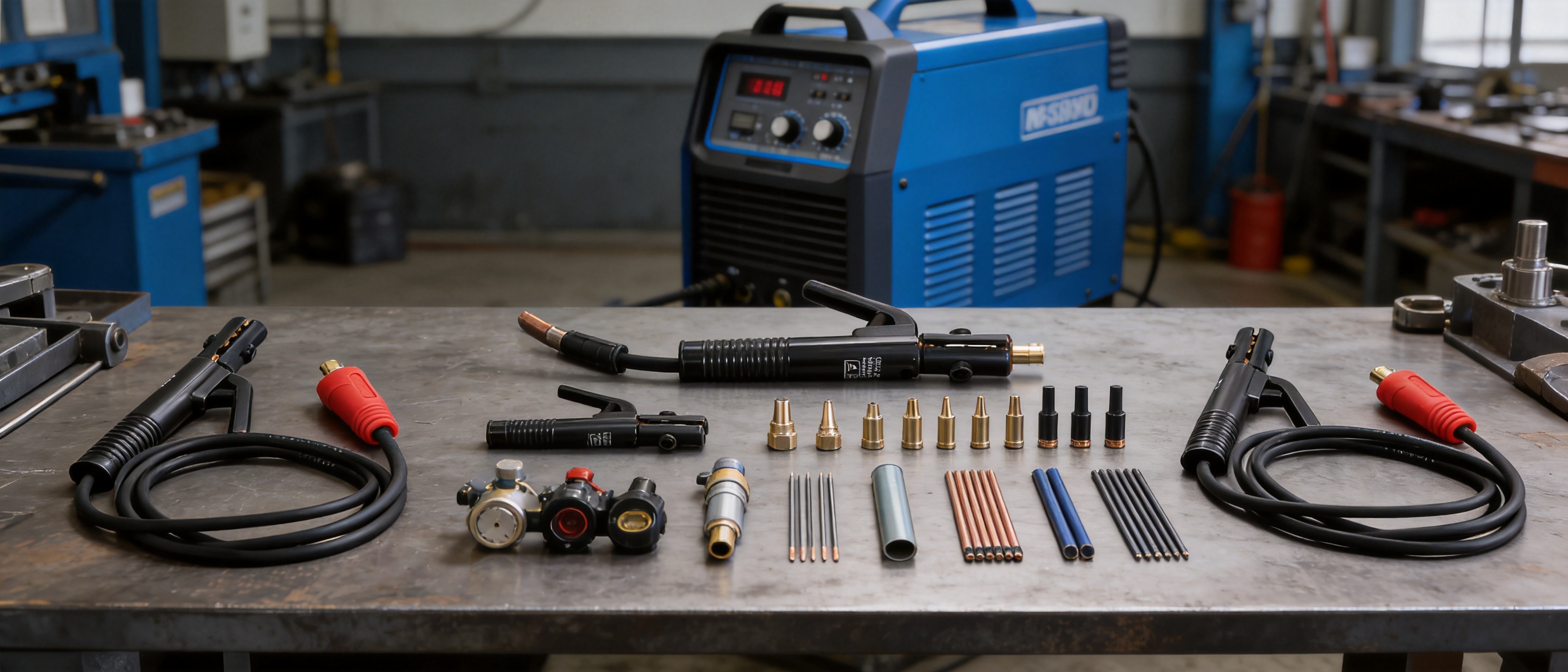
Zhejiang Kende Mechanical & Electrical Co., Ltd. is an established Chinese manufacturer and exporter of welding machines, chargers, heaters, and related products. The company operates a large production base in Zhejiang Province, covering approximately 120,000 square meters and employing about 600 people. Its scale provides a strong foundation for product development, parts manufacturing, assembly, testing, and international supply.
The company reports annual exports of nearly 1.5 million units and annual production capacity of approximately 2 million units. This level of production experience is important for customers purchasing accessories because it indicates familiarity with high-volume manufacturing, product consistency, packaging requirements, and international distribution.
Its product portfolio includes MMA or stick welding machines, MIG/MAG welding machines, flux-cored welding machines, TIG machines, plasma cutters, stud welding machines, submerged arc welding machines, battery chargers, and electric, gas, and oil heaters. Because accessories are developed within a broad welding equipment portfolio, the manufacturer can evaluate parts in relation to complete machine systems rather than treating every accessory as an isolated product.
The company uses advanced technologies that include automatic patching, plug-in and welding systems, robotic processing, laser cutting, and other automated manufacturing methods. These capabilities can support consistent production of electrical assemblies, metal components, structural parts, and precision accessories.
Its management systems include office automation, Toyota-style production management, ERP, and manufacturing execution systems. Such systems help coordinate purchasing, production scheduling, inventory, quality control, and delivery. For international buyers, organized production management can improve order consistency and reduce the risk of supply interruptions.
Welding accessories must evolve with welding machines, materials, and production requirements. A manufacturer with dedicated research resources can respond more effectively to changing market needs.
The company has a Zhejiang Provincial research and development center, an enterprise technology center, and an intelligent welding technology research institute. It reports a research and development team of 98 personnel and a portfolio of invention patents, utility model patents, appearance patents, and software copyrights.
This research structure supports improvements in inverter welding technology, thermal management, user interfaces, machine housings, control systems, and accessory compatibility. It can also help develop products for different regional standards, customer preferences, power supplies, and working environments.
For buyers, innovation is not limited to entirely new machines. It may also appear in practical improvements such as lighter torches, more durable cable assemblies, improved cooling, better gas flow, stronger strain relief, easier consumable replacement, and improved compatibility with automated welding systems.
Welding equipment and accessories are used in environments where electrical safety and mechanical reliability are important. Quality assurance should therefore cover design, materials, production, inspection, testing, packaging, and after-sales support.
The manufacturer reports international and regional certifications that include GS, CE, EMC, ERP, United States ETL, United Kingdom UKCA, and China CCC. The exact certification applicable to an individual product depends on its design, market, and intended use, so buyers should confirm product-specific documentation before placing an order.
Electrical compatibility and electromagnetic performance are particularly important for inverter welding machines. Poorly designed components can contribute to interference, overheating, or unstable operation. Proper testing helps verify that products meet the requirements of their target markets.
Quality control for welding accessories may include:
Incoming inspection of metals, plastics, cables, terminals, insulation, seals, and other raw materials.
Dimensional inspection of machined and molded components.
Electrical resistance, insulation, and continuity testing.
Thermal testing under representative current and duty-cycle conditions.
Gas-flow and leak testing for torches, hoses, regulators, and fittings.
Mechanical tests for clamps, handles, connectors, cable assemblies, and strain reliefs.
Visual inspection for defects, contamination, deformation, and assembly errors.
Packaging inspection to protect parts during storage and international transportation.
The main advantage of professionally manufactured welding parts is consistency. A low-cost accessory may appear acceptable during initial use but fail earlier because of poor materials, inaccurate dimensions, weak insulation, inadequate crimping, or limited thermal resistance.
Reliable parts offer several practical advantages:
Consistent contact resistance, gas flow, and mechanical fit help maintain predictable welding conditions. This is valuable in production environments where repeatability is essential.
Appropriate materials and controlled manufacturing can reduce premature wear. Longer service life lowers replacement frequency and reduces downtime.
Strong insulation, secure connections, and suitable thermal performance reduce risks associated with electrical shock, overheating, and accidental component failure.
The purchase price of an accessory is only one part of its cost. Frequent replacement, machine stoppages, defective welds, rework, and operator frustration may cost considerably more than the initial price difference between a basic and a professionally manufactured component.
Accessories developed alongside complete welding machines are more likely to match the electrical, mechanical, and control requirements of those machines. This helps reduce trial-and-error during installation.
Different countries and industries may require different cable lengths, connectors, plugs, torch styles, labels, packaging, or specifications. An experienced manufacturer with engineering and production resources can be better positioned to support customized orders.
Even high-quality accessories require routine maintenance. Proper care extends service life and helps identify faults before they cause production problems.
Welding cables should be inspected before use. Remove the cable from service if the conductor is exposed, the insulation is severely cut, or the terminal is loose. Do not repeatedly wrap cables into tight bends, as this can damage internal strands.
MIG/MAG contact tips should be replaced when the opening becomes enlarged, irregular, or blocked. The liner should be cleaned or replaced when wire feeding becomes difficult. Gas nozzles should be cleaned regularly, and severely deformed nozzles should not be reused.
TIG torches should be checked for cracked ceramic cups, damaged collets, loose back caps, and deteriorated cables. Tungsten electrodes should be prepared using suitable equipment and kept free from contamination.
Plasma consumables should be inspected for erosion, deformation, and damage after cutting operations. Air filters and separators should be maintained so that moisture and oil do not reach the torch.
Earth clamps should be kept free from heavy oxidation, paint, and dirt at the contact point. Electrode holders should be checked for damaged insulation and weak gripping action. Connectors should be clean, fully engaged, and protected from unnecessary impact.
Robot welding systems place additional demands on accessories. A robotic torch may perform thousands of repeated movements, making cable routing, torch balance, strain relief, and collision protection especially important.
Robotic welding accessories should be selected according to torch mounting requirements, wire diameter, current rating, cooling method, torch geometry, and robot wrist configuration. Cable assemblies must permit the required range of motion without twisting or excessive tension.
Consistent contact tips, liners, nozzles, and gas components support stable automated operation. Even a small variation can influence wire feeding, arc starting, or shielding performance. Preventive maintenance schedules should be based on weld length, arc time, and the number of starts rather than waiting for a visible failure.
Manufacturers with experience in intelligent welding technology and robotic processing can help customers select parts that support automated production. This is increasingly important as factories seek greater productivity, traceability, and repeatable quality.
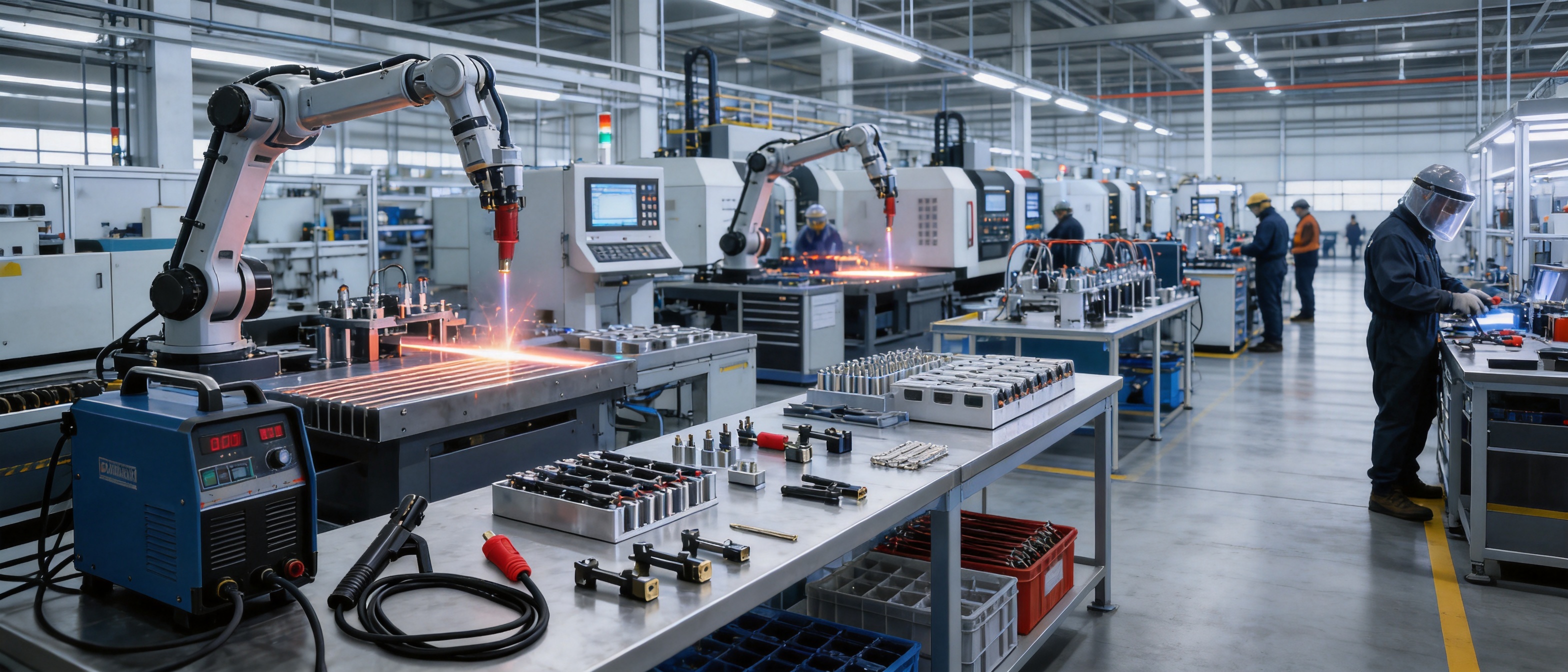
Welding accessories are used in many fields because welding machines are used in nearly every sector that fabricates, repairs, or maintains metal products.
In general metal fabrication, MIG/MAG torches, contact tips, liners, nozzles, earth clamps, and cables support the production of frames, brackets, cabinets, doors, and structural assemblies.
In automotive repair, compact torches, flexible cables, clamps, and replacement consumables help technicians work in restricted spaces and repair body panels, exhaust components, frames, and machinery.
In construction, durable cables, electrode holders, work clamps, and protective accessories are important because equipment may be moved frequently and exposed to dust, impact, and changing weather.
In agricultural machinery maintenance, MMA and MIG/MAG accessories support the repair of trailers, implements, vehicle parts, gates, supports, and heavy equipment.
In stainless steel and aluminum fabrication, TIG accessories and specialized MIG components help operators manage heat input, shielding, electrode preparation, and filler metal feeding.
In manufacturing plants, standardized accessories help maintenance teams reduce inventory complexity. Establishing approved part numbers and replacement intervals can improve purchasing efficiency and reduce emergency downtime.
Distributors should evaluate more than the appearance or unit price of a welding accessory. Important questions include whether the supplier can maintain stable quality, provide product documentation, support private labeling, offer packaging suitable for retail or industrial sales, and deliver repeat orders on schedule.
OEM customers may require customized dimensions, connectors, cable lengths, colors, labels, manuals, or packaging. They should provide detailed technical requirements and confirm sample approval before mass production.
Buyers should also ask about minimum order quantities, production lead times, spare parts availability, warranty terms, inspection procedures, and compatibility testing. A supplier with broad manufacturing capabilities may provide a more integrated solution than several unrelated small vendors.
For international orders, packaging must protect parts from moisture, abrasion, impact, and contamination during transportation. Product labels should identify model numbers, ratings, applicable processes, and safety information where required.
Before ordering replacement parts or accessories, confirm the following information:
Identify the welding process: MMA, MIG, MAG, flux-cored, TIG, plasma cutting, resistance welding, or another process.
Record the machine model, rated current, duty cycle, input voltage, and connector configuration.
Confirm wire diameter, tungsten diameter, electrode type, nozzle type, or plasma consumable specification.
Determine whether the application is light-duty, professional, industrial, outdoor, automated, or robotic.
Check cable length, conductor size, insulation requirements, torch cooling method, and gas compatibility.
Consider operating temperature, dust, moisture, oil, vibration, and physical impact.
Review applicable safety and certification requirements for the destination market.
Request technical drawings, samples, test reports, or compatibility information when necessary.
Establish a preventive replacement schedule for consumable parts.
The future of welding accessories will be influenced by automation, energy efficiency, digital monitoring, improved materials, and more demanding safety expectations. Lightweight components can reduce operator fatigue and robot payload. Improved insulation and thermal management can support higher duty cycles. Better consumable designs can reduce spatter and extend service intervals.
Digital manufacturing systems may also improve traceability. Production data can be linked to batches, inspection results, material records, and customer orders. This allows manufacturers to identify process trends and respond quickly to quality issues.
As welding machines become more intelligent, accessories may increasingly interact with sensors, control systems, and automated maintenance programs. For example, equipment may monitor arc time, consumable wear, wire-feeding resistance, or torch temperature. Such information can help users replace parts before a failure interrupts production.
Environmental considerations will also influence product development. Longer-lasting accessories reduce material consumption and waste. Efficient manufacturing, recyclable packaging, and improved repairability can help reduce the total environmental impact of welding operations.
They are internal and external components that support welding and cutting operations. Examples include cables, earth clamps, electrode holders, torches, liners, contact tips, gas nozzles, regulators, hoses, connectors, plasma consumables, and cooling components.
Accessories directly affect current transfer, wire feeding, shielding gas coverage, torch control, and operator safety. A machine can be electrically functional while worn or damaged accessories cause poor weld quality, overheating, or downtime.
Replacement intervals depend on current, duty cycle, material, welding time, operating environment, and maintenance. Consumables such as contact tips, nozzles, liners, electrodes, and plasma parts generally require more frequent replacement than cables, holders, or torch bodies.
No. Compatibility depends on the process, current rating, connector, machine design, torch configuration, wire or electrode size, cooling method, and manufacturer specification. The machine model and technical requirements should be checked before ordering.
Common causes include a worn contact tip, blocked or incorrectly sized liner, excessive drive-roll pressure, unsuitable drive rolls, contaminated wire, sharp cable bends, or a damaged torch assembly.
Porosity may result from insufficient or excessive shielding gas flow, gas leaks, a blocked or damaged nozzle, wind, moisture, contamination, incorrect torch distance, or poor surface preparation.
A water-cooled torch is useful for higher-current welding, long welds, and applications with extended duty cycles. The cooling system removes heat from the torch and helps maintain comfortable operation.
Use clean and dry compressed air, select the correct current and consumables, avoid unnecessary torch contact with the workpiece, use suitable piercing techniques, and replace worn electrodes and nozzles before severe damage occurs.
Distributors should assess manufacturing capacity, engineering support, quality systems, certification, product consistency, packaging, delivery performance, customization capability, and after-sales service.
Experienced manufacturers understand material selection, precision processing, assembly control, electrical testing, thermal behavior, and real-world welding conditions. This knowledge helps them produce parts that are more consistent and compatible with complete welding systems.
Welding accessories are essential to the performance, safety, and productivity of welding and cutting equipment. Cables, clamps, holders, torches, contact tips, liners, nozzles, gas components, plasma consumables, and connectors all influence the quality of the final operation. Selecting compatible and durable parts can reduce defects, prevent downtime, improve operator comfort, and extend the useful life of welding machines.
A capable manufacturer should combine product engineering, controlled materials, precision production, automated processing, reliable testing, certification, and responsive customization. Zhejiang Kende Mechanical & Electrical Co., Ltd. offers a broad manufacturing platform covering welding machines, battery chargers, heaters, plasma cutters, and related technologies. Its large production base, research resources, automated manufacturing equipment, management systems, international certifications, and export experience provide important strengths for customers seeking dependable welding parts and accessories.
For professional users, the best purchasing decision is based on total performance rather than initial price alone. A correctly designed accessory that lasts longer, fits accurately, transfers current efficiently, and supports stable welding can deliver greater value throughout its service life.
American Welding Society. Welding Handbook: Welding Processes, Materials, and Applications.
International Organization for Standardization. Quality Management Systems — Requirements.
International Electrotechnical Commission. Safety Requirements for Arc Welding Equipment.
International Organization for Standardization. Arc Welding Equipment and Welding Power Sources — Safety and Performance Considerations.
Manufacturer technical information for welding machines, torches, cables, consumables, chargers, and heating equipment.
Industrial guidance on preventive maintenance, shielding gas management, welding cable selection, and plasma cutting consumables.
Technical information concerning Zhejiang Kende Mechanical & Electrical Co., Ltd., including manufacturing capacity, research facilities, product categories, management systems, certifications, and export experience.
Recommended Products

Contact Us
No.2299, Luqiao Section, Shugang Avenue, Luqiao District, Taizhou, 318057 Zhejiang, PR China.
+86-576-82431568
 Privacy
China Welding Machine Factory
 English
 中文简体
 русский
 Español
 عربى
 Français
 Português
 Deutsch
 Український