Email: [email protected]
Email: [email protected]

Blog
 2026.10.26
 Blog
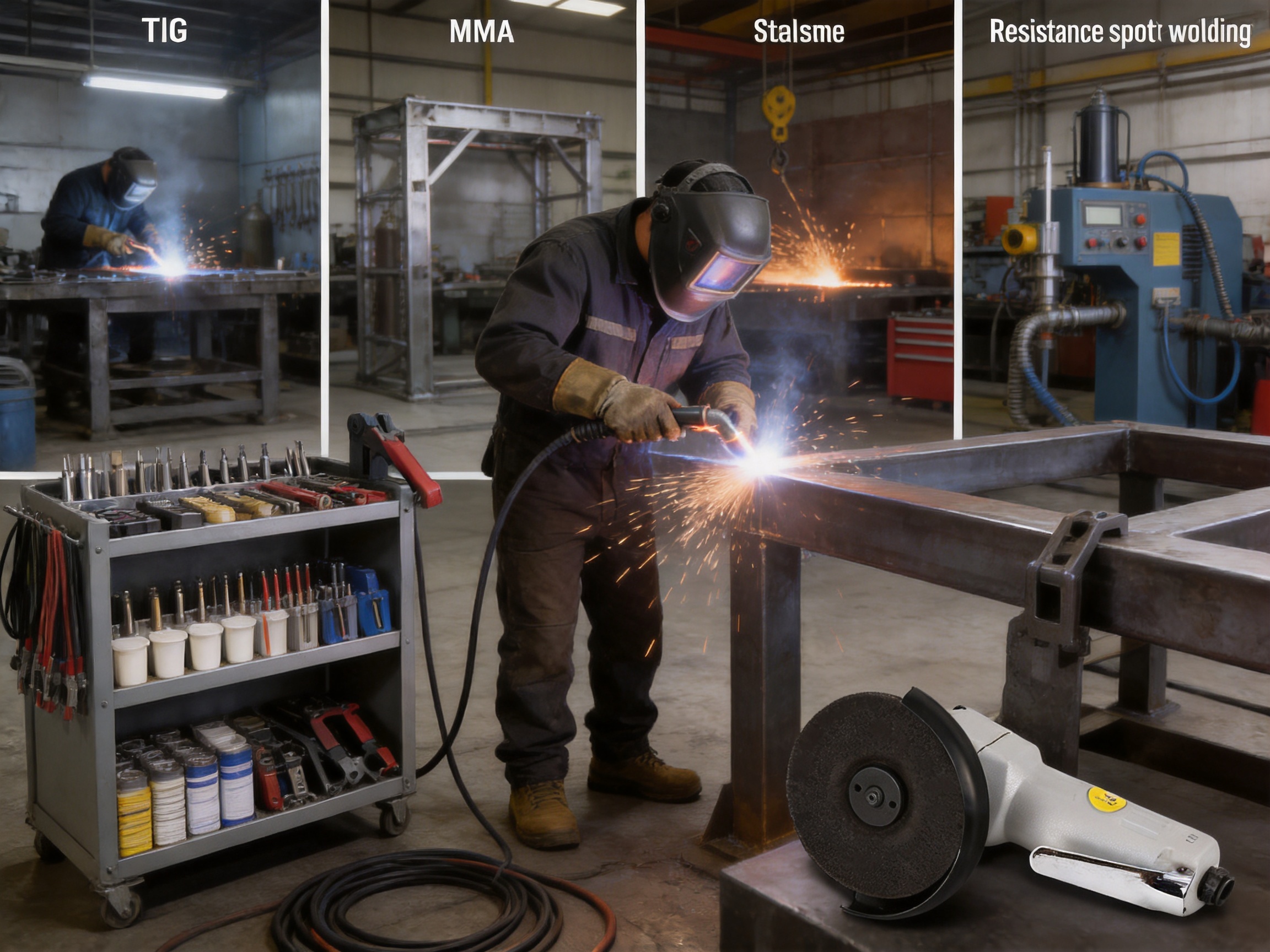
Welding quality depends on much more than the power source alone. A capable welding machine must work together with properly selected cables, torches, holders, clamps, connectors, consumable supports, control components, protective parts, and maintenance accessories. These components form the operating system around the welding power source. When they are correctly matched, they help deliver a stable arc, dependable current transfer, improved operator safety, longer service life, and more consistent production results.
The Parts product category is designed for users who need practical welding accessories and replacement components for a broad range of welding applications. It supports equipment used in manual metal arc welding, MIG/MAG welding, TIG welding, plasma cutting, submerged arc welding, resistance welding, and related workshop operations. The category is suitable for industrial manufacturers, fabrication shops, repair centers, construction contractors, agricultural machinery users, automotive workshops, maintenance departments, distributors, and professional welders.
As welding environments become more demanding, accessories are no longer treated as minor add-ons. A poorly fitted connector can cause heat buildup. An unsuitable cable can reduce operating efficiency. A worn electrode holder can create unstable contact. A damaged torch component can increase shielding-gas consumption and reduce weld protection. For these reasons, selecting dependable parts is an important way to protect the productivity and performance of the entire welding system.
Welding parts connect the operator, the workpiece, and the welding machine. They control how electrical power, shielding gas, cooling air, filler material, and mechanical support reach the welding area. Although individual accessories are often small compared with the main welding machine, their influence on welding performance can be significant.
For example, the welding cable must carry current safely without excessive voltage drop or overheating. The work clamp must establish a secure electrical connection to the workpiece. A torch or electrode holder must withstand heat and mechanical movement while remaining comfortable for the operator. Connectors must resist accidental separation and maintain reliable contact during repeated use. Protective sleeves, insulating materials, and strain-relief structures must withstand the conditions of a working workshop.
Parts also influence efficiency. When accessories are designed for quick installation and replacement, downtime can be reduced. When standard interfaces are used, distributors and service technicians can maintain a broader range of equipment with fewer inventory difficulties. When components are selected according to the welding process, operators can reduce unnecessary wear and obtain more predictable results.
The Parts category therefore represents a practical approach to equipment support. Instead of viewing accessories as isolated items, users can consider them as part of a complete welding solution. This approach helps match the accessory to the current rating, duty cycle, process, working environment, operator preference, and maintenance plan.
The available product portfolio covers welding accessories and related parts for several important welding technologies. These technologies differ in arc characteristics, current requirements, shielding methods, consumables, and operating conditions. A well-organized parts range helps users select equipment that corresponds to the technical needs of each process.
Manual metal arc welding, also called MMA or stick welding, is widely used because of its simplicity, portability, and flexibility. Typical accessories include electrode holders, welding cables, work clamps, cable connectors, and storage or handling equipment for electrodes. These parts must tolerate frequent handling, arc heat, sparks, and rough workshop conditions.
A suitable electrode holder should provide stable electrode retention while allowing the operator to change electrodes quickly. Its insulating body must protect the user from accidental contact with live conductive parts. The cable connection must be secure enough to avoid local heating and intermittent current transfer. A properly designed work clamp should grip the workpiece firmly and maintain contact even when the cable is moved.
For portable welding applications, weight and flexibility are especially important. A compact holder and flexible cable can reduce operator fatigue. For heavy fabrication, higher-capacity components may be required to support greater current and longer operating periods. The correct combination depends on electrode diameter, welding current, duty cycle, cable length, and the work environment.
MIG/MAG welding, or gas metal arc welding, uses a continuously fed wire electrode and shielding gas. Its accessories commonly include welding torches, contact tips, nozzles, liners, diffuser components, torch cables, gas connections, wire-feeding parts, and work-return cables.
Contact-tip quality is essential because the tip transfers current to the continuously moving welding wire. If the bore is too tight, wire feeding may become inconsistent. If it is excessively worn, electrical contact may become unstable. Nozzles influence shielding-gas coverage around the arc, while liners guide the wire through the torch cable assembly. These components must be matched to the wire type, wire diameter, torch design, and welding application.
MIG/MAG accessories are exposed to spatter, heat, mechanical flexing, and repeated trigger operation. Durable materials and accurate dimensions help improve service life. A well-matched torch assembly can support smoother wire feeding, fewer interruptions, reduced spatter-related maintenance, and more stable arc ignition.
TIG welding requires precise control of the arc and shielding gas. Its accessories may include TIG torches, tungsten-electrode holders, collets, collet bodies, ceramic gas cups, back caps, gas hoses, foot controls, and current-return components.
Because TIG welding is often used for stainless steel, aluminum, thin sheet, precision components, and visually demanding welds, accessory quality has a direct effect on control. The gas cup must provide suitable shielding around the tungsten and weld pool. The collet must hold the tungsten securely without damaging it. The torch handle should offer comfortable control during long welds and detailed joint preparation.
For specialized applications, users may need air-cooled or water-cooled torch configurations. Air-cooled parts are often convenient for lower and medium current work, while water-cooled systems can support higher current and extended operation when correctly maintained. The selection should consider current level, duty cycle, access to the joint, ambient temperature, and available cooling equipment.
Plasma cutting systems use an electrically conductive gas and a concentrated arc to cut metal. Replacement parts can include cutting torches, electrodes, nozzles, swirl rings, shields, retaining caps, torch leads, air fittings, and work clamps.
Plasma consumables are precision components. The electrode and nozzle work together to establish and shape the plasma arc. Incorrect installation, contaminated compressed air, excessive standoff distance, or cutting beyond the recommended capacity can accelerate wear. Properly selected accessories help maintain cut quality, minimize dross, and extend consumable life.
Because plasma cutting creates heat, bright light, molten metal, and airborne particles, accessory selection must also consider safety. Torch insulation, cable protection, and secure connections are important during both hand cutting and mechanized cutting operations.
Submerged arc welding is used for high-productivity fabrication, including large structural components, pressure-related applications, steel processing, and long weld seams. Its accessories may include wire guides, contact assemblies, flux delivery components, work-return systems, cable connectors, and supporting mechanical parts.
Submerged arc welding involves high deposition rates and extended operating periods. Parts used in this process must be able to support continuous production and maintain consistent electrical contact. Components that guide the wire or deliver flux should be positioned accurately to prevent process interruptions. The work-return path must also be sufficiently robust for the welding current required by the application.
Resistance welding uses pressure and electrical resistance to create a weld. Spot welding accessories may include electrode caps, arms, holders, cables, water-cooling connections, transformer connectors, and replacement mechanical parts.
Resistance welding components must tolerate repeated cycles, pressure, heat, and electrical load. Electrode geometry affects current concentration and weld formation. Cooling passages must remain clear where water-cooled components are used. Proper maintenance and accurate replacement of worn parts are important for consistent nugget formation and repeatable production.
A broad welding accessory range provides several advantages over purchasing unrelated components from multiple sources. The first advantage is compatibility. Accessories can be selected according to the welding process and equipment configuration instead of relying on uncertain substitutions.
The second advantage is service continuity. When a workshop can obtain replacement components through an established product range, maintenance staff can restore equipment more quickly. This is particularly valuable for production lines where an accessory failure can stop an entire operation.
The third advantage is application flexibility. A single manufacturer with experience in MMA, MIG/MAG, TIG, plasma, submerged arc, and resistance welding can support different departments within the same company. This simplifies technical communication and may reduce the complexity of procurement and inventory management.
The fourth advantage is process knowledge. Accessory design is closely related to the characteristics of the welding machine. A supplier that also manufactures welding equipment can better understand current transfer, arc behavior, thermal loading, wire feeding, shielding-gas delivery, and protection requirements.
The fifth advantage is the possibility of customized development. Different countries, industries, and customers may require different cable lengths, connector configurations, packaging methods, voltage arrangements, torch styles, or accessory combinations. A capable engineering and manufacturing organization can assess these requirements and develop practical product solutions instead of offering only fixed catalog items.

Parts
Reliable welding parts depend on controlled design, stable materials, repeatable assembly, and effective inspection. A manufacturer with broad welding-equipment experience can apply its knowledge across these stages. The result is a more coordinated product-development process from initial concept through production and after-sales support.
Product development begins with understanding how the accessory will be used. Engineers must consider current capacity, mechanical loading, heat exposure, movement frequency, operator handling, insulation requirements, connection methods, and expected service conditions. These factors influence material selection, component dimensions, structure, and assembly procedures.
Experience with complete welding machines is valuable because accessory performance cannot be separated from system performance. Cable assemblies, torches, clamps, and connectors must operate correctly with the power source, control system, wire feeder, gas supply, and workpiece. Integrated development helps reduce incompatibility and improves the likelihood that the final product will perform as expected in real working conditions.
Advanced manufacturing systems help improve consistency and production efficiency. The company uses automated electronic assembly, plug-in and welding systems, robotic processing, laser cutting, and other modern technologies. These capabilities support accurate processing of metal parts, repeatable assembly, and efficient production of both standard and customized products.
Laser cutting can produce clean and accurate profiles for metal components. Robotic processing can improve repeatability during high-volume operations and reduce variation caused by manual handling. Automated electronic assembly supports consistent placement and connection of electrical elements. These technologies are especially useful when a product range includes large volumes of parts with different specifications.
Modern equipment is most effective when combined with disciplined production management. Manufacturing software, enterprise resource planning, manufacturing execution systems, and standardized procedures help coordinate materials, production schedules, quality records, and process instructions. This creates a more traceable production environment and supports continuous improvement.
Quality control for welding accessories may include incoming material inspection, dimensional verification, electrical testing, insulation checks, connection testing, visual inspection, assembly verification, and functional evaluation. The exact inspection plan depends on the product type and its intended use.
For a cable assembly, inspectors may examine conductor size, insulation condition, terminal crimping, connector fit, resistance, flexibility, and strain relief. For a torch component, dimensional accuracy, thread quality, heat resistance, gas passage, and assembly compatibility may be important. For a work clamp, the inspection may focus on gripping strength, conductive contact, spring action, insulation, and cable connection.
Process discipline is particularly important when accessories are manufactured in large quantities. Consistent tooling, defined work instructions, calibrated test equipment, and controlled material handling help maintain similar performance across production batches. Traceability also makes it easier to investigate issues and improve future production.
The company has a strong technical base supported by a provincial research and development center, an enterprise technology center, and an intelligent welding technology research institute. Its research and engineering personnel work on product design, process improvement, application adaptation, and innovation.
The organization has obtained invention patents, utility model patents, appearance patents, and software copyrights. Nearly two hundred patents are associated with its broader product-development capabilities. Patent activity is not a guarantee of performance by itself, but it indicates sustained investment in engineering and a structured approach to developing new technologies.
Research capability is valuable for parts because accessory requirements continue to change. New welding machines may use different control systems, higher power densities, improved portability, or specialized interfaces. New manufacturing materials may require different welding processes. Engineers must therefore evaluate how accessories should evolve to maintain compatibility, efficiency, and safety.
The service life of a welding part depends on its design and the environment in which it is used. Welding workshops may expose accessories to high temperature, ultraviolet radiation, metal spatter, oil, dust, vibration, impact, and repeated bending. A suitable product must be selected according to these conditions rather than by appearance alone.
Conductive components should provide efficient current transfer and resist excessive heating. Insulating components should maintain electrical separation under normal operating conditions. Flexible cable coverings should withstand bending and abrasion while remaining manageable for the operator. Mechanical parts should maintain their shape and connection integrity during repeated use.
Thermal performance is another important consideration. Torches, holders, electrode clamps, and plasma components may become hot during operation. If an accessory is operated beyond its rated capacity, heat can accumulate and shorten its service life. Users should therefore follow the recommended current, duty cycle, cooling method, and installation instructions.
Good construction also supports maintenance. Components that can be replaced individually may lower service costs compared with replacing an entire assembly. Standardized connections and clearly identifiable parts can simplify inspection and reduce errors during maintenance. A practical accessory design should balance durability, cost, serviceability, and ease of operation.
Choosing the correct part begins with identifying the welding process. MMA, MIG/MAG, TIG, plasma, submerged arc, and resistance welding each require different accessory structures. The same cable or connector should not automatically be assumed suitable for every application.
The next consideration is electrical capacity. Users should review the required welding current, voltage, duty cycle, and cable length. Longer cables may introduce greater voltage drop, while undersized conductors may overheat. A component rated for intermittent low-current work may not be suitable for continuous industrial production.
Mechanical conditions should also be evaluated. If a torch or cable will be dragged across a workshop floor, abrasion resistance and strain relief become important. If the accessory will be used in a confined space, flexibility and compact design may have greater value. If the operator must work above shoulder height or inside a structure, weight and ergonomics should be considered.
Environmental conditions can influence the choice as well. Outdoor construction sites may expose components to moisture, dust, impact, and temperature changes. Automotive production lines may demand high cycle life and repeatable positioning. Stainless steel fabrication may require clean components that do not introduce contamination. Heavy structural fabrication may require high-capacity parts with robust cooling and connection systems.
| Application | Common Accessory Requirements | Important Selection Factors |
|---|---|---|
| MMA or stick welding | Electrode holder, welding cable, work clamp, connectors | Current rating, insulation, grip, cable flexibility, duty cycle |
| MIG/MAG welding | Torch, contact tip, nozzle, liner, diffuser, wire-feeding parts | Wire diameter, gas type, torch compatibility, thermal load, wear resistance |
| TIG welding | TIG torch, collet, gas cup, back cap, cable, gas hose | Tungsten size, current level, cooling method, gas coverage, operator control |
| Plasma cutting | Electrode, nozzle, shield, retaining cap, torch lead, air fitting | Cutting current, material thickness, air quality, standoff, consumable condition |
| Submerged arc welding | Wire guide, contact assembly, flux delivery parts, return cable | Continuous current, wire size, flux handling, alignment, production rate |
| Resistance spot welding | Electrode caps, arms, holders, cables, cooling connections | Cycle rate, force, current, cooling, electrode geometry, service life |
Users should also consider whether the part is intended for original equipment, replacement service, or a customized system. When purchasing replacement components, dimensions, thread specifications, connector positions, cable length, and interface type should be checked carefully. Photographs can assist preliminary identification, but technical measurements are normally required for final confirmation.
Welding quality is often evaluated through penetration, fusion, bead appearance, strength, dimensional accuracy, and defect level. Accessories influence many of these results indirectly by controlling current flow, shielding, wire delivery, electrode position, and operator movement.
An unstable work-return connection can cause arc fluctuation and localized heating. A damaged MIG/MAG liner can produce inconsistent wire feeding. A worn contact tip can affect electrical transfer and arc stability. A contaminated TIG gas cup can disturb shielding. A damaged plasma nozzle can distort the arc and reduce cut quality.
These problems may initially appear to be machine faults, but the cause can be an accessory that has exceeded its service life. Preventive inspection is therefore an important part of quality assurance. Operators should check cables for cuts and exposed conductors, examine holders and clamps for damage, inspect torch components for wear, and replace consumables when performance begins to decline.
Correct accessory selection also supports repeatability between operators. When the torch, cable, clamp, and control components behave consistently, welders can follow established parameters with greater confidence. This is especially important in production environments where multiple operators work on the same product.
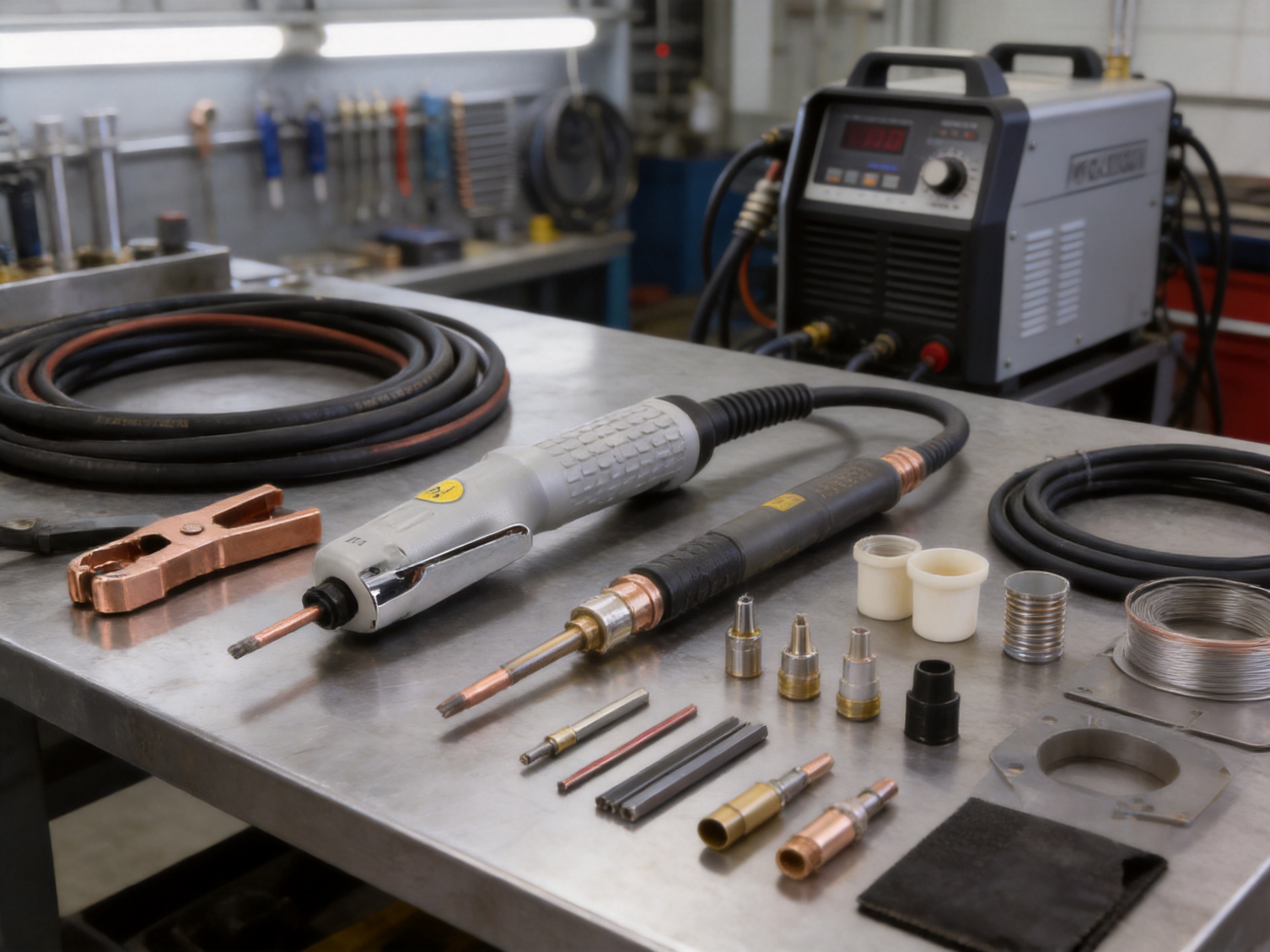
Welding accessories carry electrical current and may be exposed to high temperature, radiation, molten metal, compressed gas, and moving machinery. Safe selection and use are essential. Accessories should be inspected before operation, installed according to the equipment instructions, and removed from service when they show serious damage.
Electrical connections should be tight, clean, and correctly matched. Loose connections can generate heat and increase the risk of failure. Exposed conductors, damaged insulation, and cracked holders should not be ignored. The work-return clamp should be connected to a clean and suitable location on the workpiece or welding table.
Gas hoses and fittings should be checked for leakage, damage, and correct connection. Shielding-gas problems can affect weld quality and may create an unsafe working environment. Plasma and gas-welding applications require particular attention to compressed-gas handling, ventilation, and protection from sparks.
Operators should use suitable personal protective equipment, including a welding helmet with the correct shade, protective clothing, gloves, safety footwear, and eye protection where required. Accessories cannot replace safe working procedures, proper ventilation, fire prevention, or training. The correct accessory is one part of a complete safety system.
Regular maintenance can extend the useful life of welding accessories and reduce unplanned downtime. A maintenance program should include routine cleaning, inspection, tightening, replacement of worn consumables, and functional checks.
Cables should be stored without sharp bends or unnecessary twisting. Torches and holders should be protected from impact and excessive heat when not in use. Contact tips, nozzles, electrodes, gas cups, and other consumable parts should be replaced according to their condition rather than being used until complete failure.
Cleaning procedures should be suitable for the accessory material. Metal spatter should be removed carefully from torch nozzles and shields. Gas passages should be kept clear. Connectors should be protected from dirt and moisture. Abrasive methods that damage sealing or contact surfaces should be avoided.
Maintenance records can help identify recurring problems. If contact tips are wearing unusually quickly, the cause may be incorrect wire size, poor liner condition, excessive current, or unsuitable wire tension. If cables overheat, the issue may involve current levels, duty cycle, connection quality, or insufficient conductor capacity. A systematic approach is more effective than replacing parts without investigating the underlying cause.
Distributors benefit from a product range that serves several welding processes. Instead of stocking unrelated accessories from many manufacturers, they can build a more coherent inventory around compatible welding equipment and replacement parts. This can simplify product training, technical support, packaging, and customer communication.
Industrial buyers may benefit from centralized sourcing. A manufacturer capable of supplying welding machines, chargers, heaters, and accessories can support a wider range of workshop requirements. Consolidated purchasing may improve order coordination and make it easier to establish consistent replacement standards across multiple sites.
For export markets, certifications and documentation are important considerations. The company’s broader product portfolio includes products certified or recognized under standards and marks such as CE, EMC, ERP, GS, ETL, UKCA, and China CCC, depending on the applicable product. The exact certification requirements for a particular accessory should be confirmed during the purchasing process.
Export experience also supports practical packaging, documentation, production scheduling, and communication with international customers. The company exports approximately 1.5 million units annually and has an annual production capacity of about 2 million units across its product range. This scale indicates the ability to manage volume requirements while continuing to support different regional and customer specifications.
The manufacturer is located in Taizhou, Zhejiang Province, China, and operates from a facility covering approximately 120,000 square meters. Its workforce includes about 600 employees, supported by a modern joint-stock management structure and a team of experienced technical and administrative personnel.
The company specializes in electric welding machines, battery chargers, heaters, and related products. Its welding portfolio includes MMA or stick welding machines, MIG/MAG machines, flux-cored welding machines, TIG machines, plasma cutting machines, stud welding machines, and automatic submerged arc welding machines. This broad product knowledge provides a technical foundation for developing and supplying compatible parts.
The company also has experience with electric, gas, and oil heaters, as well as battery charging equipment. Although these products belong to different application categories, they demonstrate experience in electrical design, thermal management, manufacturing control, international compliance, and high-volume production.
As one of the national standard drafting units associated with welding-machine standardization, the company has participated in the drafting, formulation, and revision of twenty national standards and has led the drafting of one group standard. Participation in standardization activities can help a manufacturer understand technical requirements, performance expectations, testing methods, and industry development trends.
Welding users in different regions may require different input voltages, plug configurations, cable lengths, connector styles, operating instructions, packaging formats, or accessory combinations. Industrial users may also need a part adapted to a particular machine layout, production line, or maintenance procedure.
Customization should begin with a clear technical description. Relevant information may include the welding process, machine model, rated current, duty cycle, cable length, connection type, work environment, expected quantity, and application photographs. Samples or drawings may be requested when dimensions or interfaces are non-standard.
A strong manufacturer can evaluate whether an existing component is suitable, whether a standard variation is sufficient, or whether a new design is required. Engineering review helps prevent problems caused by assumptions. It also allows the manufacturer to consider tooling, test requirements, material availability, production volume, packaging, and regulatory obligations before confirming a solution.
Regional adaptation is not limited to electrical specifications. Climate, transportation conditions, local working habits, service capabilities, and customer expectations may also influence the final product. Clear communication between the buyer and manufacturer is essential for achieving the correct result.
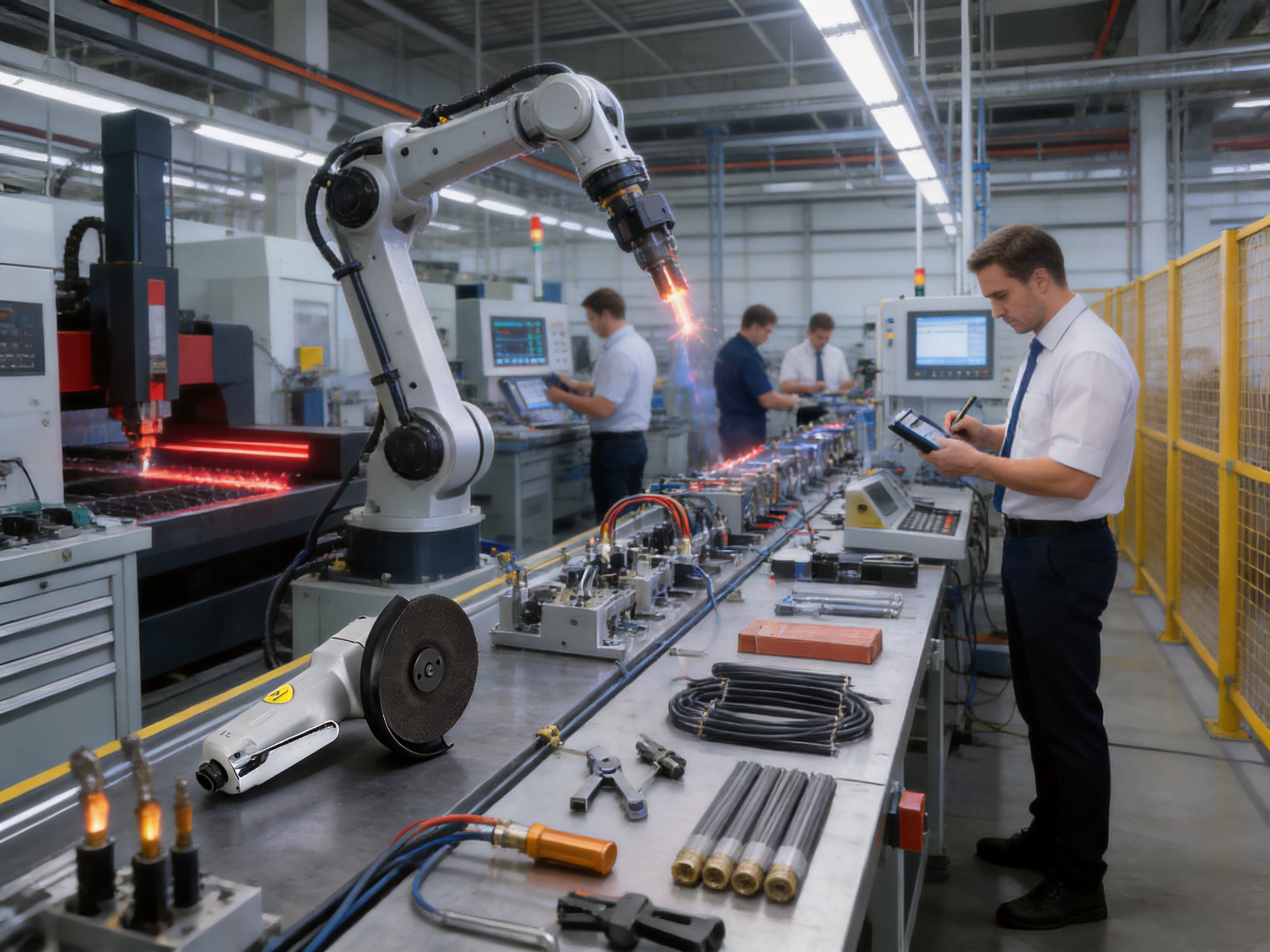
Manufacturing integration is one of the strongest advantages of sourcing parts from an established welding-equipment producer. The same organization understands the power source, control system, current path, thermal behavior, and application environment. This helps connect accessory design with actual welding performance.
Integrated manufacturing can also improve feedback. If service departments report repeated wear on a specific component, engineering teams can review the design and production process. If customers require a new connection or torch arrangement, the change can be evaluated within the wider equipment system. This feedback cycle supports gradual product improvement.
Another advantage is production coordination. A manufacturer with automated assembly, robotic processing, laser cutting, ERP systems, and MES management can coordinate parts production with machine production. This may help maintain consistent specifications and improve delivery planning, especially for customers ordering complete equipment packages.
Integration does not remove the need for technical confirmation. Buyers should still verify specifications, certifications, compatibility, and intended use. However, it can reduce the risks associated with purchasing components from suppliers that have no understanding of the welding system in which the parts will operate.
Before ordering welding parts, users should identify the welding process and the exact equipment with which the accessory will be used. The machine model, torch model, connector type, cable size, and current requirement should be recorded where possible.
The buyer should then define the operating conditions. Important questions include whether the accessory will be used indoors or outdoors, intermittently or continuously, in a clean or dusty environment, in a fixed position or with frequent movement, and at low, medium, or high current.
Quantity and replacement planning should also be considered. Production users may need to purchase critical consumables in reserve to avoid downtime. Distributors may require retail packaging, multilingual instructions, barcode information, or private-label arrangements. Large industrial users may need batch traceability and scheduled deliveries.
Finally, the buyer should confirm inspection requirements, packaging, lead time, documentation, and after-sales support. Clear specifications at the beginning of the purchase process help prevent delays and reduce the chance of receiving an unsuitable product.
The Parts category covers welding accessories and related replacement components. Depending on the welding process, these may include holders, clamps, cables, connectors, torches, contact tips, nozzles, liners, gas cups, plasma consumables, cooling connections, and other supporting parts. The exact selection should be confirmed according to the required machine and application.
Different welding processes require different accessories. An MMA electrode holder is not interchangeable with a MIG/MAG torch, and a TIG gas cup is not a plasma nozzle. Some general components, such as selected cables or connectors, may have broader compatibility, but technical specifications must be checked before use.
Consider the welding current, duty cycle, cable length, conductor capacity, flexibility, insulation, connection type, and working environment. A cable should not be selected only by physical appearance. If the cable is too small for the required current or operating period, it may overheat and suffer premature failure.
Replacement is recommended when an accessory has damaged insulation, loose or overheated connections, severe wear, unstable operation, reduced gas flow, distorted contact surfaces, cracked insulation, or other defects that may affect safety or performance. Consumables should generally be replaced when their condition begins to affect arc stability, cutting quality, or shielding.
Customized solutions may be possible for cable lengths, connector configurations, torch arrangements, packaging, regional specifications, and other requirements. Buyers should provide technical drawings, machine information, samples, photographs, quantity estimates, and operating conditions so the engineering team can evaluate the request accurately.
A welding-machine manufacturer understands the relationship between accessories and the power source, current path, arc behavior, cooling system, wire feeder, and control system. This knowledge can help improve compatibility and supports more informed accessory development, testing, and technical service.
The product category is intended to support professional welding and industrial applications, but suitability depends on the specific part, rating, and operating conditions. Users should confirm the rated current, duty cycle, compatibility, and applicable instructions for each component before placing it into service.
Useful information includes the welding process, machine model, accessory name, required quantity, current rating, cable length, connector type, dimensions, application, destination market, packaging requirements, and any certification or documentation needs. Photographs and existing part numbers can also help with identification.
Welding parts and accessories are essential to the performance, safety, and serviceability of welding equipment. They influence current transfer, shielding, wire feeding, arc control, operator comfort, maintenance time, and production consistency. Selecting the right accessory is therefore an engineering decision rather than a minor purchasing detail.
The Parts category provides support for MMA, MIG/MAG, TIG, plasma cutting, submerged arc welding, resistance welding, and related applications. Its value comes from broad process coverage, compatibility knowledge, replacement convenience, customization potential, and integration with a larger welding-equipment manufacturing system.
The manufacturer combines substantial production capacity with research and development resources, automated manufacturing technologies, robotic processing, laser cutting, electronic assembly, enterprise management systems, and international market experience. Its involvement in welding standards and extensive product certification further supports its ability to serve professional and industrial customers.
For users seeking dependable welding accessories, the best results come from matching each part to the machine, process, current, duty cycle, environment, and maintenance plan. With accurate technical communication and appropriate selection, welding parts can help reduce downtime, improve weld consistency, extend equipment life, and create a more efficient workshop or production line.
1. American Welding Society, Welding Processes and Equipment: General Principles and Industrial Applications.
2. American Welding Society, Safety in Welding, Cutting, and Allied Processes.
3. International Electrotechnical Commission, Arc Welding Equipment: Power Sources and Related Requirements.
4. International Organization for Standardization, Quality Requirements for Fusion Welding of Metallic Materials.
5. International Organization for Standardization, Welding Consumables and Classification Principles.
6. National Welding Machine Standardization Committee, Technical Guidance for Electric Welding Equipment and Welding Accessories.
7. Manufacturer technical information concerning welding machines, battery chargers, heaters, production systems, research facilities, certifications, and manufacturing capacity.
Recommended Products

Contact Us
No.2299, Luqiao Section, Shugang Avenue, Luqiao District, Taizhou, 318057 Zhejiang, PR China.
+86-576-82431568
 Privacy
China Welding Machine Factory
 English
 中文简体
 русский
 Español
 عربى
 Français
 Português
 Deutsch
 Український