Email: [email protected]
Email: [email protected]

Blog
 2026.10.30
 Blog
Drawn arc stud welding is an efficient method for attaching threaded studs, pins, anchors, and other metal fasteners directly to a base material. Instead of drilling holes, inserting bolts, or using additional adhesives, the process creates a permanent welded connection between the stud and the workpiece. This makes stud welding especially valuable in construction, shipbuilding, steel fabrication, pressure vessels, industrial equipment, automotive manufacturing, infrastructure projects, and many other fields where speed, strength, and repeatability are essential.
The RSN-1000/1200 Digital Control Drawn Arc Stud Welding Machines are designed for demanding industrial applications that require dependable welding performance and accurate process control. The machines combine advanced microprocessor control, LCD display technology, high-current output, touch-button operation, and protective monitoring functions in a compact and mobile package. They support drawn arc stud welding with either ceramic ferrule protection or shielding gas, allowing users to select a suitable welding method for different materials, joint designs, and production conditions.
The RSN series is intended to provide a practical balance between high output capacity and straightforward operation. The RSN-1000 model offers a welding current adjustment range of 100 to 1,000 amperes and is suitable for weldable stud diameters from approximately 3 to 10 millimeters. The RSN-1200 extends the capability to studs up to approximately 12 millimeters in diameter. Both machines are built around a three-phase 380-volt power supply and are designed for professional users who need stable welding quality rather than occasional light-duty performance.
Compared with conventional stud welding equipment that relies heavily on manual adjustment, the digital control design provides more consistent parameter setting, better process visibility, and improved operating convenience. The system also includes technical measures for checking the welding torch switch, workpiece contact, protective gas, and temperature condition. These features help reduce operating errors and support a more controlled production process.

RSN-1000/1200 Digital control Drawn Arc (DA) Stud Welding Machines
Drawn arc stud welding is a process in which a metal stud is positioned against a prepared workpiece and briefly lifted to create an electric arc. The arc melts the end of the stud and a small area of the base material. The stud is then plunged into the molten pool, and the materials solidify to form a strong welded joint. A ceramic ferrule, often called a porcelain ring, can surround the welding area to contain the arc and molten metal. In other applications, shielding gas can be used to protect the weld from atmospheric contamination.
The welding time is short, and the heat-affected zone is relatively small compared with many conventional welding processes. As a result, the workpiece generally experiences limited deformation after welding. This is important when studs must be attached to thin sheet metal, finished surfaces, large structural components, or assemblies that would be difficult to straighten after welding.
Drawn arc stud welding can also improve production efficiency. A trained operator can weld many studs in a short period without marking, drilling, tapping, or installing separate mechanical fasteners. The process is suitable for carbon steel, stainless steel, copper, aluminum, and certain alloys, provided that the stud, base material, surface condition, and welding parameters are properly matched.
Successful stud welding depends on several factors, including current, weld time, stud diameter, stud material, base material, surface cleanliness, lifting distance, plunge movement, and shielding method. A machine with accurate and stable control is therefore important. If current or time varies significantly from one weld to the next, the resulting joints may have inconsistent penetration, excessive spatter, incomplete fusion, or reduced mechanical strength.
The RSN-1000/1200 series is a digital-control drawn arc stud welding solution developed for industrial users. Its design emphasizes stable output, convenient parameter adjustment, rapid welding, and operational safety. The main model referenced in the available technical information is the RSN-1000, while the RSN-1200 provides a higher stud diameter capability.
| Specification | RSN-1000 | RSN-1200 |
|---|---|---|
| Product type | Digital drawn arc stud welding machine | Digital drawn arc stud welding machine |
| Power supply | Three-phase, 380 V | Three-phase, 380 V |
| Supply voltage tolerance | 380 V ±15% | Designed for the same industrial supply family |
| Frequency | 50/60 Hz | 50/60 Hz |
| Welding current adjustment | 100–1,000 A | Higher-capacity configuration |
| Maximum output current | 1,000 A | Up to approximately 1,200 A class |
| Stud diameter range | Approximately 3–10 mm | Up to approximately 12 mm |
| Rated no-load voltage | 85 V | Model-dependent |
| Rated load duration | At least 15% | Model-dependent |
| Power factor | 0.95 | Model-dependent |
| Protection class | IP21S | Model-dependent |
| Insulation class | F | F-class design family |
| Approximate weight | 45 kg | Higher-capacity configuration may vary |
| Approximate dimensions | 650 × 550 × 600 mm | Model-dependent |
The RSN-1000 specification provides a useful indication of the machine’s industrial positioning. A maximum welding current of 1,000 amperes supports a broad range of drawn arc stud welding work, while the 100–1,000 ampere adjustment range allows operators to adapt the machine to different stud diameters and material combinations. The RSN-1200 is intended for applications that require additional capacity, including larger studs and heavier fastening requirements.
One of the most important advantages of the machine is its advanced microprocessor and LCD display control system. Digital control enables the welding process to be managed through electronic logic rather than relying only on mechanical adjustment or operator estimation. Parameters can be selected and set using touch buttons, and the LCD display gives the operator a clearer view of the selected settings.
For industrial welding, parameter visibility is valuable because it supports repeatability. When several operators use the same machine, clearly displayed settings help standardize the process. Supervisors can also review the selected current, time, and operating mode more easily than with a basic analog panel. This can assist with work instructions, quality checks, and production troubleshooting.
The microprocessor also coordinates the sequence of operations. The machine must recognize the proper relationship between the welding torch, the stud, and the workpiece before beginning the welding cycle. It must then control the arc period, the movement of the stud, and the end of the weld. Electronic sequencing helps reduce timing variation and improves the consistency of each weld when the operator follows the correct procedure.
Digital control may also offer an advantage over older equipment in environments where multiple materials and stud sizes are used. Operators can select appropriate settings for carbon steel, stainless steel, copper, aluminum, or alloy studs instead of depending on a single generalized setting. The exact parameters should always be established through approved welding procedures and test welds, but the machine provides a more suitable platform for this controlled approach.
The machine uses contactless point control technology in the main circuit. This design is intended to improve reliability by reducing dependence on physical switching contacts in a high-current section. In high-current welding equipment, contact wear, arcing, and contamination can affect service life and process stability. A contactless control approach can help support consistent operation when the equipment is correctly maintained and used within its rated conditions.
The stated rated load duration of the RSN-1000 is at least 15 percent. Stud welding usually involves short individual welds, so a machine’s practical productivity depends not only on its rated current but also on the length of each weld cycle, the spacing between studs, the operator’s movement, and the required cooling time. The high-current capability and short welding period allow the machine to perform repeated industrial welds while maintaining a suitable operating cycle.
Stable output is particularly important in applications where weld quality is judged by both appearance and mechanical performance. A weld that appears acceptable may still have insufficient fusion if the current, time, or stud movement is incorrect. The combination of electronic control, parameter selection, and process monitoring is therefore more valuable than simply having a high maximum current.
Compared with low-cost machines designed mainly for occasional use, the RSN series is positioned for users who need a more systematic and repeatable approach. Its industrial power supply, high-current output, digital interface, and monitoring functions make it better suited to fabrication shops, construction contractors, manufacturing plants, and professional maintenance teams.
The machine allows the operator to select porcelain ring protection or gas protection. This flexibility is useful because the most appropriate protection method can vary according to the workpiece geometry, production environment, stud type, and desired weld appearance.
A ceramic ferrule surrounds the weld zone during the drawn arc cycle. It helps contain the arc, supports the molten pool, and contributes to a consistent weld profile. Ferrules are commonly used in structural and general-purpose stud welding because they are simple to position and can provide effective protection when the work surface is accessible and reasonably flat.
Shielding gas can be useful when a ceramic ferrule is impractical or when a particular material and weld configuration benefits from gas protection. Gas shielding may be selected for certain production arrangements, specialized components, or applications where the operator needs a different method of controlling atmospheric exposure. The machine’s ability to support both options gives users greater process flexibility than equipment limited to only one protection method.
Operators should select the correct shielding method according to the approved welding procedure. Gas type, flow rate, torch condition, surface cleanliness, and environmental airflow can influence results. In outdoor or windy conditions, shielding gas may require special attention, while ferrules may be more convenient for many structural applications.
The product information identifies several monitored conditions: the welding torch switch, contact between the workpiece and the welding torch, protective gas, and temperature. These checks are important because a drawn arc stud welding cycle should not begin unless the basic conditions for a safe and effective weld are present.
Torch switch monitoring helps confirm that the operator has intentionally initiated the process. Workpiece and torch contact monitoring helps verify that the welding circuit is properly established. If the torch is not positioned correctly, the machine may not produce the intended arc or plunge movement. Protective gas monitoring helps identify an inadequate shielding condition when gas protection is selected.
Temperature control is also important for protecting the machine during demanding operation. Power electronics, transformers, cables, and internal components generate heat during high-current welding. If temperature rises beyond a safe operating range, protective measures can reduce the risk of component damage. Correct ventilation, regular cleaning, and compliance with the duty cycle remain necessary even when the machine includes thermal protection.
These monitoring functions provide an advantage over extremely basic stud welders that offer limited feedback. They do not replace operator training or inspection, but they can help prevent some incorrect operating conditions before they result in a poor weld or equipment fault.
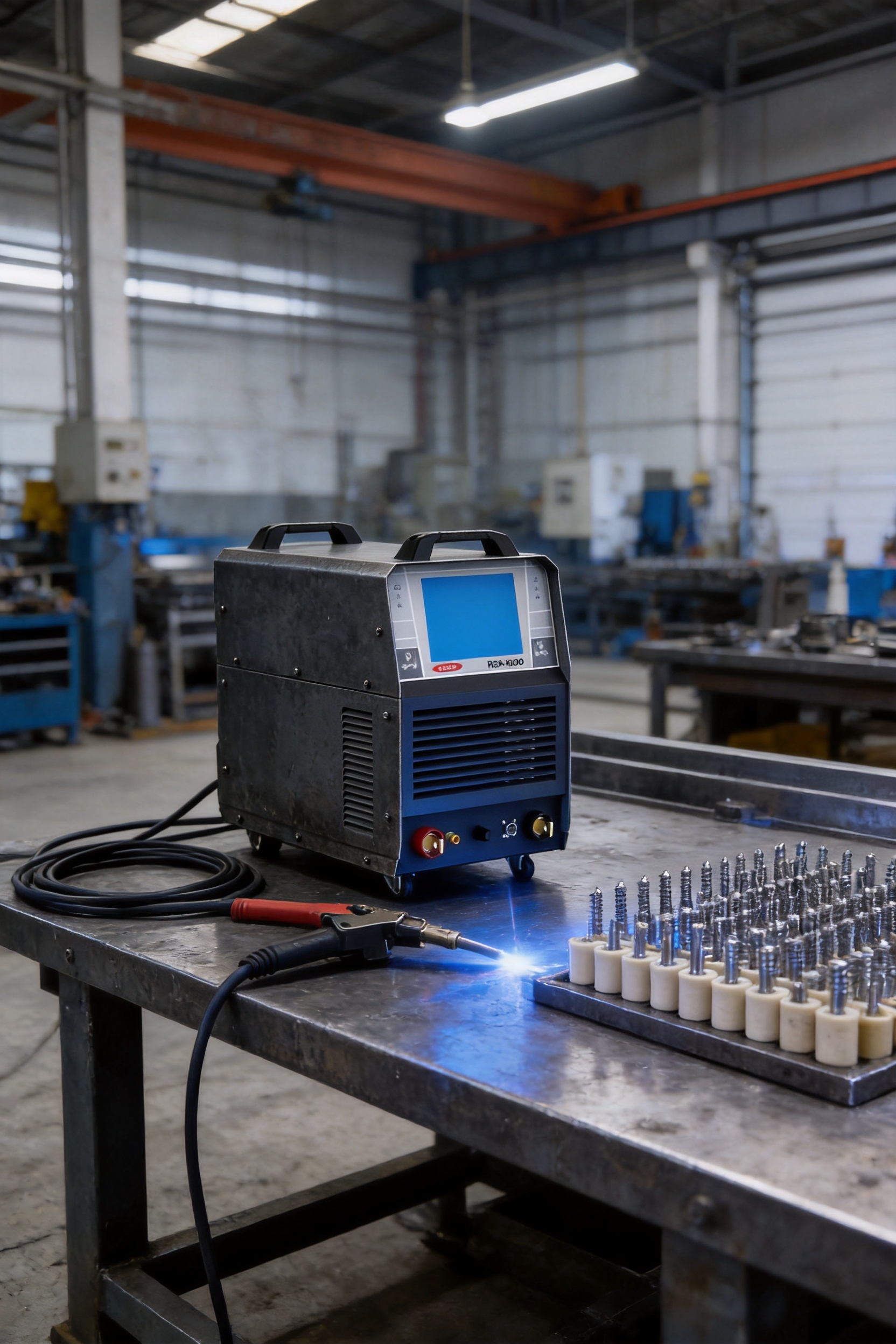
The welding time can be set within a range of approximately 0 to 3 seconds. In many practical stud welding operations, the actual time required is much shorter than this maximum. The suitable time depends on the stud diameter, material combination, current, surface condition, and welding procedure.
A short welding cycle offers two major benefits. First, it improves productivity by allowing more studs to be installed within a given working period. Second, it limits the amount of heat transferred into the surrounding workpiece. Lower overall heat input generally means a smaller heat-affected zone and reduced risk of distortion.
Low deformation is especially valuable when studs are installed on sheet metal, enclosures, panels, tanks, frames, or components that must retain accurate dimensions. Conventional welding methods may require additional fixtures, straightening, grinding, or finishing after the fasteners are attached. Drawn arc stud welding can reduce the need for these secondary operations when the procedure is correctly selected.
It is important to understand that low deformation does not mean that distortion is impossible. Thin materials, closely spaced studs, excessive current, long weld times, poor fit-up, or improper grounding can still create problems. Operators should use appropriate test pieces and inspect the first production welds before beginning a large batch.
The machine is suitable for welding studs made from or used with carbon steel, stainless steel, copper, aluminum, and their alloys. Material compatibility should always be assessed carefully because different metals have different electrical resistance, thermal conductivity, melting behavior, oxidation characteristics, and metallurgical requirements.
Carbon steel is widely used in structural fabrication, machinery, frames, supports, and general industrial components. Stainless steel studs can be used where corrosion resistance, cleanliness, or elevated service requirements are important. Copper and aluminum require careful parameter selection because they conduct heat and electricity differently from steel. Surface preparation is particularly important for aluminum because oxide layers can interfere with the welding process.
The stud must also be matched to the application. Studs may be threaded, unthreaded, headed, internally threaded, or specially shaped. The machine’s stated weldable diameter range is an important starting point, but the final selection should consider stud length, flange design, material grade, base thickness, and loading requirements.
The RSN-1000 is specified for weldable peg diameters from approximately 3 to 10 millimeters, while the broader product description identifies the RSN-1200 as suitable for studs up to approximately 12 millimeters. The listed RSN-1000 information also indicates a weldable peg length of up to approximately 400 millimeters, although the practical limit will depend on the torch, chuck, stud design, and application arrangement.
Drawn arc stud welding is used in many industries because it can attach fasteners quickly without requiring access to both sides of a workpiece. This one-sided installation capability is valuable for large structures, closed sections, tanks, vessels, and panels.
In structural steel fabrication, studs can be used to attach decking components, brackets, insulation supports, cable supports, cladding attachments, and other accessories. The machine’s high-current capacity is appropriate for industrial steelwork where many studs must be installed efficiently.
In shipbuilding and marine fabrication, stud welding can support the installation of pipe clips, insulation pins, liners, supports, and equipment attachments. The ability to work from one side is helpful when access behind a plate is limited. Surface preparation and corrosion-control procedures are especially important in marine environments.
In pressure vessel and tank manufacturing, studs may be used for insulation systems, internal fittings, support components, and removable fixtures. Operators must follow the applicable engineering and inspection requirements because the importance of the welded attachment depends on the service conditions of the vessel.
In automotive and transportation manufacturing, stud welding can be used for body components, brackets, trim attachments, and equipment mounting points. The low heat input and limited deformation of the process can help preserve panel shape and surface quality.
In industrial machinery production, studs can provide mounting points for guards, electrical components, covers, pipes, sensors, and internal accessories. The process can simplify assembly and reduce the need for drilling and tapping after fabrication.
In construction equipment and agricultural machinery, larger studs may be used for attachment points, protective structures, hydraulic supports, and accessory mounting. The higher-capacity RSN-1200 configuration can be considered where the application requires larger-diameter studs, subject to procedure qualification.
In general repair and maintenance, stud welding can restore or add fastening points without extensive disassembly. It is particularly useful when the reverse side of the workpiece is inaccessible or when drilling would damage an existing coating, lining, or finished surface.
Bolted fastening often requires marking, drilling, deburring, alignment, and access for a nut or tool. Drawn arc stud welding can eliminate many of these steps. Once the surface is prepared and the welding location is identified, the operator can place the stud and complete the weld directly.
A welded stud does not require access to the rear side of the workpiece. This is a major advantage for closed boxes, large plates, tanks, ducts, and installed structures. It can reduce disassembly and make difficult repair or modification work more practical.
The short welding cycle allows a large number of studs to be installed efficiently. Faster installation can reduce labor time and support higher production throughput, especially when the machine is used with a properly organized work sequence.
The small heat-affected zone can reduce deformation compared with longer welding operations. This may lower the need for post-weld straightening and help preserve the dimensional accuracy of panels and assemblies.
When the surface is prepared correctly and the parameters are suitable, stud welding produces a compact attachment with no drilled hole passing through the workpiece. This can help maintain the integrity of the base material and produce a visually consistent pattern of fasteners.
Because the stud is installed during the welding operation, subsequent tapping, bolting, or hardware installation may be reduced. The overall production process can become simpler and more integrated.
The RSN-1000/1200 series has several characteristics that distinguish it from simpler equipment. The most important is the digital control system. A basic machine may provide only limited adjustment and little information about the selected settings. The LCD interface and touch-button operation make the process more transparent and easier to standardize.
The second advantage is the combination of high-current output and controlled short-time welding. High current alone does not guarantee good results, but high current combined with accurate timing and stable sequencing provides a stronger foundation for welding a variety of stud sizes.
The third advantage is the ability to select ceramic ferrule or gas protection. This allows the machine to adapt to different production conditions rather than forcing the user to adopt one protection method for every application.
The fourth advantage is the range of monitoring functions. Checking the torch switch, workpiece contact, protective gas, and temperature can help prevent incorrect operation and protect the equipment. These functions are particularly useful in professional workshops where reliability and repeatability are more important than the lowest initial purchase price.
The fifth advantage is mobility. With an approximate RSN-1000 weight of 45 kilograms and dimensions of approximately 650 by 550 by 600 millimeters, the machine is substantial enough for industrial work but still movable within a workshop or jobsite with appropriate handling equipment. Its compact structure helps users bring high-current stud welding capability closer to the workpiece.
The manufacturer behind the product operates as a large-scale producer of welding machines, battery chargers, and heating equipment. Its reported production capability includes an annual output of nearly 1.5 million exported units and an annual production capacity of approximately 2 million units. This scale indicates experience in component sourcing, production planning, quality management, product testing, and international logistics.
The company occupies an area of approximately 120,000 square meters and employs around 600 people. A manufacturing organization of this size can support specialized departments for engineering, purchasing, production, quality control, certification, after-sales service, and export coordination. For industrial customers, this infrastructure is important because product value includes not only the machine itself but also technical support, spare parts, documentation, and long-term supply capability.
Its manufacturing systems include automated surface-mount technology, plug-in and welding processes, robot processing, laser cutting, and other advanced production methods. Automated and semi-automated processes can improve repeatability in electronic assembly and metal fabrication. Laser cutting supports accurate preparation of sheet-metal components, while robotic processing can improve consistency in repetitive operations.
The company also applies management and information systems that include office automation, Toyota-style production management, enterprise resource planning, and manufacturing execution systems. These tools can support production traceability, inventory control, scheduling, process monitoring, and coordination between departments. Strong production management is especially relevant to welding machines because electrical, mechanical, and software-related components must work together reliably.
Research and development capabilities include a provincial research and development center, an enterprise technology center, and an intelligent welding technology research institute. The company reports approximately 98 research and development personnel, as well as invention patents, utility model patents, appearance patents, and software copyrights. These resources support continued development of inverter technology, control systems, product structures, thermal management, and user interfaces.
The company also participates in national welding machine standardization activities and has contributed to the drafting, formulation, or revision of numerous national standards. Participation in standardization work can provide valuable technical experience and a closer understanding of safety, performance, testing, and manufacturing requirements.
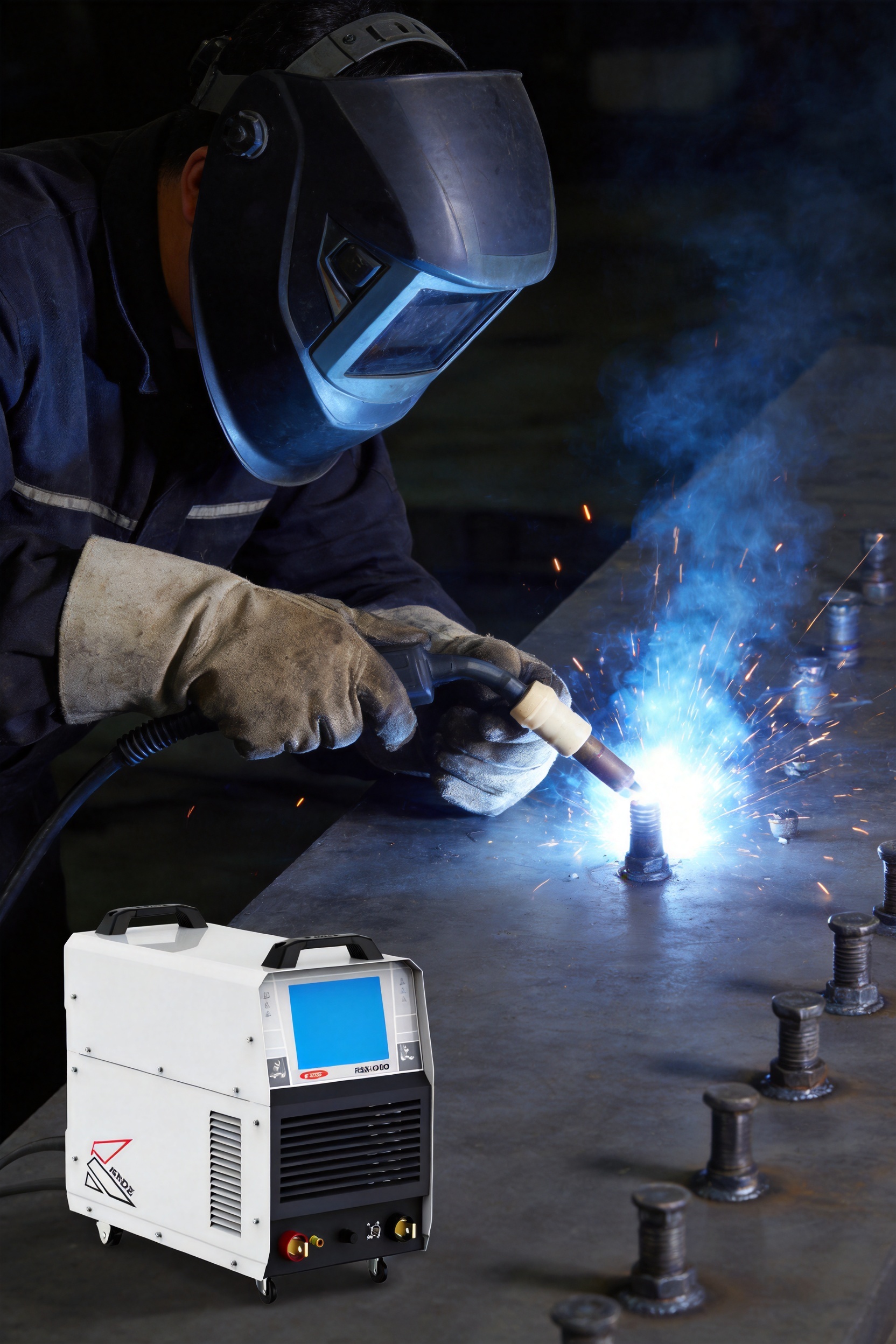
The manufacturer reports holding product certifications and compliance marks that include GS, CE, EMC, ERP, ETL, UKCA, and China CCC. The exact certification applicable to a specific model, voltage version, market, and shipment should be confirmed before purchase. Nevertheless, the range of reported certifications demonstrates experience in preparing products for different regulatory environments.
For welding equipment, compliance is relevant to electrical safety, electromagnetic compatibility, energy performance where applicable, insulation, protective construction, and user documentation. Certifications do not replace correct installation or maintenance, but they provide an additional indication that the product has been developed with formal market requirements in mind.
The RSN-1000 technical information identifies an insulation class of F and a protection class of IP21S. These ratings should be understood in relation to the installation environment. The machine should be protected from rain, conductive dust, corrosive vapors, excessive humidity, and conditions outside the specified operating range. IP21S equipment is not intended to be treated as fully weatherproof outdoor equipment.
The machine is designed for a three-phase 380-volt, 50/60 hertz power supply, with a stated supply voltage tolerance of 380 volts plus or minus 15 percent. Installation should be performed by a qualified electrician who can verify the available voltage, phase arrangement, grounding, protective devices, and cable capacity.
The power source should be capable of supporting the machine’s input requirements. The listed RSN-1000 data identifies a rated input power of approximately 40 and an instantaneous maximum input power of approximately 44 kVA. These figures should be checked against the final nameplate and installation documentation because power requirements can vary by model revision and operating condition.
Good grounding is essential for both safety and welding performance. The workpiece connection should be secure, clean, and positioned appropriately for the welding operation. Poor grounding can cause unstable arc behavior, increased heating at the connection point, inconsistent welds, and possible damage to cables or connectors.
The machine should be installed where air can circulate freely around ventilation openings. Dust and metal particles should not be allowed to accumulate inside the enclosure. Adequate clearance should be provided for inspection, cable connection, service access, and safe movement of the operator.
Remove oil, grease, paint, rust, scale, moisture, and other contamination from the welding location. The required preparation method depends on the base material and coating system. Do not remove protective coatings from areas that are not intended for welding, and follow site procedures for fumes and surface-treatment waste.
Choose a stud that matches the mechanical design and base material. Confirm the stud diameter is within the machine’s suitable range. Select a ceramic ferrule or shielding gas arrangement according to the approved welding procedure, joint design, and working environment.
Connect the power supply, welding torch, work return, and any required gas system. Inspect cables, connectors, collets, ferrules, and torch components before beginning. Damaged or loose components can affect both safety and weld quality.
Use the touch buttons and LCD display to select the appropriate current and welding time. The correct settings must be determined by stud size, material, base thickness, and procedure qualification. Do not assume that one setting is suitable for every stud or workpiece.
Place the stud perpendicular to the workpiece unless the procedure specifies another orientation. Ensure that the stud, ferrule, and torch are seated correctly. The work return should be close enough to provide a reliable circuit while avoiding interference with the welding operation.
Before production welding, make test welds on representative material. Inspect the weld collar, stud alignment, evidence of fusion, visible defects, and mechanical integrity. Destructive or non-destructive testing should be used when required by the project specification.
Once the settings and technique are confirmed, follow a consistent sequence. Maintain the correct torch pressure and position, keep the workpiece surface clean, and monitor the machine for warnings or abnormal sounds. Replace ferrules and consumable components as required.
Routine maintenance helps preserve welding performance and extend equipment life. Operators should inspect the power cable, welding cable, ground connection, torch switch, collet, gas hose, connectors, ventilation openings, and enclosure at regular intervals.
Dust and metal particles should be removed using an approved cleaning method. Compressed air may drive contamination deeper into sensitive components if used incorrectly, so cleaning should follow the manufacturer’s service instructions. The machine should be disconnected from the power supply before internal inspection or service.
The torch is a critical part of the process. A worn collet may not hold the stud firmly or may create poor electrical contact. A damaged ceramic ferrule can alter arc containment and weld shape. Gas equipment should be checked for leaks, correct flow, and adequate cylinder supply when gas protection is used.
Abnormal overheating, repeated protection alarms, unstable output, unusual noise, or poor weld quality should be investigated promptly. Continued operation under fault conditions can increase repair costs and create safety risks. Service should be carried out by personnel familiar with high-current welding equipment and electrical hazards.
Drawn arc stud welding produces intense light, heat, molten metal, ultraviolet radiation, fumes, and electrical hazards. Operators must wear suitable welding clothing, gloves, eye and face protection, safety footwear, and hearing protection where appropriate. Nearby workers should be protected from arc radiation by screens or suitable separation.
Ventilation is necessary to control welding fumes. Coated, painted, galvanized, or contaminated materials may release hazardous substances when heated. The workpiece and its coatings should be evaluated before welding, and local exhaust ventilation should be used where required.
Flammable materials must be removed from the welding area. Sparks and hot metal can travel farther than expected, particularly in industrial buildings or construction sites. Fire watches, extinguishers, hot-work permits, and site-specific controls should be used according to the applicable safety program.
Only qualified personnel should connect or service the three-phase power supply. The machine should be properly grounded, and electrical protection should be selected for the actual installation. Operators should never bypass interlocks, remove protective covers during operation, or attempt to repair energized equipment.
The RSN-1000 is appropriate when the required stud diameter is generally within the approximately 3–10 millimeter range and the application can be supported by a maximum current of 1,000 amperes. It may be a practical choice for general fabrication, structural accessories, equipment mounting, and standard industrial stud welding.
The RSN-1200 should be considered when the project requires studs up to approximately 12 millimeters or when additional current capacity is desirable. Larger studs and heavier base materials may require more energy to establish a sound weld. However, the correct choice should be based on procedure requirements rather than maximum capacity alone.
Buyers should confirm the exact technical data for the selected model, including input power, output current, duty cycle, dimensions, weight, torch configuration, accessory package, certification, and local electrical requirements. The final purchase decision should also consider expected production volume, service availability, spare parts, operator skill, and the type of welding procedures required.
The value of a stud welding machine extends beyond its purchase price. A reliable machine can reduce labor time, minimize secondary fabrication, improve attachment consistency, and reduce rework. Digital parameter control can also make it easier to train operators and maintain consistent settings across multiple shifts.
The RSN-1000/1200 series combines these production benefits with a design intended for industrial use. Its high-current output supports a useful range of stud sizes, while its compact structure allows it to be moved between work areas. The choice of ceramic ferrule or gas protection provides process flexibility, and the monitoring functions support safer and more controlled operation.
The manufacturer’s scale, export experience, research resources, certification portfolio, and automated production systems further strengthen the product proposition. Customers purchasing professional welding equipment generally need confidence that the supplier can provide not only the initial machine but also documentation, technical assistance, replacement components, and ongoing product support.
For companies that manufacture or install large numbers of studs, the combination of fast welding, reduced deformation, digital control, and broad material compatibility can produce meaningful operational advantages. The machine is particularly attractive when production teams want to replace slow drilling and bolting operations with a faster one-sided welding process.
It is a digital-control drawn arc stud welding machine. It is designed to weld metal studs to a base material using a controlled arc, stud movement, and either ceramic ferrule protection or shielding gas.
The listed welding current adjustment range is 100 to 1,000 amperes, with a maximum output current of 1,000 amperes.
The RSN-1000 is specified for approximately 3–10 millimeter weldable peg diameters. The RSN-1200 is identified as suitable for studs up to approximately 12 millimeters. Actual capability depends on material, stud design, base thickness, procedure, and torch configuration.
The product information states that the machine is suitable for carbon steel, stainless steel, copper, aluminum, and their alloys. Each material requires suitable surface preparation and validated welding parameters.
Yes. The control system allows selection of porcelain ring protection or gas protection. The appropriate method should be selected according to the approved welding procedure and working conditions.
The welding time can be set within a range of approximately 0 to 3 seconds. The actual time used in production depends on stud size, material, current, surface condition, and procedure requirements.
No. Short welding time and a small heat-affected zone can greatly reduce deformation, but distortion can still occur if the material is thin, the settings are excessive, the studs are too closely spaced, or the workpiece is poorly prepared.
The listed RSN-1000 uses a three-phase 380-volt, 50/60 hertz supply, with a stated voltage tolerance of 380 volts plus or minus 15 percent. A qualified electrician should confirm the exact requirements on the model nameplate and installation documentation.
The RSN-1000 weighs approximately 45 kilograms and has approximate dimensions of 650 by 550 by 600 millimeters. It is movable within a workshop or worksite with suitable handling practices, although it is an industrial machine rather than a handheld unit.
The LCD and touch-button system allows operators to select and set welding parameters and view operating information. The microprocessor coordinates the welding sequence and supports more repeatable operation than a simple manual control system.
The product information identifies checks for the welding torch switch, contact between the workpiece and welding torch, protective gas, and temperature. These functions help monitor operating conditions, but they do not replace operator training, inspection, grounding, ventilation, or protective equipment.
Buyers should confirm the required stud diameter, material, production volume, electrical supply, duty cycle, torch arrangement, protection method, certification, accessory package, installation conditions, spare-part availability, and local technical support.
The RSN-1000/1200 Digital Control Drawn Arc Stud Welding Machines provide a practical solution for industrial users who need fast, consistent, and flexible stud attachment. The RSN-1000 offers a 100–1,000 ampere adjustment range and supports approximately 3–10 millimeter studs, while the RSN-1200 extends the product family toward larger studs up to approximately 12 millimeters.
The machines’ principal advantages include microprocessor control, LCD display operation, touch-button parameter setting, contactless main-circuit control, short welding time, high-current performance, ceramic ferrule or gas protection, and monitoring of key operating conditions. These features help distinguish the product from basic stud welding equipment and provide a stronger foundation for repeatable industrial production.
In addition to the machine design, the manufacturer contributes substantial engineering and manufacturing resources. Its large production base, automated assembly and processing systems, research centers, patent portfolio, international certifications, standardization participation, and export experience support the product’s position as a professional industrial welding solution.
When correctly installed, adjusted, maintained, and operated by trained personnel, the RSN series can help reduce drilling and bolting work, limit heat-related deformation, improve installation speed, and create dependable welded fastening points. For fabrication shops, construction contractors, machinery manufacturers, maintenance teams, and other industrial users, it offers a capable combination of process control, output capacity, flexibility, and manufacturing support.
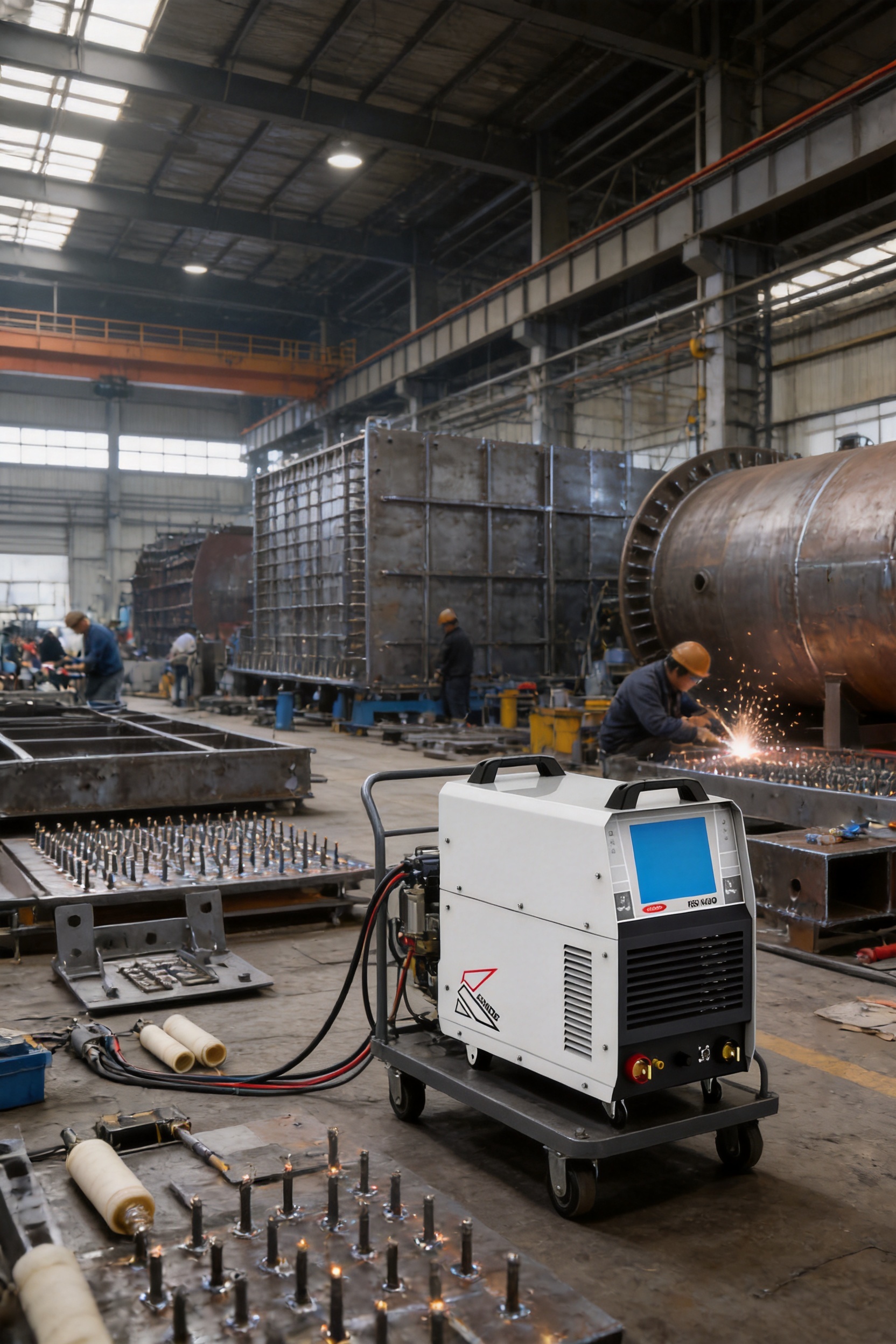
1. Product technical information for RSN-1000/1200 Digital Control Drawn Arc Stud Welding Machines.
2. Manufacturer-provided specifications for welding current, input supply, duty cycle, stud diameter, protection class, insulation class, weight, and dimensions.
3. General principles of drawn arc stud welding, ceramic ferrule protection, and shielding gas protection.
4. Industrial welding equipment safety practices covering electrical grounding, arc radiation, fumes, hot work, and personal protective equipment.
5. General guidance on welding procedure qualification, surface preparation, material compatibility, and weld inspection.
6. Manufacturer-provided information concerning production capacity, research and development facilities, manufacturing systems, patents, certifications, and standardization activities.
Recommended Products

Contact Us
No.2299, Luqiao Section, Shugang Avenue, Luqiao District, Taizhou, 318057 Zhejiang, PR China.
+86-576-82431568
 Privacy
China Welding Machine Factory
 English
 中文简体
 русский
 Español
 عربى
 Français
 Português
 Deutsch
 Український