Email: [email protected]
Email: [email protected]

Blog
 2026.11.01
 Blog
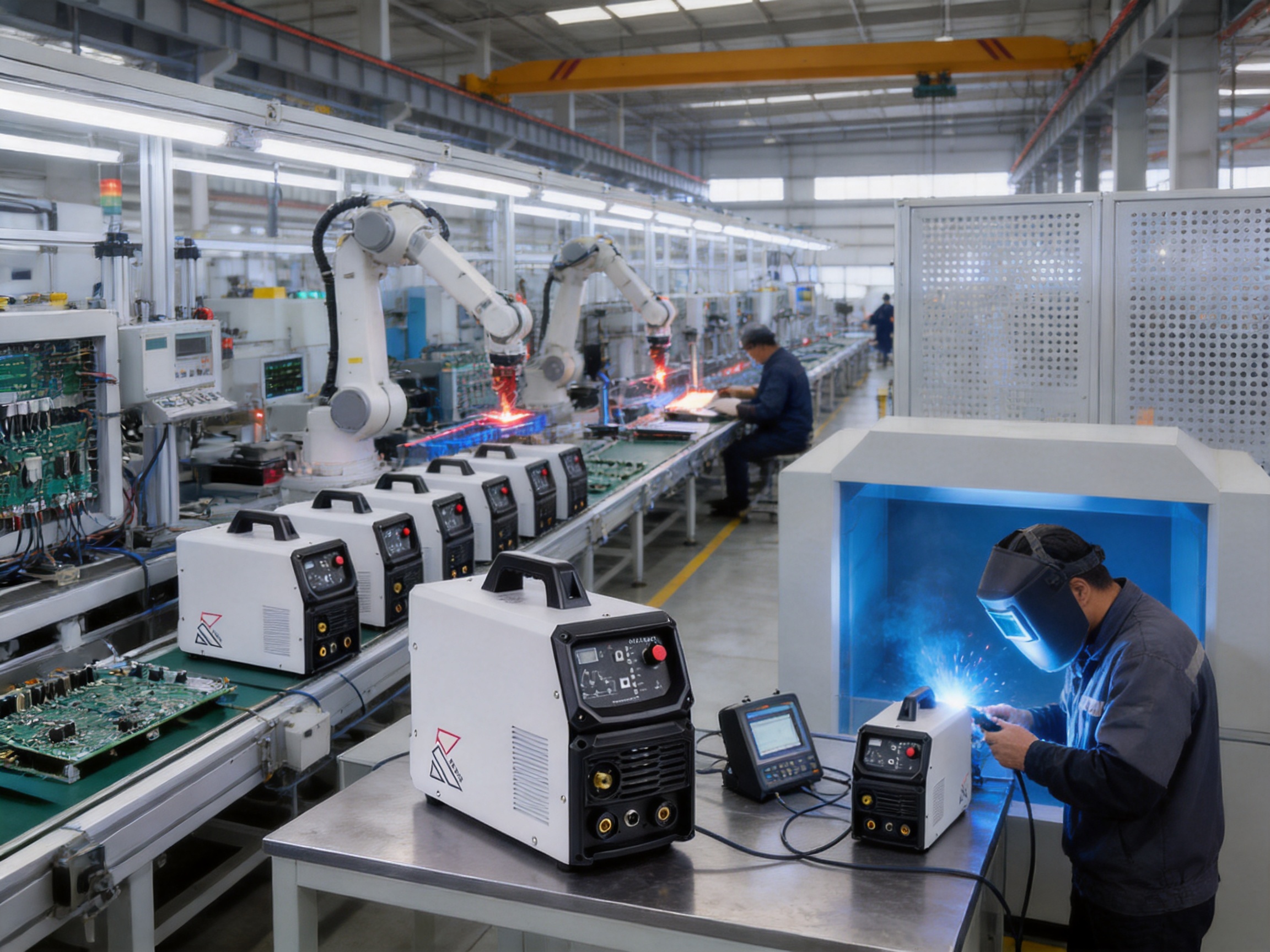
Modern welding operations require equipment that can combine accurate current control, stable arc performance, portability, energy efficiency, and dependable protection. The WSM-160K, WSM-180K, WSM-200K, and WSM-250K series of IGBT inverter TIG/MMA welding machines are designed to address these requirements in one compact platform. These machines support direct-current TIG welding with high-frequency arc ignition and pulse functionality, while also providing MMA or stick welding capability for electrodes commonly used in fabrication, repair, maintenance, construction, and metalworking.
The series is available in several output classes so users can select a machine according to material thickness, duty requirements, electrode diameter, available electrical supply, and workshop conditions. Although the machines are compact and portable, they incorporate inverter technology, digital control, 2T and 4T operating modes, voltage reduction device functionality, automatic high-frequency ignition, pulse-width modulation, and several protective systems. This combination gives the range a practical advantage over basic transformer welders and less sophisticated entry-level inverter machines.
Designed and manufactured by Zhejiang Kende Mechanical & Electrical Co., Ltd., the series reflects the company’s long-standing experience in welding equipment, heating products, chargers, and related electrical machinery. Kende combines product development, automated manufacturing, testing, quality management, and international certification experience to produce equipment for both professional and general users.
The following article examines the technical characteristics, operating advantages, manufacturing strengths, application potential, and selection considerations of this TIG/MMA welding machine family.
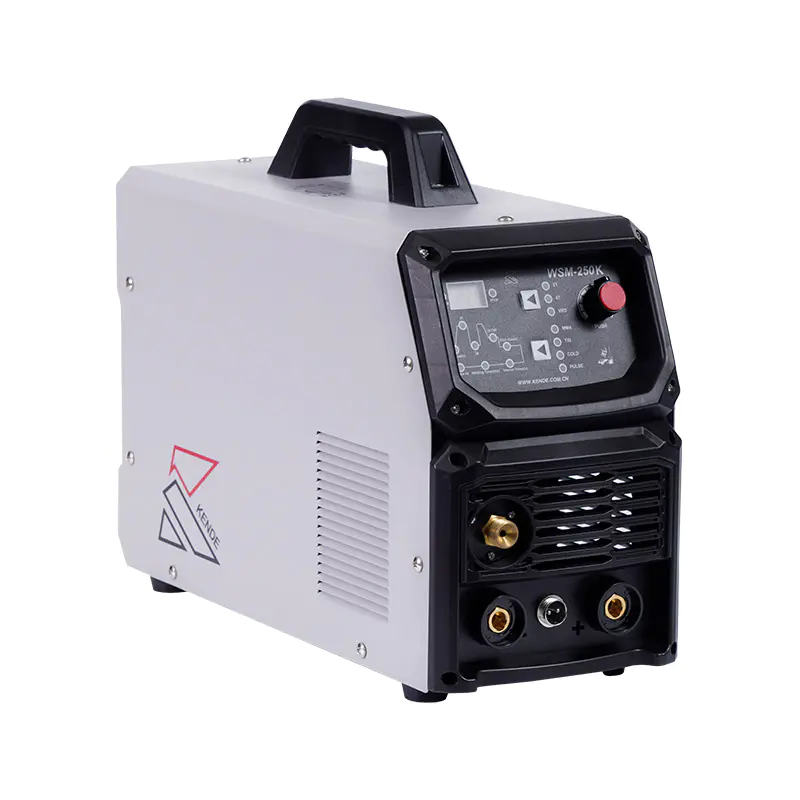
WSM-160K/180K/200K /250K IGBT Inverter TIG/MMA Welding machine(TIG DC-HF, PULSE ), Metal case with plastic frame Portable, DC TIG pulse and MMA , Digital Display, With an automatic high-frequency ignition, 2T/4T VRD
The WSM-K series is a metal-case portable welding platform with a plastic frame designed to protect the internal components while keeping overall weight and dimensions under control. The machines use powerful insulated-gate bipolar transistor, or IGBT, switching devices together with advanced inverter control technology. Compared with conventional low-frequency transformer welding machines, an IGBT inverter can operate at a much higher switching frequency. This allows the power supply to be made more compact and enables more responsive electronic control of the welding current.
The series provides two principal welding processes. The first is DC TIG welding, also known as GTAW. It uses a non-consumable tungsten electrode and shielding gas, normally argon, to create a clean and controlled arc. The second is MMA welding, also called manual metal arc, stick, or SMAW welding. MMA uses flux-coated electrodes and is valued for its simplicity, outdoor suitability, and ability to weld without a separate shielding-gas system.
By integrating both processes, the WSM-K machines allow a workshop to use one power source for precision TIG work and more rugged electrode welding. TIG is suitable for controlled work on stainless steel, carbon steel, alloy steel, and other compatible ferrous metals. MMA is useful for repair work, structural fabrication, field maintenance, installation, and applications where wind or limited access makes gas-shielded welding less convenient.
The product title identifies TIG DC-HF and pulse operation. High-frequency ignition starts the arc without requiring the tungsten electrode to touch the workpiece. This non-contact starting method helps reduce tungsten contamination and makes arc initiation smoother. Pulse operation alternates between higher peak current and lower background current. When adjusted correctly, this can help control heat input, manage the weld pool, reduce distortion, and improve control on thin materials.
Digital display technology allows the operator to view and adjust welding current more conveniently than with a basic analog control. Continuous current adjustment over a broad range helps the user match the power source to the electrode, material thickness, joint design, and welding position.
The use of IGBT switching technology is one of the most important features of this product family. IGBTs provide fast electronic switching and can be controlled by sophisticated inverter circuitry. In practical terms, this supports a smaller transformer design, reduced machine weight, more efficient power conversion, and more responsive current regulation.
Traditional transformer machines can be mechanically robust, but they are often heavier and less convenient to transport. Their output regulation may also be less flexible. An inverter machine such as the WSM-K series can offer a more compact form factor while still delivering useful welding output. The result is equipment that can move easily between a fabrication bench, a construction site, a maintenance area, or a service vehicle.
High-frequency inverter operation also supports accurate electronic control. The machine can respond more quickly to changes in the arc and can maintain a more consistent output than a simple fixed-control power source. This is especially valuable during TIG welding, where small changes in current can affect penetration, bead shape, tungsten behavior, and heat input.
The machines use pulse-width modulation control technology together with constant-current output control. PWM regulates the switching behavior of the inverter, while constant-current control helps maintain the selected welding current during the process. These functions allow the operator to adjust current continuously across a broad range rather than being limited to a small number of preset levels.
Accurate current adjustment is important because different welding tasks require different heat levels. A thin stainless-steel component may need a low, carefully controlled current to avoid burn-through. A thicker carbon-steel joint may require a higher current to achieve suitable penetration. The ability to make fine adjustments can improve weld consistency and reduce unnecessary rework.
In comparison with basic welding machines that provide limited control, the WSM-K series offers a more adaptable working platform. It can support delicate TIG work as well as practical MMA applications without requiring separate dedicated power sources.
High-frequency ignition is designed to start the TIG arc without physically touching the tungsten electrode to the workpiece. This is beneficial for several reasons. It reduces the chance of tungsten inclusions, helps preserve the sharpness of the tungsten tip, and provides a cleaner and more professional arc start.
For stainless steel and other contamination-sensitive applications, preventing unnecessary contact between the electrode and the workpiece can be particularly valuable. A controlled non-contact start can also reduce the risk of arc-start marks near the joint. The automatic high-frequency ignition feature makes the machine more accessible to operators who need repeatable arc initiation.
High-frequency ignition is a meaningful advantage over simple lift-start or scratch-start systems when the work demands clean starts and better control. It is especially appropriate for workshop fabrication, visible welds, precision repair, and components where surface appearance matters.
Pulse welding provides another layer of control. In a pulsed TIG operation, the machine alternates between a peak current and a lower background current. The peak current supports fusion and penetration, while the background current allows the weld pool to cool partially. The frequency and balance of the pulse can influence the appearance of the bead, the amount of heat introduced into the workpiece, and the operator’s ability to control the molten pool.
Pulse operation can be useful when welding thin sheet, narrow joints, heat-sensitive components, and materials prone to distortion. It may help the operator maintain a more controlled puddle while reducing average heat input. On stainless steel, appropriate pulse settings can support a more controlled weld profile and help limit discoloration caused by excessive heat.
Pulse control does not eliminate the need for correct preparation, shielding-gas coverage, tungsten selection, polarity, travel speed, and operator technique. However, it gives the operator an additional process variable that is not available on a basic DC TIG machine.
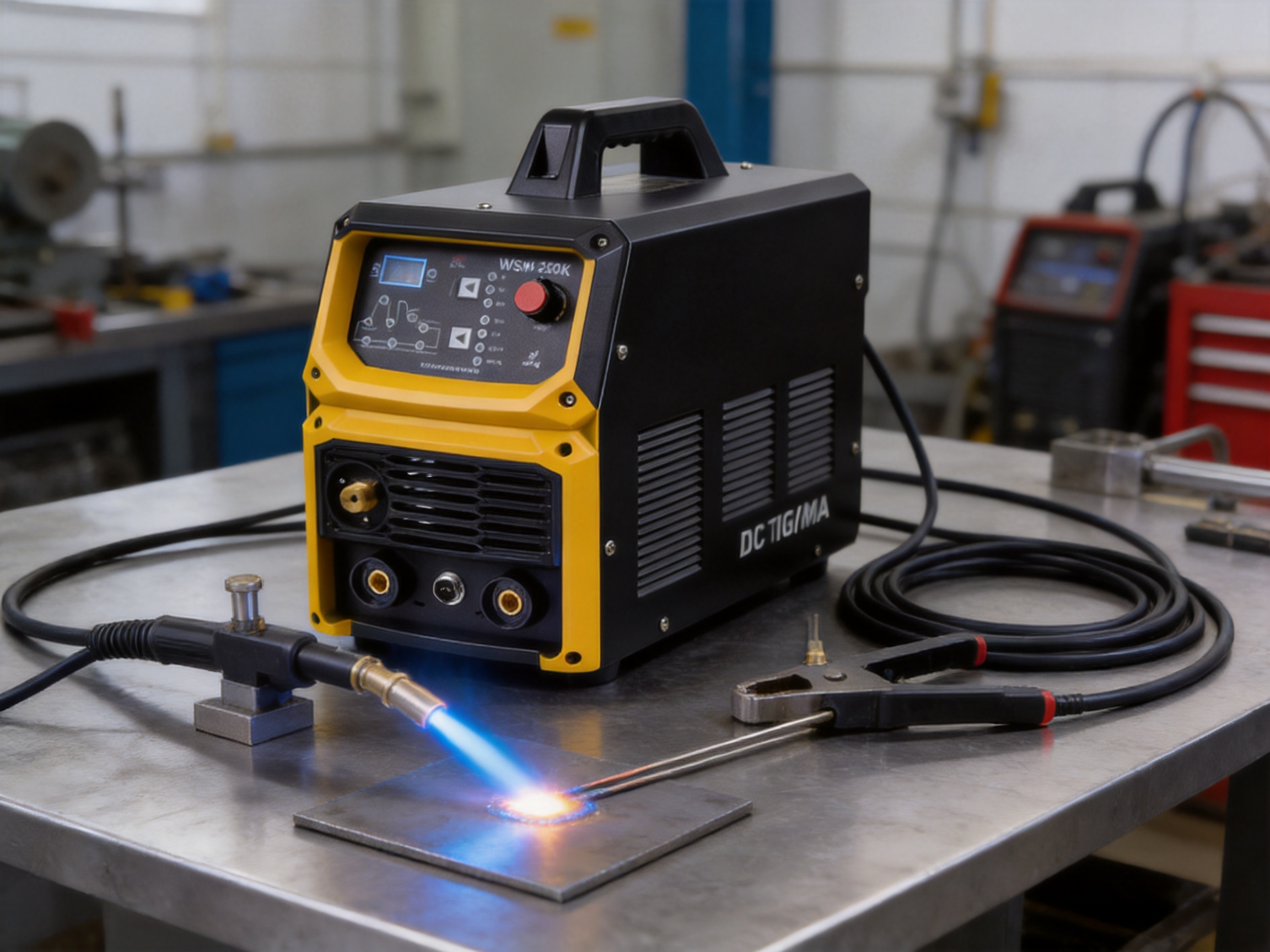
The WSM-K series includes 2T and 4T control modes. These modes determine how the torch trigger controls the welding current. In 2T operation, the operator generally holds the trigger to maintain the arc and releases it to end the weld. This mode is straightforward and is often convenient for short welds, tack welds, repairs, and applications requiring frequent starts and stops.
In 4T operation, the operator can press and release the trigger to initiate the sequence, then press and release it again to end the weld. This means the trigger does not need to be held continuously throughout the entire welding operation. For longer welds, this can reduce hand fatigue and provide a more comfortable working method.
The availability of both modes makes the machine more adaptable to different users and applications. A fabricator performing short intermittent welds may prefer 2T operation, while an operator completing a long seam may select 4T operation. The feature also helps users transition between different welding styles without changing equipment.
Although the WSM-K machines are designed around TIG capability, their MMA function significantly expands their usefulness. Stick welding remains one of the most widely used welding processes because it requires relatively little equipment. A suitable electrode holder, work clamp, and electrode supply are generally sufficient to begin welding.
MMA is well suited to outdoor work because it does not depend on a continuous external shielding-gas envelope. In windy conditions, gas-shielded processes may require screens or modified procedures, while flux-coated electrodes can remain practical. MMA is also useful when welding dirty or painted surfaces after appropriate preparation, although cleaning the joint remains important for weld quality.
The machine includes functions such as anti-stick, hot start, and arc force. Hot start can provide a temporary current increase when the arc is initiated, helping reduce difficulty during electrode starting. Arc force can support arc stability when the arc length changes or when the operator works in challenging positions. Anti-stick is designed to help limit problems if the electrode accidentally adheres to the workpiece.
These functions make the machine more forgiving for general welding tasks. They are valuable for maintenance personnel, small fabrication businesses, agricultural repair, installation work, and users who need a flexible power source rather than a TIG-only unit.
The series includes four listed model designations: WSM-160K, WSM-180K, WSM-200K, and WSM-250K. Each model uses a 230-volt, 50-hertz rated supply according to the supplied technical information. The machines share common design features, including a 64-volt no-load voltage, 85 percent efficiency, a 0.9 power factor, IP21S protection, Class H insulation, and a compact 415 by 165 by 316 millimeter form factor.
The main differences are rated input capacity, rated supply current, welding-current range, usable electrode diameter, and net weight. The WSM-160K and WSM-180K are suitable for users who require a lower and medium output range. The WSM-200K provides additional current capacity for larger electrodes and more demanding joints. The WSM-250K is the highest-output model in the listed range and is intended for users who need greater MMA capability and increased TIG output.
| Model | Rated Supply | Frequency | Rated Input Capacity | Rated Supply Current | No-Load Voltage | TIG Current Range | MMA Current Range | Usable Electrode | Net Weight |
|---|---|---|---|---|---|---|---|---|---|
| WSM-160K | 230 V | 50 Hz | 6.2 kVA | 27 A | 64 V | 10–160 A | 20–140 A | 1.6–3.2 mm | 6.1 kg |
| WSM-180K | 230 V | 50 Hz | 6.2 kVA | 27 A | 64 V | 10–180 A | 20–140 A | 1.6–3.2 mm | 6.1 kg |
| WSM-200K | 230 V | 50 Hz | 7.2 kVA | 31.5 A | 64 V | 10–200 A | 20–160 A | 1.6–4.0 mm | 6.3 kg |
| WSM-250K | 230 V | 50 Hz | 8.2 kVA | 36 A | 64 V | 10–230 A | 20–180 A | 1.6–4.0 mm | 6.3 kg |
The supplied product title refers to the WSM-250K as a 250-class machine, while the detailed table lists a TIG range up to 230 amperes. Buyers should confirm the exact rated output, duty-cycle conditions, and local documentation for the specific model before placing an order. This is particularly important when selecting equipment for production welding, where output ratings and thermal performance must match the intended workload.
The WSM-160K can be considered for lighter fabrication, service work, thin and medium-gauge components, and users who prioritize low weight. The WSM-180K offers a higher TIG ceiling while retaining the same listed dimensions and weight, making it attractive to users who need extra TIG headroom without moving to the larger electrical input of the WSM-200K.
The WSM-200K increases both TIG and MMA capacity and accepts electrodes up to 4.0 millimeters according to the supplied information. It may be appropriate for workshops that regularly alternate between precision TIG welding and more substantial stick-welding jobs.
The WSM-250K is the strongest model in the supplied range. It is designed for users who require the highest listed current output and the greatest MMA range in the series. It can be a suitable choice for heavier repair, fabrication, and maintenance work, provided that the electrical installation and duty-cycle requirements are properly evaluated.
The listed duty-cycle information is 20 percent for TIG and 25 percent for MMA. Duty cycle describes the proportion of a defined operating period during which the machine can weld at a specified output before requiring a cooling interval. It is not a universal statement that the machine can operate continuously at maximum current under all conditions.
Users should interpret duty-cycle information together with ambient temperature, welding current, electrode size, ventilation, extension-cable quality, and the cleanliness of the machine’s cooling passages. Welding at lower current generally permits longer operating periods than welding at the maximum rated output.
For intermittent repair work, short fabrication jobs, installation, and general workshop use, the listed duty cycles may provide a practical balance between output and portability. For continuous industrial production, buyers should compare the duty cycle with the actual welding schedule and consider whether a higher-duty-cycle model is required.
The machines include automatic over-temperature protection. If internal temperature rises beyond a safe operating level, the protective system is intended to interrupt or limit operation until the unit cools. This helps protect the power electronics and supports safer equipment use, but it should not be treated as a substitute for correct ventilation or appropriate workload management.
The product information identifies the machine as moisture-proof, corrosion-resistant, vibration-resistant, and resistant to conductive dust. These design intentions are important for welding equipment because workshops and job sites can expose machines to metal particles, humidity, vibration, and contaminants.
The IP21S protection classification indicates a basic level of protection against solid objects and vertically falling water under the relevant test conditions. It does not mean the machine is suitable for rain, water spray, flooding, or unprotected outdoor storage. Users should keep the unit dry and follow the operating instructions supplied with the specific model.
Class H insulation is used in the electrical insulation system. Proper insulation supports reliable operation at elevated internal temperatures, although the machine must still be used within its rated electrical and environmental limits. Protective functions for over-current and over-temperature provide an additional layer of equipment security.
The metal case and plastic frame combine structural protection with portability. A metal enclosure can help shield internal assemblies from routine workshop impacts, while plastic frame elements can reduce weight and provide practical handling surfaces. At approximately 6.1 to 6.3 kilograms, the listed models are substantially easier to transport than many conventional transformer-based alternatives.
The listed efficiency is 85 percent, and the product information states that inverter technology can reduce energy consumption by up to 30 percent compared with less efficient equipment. Actual savings depend on welding current, operating time, input voltage, duty cycle, power-source condition, and the performance of the compared machine. Nevertheless, inverter construction generally offers an efficient way to convert electrical input into controlled welding output.
Lower energy consumption can benefit workshops that operate several machines, users who work from limited electrical supplies, and contractors who transport equipment between locations. Reduced input demand may also help limit unnecessary operating costs over the life of the machine.
Portability is another major advantage. The compact 415L by 165W by 316H millimeter dimensions make the machines suitable for crowded workshops, service vehicles, field tool storage, and repair areas where floor space is limited. Their relatively low weight allows one operator to move the unit without specialized lifting equipment.
Portable equipment must still be handled responsibly. The user should protect the power source from impact, avoid pulling it by welding cables, keep ventilation openings clear, and use suitable input cables and protective devices. The compact design improves mobility, but it does not remove the need for safe installation and operation.
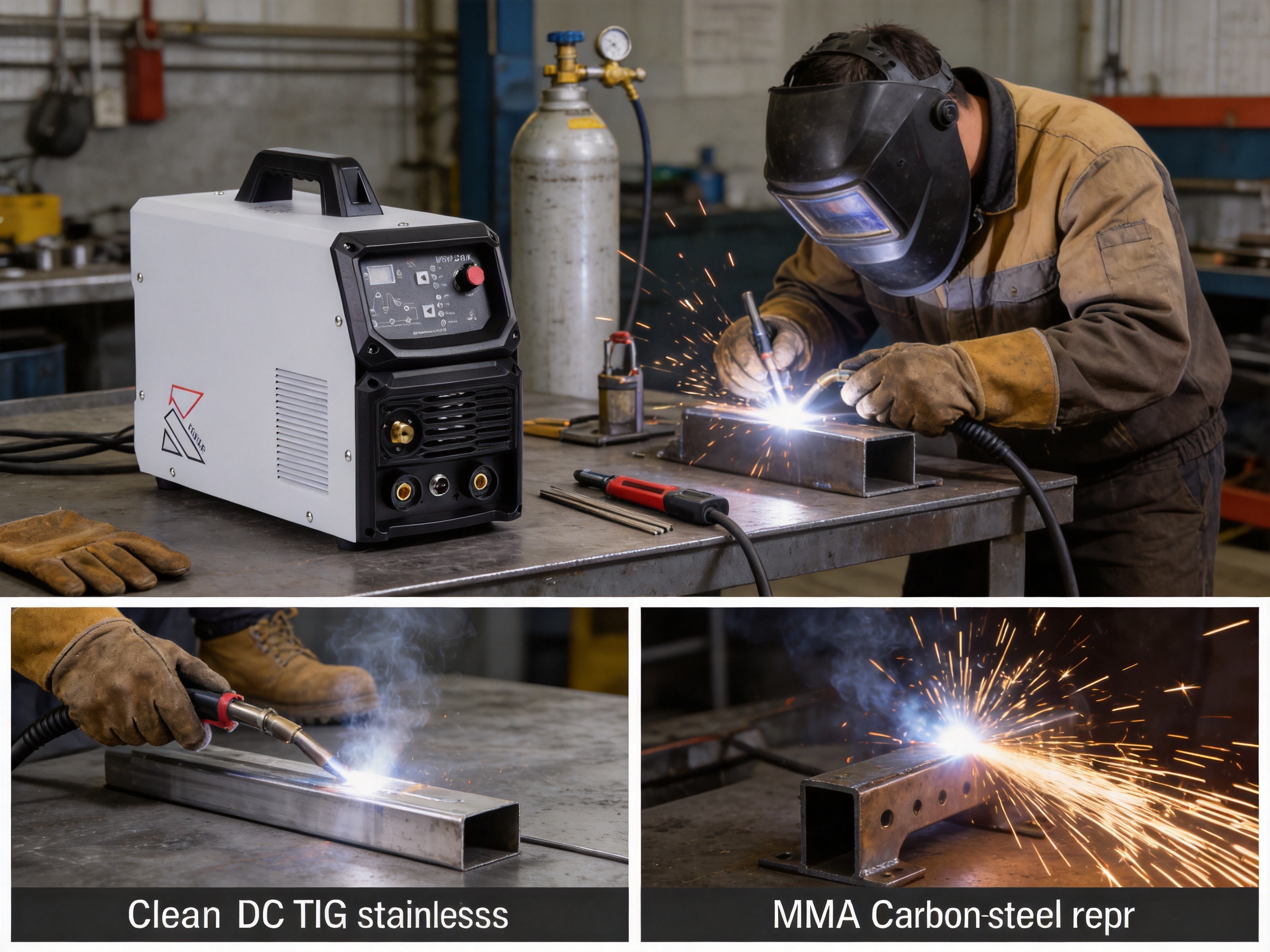
DC TIG welding is widely used for stainless-steel components where clean arc control and careful heat management are important. The high-frequency start can help prevent tungsten contact, while pulse operation may assist with thin sections and heat-sensitive joints. Applications may include small tanks, frames, food-service equipment, pipe components, brackets, and decorative fabrication.
Successful stainless-steel welding also depends on clean material, suitable shielding-gas flow, correct tungsten preparation, appropriate filler metal, and protection of the heated area from contamination. The machine provides process control, but the final result depends on the complete welding procedure.
MMA welding makes the machine suitable for carbon-steel repair and general fabrication. It can be used for brackets, supports, gates, agricultural equipment, machinery repairs, and structural components when the selected electrode and welding procedure are appropriate.
For alloy steel, the operator must select a compatible electrode and follow any preheating, interpass-temperature, and post-weld requirements. The machine’s broad current adjustment and arc-force functions support the process, but material identification and welding procedure control remain essential.
Maintenance teams often need equipment that can support more than one process. A TIG/MMA combination machine reduces the need to carry separate power sources. MMA can be used for robust repairs in accessible areas, while TIG can be selected for cleaner, more controlled work on thinner parts or visible joints.
The portable design is useful for service technicians, installers, agricultural mechanics, facility-maintenance departments, and small contractors. The unit can be transported to the work rather than requiring every component to be moved to a central workshop.
Small fabrication businesses may benefit from a machine that covers a wide range of jobs without occupying substantial floor space. The WSM-K series can support short production runs, custom metalwork, repair orders, prototyping, and general fabrication. Digital current adjustment, pulse capability, high-frequency TIG starting, and MMA functions provide flexibility for varying customer requirements.
The manufacturer, Zhejiang Kende Mechanical & Electrical Co., Ltd., operates in Taizhou, Zhejiang Province, China. The company’s stated facilities cover approximately 120,000 square meters and employ around 600 people. Its product portfolio includes welding machines, battery chargers, electric heaters, gas heaters, oil heaters, and related equipment.
The company reports annual exports of nearly 1.5 million units and annual production capacity of approximately 2 million units. A manufacturing scale of this type can support dedicated production planning, component purchasing, assembly systems, quality-control processes, and international logistics. It also gives the company experience in adapting products to different regional electrical systems, regulatory expectations, and user requirements.
Kende’s product development capabilities include MMA, MIG/MAG, flux-cored, TIG, plasma cutting, stud welding, submerged arc welding, battery charging, and heating equipment. This broad technical scope is relevant to the WSM-K series because inverter welding machines share engineering requirements with other power-electronic products, including thermal design, circuit protection, current regulation, component reliability, and electrical safety.
The company identifies a Zhejiang Provincial R&D Center, an Enterprise Technology Center, and an Intelligent Welding Technology Research Institute among its development resources. It also reports having 98 research and development personnel. These resources support the design and improvement of welding power sources, control systems, mechanical enclosures, protection functions, and production methods.
The stated patent portfolio includes invention patents, utility-model patents, appearance patents, and software copyrights. Intellectual-property activity does not by itself guarantee the performance of every product, but it indicates an ongoing emphasis on engineering development and product differentiation.
Participation in the drafting, formulation, and revision of national welding-machine standards also gives the company exposure to technical requirements and industry practices. The company states that it has participated in 20 national standards and led the drafting of one group standard. Such involvement can help a manufacturer understand how welding equipment is evaluated and specified.
The company uses automatic patching, plug-in, and welding systems, together with robot processing, laser cutting, and other automated technologies. These processes can improve repeatability in electronic assembly and mechanical fabrication. Automated placement and soldering can help maintain consistent component positioning, while robotic processing and laser cutting can support accurate enclosure and frame production.
Consistency is especially important for inverter welding machines. Small variations in assembly, thermal interface quality, cable connections, or circuit-board soldering can influence reliability. Controlled production processes help reduce variation, provided that they are supported by effective inspection and testing.
Kende also reports using office automation, Toyota TPS management, ERP K3, and MES management systems. These systems can support material traceability, production scheduling, process monitoring, inventory management, and coordination between departments. Manufacturing software does not replace skilled engineering or inspection, but it can improve visibility across a high-volume production environment.
The company states that it holds or supports products carrying GS, CE, EMC, ERP, US ETL, UKCA, and China CCC certifications. The applicability of any specific certification depends on the exact model, market, configuration, and current certificate documentation. Buyers should request the relevant declarations, test reports, and manuals for the model being purchased.
International certification is valuable because welding machines must meet electrical-safety, electromagnetic-compatibility, energy, and market-access requirements. Compliance with recognized requirements can help distributors and end users evaluate whether a product is suitable for a particular region.
Electromagnetic compatibility is important in workshops where welding equipment operates near computers, measurement equipment, automation systems, and communication devices. Correct installation, grounding, cable routing, and adherence to the product manual remain necessary even when the equipment has been designed and tested for EMC performance.
The company’s export experience may also support multilingual documentation, packaging standards, regional product adaptations, and after-sales coordination. These factors can be as important as the core welding output when equipment is purchased for commercial distribution or international projects.
The first advantage is process versatility. A basic TIG power source may not offer MMA capability, while a simple MMA machine may not provide high-frequency TIG ignition or pulse control. The WSM-K platform brings both processes together, reducing the need to purchase, store, and maintain separate machines.
The second advantage is control. PWM, constant-current regulation, digital display, pulse operation, 2T and 4T modes, and high-frequency starting give the operator more options than a basic manually adjusted welder. More control can translate into better suitability across different materials and joint designs.
The third advantage is portability. Conventional transformer machines can be heavy and difficult to relocate. The compact inverter format of this series provides a lower-weight alternative for mobile work, while the metal case and plastic frame are intended to provide practical protection.
The fourth advantage is energy efficiency. The listed 85 percent efficiency and inverter architecture can reduce wasted electrical energy compared with older designs. This may be beneficial for businesses seeking to control operating costs or for users working with limited electrical capacity.
The fifth advantage is protection and durability. Over-current and over-temperature protection, moisture-resistant and corrosion-resistant design intentions, vibration resistance, conductive-dust resistance, and Class H insulation provide a more complete equipment package than an unprotected basic power source.
These advantages should be evaluated in relation to the actual application. A heavy industrial production line may require a machine with a higher continuous duty cycle, three-phase input, water cooling, or automated welding integration. For portable TIG/MMA fabrication and general repair, however, the WSM-K series provides a strong balance between capability, size, and flexibility.
Before welding, the operator should inspect the power cable, torch, electrode holder, work clamp, gas hose, connectors, and ventilation openings. Damaged cables or loose connections should be corrected before energizing the machine.
The workpiece should be cleaned of oil, paint, rust, moisture, and other contaminants as required by the welding procedure. For TIG welding, the shielding-gas cylinder, regulator, flowmeter, hose, torch, tungsten electrode, and filler rod should be selected and prepared correctly.
The operator should choose the correct polarity for the material and process, set an appropriate current, and use suitable personal protective equipment. Welding helmet shade, gloves, flame-resistant clothing, safety footwear, and adequate ventilation are essential. Additional respiratory protection may be required for particular materials or coatings.
For MMA welding, electrode type, diameter, storage condition, and current setting should match the material and joint. Moisture-affected electrodes can produce poor arc behavior and weld defects. The work clamp should be attached to a clean, electrically suitable surface.
For TIG welding, tungsten grinding should be performed with equipment and procedures that prevent cross-contamination. Shielding-gas flow should be sufficient for the torch, cup, joint, and working environment. Excessive gas flow can create turbulence, while insufficient flow can allow atmospheric contamination.
After use, the machine should be allowed to cool when necessary. Dust should be removed according to the maintenance instructions, and the unit should be stored in a dry, clean location. Regular maintenance supports longer service life and helps preserve stable performance.
Buyers should verify the local supply voltage and frequency before ordering. The supplied data lists a 230-volt, 50-hertz supply. If the intended market uses a different electrical standard, the purchaser should confirm whether an alternative configuration is available.
Input current requirements should also be considered. The listed rated supply currents range from 27 amperes for the WSM-160K and WSM-180K to 36 amperes for the WSM-250K. The electrical circuit, plug, protective device, extension cable, and installation method must be compatible with the selected machine and local regulations.
Users should clarify which accessories are included. A complete TIG setup may require a TIG torch, gas regulator, gas hose, work clamp, electrode holder, tungsten electrodes, collets, ceramic cups, back caps, and filler metals. MMA work requires an electrode holder, work clamp, and suitable welding leads. Accessory availability can affect the real cost and convenience of deployment.
For professional buyers, it is advisable to request the user manual, wiring information where applicable, conformity documents, test reports, packaging details, spare-parts availability, warranty terms, and after-sales procedures. Distributors may also wish to confirm branding, labeling, model designation, language requirements, and regional compliance before placing a large order.
The machines support DC TIG welding and MMA or stick welding. The TIG function includes high-frequency arc starting and pulse capability according to the supplied product information. MMA operation is supported by functions such as hot start, arc force, and anti-stick.
In 2T mode, the operator normally holds the torch trigger while welding and releases it to stop. In 4T mode, the trigger can be pressed and released to begin the sequence and operated again to finish, reducing the need to hold the trigger continuously during a longer weld.
High-frequency ignition starts the TIG arc without requiring the tungsten electrode to touch the workpiece. This can reduce tungsten contamination, support cleaner starts, and improve control on visible or contamination-sensitive welds.
Pulse TIG alternates between higher peak current and lower background current. It can help control heat input, manage the weld pool, reduce distortion, and improve the operator’s control when welding thin or heat-sensitive materials.
The choice depends on the required current, electrode diameter, duty cycle, electrical supply, and typical material thickness. The WSM-160K and WSM-180K are lower-weight options, while the WSM-200K and WSM-250K provide higher listed current capacity and support electrodes up to 4.0 millimeters.
MMA welding is practical for many outdoor and field applications because it does not require a continuous shielding-gas envelope. However, the machine itself should be protected from rain, water spray, excessive moisture, and conductive contamination. IP21S is not a rating for unprotected outdoor exposure.
Yes. The product information states that the machines can weld stainless steel, carbon steel, alloy steel, cast iron, and other metals using suitable procedures and consumables. Stainless-steel TIG welding requires correct shielding, clean preparation, compatible tungsten and filler metal, and proper heat control.
They may be suitable for certain production and fabrication tasks, but users must compare the listed duty cycle with the actual welding schedule. The supplied information lists a 20 percent TIG duty cycle and a 25 percent MMA duty cycle. High-volume production may require equipment with a higher continuous duty rating or specialized automation features.
The listed protections include automatic over-current and over-temperature protection. The product information also describes resistance to moisture, corrosion, vibration, and conductive dust. The machine should still be operated, ventilated, transported, and stored according to the manufacturer’s instructions.
The manufacturer reports large-scale production facilities, research and development centers, automated electronic assembly, robotic processing, laser cutting, ERP and MES management systems, and experience with international certifications. These capabilities support repeatable production and ongoing product development.
The WSM-160K, WSM-180K, WSM-200K, and WSM-250K IGBT inverter welding machines combine DC TIG, pulse control, high-frequency ignition, MMA capability, digital adjustment, 2T and 4T modes, and practical protective functions in a portable format. Their compact dimensions and approximately 6.1 to 6.3 kilogram weight make them suitable for workshops, service vehicles, maintenance departments, fabrication businesses, and field applications.
Compared with basic welding power sources, the series offers greater process flexibility and more precise control. Compared with conventional transformer equipment, the inverter design provides a lighter package, efficient power conversion, and responsive electronic regulation. The range also benefits from the manufacturer’s experience in welding equipment, automated production, research and development, international certification, and large-scale export operations.
Selection should be based on the required output, electrode size, duty cycle, local electrical supply, accessories, and intended working environment. When correctly matched to the application and operated with suitable welding procedures, the WSM-K series can provide a versatile and practical solution for both TIG precision work and MMA repair or fabrication.
1. Product technical information for the WSM-160K, WSM-180K, WSM-200K, and WSM-250K IGBT inverter TIG/MMA welding machine series.
2. Manufacturer-provided product features, operating modes, protection functions, and technical specifications.
3. General principles of gas tungsten arc welding, manual metal arc welding, pulse-current control, and inverter welding power-source design.
4. General guidance on welding equipment duty cycle, electrical safety, electromagnetic compatibility, and protective equipment.
5. Manufacturer-provided company profile covering research and development, production capacity, certifications, patents, and manufacturing systems.
Recommended Products

Contact Us
No.2299, Luqiao Section, Shugang Avenue, Luqiao District, Taizhou, 318057 Zhejiang, PR China.
+86-576-82431568
 Privacy
China Welding Machine Factory
 English
 中文简体
 русский
 Español
 عربى
 Français
 Português
 Deutsch
 Український