Email: [email protected]
Email: [email protected]

Blog
 2026.10.10
 Blog
Modern welding operations require equipment that combines reliable arc performance, electrical efficiency, portability, and simple control. The IGBT Inverter MMA or Stick Welding Machine described in this article is designed to meet those requirements in workshops, construction sites, maintenance departments, fabrication facilities, farms, and mobile repair applications. Operating from a 220/230 V single-phase supply, the ZX7-250M provides a welding current range of 20–230 A and supports electrodes from 1.6 to 5.0 mm.
This machine uses advanced insulated-gate bipolar transistor, or IGBT, inverter technology rather than the large transformer architecture used by many conventional welding machines. The result is a compact and comparatively lightweight unit with a stable direct-current welding arc, efficient power conversion, and responsive electronic control. At approximately 8.5 kg, it is substantially easier to transport and position than many traditional machines offering a similar current capacity.
The unit incorporates three important arc-control functions: Arc Force, Hot Start, and Anti-Stick. Together, these functions help the operator initiate the arc, maintain stability during changing welding conditions, and reduce the chance of an electrode becoming firmly attached to the workpiece. These features are especially useful for general maintenance, structural repair, fabrication, agricultural equipment, gates, frames, brackets, and other steel or metalwork applications.
In addition to its product features, the manufacturing background behind this welding machine is significant. Zhejiang Kende Mechanical & Electrical Co., Ltd. operates large-scale production, research, testing, and export capabilities. Its manufacturing systems include automated electronic assembly, robotic processing, laser cutting, enterprise resource planning, manufacturing execution systems, and Toyota-style production management. These capabilities support consistent production, quality control, product development, and customization for different regions and customer requirements.
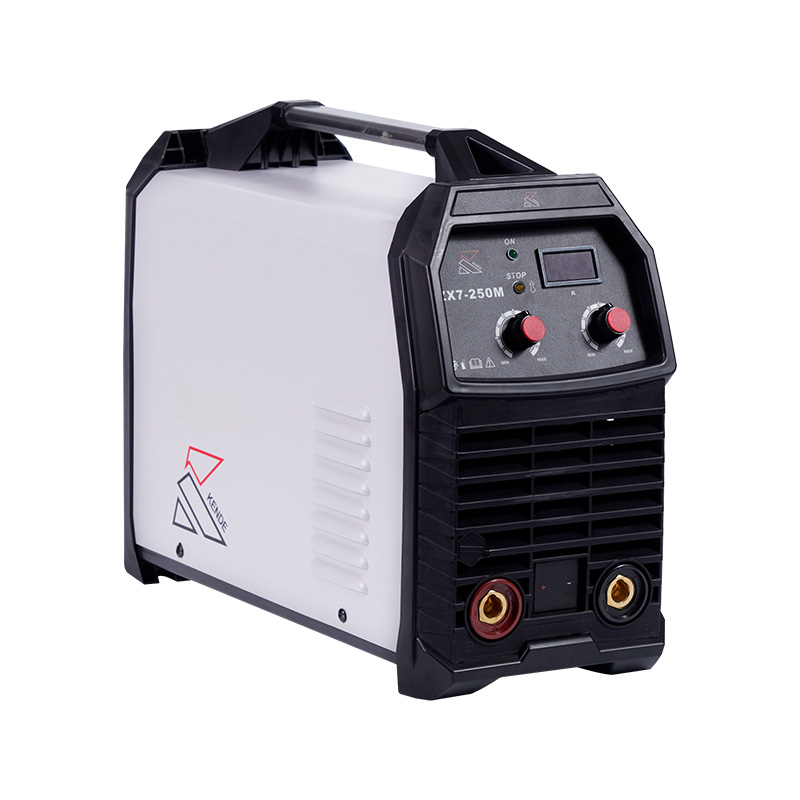
IGBT Inverter MMA or Stick Welding Machines 230V HIGH DUTY CYCLE ARC FORC, ANTI SITCK, HOT START
The ZX7-250M is an IGBT inverter MMA welding machine intended for manual metal arc welding. MMA is also commonly called stick welding, shielded metal arc welding, or SMAW. In this process, the operator uses a flux-coated consumable electrode. The electric arc melts the electrode and the base material, while the electrode coating produces shielding gases and slag to protect the molten weld pool.
The machine uses a DC-LIFT arc-start method for MMA welding. This method supports controlled arc initiation and is suitable for common stick electrodes used with carbon steel, stainless steel, cast iron, and other compatible materials. Because the process does not require an external shielding-gas cylinder, it is practical for outdoor work, remote locations, repair sites, and applications where wind would make gas-shielded welding more difficult.
The front control system is designed to provide straightforward adjustment of welding current. Depending on the production configuration, an LCD or LED display can show operating information to assist the user in selecting and monitoring the appropriate setting. Electronic control allows the inverter to respond quickly to variations in arc voltage and welding conditions.
The supplied accessory package includes an electrode holder, an earth clamp, welding cables, a brush or hammer, and a protective mask. These accessories allow the machine to be used as a practical welding set without requiring the operator to source every basic item separately. Users should still select suitable personal protective equipment, including an approved welding helmet, gloves, protective clothing, safety footwear, and suitable respiratory or ventilation controls when required by the work environment.
| Item | Specification |
|---|---|
| Model | ZX7-250M |
| Rated supply voltage | 220/230 V |
| Supply frequency | 50/60 Hz |
| Rated input capacity | 10.5 kVA |
| Rated supply current | 32.2/48 A |
| No-load voltage | 75 V |
| Welding current range | 20–230 A |
| Rated welding voltage | 29.2 V |
| Rated duty cycle | 45% |
| Usable electrode diameter | 1.6–5.0 mm |
| Efficiency | 85% |
| Power factor | 0.9 |
| Protection rating | IP21S |
| Insulation class | H |
| Net weight | 8.5 kg |
| Machine dimensions | 450 L × 195 W × 345 H mm |
Traditional welding machines commonly rely on heavy iron-core transformers to reduce and regulate supply voltage. Although transformer machines can be durable, they are often large, heavy, and less convenient for mobile applications. Their physical size can also make installation and transportation more difficult.
An IGBT inverter machine first converts the incoming electrical supply into a form that can be electronically switched at high frequency. The high-frequency power is then transformed and rectified to produce the welding output. This design reduces the size of the magnetic components and permits rapid electronic adjustment of the welding current.
The practical advantage is not simply a smaller case. High-frequency switching allows the control system to react quickly when the electrode length, arc gap, material position, or operator movement changes. A responsive power source can help preserve a smoother arc and reduce unnecessary spatter. It can also provide more consistent welding characteristics across a broad range of current settings.
The stated efficiency of 85% and power factor of 0.9 indicate that the machine is designed to make effective use of the available electrical supply. Actual power consumption depends on the selected current, duty cycle, electrode type, material thickness, supply conditions, and welding technique. Nevertheless, inverter technology generally offers a favorable balance between output capability and equipment size.
The first major advantage is portability. With a net weight of approximately 8.5 kg, the machine can be carried between work areas more easily than many conventional units. A carrying handle further supports mobile use, particularly when work must be performed on ladders, in plant rooms, on construction sites, or around large machinery.
The second advantage is electronic arc control. Conventional transformer machines may provide a dependable arc but often have fewer integrated functions for controlling difficult starts, short arcs, or temporary electrode sticking. The ZX7-250M uses microprocessor-based digital control and IGBT switching to provide Arc Force, Hot Start, and Anti-Stick functions.
The third advantage is supply adaptability. The machine is specified for 220/230 V and 50/60 Hz operation, making it suitable for many electrical systems used in international markets. Its stated ability to resist supply-voltage fluctuation can be valuable in locations where generator output or local mains voltage is not perfectly stable. Users must still confirm that the power source, circuit protection, extension cable, and generator capacity comply with the operating instructions and local regulations.
The fourth advantage is a compact and serviceable construction. A powder-coated metal housing provides a durable enclosure for the internal components. The integrated fan supports cooling during operation, while thermal overload protection helps prevent damage when the machine reaches an excessive temperature.
Starting a stick-welding arc can be difficult, particularly when the electrode coating is cold, the workpiece surface is not perfectly prepared, or the operator is using a low current setting. Hot Start briefly increases the starting current when the electrode first contacts the workpiece. This helps initiate the arc more easily and reduces the likelihood of repeated tapping or sticking at the beginning of the weld.
A reliable start improves productivity and can reduce defects at the beginning of a joint. It is useful for both experienced welders and less experienced operators because it makes the initial arc strike more forgiving. The operator must still maintain suitable electrode angle, travel speed, and contact technique.
Arc Force monitors the welding voltage and provides additional current when necessary. During manual welding, the distance between the electrode and workpiece changes continuously. If the arc becomes too short, the voltage can fall and the electrode may begin to stick. Arc Force responds by supplying additional current to help maintain the arc.
This function is particularly beneficial for short-arc welding, root passes, positional welding, and applications where the electrode must be kept close to the joint. It can also improve the operator’s ability to manage small changes in hand position. The precise effect depends on electrode type, current level, base material, and the machine’s internal control characteristics.
Anti-Stick technology helps the user separate the electrode from the workpiece if sticking occurs. When the electrode remains in contact with the material for too long, the control system can reduce the welding current. This reduces the tendency of the electrode to overheat and become permanently fused to the workpiece.
The function improves convenience and helps protect the electrode holder and welding circuit from prolonged short-circuit conditions. It is not a replacement for correct welding technique, but it provides an additional layer of control during arc initiation and difficult welding positions.
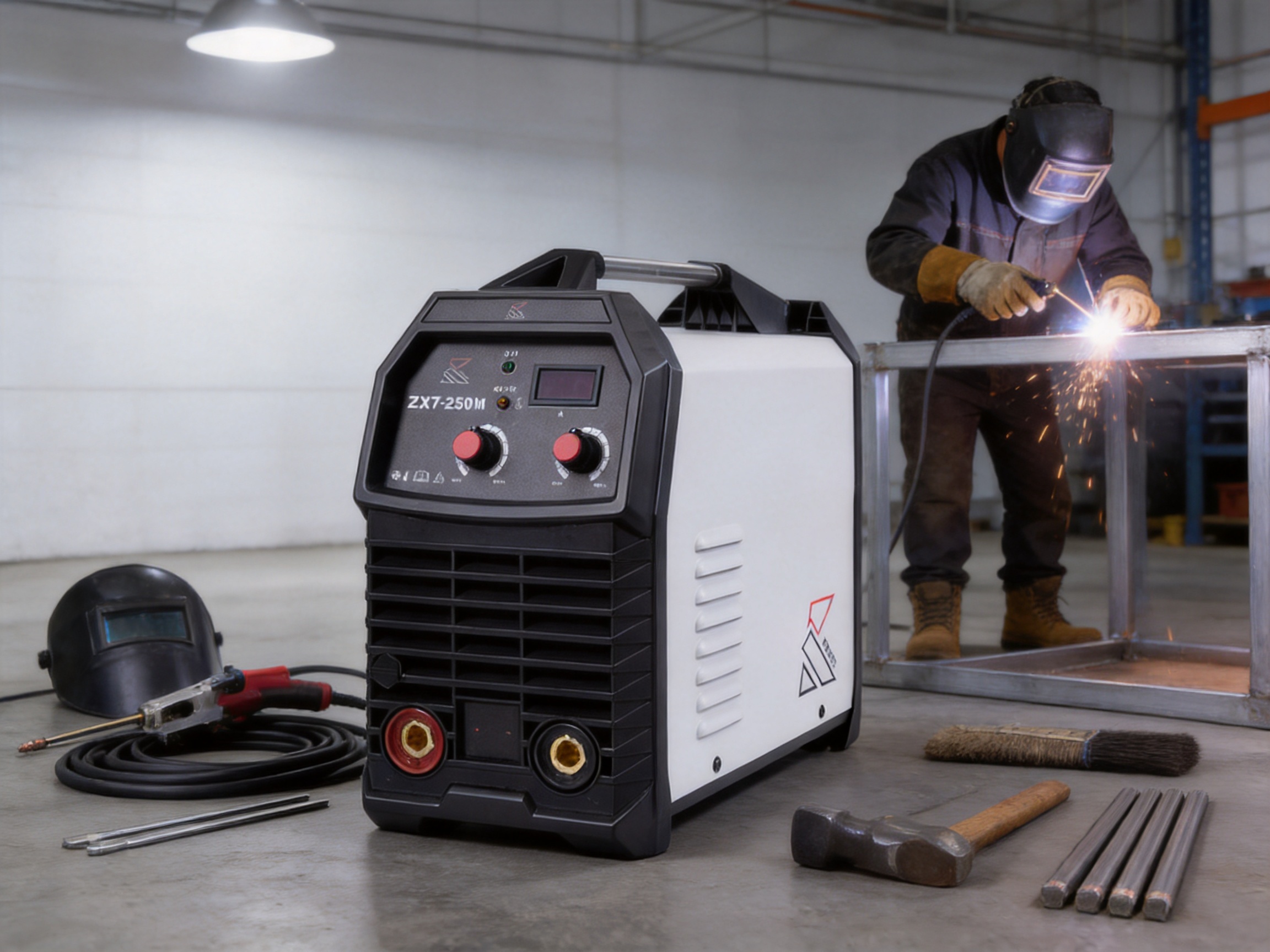
The 20–230 A welding current range allows the machine to cover light fabrication as well as more demanding repair work. Lower current settings can be used with smaller electrodes and thinner materials when the correct procedure is followed. Higher settings are suitable for larger electrodes and thicker sections, subject to the electrode manufacturer’s recommendations and the machine’s duty-cycle limitations.
The machine is described as suitable for common stainless-steel, cast-iron, and basic stick electrodes. It can also be used with many general-purpose mild-steel electrodes. Electrode selection should always consider the base material, required mechanical properties, welding position, joint design, polarity, and applicable welding procedure.
For carbon-steel fabrication, common electrode classes may be used for brackets, frames, supports, platforms, gates, railings, agricultural equipment, and general repairs. Stainless-steel electrodes can be selected when corrosion resistance and appearance are important. Cast-iron electrodes may be used for suitable repair applications, although cast iron often requires careful preparation, controlled heat input, appropriate preheating, and specialized welding procedures.
The machine is most appropriate for conductive metal materials compatible with MMA welding. It is not intended for welding plastics, non-conductive materials, or applications requiring a different thermal process. Operators should evaluate the workpiece condition before welding. Paint, oil, rust, scale, moisture, and galvanizing can affect weld quality and may create hazardous fumes.
In general fabrication, the machine can be used to assemble steel frames, supports, brackets, small structures, machinery guards, and maintenance components. Its portability allows it to be moved around a workshop without the need for a fixed welding station.
In construction and installation work, MMA welding is useful where shielding-gas cylinders would be inconvenient. The process is relatively tolerant of outdoor conditions and can be used for steelwork, repairs, site modifications, and maintenance, provided that appropriate safety controls are in place.
In agricultural and industrial maintenance, the unit can support repairs to trailers, implements, platforms, equipment frames, and steel components. Its mobile format is valuable when the workpiece cannot be transported to a fabrication shop.
For training and educational use, the machine provides access to fundamental stick-welding techniques while including electronic functions that make arc starting and stability easier to manage. Instructors should ensure that students understand electrode selection, polarity, current adjustment, weld preparation, personal protection, and inspection requirements.
The rated duty cycle is 45%. Duty cycle expresses the proportion of a defined operating period during which the machine can weld at a specified output before requiring a cooling interval. The exact reference period and test conditions should be confirmed in the applicable product documentation and regional standard.
A 45% duty cycle does not mean that the machine must be stopped after every short weld. It means that continuous high-current operation must be managed within the rated limit. At lower output currents, the machine may be able to operate for longer periods, but the user should not assume a particular duty cycle without consulting the official rating information.
The integrated fan circulates air through the enclosure to assist heat removal from the power electronics, transformer components, rectifiers, and other internal parts. Thermal overload protection with an indicator lamp is provided to warn the operator if the machine becomes too hot. When thermal protection activates, welding should stop and the unit should be allowed to cool with the power supply connected as instructed by the operating procedure.
Airflow openings must remain unobstructed. The machine should not be placed directly against walls, covered with cloth, operated in heavy dust without suitable protection, or positioned where hot air is recirculated into the cooling inlet. Periodic cleaning is important, especially in grinding areas, metalworking shops, construction sites, and dusty environments.
Thermal management also depends on the condition of the electrical supply. Undersized extension cables, loose connections, unsuitable plugs, or low generator capacity can cause voltage drop and additional heating. Correct installation and routine inspection help protect both the welding machine and the power circuit.
The powder-coated metal housing is designed to provide mechanical protection and a practical exterior for workshop and field use. Powder coating can offer a durable surface finish with resistance to ordinary abrasion and handling. It does not make the machine waterproof or suitable for unrestricted outdoor exposure.
The IP21S protection classification indicates limited protection against solid objects and vertically falling water under defined test conditions. The machine should be protected from rain, splashing water, condensation, and conductive contamination. It should be operated on a stable, dry surface with sufficient ventilation.
The adjustable carrying handle contributes to mobility. A compact unit can be stored more easily in a service vehicle, workshop cabinet, or maintenance area. It can also reduce setup time because a single operator can move the machine closer to the workpiece rather than using long welding leads unnecessarily.
Low weight does not eliminate the need for careful handling. The operator should use the handle, avoid pulling the machine by its cables, keep the unit away from edges where it could fall, and inspect the housing for damage after transport. Any cracked enclosure, damaged power cable, loose connector, or abnormal noise should be addressed before further operation.
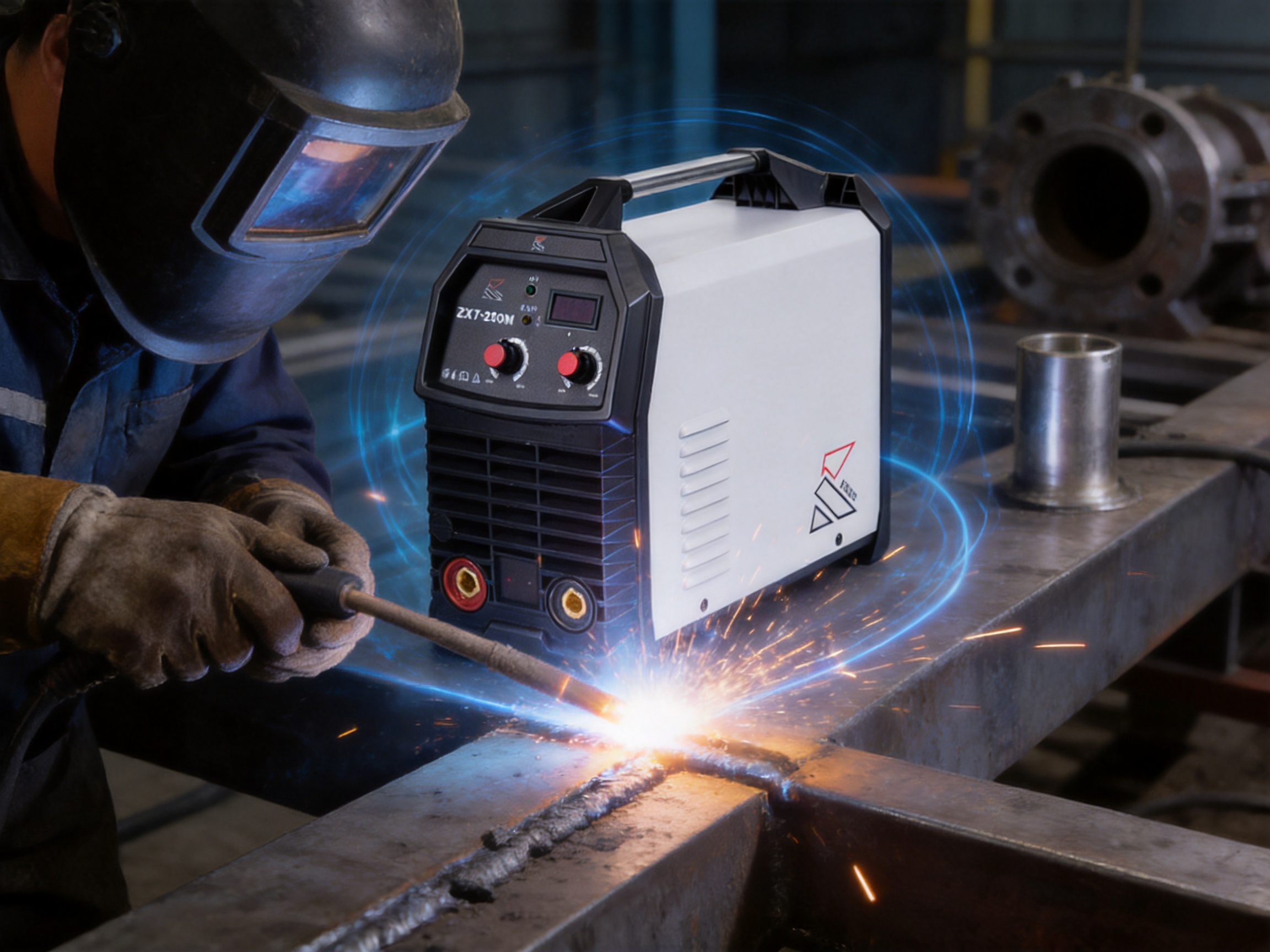
The electrode holder grips the consumable electrode and transfers welding current to it. The holder should be correctly rated for the selected current and kept clean and dry. The electrode must be secured firmly without damaging its coating. The operator should never touch the exposed metal electrode or holder contact with bare skin while the machine is energized.
The earth clamp, also called the work clamp, completes the welding circuit between the machine and the workpiece. It should be attached to clean, conductive metal as close to the weld area as practical. A clamp connected to paint, rust, scale, or a loose structural member can create unstable current flow and excessive heating.
The welding cable must be routed to avoid sharp edges, hot surfaces, moving machinery, vehicle traffic, and areas where it could be crushed. Cables should not be coiled tightly during high-current operation because heat may build up. Regular inspection should identify cuts, exposed conductors, damaged insulation, loose terminals, or overheated connectors.
A welding brush and hammer can be used to remove slag and residue between passes. Slag must be removed carefully to prevent inclusions in subsequent weld layers. Operators should use eye protection when chipping or brushing welds because slag fragments can travel at high speed.
The supplied protective mask is intended to provide basic face and eye protection during welding. The correct shade level must be used for the welding current and process. Professional users should verify that the supplied protection complies with the requirements of the applicable market and replace damaged lenses, shields, or headgear.
The product is manufactured by Zhejiang Kende Mechanical & Electrical Co., Ltd., an established producer and exporter of welding machines, battery chargers, and heaters. The company’s reported manufacturing site covers approximately 120,000 square meters and employs around 600 people. Its annual production capacity is stated at approximately two million units, with exports approaching 1.5 million units annually.
This scale provides several potential advantages for buyers. Large-scale production can support stable component sourcing, dedicated engineering teams, structured quality systems, spare-parts planning, and repeatable assembly procedures. It can also help the manufacturer respond to volume orders, private-label projects, and regional product requirements.
The company operates research and development facilities including a Zhejiang Provincial R&D Center, an Enterprise Technology Center, and an Intelligent Welding Technology Research Institute. The reported R&D organization includes 98 personnel. This technical foundation supports the development of inverter welding platforms, control systems, thermal designs, product variants, and equipment adapted to different markets.
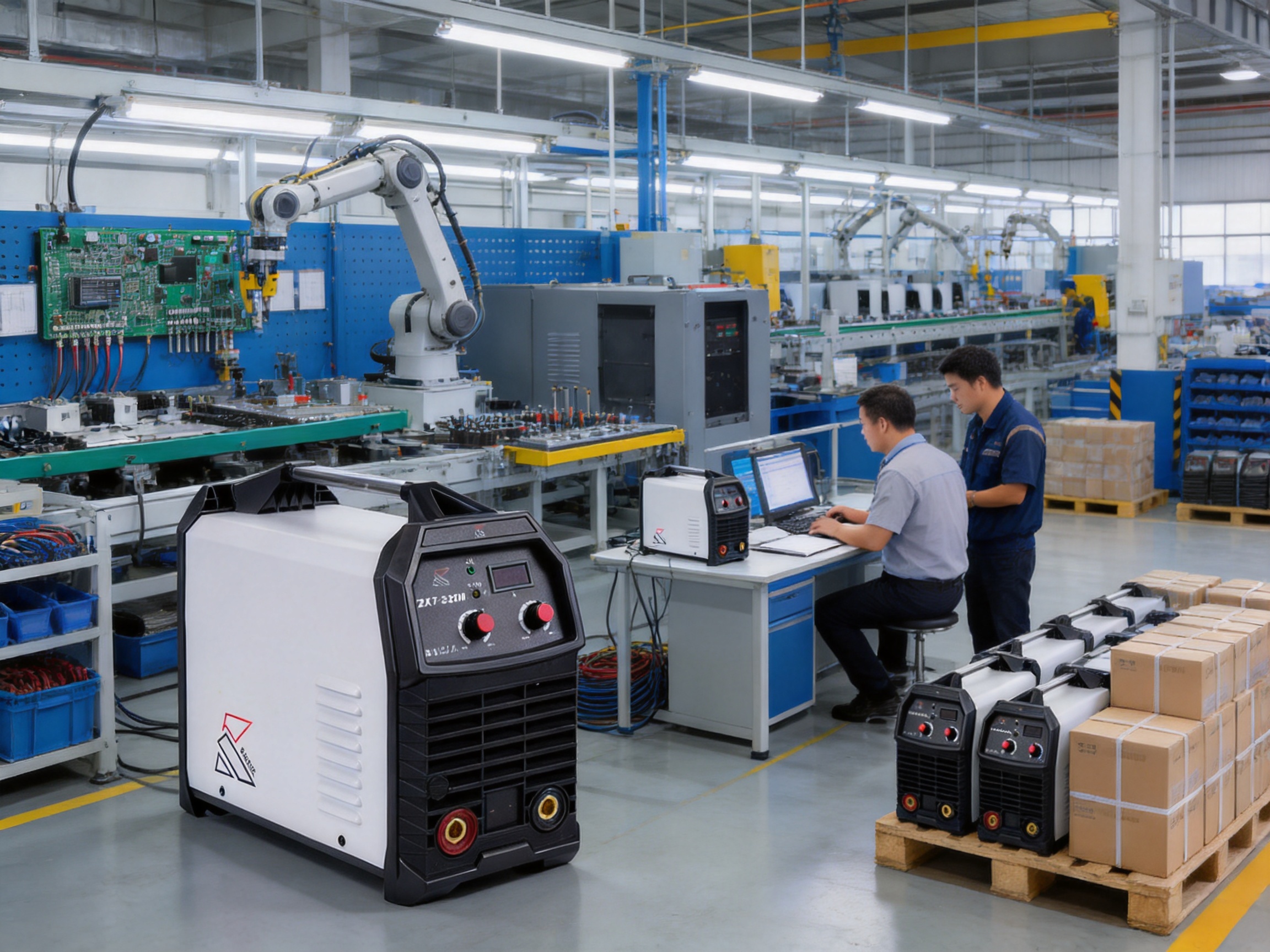
Inverter welding machines contain printed circuit boards, power semiconductors, sensors, control components, and high-current connections. Automated patching and plug-in production systems can improve placement consistency for electronic components and help standardize assembly operations. Consistent assembly is important because small variations in soldering, component placement, or connector installation can influence reliability under high electrical and thermal loads.
Automated processes do not replace engineering inspection. Production quality also depends on component verification, solder-joint inspection, electrical testing, insulation testing, output testing, thermal evaluation, and final functional checks. A well-controlled combination of automation and human inspection provides a stronger manufacturing process than either approach alone.
Robotic processing can improve repeatability in metal fabrication, including cutting, forming, handling, and selected welding or assembly operations. Laser cutting supports accurate production of housing panels, brackets, ventilation components, and structural parts. Accurate metalwork helps reduce fit-up variation and contributes to consistent enclosure assembly.
Consistent housing dimensions are important for more than appearance. Correct panel alignment protects internal components, maintains airflow paths, supports connector positioning, and helps prevent mechanical stress on switches and cable terminals. Precision fabrication can therefore contribute to both usability and product durability.
The manufacturer reports the use of office automation, ERP K3, MES, Toyota TPS management, and related production systems. Enterprise resource planning can coordinate purchasing, inventory, production orders, and shipment information. Manufacturing execution systems can connect production planning with actual shop-floor activities, helping managers monitor process status and trace manufacturing information.
Toyota-style production principles generally emphasize process discipline, waste reduction, standardized work, continuous improvement, and visual control. When correctly implemented, these methods can improve production flow and reduce avoidable variation. For a welding-machine manufacturer, such systems are valuable because the product combines metal fabrication, electronic assembly, wiring, testing, packaging, and documentation.
The company reports international product certifications and compliance marks including GS, CE, EMC, ERP, US ETL, UKCA, and China CCC across its product portfolio. Certification scope can vary by model, market, and product version, so buyers should request the specific declaration, test report, certificate, and rating applicable to the exact welding-machine configuration being purchased.
Electromagnetic compatibility is particularly relevant to inverter welding machines. High-frequency switching can produce electrical noise if the design, shielding, filtering, grounding, and layout are not properly controlled. EMC evaluation helps determine whether the equipment meets applicable limits for emissions and immunity under defined test conditions.
Electrical safety evaluation can address insulation, leakage, grounding, dielectric strength, temperature rise, abnormal operation, and protection against electric shock. Users should never modify the machine or bypass protective devices because certification depends on the approved design and configuration.
The company is also described as a participant in national welding-machine standardization work and as having contributed to the drafting or revision of multiple national standards. Such involvement can provide valuable insight into technical requirements, safety considerations, product testing, and evolving industry practices.
Certifications and standards do not remove the need for correct operation. Safe performance depends on the complete system, including the power supply, cables, workpiece, ventilation, operator training, environment, and maintenance program.
Professional users often compare welding machines according to output stability, current range, duty cycle, portability, control functions, serviceability, and total cost of ownership. The ZX7-250M addresses these factors with a balanced design rather than focusing on only one specification.
Its 230 A maximum welding current provides useful capacity for general-purpose stick welding. The broad 20–230 A range allows the operator to adjust the output to the electrode size and workpiece. The 45% duty cycle supports intermittent professional work, repair tasks, and fabrication activities when operating limits are respected.
The combination of Arc Force, Hot Start, and Anti-Stick gives the machine a functional advantage over basic entry-level units that may offer only manual current adjustment. These controls can shorten setup time, improve arc initiation, reduce electrode sticking, and make the arc more manageable during variations in welding distance.
The compact inverter format can reduce transportation effort and simplify deployment. A mobile maintenance team may carry the machine with cables and electrodes to the work location rather than transporting a large transformer unit. For workshops, the smaller footprint can leave more room for benches, fixtures, storage, and other equipment.
The integrated fan, thermal cut-out, metal housing, and adjustable handle contribute to practical usability. These features are not substitutes for good maintenance, but together they support a machine intended for recurring use in demanding working environments.
Before welding, inspect the machine, supply cable, electrode holder, earth clamp, and welding leads. Confirm that all connections are tight and that the insulation is intact. Position the machine on a dry, stable surface with adequate clearance around the ventilation openings.
Connect the earth clamp to clean metal near the welding area. Select an electrode suitable for the material and joint. Confirm polarity according to the electrode manufacturer’s instructions. Set the welding current within the recommended range and perform a test weld on scrap material when practical.
Prepare the joint by removing oil, moisture, paint, rust, and other contaminants. Joint preparation may include cleaning, beveling, gap control, tack welding, and alignment. The required preparation depends on material thickness, joint type, access, and the desired weld penetration.
During welding, maintain a suitable arc length and electrode angle. Travel steadily and observe the molten pool. If the arc becomes unstable, check current selection, electrode condition, polarity, work-clamp contact, cable condition, and the cleanliness of the joint.
Observe the duty-cycle rating and allow the machine to cool when necessary. Do not block the fan inlet or outlet. If the thermal indicator activates, stop welding and allow the machine to cool. Do not continue operating by bypassing the thermal protection.
After welding, switch off the machine according to the operating procedure, disconnect the supply when required, remove slag safely, and inspect the weld. Store the equipment in a clean and dry location. Keep electrodes dry as required by their classification and manufacturer’s instructions.
Welding produces intense ultraviolet and infrared radiation, visible light, heat, fumes, sparks, and molten metal. Appropriate eye, face, hand, body, and foot protection is essential. Protective clothing should cover exposed skin and be made from materials suitable for welding conditions.
Ventilation must be adequate for the materials and coatings being welded. Stainless steel, galvanized steel, painted materials, and contaminated surfaces may generate hazardous fumes. Local exhaust ventilation should be used where appropriate, and respiratory protection should be selected according to a qualified risk assessment.
Remove combustible materials from the welding area. Sparks can travel considerable distances and may ignite dust, paper, solvents, insulation, fuel, or concealed materials. Fire-watch procedures may be necessary during hot work, particularly in construction, maintenance, and industrial environments.
Electric shock is a serious hazard. Keep the machine and cables dry, avoid touching live components, and do not weld while standing in water or on a wet surface. Damaged cables, loose connections, or exposed conductors must be repaired or replaced before use. Maintenance inside the machine should be performed only by qualified personnel after the power supply has been isolated.
Welding on containers, tanks, pipes, or machinery that may contain flammable or hazardous substances requires specialized procedures. Such work should not be attempted without proper cleaning, isolation, testing, permits, and professional supervision.
Routine maintenance helps preserve arc quality and extend equipment life. Keep the exterior clean and inspect the ventilation openings regularly. In dusty environments, qualified personnel may use appropriate dry-air cleaning methods in accordance with the manufacturer’s instructions. Excessive air pressure or incorrect cleaning can damage electronic components.
Inspect the electrode holder and earth clamp for wear, overheating, cracked insulation, or weak gripping force. Examine all cable connections and tighten them when the machine is safely isolated. Replace components that show signs of burning, melting, fraying, or mechanical damage.
Listen for unusual fan noise and confirm that the cooling fan operates correctly. A fan that is blocked or failing can increase internal temperature and activate thermal protection more frequently. Do not operate the machine with removed covers unless a qualified service procedure specifically requires it.
If the machine displays abnormal behavior, such as unstable output, repeated thermal shutdown, burning odor, unusual noise, or failure to start, disconnect it from the supply and arrange inspection. Repeatedly resetting a fault without identifying the cause can create additional damage or safety risks.
MMA welding has strengths and limitations compared with MIG/MAG, TIG, submerged arc, and laser welding. The best choice depends on material, thickness, production volume, required appearance, operator skill, site conditions, and cost.
MIG/MAG welding generally offers higher deposition rates and does not require the operator to replace stick electrodes as frequently. However, it requires wire-feed equipment and shielding gas, and outdoor wind can disturb the gas shield. The MMA machine is simpler to transport and can be more practical for outdoor repairs.
TIG welding can produce highly controlled, clean, and attractive welds, especially on stainless steel and thin materials. It normally requires greater operator skill and is slower for many fabrication tasks. The MMA machine is better suited to general repair and structural work where speed, simplicity, and portability are important.
Submerged arc welding is highly productive for long, automated welds in controlled manufacturing environments. It is not intended for most mobile repair jobs. An MMA inverter machine provides a flexible alternative for short welds, varied positions, and workpieces that cannot easily be moved into an automated line.
Laser welding can offer low heat input, high precision, and fast production in specialized applications. It normally requires more advanced equipment, process control, training, and investment. MMA remains an economical and versatile process for a broad range of steel repair and fabrication tasks.
The 220/230 V, 50/60 Hz electrical specification corresponds to common supply systems in many countries. The compact enclosure, complete accessory set, adjustable handle, and broad electrode range make the product suitable for distributors serving professional tradespeople, repair businesses, workshops, and home users.
The manufacturer’s experience with international certifications and export operations can support documentation, packaging, product adaptation, and market-specific requirements. Regional versions may need different plugs, labels, manuals, certification marks, or electrical configurations. These details should be confirmed before an order is finalized.
Large production capacity can be important for importers who need consistent supply over time. A manufacturer with established engineering and production systems may also be able to provide private-label packaging, customized specifications, alternative accessories, and product development for particular markets, subject to technical review and order quantity.
For distributors, the product offers a clear value proposition: inverter portability, three useful arc-control functions, a 230 A output class, integrated thermal protection, and a complete basic accessory package. These features can be communicated effectively to customers who need a practical general-purpose stick welder rather than a specialized automated system.
It is designed for MMA or stick welding, also known as shielded metal arc welding. It uses coated consumable electrodes and does not require external shielding gas for standard MMA operation.
The specified welding current range is 20–230 A. The correct setting depends on electrode diameter, electrode classification, material thickness, welding position, joint design, and the recommended procedure.
The stated usable electrode diameter is 1.6–5.0 mm. The actual usable size depends on the electrode type, selected current, duty cycle, workpiece, and welding conditions.
Hot Start briefly increases current during arc initiation. It helps the electrode start more easily and reduces the likelihood of sticking at the beginning of a weld.
Arc Force provides additional current when the arc voltage falls, helping maintain arc stability when the electrode is close to the workpiece or when the arc length changes.
Anti-Stick helps reduce the welding current if the electrode remains stuck to the workpiece. This makes it easier to separate the electrode and reduces prolonged short-circuit stress.
Yes, it is described as suitable for common stainless-steel stick electrodes. The electrode, polarity, current, joint preparation, and welding procedure must be selected specifically for the stainless-steel grade and application.
It can be used with suitable cast-iron electrodes. Cast-iron repair requires careful preparation and may require preheating, controlled cooling, short weld passes, and specialized inspection.
MMA welding is often practical outdoors because it does not rely on an external shielding-gas envelope. However, the machine itself must be protected from rain, water, excessive dust, and other environmental hazards. Wind, moisture, and low temperatures can still affect weld quality and equipment safety.
A 45% duty cycle indicates the permitted operating proportion at the rated test output during the applicable test period. The user must follow the manufacturer’s rating and allow adequate cooling, especially at high current.
Yes. The product information specifies thermal overload protection with a control lamp. If thermal protection activates, welding should stop and the machine should be allowed to cool.
The listed accessories include an electrode holder, earth clamp, welding cable, brush or hammer, and protective mask. Buyers should verify the exact accessory configuration, cable lengths, plug type, and packaging for the particular order.
At approximately 8.5 kg, it is designed for mobile use and includes an adjustable carrying handle. Its compact dimensions also make it easier to store and move than many traditional transformer welding machines.
Standard MMA welding with coated electrodes does not require an external shielding-gas cylinder. This is one reason the process is useful for mobile repair and outdoor work.
Buyers should confirm the exact input voltage, frequency, plug, certification, duty-cycle rating, accessories, warranty terms, service arrangements, spare-parts availability, and technical documentation required in their market.
The ZX7-250M IGBT Inverter MMA Welding Machine combines a useful 20–230 A output range with the portability and responsive control associated with modern inverter technology. Arc Force, Hot Start, and Anti-Stick functions help improve arc initiation and stability, while the 45% duty cycle, integrated fan, thermal protection, powder-coated metal housing, and adjustable handle support practical use in workshops and mobile applications.
Its ability to work with common electrodes for carbon steel, stainless steel, cast iron, and general fabrication gives the machine broad application potential. The complete accessory package further simplifies deployment for users who need a ready-to-use stick-welding solution.
The product is supported by the manufacturing capabilities of Zhejiang Kende Mechanical & Electrical Co., Ltd., including large-scale production, engineering resources, automated electronic assembly, robotic processing, laser cutting, digital management systems, and international market experience. These strengths can benefit distributors, OEM customers, professional users, and organizations seeking consistent supply and product customization.
Compared with heavier conventional transformer units, the inverter design offers a more convenient balance of output capability, compact size, weight, electrical efficiency, and arc control. Compared with more specialized processes, MMA remains flexible, economical, and suitable for work in locations where shielding gas or automated equipment is impractical. When operated within its ratings and maintained correctly, this welding machine is a versatile option for professional repair, fabrication, construction, agricultural maintenance, and general metalworking.
1. Product technical information for the ZX7-250M IGBT Inverter MMA Welding Machine.
2. Manufacturer-provided company profile and production capability information for Zhejiang Kende Mechanical & Electrical Co., Ltd.
3. General principles of shielded metal arc welding, electrode selection, welding polarity, and arc control.
4. General guidance on welding-machine duty cycle, thermal protection, electrical safety, and equipment maintenance.
5. Internationally recognized practices for welding personal protective equipment, ventilation, hot-work control, and fire prevention.
6. General technical principles of IGBT inverter power conversion and electromagnetic compatibility in welding equipment.
Recommended Products

Contact Us
No.2299, Luqiao Section, Shugang Avenue, Luqiao District, Taizhou, 318057 Zhejiang, PR China.
+86-576-82431568
 Privacy
China Welding Machine Factory
 English
 中文简体
 русский
 Español
 عربى
 Français
 Português
 Deutsch
 Український