Email: [email protected]
Email: [email protected]

Blog
 2026.10.12
 Blog
The SS-130D is a compact direct-current manual metal arc welding machine designed for users who need portability, flexible power compatibility, stable arc performance, and practical control features. With a dual-voltage single-phase input of 110V or 220V, the machine can serve a broad range of workshop, maintenance, construction, fabrication, agricultural, and home-repair applications.
Built around IGBT inverter technology, the SS-130D provides a welding current range of 20–130A, a maximum current of 150A, and a rated welding voltage of 25.2V. Its compact 4kg construction and dimensions of 260 × 125 × 205mm make it considerably easier to transport than many conventional transformer-based welding machines. Despite its small size, the unit includes useful arc-assistance functions such as Hot Start, Arc Force, and Anti-Stick.
The machine is intended for welding a variety of common metals, including carbon steel, alloy steel, cast iron, and stainless steel, when appropriate electrodes and procedures are selected. Its DC output helps provide a consistent arc and suitable penetration, while its inverter control system contributes to reduced size, improved efficiency, and lower power consumption.
This article examines the product’s technical characteristics, operating functions, practical advantages, manufacturing background, quality capabilities, and suitability for different users. It also explains how the machine compares with traditional alternatives and what buyers should consider before selecting it for a particular welding environment.
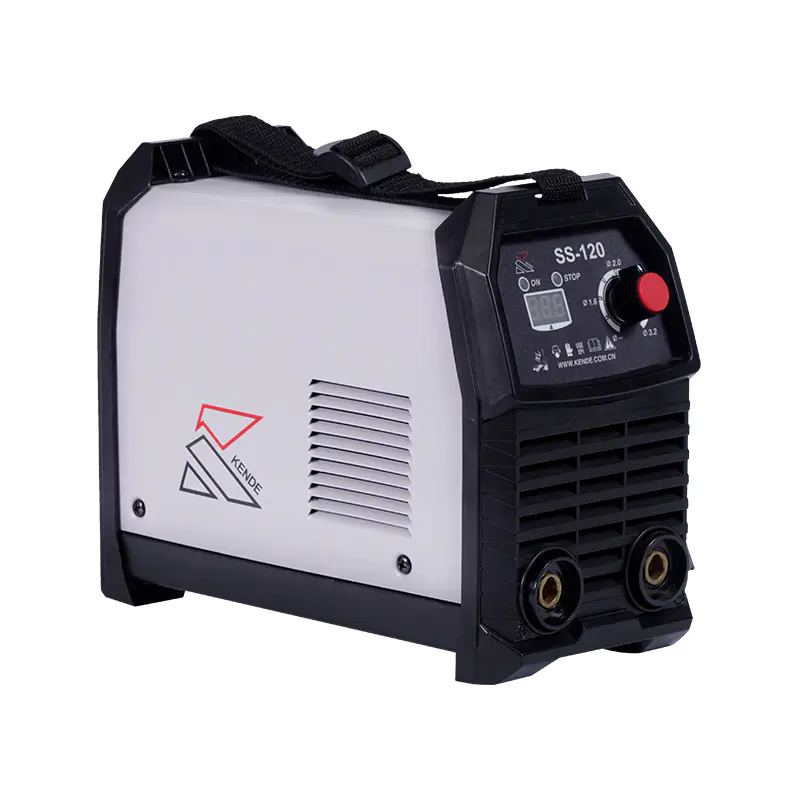
SS-130D Dual Voltage, Single Phase 110/220V, 50/60Hz, Portable easy to start arc, anti sitcker, arc force DC IGBT Inverter Welding machine (MMA) 130A
The SS-130D belongs to the IGBT Inverter MMA or Stick Welding Machine category. MMA, also known as manual metal arc welding or shielded metal arc welding, uses a consumable electrode coated with flux. During welding, the electrode coating forms a protective gas and slag layer that shields the molten weld pool from atmospheric contamination.
Unlike gas-shielded welding processes, MMA welding does not require an external shielding-gas cylinder, regulator, hose, or gas supply. This makes the process particularly useful in outdoor locations, repair areas, construction sites, agricultural facilities, and remote environments where wind or limited infrastructure can make gas-shielded welding less convenient.
The SS-130D uses inverter electronics to convert and control electrical power at high frequency. This approach allows the machine to be substantially smaller and lighter than many traditional low-frequency welding transformers. The high-frequency design also supports more precise current regulation and improved arc control.
Its dual-voltage configuration is one of its most important practical features. Users can operate the machine from either a 110V or 220V single-phase supply, subject to the correct input configuration, rated supply conditions, and local electrical requirements. This flexibility is valuable for contractors, service technicians, workshops, and users who may work in locations with different power systems.
The machine has a 50/60Hz supply frequency rating and a rated input capacity of 5.5kVA. The rated supply current is listed as 24.8A at 220V and 34A at 110V. The no-load voltage is 56V, while the welding current can be adjusted from 20A to 130A. The product information also identifies 150A as the maximum welding current.
The rated duty cycle is 30 percent. In practical terms, duty cycle indicates the proportion of a standard test period during which the machine can weld at a specified output before requiring a cooling period. Actual operating time depends on ambient temperature, output current, ventilation, electrode size, supply stability, and the specific testing standard used.
The SS-130D accepts electrodes from approximately 1.6mm to 3.2mm. This range allows the user to perform light sheet-metal work, general maintenance, small structural repairs, fabrication tasks, and many medium-duty welding applications. Electrode selection should always be matched to the base metal, joint design, welding position, required penetration, and available current.
The machine has a listed efficiency of 81 percent and a power factor of 0.75. It uses an IP21S protection rating, which is generally associated with protection against access to hazardous internal parts and vertically falling water under specified conditions. It should not be treated as a waterproof machine or exposed unnecessarily to rain, spray, condensation, or conductive contamination.
IGBT, or insulated-gate bipolar transistor, technology is widely used in modern welding power sources because it enables efficient high-frequency switching and electronic control. In a conventional transformer welder, the power transformer is often large and heavy because it operates at the utility frequency. An inverter machine first processes the incoming electrical power and then switches it at a much higher frequency.
High-frequency operation allows the transformer and associated magnetic components to be reduced in size. This is a major reason why the SS-130D weighs approximately 4kg and can be carried easily by one person. Reduced weight can lower transportation effort, simplify storage, and improve usability in locations where a large wheeled welder would be inconvenient.
Inverter control also allows the welding current to be adjusted electronically over a broad range. The product information states that pulse-width modulation and constant-current output control are used to regulate the welding current. This supports more precise adjustment than a simple fixed-output power source and helps the operator select a current suitable for different electrodes and material thicknesses.
Another important advantage is power efficiency. The product information identifies energy savings of up to 30 percent compared with less efficient conventional designs. The exact saving depends on the comparison machine, operating load, input voltage, duty cycle, and local electricity conditions. Nevertheless, the combination of inverter conversion, electronic switching, and compact components is generally advantageous where low equipment weight and efficient operation are important.
The SS-130D provides direct-current welding output. DC output is widely used for MMA welding because it can provide a smooth, stable arc and support consistent electrode performance. Depending on electrode type and polarity requirements, the operator can select the appropriate electrode connection arrangement.
A stable DC arc can make it easier to establish and maintain the weld pool. It can also help reduce unnecessary arc interruption, improve bead appearance, and support reliable penetration when the current, travel speed, electrode angle, and arc length are correctly controlled.
It is important to understand that machine stability alone does not guarantee a perfect weld. The final result also depends on joint preparation, surface cleanliness, electrode storage, welding technique, material composition, polarity, and operator skill. The SS-130D provides a stable electrical foundation, but correct procedure remains essential.
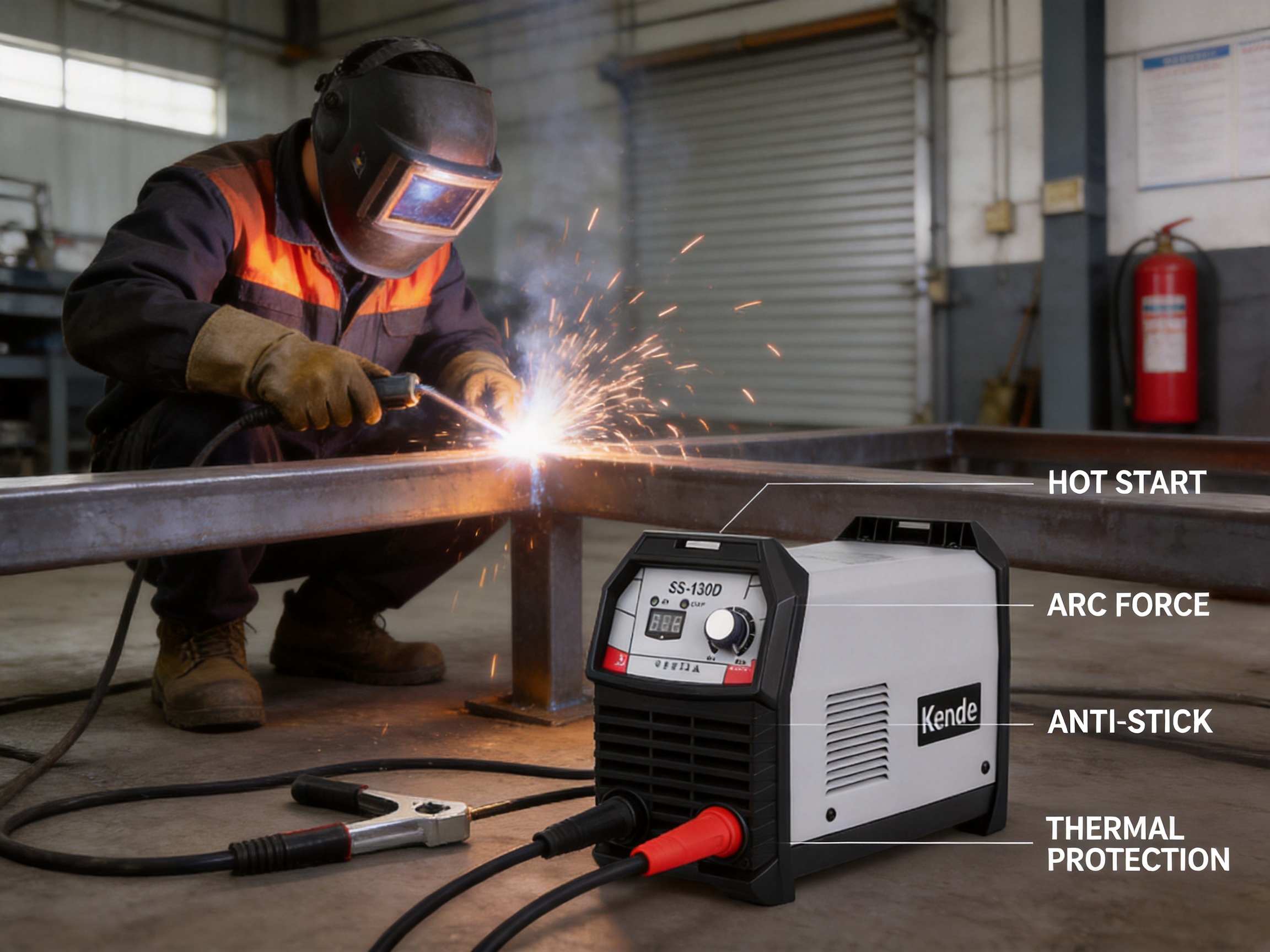
Hot Start temporarily increases the current during arc initiation. Starting an MMA arc can sometimes be difficult, especially when the electrode is cold, the workpiece surface is imperfect, or the operator is working with a small electrode. A brief current increase helps initiate the arc more easily and can reduce the tendency of the electrode to stick at the beginning of the weld.
This function is valuable for occasional welders and experienced operators alike. It can improve the consistency of arc striking and reduce the frustration associated with repeated electrode contact and separation. Easier starting is particularly useful during tack welding, positional work, and repairs where the operator must repeatedly start and stop the arc.
Arc Force monitors welding voltage and provides additional current when needed. During MMA welding, the arc length can change as the electrode moves or as the operator works around an irregular joint. If the arc becomes too short, the electrode may have a greater tendency to stick.
Arc Force helps respond to this condition by increasing current for a short period. The result can be a more dynamic arc, improved resistance to sticking, and better control when welding in difficult positions. It may also help maintain penetration when the electrode approaches the workpiece more closely than intended.
The exact behavior of Arc Force depends on the machine’s internal control design and the electrode type being used. Some electrodes perform best with a softer arc, while others benefit from a more forceful arc characteristic. Users should follow electrode manufacturer recommendations and adjust technique accordingly.
Anti-Stick technology helps the user separate the electrode from the workpiece if the electrode accidentally becomes stuck. When an electrode remains in contact with the workpiece, excessive current can cause it to overheat, damage the electrode coating, or make removal difficult.
By reducing or managing the output under sticking conditions, Anti-Stick can simplify electrode removal and reduce the risk of prolonged short-circuit heating. This is a useful feature for new welders, maintenance personnel, and operators working in awkward positions.
Anti-Stick is not a substitute for correct arc length or welding technique. It is a protective and convenience function intended to reduce the consequences of an accidental sticking event.
The SS-130D includes thermal overload protection with an indicator light. If internal temperature rises beyond a safe operating level, the protection system can interrupt or limit output to help prevent damage to the power electronics.
Thermal protection is especially important in a compact inverter machine because the enclosure contains high-power electronic components in a relatively small space. The operator should allow the machine to cool when the indicator activates and should not repeatedly restart it before the cause of overheating has been addressed.
Overheating may result from excessive duty-cycle demand, blocked ventilation openings, high ambient temperature, inadequate clearance, dust accumulation, unstable input power, or operation beyond the recommended conditions. Keeping the machine clean and ensuring adequate airflow can help maintain reliable service.
Portability is one of the SS-130D’s strongest advantages. With a net weight of approximately 4kg and a compact enclosure, it can be carried between work areas without the need for lifting equipment or a dedicated trolley. This is useful for installation teams, maintenance technicians, mobile repair services, agricultural operators, and small fabrication businesses.
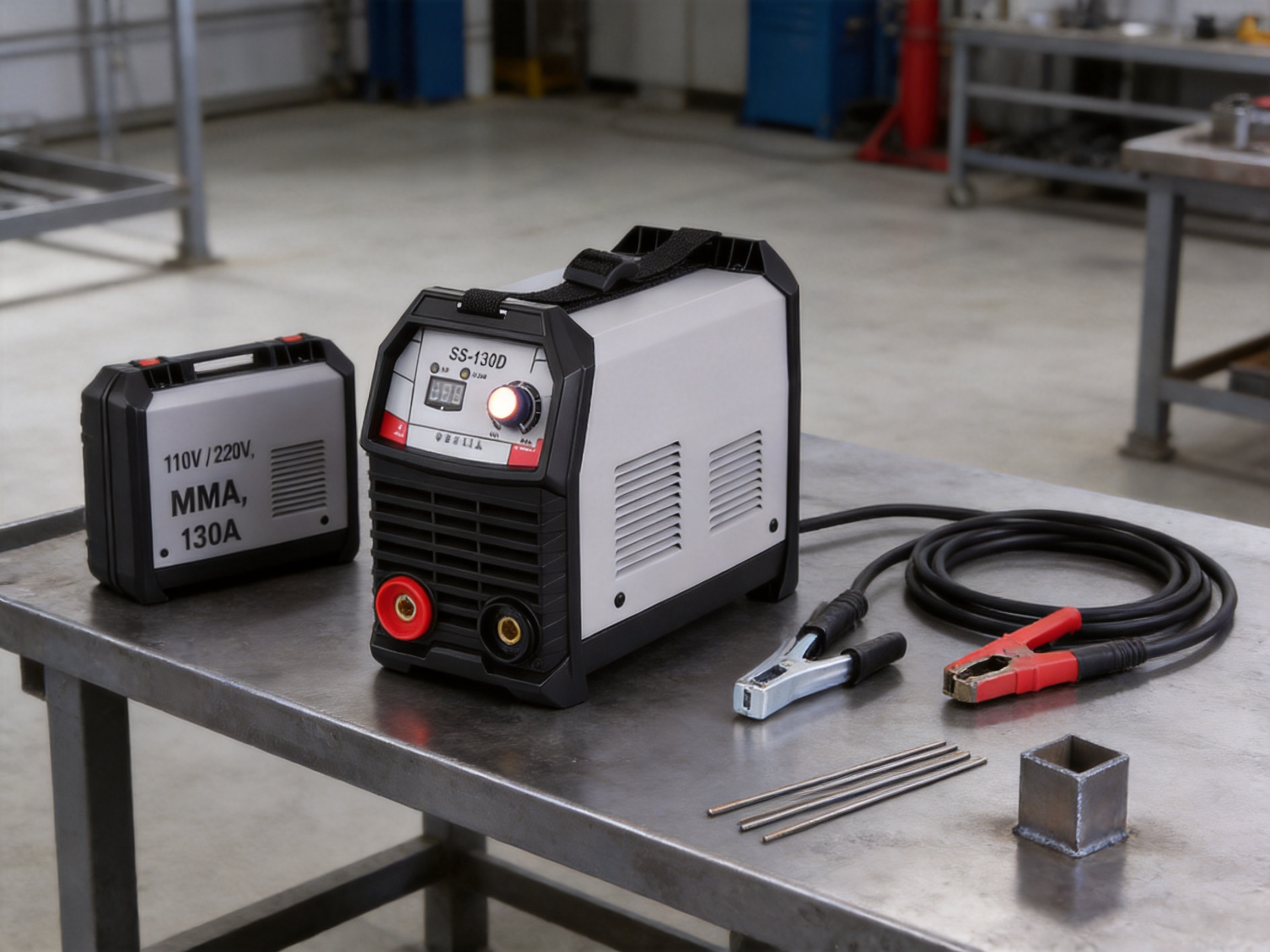
A lightweight welding machine can also reduce setup time. The operator can transport the power source, welding cable, electrode holder, and ground cable as a compact kit. The included 2m welding cable with dual-angle electrode holder provides practical reach around many small and medium-sized workpieces, while the 1.5m ground cable with clamp helps complete the basic connection arrangement.
Cable length should be evaluated in relation to the intended job. Longer cables may be needed for larger structures or work at height, while shorter cables can reduce voltage drop and simplify handling. Users should use cables with suitable ratings and inspect connectors, insulation, electrode holders, and clamps regularly.
The machine also includes a power switch with an illuminated indicator. This provides a clear visual indication that the unit is energized. Such a simple feature can improve day-to-day usability, particularly in workshops where several machines may be connected to power at the same time.
The product information describes the machine as moisture-resistant, corrosion-resistant, vibration-resistant, and resistant to conductive dust. These design objectives are valuable for equipment used in workshops, construction areas, agricultural settings, and maintenance environments.
However, resistance to environmental conditions should not be confused with unrestricted outdoor exposure. The machine should be protected from direct rainfall, standing water, heavy condensation, corrosive chemicals, metal filings, and excessive dust whenever possible. It should be placed on a stable, dry surface with adequate ventilation.
Regular inspection is recommended in environments containing conductive dust or abrasive particles. Dust accumulation can restrict airflow and may eventually affect insulation or electronic components. A maintenance program should include cleaning, inspection of cooling openings, cable checks, grounding checks, and confirmation that the power selector or input arrangement is correctly configured before operation.
| Specification | SS-130D Value |
|---|---|
| Product type | DC IGBT inverter MMA or stick welding machine |
| Rated supply voltage | 110V / 220V, single phase |
| Supply frequency | 50/60Hz |
| Rated input capacity | 5.5kVA |
| Rated supply current | 24.8A at 220V; 34A at 110V |
| No-load voltage | 56V |
| Welding current range | 20–130A |
| Maximum welding current | 150A |
| Rated welding voltage | 25.2V |
| Rated duty cycle | 30 percent |
| Usable electrode diameter | 1.6–3.2mm |
| Efficiency | 81 percent |
| Power factor | 0.75 |
| Protection rating | IP21S |
| Net weight | Approximately 4kg |
| Machine dimensions | 260 × 125 × 205mm |
| Welding cable | 2m with dual-angle electrode holder |
| Ground cable | 1.5m with clamp |
When comparing welding machines, buyers should review all specifications together rather than focusing only on the maximum current. Output range, duty cycle, input compatibility, cable quality, thermal protection, efficiency, dimensions, and service support all influence the value of a welding power source.
The SS-130D is positioned as a compact and flexible machine rather than a high-output industrial production welder. Its 30 percent rated duty cycle and 130A adjustable range are appropriate for many repair, maintenance, fabrication, and light-to-medium-duty applications. For continuous high-amperage production, users may require a larger machine with a higher duty cycle and greater thermal capacity.
Traditional transformer-based MMA machines can be bulky and difficult to move, particularly when designed for high current. The SS-130D’s inverter architecture allows a much smaller enclosure and a listed net weight of only 4kg. This makes it easier to carry to a jobsite, transport in a service vehicle, or store in a limited workshop space.
Many welding machines are designed for only one input voltage. A single-voltage product may work well in one workshop but become inconvenient when moved to a different location. The SS-130D’s 110/220V configuration provides greater flexibility for users who operate in residential, commercial, mobile, or international environments.
Before use, the operator must verify the correct input configuration and ensure that the power supply, circuit protection, plugs, extension cables, and grounding arrangements are suitable. Incorrect voltage selection or undersized electrical infrastructure can damage equipment and create safety risks.
Basic transformer machines may not provide the same combination of Hot Start, Arc Force, and Anti-Stick functions. These electronic features can make the welding process more forgiving and help users manage difficult arc-starting and electrode-sticking situations.
For occasional welders, the result may be easier operation. For experienced welders, the functions can improve consistency during maintenance and repair work. The machine therefore combines practical controls with the simplicity of the MMA process.
The manufacturer identifies energy savings of up to 30 percent through the use of inverter technology and electronic control. Lower consumption can be beneficial for mobile operations, small workshops, and users who need to manage electrical operating costs.
Power consumption varies according to current setting, welding time, input voltage, duty cycle, electrode type, and workpiece thickness. The machine should be connected to a properly rated circuit, especially when operating at 110V, where the input current is higher than at 220V for an equivalent power demand.
The SS-130D is described as suitable for welding carbon steel, alloy steel, cast iron, stainless steel, and other common metals when compatible electrodes and procedures are used. This gives the machine useful versatility in general repair and fabrication work.
Different metals require different preparation, electrode selection, preheating, cleaning, and cooling practices. Cast iron, for example, may require specialized electrodes and careful heat management, while stainless steel requires attention to contamination control and appropriate filler selection.
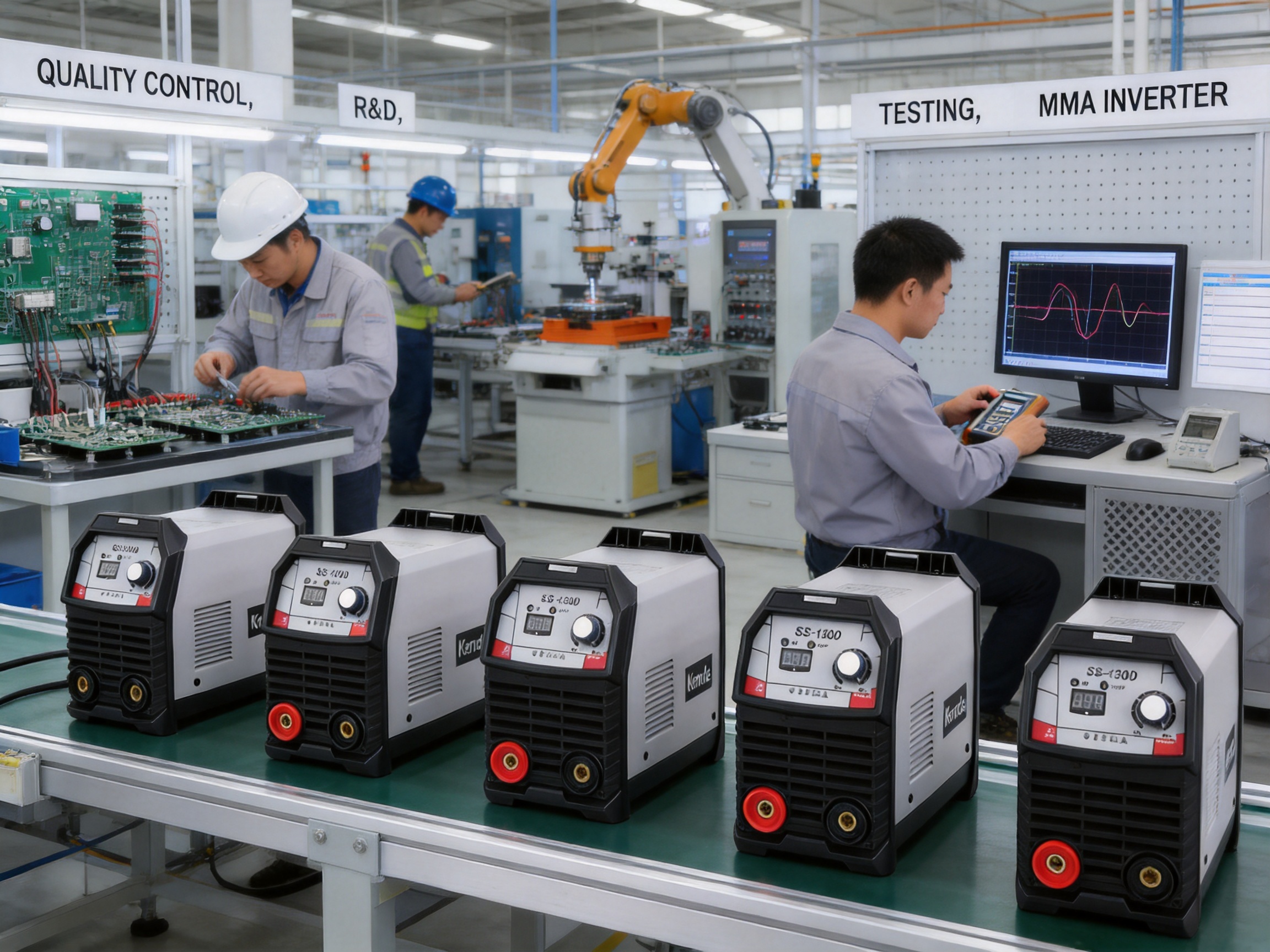
The company behind the product operates as a large manufacturer and exporter of welding machines, battery chargers, and heaters. Its reported facility covers approximately 120,000 square meters and employs around 600 people. Annual exports are described as nearly 1.5 million units, with annual production capacity of approximately 2 million units.
These production figures indicate an organization capable of supporting volume manufacturing, product standardization, supply-chain coordination, and international distribution. For buyers, manufacturing scale can be important because it may support component purchasing, production continuity, quality systems, spare-parts planning, and technical support.
The manufacturer reports having a Zhejiang Provincial Research and Development Center, an Enterprise Technology Center, and an Intelligent Welding Technology Research Institute. It also reports approximately 98 research and development personnel.
Research and development resources are especially significant in inverter welding equipment. A modern welding machine requires coordinated design of power semiconductors, control software, magnetic components, cooling systems, protection circuits, mechanical enclosures, connectors, and user controls. Improvements in any of these areas can influence arc stability, efficiency, service life, and operator experience.
The company also reports numerous invention patents, utility model patents, appearance patents, and software copyrights. Intellectual property does not by itself guarantee performance, but it indicates ongoing investment in product design and technical development.
The manufacturing process reportedly includes automatic patching, plug-in and welding systems, robot processing, laser cutting, and other advanced production technologies. These systems can improve manufacturing repeatability and reduce variation in assembly operations.
Automatic placement equipment can position electronic components consistently on circuit boards. Controlled soldering and insertion processes can improve connection reliability when supported by suitable inspection procedures. Robotic processing can provide repeatable mechanical operations, while laser cutting can produce precise metal enclosure components and improve consistency in fit and finish.
The use of automated equipment is particularly valuable in inverter welding machines because electrical performance can be affected by component placement, solder quality, connection resistance, insulation distances, and thermal pathways. A controlled manufacturing process helps ensure that production units follow the intended engineering design.
The company reports using office automation, Toyota Production System management methods, ERP K3, and MES management systems. These systems can support planning, inventory control, production scheduling, traceability, work-order management, quality records, and resource coordination.
Manufacturing execution systems can connect production activities with digital records, helping organizations monitor work progress and identify process deviations. Enterprise resource planning systems can assist with procurement, stock management, and delivery planning. Lean manufacturing methods can help reduce unnecessary movement, waiting time, excess inventory, and process waste.
For international customers, organized production management can be valuable because product consistency and delivery reliability matter alongside technical performance. A machine may be technically well designed, but dependable supply also requires controlled purchasing, assembly, testing, packaging, logistics, and after-sales coordination.
The manufacturer reports holding or supporting a range of international and domestic certifications, including GS, CE, EMC, ERP, US ETL, UKCA, and China CCC certifications or compliance marks across applicable product lines. The exact certification applicable to a particular SS-130D model, voltage version, market, and production batch should be confirmed through the relevant documentation.
Certification is important because welding machines contain high-voltage electrical circuits, high-current output systems, cooling components, and electromagnetic switching devices. Applicable standards may address electrical safety, electromagnetic compatibility, energy performance, construction, labeling, and market-specific requirements.
Buyers should request the correct declaration of conformity, test reports, user manual, wiring information, and certification documentation for the exact model being purchased. Regional requirements can differ, and compliance for one market does not automatically establish compliance for every country.
The company also reports participation in national welding machine standardization activities and involvement in drafting, formulating, or revising multiple national standards. Participation in technical standardization can provide useful exposure to industry requirements and testing expectations.
The SS-130D is suitable for many workshop repair jobs involving brackets, frames, supports, equipment stands, gates, tools, and general carbon-steel components. Its portable design allows it to be moved around a workshop rather than permanently installed in one location.
Construction teams often need welding equipment that can be transported between work areas. MMA welding is useful where shielding gas is impractical or where the job is performed outdoors. The SS-130D can support light and medium repair or installation work when electrical supply and duty-cycle requirements are properly managed.
Farms and agricultural facilities frequently require repairs to trailers, implements, brackets, gates, frames, and machinery supports. A portable MMA machine can be stored in a maintenance area or carried to a remote repair location. Operators should ensure that fuel, dust, moisture, and combustible materials are controlled before welding.
For users with suitable training, the dual-voltage configuration can be convenient in a home workshop or small fabrication space. The compact size reduces storage demands, while Hot Start and Anti-Stick functions can make the machine easier to use for occasional welding.
Service technicians can benefit from a 4kg machine that fits easily into a vehicle. The SS-130D may be useful for emergency repairs, equipment maintenance, fencing work, and field fabrication, provided that the available generator or electrical supply can deliver the required input current and that safe operating procedures are followed.
Before welding, inspect the machine, cables, electrode holder, ground clamp, power plug, and ventilation openings. Confirm that the input voltage setting corresponds to the available supply. Use a properly rated circuit and avoid extension cords that are too long or too small for the expected current.
Clean the workpiece to remove rust, paint, oil, moisture, and other contaminants that could affect arc stability or weld quality. Secure the workpiece so that it cannot move during welding. Attach the ground clamp to clean metal with a strong mechanical connection.
Select an electrode that is appropriate for the base material and welding position. Electrode diameter and recommended current should be considered together. A 1.6mm electrode generally requires less current than a 3.2mm electrode, although the correct setting varies according to electrode classification and manufacturer guidance.
Strike the arc using a controlled motion and maintain a suitable arc length. Travel speed should be adjusted to achieve the desired bead width, penetration, and profile. Remove slag between passes when required, and inspect the completed weld for visible defects such as porosity, undercut, cracking, overlap, or insufficient fusion.
When the thermal protection indicator activates, stop welding and allow the machine to cool. Do not block the cooling vents or place the machine against walls, fabric, cardboard, or other materials that restrict air movement. At the end of work, switch off the machine, disconnect it when appropriate, and store the equipment in a dry, clean location.
Welding produces intense ultraviolet and infrared radiation, sparks, molten metal, fumes, noise, and electrical hazards. Operators must use an appropriate welding helmet, flame-resistant clothing, welding gloves, safety footwear, and suitable eye and face protection.
Ventilation is essential. Welding fumes should not be inhaled, and additional fume extraction may be required depending on the metal coating, electrode type, work environment, and duration of welding. Painted, galvanized, plated, or chemically treated materials may release hazardous substances when heated.
Remove flammable materials from the work area and inspect the opposite side of the workpiece for hidden combustible materials. Keep a suitable fire extinguisher nearby and follow local hot-work procedures. Do not weld containers, tanks, pipes, or equipment that may contain flammable residues unless they have been professionally cleaned and confirmed safe.
The machine should be connected and operated according to the user manual and applicable electrical regulations. Do not open the enclosure unless qualified personnel have verified that the machine is disconnected and safe to service. Inverter equipment may retain hazardous electrical energy after disconnection.
People with implanted medical devices should consult appropriate medical and equipment guidance before working near welding currents. Cable routing should be controlled to reduce trip hazards and prevent damage to insulation.
For distributors, importers, and equipment rental companies, the SS-130D offers a combination of features that can make it attractive in several market segments. The dual-voltage input supports different customer groups, while the compact size can reduce storage and shipping requirements.
For professional users, product selection involves more than output current. Buyers may evaluate the manufacturer’s production capacity, product documentation, certifications, quality-control systems, engineering resources, packaging, spare parts, warranty policy, and ability to support regional customization.
The manufacturer’s reported experience across MMA, MIG/MAG, TIG, plasma cutting, battery charging, heating, and related equipment suggests a broad product platform. This can be useful for distributors seeking multiple categories from one manufacturing partner. It may also support the development of complementary product ranges, such as welding cables, protective equipment, chargers, plasma cutters, or heating products.
The company states that it can develop products according to the needs of different regions, countries, and customers. Customization may involve input voltage, plug type, labeling, packaging, accessories, documentation, appearance, or market-specific compliance. Any customized specification should be documented clearly before production.
MIG/MAG welding can provide high productivity and is often convenient for continuous welding on prepared materials. However, it requires a wire feeder, shielding gas in many configurations, and greater protection from wind. MMA welding is generally simpler to transport and can be more practical outdoors.
The SS-130D does not replace a high-productivity MIG/MAG system where long continuous welds and fast deposition are required. Instead, it offers a more portable solution for repair, maintenance, occasional fabrication, and locations where gas-shielding equipment is inconvenient.
TIG welding can provide excellent control and high-quality weld appearance, especially on stainless steel and thin materials. It normally requires more operator skill, a tungsten electrode, shielding gas, and a torch system. The SS-130D is more straightforward for general structural and repair work but is not intended to provide the same process control or finish as a dedicated TIG machine.
A traditional transformer MMA machine may be mechanically simple and robust, but it can be much heavier and less convenient to transport. The SS-130D offers lighter construction, electronic control, dual-voltage flexibility, and arc-assistance features that may not be available on basic transformer equipment.
Transformer machines may remain suitable for particular industrial environments, especially where extreme simplicity or very high continuous output is required. The correct choice depends on duty cycle, portability, input power, service conditions, and the operator’s priorities.
It is a DC IGBT inverter MMA or stick welding machine. It uses coated consumable electrodes and does not require external shielding gas for normal MMA operation.
Yes. The product is specified for single-phase 110V or 220V input at 50/60Hz. The user must confirm the correct voltage configuration and use a suitable electrical circuit before operation.
The listed welding current range is 20–130A, with a stated maximum welding current of 150A.
The specified usable electrode range is approximately 1.6–3.2mm. The correct electrode diameter depends on the material, joint design, welding position, and required current.
Hot Start assists arc initiation by providing additional starting current. Arc Force provides additional current when voltage conditions indicate that the arc may become unstable or the electrode may stick. Anti-Stick helps the operator separate an electrode that has accidentally adhered to the workpiece.
MMA welding is often suitable for outdoor work because it does not normally require shielding gas. However, the machine and work area must be protected from rain, standing water, excessive moisture, and unsafe electrical conditions. Wind can still affect the molten weld pool and should be managed through suitable work practices.
The listed net weight is approximately 4kg. Its compact dimensions are 260 × 125 × 205mm.
The rated duty cycle is 30 percent. Actual welding time depends on output current, ambient temperature, ventilation, supply conditions, and the applicable test method. The operator should follow the manual and allow cooling when thermal protection activates.
The product information states that it can weld carbon steel, alloy steel, cast iron, stainless steel, and other metals when suitable electrodes and procedures are used. These materials may require specialized electrodes, surface preparation, preheating, controlled cooling, or other precautions.
No. The listed IP21S rating does not mean that the machine can be exposed to rain or submerged in water. It should be kept dry and protected from moisture and conductive contamination.
The stated package includes a 2m welding cable with a dual-angle electrode holder and a 1.5m ground cable with clamp. Buyers should confirm the final package contents, plug type, input-voltage arrangement, and regional accessories with the supplier.
Buyers should verify the exact model designation, voltage configuration, applicable certification, duty-cycle standard, package contents, warranty terms, spare-parts availability, user documentation, shipping configuration, and after-sales support for the destination market.
The SS-130D is designed to provide a practical balance of portability, power flexibility, electronic control, and general-purpose MMA welding capability. Its 4kg inverter construction is a major advantage for mobile work, while the 110/220V input makes it adaptable to different electrical environments.
Hot Start, Arc Force, Anti-Stick, thermal overload protection, illuminated power indication, and stable DC output give the machine a useful set of operating and protection features. Its 20–130A working range and 1.6–3.2mm electrode compatibility cover many repair, maintenance, workshop, construction, agricultural, and hobby applications.
The product is supported by a manufacturer with reported large-scale production, dedicated research and development facilities, automated manufacturing equipment, digital management systems, international market experience, and a broad product portfolio. These capabilities can provide advantages in manufacturing consistency, product development, certification support, supply capacity, and customization.
As with any welding power source, the machine should be selected according to the required duty cycle, material thickness, operating environment, input supply, and welding process. It is not intended to replace larger high-duty-cycle production equipment in every application. For users seeking a lightweight, flexible, and capable MMA machine for general-purpose work, however, the SS-130D offers a strong combination of features and practical value.
1. Product technical specifications and operating features supplied for the SS-130D dual-voltage DC IGBT inverter MMA welding machine.
2. Manufacturer-provided information concerning production capacity, research and development resources, manufacturing systems, certifications, and product portfolio.
3. General principles of manual metal arc welding, electrode selection, arc control, duty cycle, and welding safety.
4. General electrical safety practices for single-phase inverter welding power sources.
5. General guidance on welding ventilation, personal protective equipment, hot-work precautions, and fire prevention.
Recommended Products

Contact Us
No.2299, Luqiao Section, Shugang Avenue, Luqiao District, Taizhou, 318057 Zhejiang, PR China.
+86-576-82431568
 Privacy
China Welding Machine Factory
 English
 中文简体
 русский
 Español
 عربى
 Français
 Português
 Deutsch
 Український