Email: [email protected]
Email: [email protected]

Blog
 2026.08.01
 Blog
Blog
Modern welding work demands equipment that is compact, reliable, energy-efficient, and adaptable to different materials and working environments. Workshops, repair businesses, construction contractors, maintenance teams, agricultural users, and serious home fabricators often need more than one welding process, but purchasing separate machines for every application can increase cost, storage requirements, training time, and maintenance complexity.
The MIG-120FII, MIG-140FII, and MIG-160FII welding machines are designed to address this challenge through a practical combination of no-gas flux-cored wire welding and MMA, also known as stick electrode welding. The machines use advanced IGBT inverter technology and microprocessor control to provide a stable arc, efficient power conversion, simplified adjustment, and dependable protection during demanding welding tasks.
Although these machines are categorized within the MIG/MAG or GMAW product family, their principal wire-welding function is no-gas flux-cored welding. This makes them particularly useful where shielding gas cylinders are inconvenient, unavailable, or undesirable. At the same time, the MMA function allows operators to use conventional coated electrodes for maintenance, fabrication, repair, and outdoor work.
Available in three power levels, the series provides a choice for lighter sheet-metal work, general-purpose fabrication, and applications requiring a higher current capacity. The MIG-120FII offers a maximum flux-cored welding current of 120 amperes, the MIG-140FII reaches 140 amperes, and the MIG-160FII reaches 160 amperes. All models operate from a 230-volt, 50-hertz supply and are designed around portability, operational simplicity, and efficient performance.
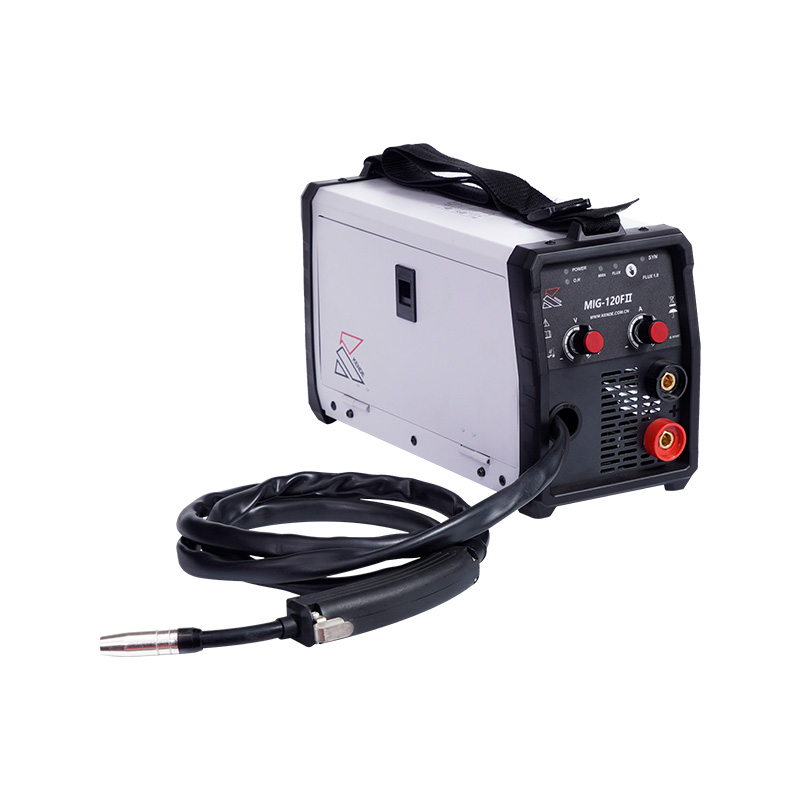
MIG-120FII/140FII/160FII , MMA (stick electrodes), flux-cored wire, 0.45-1KG, 1-5KG wire
The three machines share a common design philosophy: provide two useful welding methods in a relatively small and transportable package. Operators can select no-gas flux-cored wire welding for faster continuous work or choose MMA welding when electrode flexibility, outdoor operation, or a simple setup is preferred.
Flux-cored wire welding is suitable for many carbon-steel, alloy-steel, and stainless-steel applications, depending on the selected wire and the welding procedure. Because the flux inside the wire produces shielding during welding, the process does not require an external gas cylinder. This reduces the number of components needed at the jobsite and allows work to continue in locations where wind could disturb an external shielding gas supply.
MMA welding provides a second operating mode for users who work with coated electrodes. The machine can accommodate electrode sizes from approximately 1.6 millimeters to 3.2 millimeters on the MIG-120FII and MIG-140FII, while the MIG-160FII supports electrodes up to approximately 4.0 millimeters under the stated operating conditions. This makes the series useful for brackets, frames, gates, agricultural repairs, equipment maintenance, structural components, and general metalwork.
The machines are controlled through a touch-button interface and an encoder-based parameter adjustment system. Depending on the selected flux-cored mode, the operator can use a single-knob or synergic adjustment approach. This helps reduce setup complexity for users who do not want to calculate multiple welding parameters manually.
The MIG-120FII is the lightest model in the family. It provides a flux-cored current range of 40 to 120 amperes and an MMA range of 20 to 100 amperes. With a net weight of approximately 5.5 kilograms and dimensions of about 380 by 170 by 230 millimeters, it is suited to portable repair work, thin materials, small fabrication projects, and users who prioritize low carrying weight.
The MIG-140FII increases the available flux-cored current to 140 amperes and the MMA range to 40 to 120 amperes. It weighs approximately 8.6 kilograms and measures about 420 by 215 by 315 millimeters. This model offers additional working capacity for general workshop use while retaining a portable form factor.
The MIG-160FII is the highest-output version. It offers a flux-cored current range of 40 to 160 amperes and an MMA range of 20 to 140 amperes. Its rated duty cycle differs from the smaller models, but it provides the greatest current reserve in the series and supports electrodes up to approximately 4.0 millimeters. Its net weight is approximately 8.8 kilograms, with dimensions of about 420 by 215 by 315 millimeters.
The machines use insulated-gate bipolar transistor, or IGBT, inverter technology. Inverter welding equipment converts incoming electrical power at high frequency before transforming and regulating it for the welding circuit. Compared with traditional low-frequency transformer machines, this architecture can reduce machine size and weight while improving control over the welding current.
IGBT technology also supports faster electronic response. When the arc length, material condition, or electrode behavior changes, the control system can react quickly to maintain a more consistent welding output. This contributes to smoother arc operation and can help reduce the amount of manual correction required from the operator.
A smaller and lighter power section is especially valuable for service technicians, installers, mobile repair teams, and contractors who frequently move equipment between work areas. Portability does not eliminate the need for safe lifting and correct handling, but it makes the machines more practical than bulky conventional equipment for many applications.
An advanced microprocessor control unit manages the welding process and coordinates the machine’s electronic functions. Microprocessor-based control allows the manufacturer to program operating characteristics more precisely than a simple analog control system.
The control system can help regulate current behavior, support stable arc ignition, coordinate the selected welding mode, and maintain consistent output during operation. It also enables a clearer user interface, including touch-button selection and encoder adjustment. For the operator, this means that the machine can provide a repeatable setup rather than relying entirely on mechanical controls and personal estimation.
Control precision is particularly important when welding thin sheet metal. Excessive current can cause burn-through, while insufficient current can produce poor fusion, weak joints, or excessive spatter. By offering a controlled adjustment range and responsive electronics, the series is designed to help users find a more appropriate balance between penetration, travel speed, and heat input.
The machines also use switching-mode power supply control technology. This approach contributes to efficient power conversion and supports the compact design of the equipment. A well-controlled switching power supply can help the machine operate effectively while limiting unnecessary energy loss.
The stated efficiency rating is approximately 85 percent across the models, and the power factor is approximately 0.9. These figures indicate a design intended to use input power productively while reducing the burden placed on the electrical supply compared with less efficient equipment of similar welding capability.
No-gas flux-cored welding is one of the most practical features of this product family. The wire contains a flux material that produces shielding during the welding process. As a result, the operator does not need a separate cylinder, regulator, hose, and external shielding-gas supply for suitable flux-cored applications.
This arrangement has several operational advantages. Equipment preparation is faster because fewer components must be assembled. The workstation is easier to move because there is no gas cylinder to transport. Outdoor repair work is more convenient because the process is less dependent on maintaining a stable external gas shield. The operator can also reduce the recurring logistical requirements associated with gas-cylinder storage, refilling, and handling.
Flux-cored welding can be particularly useful for repair work performed away from a permanent workshop. Examples include farm equipment maintenance, trailer repair, steel gate fabrication, construction-site repairs, and general machinery servicing. The process is not automatically suitable for every material or joint, so the selected wire, polarity, material thickness, and welding procedure must always be matched to the application.
Flux-cored welding may produce slag and spatter, and the operator must remove slag between passes where required. However, with correct setup and technique, the process can provide productive welding performance and strong, useful joints.
MMA welding gives users the flexibility to work with coated electrodes. This process is widely recognized for its straightforward equipment requirements and ability to operate in locations where wire feeders or shielding-gas systems may be less convenient.
Coated electrodes are available in many types for carbon steel, stainless steel, low-alloy steel, and specialized repair work. The operator can select an electrode according to the required strength, position, penetration, and material characteristics. MMA is also useful when the workpiece is dirty, weathered, or difficult to prepare to the same degree required by some wire processes, although proper cleaning remains important for weld quality.
The MMA range of the three machines supports small to medium fabrication and repair activities. Users should select electrode diameter and current according to the electrode manufacturer’s recommendations, material thickness, welding position, and joint design. The rated capability of a machine does not replace the need for an appropriate welding procedure.
Combining flux-cored wire welding and MMA in one machine provides a useful balance between speed and flexibility. Flux-cored wire is convenient for longer welds and repeated fabrication tasks, while MMA is practical for isolated repairs, outdoor work, and applications where a spool of wire is not the preferred consumable.
A dual-process machine can also reduce capital expenditure for small businesses. Instead of buying one dedicated wire machine and another stick machine, a workshop can use one compact platform for a broader range of work. This may reduce storage requirements and simplify basic operator training.
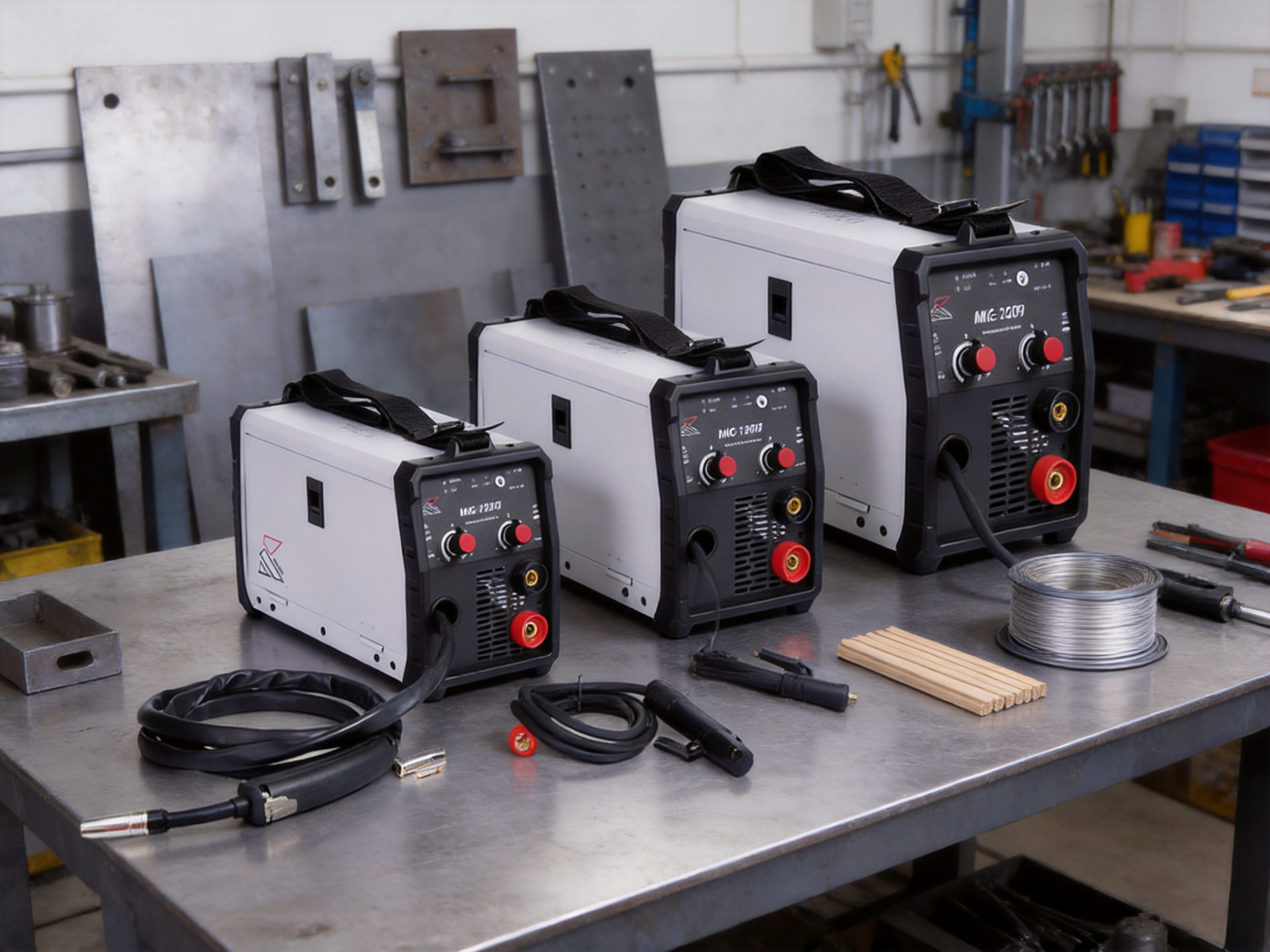
Arc stability is a central factor in weld quality. An unstable arc can produce irregular penetration, excessive spatter, inconsistent bead appearance, and operator fatigue. The microprocessor-controlled inverter design is intended to maintain a stable arc during both flux-cored and MMA operation.
A stable arc helps the operator maintain a consistent travel speed and electrode or torch position. It can also make it easier to control the weld pool, especially when working on thin or moderately thin materials. More predictable arc behavior is useful for both experienced welders seeking efficiency and less experienced users developing their technique.
The product information emphasizes small spatter and good welding performance. Spatter levels depend on many factors, including wire type, electrode selection, current, voltage, polarity, material cleanliness, stick-out, arc length, and operator technique. Nevertheless, accurate electronic control can contribute to a smoother process when the machine is correctly adjusted.
Lower spatter can improve productivity by reducing post-weld cleanup. It may also help preserve the appearance of surrounding surfaces and decrease the time spent removing unwanted metal particles. In fabrication environments where many components are welded each day, small reductions in cleanup time can have a meaningful cumulative effect.
The machines are described as capable of welding thin plates of carbon steel, alloy steel, stainless steel, and other materials when the correct consumables and procedures are used. Thin-material welding requires careful control because the available thermal margin is small.
The lower end of the current range, controlled arc behavior, and adjustable parameters allow the user to work toward lower heat input when appropriate. Proper joint fit-up, clean material, short arc control, suitable travel speed, and intermittent welding techniques may further reduce the risk of distortion or burn-through.
The combination of inverter technology, switching-mode power conversion, an approximately 85 percent efficiency rating, and a power factor of approximately 0.9 reflects an emphasis on efficient operation. Energy efficiency can lower operating costs and reduce heat generated within the electrical system.
For users who operate welding equipment regularly, energy consumption is only one part of total cost. Efficient equipment may also contribute to lower cooling requirements, easier transport, and reduced demand on portable generators, although generator compatibility must be assessed separately. The generator must have sufficient capacity and stable output for the selected welding current and duty cycle.
Portability is one of the clearest advantages of the series. The MIG-120FII weighs approximately 5.5 kilograms, while the two larger models weigh approximately 8.6 and 8.8 kilograms. These weights are considerably more manageable for mobile work than many traditional transformer-based machines.
The compact dimensions allow the machine to be transported in a service vehicle, positioned on a workshop bench, or carried between work areas. A portable machine can also be used in locations where the workpiece cannot be transported to a central fabrication shop.
Users should still place the machine on a stable, dry, and adequately ventilated surface. The enclosure should not be covered during operation, and the air vents must remain unobstructed. Portability improves flexibility, but it does not remove the need for safe installation and operation.
The following table summarizes the principal specifications supplied for the three models. Values may depend on the applicable testing standard, operating conditions, and production configuration. Users should consult the machine nameplate and technical manual before final installation.
| Specification | MIG-120FII | MIG-140FII | MIG-160FII |
|---|---|---|---|
| Rated supply voltage | 230 V | 230 V | 230 V |
| Supply frequency | 50 Hz | 50 Hz | 50 Hz |
| Rated input capacity | 5.1 kVA | 6.1 kVA | 7.1 kVA |
| Rated supply current | 22 A | 26 A | 30.5 A |
| No-load voltage | 60 V | 60 V | 60 V |
| Flux-cored current range | 40–120 A | 40–140 A | 40–160 A |
| MMA current range | 20–100 A | 40–120 A | 20–140 A |
| Flux-cored rated welding voltage | 16–20 V | 16–21 V | 16–22 V |
| MMA rated welding voltage | 20.8–24 V | 20.8–24.8 V | 20.8–25.6 V |
| Flux-cored duty cycle | 30% | 30% | 20% |
| MMA duty cycle | 40% | 40% | 30% |
| Usable electrode or wire range | Flux wire: 0.6–1.0 mm; MMA electrode: 1.6–3.2 mm | Flux wire: 0.6–1.0 mm; MMA electrode: 1.6–3.2 mm | Flux wire: 0.6–1.0 mm; MMA electrode: 1.6–4.0 mm |
| Efficiency | 85% | 85% | 85% |
| Power factor | 0.9 | 0.9 | 0.9 |
| Protection rating | IP21S | IP21S | IP21S |
| Insulation class | H | H | H |
| Net weight | 5.5 kg | 8.6 kg | 8.8 kg |
| Machine dimensions | 380 × 170 × 230 mm | 420 × 215 × 315 mm | 420 × 215 × 315 mm |
Traditional transformer welding machines can be durable and straightforward, but they are often heavier and less convenient to transport. Their control response may also be less refined than that of modern inverter equipment. The three machines in this series use high-frequency inverter architecture to deliver a smaller package with electronic control and a broader practical range of operating adjustments.
For mobile contractors and maintenance technicians, the lower weight can be a major advantage. Reduced size may also make it easier to dedicate a machine to a service vehicle or small workshop. In addition, the ability to switch between flux-cored wire and MMA can provide more process flexibility than a basic single-purpose transformer unit.
Conventional gas-shielded MIG or MAG welding is highly productive and is often preferred for clean indoor fabrication. However, it requires a gas cylinder, regulator, hose, and a suitable supply of shielding gas. This creates additional equipment and handling requirements.
The no-gas flux-cored function offers a more mobile alternative for suitable applications. It can simplify preparation, reduce dependence on gas logistics, and improve practicality in outdoor or temporary work areas. It is not a universal replacement for gas-shielded MIG welding, but it provides an important option when portability and setup speed are priorities.
A basic MMA-only machine can be useful for repair work, but it does not provide the continuous wire-feed capability that many fabrication tasks require. The dual-process design allows operators to use a wire process for longer seams and production-oriented work, then change to MMA when a coated electrode is more convenient.
This versatility may be especially valuable for small workshops that handle varied jobs rather than producing one standardized component. The same machine can support equipment repair, light structural fabrication, sheet-metal work, maintenance, and general-purpose welding.
Large industrial welding systems can provide higher output, advanced automation, and specialized process control. However, they may be excessive for small repair operations, mobile work, and low-to-medium duty applications. The MIG-120FII, MIG-140FII, and MIG-160FII are positioned as compact and practical machines for users who need useful capability without the size and complexity of a full industrial installation.
Their limitations should be understood honestly. The duty cycles are intended for intermittent operation rather than uninterrupted heavy production at maximum output. Users requiring continuous high-current welding, mechanized travel, submerged arc welding, or integrated robotic control should select equipment designed specifically for those purposes.
Ease of adjustment has a direct effect on productivity and weld consistency. The touch-button controls provide a simple way to select or manage operating functions, while the encoder allows parameters to be adjusted without relying on complicated menus.
In synergic flux-cored operation, the machine can coordinate related parameters so that the operator does not need to independently calculate every setting. This is useful for less experienced users and can reduce setup time for common materials and wire sizes. Experienced welders can still apply their knowledge of joint design, wire selection, travel speed, and heat input to refine the result.
The control arrangement also supports repeatability. Once a suitable setting has been identified for a particular material thickness and wire, the operator can return to a similar parameter range for future work. Repeatability is valuable in workshops where several operators share equipment or where the same type of repair is performed regularly.
Even with simplified controls, operators should not treat the machine as an automatic welding system. Welding quality depends on joint preparation, correct polarity, consumable condition, work angle, travel angle, arc length, grounding, and personal protective equipment. The controls make adjustment easier, but correct technique remains essential.
The product is supplied with a complete basic accessory set. The stated accessories include a MIG torch, electrode holder, earth clamp, welding cable, brush or hammer, and protective mask.
The MIG torch supports the wire-welding function, while the electrode holder is used for MMA welding. The earth clamp provides the return path required for the welding circuit. The welding cable connects the relevant components to the power source, and the brush or hammer can assist with removing slag and surface residue after welding.
The included protective mask is intended as part of the basic package, but users should verify its rating and condition before use. Welding operators must use appropriate eye and face protection, flame-resistant clothing, welding gloves, suitable footwear, and other required protective equipment. Nearby personnel may also need protection from arc flash.
Before switching on the machine, inspect the power cable, torch, electrode holder, earth lead, connectors, and enclosure. Confirm that the selected process matches the installed accessories and consumable. Make sure the workpiece is supported securely and that flammable materials have been removed from the work area.
For flux-cored welding, install the correct wire spool, confirm wire diameter compatibility, check the feed path, and set the correct polarity according to the wire manufacturer’s instructions. For MMA welding, install the electrode in the holder, connect the leads according to the electrode requirements, and select a suitable current.
Clean rust, paint, oil, moisture, and heavy scale from the joint area wherever practical. Good preparation improves arc stability, penetration, bead appearance, and overall weld integrity. The earth clamp should be attached to clean metal as close to the welding zone as possible.
After welding, remove slag where required and inspect the joint visually. Look for cracks, undercut, excessive porosity, incomplete fusion, poor tie-in, and irregular bead shape. More demanding work may require additional inspection methods or qualification procedures.
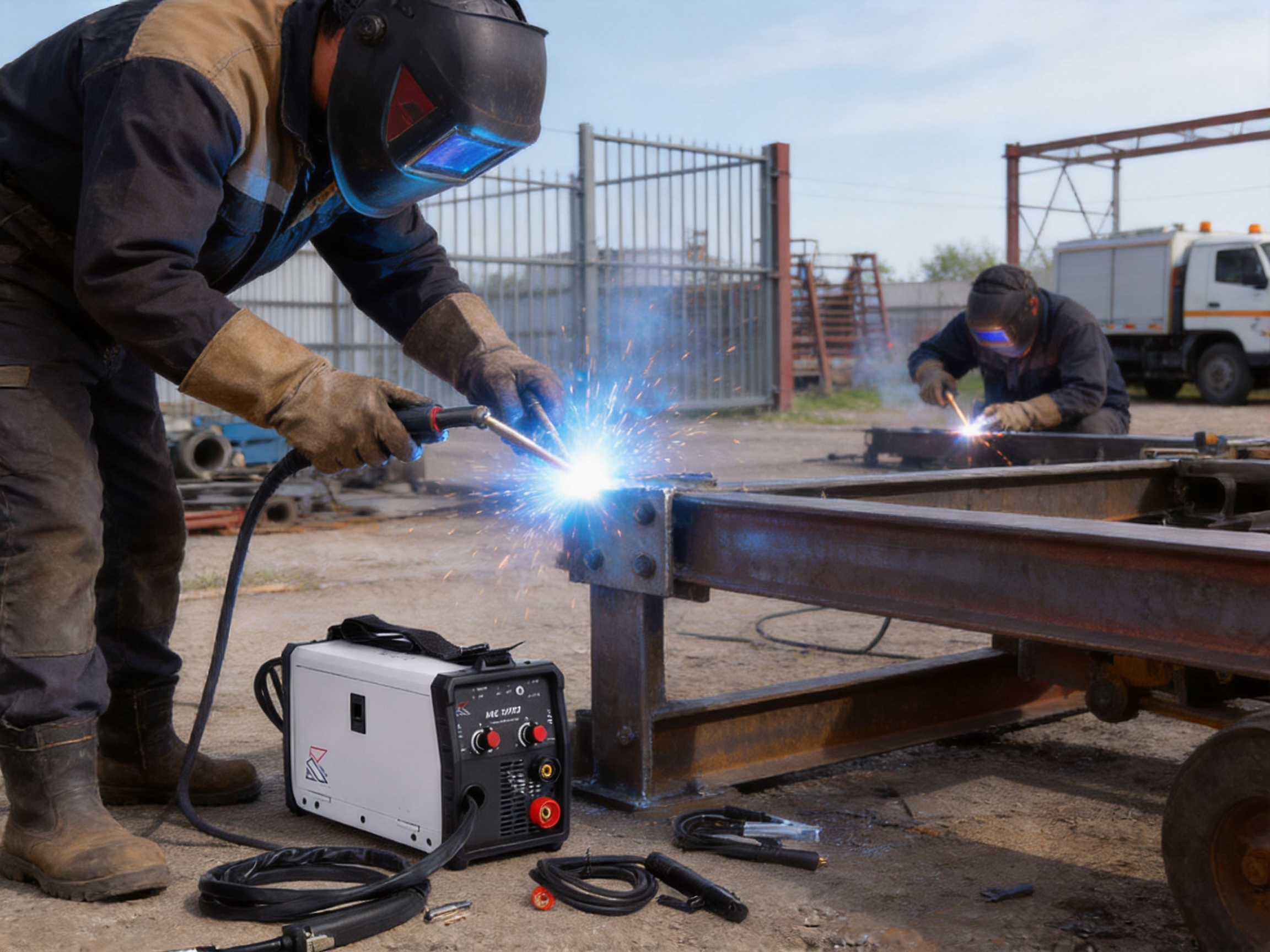
Small and medium workshops can use the series for frames, supports, brackets, panels, carts, shelves, guards, worktables, and general steel fabrication. Flux-cored wire can improve productivity on repeated welds, while MMA provides a convenient option for occasional repairs or thicker sections within the machine’s capacity.
Maintenance teams often face varied materials, irregular workpieces, and changing work locations. A portable dual-process machine can support repairs to machinery, agricultural implements, trailers, handrails, structural supports, and general steel components.
The no-gas function can be helpful when repairs take place outdoors or in areas where transporting a gas cylinder would be inconvenient. MMA provides an alternative when the operator needs to carry only a small selection of electrodes rather than a wire spool and feeder accessories.
Construction and installation environments may require equipment to be moved between floors, work zones, or temporary structures. The compact design and relatively low weight of the series can make this movement easier. Before use on a construction site, the operator must consider electrical safety, weather exposure, ventilation, grounding, and local site rules.
The lower-current range of the MIG-120FII can be useful for selected automotive and light sheet-metal applications when the material, wire, and procedure are appropriate. Thin steel requires careful control to avoid distortion and burn-through. Short welds, controlled heat input, clean surfaces, and suitable joint design are important.
The larger models may be selected where additional output is needed for frames, brackets, heavier panels, or repair components. The exact suitability depends on the thickness and grade of the material, as well as the required appearance and strength of the finished joint.
Farm machinery, gates, trailers, implements, and steel structures frequently require repair away from a dedicated fabrication shop. A portable machine that supports both flux-cored and stick welding can reduce downtime and allow operators to choose the most practical process for the location.
Because rural power supplies can vary, users should confirm that the available electrical circuit can safely support the rated input current. Long extension cables, undersized conductors, unstable generators, and poor connections can reduce performance or create safety risks.
The machines include multiple protective measures intended to improve reliability and user safety. The product information highlights resistance to changes in supply voltage, which is valuable in practical environments where electrical conditions may not be perfectly stable.
The IP21S protection classification indicates that the enclosure is designed for specified levels of protection against solid objects and vertically falling water under the applicable classification system. It does not mean that the machine is waterproof or suitable for operation in rain, standing water, or severe exposure. The equipment should be kept dry and protected from dust, moisture, conductive contamination, and corrosive substances.
Insulation class H indicates a high-temperature insulation category for the relevant electrical components. This supports the machine’s intended operating environment, but it does not permit the operator to exceed the rated duty cycle or block the ventilation openings.
Duty cycle is an essential consideration. The MIG-120FII and MIG-140FII are specified with a 30 percent duty cycle for flux-cored operation and 40 percent for MMA operation. The MIG-160FII is specified with a 20 percent flux-cored duty cycle and 30 percent MMA duty cycle. In practical terms, duty cycle describes the amount of time the machine can weld within a standard test period at a stated output before a cooling interval is required.
Welding at lower current may permit longer operating periods, while welding at maximum current generally requires more frequent rest periods. Users should follow the operating manual and allow the cooling fan and thermal protection system to work as designed.
Routine maintenance should include cleaning dust from the ventilation area, checking cable insulation, inspecting connectors, examining the torch and electrode holder, and confirming that the earth clamp remains in good condition. Wire-feed components should be kept clean and correctly adjusted when flux-cored welding is used.
Consumable contact tips, nozzles, liners, rollers, electrodes, and wire should be replaced or cleaned when wear or contamination affects feeding and arc performance. The machine should be disconnected from the power supply before internal cleaning or service, and internal repairs should be performed by qualified personnel.
The manufacturer behind this product line operates as a large-scale producer of welding machines, chargers, and heaters. Its facilities reportedly cover approximately 120,000 square meters and employ around 600 people. Annual exports are stated at nearly 1.5 million units, with annual production capacity reaching approximately 2 million units.
These production resources provide several advantages for a product family such as the MIG-120FII, MIG-140FII, and MIG-160FII. Large-scale manufacturing can support consistent component sourcing, standardized assembly methods, controlled testing, and more reliable production planning. It can also help the manufacturer maintain product continuity and respond to demand from multiple markets.
The company maintains a Zhejiang Provincial Research and Development Center, an enterprise technology center, and an intelligent welding technology research institute. Approximately 98 research and development personnel are identified in the company information.
This technical infrastructure supports continued work on inverter power systems, control software, thermal management, welding characteristics, electrical safety, and product adaptation. The use of microprocessor control in the product series demonstrates how electronic engineering and welding-process knowledge are combined in a compact machine platform.
The company also reports ownership of invention patents, utility model patents, appearance patents, and software copyrights. Such intellectual property can support the development of proprietary control methods, mechanical structures, user interfaces, and production technologies.
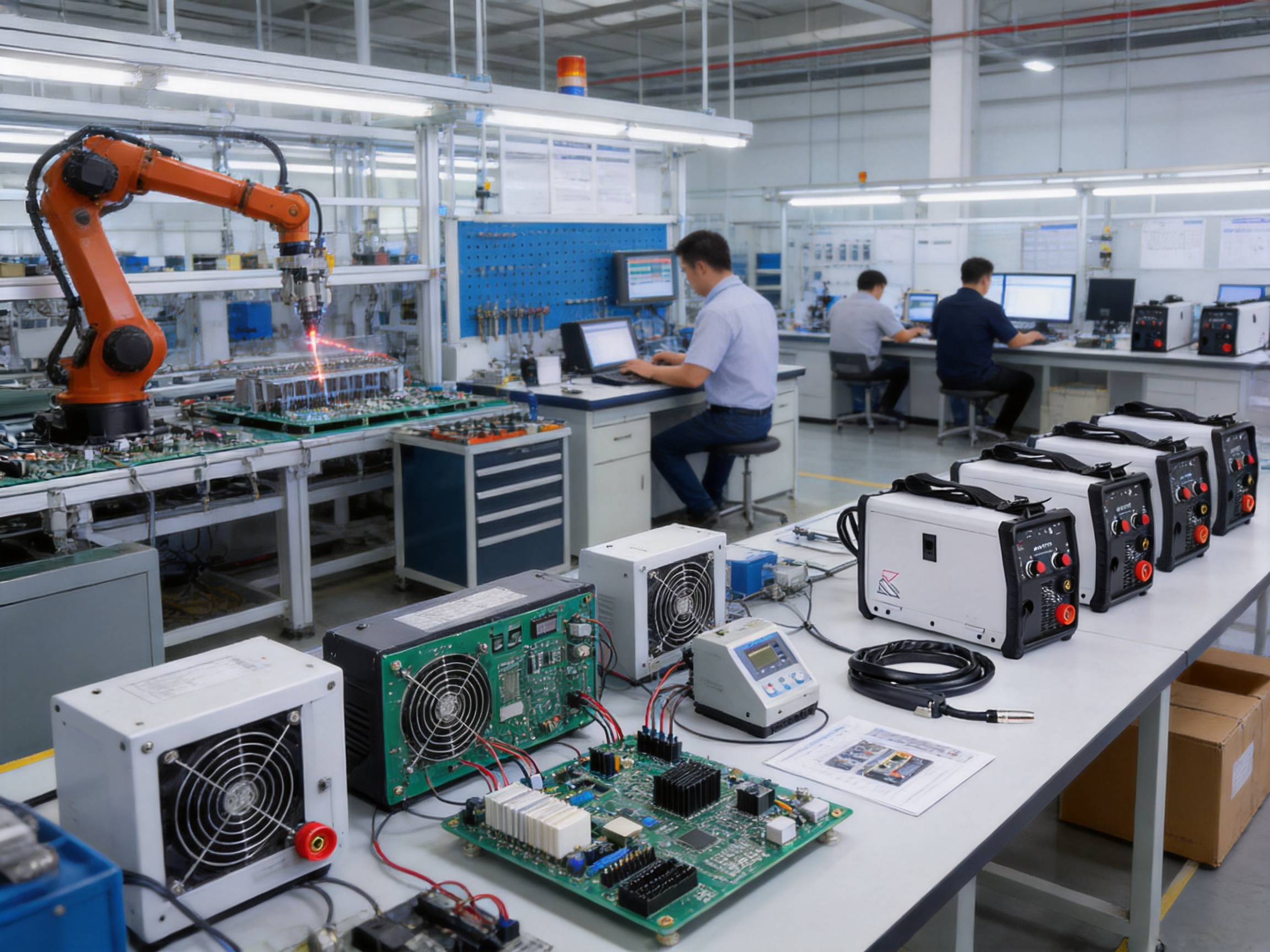
The manufacturing process includes automatic patching, plug-in assembly, welding systems, robot processing, laser cutting, and other advanced technologies. These methods can improve assembly consistency and reduce variation between units when properly managed.
Automated surface-mount and plug-in processes are particularly important for inverter welding machines because electronic boards contain many components that must be positioned and soldered accurately. Automated assembly can improve repeatability, while inspection and testing help identify manufacturing defects before products are shipped.
Robot processing can improve consistency in repetitive mechanical operations. Laser cutting can produce precise sheet-metal parts, contributing to accurate enclosure fit, ventilation layout, mounting features, and overall appearance. The combination of automated fabrication and controlled assembly supports a more stable production process than purely manual manufacturing.
The company applies several management and manufacturing systems, including office automation, Toyota Production System-based management, ERP software, and MES management systems. These systems are intended to connect production planning, material control, process tracking, quality management, and delivery coordination.
ERP systems can support purchasing, inventory, order management, and resource planning. MES systems can provide more detailed information about production status, workstations, process records, and manufacturing traceability. Toyota Production System principles emphasize process discipline, waste reduction, standardization, and continuous improvement.
For buyers, these systems may be more important than factory size alone. A reliable supplier must be able to maintain consistent specifications, manage component changes, document production, and provide technical support over time. Structured manufacturing systems help create the foundation for these capabilities.
The company reports international product certifications and compliance marks including GS, CE, EMC, ERP, United States ETL, United Kingdom UKCA, and China CCC for applicable products. Certification requirements differ by product, market, model, and configuration, so buyers should request the specific documentation relevant to the intended destination.
Compliance marks should not be interpreted as a substitute for safe installation or correct operation. They indicate that a product has been evaluated against particular requirements under specified conditions. Importers and distributors should verify current certificates, applicable standards, model numbers, rated voltage, and market-specific documentation before placing products on sale.
The company is also identified as a national standard drafting unit associated with the National Welding Machine Standardization Committee. It has reportedly participated in drafting, formulating, or revising 20 national standards and has led the drafting of one group standard.
Participation in standards work can strengthen a manufacturer’s understanding of safety, performance, testing, and terminology requirements. It also reflects involvement beyond basic assembly and indicates experience with the broader technical framework of welding equipment.
A welding machine must be evaluated as both an electrical product and a process-control tool. Quality control therefore needs to address input circuits, inverter components, insulation, thermal performance, output stability, protective functions, mechanical enclosure quality, cable connections, and user-interface operation.
For the MIG-120FII, MIG-140FII, and MIG-160FII, important production checks may include verifying the rated supply voltage, no-load voltage, current range, duty-cycle behavior, wire-feed operation, MMA output, protective shutdown functions, fan operation, and electrical insulation.
Welding performance testing should examine arc starting, arc stability, spatter behavior, wire feeding, electrode compatibility, and consistency at different output levels. Sample welds can be visually examined for bead shape, penetration, fusion, porosity, and slag removal characteristics.
Distributors and professional buyers may also request information about incoming-component inspection, final product testing, production traceability, quality-management procedures, warranty handling, and spare-parts availability. These factors help determine the total value of the equipment beyond its initial purchase price.
The MIG-120FII is the most compact option and the lightest model. It is suitable for users whose main priorities are portability, low-current welding, thin material, and occasional general fabrication. It can be a practical choice for home workshops, mobile repair kits, service vehicles, and small maintenance operations.
Its maximum flux-cored output of 120 amperes and MMA output of 100 amperes should be matched to realistic job requirements. Users who regularly weld thicker sections or require longer runs at higher output may benefit from selecting one of the larger models instead.
The MIG-140FII is a balanced general-purpose option. It provides more current capacity than the MIG-120FII while retaining the same basic dual-process concept and electrode range. It may suit workshops that handle a mix of light and medium fabrication, repair, brackets, frames, gates, and maintenance tasks.
Its 140-ampere maximum flux-cored output and 120-ampere MMA range provide additional flexibility for users who want a compact machine but need more reserve than the smallest model offers.
The MIG-160FII is appropriate for users who need the highest output in the series and the ability to use electrodes up to approximately 4.0 millimeters. It provides a maximum flux-cored current of 160 amperes and an MMA range up to 140 amperes.
The higher output should be considered together with the stated duty cycle. The model is best suited to intermittent general fabrication and repair rather than continuous heavy industrial welding at maximum current. For users who need additional current reserve but still value portability, it may offer the most capable option in the range.
Welding produces intense ultraviolet radiation, visible light, heat, fumes, sparks, and molten metal. Operators must use a suitable welding helmet or mask, protective clothing, gloves, and footwear. Work areas must be ventilated, and local extraction should be used when necessary to control fumes.
Never weld containers, pipes, tanks, or enclosed components that may contain flammable residues unless they have been professionally cleaned, tested, and declared safe. Remove combustible materials from the area and keep appropriate fire-control equipment available.
The machine should be connected to an electrical supply capable of supporting its rated input current. A qualified electrician should verify circuit protection, grounding, plug configuration, cable size, and local regulatory requirements. Extension cables should be as short and appropriately sized as possible.
Do not operate the equipment in rain, standing water, or excessively damp conditions. The IP21S rating does not make the machine weatherproof. Protect the unit from conductive dust, metal particles, corrosive chemicals, and severe temperature conditions.
Always observe the rated duty cycle. Repeated operation beyond the rated limit can activate thermal protection and may shorten component life. If thermal shutdown occurs, stop welding and allow the machine to cool naturally. Do not bypass protective devices or remove the enclosure while the machine is energized.
The MIG-120FII, MIG-140FII, and MIG-160FII support no-gas flux-cored wire welding and MMA, or stick electrode, welding. They are not presented as conventional gas-shielded MIG machines requiring an external shielding-gas cylinder.
The product information states that the machines can weld carbon steel, alloy steel, stainless steel, and other materials. Successful stainless-steel welding requires compatible wire or electrodes, correct polarity, suitable parameters, proper joint preparation, and appropriate technique.
No external shielding-gas cylinder is required for compatible no-gas flux-cored wire. The flux inside the wire generates shielding during welding. Users must ensure that the selected wire is specifically designed for gasless operation.
Yes. Each model includes an MMA welding mode and an electrode holder. The usable electrode range depends on the model and operating conditions. The MIG-160FII supports electrodes up to approximately 4.0 millimeters according to the supplied specifications.
The MIG-120FII may be suitable when low weight and lower-current operation are the main priorities. However, the correct model depends on material thickness, joint design, consumable selection, and required duty cycle. Thin sheet metal must be welded with controlled heat input and suitable technique.
The microprocessor control system helps regulate welding behavior, supports arc stability, manages operating modes, and makes parameter adjustment more repeatable. It can also support synergic control in the flux-cored mode.
Duty cycle indicates how long the machine can weld at a stated output during a standard test period before cooling is required. For example, a 30 percent duty cycle generally means that welding can occur for 3 minutes within a 10-minute period under the specified test conditions, followed by a cooling period. The exact interpretation should be confirmed in the technical manual.
They are designed for portable and general-purpose welding rather than uninterrupted high-current industrial production. The duty-cycle ratings should be compared with the intended workload. High-volume production may require a machine with a higher duty cycle, dedicated wire-feeding equipment, automation, or a specialized industrial process.
Generator use may be possible when the generator provides adequate capacity, voltage stability, waveform quality, and protective grounding. The generator rating should account for the machine’s input capacity and starting characteristics. A qualified electrical professional should confirm compatibility.
The listed accessories include a MIG torch, electrode holder, earth clamp, welding cable, brush or hammer, and protective mask. The exact configuration should be confirmed with the supplier for the specific model and market.
Keep the ventilation openings clean, inspect cables and connectors, maintain the torch and wire-feed system, replace worn consumables, and protect the machine from moisture and conductive dust. Disconnect the power before cleaning or servicing, and have internal repairs completed by qualified personnel.
The manufacturer reports large production capacity, an extensive export business, dedicated research and development centers, automated production technologies, ERP and MES systems, numerous certifications, and participation in national welding-machine standards work. These factors indicate experience in product development, manufacturing, compliance, and international distribution.
The strongest competitive advantage of the MIG-120FII, MIG-140FII, and MIG-160FII is their combination of process flexibility, compact design, electronic control, and accessible operation. Many users do not need a large industrial welding system, but they do need more versatility than a basic single-process machine can provide.
The no-gas flux-cored function reduces dependence on external shielding-gas equipment, while MMA allows the use of widely available coated electrodes. IGBT inverter technology keeps the machines relatively light, and microprocessor control supports a more stable arc and easier adjustment. The included accessories help users begin work with fewer additional purchases.
The three-model range also allows buyers to align equipment capacity with their actual workload. The smallest model prioritizes mobility, the middle model balances portability and output, and the largest model provides the greatest current reserve in the series.
From the manufacturing perspective, the product benefits from a company with extensive production resources, dedicated technical departments, automated assembly and fabrication technologies, structured management systems, international certifications, and long-term experience in welding equipment. This combination can be valuable to distributors seeking a stable product platform and to end users seeking practical equipment for varied work.
The MIG-120FII, MIG-140FII, and MIG-160FII form a flexible family of portable welding machines for no-gas flux-cored wire welding and MMA stick welding. Their design addresses the needs of users who require mobility, simplified setup, stable arc performance, and the ability to change welding processes without purchasing separate machines.
Advanced IGBT inverter technology, microprocessor control, switching-mode power conversion, touch-button operation, encoder adjustment, and synergic parameter control contribute to a modern user experience. The machines are designed to support welding on carbon steel, alloy steel, stainless steel, and other suitable materials when the correct consumables and procedures are applied.
The product range also reflects the strengths of an established manufacturer with substantial production capacity, research and development resources, automated manufacturing technologies, quality-management systems, international certifications, and standards experience. These capabilities support the consistency, adaptability, and commercial reliability expected from equipment sold across multiple markets.
For light fabrication, maintenance, mobile repair, agricultural work, construction support, and general workshop applications, the series offers a strong balance between capability and portability. Buyers should select the model according to current requirements, duty cycle, material thickness, electrical supply, and expected workload. When correctly installed, maintained, and operated, these machines can provide an efficient and versatile foundation for everyday welding work.
1. Product technical information for the MIG-120FII, MIG-140FII, and MIG-160FII welding machines.
2. Manufacturer-provided specifications for rated voltage, input capacity, welding-current ranges, duty cycles, efficiency, protection rating, insulation class, weight, and dimensions.
3. General principles of IGBT inverter welding-machine design and switching-mode power conversion.
4. General guidance on flux-cored arc welding, MMA welding, welding consumables, joint preparation, and operator safety.
5. Manufacturer information concerning research and development facilities, production capacity, automated manufacturing, quality systems, certifications, and standards participation.
6. General electrical-safety principles for arc-welding equipment, portable power supplies, grounding, ventilation, and duty-cycle management.
Recommended Products

Contact Us
No.2299, Luqiao Section, Shugang Avenue, Luqiao District, Taizhou, 318057 Zhejiang, PR China.
+86-576-82431568
 Privacy
China Welding Machine Factory
 English
 中文简体
中文简体
 русский
 Español
 عربى
عربى
 Français
 Português
 Deutsch
 Український