Email: [email protected]
Email: [email protected]

Blog
 2026.07.30
 Blog
Blog
Industrial welding requires more than a high current rating. A reliable welding machine must deliver a stable arc, respond quickly to changing conditions, protect itself against overload, operate consistently across demanding job sites, and remain practical for technicians who use it every day. The TOP-400M 380V industrial IGBT inverter MMA welding machine is designed around these requirements. It combines three-phase power input, inverter control technology, constant-current output, adjustable arc characteristics, thermal protection, and a robust enclosure into a compact DC stick welding platform.
This product is intended for professional users working with carbon steel, alloy steel, cast iron, stainless steel, and other commonly welded metals. Its manual metal arc capability makes it suitable for fabrication, repair, installation, maintenance, structural work, agricultural equipment, machinery production, and industrial service operations. Unlike basic transformer welders, the machine uses powerful IGBT switching devices and pulse-width modulation control to regulate the welding current more efficiently and with greater precision.
The product information identifies the unit as a high-duty-cycle, 380V industrial MMA welding machine. The technical table supplied for the TOP-400M lists a 40–260 ampere welding-current range, a maximum welding current of 260 amperes, a 74-volt no-load voltage, a 30.4-volt rated welding voltage, and a 40 percent rated duty cycle. The product title also refers to a 60 percent high-duty-cycle classification. Because duty-cycle values can vary according to test conditions, market configuration, or product documentation, users should confirm the rating applicable to their specific machine before selecting it for continuous maximum-current operation.
With its combination of stable DC output, intelligent inverter control, user-assistance functions, and industrial protection features, the TOP-400M provides a practical alternative to heavier conventional welding equipment. It is especially attractive to users who want a machine that can support demanding electrode work without the size, energy consumption, and maintenance burden associated with older welding technologies.
Manual metal arc welding, also known as stick welding or MMA welding, remains one of the most flexible welding processes in the industrial sector. It does not require an external shielding-gas cylinder, making it useful in outdoor environments, on construction sites, in repair workshops, and in locations where wind would disturb a gas-shielded process. The electrode coating creates the shielding atmosphere during welding, while the operator controls the electrode angle, travel speed, and arc length.
A traditional transformer welding machine normally relies on large magnetic components to convert electrical power into welding current. Although transformer machines can be durable, they are often heavy, less efficient, and less convenient to transport. Their current regulation may also be less responsive than that of a modern inverter. The TOP-400M uses IGBT inverter technology to switch and control electrical power at high frequency. This design enables a smaller machine size while supporting accurate current regulation and strong arc performance.
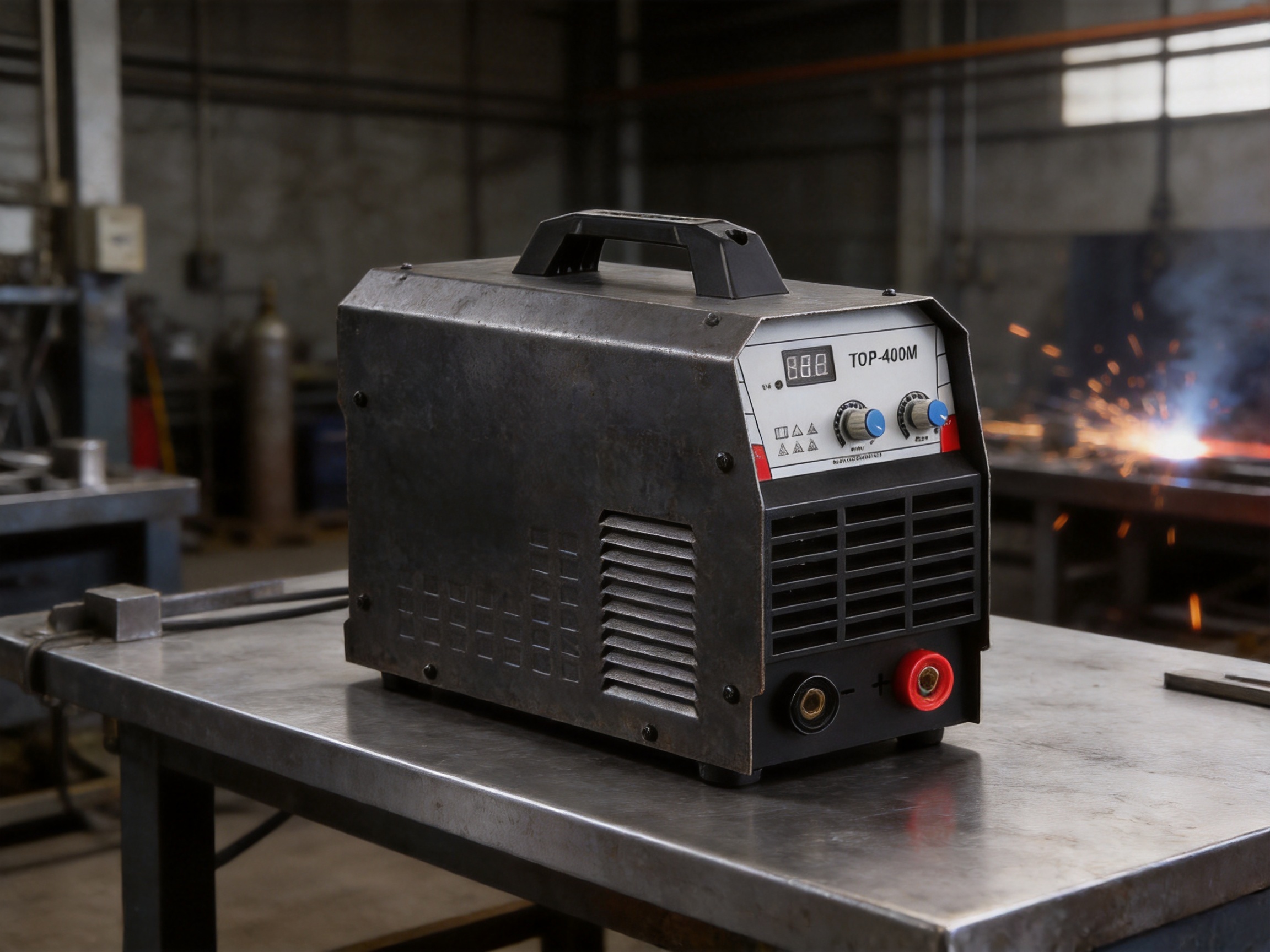
The listed machine size is 455 by 200 by 355 millimeters, and the net weight is 11.5 kilograms. These dimensions and weight make the unit significantly easier to move than many conventional industrial MMA machines with similar application goals. A portable design can reduce setup time, simplify work at elevated or remote locations, and make it easier for maintenance personnel to bring welding capability directly to the repair area.
Portability does not eliminate the need for correct installation. The TOP-400M is specified for a three-phase 380-volt supply and is designed to work properly within a broad 160–470-volt operating range according to the supplied information. Electrical installation should always be completed by qualified personnel, with appropriate circuit protection, grounding, cable sizing, and compliance with local regulations.
The TOP-400M provides direct-current welding output. DC welding is valued for its stable arc behavior, smooth electrode operation, and predictable penetration. It is suitable for a wide range of coated electrodes and materials. A stable DC output helps the operator maintain a consistent arc, reduce unnecessary spatter, and produce a more uniform weld bead when the correct electrode and welding parameters are selected.
High welding-current stability is particularly important during industrial repair and fabrication. Voltage fluctuations, cable movement, changes in arc length, and variations in workpiece position can all affect the arc. The machine’s inverter control and constant-current output design are intended to compensate for changing conditions and keep the welding current under control.
The supplied technical information lists a welding-current range of 40–260 amperes. This adjustment range allows the operator to select a lower current for smaller electrodes, thinner materials, tack welding, and controlled root work, while higher settings can be used with larger electrodes and heavier sections within the machine’s rated capacity.
Continuous adjustment across a broad range is more useful than a limited number of fixed current steps. It allows the welder to fine-tune the setting according to electrode diameter, welding position, joint design, base-metal thickness, and the desired bead profile. Proper adjustment can improve arc stability and reduce the risk of undercut, incomplete fusion, excessive penetration, or electrode sticking.
The Hot Start function briefly increases the current when the electrode is struck. This helps establish the arc quickly, especially when the electrode coating is cold, the workpiece surface is less than ideal, or the operator is working with an electrode that is more difficult to start.
Reliable arc initiation improves productivity because it reduces repeated striking attempts. It can also help prevent the electrode from sticking at the beginning of a weld. For maintenance technicians and less experienced operators, Hot Start provides useful assistance without removing the need for proper technique.
Arc Force monitors the welding voltage and supplies additional current when necessary. During manual welding, the arc length can become shorter as the electrode approaches the workpiece or as the operator changes position. A short arc can increase the chance of sticking. Arc Force helps maintain the arc by responding to this condition and adding current when required.
This feature is valuable when welding in difficult positions, using basic electrodes, or working on joints where maintaining a perfectly uniform arc length is challenging. It may also help the operator control penetration and maintain a more stable weld pool during changes in travel angle.
Anti-stick technology reduces welding current when the electrode becomes stuck to the workpiece. The operator can then separate the electrode more easily instead of forcing it away while a high current continues to flow. This protects the electrode holder, improves operator convenience, and reduces the chance of damaging the workpiece or electrode coating.
Anti-stick operation is especially useful during arc starting, low-current welding, positional work, and applications involving electrodes that are sensitive to sticking. It is one of the practical differences between a basic current source and a machine designed with operator-assistance functions.
Industrial welding machines can experience heat buildup when used at high current, in warm environments, or with restricted ventilation. The TOP-400M includes thermal overload protection and an indicator light. When the internal temperature exceeds the safe operating limit, the protective system can interrupt or limit operation until the machine cools.
This protection helps prevent damage to internal electronic components and extends the useful service life of the equipment. Operators should still follow the rated duty cycle, keep ventilation openings clear, avoid placing the machine against walls or dusty obstructions, and allow sufficient cooling time during demanding work.
Overload protection is not a substitute for correct application planning. If a job requires continuous welding at a current above the published duty-cycle rating, the user should select a larger machine, reduce the load, improve cooling conditions, or divide the welding task into appropriate intervals.
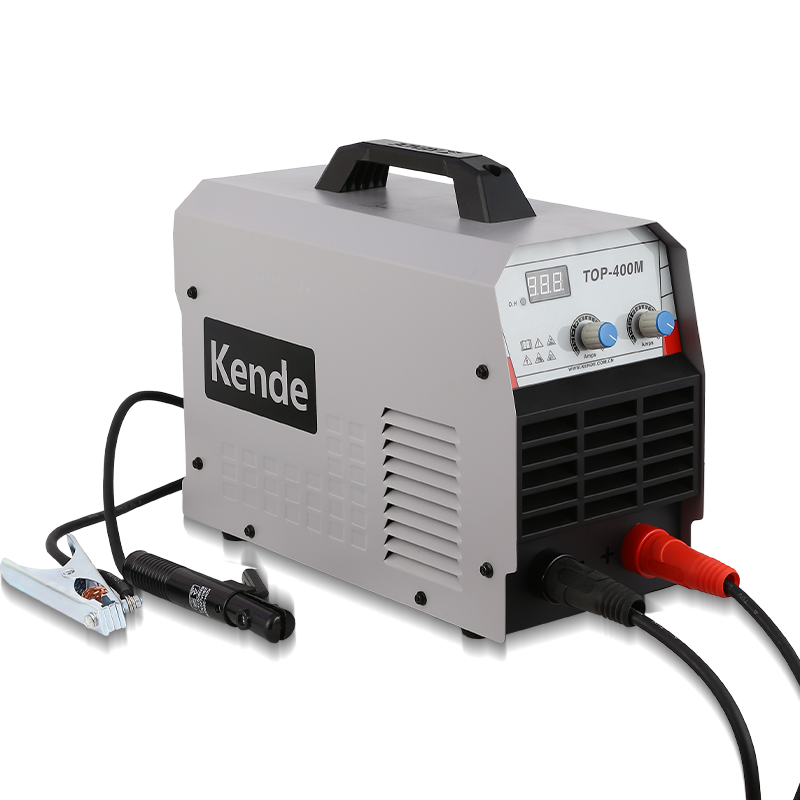
TOP-400M 380V industrial, High duty cycle 60%, 400A IGBT Inverter Welding machine (MMA)
The machine uses powerful insulated-gate bipolar transistor, or IGBT, switching devices. IGBTs are widely used in modern welding inverters because they can switch electrical power rapidly and efficiently. High-frequency switching allows the design to reduce the size of magnetic components while maintaining controlled output performance.
The result is a welding power source that can be lighter and more compact than a conventional low-frequency transformer unit. This is a major advantage for users who need industrial capability but cannot justify the transportation and storage requirements of a large transformer machine.
The product also uses pulse-width modulation, commonly called PWM, together with constant-current output control. PWM regulates the duration and timing of electrical pulses, allowing the control system to adjust the delivered power with precision. Constant-current control is important in MMA welding because the current should remain comparatively stable even when the arc voltage changes as the operator’s arc length varies.
In practical use, this technology supports several benefits:
• More precise welding-current adjustment.
• Faster response to changes in arc conditions.
• Improved arc stability during manual operation.
• Lower power consumption than many conventional designs.
• Reduced equipment size and weight.
• Better suitability for portable industrial service.
The supplied information states that the machine can save up to 30 percent energy compared with less efficient designs. Actual savings depend on the input supply, welding current, duty cycle, electrode type, operating method, and the efficiency of the alternative equipment. Nevertheless, inverter technology generally offers a strong efficiency advantage over older transformer-based equipment, especially when portability and controlled output are important.
The product information states that the TOP-400M can weld carbon steel, alloy steel, cast iron, stainless steel, and other metal types. The usable electrode range is listed as 1.6–5.0 millimeters. Electrode selection must be based on the base metal, joint design, welding position, required mechanical properties, and applicable welding procedure.
Carbon steel is one of the most common materials for MMA welding. The machine’s stable DC output can support general fabrication, structural repairs, brackets, frames, platforms, and equipment maintenance. Low-hydrogen electrodes may be selected for applications requiring improved resistance to hydrogen-related cracking, provided that they are stored, handled, and used according to the electrode manufacturer’s instructions.
Alloy steel may require controlled heat input, preheating, interpass-temperature management, and suitable filler-metal selection. The welding machine provides the current-control platform, but the complete welding procedure must account for the alloy composition and service requirements.
Cast iron presents special challenges because it is prone to cracking and hard heat-affected zones. Suitable cast-iron electrodes, controlled preheating, short weld sequences, and gradual cooling may be required. The machine’s Arc Force and Anti-stick functions can assist with arc control, but they cannot replace a technically appropriate cast-iron repair procedure.
Stainless steel electrodes can also be used when the electrode type, polarity, and current range are compatible with the application. Cleanliness is essential because oil, paint, moisture, and surface contamination may cause porosity or other defects. Stainless steel work should also be planned to limit unnecessary heat input and preserve corrosion resistance.
The listed 1.6–5.0 millimeter electrode range covers common light, medium, and heavier MMA work. Smaller electrodes are useful for thin sections and controlled welds, while larger electrodes can deposit more metal and support heavier joints. The operator must match electrode size to the selected current and avoid exceeding the machine’s current, duty-cycle, or thermal limits.
The supplied product information describes the machine as moisture-proof, anti-corrosion, anti-vibration, and resistant to conductive dust. These characteristics are valuable in workshops, construction environments, agricultural repair areas, and industrial maintenance locations where equipment may encounter vibration, humidity, airborne particles, or metal dust.
The protection rating is listed as IP21S. This rating indicates a basic level of protection against solid objects and vertically falling water under the applicable test conditions. It does not mean that the welding machine is waterproof or suitable for direct exposure to rain, spray, flooding, or high-pressure cleaning. The unit should be protected from weather and placed on a stable, dry surface whenever possible.
Dust management remains important even when a machine is designed to resist conductive dust. Welding environments can contain grinding particles, metallic debris, smoke residue, and other contaminants. Operators should inspect ventilation openings regularly and clean the unit according to the manufacturer’s maintenance instructions. Compressed air should be used carefully because excessive pressure or moisture can damage sensitive electronic components.
Anti-vibration construction can help the machine tolerate movement between workstations, but it should not be dropped, dragged by its welding cables, or exposed to unnecessary impact. Proper handling protects the enclosure, front-panel controls, internal circuit boards, and output terminals.
The product is supplied with a 2-meter welding cable and dual-angle electrode holder. A dual-angle holder can provide greater flexibility when the operator needs to maintain a suitable electrode position in corners, vertical joints, or confined areas. The cable length gives the operator useful working distance from the power source while keeping the setup relatively manageable.
A 1.5-meter ground cable with clamp is also included. A secure work clamp is essential for stable current flow. The clamp should be attached to clean, conductive metal, preferably as close to the welding area as practical. Paint, rust, scale, grease, and loose connections can increase electrical resistance and cause unstable arc behavior.
Before welding, the operator should inspect the electrode holder, welding cable, ground cable, plug, terminals, and insulation. Damaged cables should not be used. The holder must be capable of safely handling the selected welding current, and all connections should be tight. Proper cable arrangement can also reduce trip hazards and prevent accidental contact with hot surfaces.
The illuminated power switch provides a clear indication that the machine is energized. This simple feature improves awareness in busy workshops and helps reduce confusion during troubleshooting. The thermal indicator light provides additional information when the protection system has responded to excessive temperature.
At a listed net weight of 11.5 kilograms, the TOP-400M is easier to carry than many traditional industrial transformer welders. A lighter machine can reduce labor during installation, maintenance, and field service. It is also easier to move between floors, work areas, and temporary job sites.
Inverter control generally reacts faster to arc changes than basic transformer technology. Hot Start, Arc Force, and Anti-stick functions further improve the user experience. These functions can help reduce interruptions, support faster work, and make the machine more forgiving during manual welding.
The listed efficiency is 82 percent, with a power factor of 0.75. These figures provide useful information for evaluating electrical consumption and supply requirements. Inverter construction can reduce wasted energy and lower the amount of power required to achieve a given welding output compared with older designs.
Energy efficiency is particularly relevant in facilities with many welding stations. Lower consumption can reduce operating costs and decrease the load placed on the electrical distribution system. However, actual energy use depends on welding current, arc-on time, standby time, electrode deposition rate, and the efficiency of the complete installation.
The machine is specified to work properly under 160–470 volts, while its rated supply is three-phase 380 volts. This broad operating range can help accommodate variations in electrical supply. It may be valuable in industrial facilities where voltage conditions are not perfectly stable.
Users should not interpret the operating range as permission to connect the machine to any available supply without verification. The input phase, frequency, connection method, circuit protection, and local electrical standards must all be checked before commissioning.
Moisture resistance, corrosion resistance, vibration resistance, conductive-dust resistance, over-current protection, and over-temperature protection create a more complete industrial package than a simple low-cost stick welder. These features are intended to support reliable operation in demanding conditions while reducing the risk of avoidable electronic failure.
| Specification | TOP-400M Listed Value |
|---|---|
| Product type | Three-phase industrial IGBT inverter MMA welding machine |
| Rated supply voltage | 3P-380 V |
| Supply frequency | 50/60 Hz |
| Rated input capacity | 5.5 kVA |
| Rated supply current | 14.3 A |
| No-load voltage | 74 V |
| Welding-current range | 40–260 A |
| Maximum welding current listed in technical table | 260 A |
| Rated welding voltage | 30.4 V |
| Rated duty cycle listed in technical table | 40 percent |
| Duty-cycle description in product title | High-duty-cycle, 60 percent; confirm the applicable rating for the intended market and operating condition |
| Usable electrode diameter | 1.6–5.0 mm |
| Efficiency | 82 percent |
| Power factor | 0.75 |
| Protection rating | IP21S |
| Net weight | 11.5 kg |
| Machine dimensions | 455 × 200 × 355 mm |
| Welding cable | 2 m with dual-angle electrode holder |
| Ground cable | 1.5 m with clamp |
The specification table should be used as a purchasing and planning reference, not as a replacement for the machine nameplate, instruction manual, or applicable technical documentation. Particular versions may differ by market, certification, electrical configuration, or production revision. Buyers should confirm the final data before placing an order for a specific project.
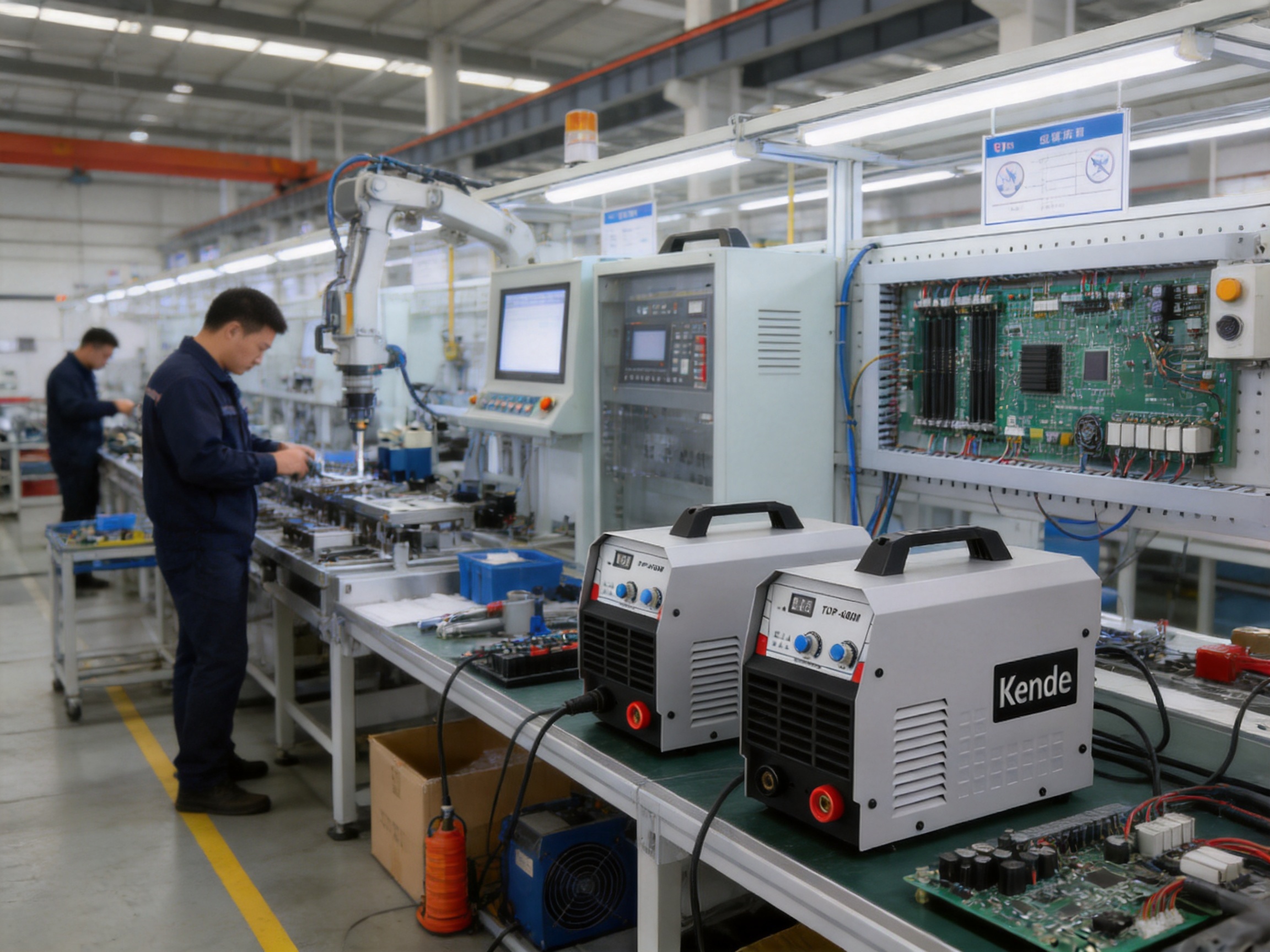
The manufacturer, Zhejiang Kende Mechanical & Electrical Co., Ltd., operates a large-scale production and research organization in Taizhou, Zhejiang, China. The company’s stated facility area is approximately 120,000 square meters, with around 600 employees. It reports annual exports of nearly 1.5 million units and annual production capacity of approximately 2 million units across its product categories.
Scale is valuable in welding-equipment production because it supports dedicated engineering teams, organized supply-chain management, process standardization, production testing, and continuous improvement. A manufacturer producing welding machines, chargers, heaters, and related equipment can develop experience across power electronics, thermal management, electrical safety, sheet-metal fabrication, control systems, and mass-production quality control.
The company reports the use of Toyota TPS management principles, ERP K3, MES management systems, and office automation systems. These tools can improve production traceability, material planning, work-order management, inventory control, process monitoring, and coordination between engineering and manufacturing departments.
MES systems are particularly valuable for products containing electronic components. They can help track assembly steps, production batches, test results, operator records, and component information. Traceability supports more effective quality investigations and can help manufacturers identify recurring process issues.
The manufacturer states that it uses automatic patching, plug-in, and welding systems, as well as robot processing and laser cutting. Automated surface-mount placement can improve the consistency of electronic component installation. Automated insertion and soldering processes can reduce variation and support repeatable circuit-board assembly.
Robot processing can improve repeatability in mechanical fabrication and handling. Laser cutting can produce accurate sheet-metal components with clean profiles, helping the manufacturer maintain consistent enclosure dimensions and mounting locations. These capabilities are relevant to inverter welding machines because reliable mechanical alignment supports ventilation, component installation, cable routing, and front-panel fit.
Advanced manufacturing does not eliminate the need for inspection. A robust quality system normally combines automated processes with incoming-material checks, operator verification, in-process inspection, electrical testing, functional testing, and final visual review. For welding equipment, testing may include no-load voltage, output-current behavior, thermal response, protective functions, insulation, grounding, and abnormal-condition checks.
The company reports having a Zhejiang Provincial Research and Development Center, an Enterprise Technology Center, and an Intelligent Welding Technology Research Institute. It also reports 98 research and development personnel and a portfolio of invention patents, utility-model patents, appearance patents, and software copyrights.
These resources support product development in areas such as inverter circuit design, control algorithms, thermal protection, arc characteristics, enclosure construction, user-interface design, energy efficiency, and manufacturing automation. A dedicated R&D structure can also help the manufacturer adapt products for different electrical systems, certification requirements, environmental conditions, and customer applications.
The company states that it participates in national welding-machine standardization activities and has contributed to the drafting, formulation, and revision of 20 national standards, while leading the drafting of one group standard. Participation in standards work can provide useful insight into safety, performance, testing, and terminology requirements. It also indicates that the organization is engaged with the broader technical development of the welding-equipment sector.
The manufacturer reports international and regional certifications including GS, CE, EMC, ERP, US ETL, UKCA, and China CCC across its product range. Certification availability can be important for distributors, importers, contractors, and industrial users who need equipment that meets market-specific safety, electromagnetic compatibility, energy, or regulatory requirements.
Certification markings should always be verified for the exact model and configuration being purchased. A company-wide certification portfolio does not automatically mean that every product carries every certification. Buyers should request the relevant declaration, test report, certificate number, and nameplate information when a project requires formal compliance documentation.
For industrial customers, regulatory readiness can simplify procurement and support acceptance by safety departments, insurers, construction managers, and end users. It may also help distributors enter different regional markets without redesigning the product for every destination, although local import and installation rules still apply.
The TOP-400M is suitable for professional MMA welding where a three-phase 380-volt supply is available. Potential applications include:
• Structural steel fabrication and repair.
• Machinery maintenance and equipment restoration.
• Agricultural machinery repair.
• General workshop fabrication.
• Construction-site welding with suitable electrical protection.
• Pipeline support and steel-frame installation where the welding procedure permits MMA.
• Repair of carbon-steel brackets, frames, platforms, and supports.
• Maintenance work involving cast iron or stainless steel with appropriate electrodes.
• Industrial service operations requiring portable welding equipment.
The machine is most appropriate where the operator values portability, stable DC output, and manual control. It is not a replacement for a dedicated MIG, TIG, submerged-arc, robotic, or laser welding system when those processes are required by production speed, joint quality, automation, shielding, or specification requirements.
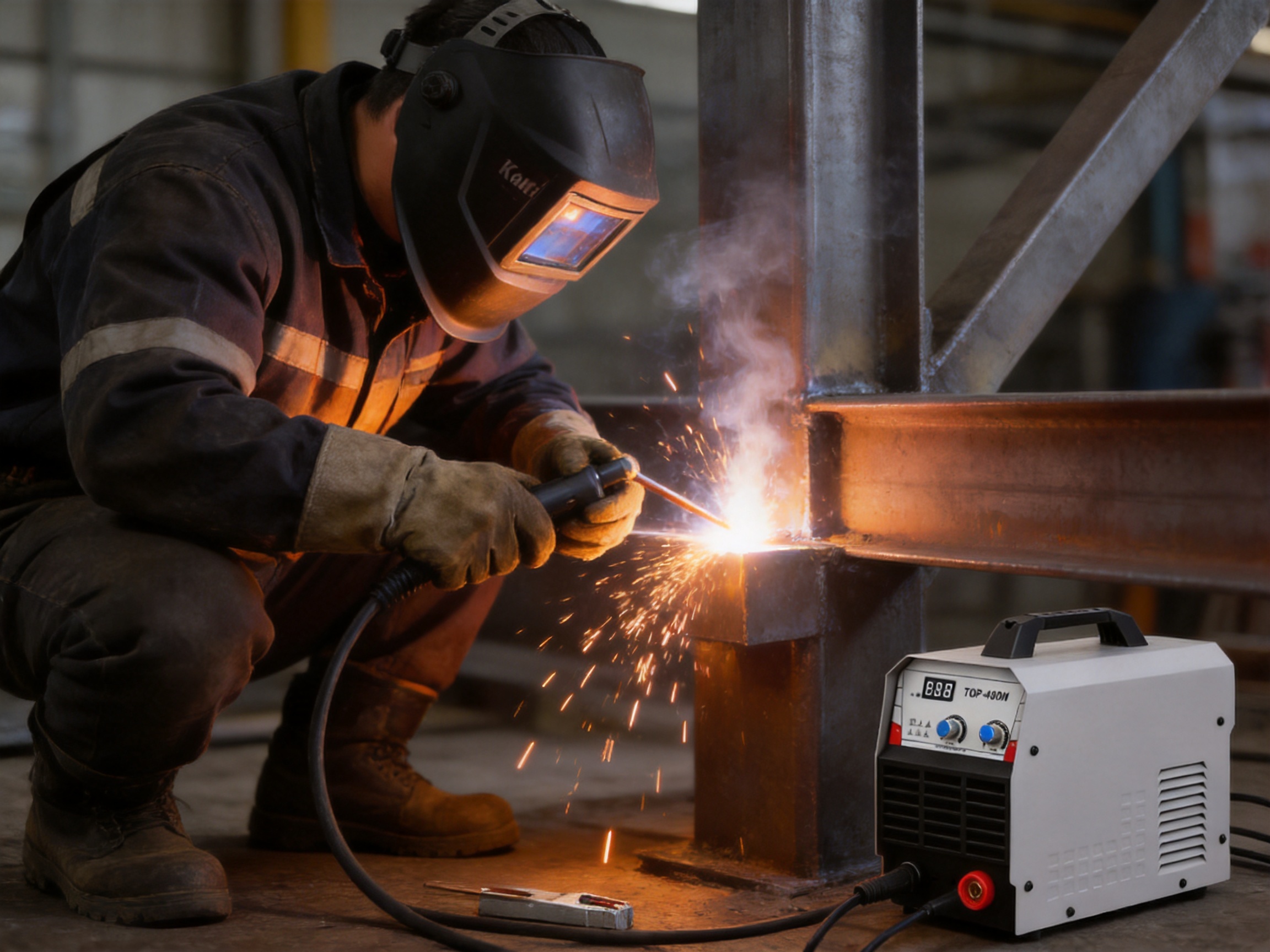
For outdoor welding, the absence of external shielding gas can be a significant practical advantage. MMA electrodes are comparatively easy to transport, and the process can be used in areas where wind would make gas-shielded welding difficult. The operator must still protect the welding area from excessive weather, moisture, contamination, and unsafe working conditions.
Remove rust, paint, oil, moisture, mill scale, and other contaminants from the welding area. Clean metal improves arc stability and reduces porosity, inclusions, and inconsistent fusion. For critical welds, joint preparation should follow the approved welding procedure, including bevel angle, root gap, fit-up, preheating, and restraint requirements.
Choose the electrode according to the material and mechanical requirements. Confirm the recommended current range and polarity printed on the electrode package. Electrodes should be stored in a dry environment and conditioned as required. Moisture-sensitive low-hydrogen electrodes require particular attention because absorbed moisture can increase the risk of hydrogen-related defects.
Begin with the electrode manufacturer’s recommended current range and adjust according to the welding position, joint thickness, arc behavior, and bead appearance. Excessive current can cause undercut, spatter, overheating, and excessive penetration. Insufficient current can produce sticking, poor fusion, an unstable arc, and a high or irregular bead.
Use a consistent arc length, travel speed, work angle, and travel angle. Remove slag between passes and inspect the weld before continuing. For vertical or overhead welding, lower heat input and controlled manipulation may be necessary. Hot Start, Arc Force, and Anti-stick functions assist the operator, but they do not replace correct hand technique.
Duty cycle expresses the amount of welding time permitted during a defined test interval at a specified current and ambient temperature. If a machine is rated at 40 percent under the applicable test condition, the operator may need to weld for four minutes and allow six minutes for cooling during that interval. The exact interpretation depends on the standard and rating conditions.
Because the supplied product title refers to 60 percent while the technical table lists 40 percent, users should verify the official rating for their purchased configuration. This is particularly important for production planning, high-current welding, and applications where downtime would be costly.
Welding produces intense ultraviolet radiation, infrared radiation, heat, fumes, sparks, and molten metal. Operators must use an approved welding helmet with the correct shade, flame-resistant clothing, welding gloves, safety footwear, and suitable eye and face protection. Nearby personnel should be protected from arc flash by screens or controlled access.
Ventilation is essential. Welding fumes may contain hazardous substances depending on the base metal, coating, electrode, and process. Local exhaust ventilation or suitable respiratory protection may be required. Galvanized, painted, coated, or chemically treated materials require special preparation and hazard control.
Keep combustible materials away from the welding area. Sparks can travel significant distances and may ignite materials outside the operator’s immediate view. Fire extinguishers and hot-work procedures should be available where required. After welding, inspect the area for smoldering materials before leaving.
Electrical safety is equally important. The machine must be connected to the correct three-phase supply by qualified personnel. Do not use damaged cables, wet connectors, defective electrode holders, or improvised grounding arrangements. Disconnect power before opening the enclosure or performing internal service. Only trained technicians should repair the inverter circuitry.
The IP21S rating does not authorize operation in rain or standing water. Keep the machine dry, maintain adequate ventilation, and do not cover the cooling openings while the unit is operating. Allow the machine to cool before storage or transportation.
Routine maintenance supports reliable performance. Before each use, inspect the power cable, welding cable, electrode holder, work clamp, connectors, ventilation openings, and enclosure. Replace components showing damaged insulation, loose contacts, severe corrosion, or overheating marks.
Keep the work clamp clean and ensure that it makes firm electrical contact. Check that the electrode holder grips electrodes securely and that its insulation remains intact. Loose terminals can create heat, voltage drop, unstable arc behavior, and premature component failure.
Periodically remove dust from the machine according to the manufacturer’s instructions. The service interval depends on the environment. A clean indoor workshop may require less frequent cleaning than a grinding area, construction site, or metal-processing facility.
If the thermal protection indicator activates, stop welding and allow the machine to cool. Do not repeatedly restart the unit while it remains hot. If over-current or over-temperature protection activates under normal load, inspect the cables, ventilation, supply voltage, electrode selection, and duty-cycle conditions. Continued abnormal behavior should be evaluated by an authorized service professional.
The TOP-400M competes through a balance of industrial output capability, compact construction, operator assistance, electrical efficiency, and manufacturing depth. Its value is not based only on the maximum current figure. Instead, it comes from the integration of several features that directly influence daily productivity and weld consistency.
Compared with a basic entry-level MMA machine, the TOP-400M offers a more comprehensive control package with Hot Start, Arc Force, Anti-stick, constant-current control, thermal protection, and a three-phase industrial configuration. Compared with a large transformer welder, it offers lower weight, smaller dimensions, easier transport, and modern inverter efficiency.
Compared with equipment from a small manufacturer without established production systems, the product benefits from the supplier’s reported factory scale, R&D resources, automated manufacturing equipment, quality-management systems, standardization participation, and international certification experience. These factors can be important for importers and professional users who need repeatable supply and technical support.
The machine is also part of a broader product platform that includes MMA, MIG/MAG, TIG, plasma cutting, submerged-arc, stud welding, battery charging, and heating equipment. A broad product range can help distributors offer coordinated equipment from one established manufacturing source, while industrial customers may benefit from a supplier familiar with multiple metalworking applications.
Before purchasing, confirm the required input supply. The TOP-400M is listed as a 3P-380V machine, so it is not automatically suitable for single-phase domestic power. Confirm that the site has a compatible three-phase supply at the correct frequency and that the electrical installation can support the rated input capacity and current.
Confirm the actual welding-current requirement. The listed technical range is 40–260 amperes, with a maximum listed output of 260 amperes. If the project specification requires a genuine 400-ampere output, this model’s supplied technical table should not be interpreted as meeting that requirement without written confirmation from the manufacturer.
Confirm the duty-cycle rating under the expected operating conditions. The supplied materials contain both a 60 percent description and a 40 percent table value. Ask for the applicable test standard, ambient temperature, output current, and certification documentation for the exact production version.
Confirm included accessories, cable lengths, plug type, regional certification, warranty terms, spare-parts availability, and service arrangements. These details can vary by market and purchase contract. For export projects, verify packaging, labeling, customs documentation, and destination-country electrical requirements.
For large orders, buyers may request pre-shipment inspection, sample testing, production-batch records, or customized labeling. The manufacturer’s reported development and manufacturing capabilities may support regional product adaptations, but all modifications should be documented and validated before mass production.
The TOP-400M is an IGBT inverter MMA, or stick-welding, machine. It provides DC welding output for manual welding with coated electrodes.
The supplied specification lists a three-phase 380-volt input and a 50/60 hertz supply frequency. Qualified electrical personnel should verify the complete installation before use.
The technical table lists an adjustable welding-current range of 40–260 amperes and a maximum welding current of 260 amperes.
The model title uses the designation TOP-400M, while the supplied technical table lists a maximum welding current of 260 amperes. The model designation should not be treated as a confirmed output rating. Buyers requiring a specific current should verify the nameplate and official technical documentation for the exact model.
The technical table lists a 40 percent rated duty cycle, while the product description refers to a 60 percent high-duty-cycle classification. Because both values appear in the supplied materials, users should confirm the applicable duty-cycle rating with the manufacturer before planning continuous high-current production work.
The listed usable electrode diameter is 1.6–5.0 millimeters. Electrode type, polarity, and current must be selected according to the base metal, welding position, joint design, and electrode manufacturer’s instructions.
The supplied information states that the machine can weld carbon steel, alloy steel, cast iron, stainless steel, and other metals. Special materials require suitable electrodes and procedures, including correct preheating, heat control, cleaning, and cooling practices where applicable.
The listed accessories include a 2-meter welding cable with a dual-angle electrode holder and a 1.5-meter ground cable with clamp.
MMA welding is practical outdoors because it does not require external shielding gas. However, the machine itself should be protected from rain, standing water, excessive moisture, and direct weather exposure. The IP21S rating is not a waterproof rating.
The machine includes thermal overload protection with an indicator light, as well as automatic protection against over-current and over-temperature conditions according to the supplied product information.
Arc Force monitors the voltage and provides additional current when needed. It can help maintain the arc when the electrode moves too close to the workpiece or when arc conditions change during welding.
When the electrode sticks to the workpiece, Anti-stick technology helps reduce the welding current so the electrode can be separated more easily. This improves convenience and reduces the risk associated with prolonged electrode sticking.
Inverter construction can provide more compact dimensions, lower weight, faster current response, improved adjustment precision, and better energy efficiency than many conventional transformer designs.
The product is manufactured by Zhejiang Kende Mechanical & Electrical Co., Ltd., a Chinese manufacturer of welding machines, battery chargers, heaters, and related equipment. The company reports large-scale production, international exports, R&D facilities, automated manufacturing processes, and multiple certifications across its product range.
The TOP-400M 380V industrial IGBT inverter MMA welding machine is designed for users who need stable DC stick-welding performance in a portable industrial format. Its IGBT switching technology, PWM control, constant-current output, Hot Start, Arc Force, Anti-stick, thermal protection, and broad electrode compatibility create a practical package for professional welding and repair work.
The machine’s compact 455 × 200 × 355 millimeter form factor and listed 11.5-kilogram net weight make it easier to transport than many conventional industrial welding machines. Its reported 82 percent efficiency, 0.75 power factor, industrial protection features, and broad input operating range further support its suitability for workshops and field service applications.
The manufacturer’s large production base, automated assembly and fabrication equipment, research centers, engineering personnel, management systems, standardization participation, and certification experience add value beyond the product’s front-panel functions. These capabilities can support consistent manufacturing, technical development, export readiness, and long-term product-platform development.
For accurate project selection, buyers should carefully verify the exact current rating and duty-cycle specification because the supplied documents describe the model with a 60 percent duty-cycle reference while the technical table lists 40 percent, and the model designation suggests 400 amperes while the table lists a maximum of 260 amperes. Once the applicable configuration is confirmed, the machine offers a strong combination of portability, stable arc control, user assistance, energy-conscious inverter technology, and industrial practicality.
1. Product specification sheet for the TOP-400M three-phase IGBT inverter MMA welding machine.
2. Manufacturer-provided information on Hot Start, Arc Force, Anti-stick, thermal overload protection, and constant-current control.
3. Manufacturer-provided technical table covering input voltage, frequency, capacity, current range, duty cycle, efficiency, protection rating, weight, and dimensions.
4. General principles of manual metal arc welding, electrode selection, welding-current adjustment, and duty-cycle management.
5. General guidance on inverter welding power sources, IGBT switching technology, pulse-width modulation, and constant-current output control.
6. General occupational safety principles for arc radiation, welding fumes, electrical hazards, fire prevention, and hot-work operations.
7. Manufacturer information concerning research and development facilities, production capacity, automated manufacturing, management systems, certifications, and standardization participation.
Recommended Products

Contact Us
No.2299, Luqiao Section, Shugang Avenue, Luqiao District, Taizhou, 318057 Zhejiang, PR China.
+86-576-82431568
 Privacy
China Welding Machine Factory
 English
 中文简体
中文简体
 русский
 Español
 عربى
عربى
 Français
 Português
 Deutsch
 Український