Email: [email protected]
Email: [email protected]

Blog
 2026.11.09
 Blog
A dependable battery charger is an essential tool for workshops, vehicle owners, maintenance departments, farms, service stations, and equipment operators. The CB-10A Series Battery Charger is designed to provide practical charging and starting support for lead-acid batteries used in cars, vans, light trucks, and other everyday applications. Its compact structure, manual operating system, selectable charging voltage, protection functions, and durable construction make it suitable for users who need a straightforward and serviceable battery power solution.
Unlike many simple household chargers that are limited to one battery voltage or a narrow range of battery types, this series is designed around flexible operation. Depending on the specific model, it can support 6 V, 12 V, or 24 V charging requirements. The series also includes models with different charging current ranges and battery capacity recommendations, allowing users to select equipment according to vehicle size, battery capacity, and intended workload.
The charger combines MOSFET-based power control with advanced switching power-source technology. This design helps provide controlled output, reliable operation, and a relatively compact machine profile. The equipment also incorporates overload protection, overheat protection, anti-reverse connection protection, and floating-charge functionality. These features are important because battery charging often takes place in demanding environments where incorrect connections, extended operation, or changing battery conditions may occur.
For professional buyers, the value of a battery charger is determined by more than its output rating. Product durability, manufacturing consistency, safety functions, serviceability, portability, and the manufacturer’s ability to maintain stable quality are equally important. The producer of this series operates large-scale manufacturing, research, testing, and export systems for welding machines, battery chargers, heaters, and related electrical equipment. Its production capabilities support the development of products intended for both domestic and industrial markets.
This article examines the structure, operating advantages, model selection, safety functions, applications, and manufacturing strengths associated with the CB-10A Series Battery Charger. It also explains how the product may compare favorably with less flexible or less protected alternatives and provides practical answers to common purchasing and operating questions.

CB-10A Series Battery Charger
The CB-10A Series Battery Charger is a manual battery charger and engine starter intended primarily for lead-acid battery service. It is available in configurations designed for different voltage requirements, including 6 V, 12 V, and 24 V applications. The series is particularly useful where users need to charge standard automotive batteries, AGM batteries, or gel batteries and where a basic, robust, manually controlled machine is preferred over a fully automatic consumer charger.
The charger is built with heavy-duty construction to support repeated use. Its physical design includes a convenient storage profile, a retractable handle, and front-mounted clamps or clamp storage. These details make the unit easier to move, store, and prepare for operation. A charger used in a workshop or vehicle service environment may be handled many times each day, so transport convenience and cable organization are practical advantages rather than cosmetic features.
Several models in the range use a 220/230 V, 50 Hz supply, while the KC-620 configuration supports 110 V or 220 V input at 50/60 Hz. This creates options for different electrical markets. Users should select the exact model according to local mains voltage, frequency, battery voltage, required current, and desired battery capacity range.
The product is described as a manual charger and engine starter. Manual operation gives the user direct control over the charging process and makes it possible to adapt the charging procedure to the battery’s condition. This type of equipment is often favored by mechanics, repair shops, agricultural users, and experienced vehicle owners who want to monitor the charging process rather than rely entirely on an automated program.
The primary functions of the series include battery charging, support for selected engine-starting tasks, voltage selection on applicable models, and floating-charge operation. The charger can be applied to a range of lead-acid batteries used in vehicles and equipment. It is not intended to replace specialized battery management systems for every chemistry or every industrial battery application. Correct matching between the charger, battery type, voltage, and capacity remains essential.
The series is particularly practical for maintaining batteries that are temporarily discharged, supporting vehicle maintenance operations, or preparing vehicles for use after storage. It may be used in garages, dealerships, transport depots, farms, construction sites, workshops, and home maintenance areas where a portable charger is needed.
Portability is one of the product’s notable advantages. The smaller units weigh approximately 1.3 to 1.5 kilograms according to the listed configurations, while the larger KC-620 model weighs approximately 3 kilograms. The retractable handle allows the operator to move the charger between vehicles or storage locations without needing a separate carrying case.
The front clamp arrangement also helps keep the charging accessories organized. When a charger is stored with loose cables, the leads can become tangled, damaged, or misplaced. A design that keeps the clamps and cable connections close to the main body can reduce preparation time and improve workshop organization.
The compact form factor is especially useful for mobile service work. A technician can transport the charger in a service vehicle, carry it into a garage, or keep it near a fleet maintenance area. Compared with large fixed charging systems, a portable charger can be used at multiple locations without requiring permanent installation.
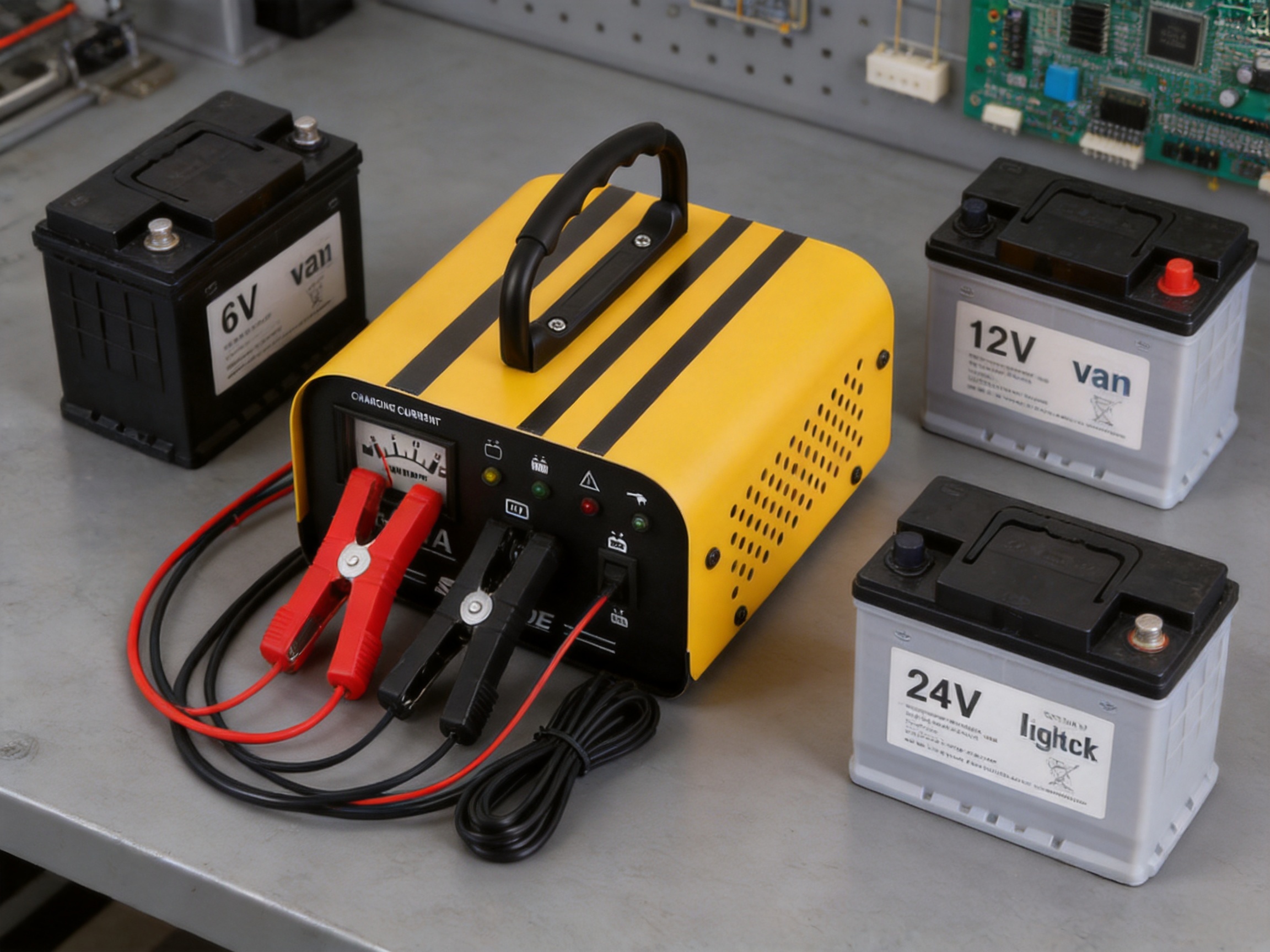
The charger uses MOSFET technology and advanced switch power-source control technology. MOSFET-based switching is widely used in modern power electronics because it can provide efficient electronic control, fast switching response, and compact circuit design. In a battery charger, this technology can help regulate the conversion of mains electricity into a controlled charging output.
The use of switching power technology also supports a more compact product structure than traditional heavy transformer-only designs. A compact design can reduce transport difficulty and storage requirements. It can also make the product more convenient for users who need to move the charger frequently between work areas.
Electronic power control must be supported by suitable protection and thermal design. The listed overload and overheat protections help protect the charger when operating conditions exceed normal limits. These functions are valuable because charging environments are not always predictable. A battery may have a low state of charge, a damaged connection, a wrong setting, or a cable that is not properly positioned. Protection circuits can reduce the likelihood that such conditions will cause immediate damage to the unit.
One of the most useful advantages of the series is the availability of different charging-voltage configurations. The CD-10A/CD-10B and CD-10M/CD-10N configurations are listed for 6 V and 12 V charging. The CD-23M/CD-23N configuration is listed for 12 V charging. The CD-26M/CD-26N configuration is listed for 12 V and 24 V charging. The KC-620 is also listed for 12 V and 24 V operation.
Voltage flexibility allows one charger platform to support more than one category of vehicle or battery. A 6 V option may be useful for certain older vehicles, small equipment, or specialized battery systems. Twelve-volt batteries are common in passenger cars, vans, motorcycles, and light commercial vehicles. Twenty-four-volt systems are frequently used in larger vehicles, trucks, industrial equipment, and certain fleet applications.
However, voltage selection must always be made before connection. Applying an unsuitable charging voltage can damage a battery or create a safety risk. Operators should check the battery label, vehicle documentation, and charger instructions before beginning the charging procedure.
The listed models provide different charging-current capabilities. The CD-10 configurations are associated with a rated current of 10 A. The CD-23 configurations are associated with an 18 A rated current. The CD-26 configuration is associated with 20 A at 12 V and 15 A at 24 V. The KC-620 is listed with 60 A charging-current values for its 12 V and 24 V settings.
The recommended reference capacity also varies by model. The CD-10 versions are listed for approximately 10 to 100 Ah batteries. The CD-23 versions are listed for approximately 7 to 270 Ah batteries. The CD-26 versions are listed for approximately 10 to 300 Ah batteries. The KC-620 is listed for approximately 20 to 500 Ah batteries.
These ranges give buyers a useful starting point for selecting the appropriate machine. A charger that is too small for a large battery may require an extended charging period and may not be suitable for demanding service work. A charger that is excessively powerful for a small battery may require careful control to prevent unsuitable charging conditions. The best selection balances battery capacity, desired charging time, vehicle type, and operating practice.
| Model Configuration | Supply Voltage | Supply Frequency | Charging Voltage | Rated Current | Reference Battery Capacity | Approximate Weight |
|---|---|---|---|---|---|---|
| CD-10A / CD-10B | 220/230 V | 50 Hz | 6/12 V | 10 A | 10–100 Ah | 1.3 kg |
| CD-10M / CD-10N | 220/230 V | 50 Hz | 6/12 V | 10 A | 10–100 Ah | 1.4 kg |
| CD-23M / CD-23N | 220/230 V | 50 Hz | 12 V | 18 A | 7–270 Ah | 1.5 kg |
| CD-26M / CD-26N | 220/230 V | 50 Hz | 12/24 V | 20 A at 12 V; 15 A at 24 V | 10–300 Ah | 1.5 kg |
| KC-620 | 110/220 V | 50/60 Hz | 12/24 V | 60 A | 20–500 Ah | 3 kg |
The technical data should be treated as model-specific information rather than a single specification for every product in the family. Buyers should confirm the final model designation, input plug arrangement, fuse rating, operating instructions, and certification requirements before placing an order.
Battery charging combines electrical energy, chemical reactions, and potentially flammable gases. A suitable charger therefore needs protective functions as well as charging capability. The CB-10A Series includes several protection features intended to improve operating security and support longer service life.
Overload protection helps limit the effect of excessive current or abnormal electrical loading. If a battery, cable, or connection causes the charger to operate outside its normal range, the protection system can help prevent immediate damage to internal components. This is particularly useful in workshops where the charger may be connected to batteries with different conditions throughout the day.
Protection does not eliminate the need for correct operation. Users should still inspect cables, clamps, plugs, fuses, and battery terminals. An overload function should be viewed as an additional safeguard rather than permission to operate the charger beyond its rated limits.
Heat is a major factor affecting electronic component life. Extended charging, blocked ventilation, high ambient temperatures, or excessive load can raise the internal temperature of a charger. Overheat protection is intended to respond when the temperature reaches an unsafe level.
Good operating practice includes placing the charger on a stable surface, keeping ventilation openings clear, avoiding exposure to unnecessary moisture, and allowing the unit to cool when required. These actions work together with the internal protection system to support safe and reliable operation.
Reverse connection is a common user error. It occurs when the positive clamp is connected to the negative battery terminal or when the negative clamp is connected to the positive terminal. The anti-reverse connection function helps protect the charger and battery system from this mistake.
Although this feature improves tolerance to incorrect connection, users should always identify positive and negative terminals before attaching the clamps. Correct connection remains essential for safe and efficient charging. Operators should also avoid allowing the clamps to touch each other while the charger is energized.
The floating-charge function is useful when a battery needs to remain at a maintained state of charge after the main charging process. A float mode can help compensate for a battery’s natural self-discharge without continuously applying the same charging level used during the initial charging stage.
Float charging is useful for vehicles and equipment that are stored for periods of time. It may help keep a battery ready for service, although the battery’s condition, age, chemistry, temperature, and storage environment must still be considered. A charger should not be used to maintain a defective or leaking battery.
The technical information lists mains-fuse values for the different configurations. A fuse provides a defined protective point against certain electrical faults. Replacement fuses must have the correct rating and type specified for the particular model. Installing an incorrectly rated fuse can create additional risk and may interfere with the protection design.
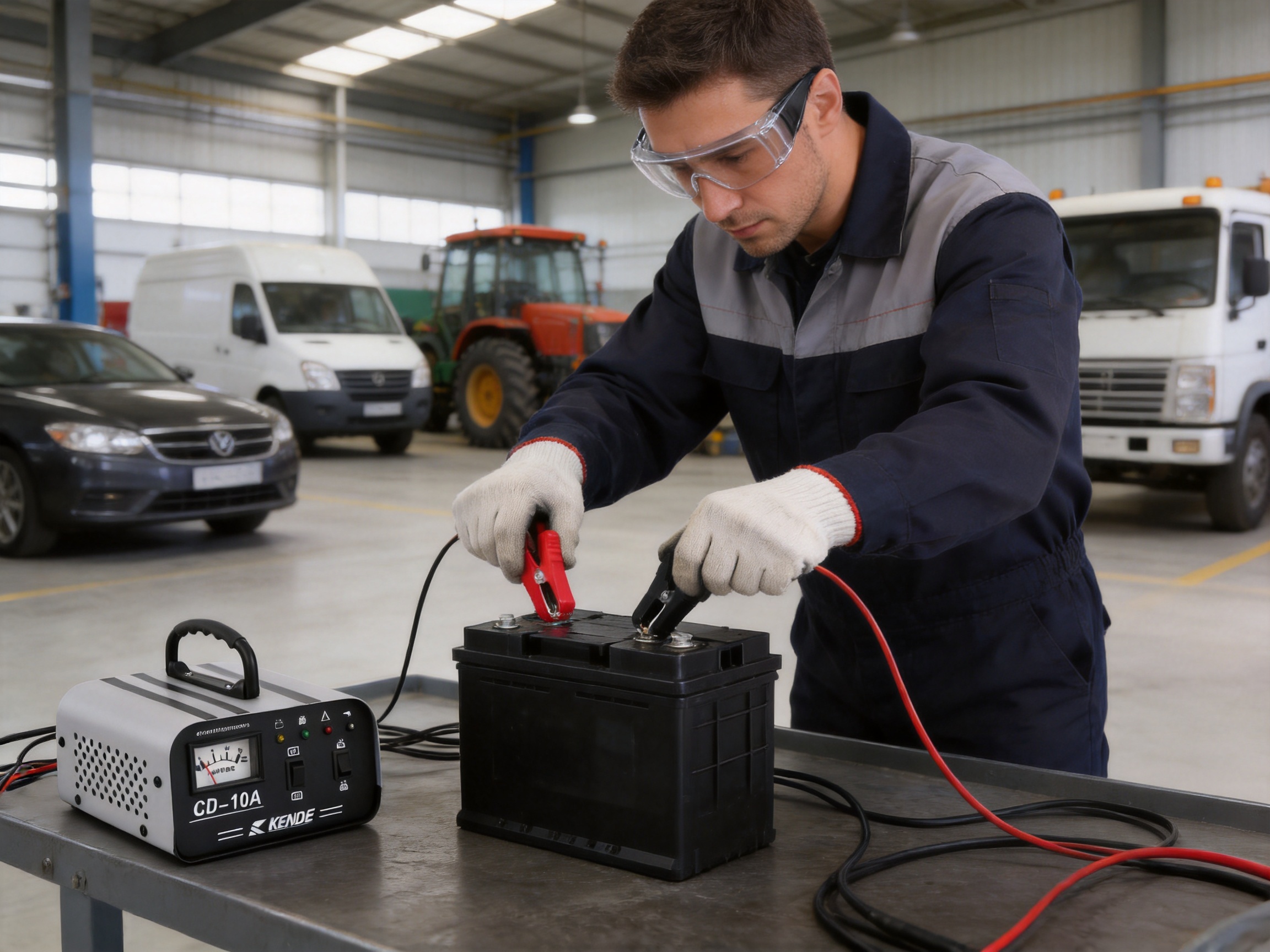
Battery chargers vary widely in design. Some low-cost products offer only one voltage, one low current output, and minimal protection. Others are large transformer-based units that are difficult to transport. The CB-10A Series offers several characteristics that can make it more competitive in professional and semi-professional use.
The availability of 6 V, 12 V, and 24 V configurations allows buyers to select equipment for different vehicle and battery requirements. A workshop that services several types of vehicles may benefit from having access to a compatible model instead of purchasing unrelated chargers from multiple suppliers.
For distributors, the range also creates opportunities to serve different customer segments. Smaller 6/12 V models may be appropriate for household vehicle owners and small workshops. Higher-current 12 V or 12/24 V models may be better suited to commercial vehicle maintenance, agricultural operations, and fleet service.
The compact dimensions and retractable handle provide an advantage over large fixed charging systems when mobility is important. The listed dimensions for many smaller models are approximately 220 × 170 × 105 mm or 240 × 180 × 115 mm, while the KC-620 is listed at approximately 275 × 370 × 150 mm.
A portable charger can be stored in a service van, moved between repair bays, or used in locations where a vehicle cannot easily be moved. Portability can reduce downtime because the charger travels to the battery rather than requiring the vehicle to be transported to a fixed charging station.
Fully automatic chargers are convenient, but they may not meet every workshop requirement. Experienced technicians may prefer manual equipment because it gives them more direct control over voltage selection, charging duration, and operating supervision. Manual control can also be useful when diagnosing a battery or supporting a controlled maintenance procedure.
The product is therefore positioned between a simple household charger and a permanently installed industrial charging system. It provides meaningful current capability and protective functions while retaining a relatively straightforward operating concept.
Overload protection, overheat protection, anti-reverse connection protection, floating-charge functionality, and fuse protection contribute to a more complete safety package than that found on very basic chargers. These features can reduce the consequences of common operating errors and abnormal conditions.
Protection functions also support confidence in commercial use. Workshop personnel may connect the charger to multiple batteries over a working day, and the equipment must tolerate normal variations in load and operating duration. A charger with appropriate protection is generally better suited to repeated service than an unprotected low-cost unit.
The product description identifies standard, AGM, and gel batteries as supported battery types. These battery technologies are all used in automotive and auxiliary applications, although their charging requirements can vary. The operator must use the correct voltage and charging method for the specific battery, but support for multiple lead-acid formats broadens practical application.
Buyers should not assume that support for AGM and gel batteries means that every setting is suitable for every battery. Battery manufacturers may specify particular voltage limits, charge durations, or temperature conditions. The charger should be used within the relevant battery manufacturer’s requirements.
Passenger cars commonly use 12 V batteries, while older or specialized vehicles may use other voltage arrangements. The 6/12 V models are suitable for users who need flexibility across different vehicles. A 10 A charger may be appropriate for routine charging of batteries within the recommended 10–100 Ah range.
In a home garage, the charger can help restore a battery after lights have been left on, support a vehicle that has been stored for a long period, or maintain a battery during seasonal use. In a professional repair shop, the same type of charger can support inspection, servicing, and vehicle preparation.
Vans and light trucks may have higher-capacity batteries than passenger cars, particularly when they operate accessories, refrigeration systems, lifting equipment, or other electrical loads. The 18 A and 20 A configurations may provide a more suitable charging solution for batteries within their recommended capacity range.
When several vehicles are managed by one business, a charger with suitable capacity and durable construction can help reduce maintenance delays. The portable format also allows the equipment to be used in a loading area, parking yard, or service bay.
Agricultural equipment may remain unused for extended periods and may be exposed to dust, changing temperatures, and irregular maintenance schedules. A portable charger with floating-charge functionality can be useful for preparing equipment before seasonal operation or maintaining batteries during storage.
Farm operators should keep the charger in a dry, clean location and should not operate it where fuel vapors, corrosive chemicals, or excessive moisture are present. Battery terminals should be cleaned and inspected before charging.
Fleet operators need equipment that can be used across multiple vehicles and maintained by different technicians. The range of model configurations allows a fleet manager to choose a charger for passenger vehicles, delivery vans, light trucks, or larger battery systems.
In fleet operations, standard procedures are important. Operators should record the battery voltage, capacity, charging time, and condition. They should also inspect the charger cables and clamps regularly. The protection functions support safer operation, but a documented maintenance process provides an additional layer of control.
Repair shops often require chargers that are easy to move and quick to connect. A retractable handle, front clamp storage, and compact dimensions can improve daily workflow. The equipment can be used while inspecting a vehicle, preparing a replacement battery, or supporting a starting procedure.
The manual design may also be useful for technicians who need to observe how a battery responds to charging. Changes in charging current, terminal condition, or battery temperature may provide information about battery health. Such diagnosis should be performed by trained personnel using appropriate instruments.
Boats, recreational vehicles, classic cars, motorcycles, generators, and seasonal machinery may remain unused for months. A charger with float functionality can help maintain charge during storage, provided that the battery type and charging requirements are compatible.
Stored batteries should still be inspected periodically. A charger cannot correct internal battery damage, severe sulfation, electrolyte loss, or a shorted cell. If a battery becomes hot, swollen, cracked, or unusually odorous, charging should stop immediately and the battery should be handled according to applicable safety procedures.

Before using the charger, read the relevant operating instructions and identify the battery voltage. Confirm that the charger’s input supply matches the available mains supply. Inspect the power cord, charging leads, clamps, fuse, housing, and ventilation openings. Do not use the equipment if any part is damaged.
Place the charger on a stable, dry, and ventilated surface. Keep it away from water, fuel, open flames, sparks, and corrosive substances. Battery charging can release gases, so the charging location should have adequate ventilation.
Switch the charger off and disconnect it from the mains before attaching the battery clamps whenever the operating instructions require this procedure. Connect the positive clamp to the positive battery terminal and the negative clamp to the negative terminal, or use the grounding arrangement specified by the vehicle or battery manufacturer.
Select the correct charging voltage. A 6 V battery must not be charged using a 12 V or 24 V setting. A 12 V battery must not be connected to a 24 V setting. Confirm the selection before energizing the charger.
After the clamps and settings have been checked, connect the charger to the correct mains supply and begin charging according to the manual. Monitor the battery and charger during operation. Excessive heat, unusual noise, smoke, leakage, strong odor, or abnormal behavior requires immediate shutdown and inspection.
When charging is complete, switch off the charger or disconnect the mains supply according to the specified procedure. Remove the clamps carefully, avoiding contact between the clamps. Store the cables neatly and keep the charger in a clean, dry place.
The engine-starting function should be used only within the model’s rated capability and according to the manufacturer’s instructions. A starting event can demand considerably more current than normal battery charging. The battery, vehicle wiring, charger, and electrical system must all be suitable for the procedure.
Do not use the charger to start a vehicle with damaged wiring, a shorted battery, frozen electrolyte, or a battery that shows signs of physical failure. The charging area must remain clear of people who are not involved in the operation, and the operator should wear suitable eye and hand protection.
The producer of the CB-10A Series operates as a major manufacturer and exporter of electric welding machines, battery chargers, and heaters. Its manufacturing site covers approximately 120,000 square meters and employs about 600 people. This scale provides a substantial base for production planning, component control, assembly management, quality inspection, and export coordination.
The company reports annual exports of nearly 1.5 million units and annual production capacity of approximately 2 million units. High-volume production experience can provide several advantages for battery charger buyers. These include repeatable assembly procedures, established supplier relationships, production scheduling capability, and experience with international packaging and documentation requirements.
Large-scale production does not automatically guarantee quality, but it creates the infrastructure needed to implement consistent processes. For an importer or distributor, this is important because stable model availability and repeatable product specifications are often as important as the initial sample.
The company maintains a Zhejiang Provincial R&D Center, an Enterprise Technology Center, and an Intelligent Welding Technology Research Institute. It reports having 98 research and development personnel and holding invention patents, utility model patents, appearance patents, and software copyrights.
Although welding technology is a major part of the company’s business, the same development environment can support power-electronics products such as battery chargers. Research capabilities may contribute to circuit design, thermal management, enclosure development, safety functions, product testing, and manufacturing improvements.
A manufacturer with its own engineering resources can respond more effectively to regional requirements and customer-specific needs. The company states that it can develop new products according to the needs of different regions, countries, and customers. This may be useful for distributors requiring different input voltages, packaging, labels, accessories, or market documentation.
The company applies several management and production systems, including office automation, Toyota-style production management, ERP, and MES management systems. These systems are intended to coordinate purchasing, manufacturing, inventory, production scheduling, quality data, and delivery.
It also uses automatic patching, plug-in and welding systems, robot processing, laser cutting, and other advanced technologies. Automated processes can improve repeatability in suitable production stages and help reduce variation caused by manual operations. Laser cutting and robotic processing can contribute to consistent enclosure dimensions, accurate component preparation, and efficient manufacturing.
For a battery charger, manufacturing consistency matters in areas such as circuit-board assembly, wire routing, terminal installation, insulation, enclosure fitting, fuse placement, and thermal component installation. A well-controlled production process helps ensure that the protective functions described in the product specification are implemented consistently across production batches.
The company reports holding international product certificates and compliance marks including GS, CE, EMC, ERP, US ETL, UKCA, and China CCC across its product portfolio. The exact certification status of a particular CB-10A Series model should be confirmed in the technical file and shipment documentation, because certifications may vary by model, market, and electrical configuration.
Experience with international certification can help a manufacturer understand requirements related to electrical safety, electromagnetic compatibility, energy performance, labeling, technical documentation, and market access. Buyers should still request the certificates and declarations applicable to the specific model they intend to import.
The company is also described as a national standard drafting unit associated with the National Welding Machine Standardization Committee and has participated in the drafting, formulation, and revision of national standards. This standards experience reflects familiarity with structured technical requirements and compliance processes, although it should not be treated as a substitute for product-specific certification.
When purchasing a battery charger from this series, the first consideration is battery voltage. Buyers should determine whether their customers require 6 V, 12 V, 24 V, or a combination of these voltages. The second consideration is battery capacity. The recommended Ah range should match the batteries most commonly serviced.
The third consideration is input power. Models intended for 220/230 V, 50 Hz markets are not automatically suitable for 110 V or 60 Hz regions. The KC-620 configuration is listed for 110/220 V and 50/60 Hz, but buyers should verify the exact switching arrangement and plug configuration before ordering.
The fourth consideration is current. A 10 A model may be suitable for smaller automotive batteries and routine charging. An 18 A or 20 A model may be more suitable for larger batteries or shorter charging periods. The 60 A KC-620 configuration is intended for higher-capacity applications, but its physical size, input requirements, and operating procedures should be considered.
Buyers should also confirm the following information before finalizing a purchase:
• Exact model name and suffix.
• Charging voltage and current for each setting.
• Supported battery types and capacity range.
• Input voltage and frequency.
• Fuse ratings and replacement requirements.
• Cable length, cable gauge, and clamp type.
• Packaging dimensions and carton quantity.
• User manual and language requirements.
• Applicable certification documents.
• Warranty terms and spare-parts availability.
• Branding, labeling, and customization options.
The listed accessories include charging cable, two clamps, and a color box. Importers should verify whether the supplied accessories are included in the standard quotation or are available as optional items. They should also confirm whether the packaging is suitable for retail shelves, e-commerce shipment, or industrial distribution.
Routine maintenance begins with visual inspection. Users should check the housing for cracks, the handle for secure attachment, the cable insulation for cuts, and the clamps for corrosion or looseness. Damaged charging leads should be replaced rather than repaired with temporary tape or non-approved connectors.
Ventilation openings should remain free of dust and obstructions. In workshops, metal particles, grinding dust, oil mist, and other contaminants may accumulate around electrical equipment. The charger should be cleaned using a method appropriate for electrical equipment and should never be sprayed directly with water or solvent.
Battery terminals should be clean enough to provide a stable connection. Poor contact can cause heating, reduced charging performance, or intermittent operation. Operators should not force clamps onto damaged terminals or use the charger to compensate for a poor connection.
Internal repairs should be performed by qualified personnel. The charger contains mains-voltage components that may remain hazardous even after disconnection. Users should not open the enclosure unless they are authorized and trained to do so.
A professional distributor may benefit from maintaining a basic stock of replacement clamps, cables, fuses, handles, and other commonly serviceable parts. Availability of replacement components can extend product life and reduce downtime for commercial users.
Battery chargers should be operated in conditions that fall within the manufacturer’s stated temperature, humidity, and ventilation requirements. Extreme heat can shorten component life, while condensation and moisture can create insulation risks. A clean, dry, sheltered environment is generally preferable.
Lead-acid batteries must be handled responsibly. They contain corrosive electrolyte and can produce hydrogen gas during charging. Smoking, welding, grinding, and open flames should be kept away from the charging area. Operators should wear appropriate protective equipment and should follow local requirements for battery handling and recycling.
At the end of its service life, the charger should be disposed of according to applicable electrical and electronic waste requirements. Batteries must be recycled through approved channels. Responsible disposal protects the environment and helps recover useful materials.
A battery charger is a technical product whose performance depends on the relationship between electrical design, component quality, assembly precision, testing, and after-sales support. A manufacturer with experience across welding equipment, chargers, and heaters may have broader knowledge of high-current circuits, thermal control, electrical safety, and demanding industrial environments.
The company’s established export activity indicates experience in serving customers outside its domestic market. Export experience can involve multilingual documentation, packaging standards, container loading, customs paperwork, regional plug requirements, and customer service. These capabilities are valuable to wholesalers and distributors that need dependable supply rather than a one-time purchase.
Its reported production scale can also support private-label and customized business models. A buyer may require a specific voltage arrangement, logo, color box, label, operating manual, or accessory package. Such requirements should be negotiated in advance and confirmed through approved samples and technical documents.
Manufacturing strength is particularly important when purchasing products for professional users. A workshop or fleet operator expects the charger to perform consistently across repeated charging cycles. Stable production processes, inspection systems, and engineering support can reduce the risk of batch-to-batch variation.
The CB-10A Series is designed for lead-acid battery applications identified by the product information. It should not automatically be assumed to support lithium-ion, lithium iron phosphate, nickel-metal hydride, or other battery chemistries. These battery types may require different charging algorithms, voltage limits, and protection systems.
The equipment is also not a substitute for a battery tester, battery analyzer, or professional electrical diagnostic system. A charger can restore charge to a healthy or recoverable battery, but it cannot reliably repair a battery with internal mechanical damage, a shorted cell, severe sulfation, leakage, or advanced aging.
Manual chargers require responsible supervision. Users should not leave the equipment operating indefinitely without considering battery condition, temperature, charging current, and manufacturer instructions. The floating-charge function can assist with maintenance, but it does not remove the need for periodic inspection.
Finally, the exact performance depends on the model configuration. The product title refers to the CB-10A Series, while the technical table includes several related model designations. Purchasers should ensure that quotations, nameplates, manuals, packaging, and certification documents all identify the same final model.
The product information identifies standard lead-acid, AGM, and gel batteries as supported applications. Users must confirm the correct voltage and charging procedure for the specific battery. The charger should not be used with an unsupported chemistry simply because the battery has a similar nominal voltage.
The CD-10A/CD-10B and CD-10M/CD-10N configurations are listed for both 6 V and 12 V charging. The correct setting must be selected before operation. Other models in the series may be limited to 12 V or may support 12 V and 24 V.
The CD-26M/CD-26N and KC-620 configurations are listed for 12/24 V charging. The exact current and battery-capacity range differs between them. The CD-26 configuration is listed at 20 A for 12 V and 15 A for 24 V, while the KC-620 is listed with 60 A values for both charging-voltage settings.
The product is described as a manual battery charger and engine starter. It provides protective functions and floating-charge functionality, but users should follow the operating instructions and supervise charging appropriately. It should not be treated as a fully automatic charger unless the exact model documentation states otherwise.
Anti-reverse connection protection helps reduce the risk of damage when the positive and negative clamps are connected incorrectly. The feature is an additional safeguard, not a replacement for checking polarity before connection.
Floating charge helps maintain a battery after the main charging phase by applying a maintenance level suitable for the battery and charger design. It may be useful for stored vehicles and seasonal equipment. Battery condition and manufacturer recommendations must still be considered.
Yes. The product information identifies cars, vans, and light trucks as suitable applications. The selected model should match the vehicle battery’s voltage and capacity. Larger vehicles or higher-capacity batteries may require the 18 A, 20 A, or 60 A configuration rather than the smaller 10 A model.
The listed protections include overload protection, overheat protection, anti-reverse connection protection, and mains-fuse protection. The charger also includes a floating-charge function. These features improve operating safety but do not replace correct installation, ventilation, inspection, and supervision.
Yes. The smaller models have compact dimensions and weigh approximately 1.3 to 1.5 kilograms. The KC-620 is larger and weighs approximately 3 kilograms. A retractable handle and front clamp arrangement support transport and storage.
An importer should confirm the exact model, input voltage, frequency, output voltage, rated current, battery-capacity range, fuse rating, plug type, accessories, packaging, certification, warranty, and spare-parts support. The importer should also confirm whether the technical data applies to the requested suffix and market version.
The company states that it can develop new products according to the needs of different regions, countries, and customers. Customization should be discussed directly with the manufacturer and confirmed through technical specifications, samples, drawings, packaging approvals, and commercial terms.
No charger should be considered a repair device for physically damaged, leaking, swollen, shorted, frozen, or severely deteriorated batteries. Such batteries may be unsafe to charge and should be inspected or replaced by qualified personnel.
The CB-10A Series Battery Charger provides a practical combination of portability, multi-voltage availability, manual control, charging-current options, and protective functions. Its configurations cover 6 V, 12 V, and 24 V applications, with reference battery-capacity ranges extending from smaller automotive batteries to higher-capacity commercial and industrial units.
The use of MOSFET and advanced switching power-source control technology supports a compact and efficient product structure. Overload protection, overheat protection, anti-reverse connection protection, floating-charge functionality, and fuse protection provide valuable safeguards for regular workshop and vehicle-maintenance use.
The product is competitive against less flexible chargers because it offers a broader selection of voltage and current configurations, a portable design, compatibility with several lead-acid battery types, and features intended for repeated practical use. Its value is further supported by the manufacturer’s large production base, research and development resources, automated manufacturing technologies, export experience, and familiarity with international standards.
For the best result, buyers should select the model according to actual battery voltage, capacity, charging current, local mains supply, and application environment. Correct operation, ventilation, inspection, and battery safety remain essential. When properly matched and maintained, the series can serve as a useful charging and starting solution for vehicle owners, workshops, agricultural users, fleet operators, and distributors seeking a dependable portable battery service product.
1. Product specification and technical information for the CB-10A Series Battery Charger, including model configurations, charging voltage, rated current, protection functions, dimensions, and reference battery capacities.
2. General principles of lead-acid battery charging, maintenance charging, battery capacity selection, and safe workshop operation.
3. Electrical safety practices for portable mains-powered equipment and battery charging systems.
4. General guidance on AGM and gel lead-acid battery charging requirements and manufacturer-specific operating limits.
5. Technical information concerning MOSFET switching power supplies, thermal protection, overload protection, and electronic polarity protection.
6. Manufacturer information regarding production capacity, research and development facilities, manufacturing systems, patents, certifications, and export experience.
7. General recommendations for automotive service workshops, fleet maintenance departments, agricultural equipment storage, and seasonal vehicle battery maintenance.
Recommended Products

Contact Us
No.2299, Luqiao Section, Shugang Avenue, Luqiao District, Taizhou, 318057 Zhejiang, PR China.
+86-576-82431568
 Privacy
China Welding Machine Factory
 English
 中文简体
 русский
 Español
 عربى
 Français
 Português
 Deutsch
 Український