Email: [email protected]
Email: [email protected]

Industry News
 2026.10.23
 Industry News
A MIG welder feeds a wire into the weld and melts it with an electric arc. The inverter version replaces the heavy transformer with the high-frequency electronics, which is why the machine is smaller and lighter than the old transformer MIG units. An inverter MIG welder factory builds these machines for the fabrication shops, the auto body shops, and the field crews. The inverter is the power supply. The wire feed is the delivery. Both have to work together or the arc sputters.
A MIG welder that cannot feed the wire consistently is a MIG welder that cannot weld. The wire has to move from the spool through the liner to the torch at a constant speed, without the slipping, without the kinking, without the stalling.
An inverter MIG welder factory builds the wire drive with the motor, the pair of the drive rollers, and the tension adjustment. The rollers grip the wire and push it. The tension has to be set for the wire diameter and the material. Too loose and the wire slips. Too tight and the wire deforms.
The drive rollers are the hardened steel with the groove that matches the wire. The gear case is the metal, not the plastic. The plastic gears strip under the start-stop of the production welding. An inverter MIG welder factory that uses the metal gears and the quality rollers builds the feed that lasts.
The inverter takes the input power and switches it at the high frequency, then rectifies it to the DC output the MIG process needs. The switching is what makes the machine lighter and more efficient than the transformer unit. It also allows the control board to shape the arc.
The arc characteristics for the MIG are the constant voltage. The machine holds the voltage and the wire feed speed sets the current. An inverter MIG welder factory that tunes the control board for the MIG process produces the stable arc at the low current and the high current alike.
The duty cycle tells how long the machine can run at the given amperage. A machine rated at 200 amps with the 60 percent duty cycle welds for the six minutes out of the ten and cools for the four.
The torch delivers the wire, the current, and the shielding gas to the weld. The liner inside the torch guides the wire from the drive rolls to the contact tip. The worn or the wrong-size liner causes the wire to drag and the arc to stutter.
The shielding gas flows through the torch and around the weld. It keeps the oxygen out of the molten metal. An inverter MIG welder factory supplies the regulator and the gas hose as part of the package.
Here is what an inverter MIG welder factory has to deliver:
The auto body shop uses the MIG welder for the thin sheet metal. The inverter gives the stable low-current arc the thin panel needs. The fabricator uses the same machine for the heavier steel. The wire feed and the arc have to cover both.
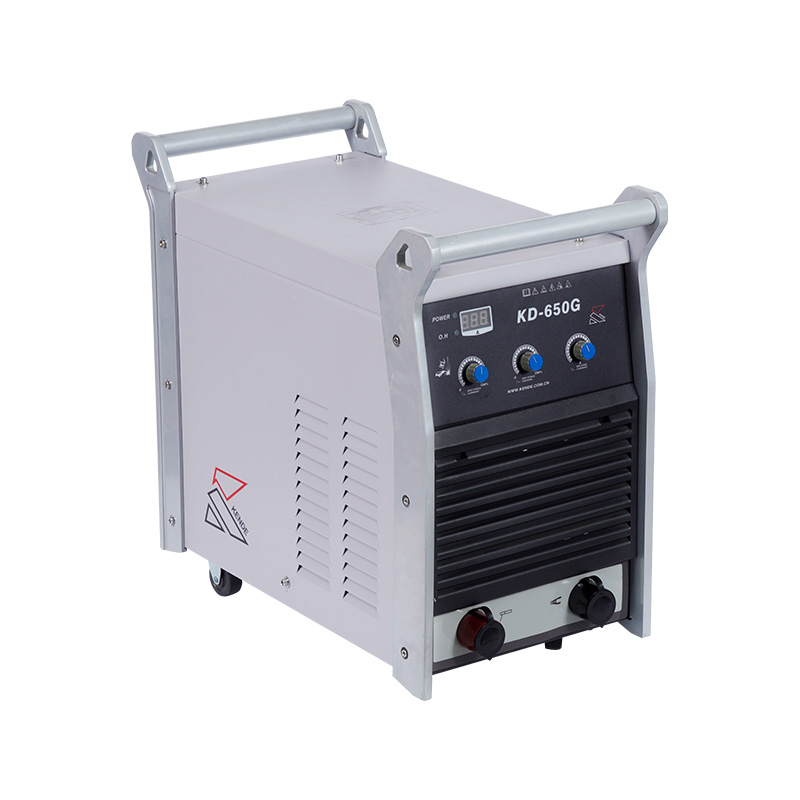
The grinding dust and the metal fines get pulled into the machine by the cooling fan. The conformal coating keeps the conductive dust off the components. The wire feed stalls because the plastic gear stripped. The metal gear holds. The arc sputters because the liner was the wrong size.
An inverter MIG welder factory builds the machine that feeds the wire and holds the arc. The drive rolls grip. The inverter shapes. Choose a factory that builds the feed with the metal parts and coats the board for the dust.
Recommended Products

Contact Us
No.2299, Luqiao Section, Shugang Avenue, Luqiao District, Taizhou, 318057 Zhejiang, PR China.
+86-576-82431568
 Privacy
China Welding Machine Factory
 English
 中文简体
 русский
 Español
 عربى
 Français
 Português
 Deutsch
 Український