Email: [email protected]
Email: [email protected]

Industry News
 Home / News / Industry News / Welding Machine Factory: The Equipment That Joins Metal Under Extreme Heat
  2026.08.07
 Industry News
Steel beams in a skyscraper. Aluminum panels on a truck body. Stainless pipe in a food processing plant. The joints holding these structures together were made by a welding machine. A welding machine factory builds the power sources that generate the arc, control the current, and feed the filler metal. These machines range from compact inverter units that a technician carries over one shoulder to multi-kilowatt industrial systems bolted to a production line. They all do the same thing: create a controlled electrical discharge hot enough to melt metal and fuse it together. Here is what welding distributors, fabrication shops, and industrial buyers need to know about the equipment behind the weld.
A welding machine is a specialized power supply. It takes input voltage from the wall or a generator and converts it into output current suitable for welding. Older transformer-based machines are heavy, durable, and simple. Modern inverter-based machines use power electronics to switch current at high frequency, shrinking the transformer and cutting the weight by more than half. A welding machine factory producing inverter units builds portable machines that a welder can carry onto a job site without a crane.
The arc characteristics depend on the current type and the volt-amp curve. Stick welding uses a constant-current output. MIG welding uses constant voltage. TIG welding uses constant current with a high-frequency start. A welding machine factory that builds multi-process machines combines these modes into one unit. The welder switches between stick, MIG, and TIG without changing power sources.
Duty cycle is the spec that tells how long the machine can run before it overheats. A machine rated at 200 amps with a sixty percent duty cycle can weld for six minutes out of every ten at that amperage, then needs four minutes to cool. A welding machine factory that publishes honest duty cycle ratings lets the buyer match the machine to the production pace. A machine pushed beyond its duty cycle trips the thermal overload and stops the job.
MIG and flux-cored welding use a wire feed system. A motor drives a spool of wire through a liner to the torch. The wire becomes the electrode and the filler metal simultaneously. A welding machine factory builds the wire drive with adjustable tension and speed control. Too little tension and the wire slips. Too much and the drive roller deforms the wire. Consistent feed speed is what keeps the arc stable and the weld bead uniform.
The MIG torch connects the wire, the shielding gas, and the electrical current. A welding machine factory supplies torches matched to the amperage range of the power source. A torch rated for 250 amps handles most fabrication work. A torch rated for 400 amps handles heavy plate and structural welding. The consumables inside the torch, the contact tip, the gas diffuser, and the nozzle, wear over time and need regular replacement.
TIG welding replaces the wire feed with a hand-fed filler rod. The TIG torch holds a tungsten electrode that creates the arc without melting. A welding machine factory building TIG-capable machines includes a high-frequency start circuit that initiates the arc without touching the tungsten to the workpiece. Touch-start contaminates the tungsten and leaves a tungsten inclusion in the weld.
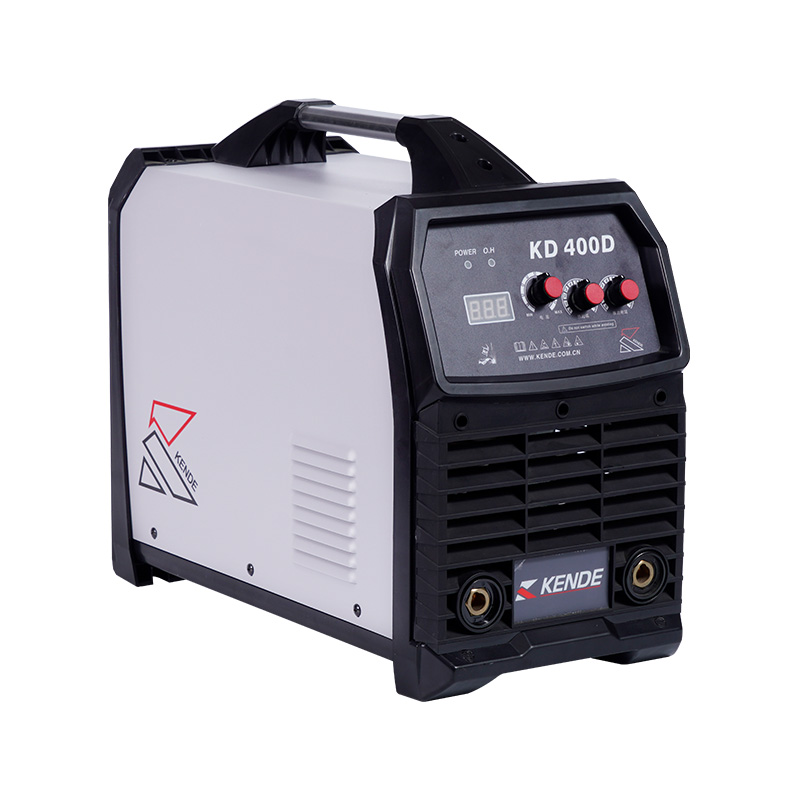
Heat is the byproduct of welding and the enemy of electronics. A welding machine factory designs the cooling system to match the power output. Small inverter machines cool with a fan pulling air through the chassis. Large industrial machines use fan cooling with additional heat sinks on the power semiconductors. Some high-amperage TIG machines use water cooling for the torch to keep the tungsten from overheating during long welds.
Dust and metal particles are everywhere in a welding environment. Grinding dust, welding spatter, and airborne metal fines get pulled into the machine by the cooling fan. A welding machine factory that coats the circuit boards with conformal coating protects the electronics from conductive dust that would otherwise short the boards. A machine with unprotected boards fails in dirty environments.
Input power protection handles the reality of job site electrical supply. Voltage spikes, low voltage from long extension cords, and generator power all stress the input circuitry. A welding machine factory that includes input voltage tolerance, automatic voltage sensing, and generator-compatible input filtering builds machines that run reliably regardless of the power quality.
Here is what a welding machine built for production needs:
The wire feed motor works until it does not. A welding machine factory using a sealed motor with metal gears instead of plastic gears builds a drive that lasts. Plastic gears strip under the constant start-stop of production welding. The feed rollers wear too. Hardened steel rollers with a knurled or grooved profile grip the wire without crushing it.
Capacitors on the power board degrade over time. A welding machine factory using quality electrolytic capacitors rated for the operating temperature and ripple current builds power boards that last years. Cheap capacitors dry out and swell, taking the machine offline.
A welding machine factory builds the equipment that fuses steel, aluminum, and stainless in shops and on job sites around the world. The arc melts the metal. The wire feed controls the deposition. The cooling keeps the machine alive. Choose a factory that specs honest duty cycles, protects the electronics from the environment, and builds the wire drive for production speeds. The welds will hold and the machine will keep striking arcs. That is the test.
Recommended Products

Contact Us
No.2299, Luqiao Section, Shugang Avenue, Luqiao District, Taizhou, 318057 Zhejiang, PR China.
+86-576-82431568
 Privacy
China Welding Machine Factory
 English
 中文简体
中文简体
 русский
 Español
 عربى
عربى
 Français
 Português
 Deutsch
 Український