Email: [email protected]
Email: [email protected]

Blog
 2026.08.21
 Blog
Reliable battery service is essential in automotive workshops, agricultural operations, fleet maintenance facilities, construction sites, service stations, and emergency roadside applications. When a vehicle battery is discharged, the ideal equipment must do more than provide a basic trickle charge. It should deliver controlled charging, dependable engine-starting assistance, clear operating information, strong protection functions, practical mobility, and sufficient electrical capacity for repeated professional use.
The KC series battery charger with jump-start function is designed to meet these requirements. It combines battery charging, engine starting, and alternator checking in one practical machine. With support for 12V and 24V battery systems, a maximum charging current of up to 60A, a 12V start current of up to 350A, and a 24V start current of up to 300A, the unit is suitable for a wide range of passenger vehicles, vans, light commercial vehicles, trucks, agricultural machinery, and workshop equipment.
Available with 110V or 220V/230V input options, the KC series can be adapted to different national electrical standards and export markets. Its LCD display provides useful operating information, while the heavy-duty housing, substantial charging cables, front-mounted clamps, and retractable handle support convenient daily operation. These features make the product a practical alternative to carrying separate chargers, jump starters, and diagnostic tools.
The KC series is a manual battery charger and engine starter intended for lead-acid battery service. Depending on the selected configuration, it can be used with conventional flooded batteries as well as AGM and gel batteries. Its principal functions are battery charging, engine starting, and alternator checking. This multifunction design helps users reduce equipment investment, save storage space, and simplify workshop procedures.
The product is engineered for 12V and 24V applications. A 12V setting is commonly used for passenger cars, motorcycles with suitable battery capacity, vans, small commercial vehicles, and many agricultural machines. The 24V setting is appropriate for trucks, buses, heavy-duty equipment, and vehicles equipped with two 12V batteries connected in series.
With a maximum charging current of 60A, the KC series can recharge larger batteries more efficiently than low-output household chargers. Its engine-starting function provides high short-term current when a vehicle starter motor requires additional assistance. The rated starting capacity reaches up to 350A for 12V systems and up to 300A for 24V systems, depending on the model configuration and operating conditions.
The unit is not intended to replace a properly maintained battery. Instead, it provides controlled electrical assistance when a battery is discharged, partially depleted, or unable to supply enough current for normal starting. Users should always confirm battery condition, voltage selection, cable connection, and vehicle requirements before activating the start function.
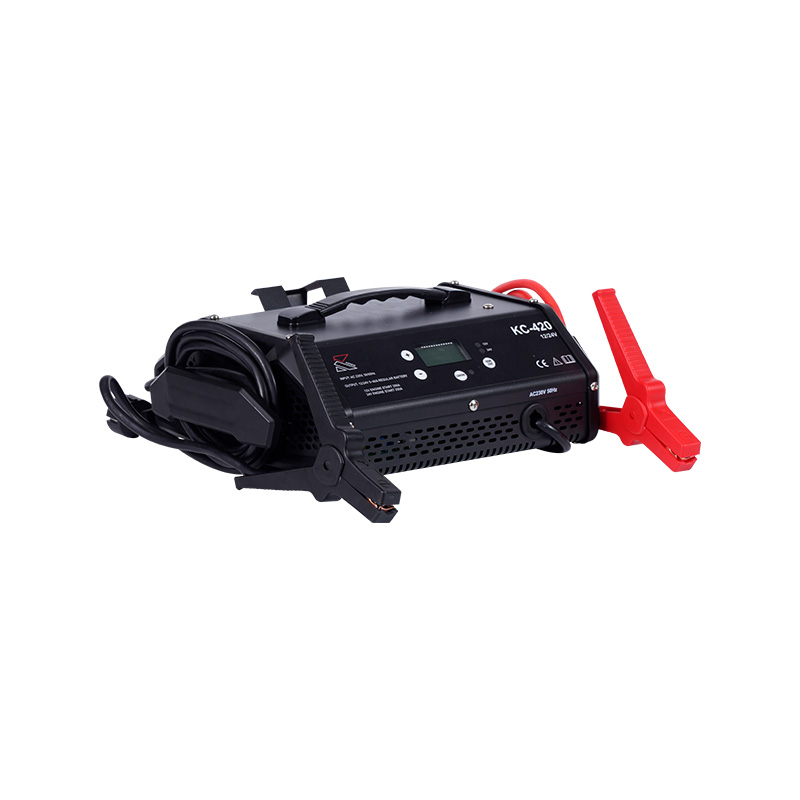
KC series battery charger with jump start function 12/24V LCD display, max charging current 60A, start current 12V 350A, 24V 300A, WITH 110V or 220V/230V INPUT
Many basic battery chargers are designed only to replenish battery energy over an extended period. A separate jump starter may then be required when a vehicle needs immediate assistance. The KC series combines these functions in a single machine, allowing workshop personnel to switch between normal charging and engine-starting support according to the task.
This combined design is particularly valuable in repair workshops and fleet depots. A technician can charge a battery after inspection, provide starting assistance when necessary, and perform an alternator check without moving the vehicle to another service area. The result is a more organized workflow and reduced dependence on multiple pieces of equipment.
Voltage flexibility is one of the most important advantages of a professional battery charger and starter. Equipment limited to 12V systems cannot serve many commercial vehicles, while a 24V-only machine is unsuitable for most passenger cars. The KC series supports both voltage levels, allowing one unit to serve mixed vehicle fleets.
The voltage selector must be set correctly before connection. Selecting 12V for a 12V battery and 24V for a 24V battery helps ensure safe and effective operation. For a 24V vehicle using two 12V batteries, users should follow the vehicle manufacturer’s connection instructions and verify the battery arrangement before charging or starting.
Starting an engine requires a short burst of high current. Cold weather, thick engine oil, poor electrical connections, and a partially discharged battery can all increase the demand placed on the starting circuit. The KC series is built to provide substantial starting assistance, with a maximum start current of up to 350A at 12V and 300A at 24V in the specified configuration.
This output gives the product a practical advantage over small domestic chargers that may have adequate charging capability but cannot supply enough current for engine starting. It is especially useful for service technicians who need a dependable workshop starting aid rather than a low-power maintenance charger.
A maximum charging current of 60A enables the KC series to handle larger-capacity batteries more effectively than compact chargers with outputs of only a few amps. Charging current can be selected or controlled according to the model and battery condition. Lower current settings may be preferred for smaller batteries or slower charging, while higher settings can be used when the battery and operating instructions permit.
Charging should always be performed within the limits recommended for the battery. Excessive current can produce heat, gas generation, or battery damage. The value of a high-capacity charger is not that it must always operate at maximum output, but that it provides sufficient headroom for demanding applications while allowing appropriate adjustment for different battery sizes.
The LCD display provides a clear interface for monitoring important operating information. Compared with a simple indicator lamp, a digital display can make the charging and starting process easier to observe. It helps users identify selected voltage, charging status, current information, or other available parameters depending on the exact version.
A visible display is useful in busy workshops where several machines may be operating at the same time. It also assists less experienced operators by making the selected operating condition easier to verify before charging or starting. Clear information reduces the possibility of incorrect settings and supports more consistent service procedures.
The KC series uses manual operation, giving technicians direct control over voltage selection, charging mode, and starting assistance. Manual equipment is often preferred in repair environments because experienced operators can adapt the process to the battery’s condition and the vehicle’s requirements.
Manual control also makes the machine straightforward to understand and maintain. There is no need for a complicated software setup or a wireless connection. Users can inspect the battery, select the correct parameters, connect the clamps, and begin the required function using a direct operating procedure.
The following table summarizes the principal specifications supplied for the KC series product configuration. Exact ratings may vary according to the selected model, input voltage, market version, and production configuration. Buyers should confirm the final technical data before placing an order.
| Parameter | Specification |
|---|---|
| Product type | Battery charger with jump-start function |
| Supported battery systems | 12V and 24V |
| Maximum charging current | Up to 60A |
| 12V start current | Up to 350A |
| 24V start current | Up to 300A |
| Input voltage options | 110V or 220V/230V |
| Display | LCD display |
| Battery compatibility | Lead-acid, AGM, and gel batteries, subject to model instructions |
| Primary functions | Charging, engine starting, and alternator checking |
| Protection functions | Reverse polarity, overheating, and short-circuit protection |
| Charging cable | Approximately 1.5 + 1.5m cable set |
| Included connection equipment | Two charging clamps |
| Portability features | Retractable handle and front clamp storage |
Input voltage selection is important for international customers. The 110V version is suitable for markets using lower-voltage single-phase systems, while the 220V/230V version is intended for regions using standard higher-voltage single-phase supplies. The supply frequency and plug arrangement should be confirmed for the destination market before shipment.
Where a customer requires a specific input, output, plug, label, packaging, or compliance configuration, the manufacturer can confirm available options during the quotation and technical approval process. This is particularly important for distributors serving several countries with different electrical standards.
Incorrect connection of positive and negative clamps is a common risk during battery service. The KC series includes reverse polarity protection and an indicator to help alert the operator when the clamps are connected incorrectly. This feature helps reduce the likelihood of damage to the charger, battery, or vehicle electrical system.
Protection technology does not eliminate the need for correct connection. Users should switch off the charger before changing connections, confirm positive and negative terminals, and keep the clamps separated until they are ready to be attached. The positive clamp should be connected to the positive terminal and the negative clamp to the negative terminal or an approved vehicle grounding point, according to the service procedure.
Charging and starting can place significant demands on electrical components. If the machine becomes too hot because of prolonged operation, insufficient ventilation, high ambient temperature, or excessive load, overheating protection helps reduce the risk of component damage.
For best results, the charger should be placed on a stable, dry, and ventilated surface. Air openings should not be blocked, and the machine should not be operated under covers or in areas where heat cannot escape. Allowing the unit to cool between repeated starting attempts is also good practice.
Short-circuit protection helps protect the machine against abnormal current conditions caused by accidental contact, damaged cables, poor connections, or incorrect operation. It is an important feature for equipment used in workshops, where tools, metal parts, and cables may be present around the service area.
Even with protective circuitry, damaged clamps or cables should be replaced immediately. Users should inspect insulation, connectors, and cable strain points before operation. Keeping the connection equipment in good condition helps the protection system work as intended and improves overall service reliability.
The product is designed for use with lead-acid battery types, including standard flooded batteries and, subject to the specific model instructions, AGM and gel batteries. Each battery type has different charging characteristics. The operator should verify that the selected charge mode and current are appropriate for the battery before beginning the process.
Flooded lead-acid batteries may release hydrogen gas during charging. Charging should therefore be carried out in a well-ventilated area away from sparks, flames, cigarettes, and other ignition sources. Battery terminals should be clean and secure, and eye and hand protection should be used during professional battery service.
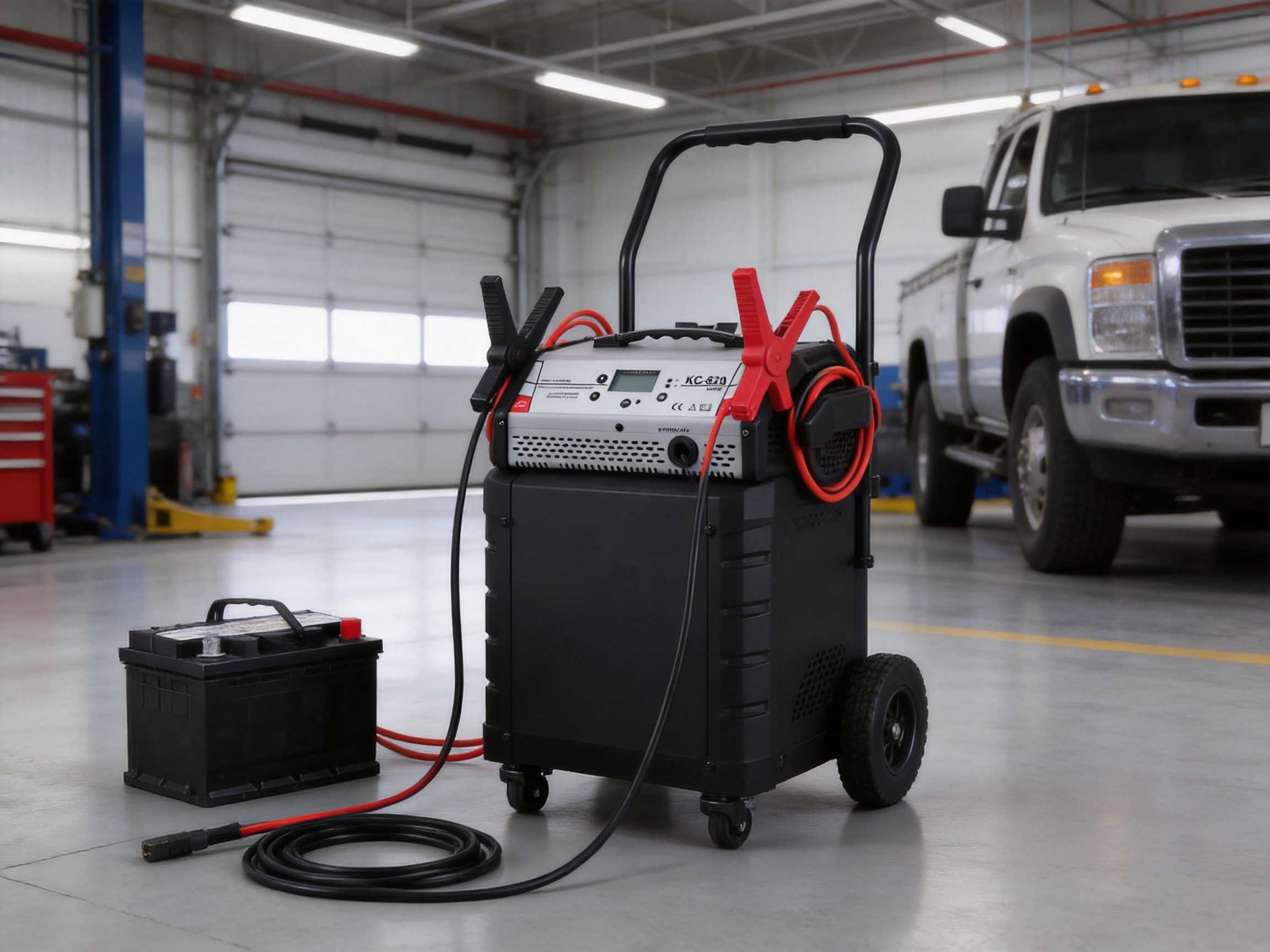
Workshop equipment must tolerate frequent movement, repeated connection cycles, and demanding operating environments. The KC series uses a heavy-duty construction intended for practical service use. A robust housing helps protect internal components from ordinary handling, while the machine’s stable form supports safe placement during charging.
Durability is particularly important for fleet maintenance departments and rental or service businesses. Equipment may be handled by different operators and moved between service bays. A sturdy design can reduce the risk of damage caused by routine transportation and contribute to a longer working life when the product is operated and maintained correctly.
The retractable handle improves portability without permanently increasing the machine’s storage footprint. It allows the operator to move the charger between vehicles, workstations, or storage areas with less effort. When the equipment is not being transported, the handle can be stored in a more compact position.
This feature is useful in workshops with limited floor space. The unit can be kept close to a service bay during use and returned to a designated storage area afterward. A practical handle also reduces the temptation to lift the machine by its cables, which can help protect the cable connections from unnecessary strain.
Charging clamps are mounted at the front of the machine for convenient access and storage. This arrangement helps keep cables organized and makes it easier for the operator to prepare the unit for use. Storing the clamps on the machine also reduces the possibility of misplacing them between jobs.
Good cable management is not merely a convenience. Loose cables can create trip hazards, become damaged by vehicle wheels or workshop equipment, and develop sharp bends that shorten their service life. A dedicated storage position encourages more orderly work practices.
The included cable set is approximately 1.5m plus 1.5m, providing useful reach between the charger and the battery. Adequate cable length allows the machine to remain in a stable position while the clamps reach the battery compartment or approved connection points.
Operators should avoid placing cables near exhaust components, moving belts, cooling fans, sharp edges, or hot engine surfaces. The cables should not be pulled excessively or used to drag the machine. After use, they should be coiled loosely and stored on the front of the unit.
Automotive technicians regularly encounter discharged batteries during inspection, diagnosis, maintenance, and vehicle storage. The KC series can support battery charging before a vehicle is returned to the customer and provide starting assistance when a vehicle cannot start under its own power.
Its 12V and 24V capability makes it suitable for workshops that service both passenger cars and commercial vehicles. Rather than maintaining separate equipment for each voltage category, a workshop can use one adaptable charger and starter for a broader range of jobs.
Fleet operators need equipment that can help return vehicles to service quickly. Delivery vans, trucks, buses, and service vehicles may be exposed to cold weather, long idle periods, or intensive daily use. A high-capacity charger and starter can be kept in the maintenance area or service vehicle for rapid response.
For a fleet, the product can be included in a preventive maintenance program. Batteries can be charged during scheduled inspections, alternator performance can be checked, and starting assistance can be provided without waiting for an external recovery service. This may reduce vehicle downtime and improve the efficiency of internal maintenance teams.
Tractors, harvesters, irrigation equipment, and other agricultural machines may remain unused for extended periods. A battery can lose charge during seasonal storage, especially when the machine is exposed to cold temperatures or has parasitic electrical loads.
The KC series offers a practical solution for agricultural workshops and farm maintenance areas. Its 24V starting capability is useful for larger machinery, while the 12V setting serves smaller equipment and utility vehicles. Operators should keep the charger protected from rain, dust, mud, and excessive moisture.
Construction machinery is often operated in demanding environments and may be parked for long periods between projects. Excavators, loaders, generators, compressors, and site vehicles can all require battery support. A portable charger and starter helps maintenance crews respond to starting problems without removing the battery from the machine.
The heavy-duty construction and retractable handle are beneficial in industrial environments where the unit may need to be moved across workshops or between equipment locations. However, the charger should not be exposed to water spray, conductive dust, explosive atmospheres, or conditions outside its specified protection rating.
Roadside service providers require equipment that is easy to transport and capable of helping different vehicle types. The KC series can be used as part of a roadside assistance kit, particularly where both 12V passenger vehicles and 24V commercial vehicles are serviced.
Before starting a vehicle, the technician should inspect for mechanical problems, frozen fluids, damaged wiring, short circuits, or a severely defective battery. Engine starting should only be attempted when the vehicle is suitable for the procedure and the battery connection is secure.
Battery retailers can use the product for charging, testing support, and pre-delivery preparation. A replacement battery may need to be charged before installation, while a customer’s existing battery may require evaluation after a vehicle fails to start. The alternator-checking function can help technicians distinguish between a battery-related problem and a vehicle charging-system problem.
Although an alternator check does not replace a complete electrical diagnosis, it provides a useful first step in the service process. Combined with visual inspection and suitable measuring instruments, it can help organize troubleshooting more efficiently.
The main advantage of the KC series over a basic low-current charger is its broader operating capability. A small charger may be adequate for maintaining a motorcycle battery or slowly charging a passenger-car battery, but it may not provide the current needed for large batteries or engine starting. The KC series is designed for more demanding service work.
Compared with a dedicated jump starter, the KC series has the advantage of being connected to an AC power supply and providing sustained charging capability. Portable jump starters are useful when mains electricity is unavailable, but their internal batteries must be maintained and recharged. A mains-powered charger and starter can deliver repeated assistance in a workshop without depending on the remaining capacity of an internal battery pack.
Compared with owning separate 12V and 24V machines, the dual-voltage design reduces equipment duplication. It can also simplify operator training, storage planning, purchasing, and spare-parts management. One versatile unit is easier to assign to a service bay or maintenance vehicle than several specialized devices.
The product’s protection functions provide another advantage over rudimentary chargers. Reverse polarity, overheating, and short-circuit protection help improve operational safety and reduce the consequences of common connection or load problems. The LCD display further improves visibility compared with machines that provide only a basic power indicator.
These advantages do not mean that every application requires the highest current or starting rating. Small batteries should be charged at an appropriate setting, and sensitive electronic vehicles may require the battery to be disconnected or a manufacturer-approved support procedure. The strength of the KC series is its adaptability when used correctly.
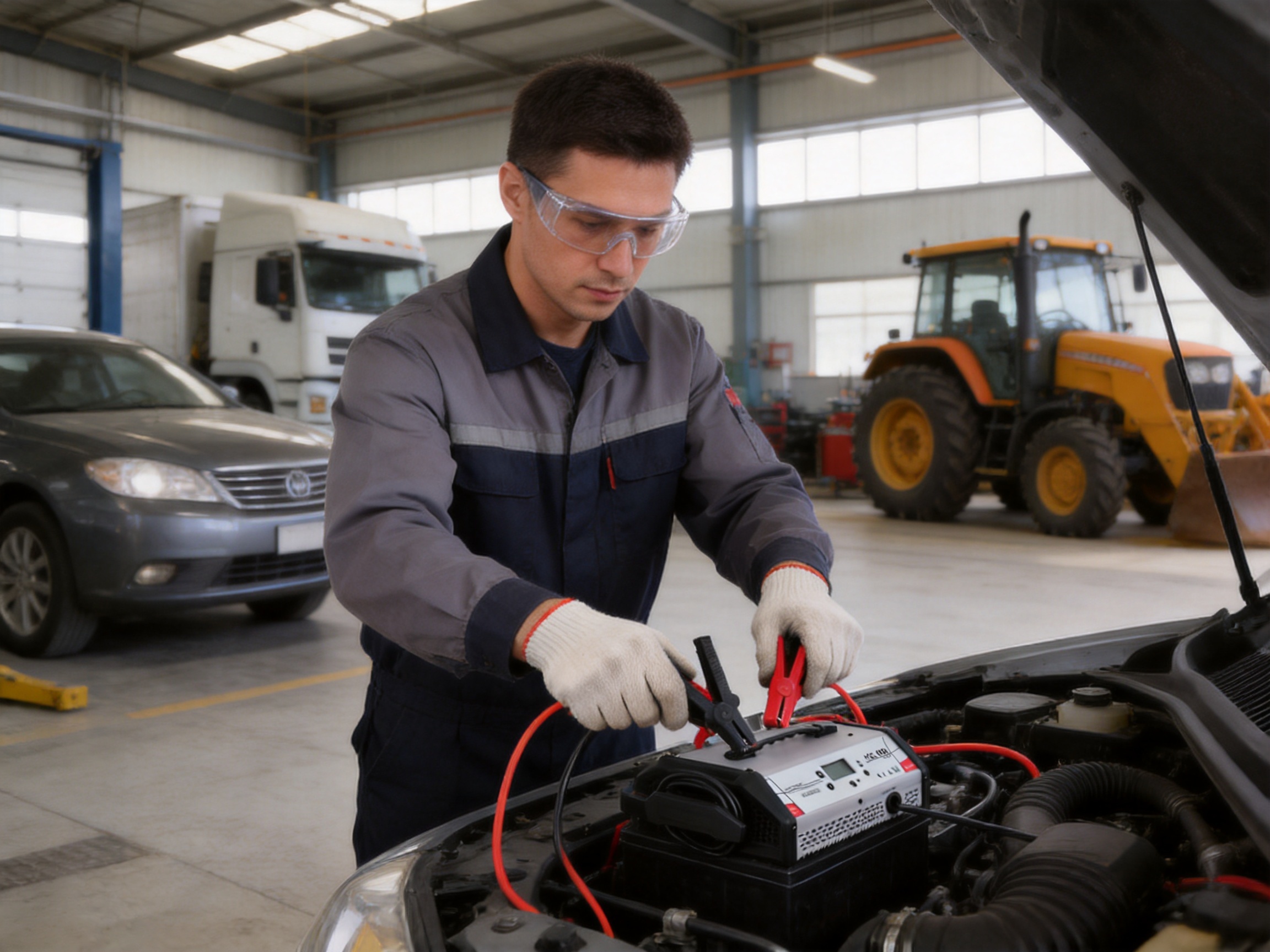
Place the charger on a dry, stable, and ventilated surface. Inspect the power cord, charging cables, clamps, housing, display, and controls. Do not operate the machine if the insulation is damaged, a clamp is loose, the housing is cracked, or liquid has entered the enclosure.
Identify the battery voltage and type. Confirm whether the application is 12V or 24V. For a 24V vehicle with two 12V batteries, follow the equipment manufacturer’s instructions and verify that the batteries are connected correctly. Remove jewelry and keep metal tools away from the battery terminals.
Ensure that the charger is switched off and disconnected from the mains before attaching the clamps. Connect the positive clamp to the positive battery terminal. Connect the negative clamp to the negative terminal or an approved grounding point, depending on the vehicle manufacturer’s instructions.
Make sure both clamps have firm contact with clean terminal surfaces. Do not allow the clamps to touch each other. If the reverse polarity indicator activates, switch off the machine, disconnect it from the mains, and correct the connections before continuing.
Select the correct battery voltage and charging mode. Choose a charging current appropriate for the battery’s capacity and condition. A deeply discharged battery may require a longer charging period. A battery that becomes excessively hot, emits an unusual odor, leaks, or shows physical damage should be disconnected and inspected by a qualified technician.
Monitor the LCD display and observe the battery during charging. Do not leave the equipment operating in an unsafe or poorly ventilated area. Charging time depends on battery capacity, state of discharge, temperature, battery age, and selected current.
Before activating the start function, confirm that the vehicle is in neutral or park, the parking brake is engaged, and all unnecessary electrical loads are switched off. Confirm the voltage selection and clamp connections. Start assistance should be applied for a short period in accordance with the product instructions.
If the engine does not start, wait before attempting another start cycle. Repeated prolonged cranking can overheat the starter motor, cables, battery, or charger. If several attempts fail, investigate fuel delivery, ignition, engine oil viscosity, wiring, immobilizer systems, and mechanical condition rather than continuing to apply starting current.
The alternator-checking function can assist with basic evaluation of the vehicle’s charging system. A technician should compare the observed result with the vehicle manufacturer’s specifications and, where necessary, confirm it using a calibrated multimeter or professional diagnostic equipment.
An alternator problem may cause a battery to discharge repeatedly even after successful charging. Identifying this possibility helps prevent unnecessary battery replacement and supports a more complete repair decision.
When charging or starting is complete, switch off the charger and disconnect it from the mains. Remove the negative clamp first unless the vehicle manufacturer specifies another procedure, followed by the positive clamp. Inspect the cables and clamps, clean them if necessary, and place them in the designated storage position.
Store the machine indoors in a dry area. Protect it from dust, corrosive chemicals, direct sunlight, and extreme temperatures. Proper storage helps preserve the housing, electrical connections, display, and cable insulation.
The product is manufactured by Zhejiang Kende Mechanical & Electrical Co., Ltd., an established Chinese producer and exporter of welding machines, battery chargers, heaters, and related equipment. The company operates in Taizhou, Zhejiang Province, and has developed a large manufacturing base supported by engineering, production, quality-control, and export capabilities.
The company covers approximately 120,000 square meters and employs around 600 people. Its reported annual production capacity is approximately two million units, with exports approaching 1.5 million units per year. This scale provides the production resources required for large-volume orders while maintaining a broad product portfolio for industrial and domestic applications.
Manufacturing scale is valuable to distributors because it can support stable supply, coordinated production planning, and consistent product availability. It also allows the company to invest in testing equipment, tooling, automated production processes, packaging development, and product improvement.
The manufacturer operates a Zhejiang Provincial Research and Development Center, an Enterprise Technology Center, and an Intelligent Welding Technology Research Institute. Although the KC series is a battery service product, this wider engineering environment is relevant because it supports electrical design, power management, thermal control, mechanical construction, and product reliability development.
The company has approximately 98 research and development personnel and holds invention patents, utility model patents, appearance patents, and software copyrights. Research resources help the manufacturer develop products for different markets, voltage standards, user expectations, and regulatory requirements.
The ability to develop products for different regions is an important advantage for international buyers. Input voltage, plug type, labeling, packaging language, protection requirements, and certification expectations vary across countries. A manufacturer with established engineering and export experience is better positioned to address these differences during product development and order preparation.
The company applies several management and manufacturing systems, including office automation, Toyota-style production management, enterprise resource planning, and manufacturing execution systems. These systems can support production scheduling, material tracking, process coordination, inventory control, traceability, and delivery management.
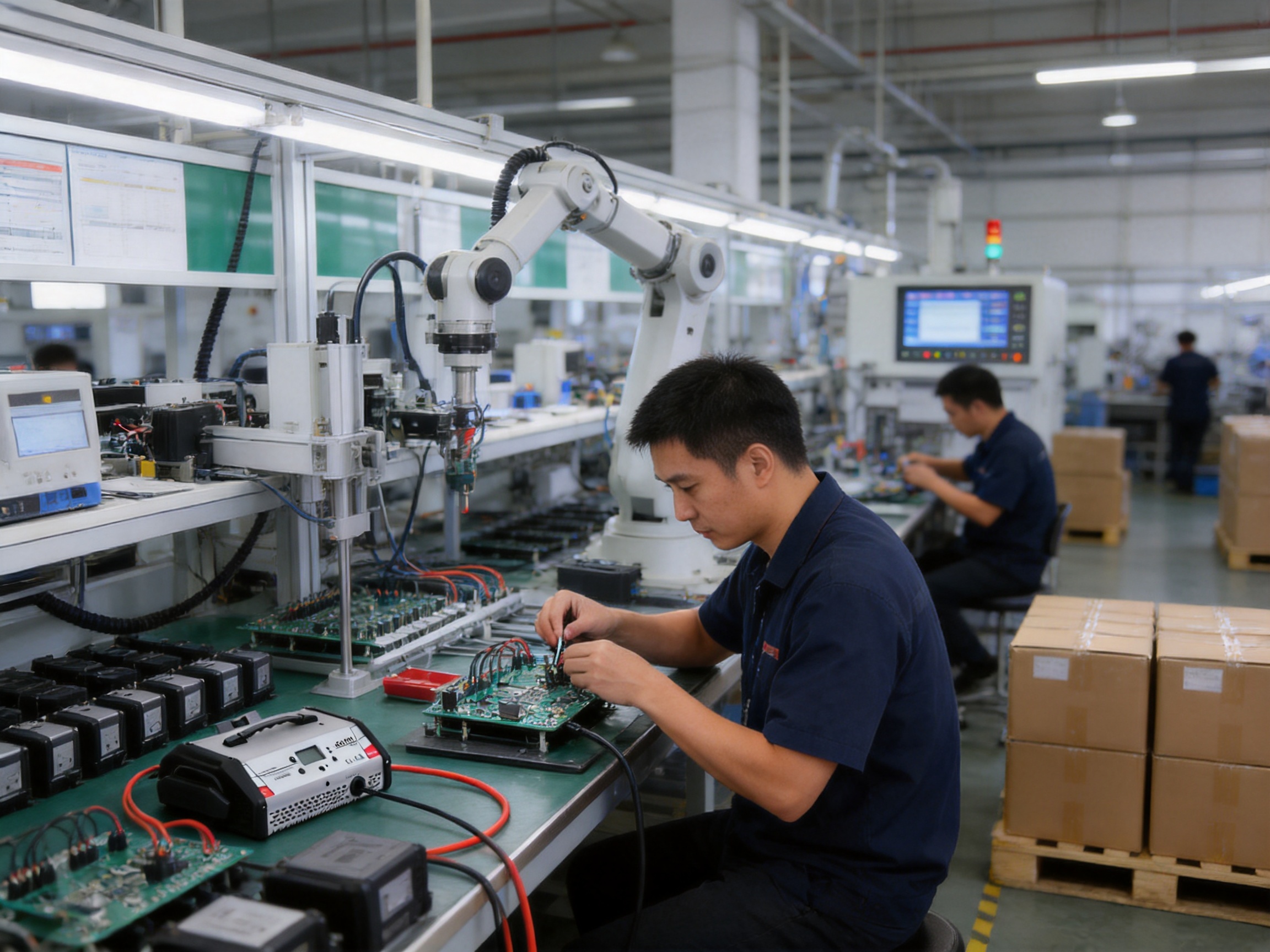
Its production technology includes automated electronic component placement, insertion and soldering systems, robotic processing, laser cutting, and other advanced manufacturing methods. Such processes are relevant to battery chargers because electrical performance depends on accurate assembly, secure solder joints, reliable wiring, correct component placement, and consistent enclosure construction.
Automation can reduce variation in repetitive operations and improve production efficiency. It also allows skilled personnel to focus on process supervision, testing, engineering improvements, and quality verification. Automated production, however, must be combined with inspection and functional testing to ensure that completed units meet the intended requirements.
The company reports holding international product certificates and compliance marks including GS, CE, EMC, ERP, US ETL, UKCA, and China CCC across its product range. The applicable certification for a particular KC series model depends on its final design, market, input configuration, and certification scope. Buyers should request the relevant documentation for the exact model being purchased.
Certification experience supports international distribution because it demonstrates familiarity with electrical safety, electromagnetic compatibility, energy-related requirements, and regional market access procedures. It also helps customers prepare technical files, product labels, user manuals, and import documentation.
The company is also described as a national standard drafting unit of the National Welding Machine Standardization Committee and has participated in the drafting, formulation, and revision of multiple national standards. While standardization experience is not a substitute for product-specific compliance, it reflects a broader understanding of technical requirements and manufacturing discipline.
For importers and distributors, the KC series can be considered as a ready product or as part of a private-label program, subject to manufacturer confirmation. Customization may include branding, color, packaging, user documentation, front-panel markings, plug type, input voltage, and market-specific labeling.
Before ordering, a buyer should define the target market, expected annual quantity, preferred input voltage, required certification, battery types, current range, starting rating, cable length, packaging requirements, and warranty expectations. Clear technical confirmation helps prevent mismatches between the sales description and the delivered configuration.
Distributors should also request product drawings, packaging dimensions, net and gross weights, carton quantities, spare-parts availability, instruction manuals, and recommended maintenance procedures. If the product is to be sold through retail channels, high-quality packaging and clear safety information are especially important.
For professional customers, it may be useful to evaluate a sample unit before a large order. Sample testing can include input-voltage verification, 12V and 24V operation, charging-current measurement, display readability, cable temperature, starting performance, protection response, and mechanical handling. Testing should be carried out using suitable batteries and controlled procedures.
Regular inspection helps maintain performance and extend service life. Before each use, examine the power cord, clamps, cable insulation, ventilation openings, switches, and display. Clean dust from the housing with a dry or slightly damp cloth after disconnecting the machine from the power supply.
Do not use solvents, abrasive cleaners, or pressurized water on the enclosure. Keep the clamps clean and free from corrosion. Poor clamp contact can cause voltage drop, heating, and unreliable charging or starting. If a clamp spring becomes weak or the jaw is damaged, replace the component rather than continuing to use it.
Internal repairs should be performed by qualified service personnel. The machine contains electrical components that may present a shock hazard even after the power supply has been disconnected. Opening the housing without authorization may also affect warranty coverage or certification status.
For commercial users, maintenance records can be helpful. The record may include inspection dates, observed faults, cable replacements, safety checks, and performance tests. This approach is especially useful for fleet operators, rental companies, workshops, and organizations with multiple service units.
The first selection factor is the vehicle voltage. A buyer serving only passenger cars may need 12V capacity, while a mixed workshop should select the 12V/24V version. If trucks, buses, or heavy equipment are included in the service range, 24V starting capability is essential.
The second factor is battery capacity. A higher maximum charging current is useful for larger batteries, but the operator must still select a suitable current for each individual battery. Buyers should consider the smallest and largest battery types they expect to service and confirm that the machine’s adjustment range is appropriate.
The third factor is the available mains supply. Customers in different countries may require 110V or 220V/230V input. The correct configuration should be confirmed before production because using an unsuitable input voltage can create a serious safety risk and damage the equipment.
The fourth factor is the working environment. A workshop may value portability, cable organization, and repeated starting capacity. A roadside provider may prioritize transport and rapid operation. A retailer may focus on packaging, labeling, documentation, and certification. The same core product can serve these users, but the commercial configuration may differ.
The KC series offers a balanced combination of electrical capacity, operating flexibility, safety protection, and practical design. Its principal competitive strength is the ability to perform several important battery-service tasks in one machine. It is more capable than a basic maintenance charger while remaining more straightforward than highly specialized diagnostic equipment.
The dual-voltage design expands its application range. The high charging current supports larger batteries, while the high starting current provides useful assistance for vehicles that cannot start normally. The LCD display improves operating visibility, and the retractable handle and front clamp storage make the machine easier to move and organize.
For distributors, the manufacturer’s production scale, research resources, international certification experience, and broad export background provide additional advantages. These strengths can support stable supply and market adaptation. For workshops and fleet managers, the product’s multifunction performance can reduce equipment duplication and help improve maintenance response times.
As with all electrical service equipment, correct operation is essential. The charger should be matched to the battery, voltage should be confirmed before connection, ventilation should be maintained, and safety instructions should be followed. When used within its intended application, the KC series can provide dependable support for charging and starting operations across a broad range of vehicles.
The KC series is a battery charger with an engine-starting or jump-start function. It is designed to charge suitable lead-acid batteries and provide additional starting current when a vehicle battery cannot crank the engine normally.
Yes. The specified KC series configuration supports both 12V and 24V battery systems. The operator must select the correct voltage before connecting the charger and should verify the vehicle and battery arrangement in advance.
The product description specifies a maximum charging current of up to 60A. The actual operating current should be selected according to the battery capacity, battery type, condition, and instructions for the exact model.
The specified starting performance is up to 350A for 12V systems and up to 300A for 24V systems. Actual results depend on battery condition, temperature, cable connection, engine requirements, and the specific product configuration.
The supplied product information identifies compatibility with standard, AGM, and gel batteries. Users should confirm the exact charging procedure and current requirements for the battery type before operation.
Yes. The KC series is described as having an LCD display for clearer operating information and easier monitoring of the selected function and charging process.
The product is available with 110V or 220V/230V input options. The required version should be specified when ordering, together with the destination country, plug standard, supply frequency, and certification requirements.
The product information lists reverse polarity protection with an indicator, overheating protection, and short-circuit protection. These functions improve safety but do not replace correct operation, inspection, and battery-service precautions.
The 24V function and high starting-current capability make the product suitable for many truck, bus, and commercial-vehicle applications. The user should confirm the battery capacity and starting requirements of the particular vehicle before purchase.
Charging time varies according to battery capacity, state of discharge, selected current, temperature, battery age, and battery condition. A severely discharged or damaged battery may require extended charging or replacement rather than continued charging.
The KC series is primarily a manual charger and engine starter. It should not be assumed to provide automatic long-term float maintenance unless the exact model documentation specifically confirms that function.
The supplied information identifies an approximately 1.5m plus 1.5m charging cable, two clamps, and a color box. Final accessory contents may vary by model and market package, so buyers should confirm the packing list before ordering.
Confirm the voltage setting, clamp polarity, battery condition, vehicle transmission position, parking brake, ventilation, and condition of the cables. Switch off unnecessary electrical loads and avoid repeated prolonged starting attempts.
The KC series is manufactured by Zhejiang Kende Mechanical & Electrical Co., Ltd., a Chinese producer of welding equipment, battery chargers, heaters, and related electrical products.
Potential customization may include input voltage, plug, packaging, labeling, color, documentation, and private branding, subject to minimum order quantities, technical feasibility, and manufacturer approval. These details should be agreed in writing before production.
The KC series battery charger and engine starter is designed as a versatile solution for charging and starting 12V and 24V vehicles. Its up-to-60A charging capability, high starting current, LCD display, protection functions, heavy-duty construction, retractable handle, and organized clamp storage make it suitable for workshops, fleets, agricultural operations, construction equipment, roadside assistance, and battery service centers.
Its value is strengthened by the manufacturer’s large production capacity, research and development resources, automated manufacturing technology, quality-management systems, certification experience, and international export background. For professional buyers seeking one adaptable machine instead of several separate devices, the product provides a practical combination of performance, mobility, and service functionality.
1. Product specification and application information supplied for the KC series battery charger with jump-start function.
2. Manufacturer-provided technical characteristics for battery chargers and engine starters.
3. General service practices for lead-acid, AGM, and gel battery charging.
4. Automotive electrical system inspection and alternator-testing principles.
5. General electrical equipment safety, ventilation, polarity, and short-circuit prevention practices.
6. Manufacturer-provided company information concerning production capacity, research and development, certifications, and manufacturing systems.
Recommended Products

Contact Us
No.2299, Luqiao Section, Shugang Avenue, Luqiao District, Taizhou, 318057 Zhejiang, PR China.
+86-576-82431568
 Privacy
China Welding Machine Factory
 English
 中文简体
 русский
 Español
 عربى
 Français
 Português
 Deutsch
 Український