Email: [email protected]
Email: [email protected]

Blog
 2026.08.17
 Blog
The IN-155 IGBT Inverter MMA Welding Machine is a compact, portable solution for manual metal arc welding, also known as stick welding or MMA welding. Designed for workshop, maintenance, fabrication, construction, agricultural, and household applications, it combines inverter technology with a lightweight structure, stable current control, broad input-voltage tolerance, and practical protection functions.
Although the IN-155 is physically small and weighs only 3.4 kilograms, it is designed to provide the essential characteristics expected from a modern welding power source. These include a controllable welding current, reliable arc initiation, anti-stick operation, hot-start assistance, arc-force control, automatic over-current protection, and over-temperature protection. It can weld a range of commonly used metals, including carbon steel, alloy steel, cast iron, and stainless steel, when the correct electrode and welding procedure are selected.
The machine is manufactured by Zhejiang Kende Mechanical & Electrical Co., Ltd., a large Chinese producer and exporter of welding equipment, battery chargers, and heating products. The company operates extensive production, research, testing, and quality-control capabilities. Its manufacturing systems include automated electronic assembly, robot processing, laser cutting, enterprise resource planning, manufacturing execution management, and Toyota Production System practices.
This article examines the IN-155 in detail. It explains the operating principle of an IGBT inverter MMA machine, evaluates the product’s technical characteristics, discusses its advantages compared with conventional welding machines, and describes the manufacturing strengths behind the equipment. It also provides guidance on applications, electrode selection, installation, maintenance, safe operation, and product evaluation.

IN-155 IGBT Inverter MMA or Stick Welding Machines IN- 155
The IN-155 belongs to the IGBT inverter MMA or stick welding machine category. MMA welding uses a consumable electrode covered with flux. An electric arc is established between the electrode and the workpiece, melting both the electrode and a small portion of the base metal. The molten electrode forms the weld deposit, while the flux coating produces shielding gas and slag that protect the molten pool from atmospheric contamination.
Unlike a traditional transformer welding machine, an inverter welding machine first converts incoming alternating current into a high-frequency electrical form. Electronic switching devices then regulate the power before it is converted into a controlled welding output. This approach allows the power source to be substantially smaller and lighter than a traditional low-frequency transformer unit with a similar practical function.
The IN-155 is designed for a nominal 230-volt single-phase supply and can operate within a stated input range of approximately 130 to 270 volts. Its rated supply tolerance is listed as 230 volts plus or minus 15 percent, while the technical description emphasizes operation under a wider 130–270 V range. Users should always confirm the actual supply conditions, local electrical requirements, and the rating label on the machine before operation.
The IN-155 model has a welding current adjustment range of 20–80 amperes in the supplied specification table, with a maximum welding current of 120 amperes. It is suitable for electrodes from 1.6 to 2.5 millimeters. This makes it particularly appropriate for light fabrication, repair work, thin and medium-gauge steel, maintenance tasks, and applications where portability is more important than very high output capacity.
The same technical table also lists related models, including the IN-175, IN-195, and IN-205. These models provide progressively higher current ranges and maximum outputs. The IN-155 should therefore be understood as the compact entry model in a broader family rather than as a substitute for a high-capacity industrial welding power source.
The product description identifies several technical characteristics that influence performance and usability. These characteristics are important because welding quality depends not only on the maximum current shown on a nameplate, but also on current stability, protection, arc behavior, input tolerance, cooling, and the suitability of the machine for the intended electrode sizes.
The machine uses powerful insulated-gate bipolar transistor, or IGBT, switches together with advanced inverter control technology. IGBT devices allow the power source to switch electrical energy rapidly and regulate the welding output with a compact electronic circuit.
Compared with traditional transformer-based equipment, an IGBT inverter can reduce the size and weight of the magnetic components and improve the controllability of the welding current. This is especially valuable for mobile welders, service technicians, construction crews, farm users, and small workshops that need to transport equipment between work areas.
Inverter technology also supports a faster response to changes in the arc. When the arc length varies slightly as the welder moves the electrode, the control system can adjust the output more quickly than a simple conventional power source. This can make the arc feel more responsive and can assist users in maintaining a stable weld.
The IN-155 uses pulse-width modulation, commonly called PWM, and constant-current output control. PWM regulates the amount of energy delivered through the electronic switching circuit. Constant-current control helps maintain the selected welding current when normal changes occur in arc length and welding conditions.
Stable current control is particularly useful in MMA welding because the electrode is gradually consumed and the arc length changes during the weld. If the current changes excessively, the arc may become unstable, the electrode may stick, or the weld bead may become irregular. A controlled output helps the operator maintain a more consistent process.
The current can be adjusted continuously across the specified range. This allows the welder to match the output to electrode diameter, base-metal thickness, joint design, welding position, and the recommendations printed on the electrode package.
The power source includes anti-stick, hot-start, and arc-force functions. These are practical features that can make manual arc welding easier, especially for less experienced operators or when welding conditions are not ideal.
Anti-stick reduces the tendency of the electrode to remain firmly attached to the workpiece when the arc is accidentally extinguished. By helping reduce the welding current under a sticking condition, the feature can make electrode removal easier and reduce the likelihood of damaging the electrode coating.
Hot-start provides an increased current at the moment of arc initiation. This helps ignite the electrode and can reduce the difficulty of starting an arc on a cold workpiece. A reliable start is important because poor arc initiation can create an unwanted crater, surface contamination, or an area of incomplete fusion at the beginning of the weld.
Arc-force control helps support the arc when the electrode comes close to the workpiece. It can help prevent the arc from collapsing and can contribute to a more stable transfer of molten metal. The precise effect depends on the internal control design, electrode type, current setting, and operator technique. These functions support the welder, but they do not replace correct preparation, suitable polarity, or proper welding practice.
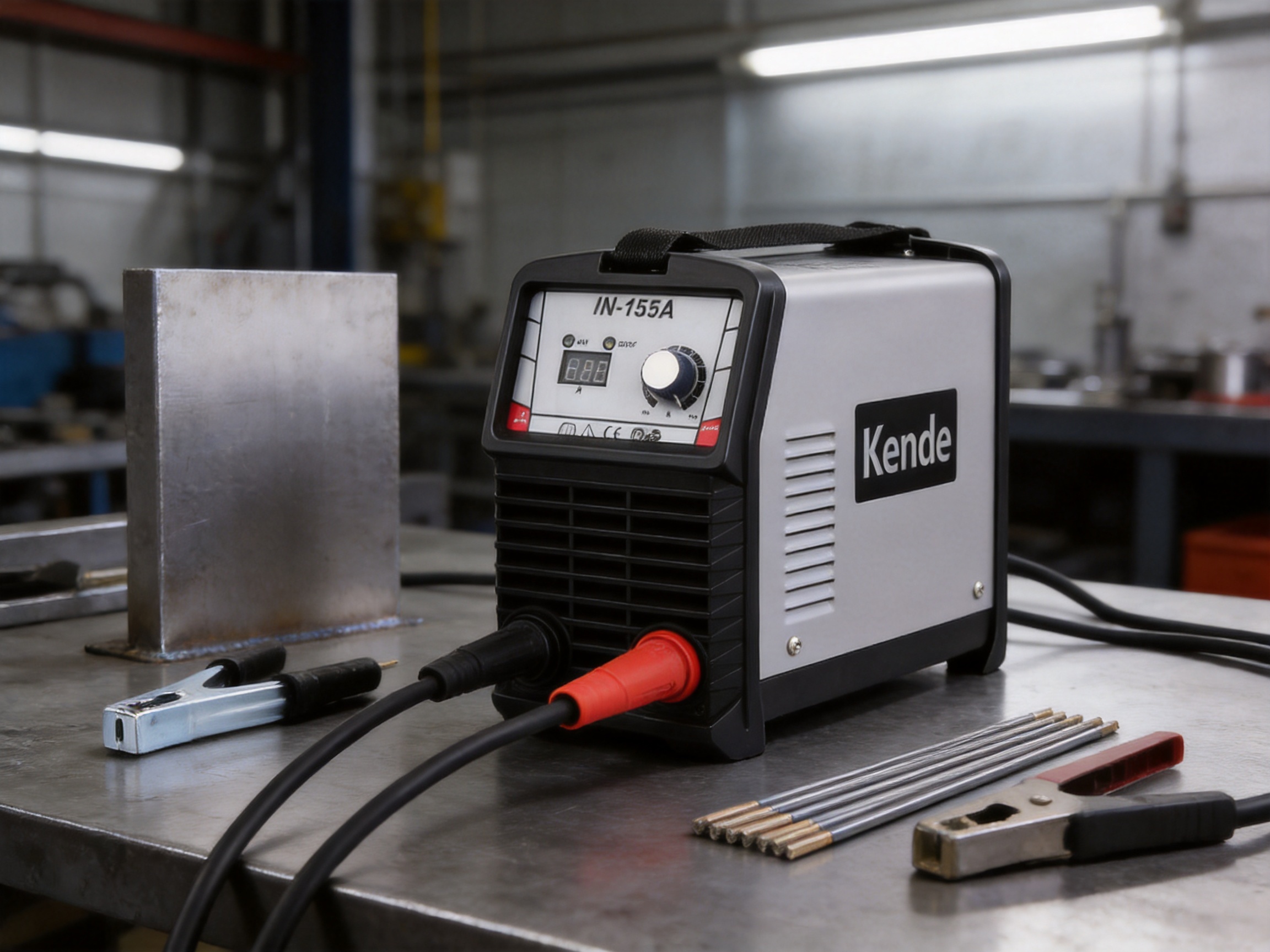
The IN-155 offers several advantages over older, heavier transformer welding machines and over basic low-cost power sources that lack sophisticated arc controls. These advantages should be evaluated in relation to the work being performed rather than treated as universal replacements for every industrial welding system.
With a listed net weight of 3.4 kilograms and machine dimensions of approximately 275 millimeters in length, 130 millimeters in width, and 245 millimeters in height, the IN-155 is easy to move around a workshop or carry to a job site. A conventional transformer machine delivering a similar light-duty output can be considerably more difficult to transport.
Portability can improve productivity in maintenance and repair work. Instead of taking a workpiece to a fixed welding station, an operator can bring the machine to the workpiece. This is helpful for gates, frames, agricultural equipment, pipes, structural repairs, machinery supports, and other installations that cannot easily be moved.
The compact format also reduces storage requirements. Small workshops, service vehicles, schools, and home users can store the unit without dedicating the floor space normally required by a larger transformer welder.
The product description states that the inverter design can achieve energy savings of up to 30 percent compared with conventional equipment. Actual savings depend on operating current, duty cycle, supply conditions, welding technique, and the efficiency of the competing machine. Nevertheless, inverter technology generally offers a favorable power-to-output ratio.
The IN-155 has a listed rated input capacity of 3.5 kVA, rated supply current of 13.2 amperes, efficiency of 85 percent, and power factor of 0.9. These figures indicate that the machine is designed to use electrical power efficiently for its intended current class. A higher power factor can also reduce the difference between useful power and the apparent power drawn from the supply.
Lower energy demand can be valuable in areas with limited electrical capacity, provided that the installation is correctly protected and the supply voltage is suitable. Users must still use an appropriate circuit, plug, extension cable, and protective device. A low-power welding machine should never be connected through an unsuitable household extension cord or overloaded circuit.
The ability to work properly under an input range of approximately 130–270 volts is a practical advantage for locations where the electrical supply is unstable. Voltage fluctuations can occur in rural areas, on construction sites, in temporary workshops, or where long supply cables are used.
A broad input range can help the machine maintain usable performance when the supply is not perfectly stable. It also gives distributors and users greater flexibility across markets with different electrical conditions. However, voltage tolerance does not eliminate the need for safe electrical installation. Extremely low voltage, generator instability, damaged cables, or inadequate circuit protection may still cause poor performance or equipment damage.
The product description states that the machine can weld with a long welding cable. This can be useful when the operator must position the welding power source away from the workpiece or when the work area is difficult to access.
Long cables introduce electrical resistance and voltage drop, so cable size, cable condition, connection quality, and welding current must be considered. The machine’s ability to work with a long cable is an advantage, but users should follow the manufacturer’s recommendations for maximum length and conductor size. Loose or undersized cables can overheat and may reduce arc stability.
The machine is described as waterproof, moisture-resistant, corrosion-resistant, vibration-resistant, and resistant to conductive dust. Its practical protection class is stated to exceed IP21, while the specification table identifies the protection rating as IP21S.
These features suggest that the enclosure and internal design are intended to provide a degree of protection in demanding working environments. This is valuable for construction and repair settings where dust, vibration, humidity, and movement are common.
However, an IP21S-rated product should not be treated as a fully weatherproof outdoor appliance. The machine should be protected from direct rain, standing water, heavy spray, and condensation. The term “waterproof” in a product description should be interpreted together with the formal rating and the instructions supplied with the equipment.
The IN-155 includes automatic protection functions for over-current and over-temperature conditions. These functions are intended to reduce the risk of damage when the machine is operated outside normal conditions or when the internal temperature becomes excessive.
Over-current protection can respond to abnormal output conditions, short circuits, or other excessive electrical demands. Over-temperature protection can interrupt or limit operation when heat inside the machine rises beyond a safe level. The operator should allow the cooling system to work and should not repeatedly restart a machine that has entered a protection state without first identifying the cause.
Protection circuits improve equipment reliability, but they do not replace ventilation, proper duty-cycle management, cable inspection, or correct welding procedures. Dust accumulation, blocked ventilation openings, excessive ambient temperature, and continuous operation beyond the rated duty cycle can still affect performance.
| Parameter | IN-155 | Meaning or practical significance |
|---|---|---|
| Rated supply voltage | 230 V ±15% | Designed for a nominal single-phase 230-volt supply within the stated tolerance. |
| Supply frequency | 50/60 Hz | Suitable for common 50-hertz and 60-hertz supply systems, subject to local requirements. |
| Rated input capacity | 3.5 kVA | Approximate apparent power demand at the rated operating condition. |
| Rated supply current | 13.2 A | Input current listed for the specified operating condition. |
| No-load voltage | 63.5 V | Voltage present at the output when no welding arc is established. |
| Welding current range | 20–80 A | Continuous adjustment range listed for the IN-155 model. |
| Maximum welding current | 120 A | Maximum output stated in the supplied technical table. |
| Rated welding voltage | 23.2 V | Output voltage associated with the stated rated welding condition. |
| Rated duty cycle | 35% | Indicates the permitted operating proportion within the applicable test cycle. |
| Usable electrode diameter | 1.6–2.5 mm | Recommended electrode diameter range for the IN-155. |
| Efficiency | 85% | Ratio of useful output power to input power under the test condition. |
| Power factor | 0.9 | Indicates relatively effective use of the supplied apparent power. |
| Protection class | IP21S | Provides limited protection against solid objects and vertically falling water under defined conditions. |
| Insulation class | H | Identifies the insulation system’s thermal classification. |
| Net weight | 3.4 kg | Supports portable use and convenient transport. |
| Machine size | 275 L × 130 W × 245 H mm | Compact dimensions for storage and job-site movement. |
The specification table includes both a current adjustment range of 20–80 amperes and a maximum welding current of 120 amperes. These values should not be interpreted as contradictory without considering the applicable test conditions and product documentation. The continuous adjustment range identifies the stated operating control range, while the maximum output identifies the highest listed current capability. Buyers should confirm the rating label, user manual, and local version before selecting electrodes or planning a production process.
The 35 percent duty-cycle value is also important. Duty cycle describes the amount of welding time permitted within a defined test period at a specified output. It does not mean that the machine can weld continuously at maximum current without interruption. When the duty cycle is reached, the operator should allow the machine to cool. The actual allowable welding time depends on ambient temperature, ventilation, current setting, cable condition, and the applicable testing standard.
The IN-155 is suited to a broad range of repair and light fabrication tasks. Its compact size and MMA process make it especially useful where shielding gas is inconvenient or unavailable. Unlike MIG or TIG welding, MMA welding does not require a gas cylinder, regulator, flowmeter, or gas hose. This reduces the number of components that must be transported to remote work areas.
Maintenance personnel can use the machine for repairing brackets, frames, supports, hinges, agricultural implements, machinery components, and general steel structures. The operator can select electrodes according to the base metal and required mechanical properties.
For repair work, surface preparation is essential. Paint, oil, rust, moisture, and dirt should be removed from the area to be welded. Cracks should be assessed before welding, and heavily stressed or safety-critical components should be repaired only by qualified personnel using an approved procedure.
The portable format is appropriate for installation tasks involving railings, gates, steel frames, handrails, brackets, and support structures. The ability to work with long welding cables can assist when the machine must remain in a protected location while the operator works at a distance.
Construction users should protect the machine from rain and direct water exposure, position it on a stable surface, and ensure that the welding area is properly ventilated. Combustible materials must be removed from the work zone because welding produces sparks, heat, ultraviolet radiation, and metal fumes.
Small workshops can use the IN-155 for routine fabrication and repair without allocating space to a large transformer unit. Training centers and technical schools may also value the machine because its controls are relatively straightforward and its features demonstrate modern inverter welding technology.
Students should receive instruction in electrical safety, electrode handling, personal protective equipment, polarity, welding positions, joint preparation, and post-weld inspection. A compact machine can support training effectively, but it must be used under supervision and within the limits of the rated duty cycle.
The product description states that the machine can weld carbon steel, alloy steel, cast iron, stainless steel, and other metals when an appropriate process and electrode are selected. The choice of electrode is critical. A mild-steel rutile electrode, for example, has different characteristics from a low-hydrogen electrode, stainless-steel electrode, or cast-iron electrode.
Electrode diameter should be matched to current, material thickness, joint type, and welding position. The listed range of 1.6–2.5 millimeters is appropriate for light and medium-duty MMA tasks. Larger electrodes may require more current and a higher-capacity welding power source than the IN-155 provides.
Electrodes must be stored according to the electrode manufacturer’s instructions. Moisture-sensitive low-hydrogen electrodes may require controlled storage and rebaking. Damp electrodes can contribute to porosity, hydrogen-related cracking, unstable arc behavior, and poor weld appearance.
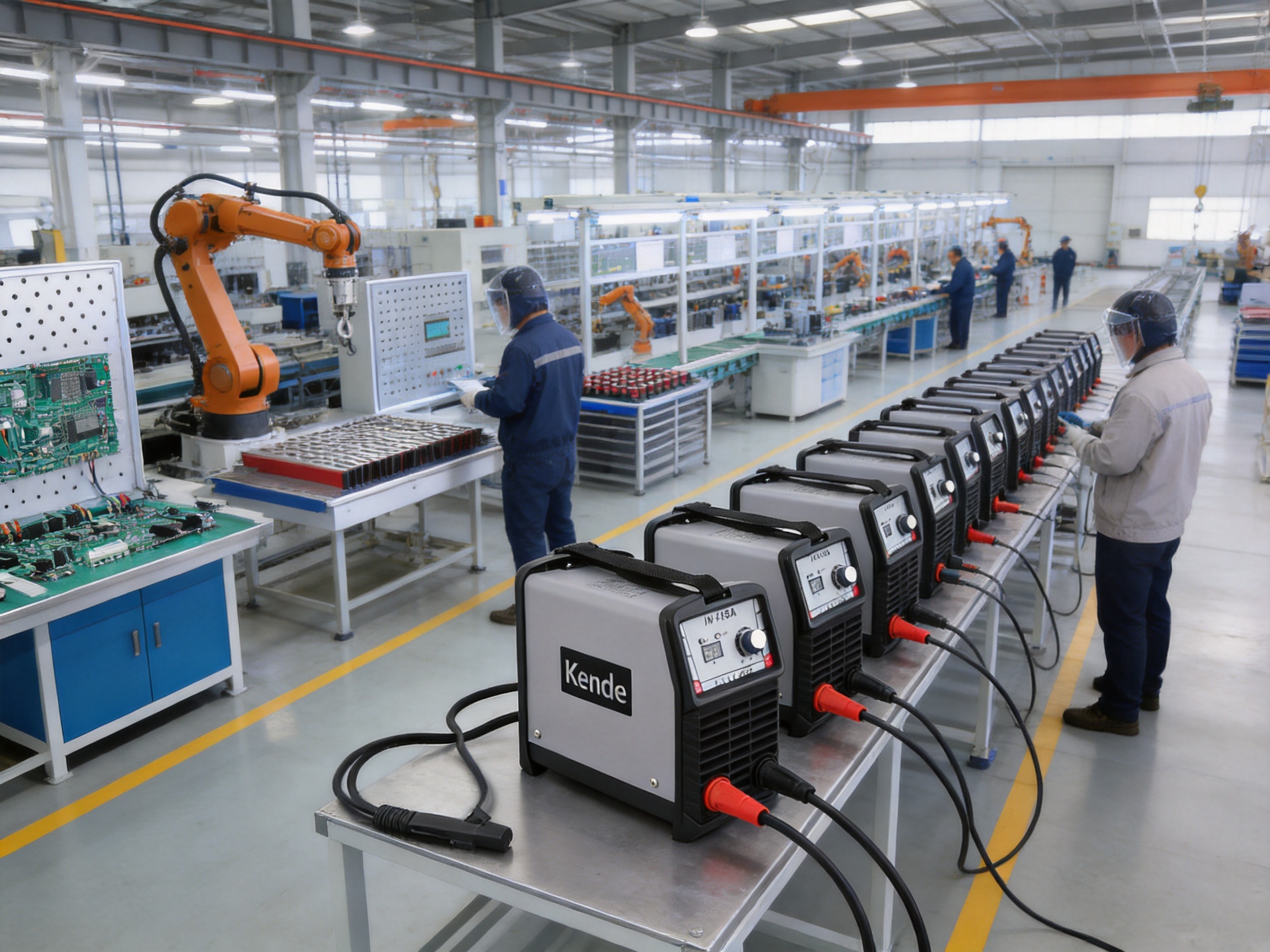
The performance of a welding machine depends on its design, components, assembly quality, inspection, and production consistency. Zhejiang Kende Mechanical & Electrical Co., Ltd. presents itself as an established manufacturer with substantial experience in welding equipment, chargers, and heaters.
The company is located in Taizhou, Zhejiang Province, China, and operates a facility covering approximately 120,000 square meters with around 600 employees. It reports annual exports of nearly 1.5 million units and annual production capacity of approximately 2 million units. These figures indicate a manufacturing organization capable of supporting large-volume production as well as multiple product categories.
The company reports a Zhejiang Provincial Research and Development Center, an Enterprise Technology Center, and an Intelligent Welding Technology Research Institute. It also reports a team of 98 research and development personnel.
These resources can support the development of inverter welding circuits, thermal-management systems, control software, enclosure structures, protection functions, and product variants for different markets. A broad engineering team is especially important for welding equipment because performance depends on the interaction of power electronics, mechanical design, electromagnetic compatibility, cooling, user controls, and safety requirements.
The company also reports multiple invention patents, utility model patents, appearance patents, and software copyrights. It states that it has obtained nearly 200 patents in total. Patent ownership alone does not guarantee product quality, but it indicates sustained investment in design and product development.
The manufacturer uses automatic patching, plug-in, and welding systems. Automated printed-circuit-board assembly can improve component placement accuracy and repeatability. Consistent soldering is important in inverter welding machines because power switches, control circuits, sensors, and protection components must operate reliably under heat and electrical stress.
Automated production also helps reduce variation between units. This is valuable when a product is manufactured in large quantities for international distribution. Process controls can support more consistent electrical characteristics, although final testing remains necessary to identify assembly defects or component problems.
Robot processing can be used for repeatable mechanical operations, while laser cutting can produce accurate enclosure parts and internal structural components. Precise sheet-metal processing helps create clean openings, mounting points, ventilation paths, and component supports.
Accurate enclosure construction also contributes to assembly efficiency and product appearance. More importantly, it can help ensure that fans, heat sinks, circuit boards, cable connections, and protective barriers are positioned consistently. Good mechanical design supports electrical safety and thermal performance.
The company reports the use of office automation, enterprise resource planning through K3, manufacturing execution systems, and Japan Toyota Production System management practices. These systems can connect purchasing, production planning, inventory, process tracking, quality management, and shipment control.
A manufacturing execution system can provide information about work orders, assembly stages, test results, and production status. Enterprise resource planning can help coordinate materials and customer orders. Lean production methods can reduce unnecessary movement, waiting time, excess inventory, and process variation.
For an international welding-machine supplier, organized production management is important because customers may require different input voltages, plugs, labels, certificates, manuals, packaging, and regional configurations. Structured systems help the manufacturer manage these variations more effectively.
The manufacturer reports product certifications and approvals including GS, CE, EMC, ERP, US ETL, UKCA, and China CCC across its product range. The exact certification applicable to a particular IN-155 model, market, and production batch should be confirmed in the supplied documentation.
The company also states that it is a national standard drafting unit of the National Welding Machine Standardization Committee and has participated in drafting, formulating, and revising 20 national standards, including leading the drafting of one group standard. Participation in standards work can provide valuable insight into technical requirements, testing methods, safety expectations, and industry development.
Customers should distinguish between a general company capability and the specific conformity documents supplied with an individual product. Importers and distributors should request the applicable declaration of conformity, test reports, rating label information, user instructions, and market-specific documentation before placing equipment into service.
In the competitive welding-equipment market, the IN-155 differentiates itself through a combination of portability, inverter control, input tolerance, arc-assistance functions, protection features, and large-scale manufacturing support. Competing products may offer one or more of these features, but the value of the IN-155 lies in how they are combined in a small and relatively light machine.
A conventional transformer machine may be robust and simple, but it is usually heavier and less convenient to transport. A basic inverter may be compact, but it may not offer the same combination of voltage tolerance, anti-stick, hot-start, arc-force control, and stated environmental protection. A larger industrial inverter may provide higher duty cycle and output, but it may be unnecessarily large for light fabrication and repair applications.
The most appropriate comparison therefore depends on the user’s needs. The IN-155 is competitive when the priorities are low weight, mobility, simple MMA operation, moderate output, and energy-conscious use. It is not intended to replace high-amperage industrial systems, automated welding cells, or specialized TIG, MIG/MAG, SAW, or laser welding equipment.
Reliability is supported by the use of IGBT power switches, automatic fault protection, insulation class H, structured production, and reported quality systems. Long-term service life will also depend on proper use. Excessive dust, blocked airflow, unstable generators, moisture, overloaded extension cables, careless handling, and operation beyond the duty cycle can reduce reliability regardless of the brand or design.
Before connecting the machine, inspect the housing, power cable, electrode holder, work clamp, welding cables, connectors, and ventilation openings. Do not use the product if the enclosure is damaged, if insulation is cut, or if a connector is loose or overheated.
Place the machine on a dry, stable, non-combustible surface. Maintain adequate clearance around ventilation openings. Do not cover the machine with cloth, plastic, cardboard, or other materials while it is operating. Keep the power source away from direct rain, standing water, corrosive chemicals, and excessive conductive dust.
Connect the work clamp firmly to clean metal. A poor work connection can create heat, unstable arc behavior, and poor welding results. Select electrode polarity according to the electrode manufacturer’s instructions. Some electrodes perform with direct current electrode positive, while others may require direct current electrode negative or a specified connection.
Set the current according to the electrode diameter and manufacturer’s recommended range. Begin with a conservative setting and adjust it based on arc behavior, penetration, bead shape, spatter, and the thickness of the material. Excessive current can cause undercut, excessive spatter, overheating, and burn-through. Insufficient current can cause sticking, poor fusion, and an irregular bead.
Strike the arc using a controlled tapping or scratching motion, depending on the electrode and operator preference. Maintain a suitable arc length, generally related to the diameter of the electrode core. Move at a consistent travel speed and angle. Remove slag between passes using appropriate tools, and inspect the weld for visible defects.
When the thermal protection activates, stop welding and allow the cooling system to reduce the internal temperature. Do not disconnect the machine immediately if the fan is still needed to dissipate heat. If protection activates repeatedly at a moderate current and normal ambient temperature, inspect ventilation, cables, supply voltage, and electrode selection, and arrange qualified service if necessary.
Regular maintenance helps preserve the performance of an inverter welding machine. Disconnect the equipment from the electrical supply before opening the enclosure or carrying out internal service. Internal repairs should be performed only by qualified personnel because capacitors and other components may retain hazardous voltage after the machine is switched off.
Inspect the case for cracks, deformation, missing fasteners, and signs of water or chemical exposure. Check the power plug and cable for cuts, heat damage, loose terminals, or exposed conductors. Examine the electrode holder and work clamp for worn jaws, damaged insulation, and poor contact surfaces.
Keep ventilation openings clear. Dust can accumulate on fans, heat sinks, circuit boards, and internal insulation. Conductive metallic dust is particularly undesirable because it may create leakage paths or short circuits. Cleaning should follow the manufacturer’s instructions and should be performed with the equipment isolated from the power supply.
Do not pull the welding machine by its cables. Coil cables without sharp bends and store them in a dry location. Replace damaged cables or connectors rather than attempting unsafe temporary repairs. Cable connections should be tight and clean because high-resistance connections generate heat and can reduce the effective welding current.
Store the IN-155 in a dry, clean environment protected from condensation and impact. If the machine has been moved from a cold area to a warm area, allow time for condensation to evaporate before connecting it to the supply. During transportation, protect the control panel, connectors, and ventilation openings from impact and contamination.
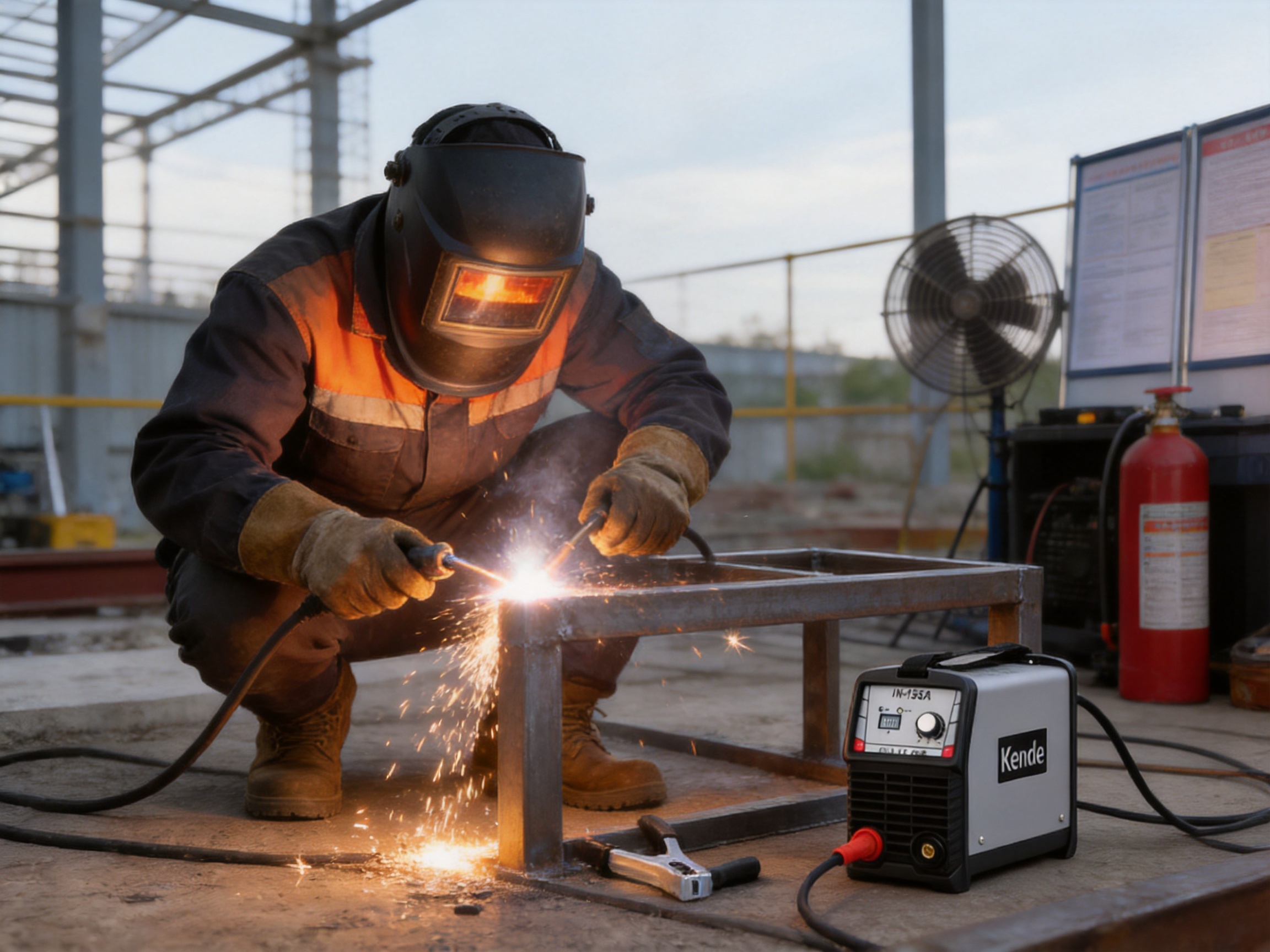
MMA welding creates intense ultraviolet and infrared radiation, hot metal, sparks, fumes, and electrical hazards. The operator should use a suitable welding helmet with the correct shade, flame-resistant clothing, welding gloves, safety footwear, and protection for exposed skin. Safety glasses should be worn under the helmet when chipping slag or grinding.
Ensure sufficient ventilation or use suitable local exhaust ventilation. Welding fumes can contain hazardous substances, particularly when coatings, galvanized materials, stainless steel, paints, degreasers, or contaminated surfaces are involved. Never weld containers, tanks, drums, or pipes that may have contained flammable or toxic materials unless they have been professionally cleaned, tested, and declared safe.
Remove combustible materials from the work area. Use fire-resistant screens to protect nearby personnel from arc flash. Check the opposite side of the workpiece and surrounding spaces for hidden combustible materials. Keep suitable fire-extinguishing equipment readily available and monitor the area after welding because hot slag can cause delayed fires.
Never touch the electrode or bare electrical connections with unprotected skin. Keep gloves and clothing dry. Do not weld in wet conditions or while standing in water. Disconnect the machine from the supply before changing internal components or carrying out repairs.
Users should also be aware of electromagnetic effects. People with implanted medical devices should consult a medical professional and follow the device manufacturer’s guidance before working near welding currents. Welding cables should be arranged close together where practical, and the work cable should be connected near the welding location.
The IN-155 is a strong choice for businesses that need a portable MMA power source for repair, installation, maintenance, and light fabrication. It can be especially useful for service companies, building contractors, agricultural operations, metalwork workshops, equipment rental providers, technical schools, and distributors serving household or professional users.
Before purchase, a business should evaluate the expected material thickness, electrode sizes, welding position, average welding duration, available supply voltage, generator compatibility, environmental conditions, and service requirements. If the work routinely requires electrodes larger than 2.5 millimeters, high current for long periods, or a high duty cycle, a larger model such as a higher-capacity member of the same product family may be more appropriate.
For distributors, the manufacturer’s broad product range can be an advantage. The company produces MMA, MIG/MAG, flux-cored, TIG, plasma-cutting, submerged-arc, stud-welding, battery-charging, and heating equipment. A distributor may therefore source related categories from one established manufacturing organization rather than managing separate suppliers for every product group.
Customization and regional adaptation may also be important. The company states that it can develop new products according to the requirements of different regions, countries, and customers. Buyers should discuss input voltage, plug type, language requirements, packaging, labels, certificates, spare parts, warranty arrangements, and minimum order quantities before finalizing a supply agreement.
The IN-155 is an MMA or stick welding machine. It uses consumable flux-coated electrodes and does not require an external shielding-gas cylinder for normal MMA operation.
It can be suitable for beginners when used under proper instruction. Anti-stick, hot-start, and arc-force functions can assist with arc initiation and stability. Beginners still need training in electrode selection, current adjustment, polarity, joint preparation, personal protective equipment, and fire prevention.
The supplied specification lists usable electrodes from 1.6 to 2.5 millimeters. Actual suitability depends on electrode type, material thickness, welding position, and the current recommended by the electrode manufacturer.
The product description states that it can weld carbon steel, alloy steel, cast iron, stainless steel, and other metals. The correct electrode, polarity, preheating, interpass temperature, cleaning, and cooling procedure must be selected for the specific material.
The technical table lists a maximum welding current of 120 amperes. It also lists a 20–80 ampere welding-current adjustment range for the IN-155. Buyers should confirm the rating label and official manual for the exact production version and applicable operating conditions.
A 35 percent duty cycle means the machine is not intended to weld continuously at the applicable rated condition throughout the full test period. The operator must provide cooling intervals according to the manual and the actual working conditions.
The product description states that it can work properly under approximately 130–270 volts, and the specification lists a nominal 230-volt supply with a plus-or-minus 15 percent tolerance. Even with this design feature, the electrical supply must be properly installed and protected.
No welding power source should be exposed unnecessarily to rain, standing water, or heavy spray. The supplied information identifies an IP21S protection class and describes resistance to moisture and water-related conditions. Users should follow the formal rating and manual rather than treating the unit as suitable for immersion or severe weather.
The IN-155 is identified as an MMA or stick welding machine. It should not be assumed to provide MIG/MAG or TIG functions unless those functions are explicitly stated on the product label and in the official documentation.
The listed net weight is 3.4 kilograms, and the dimensions are approximately 275 × 130 × 245 millimeters. This makes it convenient for mobile repair, service vehicles, small workshops, and work areas where a larger transformer machine would be difficult to move.
The product description identifies automatic over-current and over-temperature protection. It also identifies anti-stick, hot-start, and arc-force functions that support welding control and arc stability.
The machine is manufactured by Zhejiang Kende Mechanical & Electrical Co., Ltd., located in Taizhou, Zhejiang Province, China. The company produces welding machines, battery chargers, and electric, gas, and oil heaters for domestic and industrial markets.
Importers and distributors should verify the exact model, input voltage, plug configuration, conformity documents, applicable certifications, user manual, packaging, spare parts, warranty terms, labeling, and market-specific requirements. They should also confirm whether the documentation applies specifically to the IN-155 version being supplied.
The IN-155 IGBT Inverter MMA Welding Machine is designed around the needs of users who want a small, economical, and capable stick-welding power source. Its main strengths are its compact 3.4-kilogram format, IGBT inverter architecture, PWM constant-current control, broad stated voltage tolerance, long-cable capability, arc-assistance functions, automatic protection, and suitability for common ferrous and stainless-steel welding tasks.
Compared with conventional transformer machines, it offers significant advantages in portability, storage, energy use, and electronic control. Compared with very basic inverter welders, its combination of anti-stick, hot-start, arc-force, environmental-resistance claims, and production support provides a more complete feature set for general users.
The product should nevertheless be selected according to the actual workload. Its 35 percent rated duty cycle and listed 1.6–2.5 millimeter electrode range make it more appropriate for light and moderate welding than for continuous heavy industrial production. Users who need sustained high-current output should consider a larger welding power source.
The manufacturer’s extensive production capacity, research facilities, automated manufacturing equipment, management systems, reported certifications, and participation in standards development strengthen the product’s commercial position. These capabilities can support consistent production, regional customization, technical development, and international distribution.
For repair shops, contractors, maintenance departments, agricultural users, training centers, and mobile welders, the IN-155 represents a practical balance between output, portability, operating convenience, and manufacturing support. When operated within its technical limits and maintained correctly, it can serve as a flexible MMA welding solution for a wide variety of everyday metalworking applications.
1. Zhejiang Kende Mechanical & Electrical Co., Ltd., IN-155 and related inverter MMA welding machine technical specifications.
2. Zhejiang Kende Mechanical & Electrical Co., Ltd., company information concerning manufacturing capacity, research and development, production systems, and product certifications.
3. International Electrotechnical Commission, standards and guidance relating to arc-welding equipment, electrical safety, and welding power-source ratings.
4. International Organization for Standardization, standards and guidance relating to welding processes, welding consumables, quality control, and occupational safety.
5. General technical principles of manual metal arc welding, inverter power conversion, constant-current control, duty-cycle evaluation, and welding safety.
Recommended Products

Contact Us
No.2299, Luqiao Section, Shugang Avenue, Luqiao District, Taizhou, 318057 Zhejiang, PR China.
+86-576-82431568
 Privacy
China Welding Machine Factory
 English
 中文简体
 русский
 Español
 عربى
 Français
 Português
 Deutsch
 Український