Email: [email protected]
Email: [email protected]

Blog
 2026.08.15
 Blog
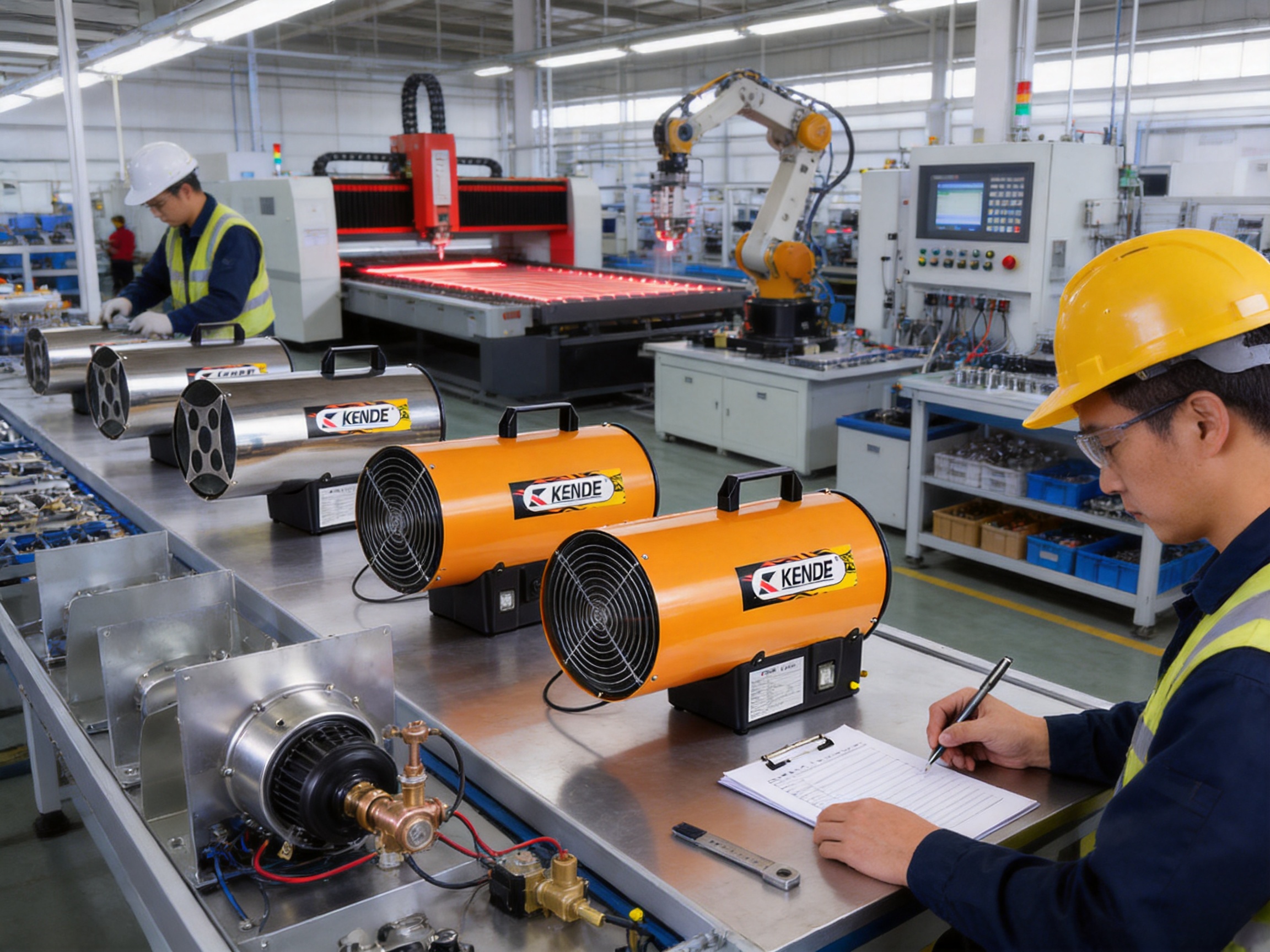
Portable LPG fan air heaters provide a practical solution for rapidly warming workshops, warehouses, construction areas, agricultural buildings, garages, temporary workspaces, and other locations where permanent heating systems are unavailable or impractical. By combining liquefied petroleum gas combustion with forced-air circulation, this type of heater delivers a strong stream of warm air almost immediately after ignition. It is especially useful in spaces that require direct heating, flexible positioning, and high thermal output without a complex installation.
The LPG/GAS fan air heater range supplied by Zhejiang Kende Mechanical & Electrical Co., Ltd. is designed around these requirements. The range includes six output classes from 10 kW to 50 kW, enabling users to select a suitable model for small work areas as well as large industrial or commercial spaces. The heaters use butane-propane gas, operate from a standard AC 220–240 V, 50 Hz single-phase power supply, and incorporate several automatic safety functions intended to reduce operational risks.
In addition to heating performance, the product range emphasizes portability, compact construction, simple operation, and dependable manufacturing quality. Its safety design includes automatic shutdown in the event of flame failure or internal overheating, automatic gas interruption following power failure, piezoelectric ignition, a copper push-rod valve, and a stainless-steel burner head. These features distinguish the heaters from basic portable heating devices that may provide heat but lack comparable protection, durability, or control.
An LPG fan air heater is a direct-fired heating appliance that uses liquefied petroleum gas as its fuel. The gas is supplied to a burner, where it is ignited to generate heat. An electric fan then draws surrounding air through the heater and pushes the heated air outward into the room. This forced-air principle allows the heater to warm a space much more quickly than passive convection equipment.
The heating process is direct and efficient because the combustion energy is transferred immediately to the moving air. There is no need to heat a large water circuit, thermal storage mass, radiator system, or duct network before useful warmth reaches occupants. The result is a compact appliance that can produce a high volume of heated air from a relatively small body.
These heaters are commonly used in areas where rapid temperature recovery is important. Examples include workshops with frequently opened doors, warehouses with high ceilings, building sites, maintenance areas, vehicle service facilities, agricultural structures, and temporary shelters. They can also be used for emergency heating or supplemental heating when an existing system cannot provide sufficient capacity.
Because LPG combustion consumes oxygen and produces combustion gases, direct-fired gas heaters must be used in accordance with applicable safety regulations and ventilation requirements. They are generally intended for appropriately ventilated spaces and should not be used in enclosed occupied areas unless the installation and operating conditions specifically permit it. A qualified user should always follow the product instructions, local gas regulations, and workplace safety requirements.
The product family includes the KEF-10/KED-10, KEF-12/KED-12, KEF-15/KED-15, KEF-17/KED-17, KEF-30/KED-30, and KEF-50/KED-50 models. The model pairings represent related heater configurations within the same output range. Their heating capacities extend from 10 kW to 50 kW, giving distributors, contractors, and end users a broad selection for different room sizes and heating demands.
The smallest models are suitable for relatively compact areas requiring fast local heating. Medium-capacity models offer additional output for larger workshops, storage areas, and work zones. The 30 kW and 50 kW models are intended for substantially larger spaces, where a higher volume of warm air is necessary to overcome heat loss through open doors, poor insulation, high ceilings, or cold external conditions.
| Model | Heat Output | Fuel Consumption | Air Output | Recommended Heating Space | Weight |
|---|---|---|---|---|---|
| KEF-10/KED-10 | 10 kW / 8,600 kcal/h | 727 g/h | Not specified | 240 m³ | 4.8 kg |
| KEF-12/KED-12 | 12 kW / 10,320 kcal/h | 875 g/h | 500 m³/h | 285 m³ | 4.8 kg |
| KEF-15/KED-15 | 15 kW / 12,900 kcal/h | 1,200 g/h | 500 m³/h | 345 m³ | 4.8 kg |
| KEF-17/KED-17 | 17 kW / 14,620 kcal/h | 1,240 g/h | 580 m³/h | 360 m³ | 6.2 kg |
| KEF-30/KED-30 | 30 kW / 25,800 kcal/h | 2,050 g/h | 580 m³/h | 660 m³ | 6.2 kg |
| KEF-50/KED-50 | 50 kW / 43,000 kcal/h | 3,640 g/h | 1,000 m³/h | 1,050 m³ | 7 kg |
The listed heating-space figures provide a practical starting point for model selection, but actual performance depends on many factors. These include insulation, outdoor temperature, ceiling height, the number of doors and windows, ventilation, the desired indoor temperature, and the amount of heat produced by machinery or occupants. For demanding applications, users should evaluate the complete heat-loss conditions rather than relying only on room volume.
One of the most important advantages of a fan-assisted LPG heater is its ability to deliver warm air rapidly. The burner produces heat directly, while the fan distributes that heat across the space. This approach reduces the waiting time associated with slower heating methods and makes the appliance suitable for workplaces that need warmth shortly after startup.
Rapid air delivery is particularly useful in areas with intermittent occupancy. A workshop may only need heating during working hours, while a construction team may require warmth at the beginning of a shift. Instead of maintaining a building at a high temperature continuously, operators can start the heater when needed and obtain useful heat quickly.
The larger models provide substantial air movement for spaces with greater heat loss. The KEF-50/KED-50 model, for example, is specified with an air output of 1,000 cubic meters per hour and a nominal heat output of 50 kW. This combination is intended to support large-volume heating applications where a small domestic heater would be unable to circulate warmth effectively.
Forced-air heating also allows the user to direct warmth toward a particular work zone. When correctly positioned, the appliance can improve comfort in areas where employees or equipment are located instead of attempting to heat every part of a large building equally. This can reduce unnecessary energy use in facilities with localized heating requirements.

LPG/GAS FAN AIR HEATER
The heaters are designed for G30/G31 butane-propane gas. LPG is widely available in many markets and can be supplied using compatible cylinders or regulated gas systems. Compared with electric resistance heating, LPG can provide high thermal output without requiring a very large electrical supply. This is valuable in industrial locations where the available electrical infrastructure is limited or where a high-power electric heater would overload existing circuits.
Every model operates from AC 220–240 V at 50 Hz through a single-phase supply. Electricity is used to drive the fan and support the ignition and control functions, while LPG provides the main heating energy. This arrangement creates a balance between electrical simplicity and high thermal capacity.
The listed fuel consumption ranges from 727 grams per hour for the 10 kW model to 3,640 grams per hour for the 50 kW model. Actual consumption can vary according to gas pressure, ambient conditions, regulator performance, burner condition, and operating duration. Users should select suitable cylinders, hoses, regulators, and gas connections based on the required flow rate and all relevant local standards.
The specified gas pressure is 300 mbar for the 10 kW and 12 kW models, 500 mbar for the 15 kW and 17 kW models, and 1,500 mbar for the 30 kW and 50 kW models. These requirements are important during installation. A heater should never be connected to an unsuitable gas source or operated without the correct regulator. Proper gas pressure supports stable combustion, consistent heat output, and safe operation.
Safety is a central feature of the product design. Gas-fired appliances require reliable control of ignition, combustion, fuel flow, and operating temperature. The heater range includes multiple protective functions intended to respond automatically when an abnormal condition occurs.
If the flame is accidentally extinguished, the heater is designed to shut down automatically. This function helps prevent unburned gas from continuing to enter the combustion area. Flameout protection is particularly important in environments where air movement, unstable gas supply, or accidental contact could interrupt the flame.
Automatic shutdown provides an additional layer of protection beyond the operator’s attention. Although users should still monitor the appliance and investigate any shutdown, the system is designed to react promptly to a loss of flame rather than relying entirely on manual intervention.
The internal overheating protection function is designed to stop the machine automatically if its internal temperature rises beyond a safe operating range. Overheating may occur if airflow is obstructed, the heater is positioned too close to another object, the fan is impaired, or accumulated dust affects ventilation.
This protective function supports equipment longevity as well as user safety. Preventing excessive internal temperatures can reduce stress on electrical components, insulation, wiring, and other parts. Operators should nevertheless keep the air inlet and outlet clear and should not treat automatic protection as a substitute for correct installation or maintenance.
In the event of a power failure, the heater incorporates automatic gas cut-off protection. This feature is intended to prevent accidental gas leakage when the fan and electrical controls are no longer operating. Cutting the gas supply during a loss of electrical power helps ensure that a temporary interruption does not create an uncontrolled fuel flow.
This function is especially useful in workshops, construction environments, and commercial facilities where power interruptions may occur. It contributes to safer restart procedures because the operator can inspect the unit and restore power before relighting the heater.
Piezoelectric ignition provides a convenient method of starting the burner without requiring an external flame. A mechanical ignition action creates an electrical spark, which ignites the gas-air mixture at the burner. This simplifies startup and avoids the need to use matches or separate ignition tools near the gas outlet.
Reliable ignition also supports repeatable operation. When the gas supply and pressure are correct, the operator can start the heater using the built-in ignition system and then confirm that the flame is stable before leaving the appliance to operate under supervision.
The push-rod type copper valve is designed to provide dependable control of the gas supply. Copper is commonly selected for gas-handling components because of its corrosion resistance and suitability for many gas applications. The valve’s mechanical design supports straightforward operation and helps provide consistent fuel control.
Valve quality is important because it affects ignition, flame stability, shutdown, and long-term reliability. A well-designed valve must work together with the regulator, hose, burner, and safety controls as part of a complete gas system. Routine inspection remains necessary to identify wear, contamination, or damage.
The stainless-steel burner head is designed to withstand high temperatures and resist corrosion. The burner is exposed to repeated heating and cooling cycles, combustion gases, and possible environmental contaminants. A heat-resistant stainless-steel construction can help preserve structural integrity and support a longer service life than less suitable materials.
The burner head also contributes to flame distribution and combustion stability. Its condition should be checked during maintenance because blocked or damaged burner openings may affect flame quality and heating performance.
Portable LPG fan air heaters compete with several categories of heating equipment, including electric fan heaters, passive gas heaters, oil-fired heaters, infrared heaters, and permanently installed central systems. Each technology has suitable applications, but the LPG fan air heater offers a combination of portability, high output, quick response, and relatively modest electrical requirements.
Electric fan heaters are convenient and clean at the point of use, but their output is limited by the available electrical supply. A high-output electric unit may require a substantial current, three-phase power, or dedicated wiring. In contrast, the LPG fan air heater uses electricity mainly for the fan and controls while obtaining most of its thermal energy from gas.
This makes LPG models attractive in workshops, remote work areas, and temporary facilities where a high-capacity electrical connection is unavailable. The 30 kW and 50 kW models in particular would be difficult to match with ordinary single-phase electric resistance heaters without significant electrical infrastructure.
Passive gas heaters rely mainly on natural convection or radiant heat. They may be suitable for small areas, but they generally distribute warmth more slowly and may not move heat effectively through a large or tall space. A fan-assisted design actively circulates heated air, helping to reduce temperature differences and warm a working area more rapidly.
The fan also allows the heater to support a more directional heating strategy. Operators can position the unit to send warm air toward a workbench, assembly area, service bay, or other target zone, provided that the required clearances and safety conditions are maintained.
Diesel and kerosene heaters are widely used for high-output heating, but fuel availability, odor, maintenance, and combustion characteristics may differ by application. LPG is a convenient alternative in markets where propane and butane cylinders are readily accessible. The LPG heater’s compact size and low weight can also simplify handling and transportation.
The choice between LPG and oil depends on the application, local fuel prices, ventilation conditions, storage arrangements, and user preference. The LPG range provides a practical option for customers seeking direct-fired heat without adopting a heavier oil-fueled system.
Permanent heating installations can provide excellent comfort, but they often require engineering, construction work, ducting, flues, fuel storage, and a long installation period. A portable LPG fan air heater can be deployed with considerably less preparation. It is suitable for temporary buildings, rental premises, changing work areas, seasonal operations, and emergency use.
Portability also provides operational flexibility. A company may use the same heater in different areas at different times rather than installing separate heating systems for each location. This can be beneficial for contractors, equipment rental companies, maintenance teams, and businesses with changing space requirements.
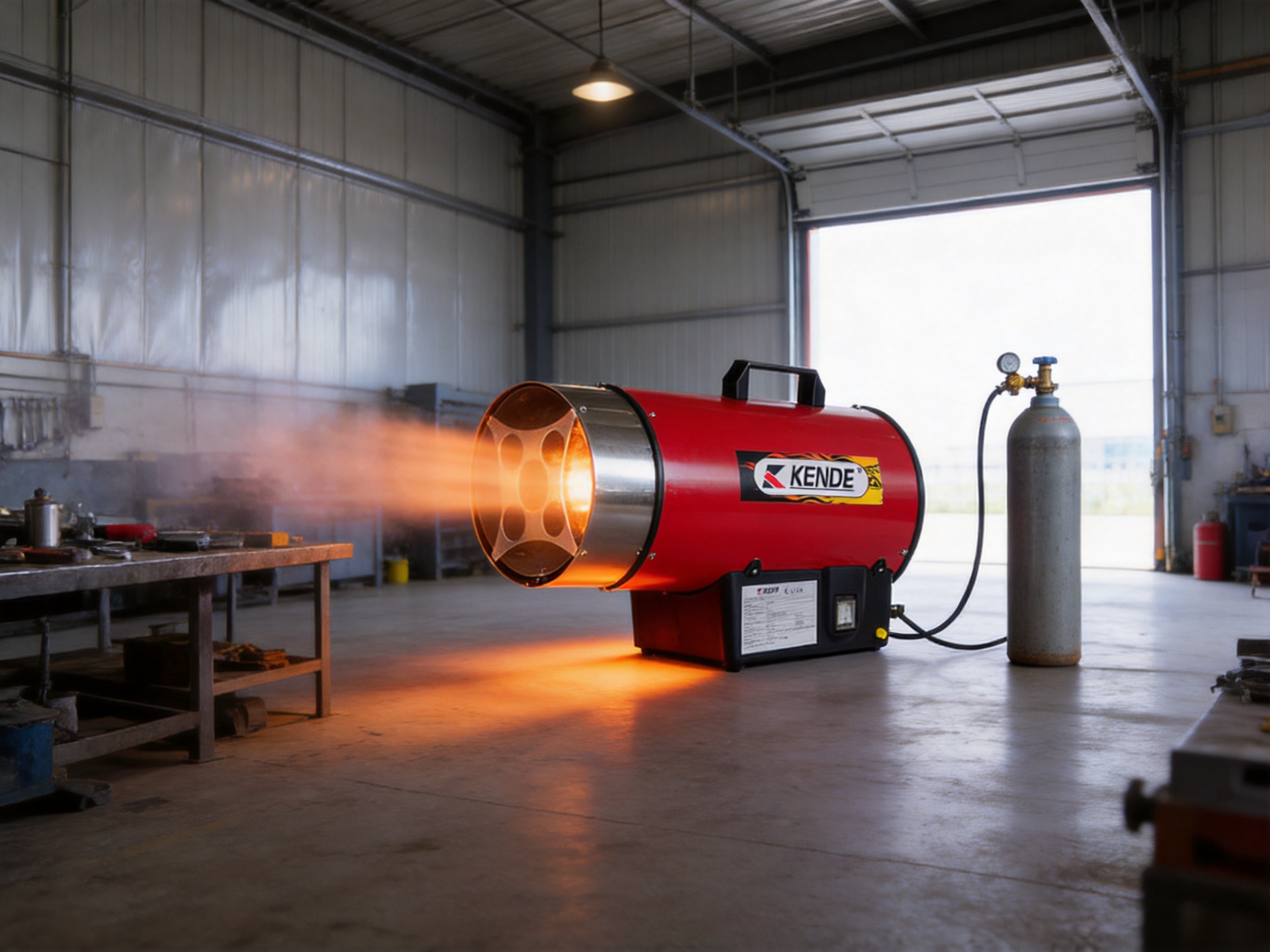
Portability is one of the defining characteristics of this product range. The listed weights are between 4.8 kg and 7 kg, depending on the model. Even the highest-output model remains relatively light for a 50 kW direct-fired heater. Compact dimensions further simplify transport, storage, and positioning.
| Model Group | Dimensions | Protection Class | Electrical Supply | Gas Type |
|---|---|---|---|---|
| KEF-10/KED-10, KEF-12/KED-12, KEF-15/KED-15 | 435 × 230 × 325 mm | IPX4 | AC 220–240 V, 50 Hz, single phase | G30/G31 butane-propane |
| KEF-17/KED-17, KEF-30/KED-30 | 490 × 230 × 325 mm | IPX4 | AC 220–240 V, 50 Hz, single phase | G30/G31 butane-propane |
| KEF-50/KED-50 | 560 × 230 × 325 mm | IPX4 | AC 220–240 V, 50 Hz, single phase | G30/G31 butane-propane |
The compact rectangular form helps the heater fit into workshops, storage rooms, service areas, and temporary facilities where floor space is limited. Users can move the appliance to a new location as work requirements change. The relatively low weight also reduces the physical effort needed for transportation, although safe lifting practices should always be followed.
The IPX4 protection classification indicates protection against water splashing from different directions under defined test conditions. It does not mean that the heater is waterproof or suitable for exposure to heavy rain, immersion, flooding, or direct water jets. Operators should protect the appliance from unsuitable weather and should never operate it in a wet condition that could endanger the electrical components or fuel system.
Zhejiang Kende Mechanical & Electrical Co., Ltd. is an established manufacturer and exporter of welding machines, battery chargers, heaters, and related equipment. The company operates from Taizhou, Zhejiang Province, and has developed a large manufacturing organization serving both domestic and international markets.
The company covers approximately 120,000 square meters and employs about 600 people. Its reported annual production capacity is approximately two million units, with exports approaching 1.5 million units each year. This scale provides important advantages for heater production, including established supply-chain management, repeatable assembly processes, production planning, quality systems, and access to experienced engineering personnel.
Large-scale manufacturing is valuable for portable heaters because consistent quality depends on more than the design of the burner or housing. The fan, motor, gas valve, ignition mechanism, electrical wiring, thermal protection, sheet-metal components, fasteners, and packaging must all be assembled correctly. A mature production organization can coordinate these elements while maintaining model consistency across large quantities.
The company maintains a Zhejiang Provincial Research and Development Center, an Enterprise Technology Center, and an Intelligent Welding Technology Research Institute. It has approximately 98 research and development personnel and has obtained invention patents, utility model patents, appearance patents, and software copyrights.
Although the company is widely known for welding equipment, its experience with electrical controls, motors, thermal systems, metal fabrication, power electronics, and industrial product design is also relevant to gas heater development. A heater requires the integration of mechanical, electrical, thermal, and safety engineering. Experience across these disciplines can support practical product improvements and efficient manufacturing.
The company also states that it can develop new products according to the requirements of different regions, countries, and customers. This capability may be valuable for distributors who require specific voltage configurations, packaging arrangements, labeling, accessories, certifications, or market adaptations, subject to technical feasibility and applicable regulations.
The company applies automated and digitally supported manufacturing systems, including automatic surface-mount placement, plug-in and welding systems, robot processing, laser cutting, and other advanced production technologies. These systems can improve repeatability, reduce manual variation, and support consistent component placement and metal fabrication.
Laser cutting is particularly useful for heater housings, brackets, ventilation openings, and other sheet-metal components. Accurate cutting supports proper fit, stable assembly, and clean external appearance. Robot processing can improve productivity in repetitive operations, while automated electronic assembly can support consistent control-board production where applicable.
The company also uses OA office automation, Toyota TPS management principles, ERP K3, and MES management systems. These systems support production planning, materials management, process tracking, inventory control, and manufacturing data collection. When applied effectively, such systems help manufacturers coordinate high-volume production while maintaining visibility across different stages of the process.
The company holds or works with international product certifications including GS, CE, EMC, ERP, US ETL, UKCA, and China CCC across its product portfolio. Certification requirements vary by product, model, destination market, and applicable standard, so buyers should confirm the exact approvals available for the specific heater configuration they intend to purchase.
Experience with international certifications is valuable for exporters and distributors because market access often requires technical documentation, electrical safety evaluation, electromagnetic compatibility testing, energy-related compliance, labeling, and traceability. A manufacturer familiar with these procedures can provide stronger support during product selection and import preparation.
The company is also identified as a national standard drafting unit associated with China’s Welding Machine Standardization Committee and has participated in the drafting, formulation, and revision of numerous national standards. While this activity is primarily connected with welding equipment, it reflects a broader familiarity with technical standards, regulatory processes, engineering documentation, and product compliance.
Workshops often have large doors, metal structures, high ceilings, and frequent movement between indoor and outdoor areas. These conditions can cause substantial heat loss. A portable LPG fan heater can provide focused warmth near workstations and help restore a comfortable temperature after doors are opened.
Maintenance facilities can benefit from the heater’s mobility. The unit may be moved between vehicle bays, repair areas, storage zones, and temporary service locations. Its compact dimensions help it remain practical in spaces where permanent heating equipment could interfere with machinery or vehicle movement.
Warehouses frequently require heating for personnel rather than for stored goods. A portable heater can be positioned near packing stations, loading zones, inspection areas, or maintenance points. The higher-output models may assist with general temperature recovery in larger storage spaces, while smaller models can provide localized warmth.
Operators should carefully consider ventilation, combustible materials, cylinder placement, and clearance requirements in warehouses. The heater must not be placed near flammable liquids, dust-producing operations, paper goods, packaging, or other materials that could be affected by heat or open combustion.
Construction projects often involve temporary structures and changing room layouts. A portable LPG fan air heater can be transported between buildings or work areas as the project progresses. It may support worker comfort in temporary workshops, drying areas, enclosed construction zones, or site offices where permitted by local safety requirements.
Construction environments can be dusty and physically demanding, so routine inspection is important. Air inlets, fan guards, burner openings, hoses, and electrical connections should be kept clean and protected from impact. The appliance should be placed on a stable surface away from traffic paths and materials that could obstruct airflow.
Agricultural buildings, equipment sheds, utility rooms, and seasonal work areas may need temporary or supplemental heating. LPG is often convenient in rural locations because cylinders can be transported and stored according to local requirements. The heater’s high air movement can be helpful in larger structures, but ventilation and fire safety remain essential.
Equipment rental businesses and event service providers can use portable heaters to meet short-term demand. The compact design, multiple output ratings, and standard electrical supply make the range suitable for a variety of temporary heating requirements. Emergency response teams may also value equipment that can be rapidly moved and deployed, provided that trained personnel manage the fuel and ventilation requirements.
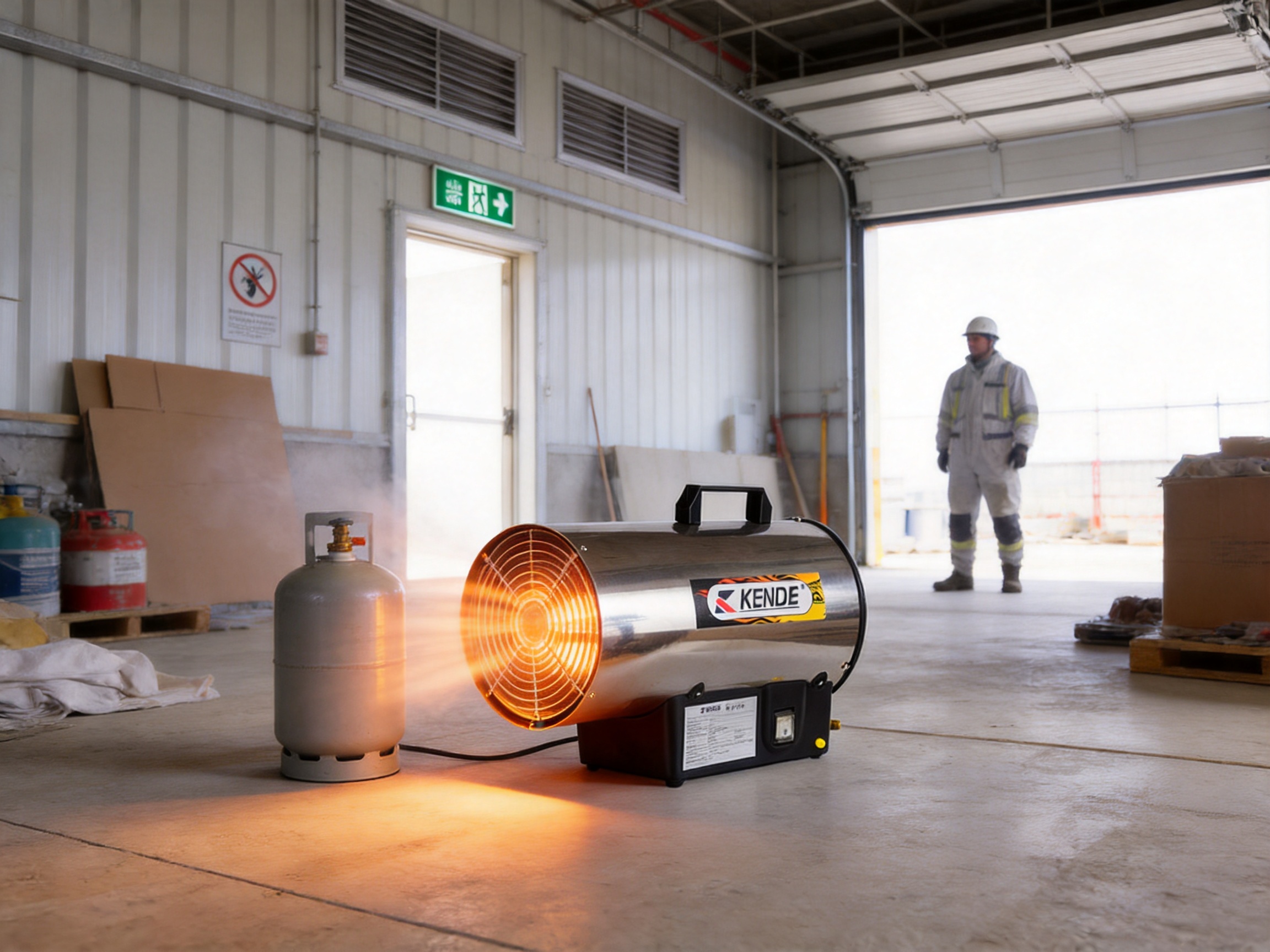
Correct installation is essential for safe performance. The heater should be placed on a stable, level, non-combustible surface. Adequate clearance must be maintained around the air inlet, warm-air outlet, sides, and rear of the appliance. The warm-air stream should not be directed at walls, cylinders, curtains, packaging, fuel containers, or other combustible objects.
The gas cylinder or supply system must be compatible with G30/G31 butane-propane gas and the specified operating pressure. Hoses, regulators, connectors, and seals should be approved for LPG service and inspected before every use. Users should not improvise connections or combine components that are not rated for the required pressure and gas type.
Before ignition, the operator should check the heater body, electrical cable, plug, gas hose, valve, regulator, and burner area. Any smell of gas requires immediate attention. The gas supply should be closed, ignition sources should be avoided, and the area should be ventilated in accordance with local safety procedures. The heater should not be operated until the cause has been identified and corrected by a qualified person.
Ventilation is necessary because direct-fired combustion affects the air in the room. Adequate fresh-air exchange helps supply oxygen and reduce the accumulation of combustion by-products. The precise ventilation requirement depends on the room, output, occupancy, local regulations, and installation method. Users should consult the operating instructions and qualified heating professionals when determining whether a particular location is suitable.
The appliance should never be left unattended in an unsafe environment. Children and unauthorized persons should not operate it. The heater should be switched off and the gas supply closed when it is not required, during maintenance, or before it is transported.
Regular maintenance helps preserve heating performance, fuel efficiency, and safety. Dust and debris should be removed from the fan inlet, outlet grille, exterior surfaces, and burner area. The cleaning procedure should follow the manufacturer’s instructions, and electrical parts should be protected from water and unsuitable cleaning agents.
The burner head should be inspected for contamination, corrosion, deformation, or blocked openings. A damaged burner can cause unstable combustion, poor ignition, excessive soot, or reduced heating output. The gas hose and connections should be checked for cracks, abrasion, hardening, loose fittings, or other signs of deterioration.
The fan should operate smoothly without unusual noise or vibration. Reduced airflow may indicate an obstruction, damaged fan component, motor problem, or overheating condition. Because airflow is essential to both heating performance and internal temperature control, operators should address fan problems promptly.
Safety devices should not be bypassed, removed, or modified. If the heater repeatedly shuts down because of flameout or overheating protection, the user should not continue resetting it without investigation. Repeated shutdown may indicate insufficient gas pressure, poor ventilation, blocked airflow, burner contamination, faulty ignition, or another condition requiring professional service.
At the end of a heating season or extended storage period, the heater should be cleaned, inspected, and stored in a dry, protected area. The gas supply should be disconnected according to the applicable procedure, and the appliance should be protected from impact, moisture, corrosive substances, and extreme contamination.
Model selection should begin with the required heat output. The 10 kW, 12 kW, and 15 kW models are appropriate starting points for smaller spaces, although the actual requirement depends on heat loss. The 17 kW model provides additional capacity for areas with greater volume or more significant air exchange. The 30 kW and 50 kW units are intended for large spaces and demanding heating conditions.
Room volume is useful for initial comparison, but it is not the only selection factor. A well-insulated 300-cubic-meter room may require less heating than a poorly insulated 200-cubic-meter workshop with open doors. Cold external temperatures, building materials, ceiling height, ventilation, and target temperature should all be evaluated.
Fuel logistics are equally important. Buyers should confirm that suitable G30/G31 gas is available, that cylinders can supply the required consumption rate, and that the correct regulator and hose system can be obtained. A high-output model may require a larger or more capable gas supply arrangement than a small model.
Users should also consider portability, air output, storage limitations, electrical access, noise tolerance, operating duration, and local certification requirements. Distributors should verify the target country’s rules before importing or selling a specific configuration.
For professional users, the value of a heater extends beyond its rated output. Product availability, replacement parts, technical support, consistent specifications, packaging quality, and production continuity can have a major effect on the total cost of ownership.
A manufacturer with substantial production capacity can support larger orders and repeat purchasing programs more effectively than a small workshop with limited assembly resources. This is important for distributors that need stable supply across multiple seasons or for rental companies that require several matching units.
Manufacturing scale can also support quality improvement. Production data collected through ERP and MES systems may help identify recurring issues, control component usage, and improve process consistency. Automated metal processing and electronic assembly can reduce variations that might otherwise affect fit, appearance, or functional reliability.
Research and development capacity adds another advantage. Markets differ in climate, fuel systems, electrical standards, documentation requirements, and customer preferences. An experienced manufacturer may be better positioned to adapt products, improve components, prepare technical documents, or develop related heating solutions for specific applications.
The heater range is suitable for distributors seeking a selection of output classes under one product family. Offering multiple capacities allows a distributor to serve homeowners, workshops, contractors, warehouses, and industrial users without sourcing every model from a different supplier.
OEM and private-label customers may also benefit from working with a manufacturer that has experience in product development, international exports, and certification processes. Possible areas of cooperation may include packaging, manuals, labels, model identification, accessories, regional electrical configurations, and customized product programs, subject to agreement and technical evaluation.
For importers, the company’s broader product portfolio can simplify supplier management. Welding machines, battery chargers, electric heaters, gas heaters, oil heaters, and related equipment may be consolidated within one manufacturing relationship. This can help distributors build a broader catalog while coordinating purchasing, inspection, shipping, and documentation more efficiently.
Efficient heating begins with correct sizing. An oversized heater operated continuously in a small space may waste fuel and create uncomfortable conditions, while an undersized unit may run continuously without reaching the desired temperature. Choosing the correct output and using the heater only when necessary can improve overall operating efficiency.
Building improvements can also reduce fuel consumption. Closing unnecessary doors, repairing gaps, improving insulation, and separating heated work zones from unoccupied areas can reduce heat loss. Positioning the heater to support air circulation without blocking the warm-air outlet can help distribute heat more evenly.
Operators should avoid using the heater as a substitute for proper building ventilation or fire protection. The appliance is a heating tool, not a general-purpose drying or combustion device. It should not be used to dry clothing, ignite materials, heat sealed containers, or operate in conditions outside the approved application range.
The heater is designed for G30/G31 butane-propane gas, commonly referred to as LPG. The gas supply must use compatible components and the pressure specified for the selected model.
All listed models use AC 220–240 V, 50 Hz, single-phase power. Electricity operates the fan, ignition, and control functions, while LPG supplies the primary heating energy.
The range includes six output classes: 10 kW, 12 kW, 15 kW, 17 kW, 30 kW, and 50 kW. Each class is identified by a KEF/KED model pairing.
As a direct-fired fan heater, it is designed to provide warm air shortly after ignition. The exact warm-up experience depends on gas pressure, ambient temperature, room conditions, airflow, and the selected model.
The product information specifies automatic shutdown for accidental flameout, automatic shutdown for internal overheating, automatic gas cut-off during power failure, piezoelectric ignition, a copper push-rod valve, and a stainless-steel burner head.
No. Direct-fired LPG heating requires appropriate ventilation and compliance with local regulations. The suitability of a particular room depends on its size, occupancy, ventilation, output requirement, and applicable safety rules.
The listed heating-space figures indicate that the 12 kW model is rated for approximately 285 cubic meters, while the 15 kW model is rated for approximately 345 cubic meters. However, insulation, climate, ventilation, and heat loss should be considered before making a final selection.
The KEF-50/KED-50 model is specified with a heat-air output of 1,000 cubic meters per hour and a nominal heat output of 50 kW.
Yes. The range has compact dimensions and listed weights from 4.8 kg to 7 kg. This supports movement between work areas, although the appliance should be switched off, cooled, and disconnected from the gas supply before transport.
IPX4 indicates protection against water splashes from different directions under defined test conditions. It does not mean that the heater is waterproof, suitable for immersion, or safe to operate in heavy rain or flooded conditions.
Repeated shutdowns should be treated as a warning. The user should stop operation and check for blocked airflow, poor ventilation, incorrect gas pressure, burner contamination, ignition problems, or other faults. Safety devices must never be bypassed.
The company states that it can develop new products according to the requirements of different regions, countries, and customers. Specific customization options should be discussed directly with the manufacturer and confirmed through technical and commercial documentation.
The company manufactures and exports welding machines, battery chargers, electric heaters, gas heaters, oil heaters, and related equipment. Its products serve industrial, commercial, domestic, construction, maintenance, and other applications.
The LPG/GAS fan air heater range offers a practical combination of fast heating, high thermal output, portability, and integrated safety protection. With models from 10 kW to 50 kW, users can select equipment for compact work areas, medium workshops, warehouses, construction facilities, and larger industrial spaces.
Its advantages include direct warm-air delivery, low electrical infrastructure requirements, compatibility with G30/G31 butane-propane gas, compact dimensions, and a range of automatic protective functions. Flameout shutdown, overheating protection, power-failure gas cut-off, piezoelectric ignition, a copper valve, and a stainless-steel burner head contribute to safe and reliable operation when the heater is installed and used correctly.
The manufacturing capabilities of Zhejiang Kende Mechanical & Electrical Co., Ltd. further strengthen the product offering. The company combines substantial production capacity with research and development resources, automated manufacturing technologies, digital management systems, international export experience, and a broad industrial product portfolio. These strengths can benefit end users seeking dependable equipment as well as distributors and OEM customers requiring stable supply and technical cooperation.
As with all direct-fired LPG appliances, safe ventilation, correct fuel pressure, suitable installation, regular inspection, and compliance with local regulations are essential. When these requirements are respected, a portable LPG fan air heater can provide an efficient and flexible source of rapid warmth for a wide range of professional and commercial applications.
1. Product specification data for the LPG/GAS fan air heater range, including model capacities, fuel consumption, airflow, dimensions, weights, gas type, and protection classification.
2. Manufacturer-provided product safety features for LPG fan air heaters, including flameout shutdown, overheating shutdown, power-failure gas cut-off, piezoelectric ignition, copper valve construction, and stainless-steel burner design.
3. General principles of liquefied petroleum gas appliance operation, ventilation, combustion safety, and fuel-system maintenance.
4. General guidance for portable direct-fired heaters used in workshops, warehouses, construction environments, agricultural buildings, and temporary facilities.
5. Manufacturer information concerning production capacity, research and development resources, manufacturing technologies, management systems, export experience, and product certification capabilities.
Recommended Products

Contact Us
No.2299, Luqiao Section, Shugang Avenue, Luqiao District, Taizhou, 318057 Zhejiang, PR China.
+86-576-82431568
 Privacy
China Welding Machine Factory
 English
 中文简体
 русский
 Español
 عربى
 Français
 Português
 Deutsch
 Український