Email: [email protected]
Email: [email protected]

Blog
 2026.10.06
 Blog
Modern welding users increasingly need equipment that combines portability, dependable arc performance, simple operation, and low operating cost. Large industrial welding systems remain essential for heavy fabrication, but many repair technicians, maintenance teams, small workshops, agricultural users, construction workers, and serious home fabricators require a more compact solution. The MIG-120 is designed for this practical operating environment. It is a mini portable gasless flux-cored MIG welding machine with a 220/230 V supply, a welding current range of 50–120 A, and a compact body weighing approximately 5 kg.
The machine uses advanced inverter and microcomputer control technology to deliver controlled welding performance in a small package. Its powerful insulated-gate bipolar transistor, or IGBT, switching system works with pulse-width modulation control to convert and regulate electrical power efficiently. The result is a welding platform that is easier to transport than traditional transformer machines while providing the fast response, stable output, and energy-saving characteristics expected from modern inverter equipment.
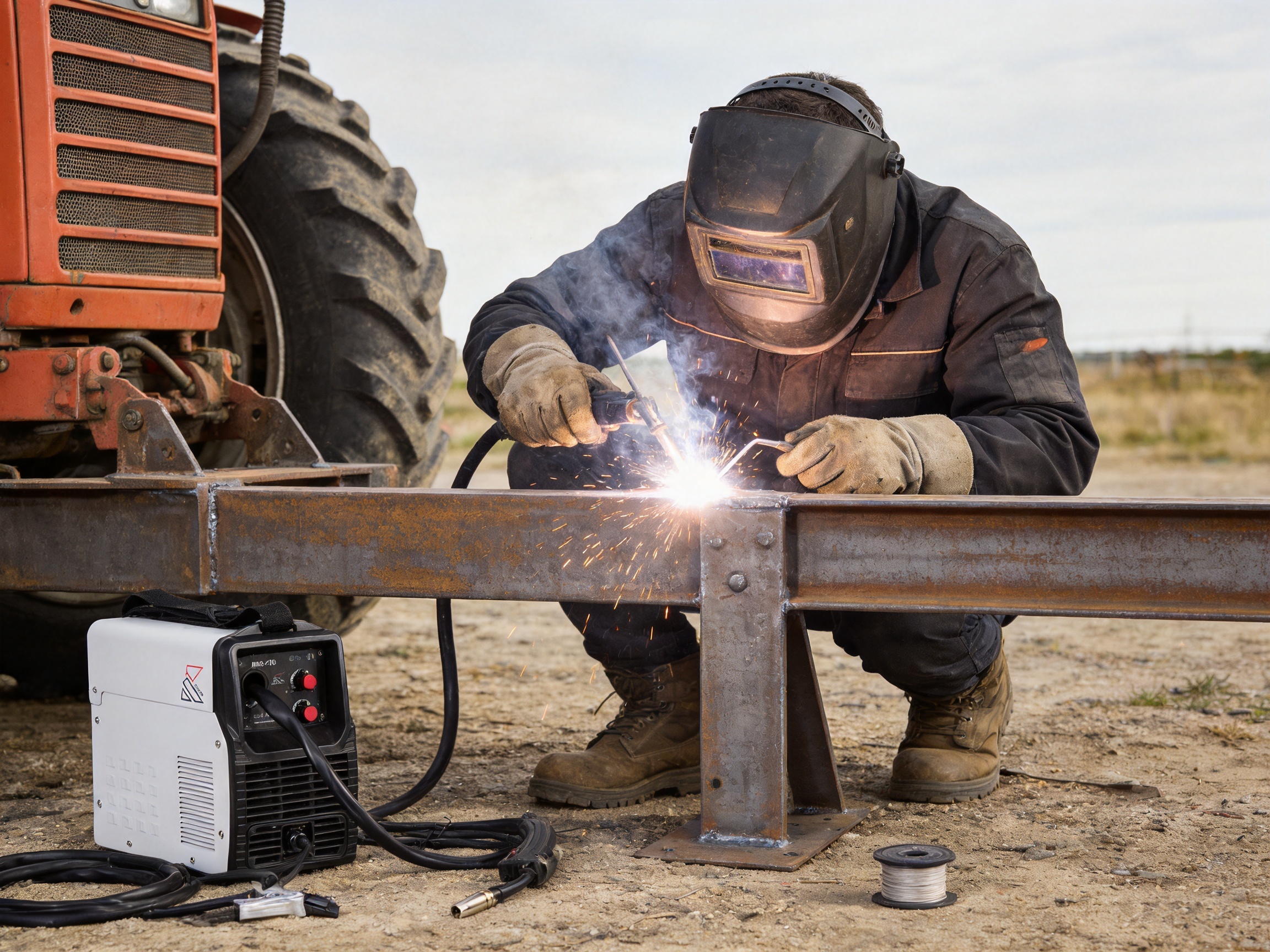
One of the product’s most important advantages is its no-gas flux-cored welding capability. The operator can weld with flux-cored wire without carrying a shielding-gas cylinder, regulator, hose, or separate gas supply. This makes the machine especially suitable for outdoor repairs, mobile service work, agricultural maintenance, small construction tasks, and locations where wind could disturb external shielding gas. The machine can weld carbon steel, alloy steel, and other compatible materials when the correct wire, polarity, settings, and preparation procedures are used.
Although compact, the MIG-120 is not limited to occasional light-duty use. It incorporates constant-voltage output control, protection against over-current and overheating, useful wire compatibility from 0.6 to 1.0 mm, and a rated duty cycle of 25 percent. Its combination of 50–120 A output and 20 V rated welding voltage supports a broad range of thin and medium-gauge repair and fabrication work. It is a practical choice for users who value mobility and operating simplicity without abandoning the advantages of inverter technology.
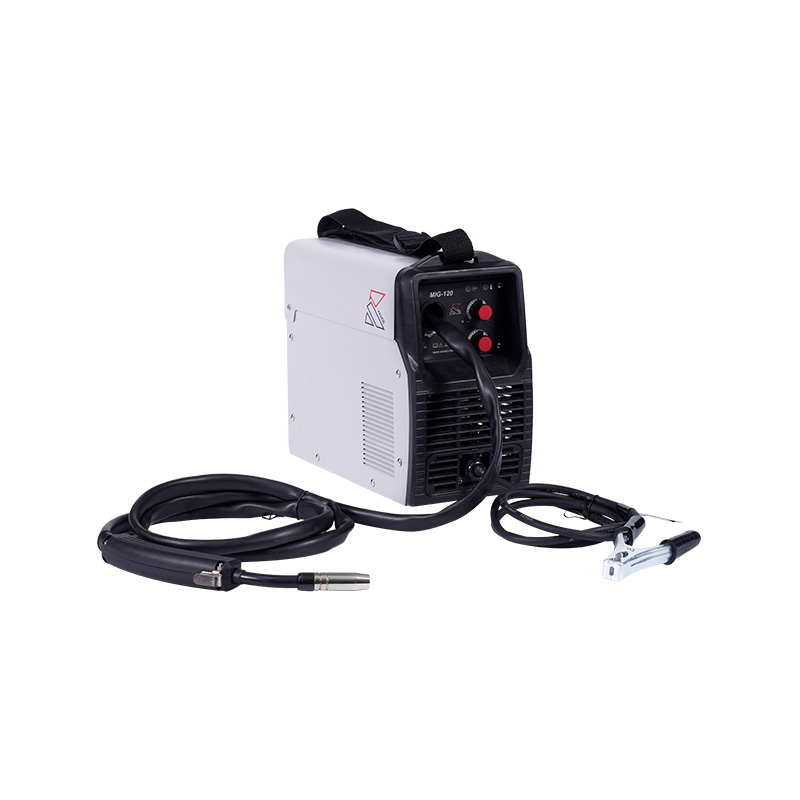
MIG-120 GS SAA 220v/230V 100A 120A gasless FLUX mig welder mini portable 1kg wire welding machine
The MIG-120 is a single-phase inverter MIG welding machine intended primarily for gasless flux-cored arc welding, commonly identified as FCAW. Its rated supply voltage is 220/230 V at 50/60 Hz, allowing it to operate on common electrical systems in many markets. The rated input capacity is 4.4 kVA, while the rated supply current is 20 A. These figures provide a useful indication of the electrical supply requirements and help users select suitable extension cables, sockets, circuit protection, and workplace power arrangements.
During operation, the machine supplies controlled welding power through the wire electrode. A continuously fed flux-cored wire creates the arc and forms the weld pool. The flux inside the wire produces shielding gases and slag during welding, reducing the need for an external shielding-gas system. This process can improve mobility and simplify setup, particularly when the machine is used in exposed areas or in locations where gas cylinders are inconvenient to transport.
The machine’s no-load voltage is 43 V, and its rated welding voltage is 20 V. The adjustable welding-current range is 50–120 A. This range is suitable for a variety of light fabrication and maintenance tasks, including brackets, frames, sheet-metal repairs, gates, equipment supports, agricultural implements, and general carbon-steel assemblies. Actual material thickness depends on joint design, number of passes, wire type, operator technique, and available duty cycle.
The product accepts usable wire diameters from 0.6 to 1.0 mm. This range gives the operator flexibility to select a smaller wire for thinner work and a larger wire for increased deposition and penetration when the machine’s output and the material allow it. Wire selection should always be matched to the workpiece, welding position, current setting, polarity, and the manufacturer’s recommendations for the selected flux-cored wire.
| Specification | Value |
|---|---|
| Product model | MIG-120 |
| Welding process | Gasless flux-cored MIG/FCAW |
| Rated supply voltage | 220/230 V |
| Supply frequency | 50/60 Hz |
| Rated input capacity | 4.4 kVA |
| Rated supply current | 20 A |
| No-load voltage | 43 V |
| Welding-current range | 50–120 A |
| Rated welding voltage | 20 V |
| Rated duty cycle | 25% |
| Compatible wire diameter | 0.6–1.0 mm |
| Efficiency | 82% |
| Power factor | 0.75 |
| Protection degree | IP21S |
| Net weight | Approximately 5 kg |
| Machine dimensions | Approximately 340 × 145 × 240 mm |
The specifications show why the MIG-120 occupies a useful position between basic hobby welders and larger professional systems. It offers substantially more control and process convenience than a simple traditional stick welder for users who prefer continuous wire feeding. At the same time, its compact dimensions and 5 kg net weight make it significantly easier to move than many conventional transformer-based MIG units.
Gasless flux-cored welding is the defining feature of this product. Conventional solid-wire MIG welding normally requires an external shielding gas, such as carbon dioxide or an argon-rich mixture. That arrangement can produce excellent results, but it also adds equipment, cost, and logistical requirements. The user must obtain a gas cylinder, regulator, hose, suitable storage area, and a reliable gas supply. Outdoor air movement can also disperse the shielding gas before it adequately protects the arc.
With flux-cored wire, the shielding function is generated by the flux contained within the electrode. The operator can therefore prepare the machine with fewer components and begin work more quickly. This is especially valuable for mobile repair work. A technician can carry the welder and a spool of suitable wire to the repair location without transporting a heavy cylinder. For farmers, maintenance workers, vehicle repair technicians, and construction crews, this reduction in equipment can save time and simplify site organization.
Gasless operation can also reduce the total cost of ownership for selected applications. The user does not need to purchase or refill shielding-gas cylinders, and there is no gas regulator to maintain. The reduction in setup components can be valuable for occasional welders who do not use their equipment every day. The machine can remain ready for use with the correct wire, a suitable power source, and basic protective equipment.
Another advantage is improved suitability for outdoor work. Wind is a major concern when external shielding gas is used. Even a moderate breeze can cause porosity, unstable shielding, and weld contamination if the work area is not protected. Flux-cored welding is not completely unaffected by environmental conditions, and the operator must still control drafts, surface contamination, and moisture. However, the process is generally more practical for outdoor repairs than gas-shielded solid-wire MIG welding without a windscreen.
Gasless flux-cored welding also provides a visible slag layer that can protect the cooling weld bead. After welding, the slag must be removed with an appropriate chipping hammer or wire brush before inspection or additional passes. This additional cleaning step is a normal part of the process. Users who understand the process and maintain correct travel speed can obtain clean, strong, and consistent results on compatible steel materials.
Traditional transformer welding machines are known for their robust electrical design, but they are often heavier and less convenient to transport. Their larger iron cores and copper windings can make the equipment difficult for one person to carry. In contrast, the MIG-120 uses high-frequency inverter technology and IGBT power switching to reduce the size and weight of the power-conversion system.
The lower weight does not simply improve convenience. It can also make the machine more productive because the operator can position it closer to the work area, move it between different service locations, and store it more easily. A 5 kg machine with dimensions of approximately 340 × 145 × 240 mm can fit into workshops, service vehicles, storage cabinets, and temporary jobsite areas where a large transformer machine may be impractical.
Inverter technology also supports more responsive output regulation. The control system can monitor and adjust electrical performance much more quickly than a basic low-frequency transformer arrangement. This contributes to a more controlled arc and can help the operator manage starting, wire feeding, and weld-pool behavior. The machine’s excellent arc characteristics and low-spatter performance are important benefits for users seeking a cleaner and more manageable welding process.
Gas-shielded solid-wire MIG welding remains highly useful for indoor production work, clean sheet metal, and applications where a controlled welding environment is available. However, it depends on external shielding gas and may be less convenient in open or windy locations. The MIG-120’s flux-cored process eliminates the need for that gas system and can reduce setup time.
The most suitable process depends on the work. Gasless flux-cored welding may produce more smoke and slag than solid-wire MIG and requires attention to wire polarity and post-weld cleaning. It is not automatically superior in every application. Its principal advantage is flexibility in mobile and outdoor conditions. The MIG-120 gives the user access to this process in a compact machine designed for practical field use.
The power system is based on powerful IGBT switches, advanced inverter technology, and pulse-width modulation control. IGBTs are semiconductor devices commonly used in modern welding power sources because they can switch electrical power at high speed while supporting efficient and controllable output. High-frequency switching allows the machine to use smaller magnetic components than a traditional low-frequency transformer design.
Pulse-width modulation regulates the amount of energy delivered to the welding circuit by controlling the timing of the switching operation. When combined with feedback and control electronics, PWM can help maintain a stable welding output under changing arc conditions. This is important because the arc is not a perfectly constant electrical load. Variations in arc length, wire feed behavior, workpiece position, and surface condition can all affect the welding circuit.
Microcomputer control provides a further level of monitoring and coordination. The control system can manage output behavior and protection functions while supporting consistent operation. It helps the machine respond to current demand, thermal conditions, and abnormal electrical situations. While no electronic welding machine eliminates the need for correct operation and maintenance, intelligent control can help protect internal components and improve overall usability.
The practical result is a machine that combines a compact structure with stable electrical performance. Inverter welding equipment is often selected because it offers a favorable balance of power density, portability, control, and energy efficiency. The MIG-120 has a stated efficiency of 82 percent, which supports reduced power loss compared with less efficient designs. The product information also identifies energy savings of up to 30 percent as a design benefit, although actual savings depend on duty cycle, input power quality, welding settings, material, and usage patterns.
The power factor is specified as 0.75. Power factor describes how effectively the machine draws electrical power from the supply. Users should still provide an appropriate circuit and avoid undersized extension cables, damaged outlets, or overloaded distribution equipment. Good electrical installation practice is essential for both performance and safety.
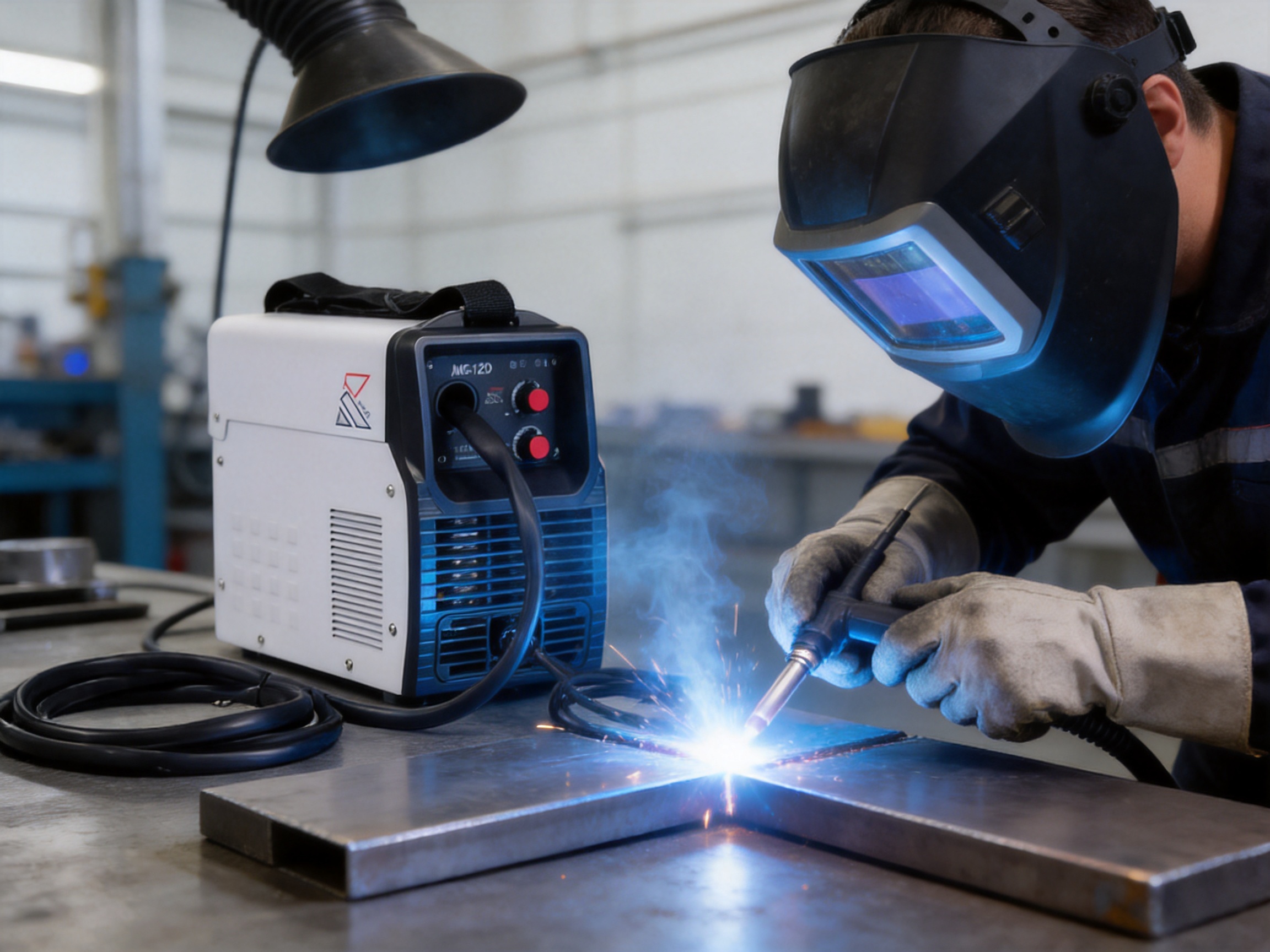
Arc characteristics strongly influence the user’s experience and the final appearance of the weld. A difficult-to-control arc can cause excessive spatter, inconsistent penetration, frequent wire sticking, and poor bead shape. The MIG-120 is designed to provide excellent arc characteristics, good welding performance, and reduced spatter when operated with suitable wire and correct settings.
Constant-voltage output control is particularly relevant to wire welding. In a CV system, the machine attempts to maintain a stable voltage while the wire feed and arc conditions determine the welding current. This relationship supports a relatively smooth continuous-wire process. The operator can adjust the welding settings to match the wire diameter and material thickness, then maintain a consistent travel technique.
Lower spatter can provide several practical advantages. It reduces cleanup around the weld, improves the appearance of finished assemblies, and decreases the chance of unwanted particles adhering to nearby surfaces. It can also make the welding area more comfortable and reduce the time needed for grinding and finishing. Spatter levels are still affected by wire quality, polarity, surface contamination, grounding, stick-out, voltage, current, and operator movement, so the machine must be used with appropriate consumables and settings.
The adjustable 50–120 A range gives the user control over heat input for light and medium repair tasks. Lower settings can be selected for thinner material when burn-through is a concern. Higher settings can be used for thicker sections or increased deposition, provided that the joint design, wire diameter, and duty cycle are appropriate. The operator should always perform a test weld on similar material before beginning critical work.
The product information states that the machine can weld carbon steel and alloy steel. Typical applications include steel brackets, frames, supports, equipment repairs, workshop fixtures, gates, railings, agricultural tools, storage racks, and general maintenance components. It can be useful for joining new steel parts as well as repairing worn or damaged structures.
Material preparation remains essential. Rust, paint, oil, moisture, scale, and other contaminants can create porosity, inclusions, unstable arc behavior, and weak welds. Before welding, the operator should clean the joint area, verify the fit-up, establish an appropriate ground connection, and select a wire designed for the base material. Thick materials may require beveling, preheating, multiple passes, or a larger welding system, depending on the engineering requirements.
The machine is not intended to replace specialized heavy-duty equipment for thick structural fabrication, long continuous welds, or high-deposition industrial production. Its strengths are mobility, accessible power, gasless operation, and practical control for light and medium-duty tasks. Correctly matching the machine to the application is one of the most important factors in achieving reliable results.
Welding machines operate under demanding electrical and thermal conditions. The MIG-120 includes automatic protection functions for over-current and overheating. These functions are designed to help protect the power electronics when operating conditions exceed safe limits. If the internal temperature rises excessively or an abnormal current condition occurs, the protection system can interrupt or limit operation until conditions return to an acceptable range.
Thermal protection is especially important when users work near the upper end of the current range or continue welding for long periods. The rated duty cycle is 25 percent. In practical terms, a 25 percent duty cycle is generally interpreted over a standard ten-minute period, subject to the applicable test conditions and product documentation. The exact operating time depends on current, ambient temperature, ventilation, and other conditions. At lower output settings, the machine may be able to operate for longer periods, but users should follow the equipment rating and allow cooling pauses as required.
The IP21S protection rating indicates a basic level of protection against contact with hazardous internal parts and vertically falling water under specified test conditions. It does not mean the machine is waterproof or suitable for exposure to rain, splashing water, mud, or excessive dust. The unit should be kept dry, clean, adequately ventilated, and protected from conductive contamination. Outdoor welding should be performed under suitable shelter and with proper electrical safety controls.
Reliable operation also depends on the condition of the power supply. Voltage fluctuations, undersized cables, loose connections, and overloaded circuits can affect arc performance and increase heat in the electrical system. Users should inspect the power cord, welding leads, work clamp, wire-feed components, and ventilation openings regularly. Dust should be removed according to appropriate maintenance procedures, and unauthorized internal repairs should be avoided.
Welding produces intense ultraviolet radiation, visible light, heat, fumes, and sparks. Operators must use a suitable welding helmet with the correct shade, flame-resistant clothing, insulated gloves, safety footwear, and appropriate eye and face protection. The work area should be free of combustible materials, and adequate ventilation or fume extraction should be provided.
Gasless flux-cored welding can produce visible fumes and slag. The operator should avoid breathing the plume and should position the head away from the rising smoke. Coated, painted, galvanized, or chemically contaminated materials may release hazardous substances when heated. Such materials require special preparation, ventilation, and risk assessment before welding.
The work clamp must be attached to clean metal with a secure connection. Welding should not be performed on sealed containers, tanks, drums, or pipe systems that may contain flammable or pressurized substances unless they have been professionally cleaned, tested, and approved for hot work. The machine should be disconnected from the power supply before service or internal inspection.
Portability is one of the clearest competitive advantages of the MIG-120. With a net weight of approximately 5 kg and a compact body, the machine can be carried by one person and transported with minimal effort. This makes it useful for service calls, maintenance rounds, workshops with multiple work areas, and projects where the welding equipment must be moved frequently.
The small size also helps users organize limited workspaces. The machine can be positioned on a bench, stored on a shelf, or placed in a vehicle without occupying the space required by a conventional industrial welder. For small businesses, this can reduce the need for a dedicated welding bay. For home and farm users, it provides a practical way to keep welding capability available without investing in oversized equipment.
A mini portable welder can also improve response time. When a bracket breaks, a gate needs repair, or a machine frame develops a crack, the user can bring the welding unit to the work instead of transporting a large component to a fixed workshop. This is particularly valuable when dismantling or moving the damaged item would be expensive or disruptive.
The use of a 1 kg wire spool is consistent with the machine’s compact format and target applications. A smaller spool is easier to store and carry, and it is suitable for occasional users who do not require the large wire packages used in production environments. The operator should ensure that the spool, drive roller, liner, contact tip, and wire diameter are compatible with the selected consumable.
The manufacturer, Zhejiang Kende Mechanical & Electrical Co., Ltd., operates as an established producer and exporter of electric welding machines, battery chargers, and heaters. Its reported facilities cover approximately 120,000 square meters and employ around 600 people. The company has an annual production capacity of approximately 2 million units and exports close to 1.5 million units annually. These figures indicate a manufacturing organization with significant experience in volume production, international distribution, and product standardization.
Large-scale manufacturing capability can benefit the MIG-120 in several ways. A structured production system can support consistent component sourcing, repeatable assembly, process inspection, product testing, packaging control, and after-sales support. For distributors and professional users, production stability is important because it improves the likelihood of continued product availability and replacement-part support.
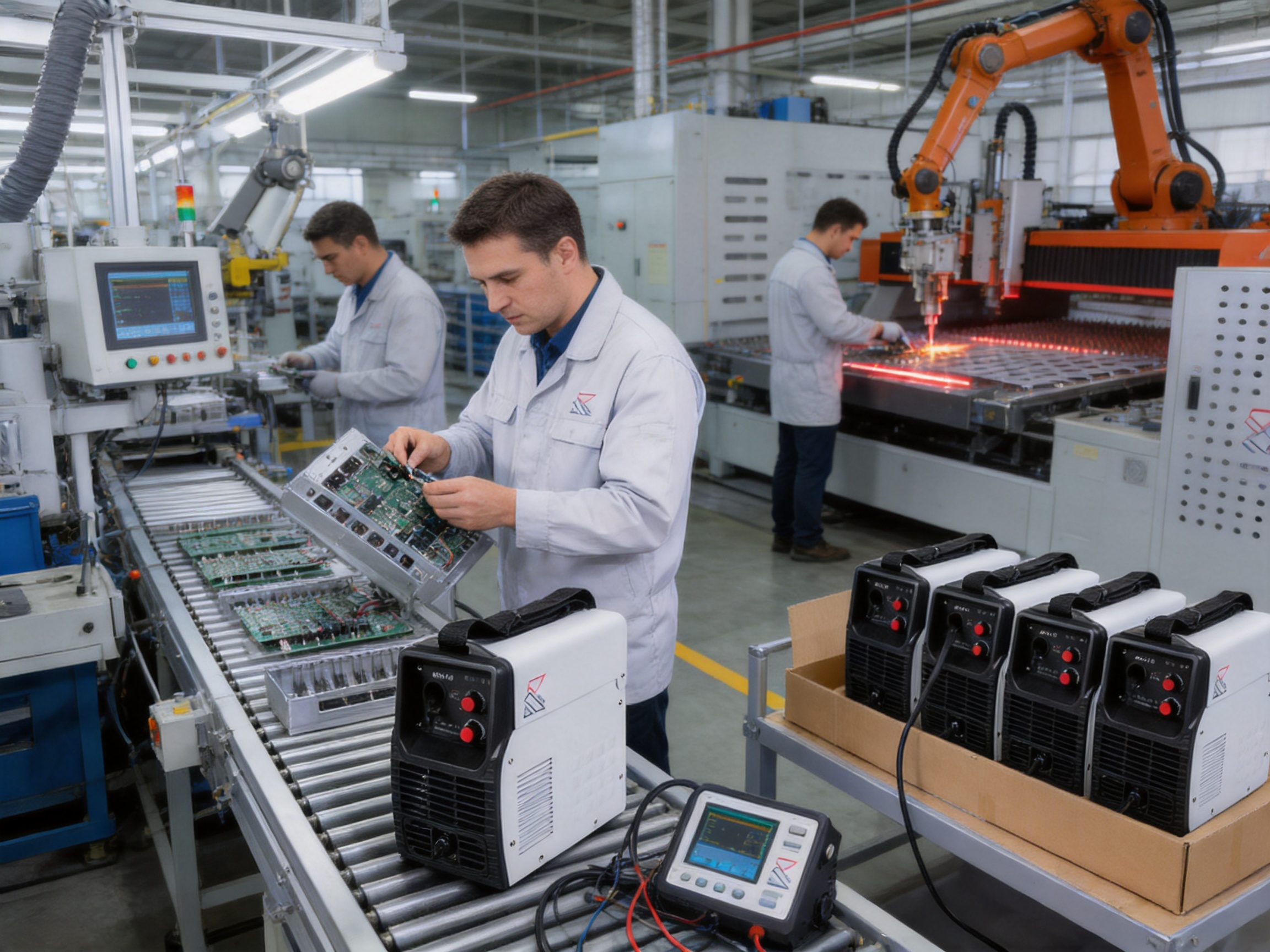
The company states that it uses advanced automatic patching, plug-in, and welding systems in its production operations. These processes can improve repeatability in electronic assembly and reduce variation caused by manual placement or soldering. Automated equipment is especially valuable in inverter welding machines because the power board contains components that must be positioned and connected accurately to manage high-frequency switching and thermal loads.
The reported use of robotic processing, laser cutting, and other advanced manufacturing technologies also supports the production of precise metal housings and internal structural parts. Accurate sheet-metal cutting and forming can improve fit, ventilation layout, mounting consistency, and overall product appearance. Consistent mechanical construction is important because the enclosure must protect internal components while allowing suitable cooling airflow.
The manufacturer also operates with OA office automation, Toyota TPS-style management practices, ERP K3, and MES management systems. These systems can connect production planning, material management, work orders, process records, quality information, and manufacturing execution. When properly implemented, digital manufacturing controls help trace products through assembly and testing, identify process deviations, improve inventory coordination, and support continuous improvement.
Product performance begins with engineering design. The company reports a Zhejiang Provincial Research and Development Center, an Enterprise Technology Center, and an Intelligent Welding Technology Research Institute. It also reports a research and development team of 98 personnel. These resources support the development of inverter welding machines, battery chargers, heaters, plasma cutters, and other related products.
The company has obtained invention patents, utility model patents, appearance patents, and software copyrights. It also reports participation in the drafting, formulation, and revision of 20 national standards, including leadership in drafting one group standard. Such participation indicates familiarity with technical requirements, product safety considerations, testing methods, and the broader development of the welding-equipment industry.
For the MIG-120, engineering capability is reflected in the combination of IGBT switching, PWM control, constant-voltage output, microcomputer management, thermal protection, and compact mechanical design. Integrating these elements into a small machine requires attention to electrical layout, heat dissipation, insulation, current paths, control algorithms, wire-feeding behavior, and enclosure ventilation. A mature product-development organization can help balance these competing requirements.
The company’s product range includes manual arc welding machines, MIG/MAG machines, flux-cored welding systems, TIG machines, plasma cutting machines, stud welders, submerged arc welding equipment, battery chargers, and electric, gas, and oil heaters. This broad portfolio gives the manufacturer experience across multiple power-electronics and thermal-management applications. It also allows the company to serve different user groups, from household and maintenance users to industrial customers.
The manufacturer reports certifications and compliance marks including GS, CE, EMC, ERP, US ETL, UKCA, and China CCC across its product portfolio. The exact certification status of a particular model should always be confirmed through current product documentation and the intended destination-market requirements. Nevertheless, the presence of international certification experience is important for exporters and distributors.
Electrical welding machines must satisfy requirements relating to safety, electromagnetic compatibility, energy performance, labeling, documentation, and regional market access. Certification programs may involve electrical insulation tests, leakage-current testing, abnormal-operation tests, electromagnetic-emission evaluation, immunity testing, thermal assessment, and mechanical inspection. A manufacturer familiar with these procedures is better positioned to prepare products for different regulatory environments.
International market readiness also involves packaging, user manuals, rating labels, spare parts, language support, shipping protection, and quality consistency. The MIG-120 is specified for 220/230 V and 50/60 Hz operation, making it suitable for many regions, but buyers should verify plug type, local electrical standards, welding polarity, included accessories, and certification documents before purchase.
The MIG-120 is well suited to small workshops that need a convenient wire-welding process without a gas-cylinder installation. It can support fabrication of light steel frames, brackets, shelves, gates, railings, carts, fixtures, and repair components. Its compact size allows the machine to remain available for occasional work without occupying valuable floor space.
It is also suitable for maintenance and repair technicians. A service worker can transport the welder to machinery, agricultural equipment, trailers, steel structures, and construction components. The gasless process is useful where access to shielding gas is limited or where the repair location is exposed to moving air.
Farm and agricultural users may benefit from the machine’s combination of portability and simple setup. Repairs to steel gates, frames, tool mounts, implements, and non-critical supports can often be completed close to the point of use. However, any repair involving safety-critical structures, pressure vessels, lifting equipment, or vehicle components should follow the relevant engineering and welding standards.
For training and educational environments, the machine can introduce users to wire-feed welding, constant-voltage output, flux-cored consumables, joint preparation, and weld inspection. Instructors should provide proper supervision, ventilation, protective equipment, and practical instruction in polarity, wire selection, travel speed, and slag removal.
Before welding, inspect the machine, power cord, welding lead, work clamp, torch, wire spool, contact tip, and drive system. Confirm that the selected wire is compatible with the machine and base material. Install the wire carefully, ensure that the drive roller matches the wire diameter, and set the correct feed tension. Excessive tension can deform soft wire, while insufficient tension can cause slipping and inconsistent feeding.
Clean the workpiece and establish a secure ground connection. Select a starting current and voltage setting appropriate for the wire and material thickness. Make a test weld on scrap steel or a sample joint. Observe arc sound, bead shape, penetration, spatter, and slag coverage. Adjust the settings gradually rather than making large changes without testing.
Maintain a suitable electrode stick-out and consistent travel angle. Move at a steady speed so that the weld pool remains controlled. Excessive travel speed may produce a narrow bead or insufficient fusion, while slow movement can create excessive heat and an overly wide bead. Remove slag completely between passes and inspect the weld before adding another layer.
After use, allow the machine to cool when necessary, switch off the power, and store the equipment in a dry location. Protect the welding torch and cables from sharp edges, oil, water, and unnecessary bending. Periodic inspection of the liner, contact tip, drive roller, fan openings, and electrical connections will help preserve performance.
The machine is designed primarily for gasless flux-cored welding, also called FCAW. It uses flux-cored wire rather than requiring an external shielding-gas cylinder for the intended process.
The specified welding-current range is 50–120 A. The correct setting depends on wire diameter, material thickness, joint design, welding position, and the required penetration.
Yes. The product information states that it can weld carbon steel and alloy steel when compatible flux-cored wire and suitable welding procedures are used.
The listed usable wire range is 0.6–1.0 mm. The operator should match wire diameter with the drive roller, contact tip, liner, polarity, and welding settings.
For its no-gas flux-cored process, the machine does not require an external shielding-gas cylinder. The flux in the wire provides the shielding action. The operator must still use wire intended for gasless operation.
The net weight is approximately 5 kg, and the machine size is approximately 340 × 145 × 240 mm. This makes it suitable for workshops, service vehicles, field repairs, and locations where a large welder would be inconvenient.
The rated duty cycle is 25 percent. Users should observe cooling periods and avoid exceeding the duty-cycle rating, especially when welding at high current or in warm environments.
The machine includes automatic over-current and overheat protection. These functions help protect the equipment during abnormal electrical conditions or excessive thermal loading, but they do not replace correct operation and adequate ventilation.
Its gasless process is practical for many outdoor repair situations because it does not depend on external shielding gas that can be disturbed by wind. The machine itself must still be protected from rain, water, conductive dust, and unsuitable environmental conditions.
The machine is best suited to portable light and medium-duty welding. Its 120 A maximum output and 25 percent rated duty cycle make it less suitable for long continuous welds, very thick sections, or high-deposition industrial production that requires larger equipment.
The IGBT inverter design supports a smaller and lighter machine while enabling responsive control, stable output, useful efficiency, and compact power conversion. These characteristics give the product advantages over many traditional transformer-based machines.
Buyers should confirm local voltage, plug configuration, certification requirements, included accessories, wire compatibility, spare parts, warranty conditions, and whether the intended application falls within the machine’s output and duty-cycle limits.
The MIG-120 is a compact gasless flux-cored MIG welder designed for users who need mobility, straightforward operation, and modern inverter performance. Its 220/230 V input, 50–120 A welding range, 0.6–1.0 mm wire compatibility, constant-voltage output, IGBT switching, PWM control, and microcomputer management provide a practical technical foundation for light and medium-duty steel welding.
Its strongest competitive advantages are the combination of no-gas operation, small size, low weight, stable arc characteristics, reduced spatter, and automatic over-current and overheat protection. Compared with traditional transformer machines, it is easier to carry and generally more compact. Compared with gas-shielded solid-wire systems, it simplifies field setup and avoids the need for a gas cylinder in suitable flux-cored applications.
The manufacturer’s broad production capability, reported automated assembly systems, digital manufacturing management, research facilities, engineering staff, certification experience, and large product portfolio further support the product’s market position. These strengths are relevant to distributors and users who value supply continuity, manufacturing experience, technical development, and international product support.
As with every welding machine, performance depends on correct wire selection, material preparation, electrical supply, operator technique, ventilation, and adherence to duty-cycle limits. When used within its intended range, the MIG-120 offers an efficient and portable solution for workshops, maintenance teams, agricultural users, mobile technicians, construction tasks, and general steel repair.
1. Product technical information for the MIG-120 220/230 V gasless flux-cored MIG welding machine.
2. Manufacturer-provided specifications covering rated input, welding-current range, duty cycle, wire diameter, efficiency, power factor, protection degree, weight, and dimensions.
3. Manufacturer-provided company information concerning production capacity, research and development facilities, manufacturing systems, certifications, and product categories.
4. General principles of gasless flux-cored arc welding, including consumable selection, polarity, shielding action, slag removal, and weld preparation.
5. General inverter welding technology references covering IGBT power switching, pulse-width modulation, constant-voltage output control, thermal protection, and electrical efficiency.
6. General welding safety guidance concerning personal protective equipment, ventilation, fire prevention, electrical safety, hot-work controls, and inspection procedures.
Recommended Products

Contact Us
No.2299, Luqiao Section, Shugang Avenue, Luqiao District, Taizhou, 318057 Zhejiang, PR China.
+86-576-82431568
 Privacy
China Welding Machine Factory
 English
 中文简体
 русский
 Español
 عربى
 Français
 Português
 Deutsch
 Український