Email: [email protected]
Email: [email protected]

Blog
 2026.10.04
 Blog
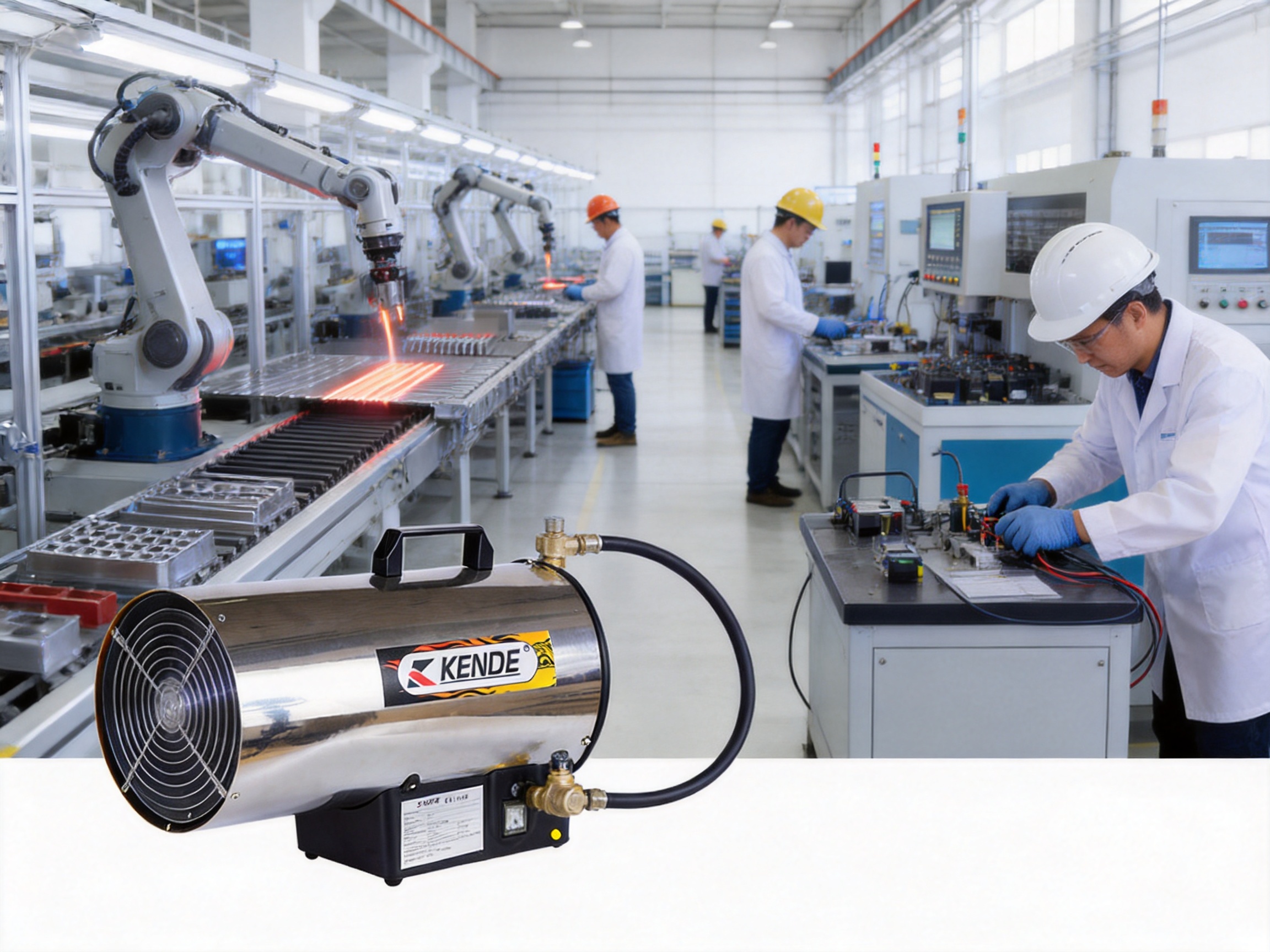
Portable LPG fan air heaters provide a practical way to deliver concentrated warmth to warehouses, factories, workshops, farms, construction areas, garages, and other spaces where fixed heating systems may be unavailable or inefficient. The KEF-10, KED-10, KEF-12, KED-12, KEF-15, KED-15, KEF-17, and KED-17 models are designed as compact forced-air gas heaters that combine fuel flexibility, strong airflow, automatic control, built-in protection, and easy portability.
These heaters use liquefied petroleum gas, including propane and butane, to generate heat. An integrated fan distributes the heated air through the surrounding space, helping operators warm working areas more quickly than many passive heating solutions. With heat outputs from 10 kW to 17 kW, the range is suitable for different room sizes and operating requirements. The products also offer adjustable gas input and heat levels, allowing users to balance heating performance and fuel consumption.
The heater range is manufactured by Zhejiang Kende Mechanical & Electrical Co., Ltd., an established producer of welding equipment, battery chargers, and electric, gas, and oil heating products. The company combines product development, automated manufacturing, quality management, and international certification experience to produce equipment for both industrial and domestic users.
Industrial and agricultural buildings often have large air volumes, open doors, poor insulation, or changing layouts. Installing a permanent heating system in such locations may require substantial construction work, fixed fuel lines, extensive ducting, or high initial investment. A portable LPG fan heater offers a more flexible alternative.
The heater can be moved to the area where warmth is required, connected to a suitable LPG cylinder, and placed into service with relatively little preparation. This flexibility is especially useful in workshops, temporary work areas, storage facilities, agricultural buildings, and locations where heating requirements change throughout the day.
Forced-air operation is another major advantage. A fan circulates air across the heated area, helping distribute warmth rather than allowing it to remain concentrated near the burner. The result is a more active heating pattern that can improve comfort for workers and help maintain usable temperatures in working zones.
Compared with many electric heaters of similar heating capacity, direct gas-fired units can deliver high thermal output without requiring a high-capacity electrical supply. The electrical connection is primarily used for the fan and control functions, while the main energy source is LPG. This makes the heaters suitable for sites where electrical infrastructure is limited or where operators want to reduce dependence on high-power electrical heating.
Another benefit is fast heat generation. Gas combustion produces heat immediately after ignition, allowing the heater to begin warming the airflow without a long preheating period. For workshops, warehouses, and farm buildings that are occupied intermittently, quick-start performance can be more useful than a system designed for continuous background heating.
The product family includes four nominal heating capacities: 10 kW, 12 kW, 15 kW, and 17 kW. Each capacity is represented by KEF and KED model designations. The specifications indicate heating outputs from 8,600 kcal/h to 12,900 kcal/h and recommended heating areas from approximately 90 to 145 square meters, depending on model and environmental conditions.
The 10 kW models are compact options for smaller workshops, enclosed workspaces, service areas, and agricultural rooms. They provide a rated heat output of 10 kW, an air delivery of 500 cubic meters per hour, and a stated heating area of 90 square meters. Their relatively low weight of 5.2 kg makes them convenient for frequent relocation.
The 12 kW models provide additional heating capacity while retaining the same 500 cubic meter per hour air output. They are rated for a heating area of approximately 105 square meters and weigh approximately 5.3 kg. This configuration can be suitable when a building requires more heat than the 10 kW version but does not require the larger housing used by the 15 kW and 17 kW units.
The 15 kW models increase airflow to 580 cubic meters per hour and are rated for a heating area of approximately 130 square meters. Their fuel consumption is listed at 1,200 grams per hour, with a maximum air pressure of 500 mbar. They weigh approximately 5.5 kg and use a slightly longer housing.
The 17 kW models provide the highest nominal heating output in this range. They also deliver 580 cubic meters of air per hour and are listed for heating areas up to approximately 145 square meters. Their fuel consumption is listed at 1,240 grams per hour. Despite the greater output, the unit weighs approximately 5.6 kg, preserving the portability required for mobile use.
| Model | Heat Output | Electrical Supply | Air Output | Fuel Consumption | Heating Area | Weight | Dimensions |
|---|---|---|---|---|---|---|---|
| KEF-10 / KED-10 | 10 kW, 8,600 kcal/h | AC 220–240 V, 50 Hz | 500 m³/h | 727 g/h | 90 m² | 5.2 kg | 435 × 230 × 305 mm |
| KEF-12 / KED-12 | 12 kW, 10,320 kcal/h | AC 220–240 V, 50 Hz | 500 m³/h | 875 g/h | 105 m² | 5.3 kg | 435 × 230 × 305 mm |
| KEF-15 / KED-15 | 15 kW, 12,900 kcal/h | AC 220–240 V, 50 Hz | 580 m³/h | 1,200 g/h | 130 m² | 5.5 kg | 490 × 230 × 305 mm |
| KEF-17 / KED-17 | 17 kW, 12,900 kcal/h | AC 220–240 V, 50 Hz | 580 m³/h | 1,240 g/h | 145 m² | 5.6 kg | 490 × 230 × 305 mm |
Actual heating performance depends on building insulation, outdoor temperature, ceiling height, ventilation, door openings, humidity, fuel quality, and the desired indoor temperature. The stated heating areas should therefore be used as practical reference values rather than universal guarantees. A professional installer or heating specialist can help select the correct capacity for a specific site.
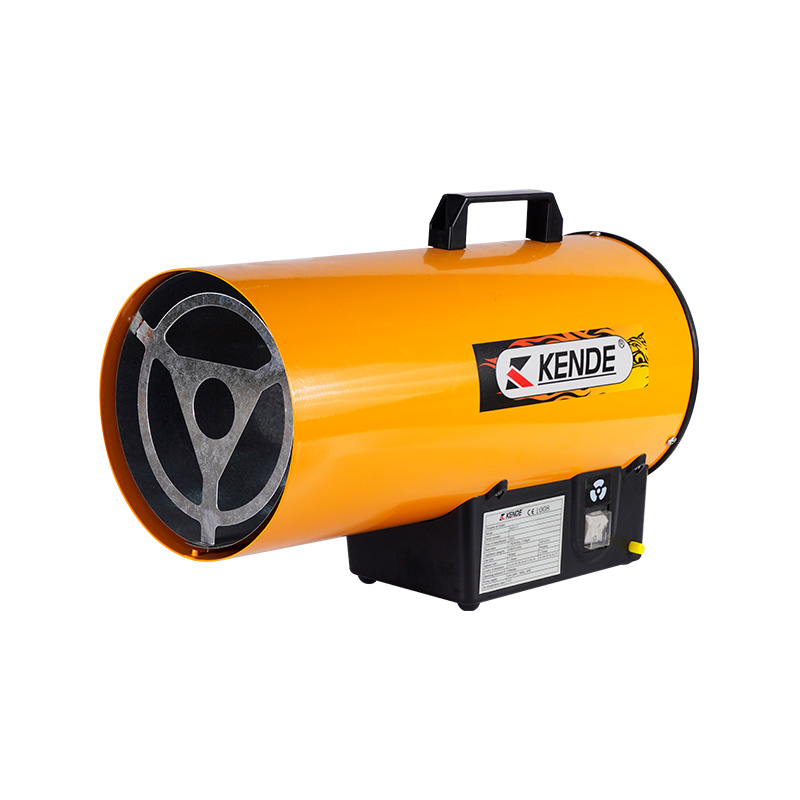
KEF-10/KED-10 KEF-12/KED-12 KEF-15/KED-15 KEF-17/KED-17 Lpg/gas fan air heaters
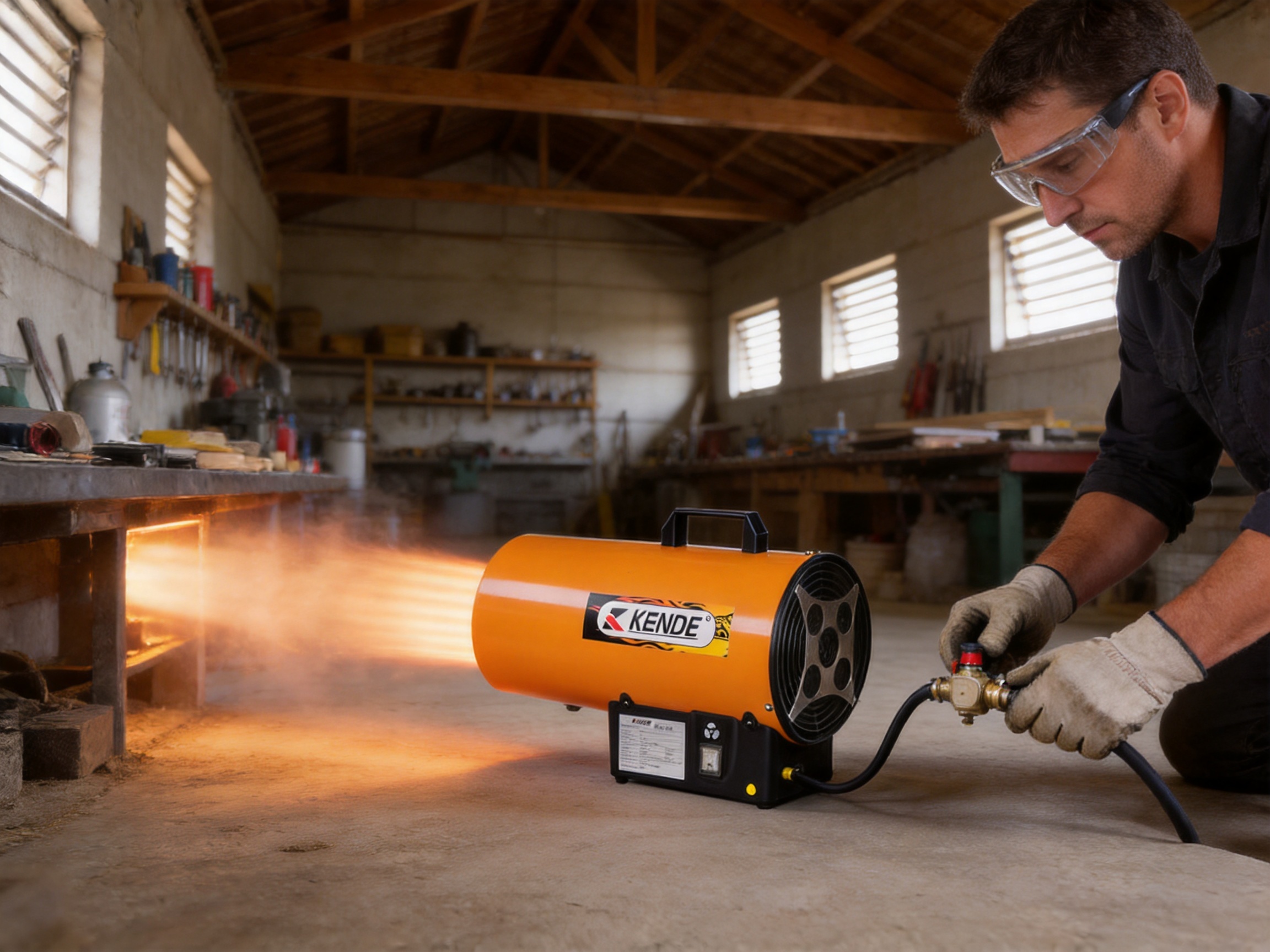
These heaters use direct gas-fired air heating. LPG is supplied through the regulator and hose to the burner, where it is ignited and converted into thermal energy. The fan moves air through the heated zone and discharges warm air into the room.
Direct gas-fired heating can be highly effective in open or semi-open industrial environments because the equipment produces heat directly at the point of use. Unlike systems that heat water or require long duct networks, the heater does not need a separate boiler, radiator circuit, or large heat exchanger installation. This reduces system complexity and supports quick deployment.
The gas input capacity can be adjusted, enabling the operator to regulate the heat level according to current conditions. During mild weather, a lower setting may provide sufficient comfort while reducing fuel use. During cold weather or when a large door is open, a higher setting can deliver stronger heating performance.
Gas type compatibility is listed as G30/G31, corresponding generally to butane and propane categories. Because LPG pressure and fuel specifications may vary by country, the heater must be connected only to an appropriate fuel supply and regulator configuration. Users should always follow local installation rules, cylinder requirements, ventilation standards, and manufacturer instructions.
The listed electrical supply is AC 220–240 V at 50 Hz. Electrical power operates the fan and control components. Before operation, the user should confirm that the available supply matches the rating shown on the product and that the outlet, plug, extension cable, and protective devices are suitable for the expected load and working environment.
Portability is one of the most important product advantages. Each model uses a compact housing and an insulated handle to make transportation easier. The listed weights range from 5.2 kg to 5.6 kg, allowing one operator to move the heater between work zones without specialized lifting equipment.
A portable design is particularly useful for facilities that have multiple heating needs. For example, a workshop may need warmth near a maintenance bench in the morning, beside a loading area during the afternoon, and in a temporary assembly zone later in the day. A fixed heater would not provide the same level of flexibility.
The steel housing is coated with high-temperature-resistant paint. This finish helps protect the exterior from the heat generated during operation and contributes to a durable appearance in demanding environments. The metal housing also supports the mechanical protection of internal components while keeping the heater compact.
The insulated handle helps reduce heat transfer to the operator’s hand during movement after or between operating cycles. Nevertheless, users should allow the appliance to cool where appropriate, use safe lifting practices, and avoid touching hot surfaces.
The compact dimensions allow the units to be stored when not in use. The 10 kW and 12 kW models measure approximately 435 × 230 × 305 mm, while the 15 kW and 17 kW models measure approximately 490 × 230 × 305 mm. This relatively narrow profile can be helpful in crowded workshops, storage rooms, and agricultural buildings where floor space is limited.
Safety is essential for any fuel-burning heater. The product specifications identify several features intended to support safer operation, including an overheat protector, automatic control, an outdoor thermostat, and a regulator with a safety valve.
The overheat protector is designed to respond if the heater temperature rises beyond a permitted operating level. Excessive temperature can result from blocked airflow, a failed fan, an unsuitable installation position, or other abnormal conditions. A protective cutoff can help limit the risk of damage, although it does not replace regular maintenance or proper supervision.
The regulator includes a safety valve that stops the gas flow if the gas tube develops a crack. This feature is important because a damaged hose can create a dangerous leakage condition. The supplied regulator and gas hose help simplify initial setup, but the user must inspect these components regularly and replace them if they show wear, cuts, hardening, deformation, or other damage.
Automatic control helps coordinate the operating sequence and regulate heater functions. The exact control behavior depends on the product version and local configuration, but automatic systems generally reduce the amount of manual intervention required during normal operation.
An outdoor thermostat is included as part of the stated feature set. Thermostat-based control can help maintain a target temperature or provide temperature-responsive operation. When used correctly, this can improve comfort and reduce unnecessary fuel consumption compared with constant operation at maximum output.
Manual ignition gives the operator direct control over the starting process. Manual ignition can be advantageous in environments where a simple and serviceable ignition arrangement is preferred. Operators should follow the specified lighting sequence, ensure that gas has not accumulated before ignition, and stop immediately if ignition does not occur as expected.
Safety features are most effective when combined with responsible operating procedures. The heater should be positioned on a stable, level surface with adequate clearance around the air inlet and outlet. It should not be placed near combustible materials, flammable liquids, curtains, paper, packaging, wood shavings, or other materials that could be ignited by heat.
Because the heater consumes oxygen and produces combustion gases, suitable ventilation is necessary. Direct gas-fired appliances should not be used in a sealed room without adequate fresh-air exchange. Carbon monoxide can be dangerous and may not be detectable by smell. Facilities using fuel-burning heaters should evaluate ventilation requirements, install suitable carbon monoxide detection where appropriate, and follow applicable regulations.
The heater should never be modified to use an unapproved fuel, pressure, hose, nozzle, electrical supply, or control system. Any service involving the gas circuit should be completed by trained personnel using suitable replacement parts.
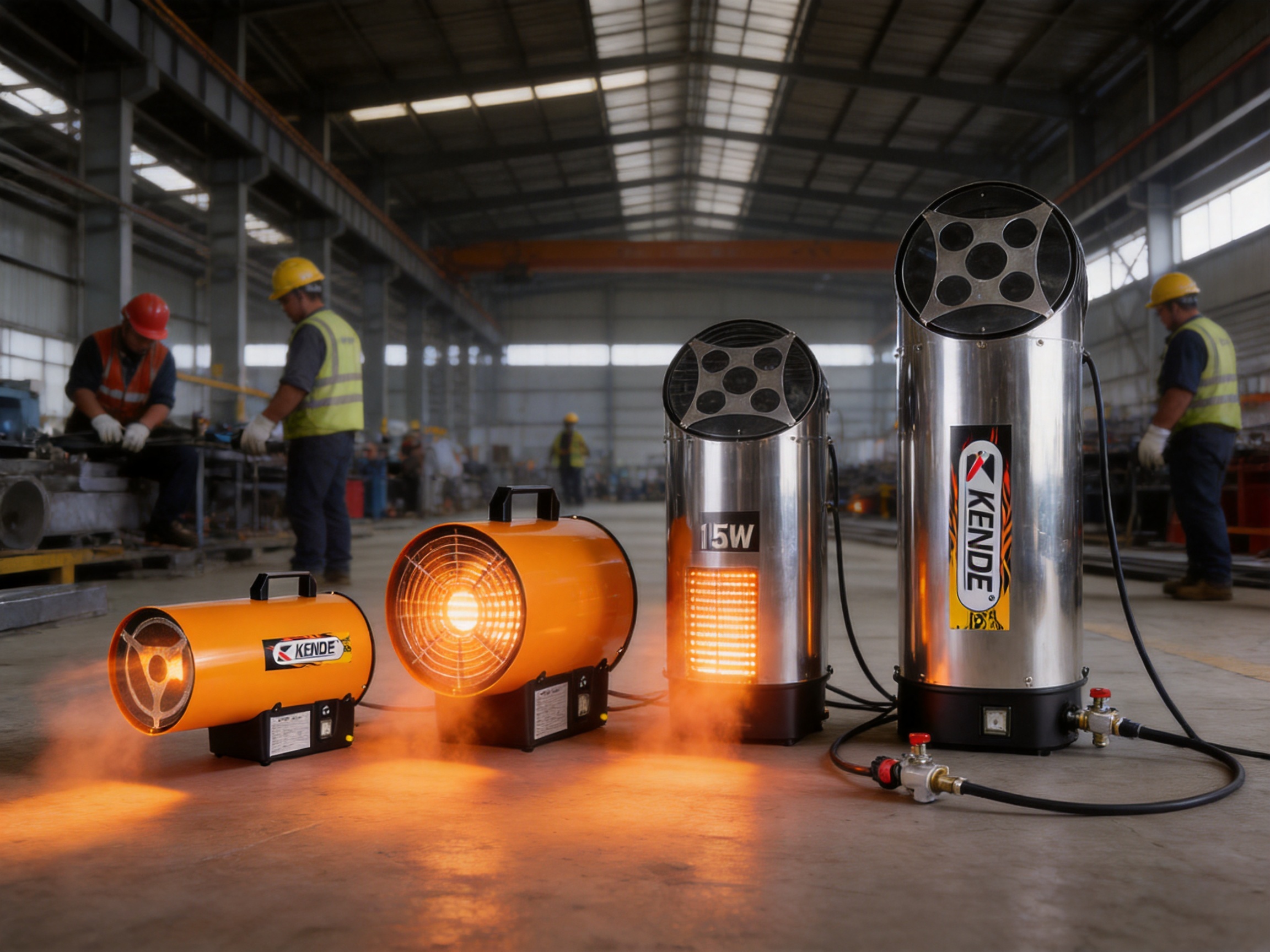
The product information identifies low noise as one of the heater’s operating characteristics. Noise level is important in workshops, service facilities, farm buildings, and work areas where employees must communicate, operate tools, or concentrate on detailed tasks.
A fan heater cannot be completely silent because it contains a motor and moving air. However, a controlled airflow design and properly maintained fan can support a more comfortable sound environment than equipment with excessive vibration or poorly balanced rotating components.
Low-noise operation can also make the heater more suitable for intermittent use in occupied areas. Workers are less likely to regard the heater as disruptive when the sound is controlled. For commercial and industrial users, this can improve acceptance of the heating system and support better working conditions during cold periods.
Noise performance can change if the air inlet becomes blocked, the fan accumulates dust, the housing vibrates, or the motor bearings deteriorate. Regular cleaning and inspection are therefore important for preserving both airflow and acoustic performance.
Warehouses often have high ceilings, large doors, and frequent air exchange. These conditions can make it difficult to maintain a comfortable temperature. A portable LPG fan heater can be moved near packing stations, loading areas, inspection points, or workstations where heat is most needed.
The 10 kW and 12 kW models may be suitable for smaller storage rooms or partially enclosed areas, while the 15 kW and 17 kW versions may provide stronger performance in larger work zones. Operators should account for the effect of open doors and external airflow when selecting a model.
Manufacturing spaces may require heating near machine operators, maintenance areas, assembly benches, or temporary production zones. Portable equipment can be repositioned as production layouts change. This is an advantage over fixed radiators or permanently installed heating equipment that serves only one location.
The steel housing, compact form, adjustable heat input, and protective controls make the heaters practical for many workshops. However, the appliance should be kept away from dust concentrations, flammable vapors, paint spraying areas, welding sparks, and other hazardous conditions unless the installation has been specifically assessed for those risks.
Agricultural buildings may include barns, equipment sheds, maintenance rooms, storage buildings, and workspaces with uneven temperatures. Portable gas heaters can provide localized warmth for workers and help make maintenance activities more comfortable.
Farm operators should pay particular attention to ventilation, combustible hay or straw, dust, animal safety, and the placement of LPG cylinders. The heater must be positioned so that livestock cannot contact it, knock it over, or interfere with the hose and regulator.
Construction projects frequently involve incomplete buildings without permanent heating systems. A portable heater can provide temporary warmth during finishing, installation, or repair work. Its relatively low weight and integrated handle make it easier to move as the project progresses.
Construction sites can contain wood products, insulation, solvents, adhesives, fuel containers, and other combustible materials. The heater should be operated only after a site-specific risk assessment and should not be left unattended in changing or uncontrolled conditions.
Vehicle repair garages and service facilities often need rapid heat during cold mornings or when large entrance doors are opened. A portable unit can warm a particular bay or work zone without requiring the entire building to be heated continuously.
Garages may contain gasoline vapors, solvents, oils, batteries, and welding gases. The heater must be kept away from ignition-sensitive materials and used only where ventilation is sufficient. Product selection should also consider whether the environment contains hazardous atmospheres that require specially certified equipment.
Portable LPG fan heaters offer a distinct combination of mobility, heat output, and installation simplicity. Compared with fixed electric heating systems, they generally require less permanent infrastructure. There is no need to install radiators throughout the building or create a large heating circuit before use.
Compared with small radiant heaters, forced-air models can distribute warmth over a broader area. Radiant heaters are often effective when aimed directly at a person or object, while fan heaters are better suited to raising the temperature of an occupied zone or circulating warm air through a room.
Compared with oil-fired portable heaters, LPG units can offer a cleaner and simpler fuel-handling process when the application is correctly ventilated. LPG cylinders are widely available in many markets, and the supplied regulator and hose support straightforward connection. The appropriate fuel choice still depends on local availability, operating regulations, ventilation, and the specific environment.
Compared with permanently installed gas heaters, portable models usually require less time and cost to deploy. They can be stored during warm seasons and moved between buildings. This makes them attractive to small businesses, contractors, farms, and facilities with seasonal heating needs.
Another competitive strength is the broad model range. Buyers can select 10 kW, 12 kW, 15 kW, or 17 kW output instead of using one oversized unit for every application. A more appropriately sized heater may provide better operating control and reduce unnecessary fuel consumption.
However, no heater is universally superior. Electric heaters may be preferable in small sealed rooms where combustion is undesirable. Indirect-fired systems may be required where clean, uncontaminated air is essential. Permanent central heating may be more suitable for buildings that need uniform temperature control throughout the entire facility. The advantage of this LPG range is its balance of portability, direct heat, airflow, and installation convenience for suitable environments.
The heater range is supported by the manufacturing capabilities of Zhejiang Kende Mechanical & Electrical Co., Ltd. The company operates in Taizhou, Zhejiang Province, China, on a site covering approximately 120,000 square meters and employs about 600 people. Its product portfolio includes welding machines, battery chargers, electric heaters, gas heaters, and oil heaters.
The company reports annual exports of nearly 1.5 million units and annual production capacity of approximately 2 million units. These figures indicate experience in high-volume manufacturing, international logistics, product standardization, and the coordination of multiple product categories.
Manufacturing scale can benefit customers in several ways. Consistent production processes can improve repeatability from one batch to another. Established procurement systems can support component availability. Dedicated quality procedures can help identify defects before products are shipped. A broad product range can also provide engineering knowledge that transfers between heating, electrical, control, and mechanical product lines.
The company uses advanced production technologies including automatic component placement, plug-in and welding systems, robot processing, and laser cutting. These processes can improve manufacturing precision, reduce variation, and increase production efficiency. Laser cutting is particularly useful for accurately producing sheet-metal housing components, openings, brackets, and structural parts.
Robotic processing can provide repeatable movement and stable production quality for suitable operations. Automated electronic assembly can improve consistency in control boards and electrical modules. Welding and joining systems can support reliable cabinet construction while reducing dependence on manual variation.
The company also applies management systems including office automation, Toyota Production System principles, ERP K3, and MES management systems. These tools can support production planning, material tracking, process monitoring, inventory management, and manufacturing data collection.
For international buyers, traceability and process control are important. Heating appliances contain mechanical, electrical, and gas-related components that must work together reliably. A structured manufacturing system helps coordinate incoming material inspection, assembly, functional testing, packaging, and shipment documentation.
The company states that it has a Zhejiang Provincial Research and Development Center, an Enterprise Technology Center, and an Intelligent Welding Technology Research Institute. Although the heater is a relatively compact product, the ability to conduct structured research and development can support improvements in combustion, airflow, controls, housing design, safety, and manufacturability.
The company reports having 98 research and development personnel and holding invention patents, utility model patents, appearance patents, and software copyrights. Intellectual property activity can indicate ongoing investment in product design rather than reliance only on older configurations.
Product development for portable gas heaters requires attention to multiple engineering disciplines. Mechanical engineers must consider housing strength, handle insulation, fan mounting, vibration, and airflow paths. Electrical engineers must address motor operation, controls, thermostats, protective devices, and electrical insulation. Combustion specialists must consider burner performance, fuel pressure, ignition, flame stability, and heat transfer. Quality engineers must establish inspection and testing procedures that reflect real operating risks.
Because the company also manufactures welding equipment and battery chargers, it has experience with electrical power systems, motors, metal housings, control electronics, and industrial production. This cross-category experience can be valuable when developing products that combine electrical and mechanical functions.
Customization is another reported capability. The company indicates that it can develop products according to the requirements of different regions, countries, and customers. For heating equipment, regional requirements may include different plugs, electrical frequencies, gas categories, labeling languages, packaging formats, thermostat arrangements, and certification needs. Any customization must be reviewed against the relevant technical and safety standards before production.
The company reports holding multiple international product certificates, including GS, CE, EMC, ERP, US ETL, UKCA, and China CCC certifications or approvals across its product portfolio. The exact certification applicable to a particular heater model, configuration, voltage, and market should always be confirmed in current technical documentation.
Certification and compliance are important for importers, distributors, contractors, and end users. Heating equipment can be subject to requirements related to electrical safety, electromagnetic compatibility, energy performance, gas appliances, mechanical construction, labeling, and user instructions.
CE marking, where applicable, indicates conformity with relevant European Union requirements under the manufacturer’s responsibility. UKCA is associated with the applicable United Kingdom conformity framework. ETL certification is commonly recognized in North American markets for products evaluated against relevant safety standards. China CCC requirements apply to designated product categories in China.
Certification does not eliminate the need for correct installation or safe operation. A certified product can become unsafe if it is connected to the wrong gas pressure, used without ventilation, modified, damaged, or placed near combustible materials. Importers and users must also consider national and local installation rules.
Professional buyers should request the technical file, declaration of conformity, applicable certificates, user manual, gas pressure information, spare-parts list, packaging details, and warranty conditions before placing a large order. They should also confirm whether the delivered configuration is identical to the tested configuration.
Before installation, inspect the heater, power cable, plug, gas hose, regulator, housing, handle, control components, and air openings. Do not use the appliance if it has been damaged during transportation or if any gas component appears defective.
Place the heater on a firm, level, non-combustible surface. Keep the air inlet and hot-air outlet clear. Do not place the heater directly against a wall or inside a confined enclosure unless the installation instructions specifically permit that arrangement.
Connect the gas supply using the supplied or approved regulator and hose. Confirm that the cylinder valve, hose connections, and regulator are suitable for the specified LPG type and pressure. Never use makeshift adapters, damaged connectors, or incompatible hose fittings.
After connecting the gas supply, check for leaks according to approved procedures. A suitable leak-detection solution may be used where permitted. Never check for gas leaks with an open flame. If a leak is suspected, close the cylinder valve, ventilate the area, keep away from ignition sources, and obtain professional assistance.
Connect the heater to a correctly rated AC 220–240 V, 50 Hz supply. The electrical outlet should have appropriate earthing and protection. Extension cables should be selected for the environment and load, and should not be coiled in a way that could cause overheating.
During startup, follow the prescribed ignition sequence. Ensure that the area is ventilated and that no unburned gas has accumulated. If the burner fails to ignite, turn off the gas and wait for the required dissipation period before attempting another ignition.
Observe the flame, airflow, sound, and odor during initial operation. Abnormal flame color, repeated shutdown, excessive vibration, unusual noise, gas odor, smoke, or overheating requires immediate shutdown and inspection by qualified personnel.
Regular maintenance supports safe operation, stable airflow, efficient fuel use, and longer service life. Before cleaning or servicing, switch off the heater, close the gas supply, disconnect electrical power, and allow hot components to cool.
Keep the air inlet and outlet free of dust, fibers, packaging fragments, insects, and other obstructions. Blocked openings can reduce airflow and cause overheating. In dusty workshops or agricultural buildings, the inspection interval may need to be shorter than in clean indoor areas.
Inspect the fan and motor for dust accumulation, unusual noise, vibration, or reduced airflow. A fan that is unbalanced or obstructed can increase motor stress and reduce heating performance. Electrical inspection should include the power cord, plug, switches, thermostat connections, and protective devices.
Inspect the gas hose and regulator frequently. Look for cracking, abrasion, swelling, discoloration, loose fittings, and signs of chemical attack. Replace components according to local regulations, manufacturer recommendations, or whenever damage is found.
Check the burner and ignition system only as described in the service documentation. Gas appliances should not be disassembled by untrained users. Incorrect burner adjustment can result in poor combustion, carbon monoxide production, flame instability, or damage to the heater.
At the end of the heating season, close the gas cylinder, disconnect the supply where appropriate, clean the appliance, and store it in a dry, protected place. Keep the heater away from corrosive chemicals, excessive humidity, direct rain, and unauthorized access.
Model selection should begin with the area to be heated and the building conditions. For a relatively enclosed 90 square meter workspace with moderate insulation, the 10 kW model may be suitable. For a larger or colder 105 square meter area, the 12 kW model provides additional capacity.
The 15 kW and 17 kW models are appropriate candidates for larger areas or spaces with greater heat loss. The 17 kW version is listed for up to 145 square meters, but a professional assessment may recommend a different capacity if the building has high ceilings, open doors, strong drafts, or poor insulation.
Fuel availability and cylinder size should also be considered. The listed fuel consumption ranges from 727 grams per hour to 1,240 grams per hour. A cylinder must be capable of supplying the required vaporization rate at the expected ambient temperature. Undersized cylinders may cause pressure drop or inconsistent operation.
Users should also consider electrical access, noise sensitivity, transport frequency, storage conditions, ventilation, and local gas appliance rules. Buyers operating several buildings may select different models for different locations rather than purchasing one capacity for all applications.
Fuel consumption is directly related to operating cost. The 10 kW model is listed at 727 grams per hour, while the 12 kW model is listed at 875 grams per hour. The 15 kW and 17 kW models are listed at 1,200 grams per hour and 1,240 grams per hour respectively.
Actual consumption can vary according to gas pressure, fuel composition, thermostat operation, ambient temperature, heat loss, and selected output level. The adjustable gas input capacity allows the operator to avoid running at maximum output when lower heating power is sufficient.
Good building management can reduce fuel use. Closing unnecessary doors, improving insulation, sealing drafts, and using the heater only in occupied zones can make a significant difference. A thermostat can help avoid excessive heating when the target temperature has been reached.
Maintenance also affects energy efficiency. A dirty fan, blocked inlet, contaminated burner, or damaged hose can reduce performance or cause unstable operation. Regular inspections help preserve the relationship between fuel consumption and useful heat output.
For businesses, energy management should include recording fuel use, operating hours, ambient conditions, and maintenance events. This information can help identify abnormal consumption and support decisions about insulation improvements or equipment replacement.
For distributors and industrial buyers, product quality includes more than the individual heater. It also includes packaging, documentation, spare parts, production consistency, delivery capability, and technical support.
An experienced manufacturer with a broad product portfolio can support customers through standardized components, established quality procedures, and product documentation. The company’s reported export volume and international customer base suggest familiarity with overseas shipping, market requirements, and distributor relationships.
Buyers should clarify the available spare parts before ordering. Important service items may include regulators, gas hoses, ignition components, thermostats, fan motors, protective switches, control boards, burner parts, and housing components. Availability of these parts can reduce downtime during the product’s service life.
Packaging should protect the heater from impact, moisture, and abrasion during international transport. Clear labels and multilingual instructions can help reduce installation errors in the destination market. For wholesale orders, buyers may also require barcodes, private labeling, pallet specifications, carton markings, or customized manuals.
Warranty terms should identify coverage duration, exclusions, service procedures, required maintenance, and responsibilities for installation. A well-defined warranty process helps distributors and end users understand how technical problems will be handled.
The heaters are designed for LPG fuel, with the product information identifying G30/G31 gas types associated with butane and propane. Users must confirm the correct fuel, regulator, pressure, and connection requirements for the specific model and local market.
They are portable gas heaters intended for suitable industrial, agricultural, and semi-open applications, but they must be used in accordance with the product instructions and local regulations. Outdoor use does not remove the need for stable placement, ventilation, safe gas connections, and protection from rain or severe weather.
No. Direct gas-fired appliances require adequate ventilation because combustion consumes oxygen and produces combustion gases. The correct ventilation arrangement depends on the building and local regulations. Carbon monoxide detection should be considered where appropriate.
The listed rating is AC 220–240 V, 50 Hz, single-phase. Users should verify the rating plate and technical documentation for the exact configuration before connecting the heater.
The KEF-17 and KED-17 models provide the highest nominal output in the range at 17 kW. They are listed for a heating area of approximately 145 square meters, subject to building conditions and ventilation requirements.
The supplied information lists KEF and KED versions at the same nominal capacities and provides shared specifications. Buyers should request the detailed model datasheet to confirm any differences in controls, packaging, configuration, regional compliance, or distribution format.
Yes. The product information states that a regulator and gas hose are included. The user must still confirm that the supplied components match the destination market’s fuel type, pressure, connection standard, and regulations.
The overheat protector is intended to interrupt or limit operation if the heater reaches an excessive temperature. It is a safety feature, not a substitute for cleaning, ventilation, correct placement, or professional service.
Yes. The specifications identify adjustable gas input capacity and heat. Adjusting the setting allows users to match heat production to the room conditions and may reduce unnecessary fuel consumption.
Service frequency depends on operating hours, dust levels, fuel quality, storage conditions, and local rules. The heater should be inspected before each use, cleaned regularly, and professionally serviced whenever abnormal operation or gas-system problems are suspected.
Not unless the exact product is specifically certified and approved for that hazardous environment. Workshops, paint rooms, fuel storage areas, and chemical facilities may require special equipment. A risk assessment must be completed before use.
It may warm a suitable zone or smaller warehouse, but total performance depends on the building’s size, insulation, ceiling height, door openings, outdoor temperature, and ventilation. Large facilities may require multiple units or a different heating system.
The main advantages are portable construction, compact dimensions, low listed weights, direct LPG heating, forced-air distribution, adjustable heat input, supplied gas accessories, protective functions, low-noise operation, and four output levels. These features provide a flexible alternative to fixed or less mobile heating systems.
The KEF and KED LPG fan air heater range is designed for users who need fast, mobile, and practical heat in industrial, agricultural, commercial, and temporary work environments. With capacities from 10 kW to 17 kW, the range gives buyers several options for matching output to the size and heat-loss characteristics of the application.
Its core strengths include direct gas-fired heating, strong forced-air circulation, adjustable heat input, compact steel construction, insulated handling, automatic control, thermostat support, overheat protection, and a regulator with a gas-flow safety valve. The inclusion of a hose and regulator simplifies the equipment package, while the low listed weights make relocation easier.
The product’s competitive value is supported by the manufacturer’s broader capabilities. Zhejiang Kende Mechanical & Electrical Co., Ltd. operates large-scale production facilities, maintains research and development resources, uses automated manufacturing and digital management systems, and serves international markets. Its experience with welding equipment, electrical products, and heating appliances provides a foundation for mechanical, electrical, and thermal product development.
For successful use, the heater must be selected correctly, installed with suitable gas and electrical connections, operated in a ventilated environment, and maintained according to the instructions. When these requirements are followed, a portable LPG fan heater can provide an efficient and adaptable source of warmth for many demanding applications.
1. Product specification information for KEF-10, KED-10, KEF-12, KED-12, KEF-15, KED-15, KEF-17, and KED-17 LPG fan air heaters.
2. Manufacturer-provided product features, application information, and technical data for portable LPG heating equipment.
3. Manufacturer-provided company profile covering production capacity, research and development, manufacturing systems, certifications, and export experience.
4. General principles of safe installation and operation for portable LPG-fired heating appliances.
5. General guidance concerning ventilation, carbon monoxide awareness, gas hose inspection, regulator safety, and combustible-material clearance.
Recommended Products

Contact Us
No.2299, Luqiao Section, Shugang Avenue, Luqiao District, Taizhou, 318057 Zhejiang, PR China.
+86-576-82431568
 Privacy
China Welding Machine Factory
 English
 中文简体
 русский
 Español
 عربى
 Français
 Português
 Deutsch
 Український