Email: [email protected]
Email: [email protected]

Blog
 2026.10.02
 Blog
Modern metal fabrication requires cutting equipment that combines speed, accuracy, portability, safety, and dependable operation. Plasma cutting has become one of the most practical technologies for workshops, construction sites, maintenance departments, agricultural machinery producers, vehicle repair facilities, and industrial manufacturers. Compared with conventional flame cutting, an air plasma cutter can provide faster cutting on suitable conductive metals while reducing the need to handle oxygen and fuel gases.
The CUT-45F, CUT-60F, CUT-100F, and CUT-120F inverter air plasma arc cutting machines are designed for users who need reliable cutting performance across a broad range of applications. These machines use insulated-gate bipolar transistor technology, switching-mode power supply design, and pulse-width modulation control to convert electrical power into a stable and controllable plasma arc. The result is a compact cutting system capable of processing carbon steel, alloy steel, stainless steel, and other electrically conductive materials.
The series is engineered around practical workshop requirements. Operators can adjust the cutting current according to material thickness and observe the operating value through a digital meter. The stable arc helps maintain consistent cutting performance, while integrated protective functions support dependable operation under changing power-supply conditions. High efficiency, energy-saving operation, and a relatively compact structure also make the machines easier to move between workstations.
Behind these products is Zhejiang Kende Mechanical & Electrical Co., Ltd., an established Chinese manufacturer of welding machines, plasma cutters, battery chargers, and heaters. The company combines large-scale production capacity with research and development, automated manufacturing, quality certification, and experience in international markets. This combination is important because the performance of a plasma cutter depends not only on its basic circuit design but also on component selection, production consistency, thermal management, inspection, and long-term serviceability.
This article examines the product series in detail, explains its operating advantages, reviews the technical specifications, and discusses how advanced manufacturing capabilities support the machines’ value in comparison with conventional and less specialized cutting equipment.
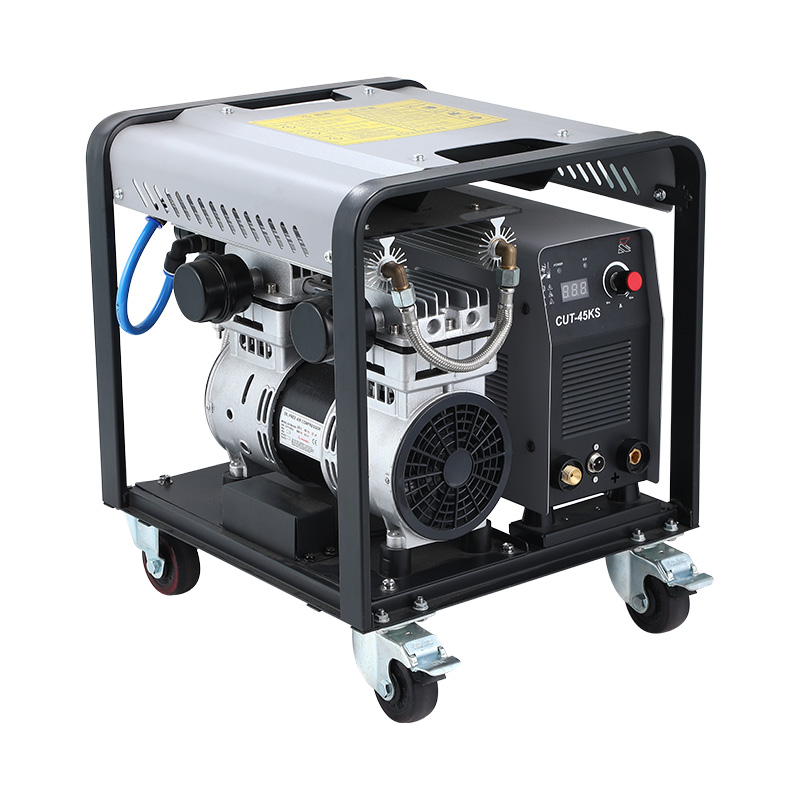
CUT-45F/60F/100F/120F Inverter Air Plasma Arc Cutting Machines
An air plasma arc cutting machine uses an electric arc and compressed air to cut electrically conductive metal. During operation, the power source creates an arc between the torch electrode and the workpiece or within the torch assembly, depending on the starting method. Compressed air passes through the torch, where it is heated and ionized by the arc. The ionized air becomes plasma, a high-temperature conductive gas that exits through a small nozzle at high velocity.
This concentrated plasma jet melts the metal in the cutting path and blows the molten material away from the workpiece. Because the plasma stream is narrow and energetic, it can produce a relatively small kerf and a fast cutting action. The operator guides the torch manually or integrates the cutting power source into a mechanized cutting system, depending on the application.
The word “inverter” refers to the electronic power-conversion architecture used inside the machine. Instead of relying on a large, low-frequency transformer alone, an inverter power source first converts incoming electrical power and then switches it at a much higher frequency. This allows the machine to use a smaller transformer and more responsive control circuitry. Inverter technology can therefore contribute to reduced size, lower weight, improved electrical control, and better energy efficiency.
The CUT series combines inverter technology with switching-mode power supply and PWM control. These systems regulate the output current more precisely than a simple fixed-output power source. The result is improved control over the cutting arc and a power source that can respond rapidly to changes in the arc condition, torch movement, material surface, and electrical load.
The machines are intended for conductive metals, including carbon steel, alloy steel, and stainless steel. Depending on material composition, surface condition, plate thickness, consumable condition, air quality, and operator technique, the practical result can vary. Aluminum and other conductive nonferrous metals may also be cut when the machine, torch, and consumables are correctly configured for the application.
Plasma cutting is not intended for ordinary wood, glass, ceramics, or most nonconductive plastics. The cutting process depends on an electrical circuit through the workpiece, so a clean electrical connection and a suitable conductive material are essential.
Using compressed air as the plasma gas provides a practical advantage for general fabrication. The user does not necessarily need to maintain separate oxygen, nitrogen, or argon cylinders for routine cutting work. A suitable air compressor, filtration system, and pressure regulator are still required, but the overall gas arrangement can be simpler than a multi-cylinder cutting installation.
Clean and adequately dry air is important. Water, oil, and excessive moisture can damage torch consumables, reduce arc stability, and affect cut quality. For demanding production work, a properly sized compressor and air-treatment system should be considered part of the complete plasma-cutting installation.
The use of IGBT inverter technology gives the CUT series a modern electrical foundation. IGBTs can switch power efficiently at high frequency, allowing the power source to regulate the output with a comparatively compact circuit design. This is especially useful in equipment that must deliver high cutting current without the excessive size and weight associated with older transformer-based systems.
High-frequency switching also supports responsive current control. When the arc length changes or the torch moves across an uneven surface, the power source can react quickly. This helps maintain a usable arc and reduces the likelihood of unstable operation caused by normal variations in manual cutting.
For users, the practical benefits include a more portable machine, improved power utilization, a responsive cutting arc, and easier adjustment across different metal thicknesses. These advantages can be particularly valuable for contractors and maintenance teams that move equipment frequently rather than operating from a fixed production line.
The switching-mode power supply contributes to the machines’ compact structure and efficient electrical conversion. A conventional low-frequency transformer is often large and heavy because it must process power at the frequency of the mains supply. A switching-mode design operates at a much higher frequency, making it possible to use smaller magnetic components and more compact filtering arrangements.
Compactness does not mean that the machine is intended only for light-duty work. The CUT-100F and CUT-120F models are designed for higher output categories than the smaller single-phase models. Their three-phase input arrangement and higher cutting-current capability make them more appropriate for industrial workshops and production environments with suitable electrical infrastructure.
Pulse-width modulation is used to regulate the amount of power delivered to the cutting arc. By controlling the duration and timing of electronic switching pulses, the control system can maintain the desired output level and respond to changing operating conditions. This helps the operator obtain a stable arc over the selected current range.
A stable arc is important for several reasons. It supports a more uniform kerf, helps reduce unnecessary dross, makes torch movement easier to control, and contributes to repeatable results. It also reduces the frustration associated with repeated arc interruptions during manual cutting.
Plasma cutting can be substantially faster than oxygen and acetylene flame cutting on suitable conductive materials. The concentrated arc melts a narrow path directly, while the high-velocity air stream removes molten metal. This direct process avoids the preheating period required by many flame-cutting operations and can improve productivity when preparing brackets, plates, tubes, frames, and repair components.
Faster cutting can also reduce labor time. In a busy fabrication environment, the economic benefit is not limited to the time that the torch is actively cutting. Reduced setup, faster movement between cuts, and less dependence on multiple fuel-gas cylinders can simplify the complete workflow.
Each machine is equipped with a digital meter that displays the cutting current. This gives operators a direct reference when setting the machine and repeating work. A visible current value is especially useful when several operators share the same equipment or when production procedures require a defined setting for a particular material thickness.
The digital display also helps during troubleshooting. If the machine does not deliver the expected cutting result, the operator can verify whether the selected current is appropriate before investigating air pressure, torch consumables, grounding, travel speed, or material condition.
Plasma power sources operate under demanding electrical and thermal conditions. The CUT series incorporates multiple protective measures intended to improve reliability and protect the machine during abnormal operation. The supplied information emphasizes resistance to power-supply voltage changes, which is valuable in workshops where the mains supply may fluctuate.
Protection systems may include safeguards associated with overcurrent, overheating, abnormal input conditions, and other operating faults. The exact protection behavior should always be confirmed in the machine manual and regional technical documentation. Operators should also follow the rated duty cycle, maintain adequate ventilation, and avoid blocking the machine’s cooling air passages.
The inverter construction allows the equipment to be more compact than many traditional power sources with comparable output. The listed net weights range from 25.2 kilograms for the CUT-45F to 48 kilograms for the CUT-120F. These weights are substantial enough to reflect industrial construction while remaining practical for relocation with appropriate lifting or wheeled support.
Portability is particularly useful for field repair, structural installation, agricultural equipment maintenance, shipyard work, and construction projects. A cutting machine can be transported to the workpiece instead of forcing the workpiece to be moved to a fixed cutting station.
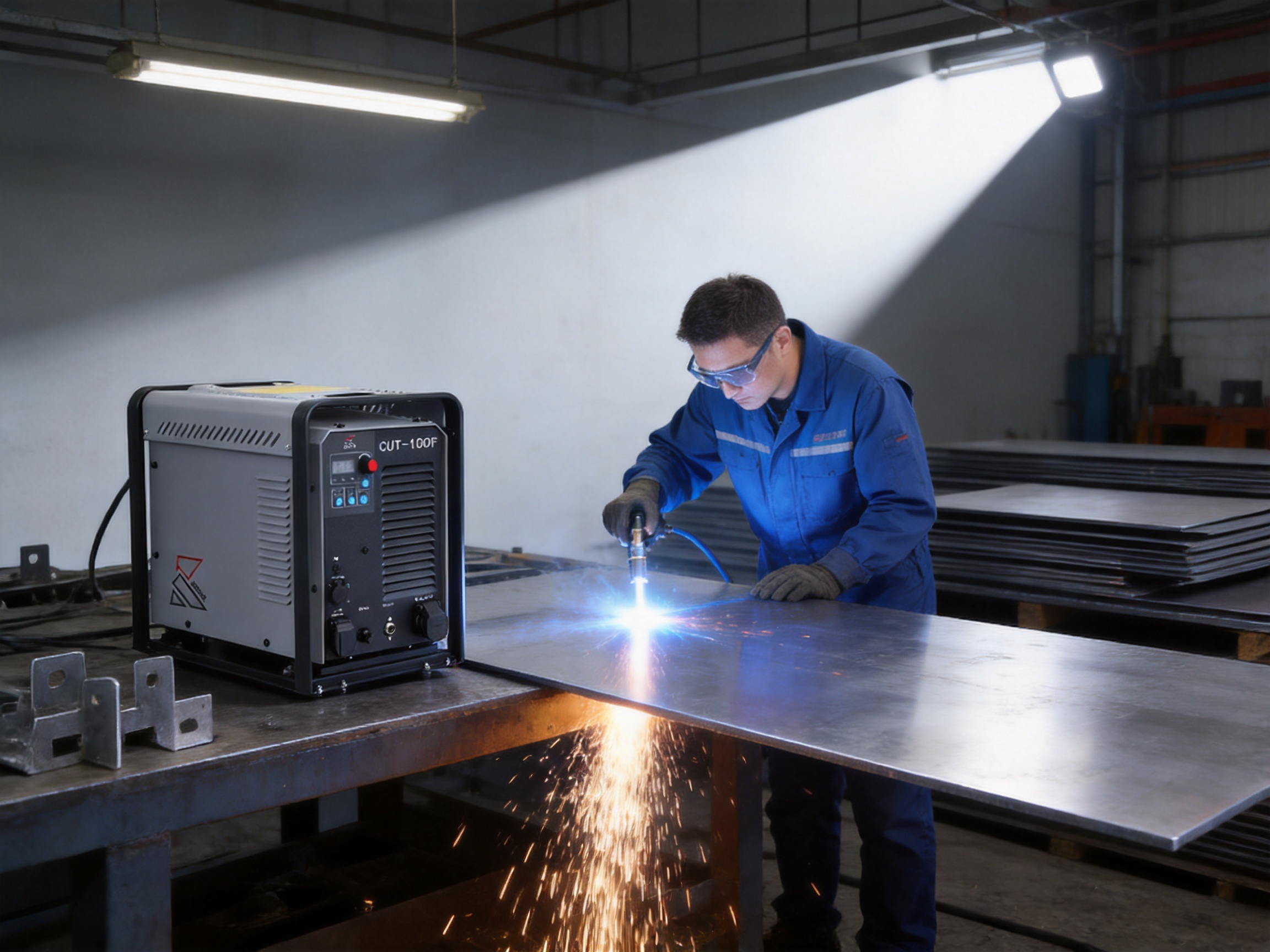
The following table summarizes the technical data supplied for the four models. Users should verify the final nameplate, instruction manual, and regional version before purchase because electrical configurations and specifications can vary by market.
| Model | Rated Supply Voltage | Rated Input Capacity | Rated Supply Current | No-Load Voltage | Rated Duty Cycle | Current Range | Quality Cutting | Maximum Cutting | Arc Start | Protection | Net Weight | Machine Size |
|---|---|---|---|---|---|---|---|---|---|---|---|---|
| CUT-45F | 1-220/230 ±10% | 7.7 kVA | 33.3 A | 280 V | 20% | 15–45 A | 12 mm | 15 mm | Contact arc ignition | IP21S | 25.2 kg | 455 × 390 × 460 mm |
| CUT-60F | 1-220/230 ±10% | 7.7 kVA | 33.3 A | 280 V | 20% | 15–45 A* | 12 mm | 15 mm | Contact arc ignition | IP21S | 30.5 kg | 480 × 390 × 510 mm |
| CUT-100F | 3-380 ±10% | 11.8 kVA | 18 A | 282 V | 60% | 30–80 A | 20 mm | 35 mm | Contact arc ignition | IP21S | 47 kg | 460 × 450 × 550 mm |
| CUT-120F | 3-380 ±10% | 15.1 kVA | 23 A | 282 V | 60% | 30–100 A | 30 mm | 40 mm | Contact arc ignition | IP21S | 48 kg | 460 × 450 × 550 mm |
*The supplied technical table lists the CUT-60F current range as 15–45 A. Buyers should confirm this value with the manufacturer or the final product nameplate if a different output range is expected from the model designation.
The “quality cutting” and “maximum cutting” values should not be interpreted as identical operating targets. Quality cutting generally describes a thickness at which the machine can produce a cleaner, more usable cut under appropriate conditions. Maximum cutting describes the upper capability under favorable conditions, often with slower travel speed, more attention to torch height, and potentially greater dross.
Actual performance depends on the type and grade of metal, surface rust, paint, mill scale, material temperature, air pressure, nozzle condition, electrode wear, grounding, torch angle, and operator travel speed. For production work where edge quality is important, users should select a machine with reserve capacity rather than operating continuously at its maximum cutting limit.
Duty cycle indicates how long a power source can operate within a defined test period at a stated output before it requires cooling time. The smaller CUT-45F and CUT-60F models are listed with a 20 percent rated duty cycle, while the CUT-100F and CUT-120F are listed with a 60 percent duty cycle.
A higher duty cycle is beneficial for repetitive industrial cutting because it allows longer operation before thermal protection may intervene. Duty cycle should be considered alongside the intended current. A machine may have a different duty-cycle rating at different output levels, so the full technical manual should be consulted for detailed planning.
The CUT-45F and CUT-60F are specified for single-phase 220/230-volt input with a tolerance of plus or minus 10 percent. This makes them suitable for many workshops and service locations that have standard industrial or commercial single-phase power available.
The CUT-100F and CUT-120F are specified for three-phase 380-volt input with the same stated tolerance. These models are better suited to facilities equipped with three-phase electrical distribution. Proper installation should be completed by qualified personnel, with correctly sized breakers, cables, grounding, and disconnect equipment.
Flame cutting remains useful for certain heavy steel applications, but it requires fuel gas and oxygen, produces a large heat-affected area, and involves open-flame risks. Plasma cutting uses an electrical arc and compressed air, which can simplify gas logistics and reduce the hazards associated with storing and handling fuel gases.
On thin and medium conductive plates, plasma cutting can provide a faster start and faster travel speed. The operator does not need to preheat the workpiece to the same extent as in many flame-cutting processes. The narrower cutting zone can also help reduce heat distortion, although all thermal cutting methods require appropriate control of heat input.
Plasma cutting is not automatically superior for every application. Flame cutting may remain more economical for very thick carbon-steel plate or for locations without a suitable electrical supply. However, for the thin-to-medium material range described for the CUT series, the combination of speed, flexibility, and reduced fuel-gas dependence is a significant advantage.
Older transformer-based machines can be durable, but they are often heavier and less efficient than modern inverter designs. A high-frequency inverter can provide a more compact package, finer electronic adjustment, and better response to arc changes. Lower weight makes the machine easier to position, while improved control can make manual cutting more consistent.
The inverter approach also provides manufacturers with greater flexibility in developing multiple output models. A common technology platform can be adapted for different input phases, current ranges, duty cycles, and physical configurations while maintaining a consistent operating concept across the product family.
Low-cost cutting equipment may appear attractive at the initial purchase stage, but inconsistent components, inadequate cooling, limited protection, poor air management, and unstable output can create higher operating costs. Unreliable arc starting, frequent consumable replacement, excessive dross, and unexpected downtime can quickly reduce the apparent savings.
The CUT series is positioned around controlled inverter operation, digital current indication, protective functions, and a manufacturing infrastructure capable of producing welding and cutting equipment at scale. These features do not eliminate the need for correct operation and maintenance, but they support a more predictable ownership experience than an inadequately designed power source.
Before cutting, the workpiece should be placed securely on a stable, nonflammable support. Paint, heavy rust, oil, and other contaminants should be removed where practical, especially around the grounding point. A clean electrical connection helps the cutting circuit function correctly and may reduce arc interruptions.
The workpiece should be positioned so that molten metal and sparks can fall safely without damaging equipment or creating a fire hazard. Operators should inspect the opposite side of the plate before starting because plasma can penetrate through the material and ignite combustible substances below it.
The compressed-air system should deliver clean, dry air at the pressure and flow specified for the torch and machine. An undersized compressor may cause pressure to fall during cutting, leading to arc instability and poor edge quality. Excessive pressure can also interfere with the torch’s intended plasma flow, so simply increasing pressure is not a substitute for correct adjustment.
Air filters, separators, regulators, and drains should be checked regularly. Moisture and oil contamination can shorten the life of electrodes and nozzles. In demanding environments, additional air treatment may be justified to improve consumable life and cut consistency.
The listed machines use contact arc ignition. The torch is brought into contact with the workpiece to initiate the arc, after which the operator establishes the appropriate cutting distance. Contact starting is a practical and straightforward method, but it requires attention to torch handling and consumable condition.
Operators should follow the instructions for the specific torch supplied with the machine. Excessive dragging, incorrect stand-off distance, or prolonged contact can accelerate nozzle wear. A drag shield or guide may be useful for maintaining a consistent torch position during manual cutting, provided it is compatible with the torch design.
Travel speed has a direct effect on cut quality. Moving too slowly can widen the kerf, increase dross, and allow excessive heat into the workpiece. Moving too quickly may cause incomplete penetration, an angled cut face, or intermittent cutting. The operator should watch the plasma stream and adjust speed according to material thickness and current.
For a clean through-cut, the arc should exit the underside of the workpiece in a controlled direction. A trailing arc angle can provide useful feedback. If the arc does not fully penetrate, the operator may need to reduce travel speed, increase current within the recommended range, improve grounding, or inspect the air supply and consumables.
Electrodes and nozzles are wear components. Their condition affects arc concentration, starting reliability, kerf width, and dross. A damaged nozzle can cause an irregular plasma jet, while a worn electrode may make arc starting more difficult or reduce cutting consistency.
Consumables should be inspected at regular intervals and replaced when the wear limit is reached. Operators should use compatible parts and avoid continuing to cut with visibly damaged components. Proper consumable maintenance is one of the simplest ways to protect the investment in the power source and maintain stable performance.
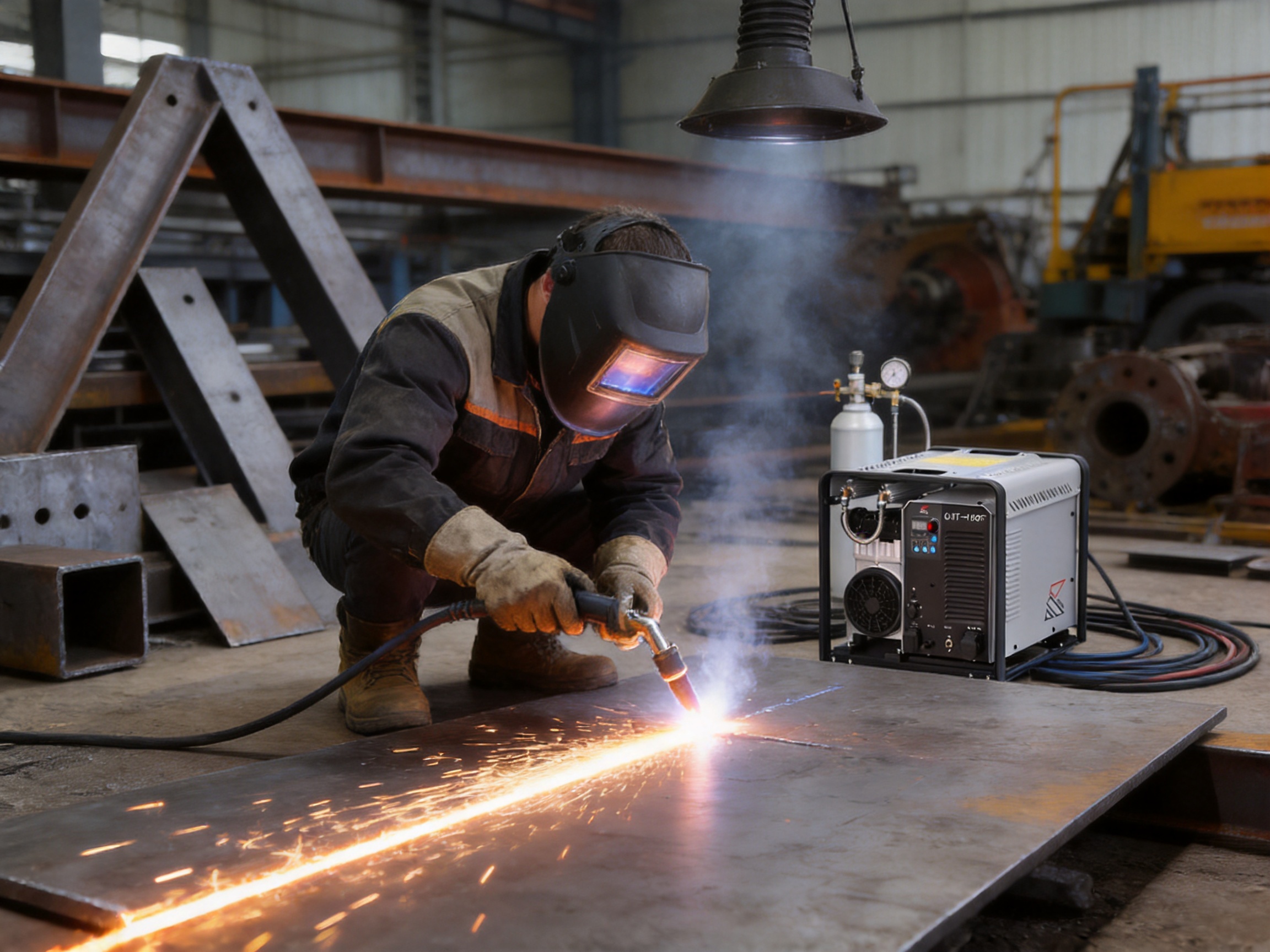
Fabrication shops can use the CUT series to prepare sheet metal, brackets, gussets, frames, channels, and repair components. The adjustable current range allows one machine to serve multiple material thicknesses, reducing the need to maintain separate equipment for every task.
On construction sites, cutting equipment often needs to be moved between work areas. The compact inverter design and practical machine dimensions support mobile use. The CUT-45F and CUT-60F can be considered where single-phase power is available, while the higher-output CUT-100F and CUT-120F require appropriate three-phase infrastructure.
Repair operations frequently involve cutting damaged sections, removing fasteners, modifying brackets, or preparing replacement pieces. Plasma cutting can be useful because it starts quickly and can handle many common steel components. Proper control is essential around fuel systems, hydraulic oil, batteries, coatings, and other flammable materials.
Maintenance departments may need to cut guards, machine frames, pipes, tanks, platforms, and worn structural parts. A portable plasma cutter reduces dependence on external cutting services for routine modifications and emergency repairs. For repetitive work, the higher duty-cycle models can provide greater operating capacity.
Training centers can use inverter plasma cutters to teach safe thermal cutting, current adjustment, torch control, material preparation, and inspection of cut edges. The digital current display provides an understandable connection between machine settings and practical results, helping students develop repeatable working methods.
The performance of an industrial cutting machine depends on much more than its published current range. Consistency in assembly, soldering, wiring, cooling, enclosure construction, inspection, and final testing directly affects reliability. The manufacturer of the CUT series operates a large production and engineering organization designed to support these requirements.
Zhejiang Kende Mechanical & Electrical Co., Ltd. is based in Taizhou, Zhejiang Province, China. The company’s stated facility covers approximately 120,000 square meters and employs around 600 people. It reports an annual production capacity of approximately two million units and exports nearly 1.5 million units annually across its product categories.
Large-scale production can provide several advantages when supported by appropriate quality systems. Purchasing volumes may improve access to electronic components and mechanical materials. Standardized work instructions can reduce variation between production batches. Dedicated production lines can also make it easier to train personnel and monitor process performance.
The company manufactures MMA or stick welding machines, MIG/MAG welding machines, flux-cored welding equipment, TIG machines, plasma cutters, stud welders, submerged arc welding equipment, battery chargers, and electric, gas, and oil heaters. This broad portfolio gives the engineering organization experience with power electronics, thermal management, arc control, metal enclosures, cooling systems, and high-current output circuits.
Experience across related welding technologies can support product development because many design challenges are shared. These include electromagnetic interference control, protection against overload, thermal design, reliable cable connections, insulation, output-current regulation, and safe enclosure construction.
The company reports having a Zhejiang Provincial Research and Development Center, an Enterprise Technology Center, and an Intelligent Welding Technology Research Institute. It also states that approximately 98 research and development personnel are involved in product development and technical innovation.
These resources are relevant to plasma-cutting equipment because inverter power sources must balance electrical performance, thermal behavior, manufacturability, electromagnetic compatibility, and user safety. Research and development teams can evaluate circuit revisions, cooling arrangements, control algorithms, torch compatibility, and enclosure improvements before products enter wider production.
The company reports holding invention patents, utility model patents, appearance patents, and software copyrights, with nearly 200 patents referenced in its corporate material. Patents alone do not guarantee product quality, but they indicate continuing investment in product design and technical development. In a competitive welding-equipment market, innovation may involve improved inverter circuits, control software, thermal protection, mechanical layouts, consumable interfaces, or manufacturing methods.
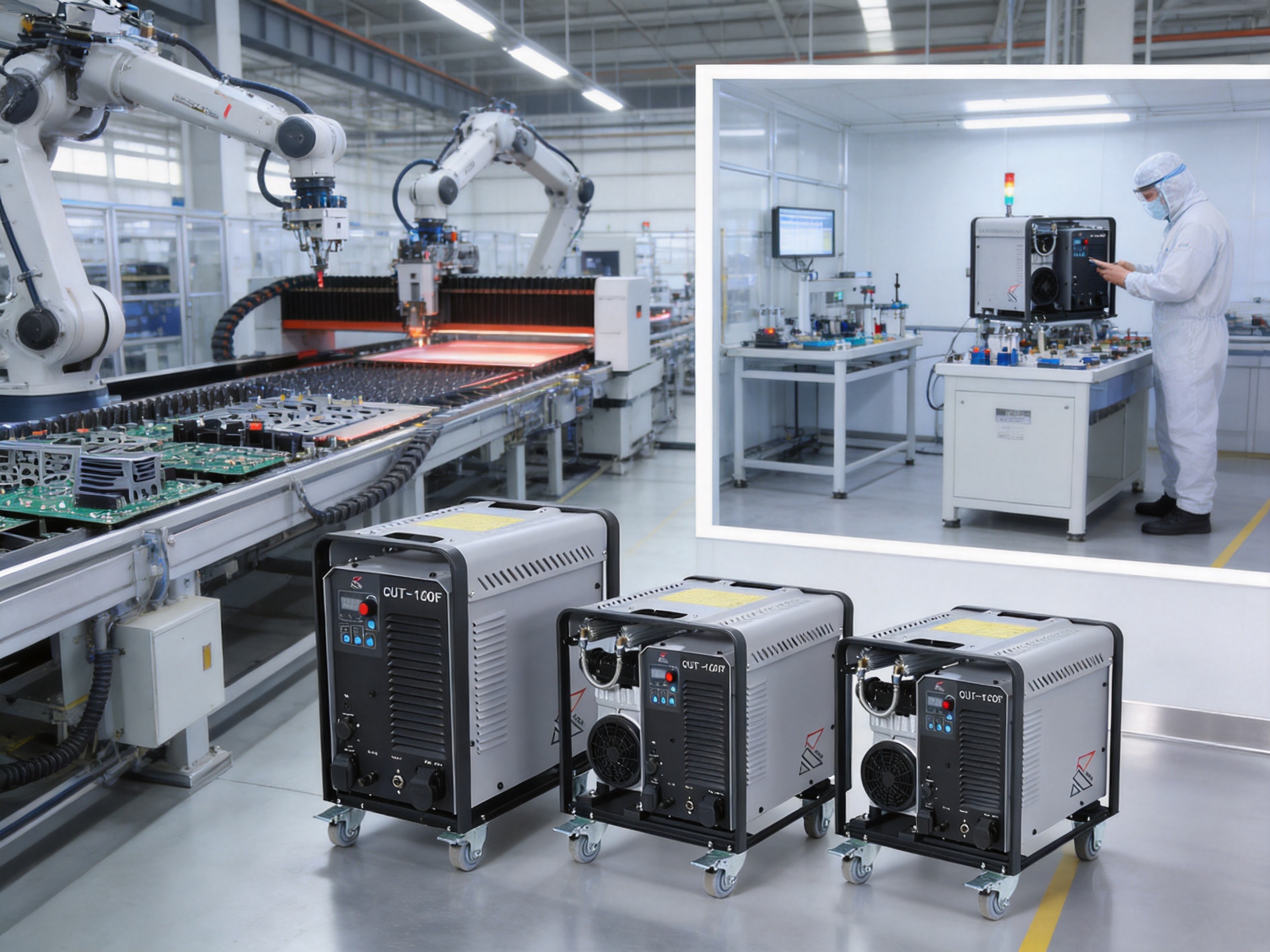
The company uses automatic patching, plug-in and welding systems, robot processing, laser cutting, and other advanced production technologies. These processes can improve repeatability when correctly controlled. Automated surface-mount placement supports consistent positioning of electronic components. Automated insertion and soldering can reduce assembly variation. Robotic processing can improve repeatability in mechanical operations, while laser cutting can produce accurate enclosure panels and brackets.
The company also applies OA office automation, Toyota TPS-style management, ERP K3, and MES management systems. Such systems can connect material planning, production scheduling, work instructions, inventory, process tracking, and quality records. A manufacturing execution system is particularly useful for monitoring the movement of products through production and identifying process deviations.
Advanced manufacturing should not be viewed only as a way to increase production volume. Its more important role is to create repeatable processes. When the same machine design is produced for customers in different regions, consistency in component placement, wiring, mechanical assembly, and inspection helps reduce variation in field performance.
The company states that it holds product certifications and compliance approvals including GS, CE, EMC, ERP, US ETL, UKCA, and China CCC across its product portfolio. Requirements differ by product, market, and model, so buyers should confirm the exact certification status of the selected CUT version.
Experience with international compliance requirements can strengthen product development and documentation. Electromagnetic compatibility, electrical safety, energy performance, labeling, user instructions, and production controls may all be reviewed during certification processes. This is important for distributors and professional users who require equipment suitable for regulated markets.
Plasma cutting combines high current, high temperature, ultraviolet radiation, compressed air, molten metal, fumes, noise, and sparks. Operators must receive appropriate training and use suitable personal protective equipment. A welding or cutting helmet with the correct shade, flame-resistant clothing, gloves, safety footwear, and eye protection are essential.
Ventilation or local exhaust should be provided to control fumes generated from the base metal, coatings, oil, paint, and surface treatments. Cutting galvanized, painted, stainless, or chemically treated materials requires additional attention to the hazards of the resulting fumes. Safety data and workplace regulations should be reviewed before cutting unfamiliar materials.
The work area should be cleared of combustible materials. Fire watch procedures may be necessary when cutting near walls, floors, insulation, vehicles, stored goods, or concealed spaces. The machine should be connected to a suitable electrical supply with correct grounding and protection. Cables should be inspected for damage, and the torch should never be operated with missing or defective insulation.
The IP21S protection rating listed for the machines indicates that they are intended for appropriate indoor or sheltered working conditions rather than exposure to rain, spray, or uncontrolled moisture. The enclosure should be kept dry, clean, and adequately ventilated. The machine should not be placed where metal dust, corrosive vapors, or water can enter the housing.
A plasma cutter’s purchase price is only one part of its total cost. Electricity, compressed air, consumables, maintenance, downtime, labor, and cut quality all influence the economic result. Efficient inverter operation can help control energy use, while a stable arc and proper torch maintenance can reduce waste and rework.
Routine maintenance should include cleaning dust from air passages, checking cooling fans, inspecting power cables, verifying the ground connection, draining the compressor receiver, checking filters, and examining torch consumables. Maintenance intervals should be adapted to the operating environment. A machine used in a dusty workshop may require more frequent cleaning than one used in a clean fabrication area.
Users should avoid opening or modifying the power source unless qualified service personnel are responsible for the work. Inverter machines contain hazardous voltages that may remain present after disconnection. Service should follow the manufacturer’s instructions, and replacement components should meet the required ratings.
Correct selection can also reduce ownership costs. A machine that is too small may be forced to operate near its limit, increasing thermal interruptions and consumable wear. A machine that is unnecessarily large may increase purchase and electrical costs. The best choice is generally a model that provides the required quality-cutting thickness with reasonable reserve capacity.
The CUT-45F is the smallest listed model and has a single-phase 220/230-volt input, a 15–45 amp current range, a stated quality-cutting thickness of 12 millimeters, and a maximum cutting thickness of 15 millimeters. Its 25.2-kilogram net weight makes it suitable for mobile workshops and general repair applications where moderate cutting capacity is sufficient.
The CUT-60F shares the listed single-phase voltage, input capacity, supply current, no-load voltage, duty cycle, current range, and cutting thickness values shown for the CUT-45F, but has a larger listed body and a net weight of 30.5 kilograms. Because the supplied table lists the same 15–45 amp current range and the same thickness values, buyers should confirm the precise differences between the CUT-45F and CUT-60F before ordering.
The CUT-100F is a three-phase model with a 30–80 amp current range, a stated quality-cutting thickness of 20 millimeters, and a maximum cutting thickness of 35 millimeters. Its 60 percent duty cycle makes it more appropriate for heavier and more repetitive cutting than the smaller models, provided the facility has a suitable 380-volt three-phase supply.
The CUT-120F is the highest-output model in the listed series. It provides a 30–100 amp current range, a stated quality-cutting thickness of 30 millimeters, and a maximum cutting thickness of 40 millimeters. Its 60 percent duty cycle and 48-kilogram net weight reflect a machine intended for demanding industrial and fabrication work.
When evaluating a plasma-cutting supplier, buyers should consider more than the catalog description. Important questions include whether the manufacturer can provide consistent production, technical documentation, spare parts, consumables, warranty support, certification records, and export experience. A supplier with a broad product portfolio and established manufacturing systems may be better equipped to support distributors and industrial users over the long term.
Factory scale is valuable when it is combined with process discipline. Automated assembly, ERP and MES systems, engineering laboratories, and documented inspection procedures can help manufacturers identify defects earlier and improve traceability. International certifications can also provide evidence that the company understands the requirements of different markets, although each model and destination still requires verification.
For importers, the most useful evaluation process includes a sample-machine test, confirmation of input voltage and plug configuration, inspection of manuals and labels, review of replacement torch parts, and a clear agreement on packaging and after-sales service. Demonstration cutting on the intended material thickness is especially valuable because it reveals practical performance under realistic conditions.
The CUT series is designed for electrically conductive metals such as carbon steel, alloy steel, and stainless steel. Other conductive metals may be suitable when the correct operating settings and consumables are used. Nonconductive materials cannot be cut by this process because the arc requires an electrical circuit through the workpiece.
No. The machines use compressed air as the plasma gas, so routine cutting does not require oxygen and acetylene cylinders. A properly sized compressor, regulator, filter, and moisture separator are still necessary.
The CUT-45F or CUT-60F may be suitable for a small workshop with single-phase 220/230-volt power and moderate cutting requirements. The choice depends on the desired operating capacity, actual material thickness, available space, and confirmed model specifications.
The CUT-100F and CUT-120F provide higher current ranges, larger stated cutting capacities, and 60 percent rated duty cycles. They are intended for facilities with compatible three-phase 380-volt electrical service and more demanding cutting schedules.
Quality cutting refers to a thickness at which a cleaner and more usable cut is expected under suitable conditions. Maximum cutting represents the upper capability under favorable conditions and may involve slower speed, more dross, and lower edge quality. Production users should normally select a machine based on the quality-cutting value rather than the absolute maximum.
Oil, water, and dirt can destabilize the plasma arc and damage torch consumables. Clean, dry air supports better arc concentration, longer consumable life, and more consistent cutting. Regularly draining and maintaining the air system is therefore essential.
Generally, yes. High-frequency inverter technology allows the use of smaller and lighter magnetic components than many older low-frequency transformer designs. The listed CUT models range from 25.2 to 48 kilograms, making them practical for relocation with suitable handling procedures.
The current should be selected according to material type, thickness, required speed, and the torch manufacturer’s recommendations. Higher current is not always better. Excessive current for a thin plate can widen the kerf and increase heat distortion, while insufficient current may cause incomplete penetration.
They can be used on suitable outdoor job sites when protected from rain, spray, excessive dust, and direct moisture. The listed IP21S rating indicates that the machines should not be exposed to uncontrolled wet conditions. Electrical connections and compressed-air equipment must also be protected.
Buyers should confirm the exact model, rated input voltage, phase arrangement, current range, duty-cycle test conditions, cutting-thickness expectations, included torch and cables, plug type, certification, warranty, spare consumables, packaging, and technical documentation. The CUT-60F current range should receive particular confirmation because the supplied table lists it as 15–45 amps.
The CUT-45F, CUT-60F, CUT-100F, and CUT-120F inverter air plasma arc cutting machines provide a practical range of solutions for conductive-metal cutting. Their principal advantages include IGBT inverter technology, switching-mode power supply design, PWM control, digital current indication, stable arc performance, multiple protective measures, energy-conscious operation, and a compact structure.
Compared with oxygen and acetylene flame cutting, plasma technology can offer faster operation on thin and medium conductive plates while simplifying gas requirements and reducing risks associated with fuel-gas handling. Compared with older transformer machines, the inverter design can provide a more portable package and more responsive electronic control. The different models also allow users to match cutting capacity and electrical requirements to their workshop conditions.
The value of the product series is strengthened by the manufacturer’s broader capabilities. Large-scale production, research and development centers, automated electronic and mechanical processing, digital management systems, international certification experience, and a diverse welding-equipment portfolio provide a substantial foundation for consistent manufacturing. These strengths are important for distributors and professional users who require dependable equipment, technical support, and long-term product availability.
Successful plasma cutting still depends on correct model selection, clean compressed air, suitable electrical installation, proper consumables, operator training, and safe working practice. When those requirements are addressed, the CUT series can serve as a productive and flexible cutting solution for workshops, construction operations, repair departments, and industrial fabrication environments.
1. Product technical information for CUT-45F, CUT-60F, CUT-100F, and CUT-120F inverter air plasma arc cutting machines.
2. Manufacturer-provided company profile and corporate capability information for Zhejiang Kende Mechanical & Electrical Co., Ltd.
3. General principles of plasma arc cutting, inverter power conversion, and compressed-air plasma systems.
4. Welding and cutting equipment safety practices, including electrical safety, fume control, fire prevention, and personal protective equipment.
5. General guidance on duty cycle, cutting-thickness ratings, torch consumable maintenance, and compressed-air quality.
Recommended Products

Contact Us
No.2299, Luqiao Section, Shugang Avenue, Luqiao District, Taizhou, 318057 Zhejiang, PR China.
+86-576-82431568
 Privacy
China Welding Machine Factory
 English
 中文简体
 русский
 Español
 عربى
 Français
 Português
 Deutsch
 Український