Email: [email protected]
Email: [email protected]

Industry News
 Home / News / Industry News / Handheld Laser Welding Manufacturer: Shops Are Switching for Good Reason
  2026.06.05
 Industry News
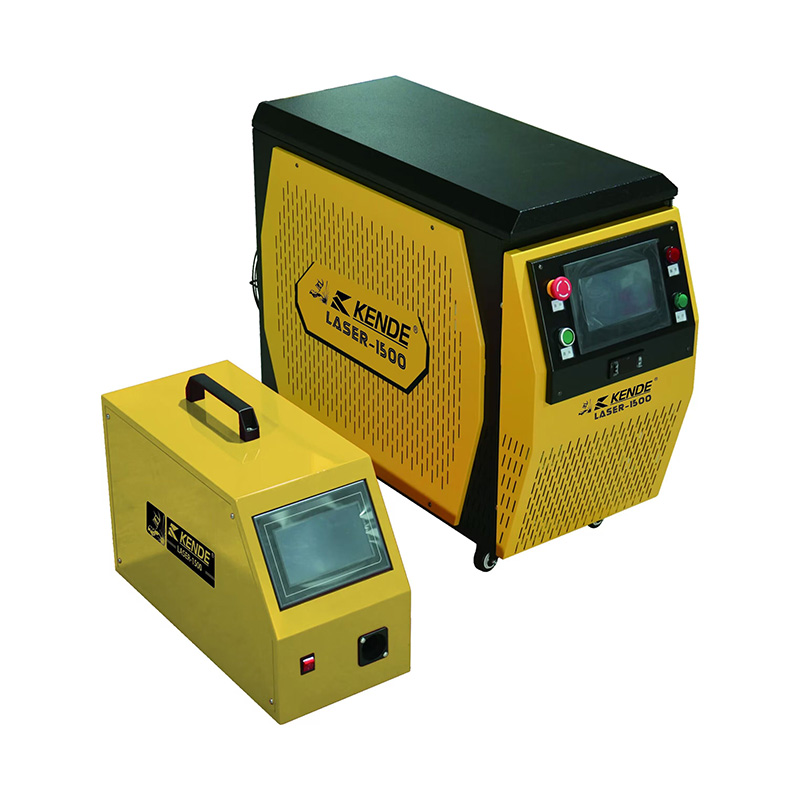
Walk into any metal fabrication shop these days, and you are starting to see them. Small units on wheels. A handheld head connected by a cable. No foot pedal. No filler rod. Just a laser beam that melts metal cleanly. A handheld laser welding manufacturer builds these machines. Shops are buying them because they solve problems that TIG and MIG cannot fix.
It welds faster than TIG
TIG welding is precise, but it is slow. The operator has to feed filler rod, control the foot pedal, and move the torch at the same time. Handheld laser welding cuts that time way down. The laser moves at 1 to 5 meters per minute. TIG moves in inches per minute.
It puts less heat into the metal
TIG spreads heat across a wide area. Thin sheets warp. Parts distort. Laser welding focuses heat in a small spot. The surrounding metal stays cool. Parts stay straight. Less grinding. Less rework.
It is easier to learn
TIG takes months or years to master. Handheld laser welding takes days. A new guy can pick it up fast. A handheld laser welding manufacturer builds machines that do not require years of experience to run.
Sheet metal and stainless steel
Thin sheet warps easily with TIG. Handheld laser welding puts less heat into the part. The part stays flat. Food-grade stainless needs clean welds. Laser welding produces smooth welds with no contamination.
Automotive and aerospace
Lightweight materials need precise welding. Laser welding works on aluminum, steel, and titanium. Heat is controlled. Welds are consistent.
On-site repairs
Portable units go to the job site. Pipe repairs. Equipment repairs. No need to move heavy parts to the shop.
Here is where handheld laser welding really shines:
Laser power
Power is measured in watts. 1,000 watts handles most sheet metal. 1,500 watts works on thicker material. A machine with more power is more versatile.
Wobble function
The laser beam wobbles in a small circle. This helps bridge gaps between parts. Without wobble, the joint has to be tight. With wobble, you can weld imperfect fits.
Cooling system
The laser generates heat. The machine needs a cooling system. Water cooling is common. A machine with good cooling runs longer without overheating.
Safety features
Laser welding is bright. The machine needs protective glass. Operators need proper eyewear. A machine with safety features protects the operator.
Handheld laser welding machines are not cheap. A good one costs $10,000 to $30,000. TIG welders cost less. But the speed difference pays for the machine. One operator with a laser welder can do the work of two or three TIG welders. The labor savings add up fast.
Reliability matters
A good manufacturer builds machines that run all day. A handheld laser welding manufacturer with quality components reduces downtime. The laser stays aligned. The cooling works. The machine keeps running.
Support and training
New technology needs training. A manufacturer with good support helps operators learn. They provide training materials. They answer questions when things go wrong.
Parts availability
Lasers wear out. Cooling systems need maintenance. A manufacturer with good parts availability keeps machines running. Downtime is expensive.
A handheld laser welding manufacturer provides machines that weld faster, cleaner, and with less distortion than TIG. Choose the right power. Look for wobble function. Good cooling. Safety features. A quality manufacturer delivers reliability, support, and parts. Welding is changing. Handheld laser welding is leading the way. Shops that adopt it will outpace those that do not. The time to switch is now. A good manufacturer makes that switch easy.
Recommended Products

Contact Us
No.2299, Luqiao Section, Shugang Avenue, Luqiao District, Taizhou, 318057 Zhejiang, PR China.
+86-576-82431568
 Privacy
China Welding Machine Factory
 English
 中文简体
中文简体
 русский
 Español
 عربى
عربى
 Français
 Português
 Deutsch
 Український